start VOLKSWAGEN T-ROC 2021 Owner´s Manual
[x] Cancel search | Manufacturer: VOLKSWAGEN, Model Year: 2021, Model line: T-ROC, Model: VOLKSWAGEN T-ROC 2021Pages: 502, PDF Size: 9.42 MB
Page 365 of 502

Depress and hold the brake pedal until you have switched off the ignition.
Switch on the electronic parking brake Electronic parking brake.
Move the gear lever to neutral position Manual gearbox: selecting a gear or move the selector lever
to position P DSG® dual clutch gearbox.
Switch off the ignition and remove the vehicle key from the ignition lock Starting and stopping the
engine.
Allow the engine to cool sufficiently.
Children and other people should be kept well away from the engine compartment.
Ensure that the vehicle cannot roll away unexpectedly.
WARNING
Ignoring any of the items on this important safety checklist can lead to severe injuries.
Opening and closing the bonnet
Page 376 of 502

In order to avoid overfilling, wait for approximately one minute after each refill step to allow the
engine oil to flow into the sump up to the marking on the engine oil dipstick.
Read the engine oil level from the dipstick again before refilling with a further small quantity of
engine oil. Never overfill engine oil .
After refilling, the engine oil level should be in the middle of area Ⓒ. It should not be above Ⓒ, in
area Ⓑ, and must not be in area Ⓐ .
If too much engine oil has been added unintentionally and the engine oil level is in area Ⓐ, do not
start the engine. Inform a qualified workshop and seek expert assistance if necessary.
Close the engine oil filler opening with the cap after filling.
Insert the oil dipstick into the guide tube as far as it will go. If there is a marking on the upper end of
the oil dipstick, this marking must fit into the corresponding groove at the top end of the guide tube
upon insertion.
Close the bonnet In the engine compartment.
WARNING
Engine oil can ignite if it comes into contact with hot engine components. It can cause fires, burns
and other serious injuries.
up and ignite when the engine is running.
dipstick is properly inserted back into the guide tube. This will prevent the engine oil from draining
out on to hot engine components when the engine is running.
NOTICE
⇒ Fig. 186 Ⓐ, do not start the engine. Inform a qualified workshop and seek expert assistance if
necessary. The catalytic converter and the engine could otherwise be damaged.
Page 381 of 502

Otherwise, the engine could be damaged. If you cannot see any coolant in the expansion tank do not
drive on. Seek professional assistance.
level remains stable.
⇒ Fig. 188 . Do not
fill up above the top edge of the marked area⇒ .
⇒ Coolant
specification , do not use any other coolant additive! Instead, initially refill with distilled water⇒
only. Then add the correct proportion of the specified coolant additive as soon as possible
⇒ Coolant specification .
WARNING
Hot steam and hot coolant can cause serious burns.
coolant coming out of the engine
compartment. Always wait until you can no longer see or hear escaping steam or coolant.
components can burn the skin.
wing points must be observed before opening the bonnet once it has cooled down:
P or move the gear
lever to the neutral position.
hicle key from the ignition lock.
unattended.
expansion tank when the engine is hot. Coolant may spray out and cause serious burns and other
injuries.
-clockwise while exerting gentle downward pressure on
the cap.
with a large, thick cloth.
spilt service fluids can start a fire. In certain circumstances, the ethylene glycol in the coolant can
catch fire.
NOTICE
Page 386 of 502
-volt vehicle battery. Discharged 12-volt vehicle batteries can already freeze
at temperatures of around 0°C (+32°F). Frozen 12-volt vehicle batteries must be renewed
immediately.
NOTICE
Do not expose the 12-volt vehicle battery to direct daylight for an extended time.
NOTICE
Protect the 12-volt vehicle battery against frost if the vehicle is left standing for extended periods.
-volt vehicle battery can freeze and be destroyed as a result.
When you start the engine after the 12-volt battery has been totally discharged or after jump
starting, you may find that system settings (time, date, personal convenience settings and
programming) have been changed or deleted. Check and correct the settings as necessary once the
12-volt vehicle battery has been sufficiently charged.
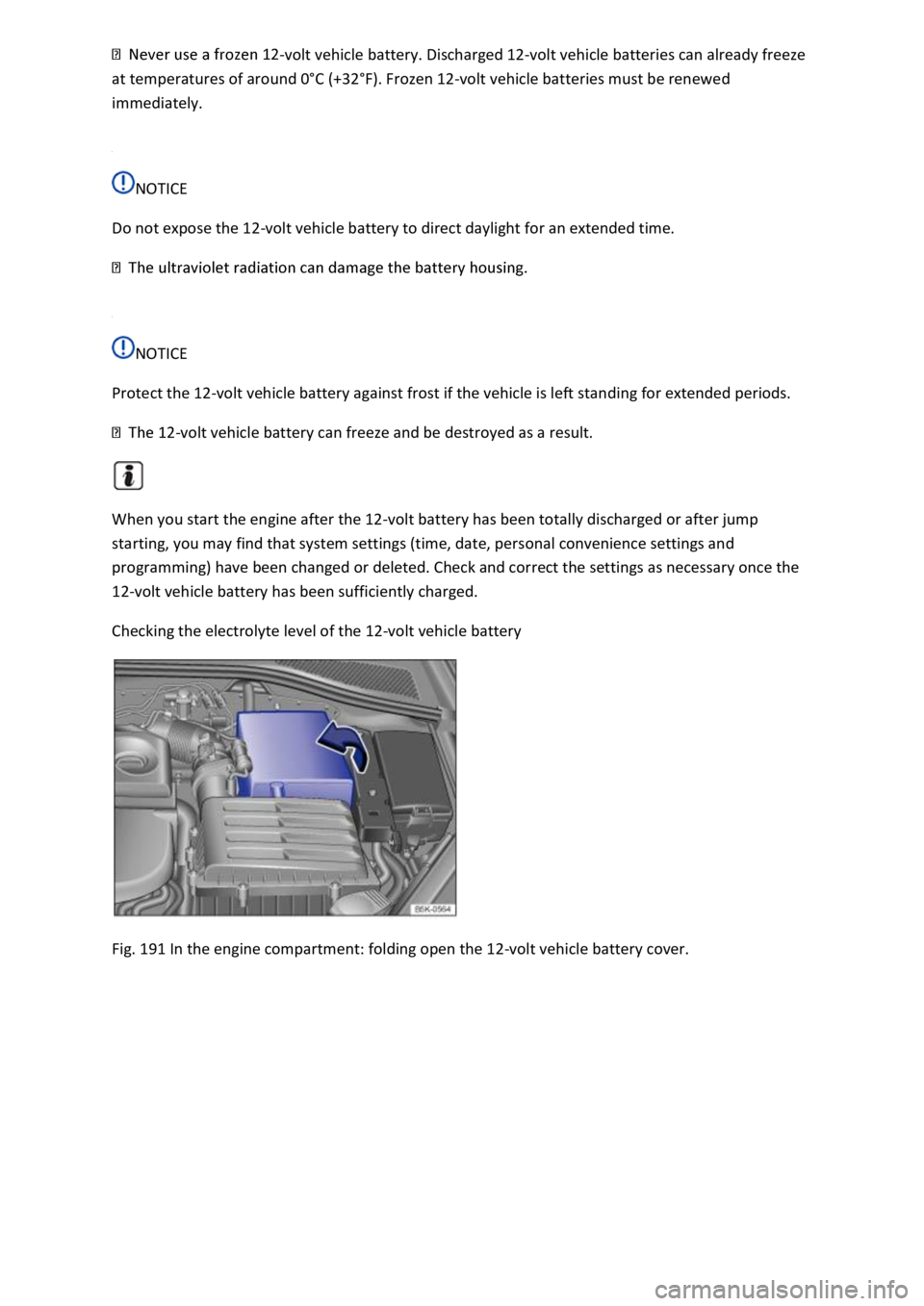
Checking the electrolyte level of the 12-volt vehicle battery
Fig. 191 In the engine compartment: folding open the 12-volt vehicle battery cover.
Page 389 of 502

Connecting the 12-volt vehicle battery
-volt vehicle
battery.
e cable and then the negative cable ⇒ .
Various indicator lamps may light up after the 12-volt vehicle battery has been connected and the
ignition is switched on. They will go out when you drive a short distance at a speed of approximately
15 – 20 km/h (10 – 12 mph). If the indicator lamps remain lit up, the vehicle should be checked by a
qualified workshop.
If the 12-volt vehicle battery was disconnected for an extended period, the system may not able to
calculate or correctly display the time when the next service is due ⇒ Instrument cluster . Observe
the maximum permissible service intervals ⇒ Service .
Automatic switch-off for electrical consumers
The intelligent vehicle electrical system management function automatically implements a range of
measures to prevent the 12-volt vehicle battery from discharging under high loads:
power supply to the 12-volt socket and the cigarette lighter may be interrupted temporarily
while the engine is being started.
The vehicle electrics management system cannot always prevent the 12-volt vehicle battery from
being discharged, for example if the ignition is left on over a long period with the engine off or the
side lights or parking lights are left on over a long period of time.
12-volt vehicle battery is discharged
gnition is switched on.
⇒ Auxiliary heater and ventilation .
WARNING
Incorrectly mounting the battery and using incorrect 12-volt vehicle batteries can cause short
circuits, fire and serious injuries.
-free and leak-proof 12-volt vehicle batteries that have the same
properties, specifications and dimensions as the factory-fitted 12-volt vehicle battery.
WARNING
A highly explosive mixture of gases is given off when the 12-volt vehicle battery is being charged.
Page 390 of 502

-volt vehicle batteries should be charged only in well-ventilated spaces.
-volt vehicle battery. Discharged 12-volt vehicle batteries can
already freeze at temperatures of around 0°C (+32°F).
-volt vehicle battery must be replaced if it has ever been frozen.
the negative cable.
NOTICE
-volt vehicle batteries if the ignition is switched on or the engine is
running. Never use a 12-volt vehicle battery that does not correspond with the vehicle's
specifications. This can damage the electrical system or electronic components and electrical
malfunctions can occur.
to the 12-volt socket or to the cigarette lighter in order to charge the 12-volt vehicle battery. The
electrical system of the vehicle could otherwise be damaged.
12-volt vehicle batteries may contain toxic substances such as sulphuric acid and lead. Dispose of the
12-volt vehicle battery in accordance with the regulations.
Electrolyte can pollute the environment. Collect any service fluids that escape or are spilt and
dispose of them properly.
Troubleshooting
First read and observe the introductoryinformation and safety warnings⇒Introduction
Vehicle battery (12-volt)
The indicator lamp lights up red.
Fault in the alternator. The 12-volt vehicle battery will not be charged by the alternator while the
vehicle is in motion.
Switch off any electrical consumers that are not required. Inform a qualified workshop. Have the
electrical system checked.
The start/stop system cannot start the engine ⇒ Start/stop system .
and vehicle battery (12-volt)
The central warning lamp lights up red and the text message 12 V battery not charging. Stop vehicle.
is displayed.
Page 391 of 502

Fault in the alternator. The 12-volt vehicle battery will not be charged by the alternator while the
vehicle is in motion.
Switch off any electrical consumers that are not required. Inform a qualified workshop. Have the
electrical system checked.
The start/stop system cannot start the engine ⇒ Start/stop system .
and vehicle battery (12-volt)
The central warning lamp lights up yellow and the text message 12 V battery low. Charge by driving.
is displayed.
The charge level of the vehicle battery is insufficient.
Recharge the 12-volt vehicle battery by driving the vehicle for an extended time.
The start/stop system cannot start the engine ⇒ Start/stop system .
and vehicle battery (12-volt)
The central warning lamp lights up red and the text message Replace 12 V battery. Workshop. is
displayed.
The vehicle battery condition is not ok.
Seek expert assistance and have the battery checked and replaced if necessary.
The start/stop system cannot start the engine ⇒ Start/stop system .
Wheels and tyres
Tyre monitoring system
Introduction
This chapter contains information on the followingsubjects:
⇒ Tyre Pressure Loss Indicator
⇒ Troubleshooting for Tyre Pressure Loss Indicator
The tyre monitoring system warns the driver when the tyre pressures are too low.
The tyre monitoring system monitors various parameters (for example, rolling circumference) of all
wheels using ABS sensors (indirect measurement).
WARNING
The intelligent tyre monitoring system technology cannot overcome the laws of physics, and
functions only within the limits of the system. Incorrect handling of the wheels and tyres can lead to
a sudden loss of pressure in the tyres, tread separation and even tyre blow-out.
Page 439 of 502

Follow the manufacturer’s instructions for the high-pressure cleaner. Never use rotating nozzles ⇒
.
-pressure cleaner.
cm away from the side windows and
other vehicle components.
yres,
rubber hoses, insulation materials or any other sensitive components, e.g. door locks.
brief periods of time.
Hand wash
As a rule, a hand wash is a gentle method to clean your vehicle. However, there are also some things
to note for this ⇒ .
g brush using only light pressure.
Start with the roof and work from the top to the bottom.
Use a shampoo for very stubborn dirt only.
Waxing
Waxing protects the paintwork. At the latest when water no longer clearly forms small drops and
runs off the paintwork when the vehicle is clean, reapply the protection to the vehicle using a quality
preservative wax.
Even if a preservative wax is applied regularly in the automatic car wash, Volkswagen recommends
protecting the vehicle paintwork at least twice a year using Volkswagen Genuine hard wax (-
000 096 317 -).
Polishing
Polishing is only necessary if the paint has lost its shine, and the gloss cannot be brought back by
applying wax.
Matt-painted vehicle parts must not be polished in order to avoid producing a shine ⇒ .
WARNING
Page 443 of 502

Volkswagen recommends using Volkswagen Genuine de-icing agent (- 000 096 322 -) for de-icing. Do
not use door lock de-icer containing grease solvents.
WARNING
The engine compartment of any motor vehicle is a hazardous area. All work in the engine
compartment carries the risk of injury, scalding, accidents and fire.
and safety precautions ⇒ Safety notes for working in the engine compartment .
NOTICE
Incorrect cleaning and care can cause vehicle damage.
tools.
NOTICE
The drainage channels for the plenum chamber may get blocked by leaves and dirt. Water that does
not drain away could get into the vehicle interior.
The durability and colourfastness of decorative and protective films can be affected by
environmental influences such as direct sunlight, moisture, air pollution, stone impact etc.
Decorative films may show signs of use or ageing after about one to three years, protective films
after about two to three years. In very hot climates, decorative films may start to fade within a year
and protective films within two years.
1) null
2) Mild soap solution: a maximum of two tablespoons neutral soap diluted in one litre of water.
Vehicle interior care and cleaning
The following overview contains recommendations for cleaning and care of individual vehicle
components ⇒ .
Windows:
Clean with a glass cleaning agent and then wipe dry using a clean chamois cloth or a lint-free cloth.
Page 486 of 502

a) In certain European countries, the activation of or permission to use radio technology may be
restricted, not possible, or possible only when additional requirements have been fulfilled.
Technical data
Notes on technical data
Unless otherwise indicated or separately listed, the technical data apply to the basic model. The
values may differ if additional equipment is fitted, for different model versions and for special
vehicles and in the case of country-specific vehicle specifications. All data in the official vehicle
documents take precedence over these data.
Engine
The vehicle data sticker and the official vehicle documents show which engine is installed in your
vehicle.
Weight
The values for the kerb weight in the following tables apply for the road-ready vehicle with driver
(75 kg), service fluids including fuel tank carrying 90% of its capacity and, where applicable, tools and
spare tyre ⇒ . Additional equipment and retrofitted accessories increase the stated kerb weight
and reduce the maximum permitted load accordingly.
The load comprises the weights of the following:
system
Performance figures
In certain vehicles with heavy duty running gear, the engine could be governed to provide a
maximum speed of 210 km/h.
The performance figures were measured without equipment which may negatively influence
performance, such as a roof carrier or mudflaps.
Gross combination weight
The specified gross combination weights are applicable only for altitudes up to 1,000 m above sea
level. The maximum gross combination weight must be reduced by approximately 10% for every
further started 1,000 m in altitude.
Notes on the tables
Gearbox abbreviations: MG = manual gearbox, AG = automatic gearbox, DSG® = DSG® dual clutch
gearbox. MG6 = 6-speed manual gearbox.
WARNING