Wheel VOLKSWAGEN T-ROC 2021 Owner´s Manual
[x] Cancel search | Manufacturer: VOLKSWAGEN, Model Year: 2021, Model line: T-ROC, Model: VOLKSWAGEN T-ROC 2021Pages: 502, PDF Size: 9.42 MB
Page 419 of 502
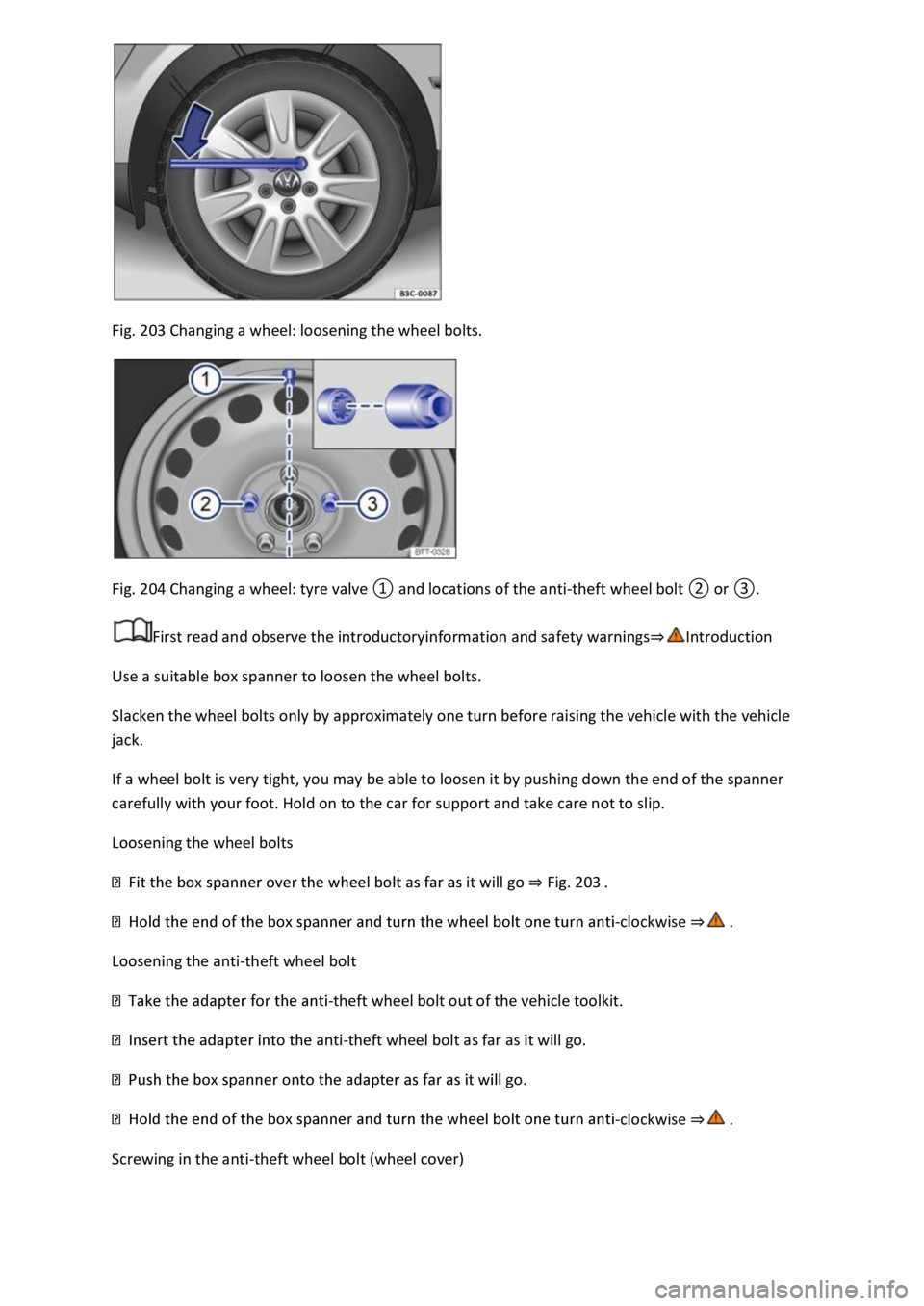
Fig. 203 Changing a wheel: loosening the wheel bolts.
Fig. 204 Changing a wheel: tyre valve ① and locations of the anti-theft wheel bolt ② or ③.
First read and observe the introductoryinformation and safety warnings⇒Introduction
Use a suitable box spanner to loosen the wheel bolts.
Slacken the wheel bolts only by approximately one turn before raising the vehicle with the vehicle
jack.
If a wheel bolt is very tight, you may be able to loosen it by pushing down the end of the spanner
carefully with your foot. Hold on to the car for support and take care not to slip.
Loosening the wheel bolts
it will go ⇒ Fig. 203 .
-clockwise ⇒ .
Loosening the anti-theft wheel bolt
-theft wheel bolt out of the vehicle toolkit.
anti-theft wheel bolt as far as it will go.
-clockwise ⇒ .
Screwing in the anti-theft wheel bolt (wheel cover)
Page 420 of 502

On wheels with a wheel cover, the anti-theft wheel bolt must be screwed into position
⇒ Fig. 204② or ③ according to the position of the tyre valve ①. The wheel cover can otherwise
not be fitted.
Tightening torque of wheel bolts
Specified tightening torque for wheel bolts for steel or alloy wheels:
Nm
If the wheel bolts are corroded and difficult to turn, they must be replaced before the tightening
torque is checked and the wheel hub threads cleaned.
Never grease or oil the wheel bolts or the threads of the wheel hub.
The tightening torque should be checked with a properly functioning torque wrench immediately
after changing a wheel.
WARNING
Incorrectly tightened wheel bolts can loosen while the vehicle is in motion and cause accidents,
serious injury, and loss of control of the vehicle.
easily.
bolts.
the wheel bolts only by approximately one turn before raising the vehicle with the vehicle
jack.
loosen while the vehicle is in motion, even if they have been tightened with the specified tightening
torque.
-on rings.
while the vehicle is in motion. The wheel bolts and the threads could be damaged if the tightening
torque is too high. Check the tightening torque regularly using a torque wrench.
WARNING
The wrong wheel bolts can loosen while the vehicle is in motion and cause accidents, serious injury,
and loss of control of the vehicle.
Page 421 of 502
-piece wheel bolts: use only two-piece wheel bolts.
Lifting the vehicle with the jack
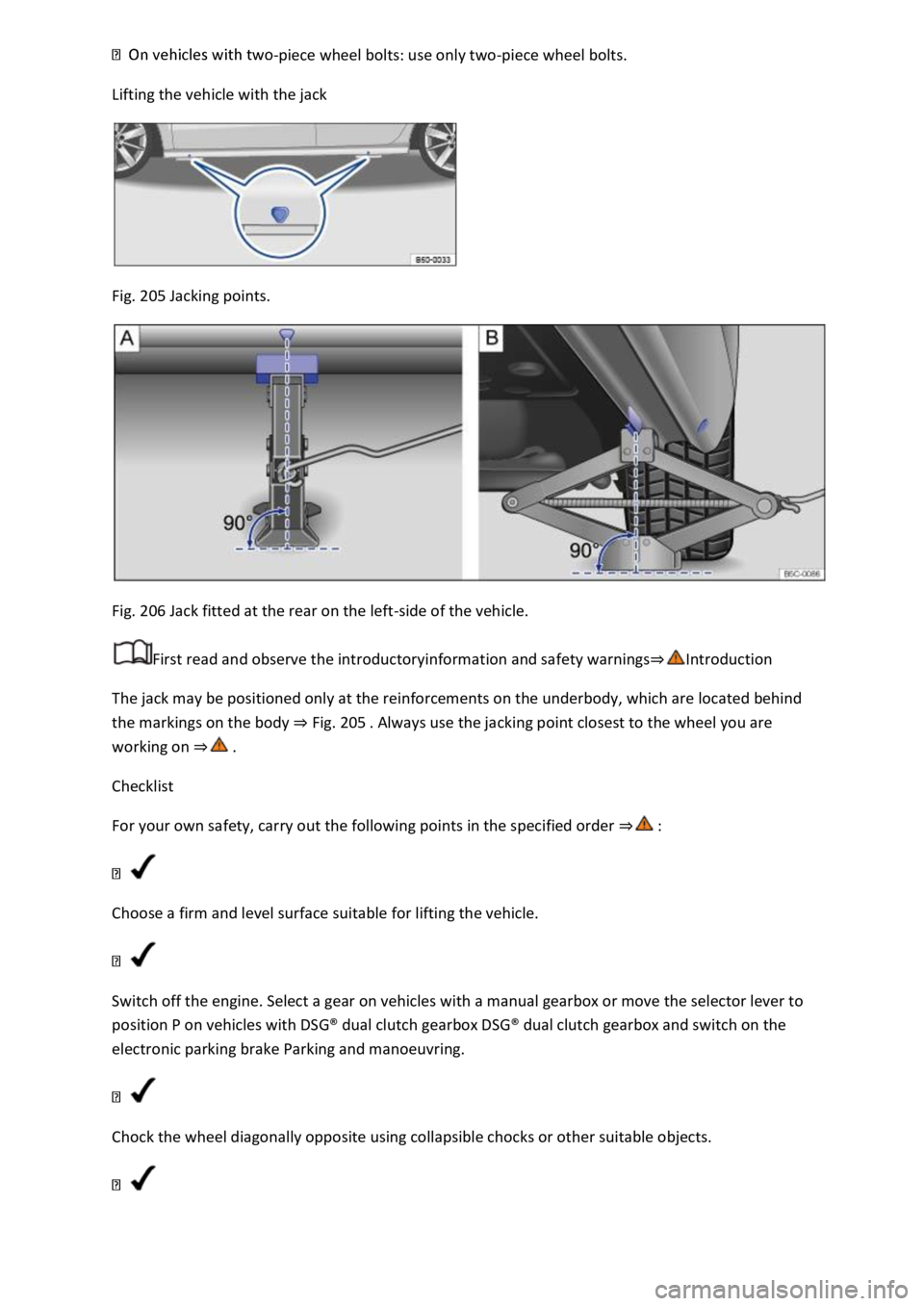
Fig. 205 Jacking points.
Fig. 206 Jack fitted at the rear on the left-side of the vehicle.
First read and observe the introductoryinformation and safety warnings⇒Introduction
The jack may be positioned only at the reinforcements on the underbody, which are located behind
the markings on the body ⇒ Fig. 205 . Always use the jacking point closest to the wheel you are
working on ⇒ .
Checklist
For your own safety, carry out the following points in the specified order ⇒ :
Choose a firm and level surface suitable for lifting the vehicle.
Switch off the engine. Select a gear on vehicles with a manual gearbox or move the selector lever to
position P on vehicles with DSG® dual clutch gearbox DSG® dual clutch gearbox and switch on the
electronic parking brake Parking and manoeuvring.
Chock the wheel diagonally opposite using collapsible chocks or other suitable objects.
Page 422 of 502

When towing a trailer : unhitch the trailer from the vehicle and park it properly.
Loosen the wheel bolts Wheel bolts.
Find the jacking point under the vehicle which is closest to the wheel that is being changed.
Insert the crank into the opening on the jack (depends on the vehicle equipment).
Crank up the jack until it just fits under the jacking point of the vehicle.
Ensure that the entire surface of the foot of the jack is resting securely on the floor, and that the
foot of the jack is positioned fully underneath the point of application and .
Position the jack and simultaneously continue to crank the claw up until it is in position around the
vertical rib underneath the vehicle .
Crank the jack further until the wheel is just clear of the ground.
WARNING
Incorrect use of the vehicle jack could cause the vehicle to slip off the jack. This could lead to severe
injuries. Observe the following points in order to reduce the risk of injuries:
jacks could slip out of position – this includes vehicle jacks supplied with other Volkswagen models.
the vehicle to slip off the jack. If necessary, use a large, sturdy board or similar support for the
vehicle jack.
side member securely ⇒ Fig. 206 .
lace any part of your body (e.g. an arm or leg) underneath the vehicle if the latter is
supported only by the vehicle jack.
Page 423 of 502
vehicle.
cle when the engine is running, or if the vehicle is tilted to one side or on a
gradient.
cause the vehicle to fall off the vehicle jack.
WARNING
Ignoring any of the items on this important safety checklist can lead to accidents and severe injuries.
Changing a wheel
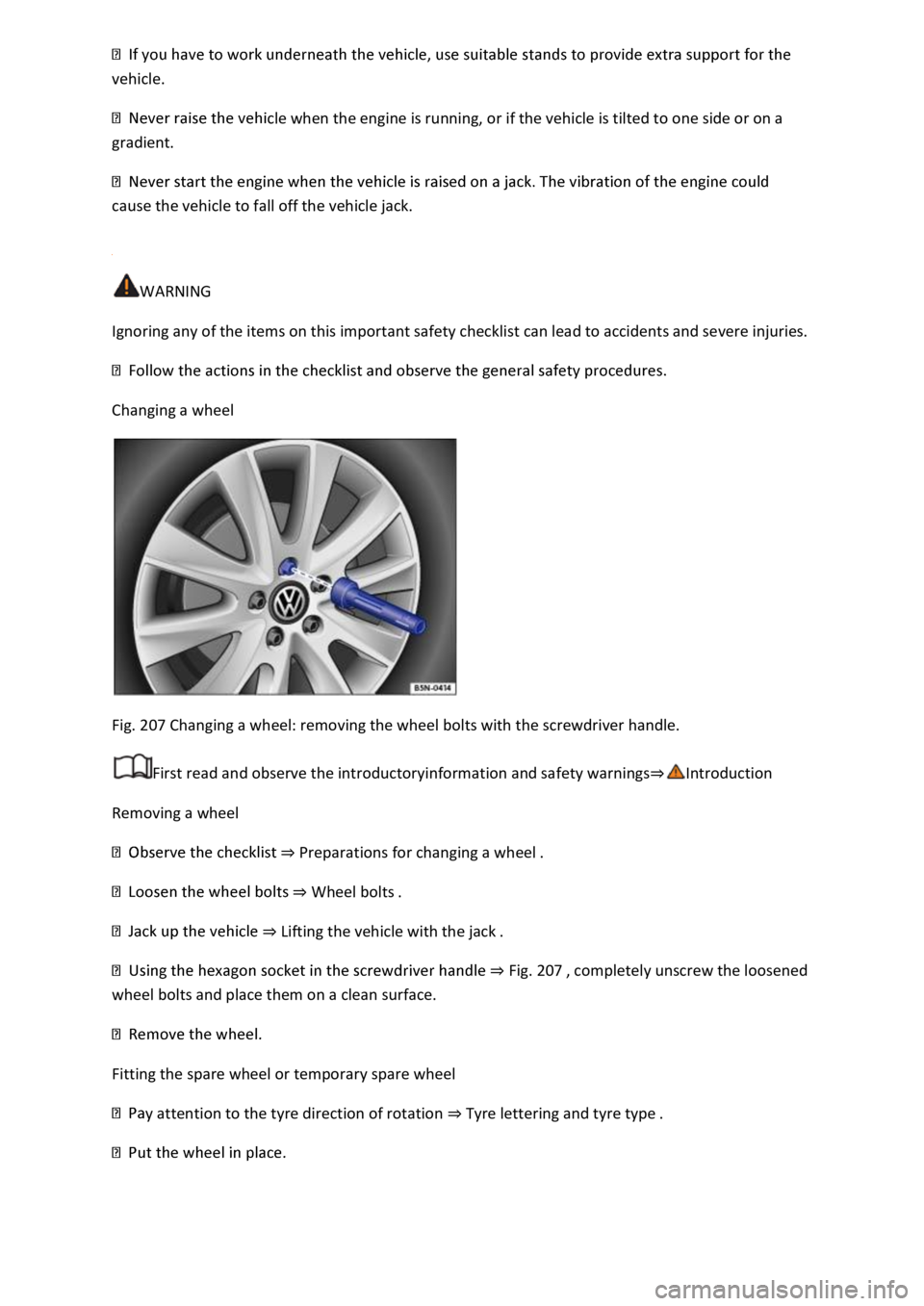
Fig. 207 Changing a wheel: removing the wheel bolts with the screwdriver handle.
First read and observe the introductoryinformation and safety warnings⇒Introduction
Removing a wheel
⇒ Preparations for changing a wheel .
⇒ Wheel bolts .
⇒ Lifting the vehicle with the jack .
⇒ Fig. 207 , completely unscrew the loosened
wheel bolts and place them on a clean surface.
Fitting the spare wheel or temporary spare wheel
y attention to the tyre direction of rotation ⇒ Tyre lettering and tyre type .
Page 424 of 502

-theft wheel bolt using the adapter at position ⇒ Fig. 204② or ③ and tighten it
slightly in a clockwise direction.
l the other wheel bolts in clockwise direction and tighten them slightly.
⇒ . Do not
tighten the bolts in order but always in diagonally opposite sequence.
⇒ Hubcaps .
WARNING
Incorrect tightening torque or incorrect use of wheel bolts can lead to a loss of control of the vehicle,
and cause accidents and serious injuries.
ep all wheel bolts and threads in the wheel hubs clean and free from oil and grease. The
wheel bolts must be easy to turn and be tightened to the specified torque.
not use
for loosening or tightening them.
After changing a wheel
First read and observe the introductoryinformation and safety warnings⇒Introduction
luggage compartment ⇒ Vehicle toolkit .
⇒ Tightening torque of wheel
bolts .
as possible.
After changing a wheel, the indicator lamp for the tyre monitoring system may indicate a fault in the
system ⇒ Troubleshooting for Tyre Pressure Loss Indicator .
Breakdown set
Introduction
This chapter contains information on the followingsubjects:
⇒ Contents of the breakdown set
⇒ Preparations
⇒ Sealing and inflating tyres
Page 431 of 502

⇒ .
1.4 bar (20 psi/140 kPa) and higher:
⇒ Useful information about wheels and tyres .
80 km/h (50 mph).
WARNING
Driving with a tyre that cannot be sealed is dangerous and can cause accidents and serious injuries.
bar (19 psi/130 kPa) or lower.
Maintenance
Service
Service work and digital service schedule
The vehicle data attached to the inside cover of this owner's manual help ensure that you can have
the correct Volkswagen Genuine Parts® installed in your vehicle whenever required. It also
determines which type of service applies to your vehicle.
The vehicle data sticker confirms when the vehicle was first registered or delivered, when the pre-
delivery inspection was carried out, and thus the date from which your vehicle is covered by our
warranty.
Storing the service operations performed (digital service schedule)
Each service record is stored by your Volkswagen dealership and qualified workshop in a central
system. This transparent documentation of the service history allows the service operations
performed to be reproduced at any time. Each time you have your vehicle serviced, Volkswagen
recommends asking for a printed service record, which contains all service work stored in the
system.
With every service, the printout of the previous service record is replaced by a current printout.
The digital service schedule is not available in some markets. In this case, your Volkswagen
dealership will inform you about the documentation process for service work.
Service work
The following information is documented in the digital service schedule by your Volkswagen
dealership or qualified workshop:
Page 437 of 502

Care allergen filter: change.
It is also possible to have servicing work carried out in between the scheduled service events
⇒ Fixed service or flexible service .
The scope of service is subject to change for technical reasons (continuous further development of
components). Your Volkswagen dealership or qualified workshop always has the latest information
about any changes.
Vehicle care
Notes on vehicle care
Regular, expert care helps to maintain your vehicle.
The longer contamination or dirt is left on the surface of vehicle components and upholstery fabrics,
the more difficult it can become to clean and treat them. Extended exposure may mean that it is no
longer possible to remove contamination or dirt.
Volkswagen recommend using Genuine care products that have been matched to your vehicle.1)
Consult a qualified workshop if you have any specific questions or if vehicle parts are not listed.
WARNING
Incorrect care and cleaning of vehicle components can impair the safety features of the vehicle and
cause serious injury.
be cleaned according to the manufacturer's instructions.
airbag modules.
ms against parts with sharp edges, e.g. when cleaning the insides of the
wheel housings.
WARNING
If the windows are covered in dirt, condensation, or ice, visibility will be reduced and the risk of
accidents and severe injuries will increase. This could impair the safety equipment of the vehicle.
-repellent window coating agents. In unfavourable
conditions, such coatings can cause increased dazzle.
Page 442 of 502

Sensors, camera lenses:
clean the area in front of the sensors or camera with a soft cloth and solvent-free cleaning agent.
Observe the installation locations ⇒ Vehicle overviews .
camera lens.
Clean sensitive surfaces on the rain/light sensor and the camera window on the windscreen in the
same way as windows and glass surfaces (depending on vehicle equipment).
Remove snow with a hand brush. Do not use warm or hot water. Use the Volkswagen Genuine de-
icing agent (- 000 096 322 -) to remove ice.
Decorative films, protective films:
Remove soiling as for paint. Always use Volkswagen Genuine plastic cleaner (- 000 096 314 -) for
matt decorative films.
Treat the vehicle with liquid hard wax every three months after washing and removing dust. Use
only clean, soft microfibre cloths to apply it. Do not use hot wax, even in car washes.
Trim parts, trim strips, exhaust pipes made of chrome, aluminium or stainless steel:
Clean only using a clean, soft cloth and a mild soap solution2) in a dust-free environment.
Chrome parts can be protected using Volkswagen Genuine hard wax (- 000 096 317 -).
Anodised surfaces: do not use chrome cleaning products.
Headlights, tail light clusters:
Use a soft sponge soaked with a mild soap solution2). Do not use any cleaning agents that contain
alcohol or solvents.
nium care product (-
000 096 319 D -).
Wheels:
Remove dirt and gritting salt deposits with plenty of water.
Alloy wheels: treat dirty aluminium wheels with Volkswagen Genuine wheel rim cleaner (-
000 096 304 -). Volkswagen recommends treating the wheel rims with Volkswagen Genuine hard
wax (- 000 096 317 -) every three months.
-up pen. Go to a qualified
workshop if necessary.
- 000 096 304 -).
Door lock cylinders:
Page 449 of 502

Repairs and technical modifications must always be carried out according to Volkswagen
specifications⇒ .
Modifications and repairs to the front bumper, doors, front seats, headliner or the bodywork should
be carried out only by a qualified workshop. Airbag system components and sensors might be fitted
on these vehicle components.
If you work on the airbag system or remove and install parts of the system when performing other
repair work, parts of the airbag system may be damaged. The consequence may be that, in the event
of an accident, the airbag inflates incorrectly or does not inflate at all.
Regulations must be observed to ensure that the effectiveness of the airbags is not reduced and that
removed parts do not cause any injuries or environmental pollution. Qualified workshops are
familiar with these regulations.
Any modifications to the vehicle's suspension could prevent the airbag system from working
properly during a collision. For example, using wheel rim/tyre combinations that have not been
approved by Volkswagen, lowering the suspension or making modifications to the suspension rate
including work on the springs, struts and shock absorbers etc., could change the forces that are
measured by the airbag sensors and sent to the electronic control unit. Some changes to the
suspension could cause the forces measured by the sensors to increase, for example. This can lead
to the airbag system being triggered in collision scenarios where it normally would not be triggered if
modifications to the suspension had not been made. Other modifications can cause the forces
measured by the sensors to decrease, therefore preventing the airbag system from being triggered
when it should have been.
WARNING
Incorrect repairs and modifications can cause malfunctions and damage to the vehicle and impair
the effectiveness of the airbag system. This can result in accidents and serious or even fatal injuries.
en taken from end-of-life
vehicles in your vehicle.
WARNING
Modifications to the vehicle's suspension, including the use of unsuitable tyre/rim combinations, can
cause the airbag system to function differently and increase the risk of serious or fatal injuries in the
event of an accident.
the original factory-fitted components.
en.
Mobile reception in the vehicle