Wheel VOLKSWAGEN T-ROC 2021 Owner´s Manual
[x] Cancel search | Manufacturer: VOLKSWAGEN, Model Year: 2021, Model line: T-ROC, Model: VOLKSWAGEN T-ROC 2021Pages: 502, PDF Size: 9.42 MB
Page 344 of 502
Fit the connector ⇒ Fig. 168 ① on the bulb holder ⇒ Fig. 168 ②. The connector should
click into place.
Fit the cover in the wheel housing liner ⇒ Fig. 168 and lock it in position.
NOTICE
the headlight housing is seated properly in order to
prevent damage to the electrical system caused by water entering the system.
damaged.
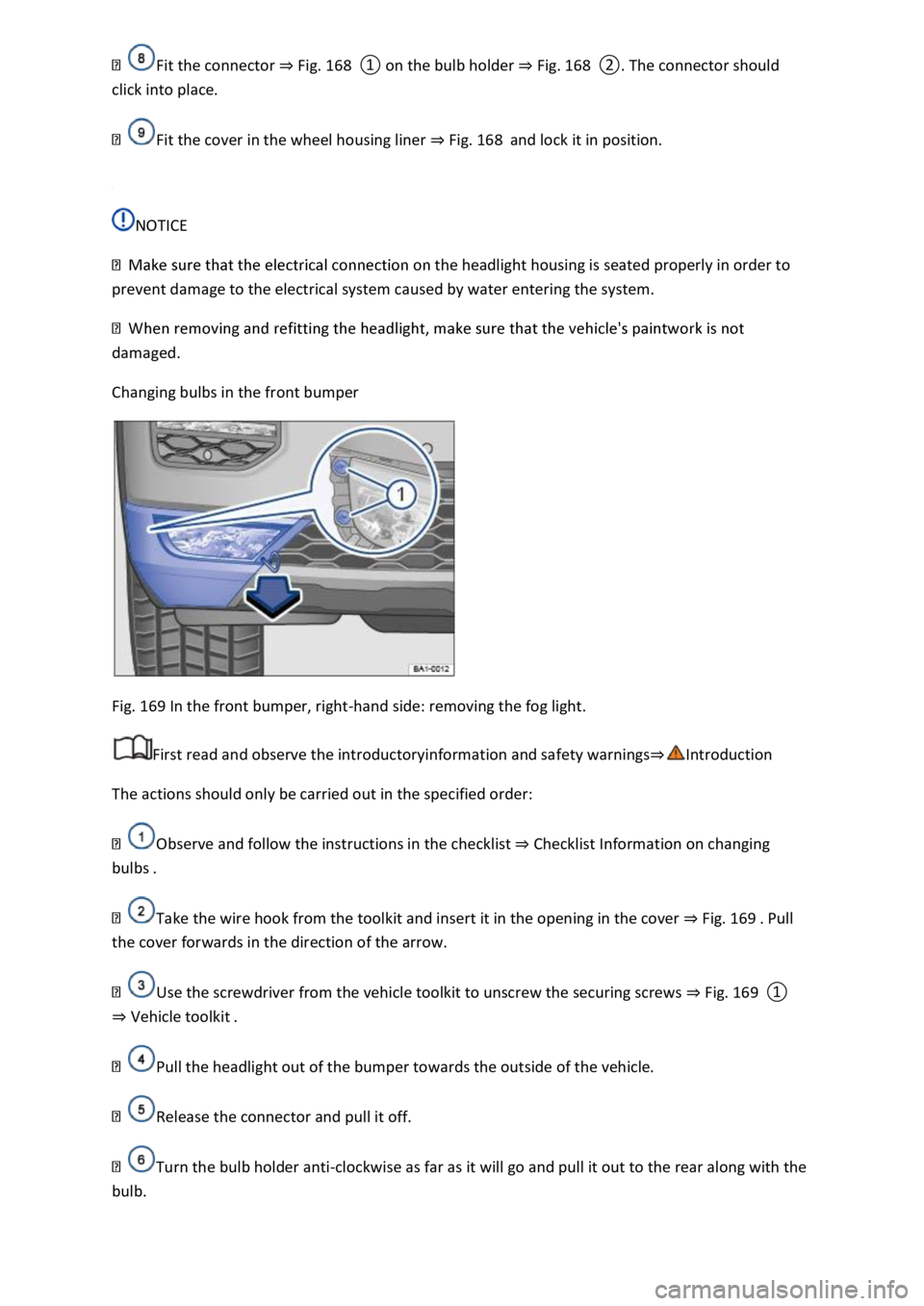
Changing bulbs in the front bumper
Fig. 169 In the front bumper, right-hand side: removing the fog light.
First read and observe the introductoryinformation and safety warnings⇒Introduction
The actions should only be carried out in the specified order:
Observe and follow the instructions in the checklist ⇒ Checklist Information on changing
bulbs .
Take the wire hook from the toolkit and insert it in the opening in the cover ⇒ Fig. 169 . Pull
the cover forwards in the direction of the arrow.
Use the screwdriver from the vehicle toolkit to unscrew the securing screws ⇒ Fig. 169 ①
⇒ Vehicle toolkit .
Pull the headlight out of the bumper towards the outside of the vehicle.
Release the connector and pull it off.
Turn the bulb holder anti-clockwise as far as it will go and pull it out to the rear along with the
bulb.
Page 356 of 502

⇒ Tow-starting
⇒ Towing
⇒ Fitting the rear towing eye
⇒ Fitting the front towing eye
Towing requires some experience, especially when using a tow rope. Both drivers should be familiar
with the technique required for towing. Inexperienced drivers should not attempt to tow.
Ensure that no excessive pulling forces occur and take care to avoid jerking movements. When
towing offroad, there is always a risk of overloading the anchorage points.
Observe any legal requirements when towing or tow-starting.
Tow-starting
Tow-starting describes the procedure for starting the vehicle by moving it using another towing
vehicle.
The vehicle can be tow-started with a tow-bar or a tow-rope.
Towing
Towing is where a vehicle that cannot be driven is pulled with the aid of another vehicle.
The vehicle can be towed with a tow-bar or a tow-rope. When the engine is stopped, the gearbox is
not lubricated sufficiently at higher speeds and over long distances:
km/h (30 mph).
km.
Tow rope, tow bar
It is easier and safer to tow a vehicle with a tow bar. Use a tow rope only if you do not have a tow
bar.
The tow rope should be slightly elastic to reduce the strain on both vehicles. It is advisable to use a
tow rope made of synthetic fibre or similarly elastic material.
Towing with a tow truck
If your vehicle is to be raised on one axle for towing, this may only be done using the following axles
according to the gearbox/drive combination:
Front-wheel drive
Manual gearboxFront or rear axleAutomatic gearboxFront axle
WARNING
If a vehicle is being towed, the vehicle handling and braking efficiency will change significantly.
Page 357 of 502

WARNING
Never tow a vehicle that has no power supply.
assistance.
NOTICE
When pushing the vehicle by hand, do not press on the tail light clusters, the side spoilers on the
rear window, the rear spoiler or large panels. This could damage the vehicle and the rear spoiler
could become detached.
NOTICE
Remove and install the cover and the towing eye carefully so as to avoid damage to the vehicle, e.g.
the paintwork.
Notes on tow-starting and towing
First read and observe the introductoryinformation and safety warnings⇒Introduction
It is still possible to activate the turn signals in a vehicle that is being towed, even if the hazard
warning lights are switched on. To do this, operate the turn signal lever in the required direction
while the ignition is switched on. The hazard warning lights will not flash while the turn signal is
being used. The hazard warning lights will start flashing again automatically as soon as the turn
signal lever is moved back to the neutral position.
When should your vehicle not be tow-started or towed?
an 50 km.
accident.
If the vehicle cannot be towed on its own four wheels due to one of the above conditions, seek
expert assistance and have the vehicle transported on a recovery vehicle if necessary.
Tow-starting
First read and observe the introductoryinformation and safety warnings⇒Introduction
Preparations for tow-starting
Vehicles with an automatic gearbox:
Page 359 of 502
Vehicles with a manual gearbox:
Pulled vehicle (rear)
Ensure that the ignition is switched on so that the steering wheel is not locked and so that you can
indicate, sound the horn and operate the wipers if necessary.
the
ignition is switched on and the vehicle is rolling. Otherwise you must press the brake pedal with
significantly more force and also use more effort for steering.
-rope is always taut.
ox in neutral or select the selector lever position N.
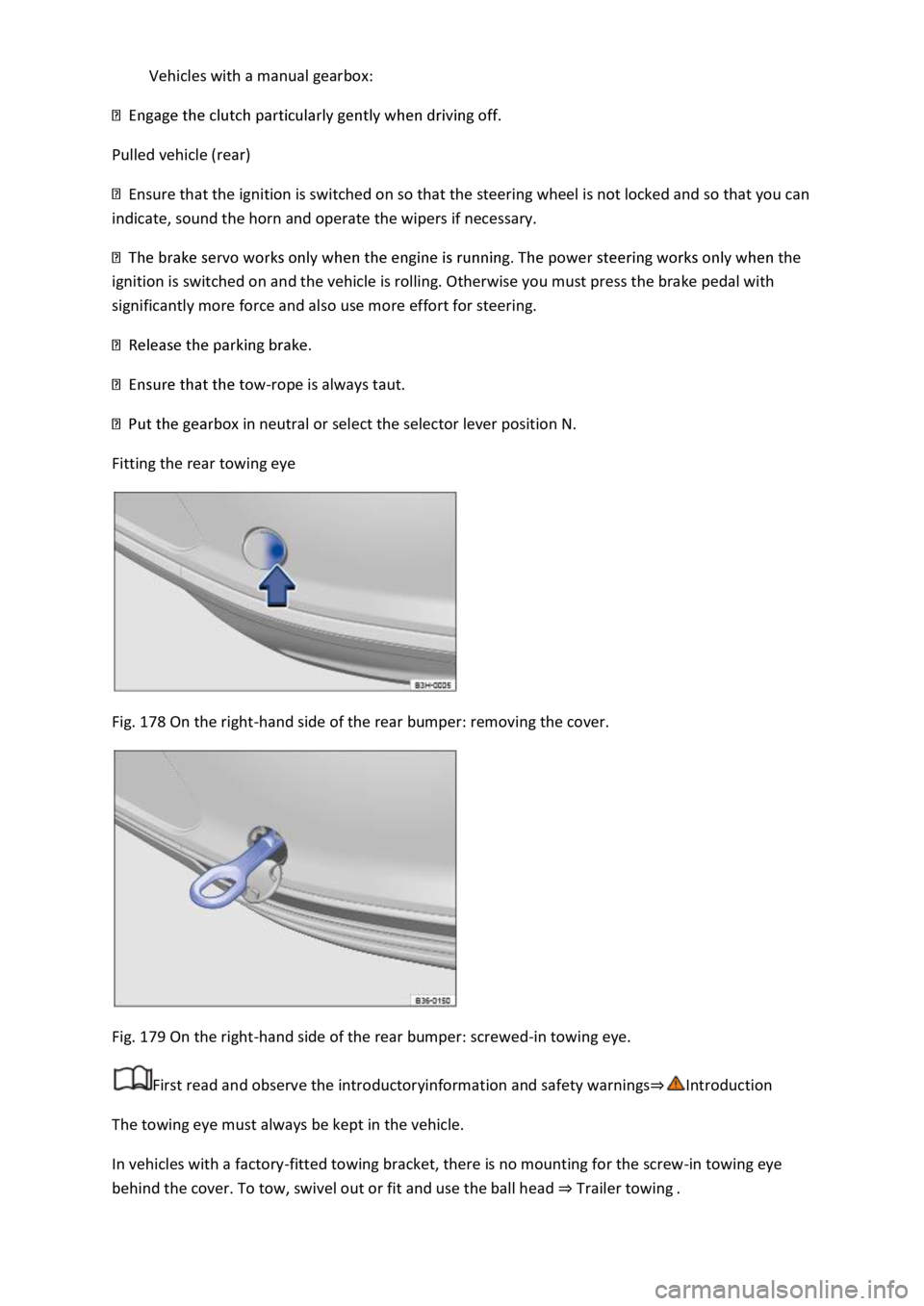
Fitting the rear towing eye
Fig. 178 On the right-hand side of the rear bumper: removing the cover.
Fig. 179 On the right-hand side of the rear bumper: screwed-in towing eye.
First read and observe the introductoryinformation and safety warnings⇒Introduction
The towing eye must always be kept in the vehicle.
In vehicles with a factory-fitted towing bracket, there is no mounting for the screw-in towing eye
behind the cover. To tow, swivel out or fit and use the ball head ⇒ Trailer towing .
Page 362 of 502

The engine compartment of a motor vehicle is a hazardous area. Do not work on the engine and in
the engine compartment unless you are familiar with the task, aware of the general safety
procedures and have the correct equipment, service fluids and suitable tools. Serious injuries can be
caused by carrying out work incorrectly ⇒ . The work should be carried out by a qualified
workshop if you are uncertain. Volkswagen recommends using a Volkswagen dealership for this
purpose.
Always park the vehicle on a level and stable surface before carrying out any work in the engine
compartment.
WARNING
Unintentional vehicle movements during service work can cause serious injury.
underneath the vehicle while the wheels are on the ground, the vehicle must be on a level surface,
the wheels chocked, and the vehicle key removed from the ignition lock as required.
vehicle. The vehicle jack is not sufficient for this task and can fail, which can lead to serious injuries.
WARNING
The engine compartment of any motor vehicle is a dangerous area. Serious injuries can be sustained
here.
st care and attention must be paid when carrying out any work and you must follow the
general safety rules. Never take any risks.
carry it out. If you are uncertain of what to do, the work should be carried out by a qualified
workshop. Serious injuries can result from work that has not been carried out properly.
steam or hot coolant can cause serious burns. Always wait until you can no longer see or hear steam
or coolant coming from the engine compartment.
urn the skin.
P or move the gear
lever to the neutral position.
and remove the vehicle key from the ignition lock.
Page 391 of 502

Fault in the alternator. The 12-volt vehicle battery will not be charged by the alternator while the
vehicle is in motion.
Switch off any electrical consumers that are not required. Inform a qualified workshop. Have the
electrical system checked.
The start/stop system cannot start the engine ⇒ Start/stop system .
and vehicle battery (12-volt)
The central warning lamp lights up yellow and the text message 12 V battery low. Charge by driving.
is displayed.
The charge level of the vehicle battery is insufficient.
Recharge the 12-volt vehicle battery by driving the vehicle for an extended time.
The start/stop system cannot start the engine ⇒ Start/stop system .
and vehicle battery (12-volt)
The central warning lamp lights up red and the text message Replace 12 V battery. Workshop. is
displayed.
The vehicle battery condition is not ok.
Seek expert assistance and have the battery checked and replaced if necessary.
The start/stop system cannot start the engine ⇒ Start/stop system .
Wheels and tyres
Tyre monitoring system
Introduction
This chapter contains information on the followingsubjects:
⇒ Tyre Pressure Loss Indicator
⇒ Troubleshooting for Tyre Pressure Loss Indicator
The tyre monitoring system warns the driver when the tyre pressures are too low.
The tyre monitoring system monitors various parameters (for example, rolling circumference) of all
wheels using ABS sensors (indirect measurement).
WARNING
The intelligent tyre monitoring system technology cannot overcome the laws of physics, and
functions only within the limits of the system. Incorrect handling of the wheels and tyres can lead to
a sudden loss of pressure in the tyres, tread separation and even tyre blow-out.
Page 392 of 502

⇒ Tyre
pressure . If the tyre pressure is too low, it is possible that the tyre temperature will increase to such
an extent that the tread peels off and the tyre bursts.
⇒ Tyre pressure .
eck the tyre pressure regularly when the tyres are cold. If necessary, adjust the tyre pressure in
the cold tyre to the recommended tyre pressure for the tyres installed on your vehicle ⇒ Tyre
pressure .
amage.
If the tyre pressure is too low, this will increase fuel consumption and tyre wear.
When new tyres are driven at high speeds for the first time, they can expand slightly and trigger a
one-off pressure warning.
Old tyres should be replaced only by tyres that have been approved by Volkswagen for the vehicle
type.
Do not rely solely on the tyre monitoring system. Check your tyres regularly to ensure that they are
properly inflated and have no signs of damage, such as punctures, cuts, cracks, and blisters. Remove
any objects that become embedded in the tyre tread but have not penetrated into the body of the
tyre itself.
Tyre Pressure Loss Indicator
First read and observe the introductoryinformation and safety warnings⇒Introduction
Functional description
The Tyre Pressure Loss Indicator uses data from the ABS sensors and other functions to compare the
speed of rotation and the rolling circumference of the individual wheels.
The rolling circumference can change:
Page 393 of 502

ary spare wheel has been fitted.
The Tyre Pressure Loss Indicator may react with a delay or not display anything at all in the event
of a sporty driving style, when driving on snow-covered or icy roads or unpaved roads or when
driving with snow chains.
Synchronising the Tyre Pressure Loss Indicator
button or function button, depending on version ⇒ Vehicle settings menu .
tem.
button.
After an extended driving time with driving at different speeds, the system will automatically learn
the new values and monitor them.
t to rear.
The Tyre Pressure Loss Indicator does not work if there is a fault in the ESC or ABS
⇒ Troubleshooting .
After a warning about the tyre pressure being too low, switch the ignition off and then back on
again. The Tyre Pressure Loss Indicator can be re-synchronised only after this has been done.
Troubleshooting for Tyre Pressure Loss Indicator
First read and observe the introductoryinformation and safety warnings⇒Introduction
lit up
Do not drive on!
s ⇒ Tyre pressure .
Page 394 of 502

-synchronise the Tyre Pressure Loss Indicator ⇒ Tyre Pressure Loss Indicator .
flashes for 65 seconds and then remains lit continuously
Do not drive on!
-synchronise the Tyre Pressure Loss Indicator ⇒ Tyre Pressure Loss Indicator .
WARNING
Differing tyre pressures or tyre pressures that are too low can cause tyre damage, tyre failure, loss of
vehicle control, accidents, serious injury and death.
lights up, stop the vehicle as soon as possible and check all the tyres
⇒ Useful information about wheels and tyres .
vehicle stability and increase the braking distance.
lead
to a tyre bursting and the loss of control over the vehicle.
recommended tyre pressure can be found on a sticker ⇒ Tyre pressure .
em cannot function correctly unless all cold tyres have the correct tyre
pressure.
⇒ Tyre pressure .
⇒ Tyre pressure .
warm up the tyre to such an extent that the tread may separate and the tyre could burst. This could
cause the driver to lose control of the vehicle.
the tyre bursts, leading you to lose control of the vehicle.
rely and the vehicle will not
handle well.
to the nearest qualified workshop and check and correct the tyre pressure ⇒ Useful information
about wheels and tyres .
Page 395 of 502

Driving on unpaved roads for long periods or a sporty driving style can temporarily deactivate the
Tyre Pressure Loss Indicator. In the event of a malfunction, the indicator lamp will flash for 65
seconds and then light up continuously. However, the indicator lamp will go out when the road
conditions or driving style change.
Useful information about wheels and tyres
Introduction
This chapter contains information on the followingsubjects:
⇒ Handling wheels and tyres
⇒ Wheel rims and wheel bolts
⇒ Tyre pressure
⇒ Tread depth and wear indicators
⇒ Tyre damage
⇒ Spare wheel or temporary spare wheel
⇒ Tyre lettering and tyre type
⇒ Maximum load and speed range for tyres
⇒ Winter tyres
⇒ Snow chains
The tyres are the most heavily loaded and most underestimated parts of a vehicle. Tyres are very
important as the narrow tyre contact surfaces are the only contact between the vehicle and the
road.
The service life of tyres is dependent on tyre pressure, driving style, handling and correct fitting.
WARNING
New tyres or tyres which are old, worn down or damaged cannot provide full vehicle control and
braking efficiency.
injuries.
s must be fitted with radial tyres of the same type, size (rolling circumference) and
the same tread pattern.
particularly carefully for the first 600 km in order to prevent accidents and serious injury.
the tyre pressure is too low, it is possible that the tyre temperature will increase to such an extent
when driving that the tread peels off and the tyre bursts.