fluid VOLKSWAGEN T-ROC 2021 Owner´s Manual
[x] Cancel search | Manufacturer: VOLKSWAGEN, Model Year: 2021, Model line: T-ROC, Model: VOLKSWAGEN T-ROC 2021Pages: 502, PDF Size: 9.42 MB
Page 370 of 502

⇒ . Observe the dilution instructions on the packaging.
peratures, add a special anti-freeze agent so that the fluid cannot freeze ⇒ .
The windscreen washer fluid reservoir has a capacity of about 3.0–7.5 litres, according to the vehicle
equipment.
WARNING
Never mix coolant additive or other unsuitable additives into the washer fluid. These may leave an
oily film on the screen, restricting the field of vision.
-freeze agent should be added to the washer fluid if necessary.
NOTICE
cause the ingredients to flocculate and block the washer jets.
rrect service fluids are filled through the
correct openings. The use of incorrect service fluids could result in serious malfunctions and engine
damage.
Engine oil
Introduction
This chapter contains information on the followingsubjects:
⇒ Engine oil standards
⇒ Changing engine oil
⇒ Engine oil consumption
⇒ Checking the engine oil level and refilling the engine oil
⇒ Troubleshooting
The engine oils are not only tailored to the requirements of engines and exhaust gas treatment
systems, but also to fuel quality. Due to the way in which a combustion engine works, engine oil
always comes into contact with combustion residues and fuel, which has corresponding effects on
the ageing process of the oil. The correct engine oil is important for the function and service life of
the engine. A special multigrade high-lubricity oil has been filled at the factory and this can normally
be used as an all-season oil.
Page 371 of 502

Engine oils are constantly being developed and improved. Volkswagen dealerships always have the
latest information about any changes. Volkswagen therefore recommends having engine oil changes
done by a Volkswagen dealership.
Information for warning and indicator lamps lit up can be found in the troubleshooting at the end of
the chapter ⇒ Troubleshooting .
WARNING
Incorrect handling of engine oil can cause serious burns and other injuries.
original container. This also applies to used oil until it is
disposed of.
may then drink the engine oil.
skin. Skin that has been in contact with engine oil
should be washed thoroughly with water and soap.
allow the engine to cool down.
Leaking or spilt engine oil can pollute the environment. Spilt service fluids must be collected and
then disposed of properly and in an environmentally responsible way.
Engine oil standards
First read and observe the introductoryinformation and safety warnings⇒Introduction
If possible, use only Volkswagen-approved engine oil ⇒ . To comply with the requirements of the
flexible oil change service, use only approved flexible service engine oil that complies with the
corresponding VW standard.
Since the quality of fuels can vary greatly between individual markets, this must be taken into
account when selecting the correct engine oil.
The use of engine oils compliant with the VW 504 00, VW 507 00 and VW 508 00 specifications
requires a fuel quality compliant with EN 228 (petrol) and EN 590 (diesel), or fuel of an equivalent
quality. Engine oils compliant with VW 504 00, VW 507 00 and VW 508 00 are therefore unsuitable
for use in a large number of markets.
If the engine has been filled with engine oil in accordance with the standards W 502 00, VW 504 00
and VW 507 00, a sticker with the relevant information will be located on the lock carrier in the
engine compartment. Observe this information!
Page 377 of 502

correct openings. The use of incorrect service fluids could result in serious malfunctions and engine
damage.
The engine oil level must never be above area ⇒ Fig. 186 Ⓑ. Otherwise oil can be drawn in through
the crankcase breather and escape into the atmosphere via the exhaust system.
Troubleshooting
First read and observe the introductoryinformation and safety warnings⇒Introduction
and Engine oil pressure too low
The central warning lamp lights up red and the text message Stop vehicle. Oil pressure. Observe
vehicle wallet is displayed.
Do not drive on!
Switch off the engine and check the engine oil level. Checking the engine oil level ⇒ Checking the
engine oil level and refilling the engine oil . - Do not drive on or allow the engine to run if the
warning lamp is flashing although the engine oil level is correct. The engine could otherwise be
damaged. Seek expert assistance.
and Engine oil level too low
The central warning lamp lights up red and the text message Refill engine oil. is displayed.
Engine oil level is too low. Switch off the engine.
Checking the engine oil level ⇒ Checking the engine oil level and refilling the engine oil .
and Engine oil level low
The central warning lamp lights up yellow and the text message Check oil level. is displayed.
Engine oil level is low. Switch off the engine.
Checking the engine oil level ⇒ Checking the engine oil level and refilling the engine oil .
and Fault in engine oil system
The central warning lamp lights up yellow and the text message Oil sensor: workshop. is displayed.
Engine oil system is faulty. Go to a qualified workshop and have the engine oil sensor checked.
and Engine oil level too high
The central warning lamp lights up yellow and the text message Reduce oil level. is displayed.
Engine oil level is too high. Switch off the engine.
Check the engine oil level. Checking the engine oil level ⇒ Checking the engine oil level and refilling
the engine oil . Seek expert assistance.
Page 378 of 502

Coolant
Introduction
This chapter contains information on the followingsubjects:
⇒ Coolant specification
⇒ Checking the coolant level and refilling coolant
Do not work on the cooling system unless you are familiar with the task, aware of the general safety
procedures and have the correct equipment, service fluids and suitable tools. Serious injuries can be
caused by carrying out work incorrectly ⇒ . The work should be carried out by a qualified
workshop if you are uncertain. Volkswagen recommends using a Volkswagen dealership for this
purpose.
WARNING
Coolant is toxic.
ce.
-original containers as
people finding these containers may then drink the coolant.
ct coolant additive used must be sufficient for the lowest
ambient temperature that you expect the vehicle to be exposed to.
Vehicle occupants with inadequate winter clothing could then freeze to death as the heating will
also no longer function.
Coolant and coolant additives can pollute the environment. Spilt service fluids must be collected
then disposed of properly and in an environmentally responsible way.
Coolant specification
First read and observe the introductoryinformation and safety warnings⇒Introduction
The cooling system is filled at the factory with a mixture of specially prepared water and at least 40%
coolant additive G 13 (TL-VW 774 J).
The proportion of engine coolant additive must always be at least 40% to protect the cooling system.
If greater frost protection is required in very cold climates, the proportion of anti-freeze additive can
be increased. However, the percentage of coolant additive should not exceed 60%, as this would
reduce the frost protection again and the cooling effect.
Page 379 of 502

The coolant additive is dyed purple. The mixture of water and a coolant additive offers anti-freeze
protection down to -25°C (-13°F), protects the alloy parts in the cooling system against corrosion,
prevents limescale deposits and significantly increases the boiling point of the coolant.
When refilling the coolant, a mixture of distilled water and at least 40% coolant additive - G 13 - or -
G 12 plus-plus - (TL-VW 774 G) (both of which are dyed purple) must be used in order to obtain the
optimum corrosion protection ⇒ .
Mixing - G 13 - with the coolant additives - G 12 plus - (TL-VW 774 F), - G 12 - (dyed red) or - G 11 -
(dyed blue-green) will significantly decrease the level of corrosion protection and should therefore
be avoided ⇒ .
WARNING
Insufficient anti-freeze in the coolant system can cause the engine to break down and cause serious
injuries.
ive used must be sufficient for the lowest
ambient temperature that you expect the vehicle to be exposed to.
Vehicle occupants with inadequate winter clothing could then freeze to death as the heating will
also no longer function.
NOTICE
Never mix genuine coolant additives with other coolants that have not been approved by
Volkswagen.
ts from mixing the purple
coolant additive with distilled water) but for example, brown instead of purple, - G 13 - has been
mixed with an unsuitable coolant additive. The coolant must be changed as soon as possible if this is
the case. Failure to observe this warning can result in serious malfunctions or damage to the engine
and cooling system.
Coolant and coolant additives can pollute the environment. Spilt service fluids must be collected and
then disposed of properly and in an environmentally responsible way.
Checking the coolant level and refilling coolant
Page 381 of 502

Otherwise, the engine could be damaged. If you cannot see any coolant in the expansion tank do not
drive on. Seek professional assistance.
level remains stable.
⇒ Fig. 188 . Do not
fill up above the top edge of the marked area⇒ .
⇒ Coolant
specification , do not use any other coolant additive! Instead, initially refill with distilled water⇒
only. Then add the correct proportion of the specified coolant additive as soon as possible
⇒ Coolant specification .
WARNING
Hot steam and hot coolant can cause serious burns.
coolant coming out of the engine
compartment. Always wait until you can no longer see or hear escaping steam or coolant.
components can burn the skin.
wing points must be observed before opening the bonnet once it has cooled down:
P or move the gear
lever to the neutral position.
hicle key from the ignition lock.
unattended.
expansion tank when the engine is hot. Coolant may spray out and cause serious burns and other
injuries.
-clockwise while exerting gentle downward pressure on
the cap.
with a large, thick cloth.
spilt service fluids can start a fire. In certain circumstances, the ethylene glycol in the coolant can
catch fire.
NOTICE
Page 382 of 502
Refill only with distilled water. All other types of water can cause corrosion in the engine due to
the chemical components contained in the water. This can also lead to engine failure. If any other
type of water apart from distilled water has been refilled, the fluid in the cooling system should be
completely replaced immediately by a qualified workshop.
⇒ Fig. 188 . Otherwise the excess coolant will
be forced out of the cooling system when the engine is hot and could cause damage.
completely. Heavy coolant loss is an indication of leaks in the cooling system. The cooling system
should be checked by a qualified workshop as soon as possible. Failure to do so can result in engine
damage.
have entered the cooling system. Do not drive on! Seek expert assistance. Failure to do so can result
in engine damage.
correct openings. The use of incorrect service fluids could result in serious malfunctions and engine
damage.
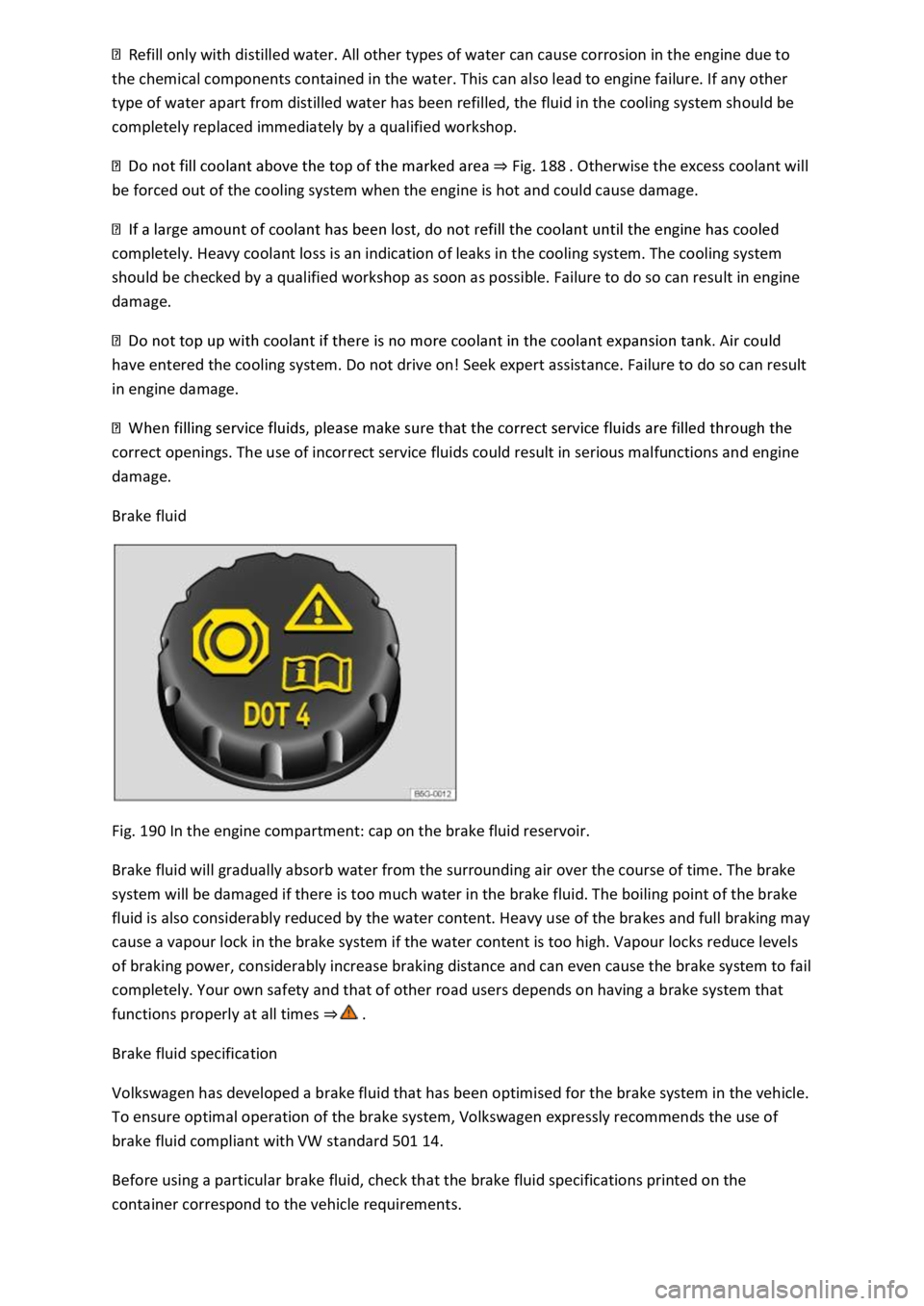
Brake fluid
Fig. 190 In the engine compartment: cap on the brake fluid reservoir.
Brake fluid will gradually absorb water from the surrounding air over the course of time. The brake
system will be damaged if there is too much water in the brake fluid. The boiling point of the brake
fluid is also considerably reduced by the water content. Heavy use of the brakes and full braking may
cause a vapour lock in the brake system if the water content is too high. Vapour locks reduce levels
of braking power, considerably increase braking distance and can even cause the brake system to fail
completely. Your own safety and that of other road users depends on having a brake system that
functions properly at all times ⇒ .
Brake fluid specification
Volkswagen has developed a brake fluid that has been optimised for the brake system in the vehicle.
To ensure optimal operation of the brake system, Volkswagen expressly recommends the use of
brake fluid compliant with VW standard 501 14.
Before using a particular brake fluid, check that the brake fluid specifications printed on the
container correspond to the vehicle requirements.
Page 383 of 502

Brake fluid that is compliant with VW standard 501 14 is available from Volkswagen dealerships.
If this brake fluid is not available and it is necessary to use another high-quality brake fluid instead,
brake fluid that is compliant with DIN ISO 4925 CLASS 4 or US standard FMVSS 116 DOT 4 can be
used.
Not all brake fluids that are compliant with DIN ISO 4925 CLASS 4 or US standard FMVSS 116 DOT 4
have the same chemical composition. Some of these brake fluids may contain chemicals that can
damage or destroy brake system components over time.
Volkswagen therefore recommends the use of brake fluid that is compliant with VW standard 501 14
to ensure sustained proper operation of the brake system.
Brake fluid that is compliant with VW standard 501 14 fulfils the requirements of DIN ISO 4925
CLASS 4 or US standard FMVSS 116 DOT 4.
Brake fluid level
The brake fluid level must always be between the MIN and MAX marking on the brake fluid reservoir
or above the MIN marking ⇒ .
The brake fluid level cannot be checked accurately in all models as engine components may partially
conceal the fluid level in the brake fluid reservoir. If the brake fluid level cannot be read exactly,
please go to a qualified workshop.
The brake fluid level drops slightly during vehicle operation as the brake pads wear and the brakes
are automatically adjusted.
Brake fluid level
The indicator lamp lights up red.
Brake fluid level is too low.
Do not drive on! Check the brake fluid level.
If the brake fluid level is too low, inform a qualified workshop. Have the brake system checked.
Changing the brake fluid
The brake fluid should be changed by a qualified workshop. Volkswagen recommends using a
Volkswagen dealership for this purpose. Only brake fluid that conforms with the required
specification should be used.
WARNING
Brake failure or reduced braking efficiency can be caused by the brake fluid level being too low or by
brake fluid that is too old or unsuitable.
Page 384 of 502

reduce braking efficiency, considerably increase braking distance and can cause the brake system to
fail completely.
with VW standard 501 14.
fluid or low-quality brake fluid can affect the functioning of the brakes and reduce
their effectiveness.
501 14 is not available, use a high-quality brake fluid
compliant with DIN ISO 4925 CLASS 4 or the US standard FMVSS 116 DOT 4, but only in exceptional
circumstances.
WARNING
Brake fluid is toxic.
brake fluid. There is always a risk of someone drinking from such containers, even if they are labelled
appropriately.
children.
NOTICE
Brake fluid that has leaked or been spilt can damage the vehicle paintwork, plastic parts and tyres.
Immediately wipe off brake fluid that has leaked or been spilt from all parts of the vehicle.
Brake fluid can pollute the environment. Any service fluids that have escaped or been spilt must be
collected and disposed of properly.
12-volt vehicle battery
Introduction
This chapter contains information on the followingsubjects:
⇒ Checking the electrolyte level of the 12-volt vehicle battery
⇒ Charging, replacing, disconnecting and connecting the 12-volt vehicle battery
⇒ Troubleshooting
The 12-volt vehicle battery is a component of the electrical system and serves to supply power in the
vehicle.
Page 385 of 502

Do not work on the electrical system unless you are familiar with the task, aware of the general
safety procedures and have the correct equipment, service fluids and suitable tools. Serious injuries
can be caused by carrying out work incorrectly ⇒ . All work should be carried out by a qualified
workshop. Volkswagen recommends using a Volkswagen dealership for this purpose.
Information for warning and indicator lamps lit up can be found in the troubleshooting at the end of
the chapter ⇒ Troubleshooting .
Location of the 12-volt vehicle battery
The 12-volt vehicle battery is located in the engine compartment.
Explanation of the warnings on the 12-volt vehicle battery
Always wear eye protection!Electrolyte is very corrosive and caustic. Always wear
protective gloves and eye protection!Fire, sparks, naked lights and smoking are prohibited!
A highly explosive mixture of gases is given off when the 12-volt vehicle battery is charging!
Always keep children away from electrolyte and the 12-volt vehicle battery!Always
observe the owner's manual!
WARNING
Any work on the 12-volt vehicle battery and the electrical system can cause serious chemical burns,
fire or electric shocks. Always read and observe the following warnings and safety information
before carrying out any kind of work:
any work on the 12-volt
vehicle battery and also disconnect the negative cable from the 12-volt vehicle battery.
-volt vehicle battery.
12-volt vehicle battery, ensure that your hands, arms and face in particular are protected from acid
spillages.
r work near naked flames or sparks.
discharge.
-volt vehicle battery. It can explode. Damaged 12-volt vehicle batteries
must be replaced as soon as possible.