warning light VOLKSWAGEN TIGUAN 2017 Owner´s Manual
[x] Cancel search | Manufacturer: VOLKSWAGEN, Model Year: 2017, Model line: TIGUAN, Model: VOLKSWAGEN TIGUAN 2017Pages: 341, PDF Size: 9.14 MB
Page 234 of 341
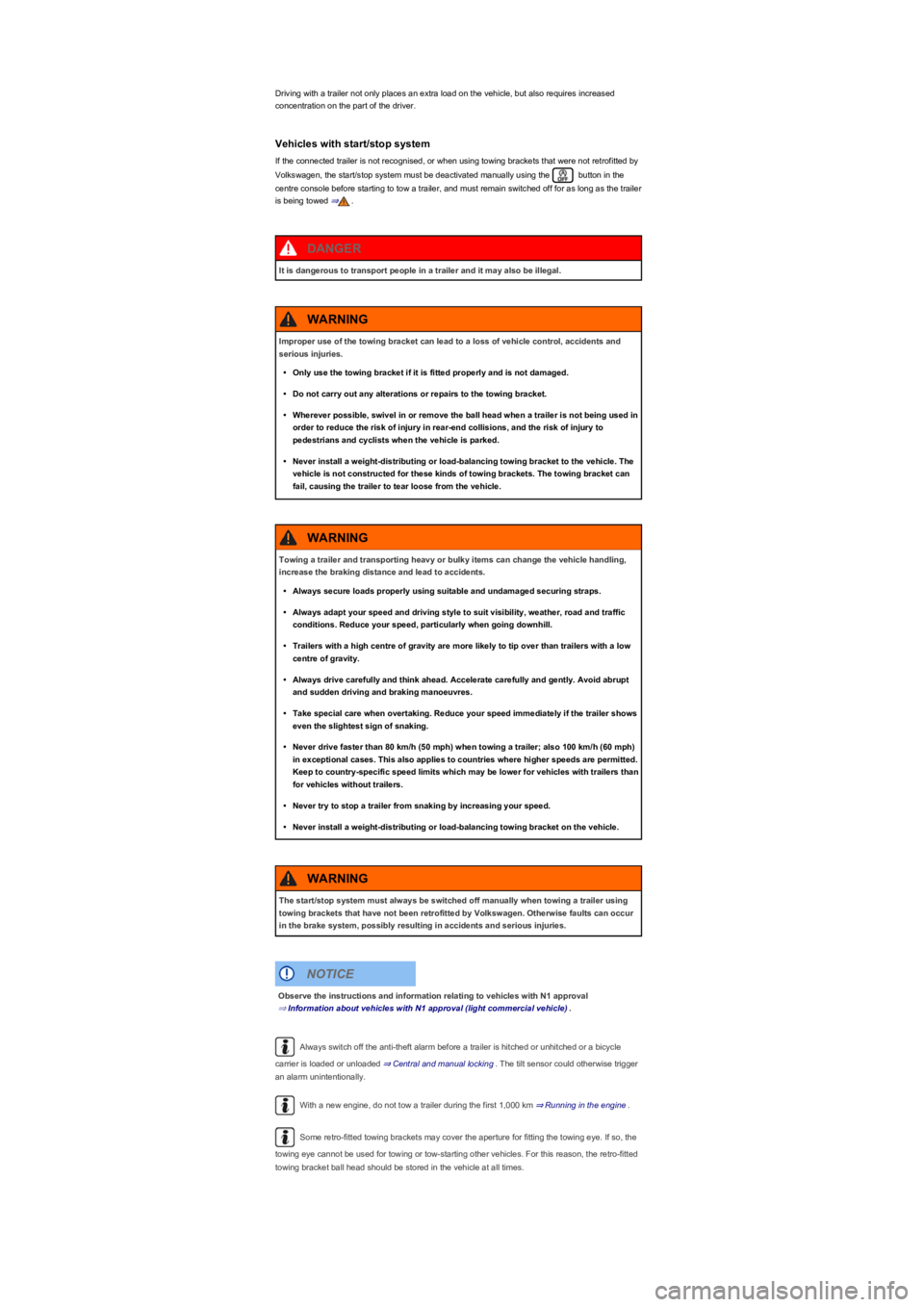
Driving with a trailer not only places an extra load on the vehicle, but also requires increased
concentration on the part of the driver.
Vehicles with start/stop system
If the connected trailer is not recognised, or when using towing brackets that were not retrofitted by
Volkswagen, the start/stop system must be deactivated manually using the button in the
centre console before starting to tow a trailer, and must remain switched off for as long as the trailer
is being towed ⇒.
Always switch off the anti-theft alarm before a trailer is hitched or unhitched or a bicycle
carrier is loaded or unloaded ⇒ Central and manual locking. The tilt sensor could otherwise trigger
an alarm unintentionally.
With a new engine, do not tow a trailer during the first 1,000 km ⇒ Running in the engine.
Some retro-fitted towing brackets may cover the aperture for fitting the towing eye. If so, the
towing eye cannot be used for towing or tow-starting other vehicles. For this reason, the retro-fitted
towing bracket ball head should be stored in the vehicle at all times.
It is dangerous to transport people in a trailer and it may also be illegal.
DANGER
Improper use of the towing bracket can lead to a loss of vehicle control, accidents and
serious injuries.
•Only use the towing bracket if it is fitted properly and is not damaged.
•Do not carry out any alterations or repairs to the towing bracket.
•Wherever possible, swivel in or remove the ball head when a trailer is not being used in
order to reduce the risk of injury in rear-end collisions, and the risk of injury to
pedestrians and cyclists when the vehicle is parked.
•Never install a weight-distributing or load-balancing towing bracket to the vehicle. The
vehicle is not constructed for these kinds of towing brackets. The towing bracket can
fail, causing the trailer to tear loose from the vehicle.
WARNING
Towing a trailer and transporting heavy or bulky items can change the vehicle handling,
increase the braking distance and lead to accidents.
•Always secure loads properly using suitable and undamaged securing straps.
•Always adapt your speed and driving style to suit visibility, weather, road and traffic
conditions. Reduce your speed, particularly when going downhill.
•Trailers with a high centre of gravity are more likely to tip over than trailers with a low
centre of gravity.
•Always drive carefully and think ahead. Accelerate carefully and gently. Avoid abrupt
and sudden driving and braking manoeuvres.
•Take special care when overtaking. Reduce your speed immediately if the trailer shows
even the slightest sign of snaking.
•Never drive faster than 80 km/h (50 mph) when towing a trailer; also 100 km/h (60 mph)
in exceptional cases. This also applies to countries where higher speeds are permitted.
Keep to country-specific speed limits which may be lower for vehicles with trailers than
for vehicles without trailers.
•Never try to stop a trailer from snaking by increasing your speed.
•Never install a weight-distributing or load-balancing towing bracket on the vehicle.
WARNING
The start/stop system must always be switched off manually when towing a trailer using
towing brackets that have not been retrofitted by Volkswagen. Otherwise faults can occur
in the brake system, possibly resulting in accidents and serious injuries.
WARNING
Observe the instructions and information relating to vehicles with N1 approval
⇒ Information about vehicles with N1 approval (light commercial vehicle).
NOTICE
Page 235 of 341
Technical requirements
First read and observe the introductoryinformation and safety warnings⇒
Introduction
Engine cooling system
There is an increased load on the engine and the engine cooling system when trailer towing. The
engine cooling system must contain sufficient engine coolant and be able to cope with the extra
load added by the trailer.
Trailer brake
If the trailer is equipped with its own brake system, comply with the relevant regulations.
Trailer tail light clusters
The trailer tail light clusters must work correctly and meet legal requirements. Do not exceed the
maximum power consumption for the trailer.
Exterior mirrors
If you are unable to see the traffic behind the trailer in the vehicle's standard exterior mirrors,
additional exterior mirrors should be fitted in accordance with any country-specific regulations.
Before setting off, adjust the mirrors so that you have a sufficient view of the rear.
Retrofitting a towing bracket
Only use a towing bracket which has been approved by Volkswagen for your vehicle type. Always
check and follow the data provided by the towing bracket manufacturer.
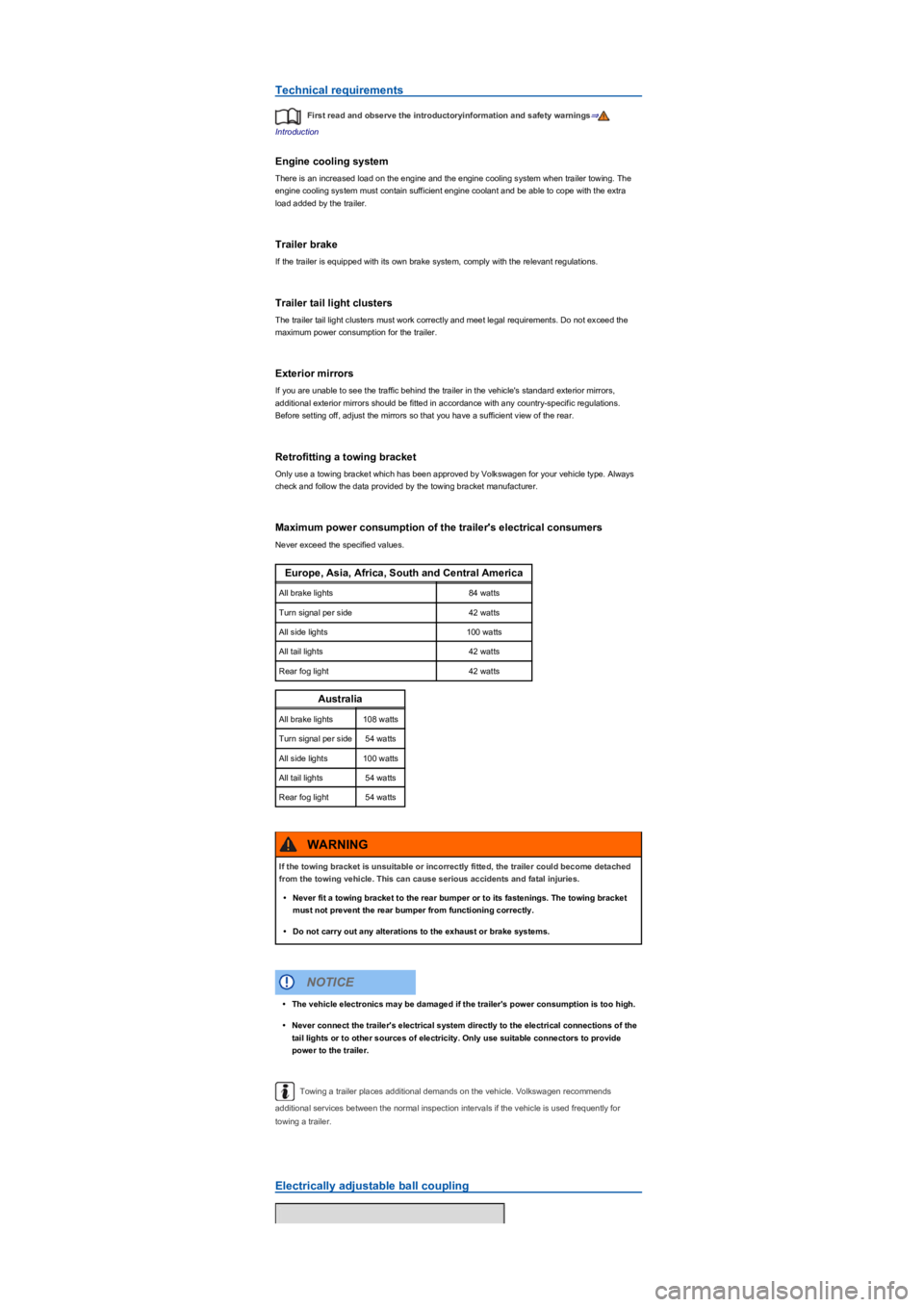
Maximum power consumption of the trailer's electrical consumers
Never exceed the specified values.
Europe, Asia, Africa, South and Central America
All brake lights84 watts
Turn signal per side42 watts
All side lights100 watts
All tail lights42 watts
Rear fog light42 watts
Australia
All brake lights108 watts
Turn signal per side54 watts
All side lights100 watts
All tail lights54 watts
Rear fog light54 watts
Towing a trailer places additional demands on the vehicle. Volkswagen recommends
additional services between the normal inspection intervals if the vehicle is used frequently for
towing a trailer.
Electrically adjustable ball coupling
If the towing bracket is unsuitable or incorrectly fitted, the trailer could become detached
from the towing vehicle. This can cause serious accidents and fatal injuries.
•Never fit a towing bracket to the rear bumper or to its fastenings. The towing bracket
must not prevent the rear bumper from functioning correctly.
•Do not carry out any alterations to the exhaust or brake systems.
WARNING
•The vehicle electronics may be damaged if the trailer's power consumption is too high.
•Never connect the trailer's electrical system directly to the electrical connections of the
tail lights or to other sources of electricity. Only use suitable connectors to provide
power to the trailer.
NOTICE
Page 236 of 341
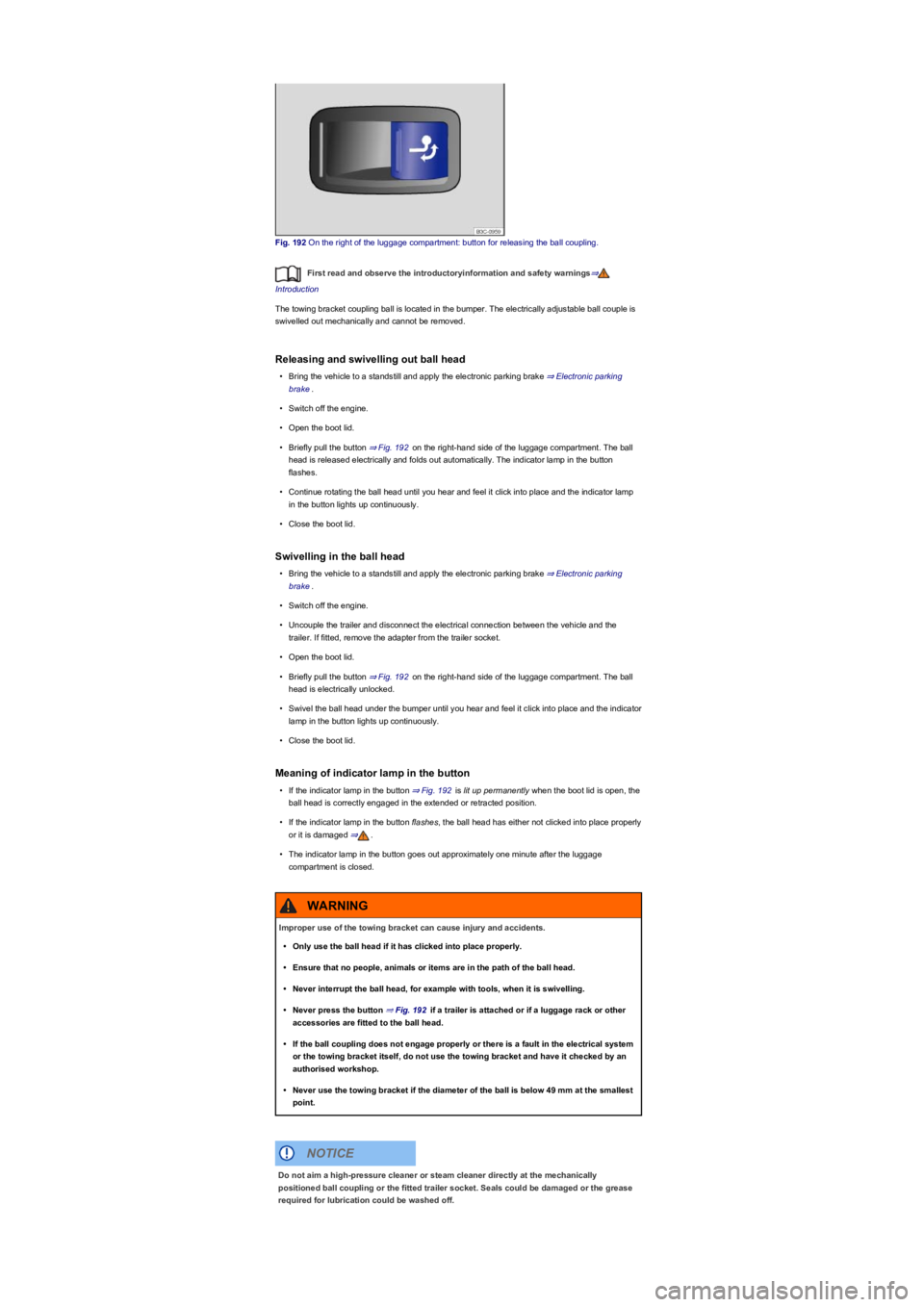
Fig. 192 On the right of the luggage compartment: button for releasing the ball coupling.
First read and observe the introductoryinformation and safety warnings⇒
Introduction
The towing bracket coupling ball is located in the bumper. The electrically adjustable ball couple is
swivelled out mechanically and cannot be removed.
Releasing and swivelling out ball head
•Bring the vehicle to a standstill and apply the electronic parking brake ⇒ Electronic parking
brake.
•Switch off the engine.
•Open the boot lid.
•Briefly pull the button ⇒ Fig. 192 on the right-hand side of the luggage compartment. The ball
head is released electrically and folds out automatically. The indicator lamp in the button
flashes.
•Continue rotating the ball head until you hear and feel it click into place and the indicator lamp
in the button lights up continuously.
•Close the boot lid.
Swivelling in the ball head
•Bring the vehicle to a standstill and apply the electronic parking brake ⇒ Electronic parking
brake.
•Switch off the engine.
•Uncouple the trailer and disconnect the electrical connection between the vehicle and the
trailer. If fitted, remove the adapter from the trailer socket.
•Open the boot lid.
•Briefly pull the button ⇒ Fig. 192 on the right-hand side of the luggage compartment. The ball
head is electrically unlocked.
•Swivel the ball head under the bumper until you hear and feel it click into place and the indicator
lamp in the button lights up continuously.
•Close the boot lid.
Meaning of indicator lamp in the button
•If the indicator lamp in the button ⇒ Fig. 192 is lit up permanently when the boot lid is open, the
ball head is correctly engaged in the extended or retracted position.
•If the indicator lamp in the button flashes, the ball head has either not clicked into place properly
or it is damaged ⇒.
•The indicator lamp in the button goes out approximately one minute after the luggage
compartment is closed.
Improper use of the towing bracket can cause injury and accidents.
•Only use the ball head if it has clicked into place properly.
•Ensure that no people, animals or items are in the path of the ball head.
•Never interrupt the ball head, for example with tools, when it is swivelling.
•Never press the button ⇒ Fig. 192 if a trailer is attached or if a luggage rack or other
accessories are fitted to the ball head.
•If the ball coupling does not engage properly or there is a fault in the electrical system
or the towing bracket itself, do not use the towing bracket and have it checked by an
authorised workshop.
•Never use the towing bracket if the diameter of the ball is below 49 mm at the smallest
point.
WARNING
Do not aim a high-pressure cleaner or steam cleaner directly at the mechanically
positioned ball coupling or the fitted trailer socket. Seals could be damaged or the grease
required for lubrication could be washed off.
NOTICE
Page 237 of 341
At extremely low outside temperatures, the electric ball head might not rotate. If this
happens, it is sufficient to place the vehicle in a warmer room, e.g. a garage.
Fitting a bicycle carrier on the swivelling ball head
First read and observe the introductoryinformation and safety warnings⇒
Introduction
Mount the bicycle carrier in accordance with the manufacturer's assembly instructions.
Only carrier systems which can hold a maximum of three bicycles may be used ⇒. Position
heavy bicycles as close to the vehicle (ball head) as possible.
Maximum carrying load
The maximum permitted load (carrier system including load) on the ball coupling is 75 kg at a
distance of 300 mm. This distance refers to the gap between the centre of gravity of the bicycle
carrier and the middle of the ball head.
Volkswagen recommends that you remove all add-on parts from the bicycles before setting
off. This includes for example bicycle bags and baskets, child seats or batteries. This helps improve
the carrier system's wind load and centre of gravity.
Notes on towing a trailer
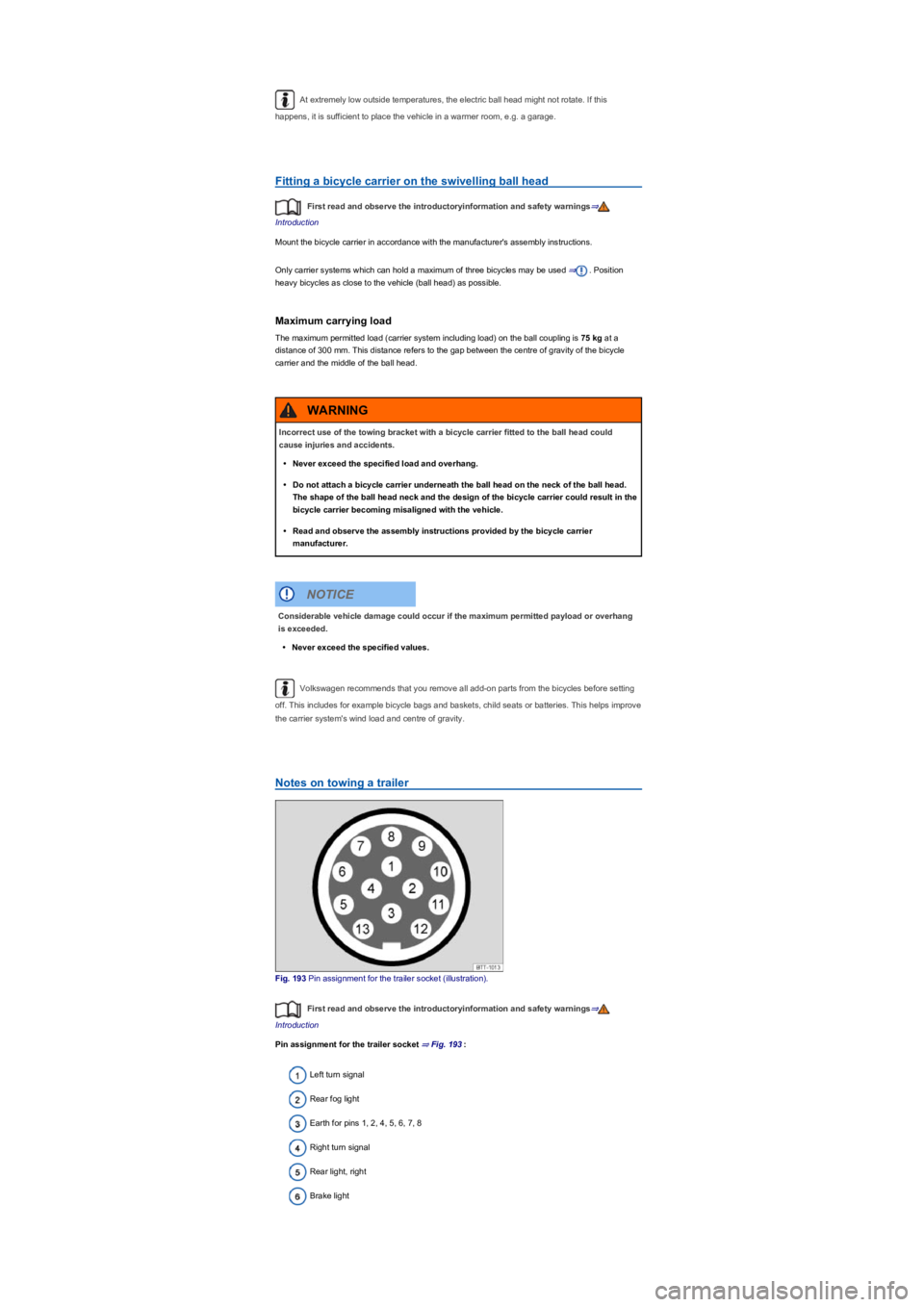
Fig. 193 Pin assignment for the trailer socket (illustration).
First read and observe the introductoryinformation and safety warnings⇒
Introduction
Pin assignment for the trailer socket ⇒ Fig. 193:
Left turn signal
Rear fog light
Earth for pins 1, 2, 4, 5, 6, 7, 8
Right turn signal
Rear light, right
Brake light
Incorrect use of the towing bracket with a bicycle carrier fitted to the ball head could
cause injuries and accidents.
•Never exceed the specified load and overhang.
•Do not attach a bicycle carrier underneath the ball head on the neck of the ball head.
The shape of the ball head neck and the design of the bicycle carrier could result in the
bicycle carrier becoming misaligned with the vehicle.
•Read and observe the assembly instructions provided by the bicycle carrier
manufacturer.
WARNING
Considerable vehicle damage could occur if the maximum permitted payload or overhang
is exceeded.
•Never exceed the specified values.
NOTICE
Page 238 of 341
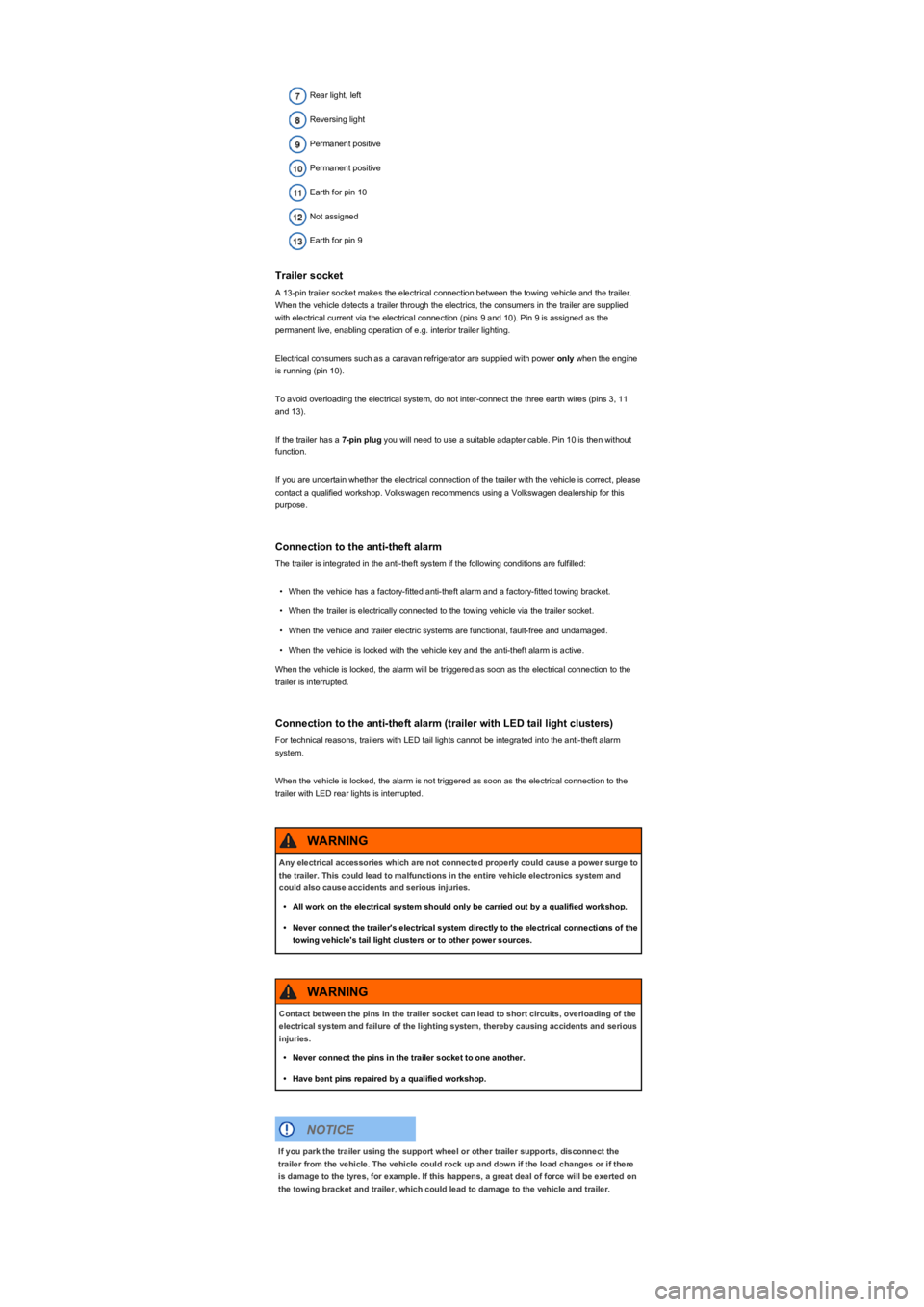
Rear light, left
Reversing light
Permanent positive
Permanent positive
Earth for pin 10
Not assigned
Earth for pin 9
Trailer socket
A 13-pin trailer socket makes the electrical connection between the towing vehicle and the trailer.
When the vehicle detects a trailer through the electrics, the consumers in the trailer are supplied
with electrical current via the electrical connection (pins 9 and 10). Pin 9 is assigned as the
permanent live, enabling operation of e.g. interior trailer lighting.
Electrical consumers such as a caravan refrigerator are supplied with power only when the engine
is running (pin 10).
To avoid overloading the electrical system, do not inter-connect the three earth wires (pins 3, 11
and 13).
If the trailer has a 7-pin plug you will need to use a suitable adapter cable. Pin 10 is then without
function.
If you are uncertain whether the electrical connection of the trailer with the vehicle is correct, please
contact a qualified workshop. Volkswagen recommends using a Volkswagen dealership for this
purpose.
Connection to the anti-theft alarm
The trailer is integrated in the anti-theft system if the following conditions are fulfilled:
•When the vehicle has a factory-fitted anti-theft alarm and a factory-fitted towing bracket.
•When the trailer is electrically connected to the towing vehicle via the trailer socket.
•When the vehicle and trailer electric systems are functional, fault-free and undamaged.
•When the vehicle is locked with the vehicle key and the anti-theft alarm is active.
When the vehicle is locked, the alarm will be triggered as soon as the electrical connection to the
trailer is interrupted.
Connection to the anti-theft alarm (trailer with LED tail light clusters)
For technical reasons, trailers with LED tail lights cannot be integrated into the anti-theft alarm
system.
When the vehicle is locked, the alarm is not triggered as soon as the electrical connection to the
trailer with LED rear lights is interrupted.
Any electrical accessories which are not connected properly could cause a power surge to
the trailer. This could lead to malfunctions in the entire vehicle electronics system and
could also cause accidents and serious injuries.
•All work on the electrical system should only be carried out by a qualified workshop.
•Never connect the trailer's electrical system directly to the electrical connections of the
towing vehicle's tail light clusters or to other power sources.
WARNING
Contact between the pins in the trailer socket can lead to short circuits, overloading of the
electrical system and failure of the lighting system, thereby causing accidents and serious
injuries.
•Never connect the pins in the trailer socket to one another.
•Have bent pins repaired by a qualified workshop.
WARNING
If you park the trailer using the support wheel or other trailer supports, disconnect the
trailer from the vehicle. The vehicle could rock up and down if the load changes or if there
is damage to the tyres, for example. If this happens, a great deal of force will be exerted on
the towing bracket and trailer, which could lead to damage to the vehicle and trailer.
NOTICE
Page 240 of 341
Trailer towing
First read and observe the introductoryinformation and safety warnings⇒
Introduction
Headlight adjustment
Towing a trailer can raise the front end of the vehicle enough for the dipped beam to blind other
road users. Use the headlight range control to lower the light cone as required. Vehicles with
automatic headlight range adjustment are adjusted automatically.
Things to note when driving with a trailer
•If the trailer has an overrun brake, apply the brakes gently at first and then firmly. This will
prevent the jerking that can be caused by the trailer wheels locking.
•The combination weight causes the braking distance to increase.
•Engage a lower gear prior to inclines (manual gearbox or Tiptronic mode of the automatic
gearbox) to additionally make use of engine braking. The brake system could otherwise
overheat and fail.
•The vehicle's centre of gravity and, in turn, the vehicle's handling, will change because of the
trailer load and the increased combined towing weight of the vehicle and trailer.
•The weight distribution of a loaded trailer with an unladen towing vehicle is very unfavourable.
When driving in this situation, drive particularly carefully and slowly.
Pulling off on slopes when towing a trailer
A vehicle towing a trailer is liable to roll back a short distance when moving off on a slope,
depending on the angle of the slope and the total weight of the trailer and vehicle.
When towing a trailer, pull off on slopes as follows:
•Depress and hold the brake pedal.
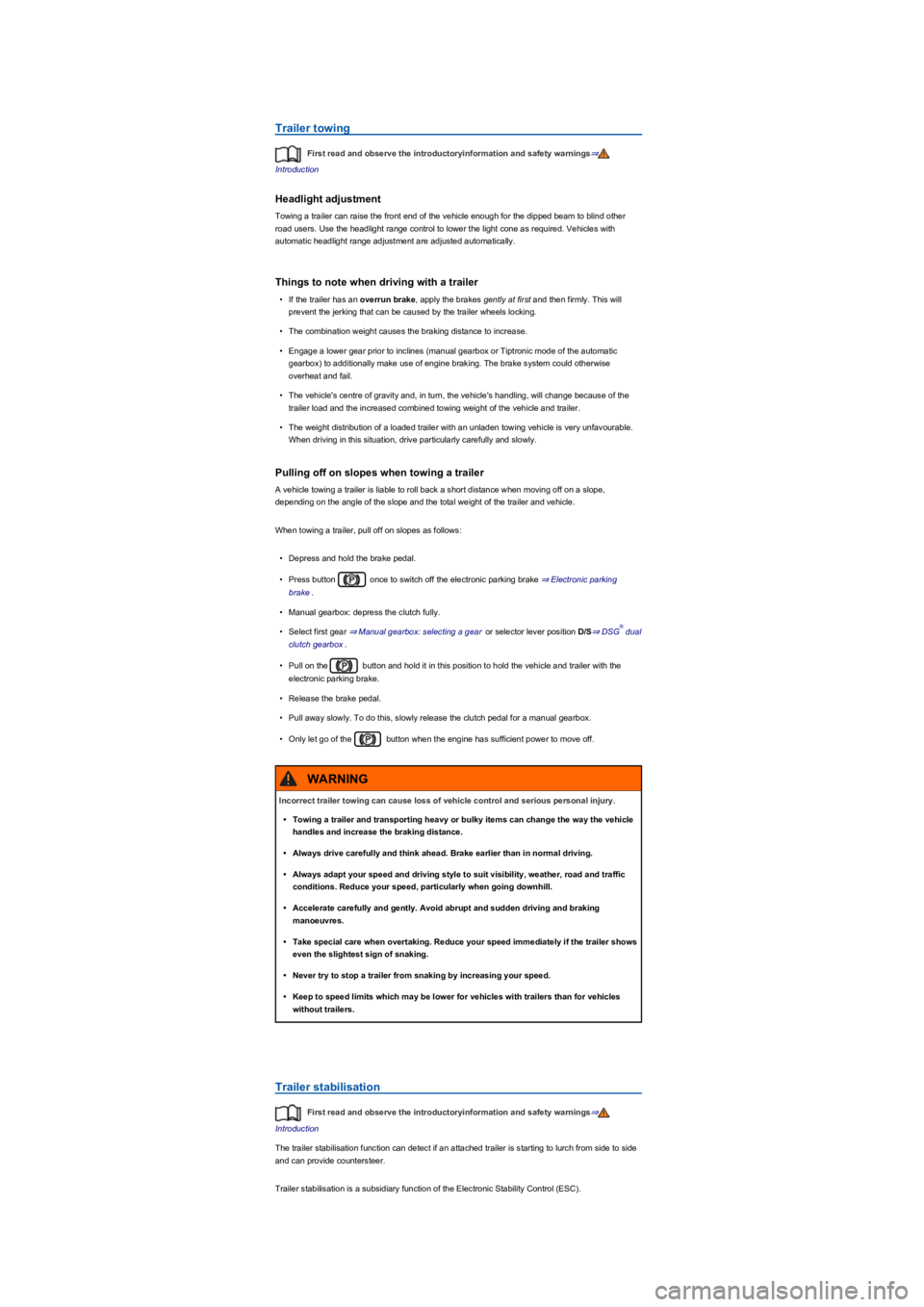
•Press button once to switch off the electronic parking brake ⇒ Electronic parking
brake.
•Manual gearbox: depress the clutch fully.
•Select first gear ⇒ Manual gearbox: selecting a gear or selector lever position D/S⇒ DSG dual
clutch gearbox.
•Pull on the button and hold it in this position to hold the vehicle and trailer with the
electronic parking brake.
•Release the brake pedal.
•Pull away slowly. To do this, slowly release the clutch pedal for a manual gearbox.
•Only let go of the button when the engine has sufficient power to move off.
Trailer stabilisation
First read and observe the introductoryinformation and safety warnings⇒
Introduction
The trailer stabilisation function can detect if an attached trailer is starting to lurch from side to side
and can provide countersteer.
Trailer stabilisation is a subsidiary function of the Electronic Stability Control (ESC).
®
Incorrect trailer towing can cause loss of vehicle control and serious personal injury.
•Towing a trailer and transporting heavy or bulky items can change the way the vehicle
handles and increase the braking distance.
•Always drive carefully and think ahead. Brake earlier than in normal driving.
•Always adapt your speed and driving style to suit visibility, weather, road and traffic
conditions. Reduce your speed, particularly when going downhill.
•Accelerate carefully and gently. Avoid abrupt and sudden driving and braking
manoeuvres.
•Take special care when overtaking. Reduce your speed immediately if the trailer shows
even the slightest sign of snaking.
•Never try to stop a trailer from snaking by increasing your speed.
•Keep to speed limits which may be lower for vehicles with trailers than for vehicles
without trailers.
WARNING
Page 241 of 341
If a lurching motion is detected, the trailer stabilisation function automatically helps to reduce the
trailer's rocking motion using counter steering assistance.
Requirements for trailer stabilisation
•The vehicle is a factory-fitted towing bracket or a compatible towing bracket is fitted.
•Electronic Stability Control and the traction control system (TCS) are active. The indicator lamp
or in the instrument cluster is not lit up.
•The trailer is electrically connected to the towing vehicle via the trailer socket.
•The vehicle speed is higher than approximately 60 km/h (37 mph).
•The maximum drawbar load is being carried.
•The trailer must have a rigid drawbar.
•Trailers with brakes must have a mechanical overrun system.
Retrofitting a towing bracket
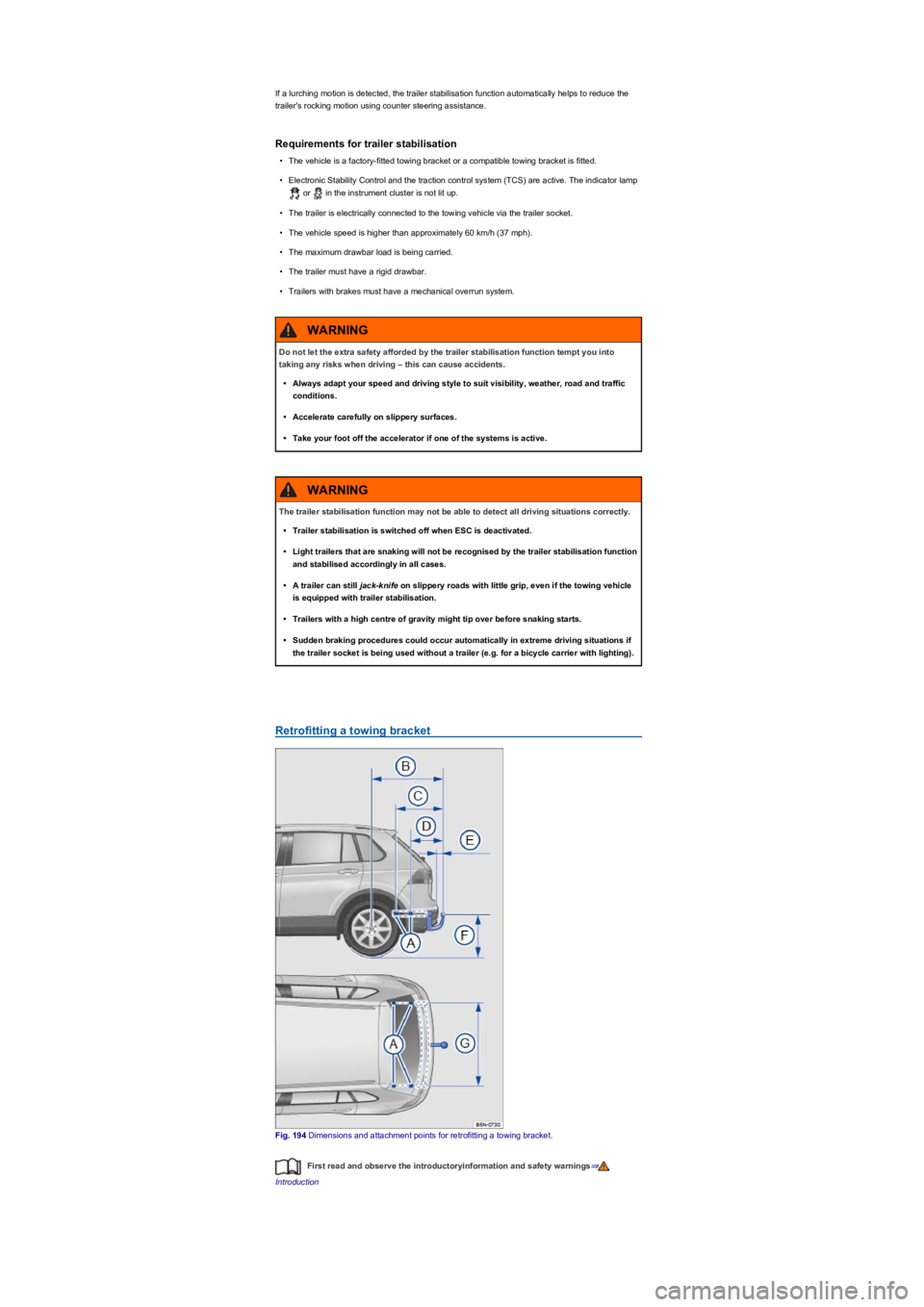
Fig. 194 Dimensions and attachment points for retrofitting a towing bracket.
First read and observe the introductoryinformation and safety warnings⇒
Introduction
Do not let the extra safety afforded by the trailer stabilisation function tempt you into
taking any risks when driving – this can cause accidents.
•Always adapt your speed and driving style to suit visibility, weather, road and traffic
conditions.
•Accelerate carefully on slippery surfaces.
•Take your foot off the accelerator if one of the systems is active.
WARNING
The trailer stabilisation function may not be able to detect all driving situations correctly.
•Trailer stabilisation is switched off when ESC is deactivated.
•Light trailers that are snaking will not be recognised by the trailer stabilisation function
and stabilised accordingly in all cases.
•A trailer can still jack-knife on slippery roads with little grip, even if the towing vehicle
is equipped with trailer stabilisation.
•Trailers with a high centre of gravity might tip over before snaking starts.
•Sudden braking procedures could occur automatically in extreme driving situations if
the trailer socket is being used without a trailer (e.g. for a bicycle carrier with lighting).
WARNING
Page 242 of 341
Volkswagen recommends having the towing bracket retrofitted by a qualified workshop. The cooling
system may need to be modified or heat shields may need to be fitted. Volkswagen recommends
using a Volkswagen dealership for this purpose.
Dimensions
The dimensions ⇒ Fig. 194 must be adhered to for the retro-fitting of a towing bracket. Always
observe the minimum distance given from the middle of the ball coupling Ⓕ to the surface of the
road. This also applies when the vehicle is fully laden, including maximum drawbar load.
Attachment points
989 mm
595 mm
348 mm
At least 65 mm
350 – 420 mm
1,061 – 1,066 mm
Only use towing brackets which have been approved by Volkswagen for your vehicle type.
Troubleshooting
First read and observe the introductoryinformation and safety warnings⇒
Introduction
The ball head on the towing bracket is not locked. Check towing bracket lock ⇒ Electrically
adjustable ball coupling.
Fuel and emission control
Electrical accessories that are not connected properly can cause malfunctions in the
entire vehicle electronics system and also cause accidents and serious injuries.
•Never connect the trailer's electrical system directly to the electrical connections of the
tail lights or to other unsuitable sources of electricity. Only a suitable connector may
be used to connect the trailer.
•A towing bracket should be retrofitted to the vehicle by a qualified workshop.
WARNING
The trailer can become detached from the towing vehicle if the towing bracket is
unsuitable or incorrectly fitted. This can cause serious accidents and fatal injuries.
WARNING
Page 249 of 341
•Only refuel with fuels that are suitable for the vehicle ⇒ Fuel types and refuelling.
•Do not allow the fuel tank to run completely empty.
•Use only suitable engine oil for the vehicle and do not overfill ⇒ Engine oil.
•Do not tow start the vehicle. Use jump leads ⇒ Jump starting.
Periodic regeneration
The soot in the particulate filter is burnt off at high temperatures on a periodic basis.
To assist the regeneration of the particulate filter, Volkswagen recommends that you avoid making
only short journeys.
Noises, slight smells and increased engine speeds may occur during regeneration. The radiator fan
may run on while the vehicle is moving or when the engine has been switched off.
During the periodic regeneration process, the yellow indicator lamp does not light
up.
Troubleshooting
First read and observe the introductoryinformation and safety warnings⇒
Introduction
Irregular engine running and malfunctions
If the engine shows signs of irregular running or malfunctions while you are driving, this may mean
that the fuel is of poor quality. Reduce speed immediately. Drive to nearest qualified workshop at
medium engine speeds and low loads on the engine.
If these symptoms occur directly after refuelling, switch off the engine immediately to avoid any
subsequent damage. You should obtain professional assistance.
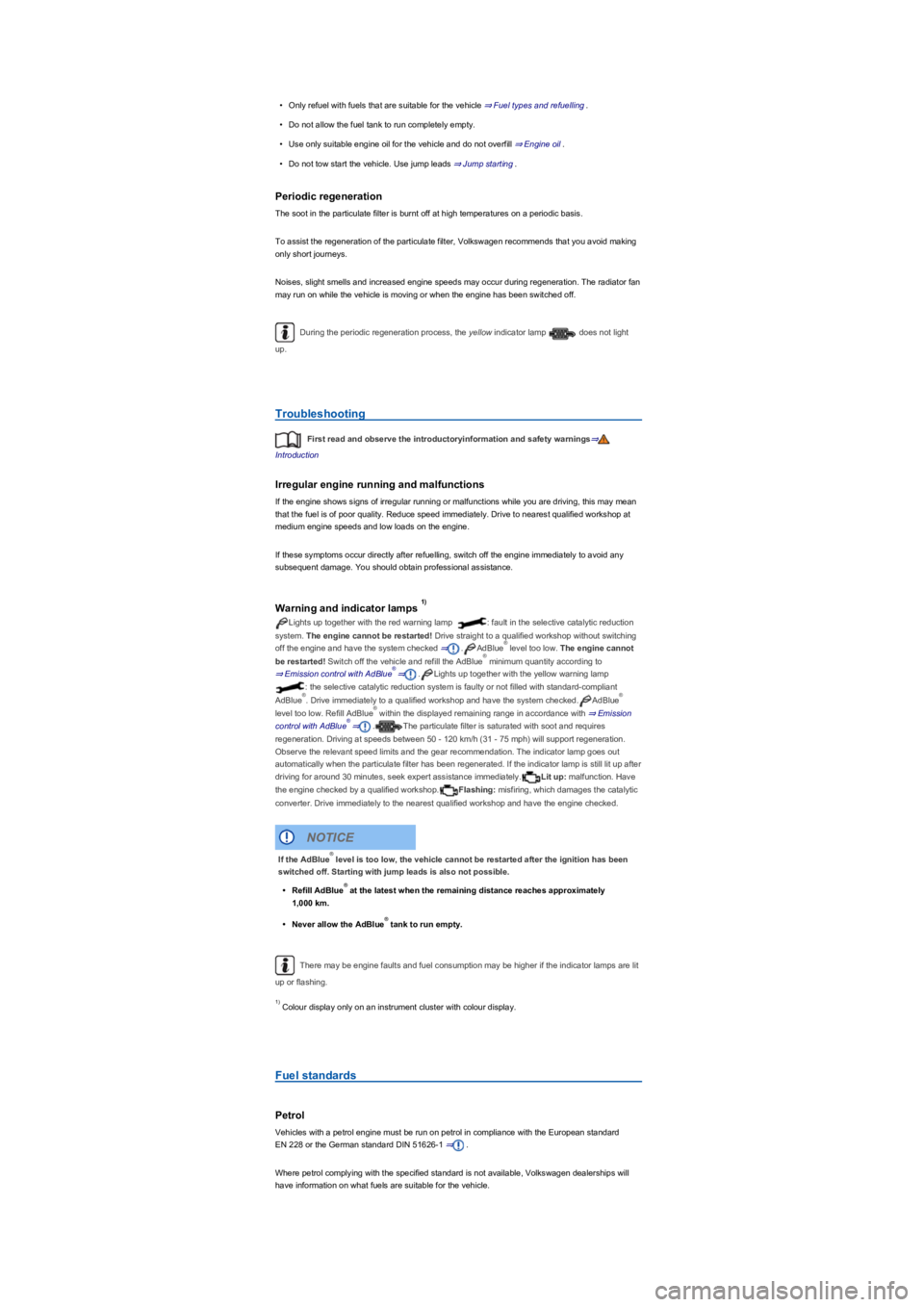
Warning and indicator lamps
Lights up together with the red warning lamp : fault in the selective catalytic reduction
system. The engine cannot be restarted! Drive straight to a qualified workshop without switching
off the engine and have the system checked ⇒.AdBlue level too low. The engine cannot
be restarted! Switch off the vehicle and refill the AdBlue minimum quantity according to
⇒ Emission control with AdBlue⇒.Lights up together with the yellow warning lamp
: the selective catalytic reduction system is faulty or not filled with standard-compliant
AdBlue. Drive immediately to a qualified workshop and have the system checked.AdBlue
level too low. Refill AdBlue within the displayed remaining range in accordance with ⇒ Emission
control with AdBlue⇒.The particulate filter is saturated with soot and requires
regeneration. Driving at speeds between 50 - 120 km/h (31 - 75 mph) will support regeneration.
Observe the relevant speed limits and the gear recommendation. The indicator lamp goes out
automatically when the particulate filter has been regenerated. If the indicator lamp is still lit up after
driving for around 30 minutes, seek expert assistance immediately.Lit up: malfunction. Have
the engine checked by a qualified workshop.Flashing: misfiring, which damages the catalytic
converter. Drive immediately to the nearest qualified workshop and have the engine checked.
There may be engine faults and fuel consumption may be higher if the indicator lamps are lit
up or flashing.
Colour display only on an instrument cluster with colour display.
Fuel standards
Petrol
Vehicles with a petrol engine must be run on petrol in compliance with the European standard
EN 228 or the German standard DIN 51626-1 ⇒.
Where petrol complying with the specified standard is not available, Volkswagen dealerships will
have information on what fuels are suitable for the vehicle.
1)
®
®
®
®®
®
®
If the AdBlue level is too low, the vehicle cannot be restarted after the ignition has been
switched off. Starting with jump leads is also not possible.
•Refill AdBlue at the latest when the remaining distance reaches approximately
1,000 km.
•Never allow the AdBlue tank to run empty.
NOTICE
®
®
®
1)
Page 253 of 341
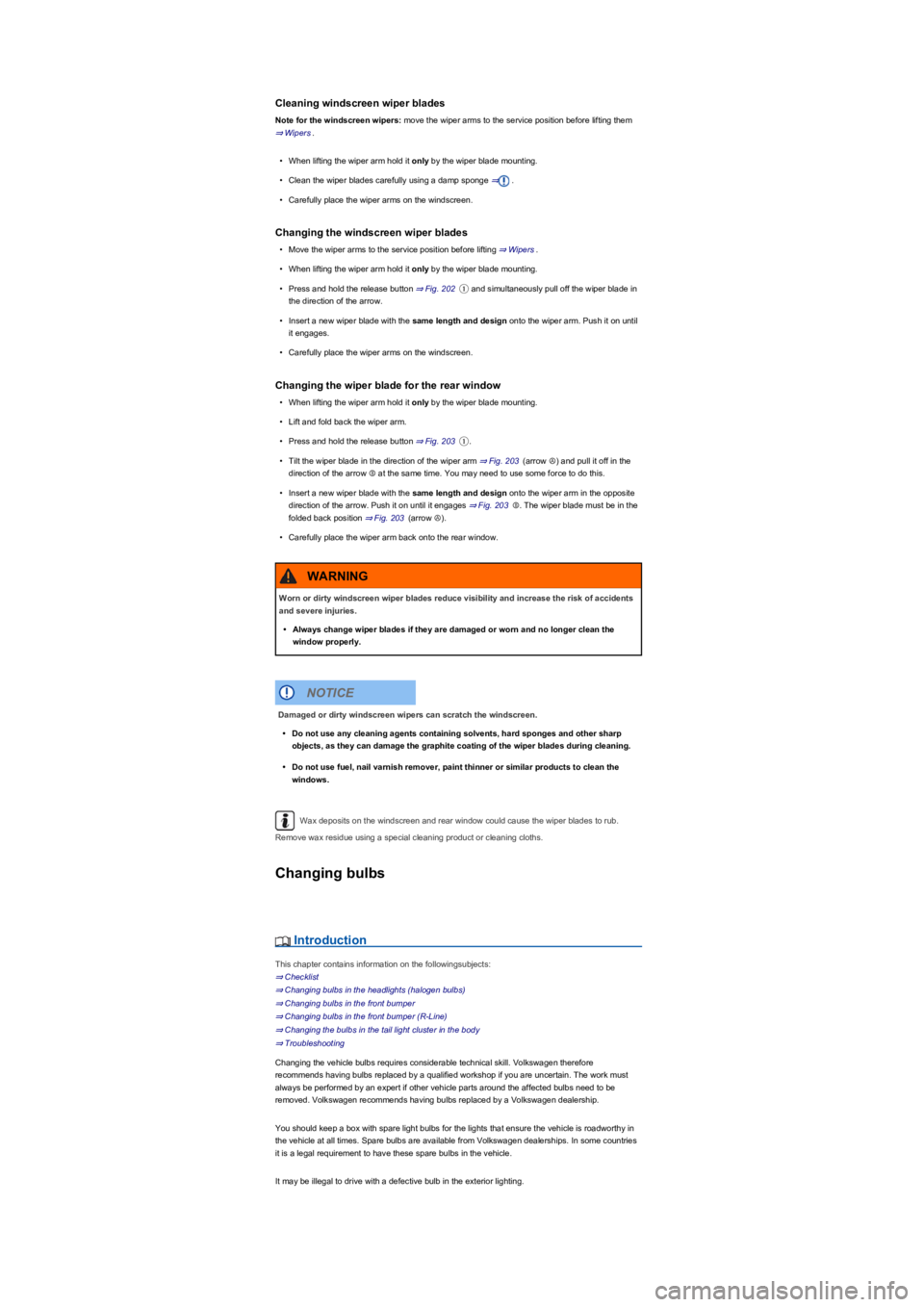
Cleaning windscreen wiper blades
Note for the windscreen wipers: move the wiper arms to the service position before lifting them
⇒ Wipers.
•When lifting the wiper arm hold it only by the wiper blade mounting.
•Clean the wiper blades carefully using a damp sponge ⇒.
•Carefully place the wiper arms on the windscreen.
Changing the windscreen wiper blades
•Move the wiper arms to the service position before lifting ⇒ Wipers.
•When lifting the wiper arm hold it only by the wiper blade mounting.
•Press and hold the release button ⇒ Fig. 202① and simultaneously pull off the wiper blade in
the direction of the arrow.
•Insert a new wiper blade with the same length and design onto the wiper arm. Push it on until
it engages.
•Carefully place the wiper arms on the windscreen.
Changing the wiper blade for the rear window
•When lifting the wiper arm hold it only by the wiper blade mounting.
•Lift and fold back the wiper arm.
•Press and hold the release button ⇒ Fig. 203①.
•Tilt the wiper blade in the direction of the wiper arm ⇒ Fig. 203 (arrow Ⓐ) and pull it off in the
direction of the arrow Ⓑ at the same time. You may need to use some force to do this.
•Insert a new wiper blade with the same length and design onto the wiper arm in the opposite
direction of the arrow. Push it on until it engages ⇒ Fig. 203Ⓑ. The wiper blade must be in the
folded back position ⇒ Fig. 203 (arrow Ⓐ).
•Carefully place the wiper arm back onto the rear window.
Wax deposits on the windscreen and rear window could cause the wiper blades to rub.
Remove wax residue using a special cleaning product or cleaning cloths.
Changing bulbs
Introduction
This chapter contains information on the followingsubjects:
⇒ Checklist
⇒ Changing bulbs in the headlights (halogen bulbs)
⇒ Changing bulbs in the front bumper
⇒ Changing bulbs in the front bumper (R-Line)
⇒ Changing the bulbs in the tail light cluster in the body
⇒ Troubleshooting
Changing the vehicle bulbs requires considerable technical skill. Volkswagen therefore
recommends having bulbs replaced by a qualified workshop if you are uncertain. The work must
always be performed by an expert if other vehicle parts around the affected bulbs need to be
removed. Volkswagen recommends having bulbs replaced by a Volkswagen dealership.
You should keep a box with spare light bulbs for the lights that ensure the vehicle is roadworthy in
the vehicle at all times. Spare bulbs are available from Volkswagen dealerships. In some countries
it is a legal requirement to have these spare bulbs in the vehicle.
It may be illegal to drive with a defective bulb in the exterior lighting.
Worn or dirty windscreen wiper blades reduce visibility and increase the risk of accidents
and severe injuries.
•Always change wiper blades if they are damaged or worn and no longer clean the
window properly.
WARNING
Damaged or dirty windscreen wipers can scratch the windscreen.
•Do not use any cleaning agents containing solvents, hard sponges and other sharp
objects, as they can damage the graphite coating of the wiper blades during cleaning.
•Do not use fuel, nail varnish remover, paint thinner or similar products to clean the
windows.
NOTICE