light VOLKSWAGEN TIGUAN 2017 Owner´s Manual
[x] Cancel search | Manufacturer: VOLKSWAGEN, Model Year: 2017, Model line: TIGUAN, Model: VOLKSWAGEN TIGUAN 2017Pages: 341, PDF Size: 9.14 MB
Page 271 of 341
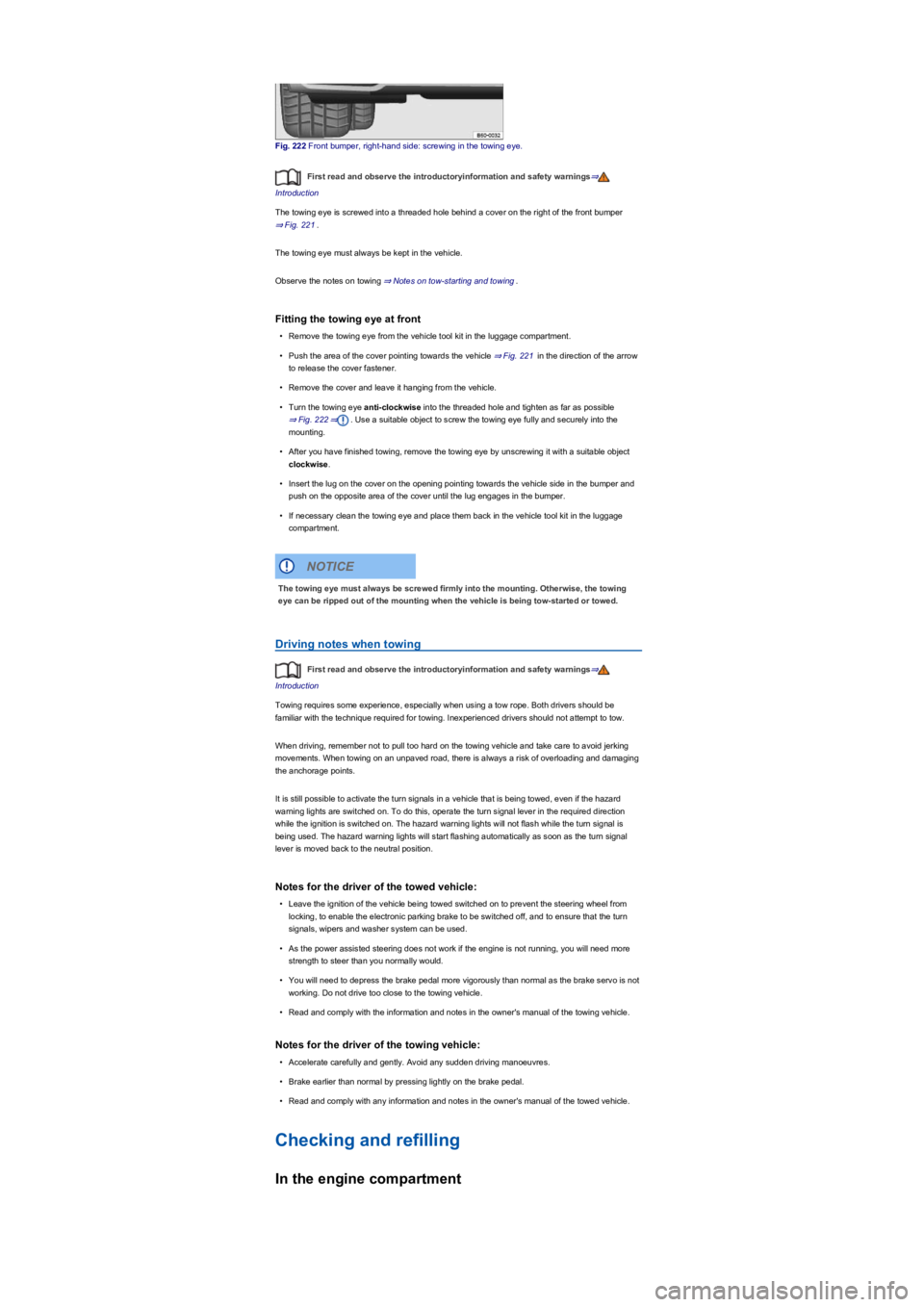
Fig. 222 Front bumper, right-hand side: screwing in the towing eye.
First read and observe the introductoryinformation and safety warnings⇒
Introduction
The towing eye is screwed into a threaded hole behind a cover on the right of the front bumper
⇒ Fig. 221.
The towing eye must always be kept in the vehicle.
Observe the notes on towing ⇒ Notes on tow-starting and towing.
Fitting the towing eye at front
•Remove the towing eye from the vehicle tool kit in the luggage compartment.
•Push the area of the cover pointing towards the vehicle ⇒ Fig. 221 in the direction of the arrow
to release the cover fastener.
•Remove the cover and leave it hanging from the vehicle.
•Turn the towing eye anti-clockwise into the threaded hole and tighten as far as possible
⇒ Fig. 222⇒. Use a suitable object to screw the towing eye fully and securely into the
mounting.
•After you have finished towing, remove the towing eye by unscrewing it with a suitable object
clockwise.
•Insert the lug on the cover on the opening pointing towards the vehicle side in the bumper and
push on the opposite area of the cover until the lug engages in the bumper.
•If necessary clean the towing eye and place them back in the vehicle tool kit in the luggage
compartment.
Driving notes when towing
First read and observe the introductoryinformation and safety warnings⇒
Introduction
Towing requires some experience, especially when using a tow rope. Both drivers should be
familiar with the technique required for towing. Inexperienced drivers should not attempt to tow.
When driving, remember not to pull too hard on the towing vehicle and take care to avoid jerking
movements. When towing on an unpaved road, there is always a risk of overloading and damaging
the anchorage points.
It is still possible to activate the turn signals in a vehicle that is being towed, even if the hazard
warning lights are switched on. To do this, operate the turn signal lever in the required direction
while the ignition is switched on. The hazard warning lights will not flash while the turn signal is
being used. The hazard warning lights will start flashing automatically as soon as the turn signal
lever is moved back to the neutral position.
Notes for the driver of the towed vehicle:
•Leave the ignition of the vehicle being towed switched on to prevent the steering wheel from
locking, to enable the electronic parking brake to be switched off, and to ensure that the turn
signals, wipers and washer system can be used.
•As the power assisted steering does not work if the engine is not running, you will need more
strength to steer than you normally would.
•You will need to depress the brake pedal more vigorously than normal as the brake servo is not
working. Do not drive too close to the towing vehicle.
•Read and comply with the information and notes in the owner's manual of the towing vehicle.
Notes for the driver of the towing vehicle:
•Accelerate carefully and gently. Avoid any sudden driving manoeuvres.
•Brake earlier than normal by pressing lightly on the brake pedal.
•Read and comply with any information and notes in the owner's manual of the towed vehicle.
Checking and refilling
In the engine compartment
The towing eye must always be screwed firmly into the mounting. Otherwise, the towing
eye can be ripped out of the mounting when the vehicle is being tow-started or towed.
NOTICE
Page 274 of 341
Allow the engine to cool sufficiently.
Children and other people should be kept well away from the engine compartment.
Ensure that the vehicle cannot roll away unexpectedly.
Opening and closing the bonnet
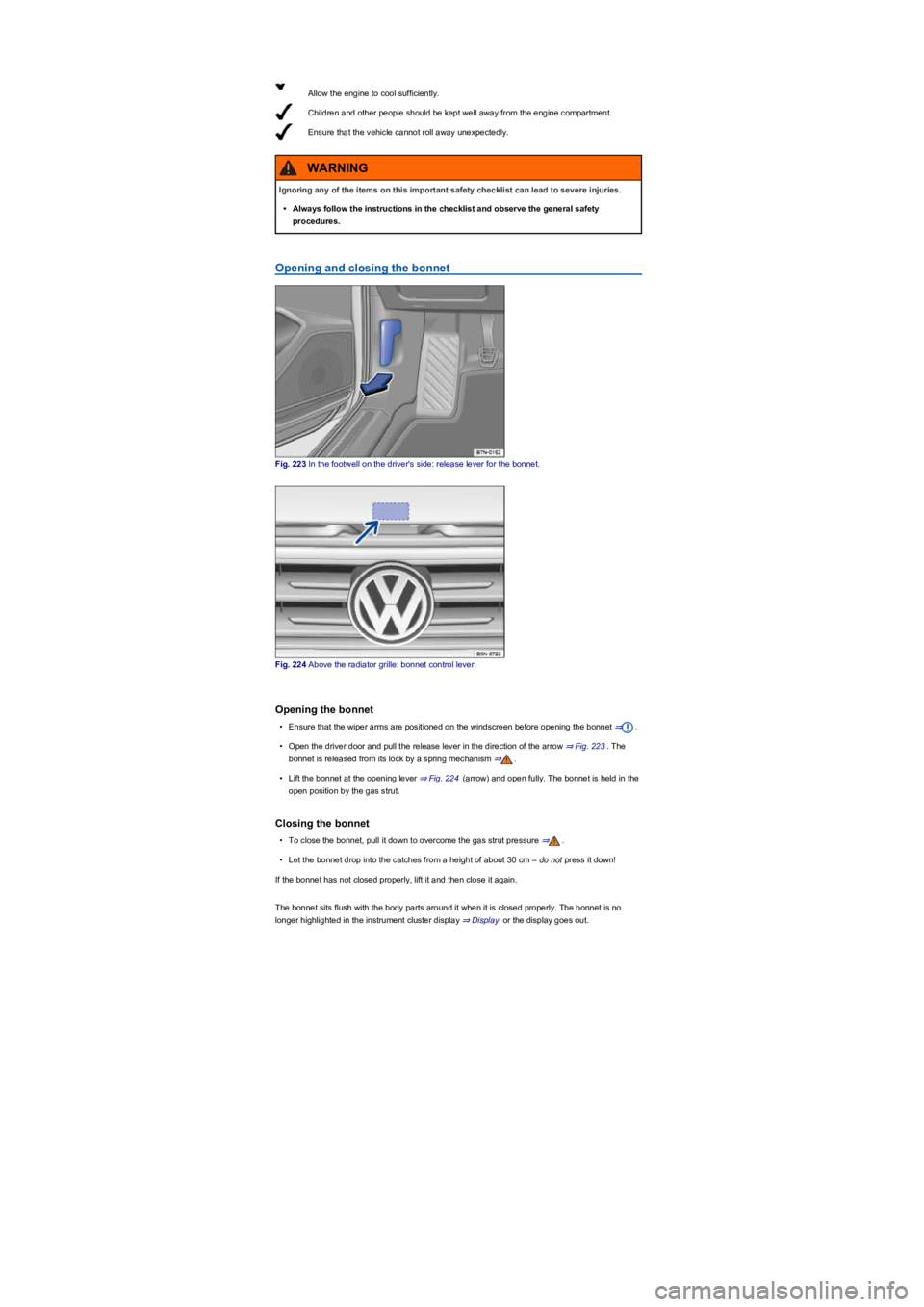
Fig. 223 In the footwell on the driver's side: release lever for the bonnet.
Fig. 224 Above the radiator grille: bonnet control lever.
Opening the bonnet
•Ensure that the wiper arms are positioned on the windscreen before opening the bonnet ⇒.
•Open the driver door and pull the release lever in the direction of the arrow ⇒ Fig. 223. The
bonnet is released from its lock by a spring mechanism ⇒.
•Lift the bonnet at the opening lever ⇒ Fig. 224 (arrow) and open fully. The bonnet is held in the
open position by the gas strut.
Closing the bonnet
•To close the bonnet, pull it down to overcome the gas strut pressure ⇒.
•Let the bonnet drop into the catches from a height of about 30 cm – do not press it down!
If the bonnet has not closed properly, lift it and then close it again.
The bonnet sits flush with the body parts around it when it is closed properly. The bonnet is no
longer highlighted in the instrument cluster display ⇒ Display or the display goes out.
Ignoring any of the items on this important safety checklist can lead to severe injuries.
•Always follow the instructions in the checklist and observe the general safety
procedures.
WARNING
Page 278 of 341
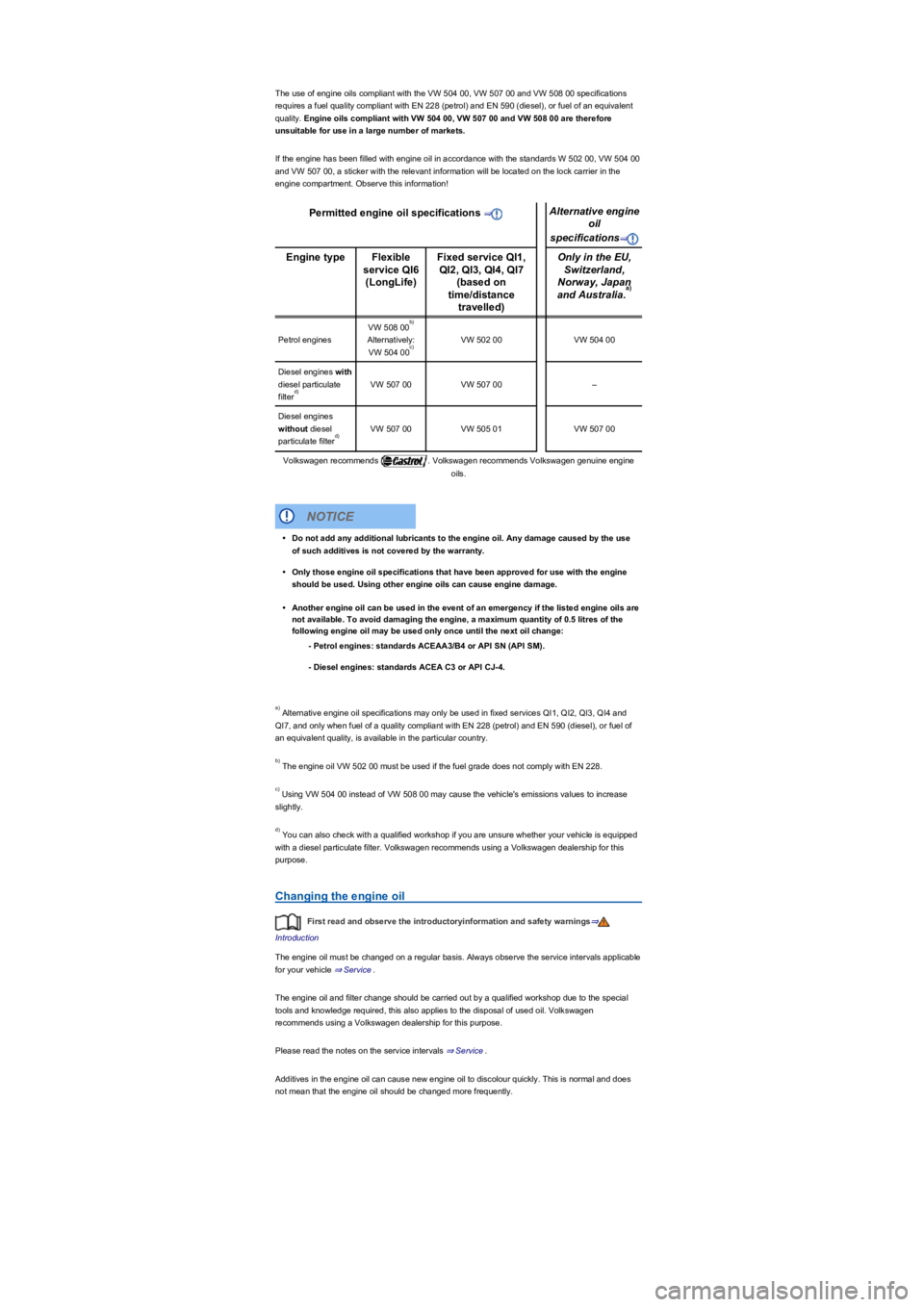
The use of engine oils compliant with the VW 504 00, VW 507 00 and VW 508 00 specifications
requires a fuel quality compliant with EN 228 (petrol) and EN 590 (diesel), or fuel of an equivalent
quality. Engine oils compliant with VW 504 00, VW 507 00 and VW 508 00 are therefore
unsuitable for use in a large number of markets.
If the engine has been filled with engine oil in accordance with the standards W 502 00, VW 504 00
and VW 507 00, a sticker with the relevant information will be located on the lock carrier in the
engine compartment. Observe this information!
Permitted engine oil specifications ⇒Alternative engine
oil
specifications⇒
Engine typeFlexible
service QI6
(LongLife)
Fixed service QI1,
QI2, QI3, QI4, QI7
(based on
time/distance
travelled)
Only in the EU,
Switzerland,
Norway, Japan
and Australia.
Petrol engines
VW 508 00
Alternatively:
VW 504 00
VW 502 00VW 504 00
Diesel engines with
diesel particulate
filter
VW 507 00VW 507 00–
Diesel engines
without diesel
particulate filter
VW 507 00VW 505 01VW 507 00
Volkswagen recommends . Volkswagen recommends Volkswagen genuine engine
oils.
Alternative engine oil specifications may only be used in fixed services QI1, QI2, QI3, QI4 and
QI7, and only when fuel of a quality compliant with EN 228 (petrol) and EN 590 (diesel), or fuel of
an equivalent quality, is available in the particular country.
The engine oil VW 502 00 must be used if the fuel grade does not comply with EN 228.
Using VW 504 00 instead of VW 508 00 may cause the vehicle's emissions values to increase
slightly.
You can also check with a qualified workshop if you are unsure whether your vehicle is equipped
with a diesel particulate filter. Volkswagen recommends using a Volkswagen dealership for this
purpose.
Changing the engine oil
First read and observe the introductoryinformation and safety warnings⇒
Introduction
The engine oil must be changed on a regular basis. Always observe the service intervals applicable
for your vehicle ⇒ Service.
The engine oil and filter change should be carried out by a qualified workshop due to the special
tools and knowledge required, this also applies to the disposal of used oil. Volkswagen
recommends using a Volkswagen dealership for this purpose.
Please read the notes on the service intervals ⇒ Service.
Additives in the engine oil can cause new engine oil to discolour quickly. This is normal and does
not mean that the engine oil should be changed more frequently.
a)
b)
c)
d)
d)
•Do not add any additional lubricants to the engine oil. Any damage caused by the use
of such additives is not covered by the warranty.
•Only those engine oil specifications that have been approved for use with the engine
should be used. Using other engine oils can cause engine damage.
•Another engine oil can be used in the event of an emergency if the listed engine oils are
not available. To avoid damaging the engine, a maximum quantity of 0.5 litres of the
following engine oil may be used only once until the next oil change:
- Petrol engines: standards ACEAA3/B4 or API SN (API SM).
- Diesel engines: standards ACEA C3 or API CJ-4.
NOTICE
a)
b)
c)
d)
Page 282 of 341
Coolant and coolant additives can pollute the environment. Spilt service fluids must be
collected then disposed of properly and in an environmentally responsible way.
Checking the coolant level and refilling coolant
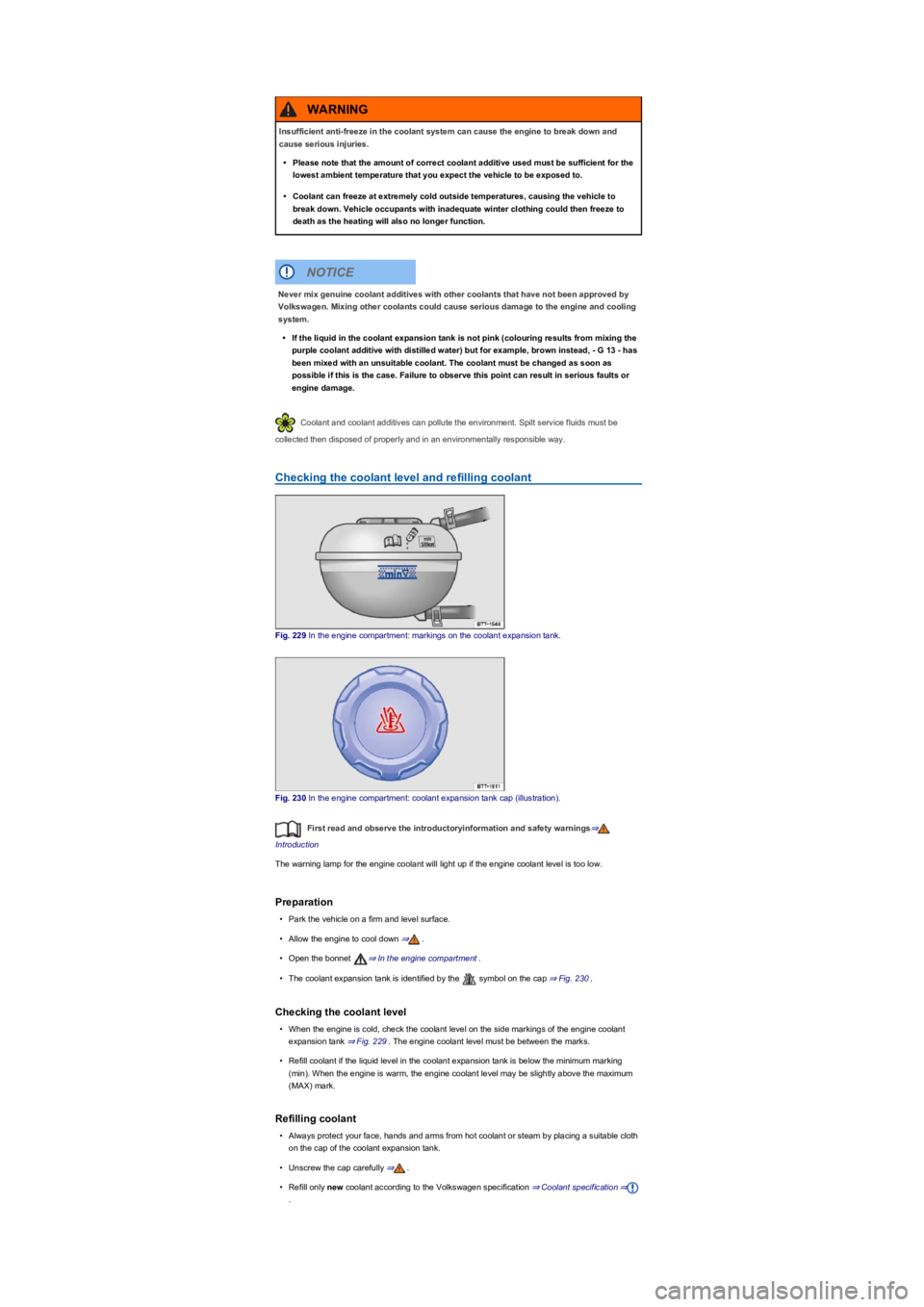
Fig. 229 In the engine compartment: markings on the coolant expansion tank.
Fig. 230 In the engine compartment: coolant expansion tank cap (illustration).
First read and observe the introductoryinformation and safety warnings⇒
Introduction
The warning lamp for the engine coolant will light up if the engine coolant level is too low.
Preparation
•Park the vehicle on a firm and level surface.
•Allow the engine to cool down ⇒.
•Open the bonnet ⇒ In the engine compartment.
•The coolant expansion tank is identified by the symbol on the cap ⇒ Fig. 230.
Checking the coolant level
•When the engine is cold, check the coolant level on the side markings of the engine coolant
expansion tank ⇒ Fig. 229. The engine coolant level must be between the marks.
•Refill coolant if the liquid level in the coolant expansion tank is below the minimum marking
(min). When the engine is warm, the engine coolant level may be slightly above the maximum
(MAX) mark.
Refilling coolant
•Always protect your face, hands and arms from hot coolant or steam by placing a suitable cloth
on the cap of the coolant expansion tank.
•Unscrew the cap carefully ⇒.
•Refill only new coolant according to the Volkswagen specification ⇒ Coolant specification⇒
.
Insufficient anti-freeze in the coolant system can cause the engine to break down and
cause serious injuries.
•Please note that the amount of correct coolant additive used must be sufficient for the
lowest ambient temperature that you expect the vehicle to be exposed to.
•Coolant can freeze at extremely cold outside temperatures, causing the vehicle to
break down. Vehicle occupants with inadequate winter clothing could then freeze to
death as the heating will also no longer function.
WARNING
Never mix genuine coolant additives with other coolants that have not been approved by
Volkswagen. Mixing other coolants could cause serious damage to the engine and cooling
system.
•If the liquid in the coolant expansion tank is not pink (colouring results from mixing the
purple coolant additive with distilled water) but for example, brown instead, - G 13 - has
been mixed with an unsuitable coolant. The coolant must be changed as soon as
possible if this is the case. Failure to observe this point can result in serious faults or
engine damage.
NOTICE
Page 284 of 341
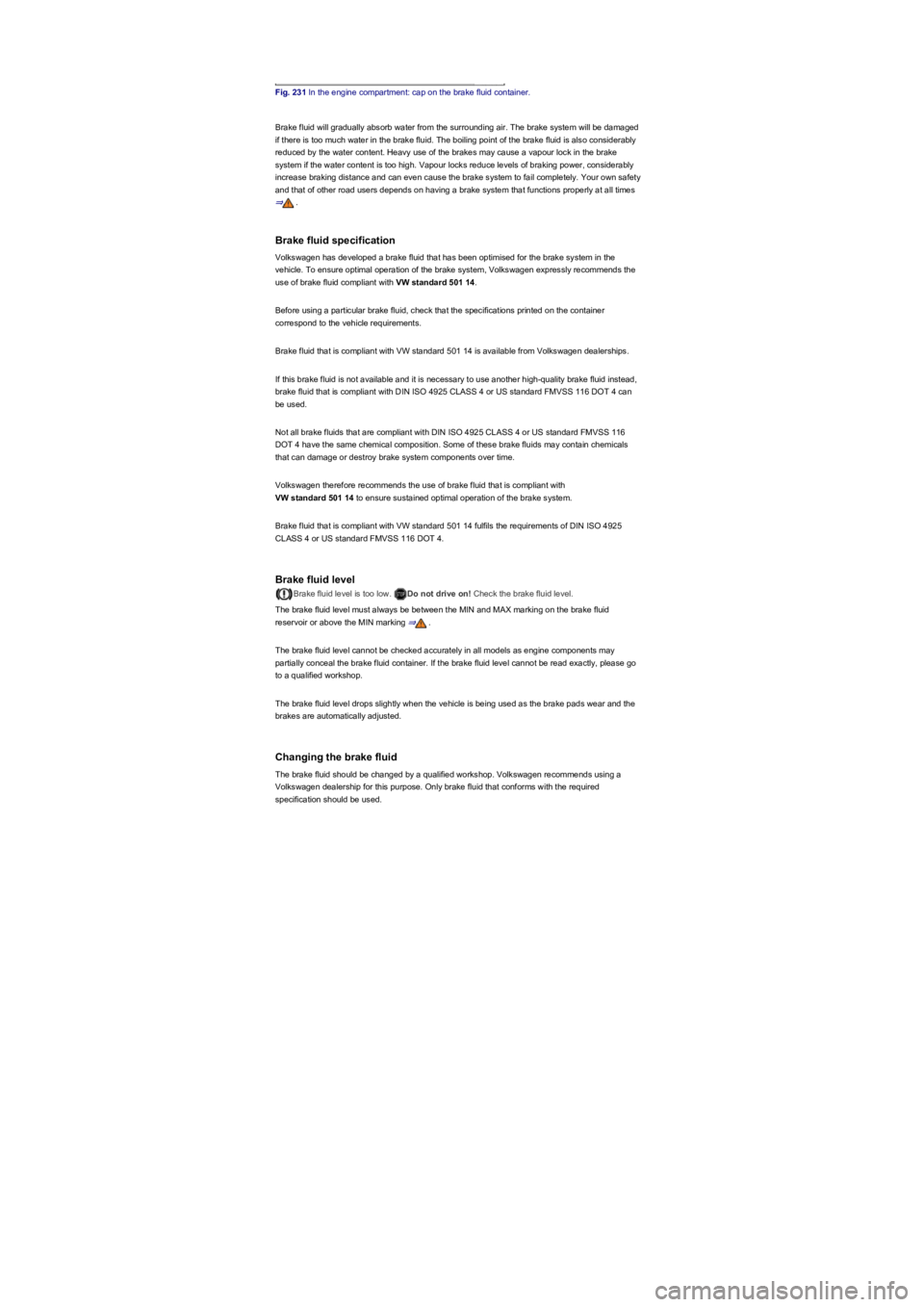
Fig. 231 In the engine compartment: cap on the brake fluid container.
Brake fluid will gradually absorb water from the surrounding air. The brake system will be damaged
if there is too much water in the brake fluid. The boiling point of the brake fluid is also considerably
reduced by the water content. Heavy use of the brakes may cause a vapour lock in the brake
system if the water content is too high. Vapour locks reduce levels of braking power, considerably
increase braking distance and can even cause the brake system to fail completely. Your own safety
and that of other road users depends on having a brake system that functions properly at all times
⇒.
Brake fluid specification
Volkswagen has developed a brake fluid that has been optimised for the brake system in the
vehicle. To ensure optimal operation of the brake system, Volkswagen expressly recommends the
use of brake fluid compliant with VW standard 501 14.
Before using a particular brake fluid, check that the specifications printed on the container
correspond to the vehicle requirements.
Brake fluid that is compliant with VW standard 501 14 is available from Volkswagen dealerships.
If this brake fluid is not available and it is necessary to use another high-quality brake fluid instead,
brake fluid that is compliant with DIN ISO 4925 CLASS 4 or US standard FMVSS 116 DOT 4 can
be used.
Not all brake fluids that are compliant with DIN ISO 4925 CLASS 4 or US standard FMVSS 116
DOT 4 have the same chemical composition. Some of these brake fluids may contain chemicals
that can damage or destroy brake system components over time.
Volkswagen therefore recommends the use of brake fluid that is compliant with
VW standard 501 14 to ensure sustained optimal operation of the brake system.
Brake fluid that is compliant with VW standard 501 14 fulfils the requirements of DIN ISO 4925
CLASS 4 or US standard FMVSS 116 DOT 4.
Brake fluid level
Brake fluid level is too low. Do not drive on! Check the brake fluid level.
The brake fluid level must always be between the MIN and MAX marking on the brake fluid
reservoir or above the MIN marking ⇒.
The brake fluid level cannot be checked accurately in all models as engine components may
partially conceal the brake fluid container. If the brake fluid level cannot be read exactly, please go
to a qualified workshop.
The brake fluid level drops slightly when the vehicle is being used as the brake pads wear and the
brakes are automatically adjusted.
Changing the brake fluid
The brake fluid should be changed by a qualified workshop. Volkswagen recommends using a
Volkswagen dealership for this purpose. Only brake fluid that conforms with the required
specification should be used.
Page 285 of 341
Brake fluid can pollute the environment. Any spilt service fluids must be cleaned up and
disposed of properly.
12-volt vehicle battery
Introduction
This chapter contains information on the followingsubjects:
⇒ Checking the electrolyte level of the 12-volt vehicle battery
⇒ Charging, replacing, disconnecting and connecting the 12-volt vehicle battery
⇒ Troubleshooting
The 12-volt vehicle battery is a component of the electrical system and serves to supply power in
the vehicle.
You should only carry out work on the electrical system if you know exactly how to perform the
required tasks, are aware of the general safety procedures and have access to the correct
equipment, service fluids and suitable tools. Failing to carry out work correctly can cause serious
injuries ⇒. All work should be carried out by a qualified workshop. Volkswagen recommends
using a Volkswagen dealership for this purpose.
Location of the 12-volt vehicle battery
Depending on the vehicle equipment level, the 12-volt vehicle battery may be located in the engine
compartment or in the luggage compartment under the luggage compartment floor.
Explanation of the warnings on the 12-volt vehicle battery
m/k/n948MKAlways wear eye protection!m/k/n947MKElectrolyte is very corrosive
and caustic. Always wear protective gloves and eye protection!m/k/n944MKNo fires,
sparks, naked lights or smoking!m/k/n946MKA highly explosive mixture of gases is given
off when the 12-volt vehicle battery is charging!m/k/n945MKAlways keep children away
from battery acid and the 12-volt vehicle battery!m/k/n949MKAlways observe the owner's
manual!
Brake failure or reduced braking effect can be caused by the brake fluid level being too
low or by brake fluid that is too old or unsuitable.
•The brake system and brake fluid level must be checked regularly.
•The brake fluid should be changed regularly.
•Heavy use of the brakes may cause a vapour lock if the brake fluid is left in the system
for too long. Vapour locks reduce levels of braking power, considerably increase
braking distance and can cause the brake system to fail completely.
•Please ensure that the correct brake fluid is used. Only use brake fluid that is explicitly
compliant with VW standard 501 14.
•Any other brake fluid or a low-quality one can affect the functioning of the brakes and
reduce their effectiveness.
•If a brake fluid compliant with VW standard 501 14 is not available, use a high-quality
brake fluid compliant with DIN ISO 4925 CLASS 4 or the US standard FMVSS 116 DOT
4, but only in exceptional circumstances.
•The refilled brake fluid must be new.
WARNING
Brake fluid is toxic.
•In order to reduce the risk of poisoning, never use bottles or other containers to store
brake fluid. There is always a risk of someone drinking from such containers, even if
they are labelled appropriately.
•Brake fluid must always be stored in its original sealed container and kept out of the
reach of children.
WARNING
Brake fluid that has leaked or been spilt can damage the vehicle paintwork, plastic parts
and tyres. Wipe off brake fluid that has leaked or been spilled immediately from all parts of
the vehicle.
NOTICE
Page 286 of 341
When you start the engine after the 12-volt battery has been totally discharged or after a
successful jump start, you may find that system settings (time, date, personal convenience settings
and programming) have been changed or deleted. Check and correct the settings as necessary
once the 12-volt vehicle battery has been sufficiently charged.
Checking the electrolyte level of the 12-volt vehicle battery
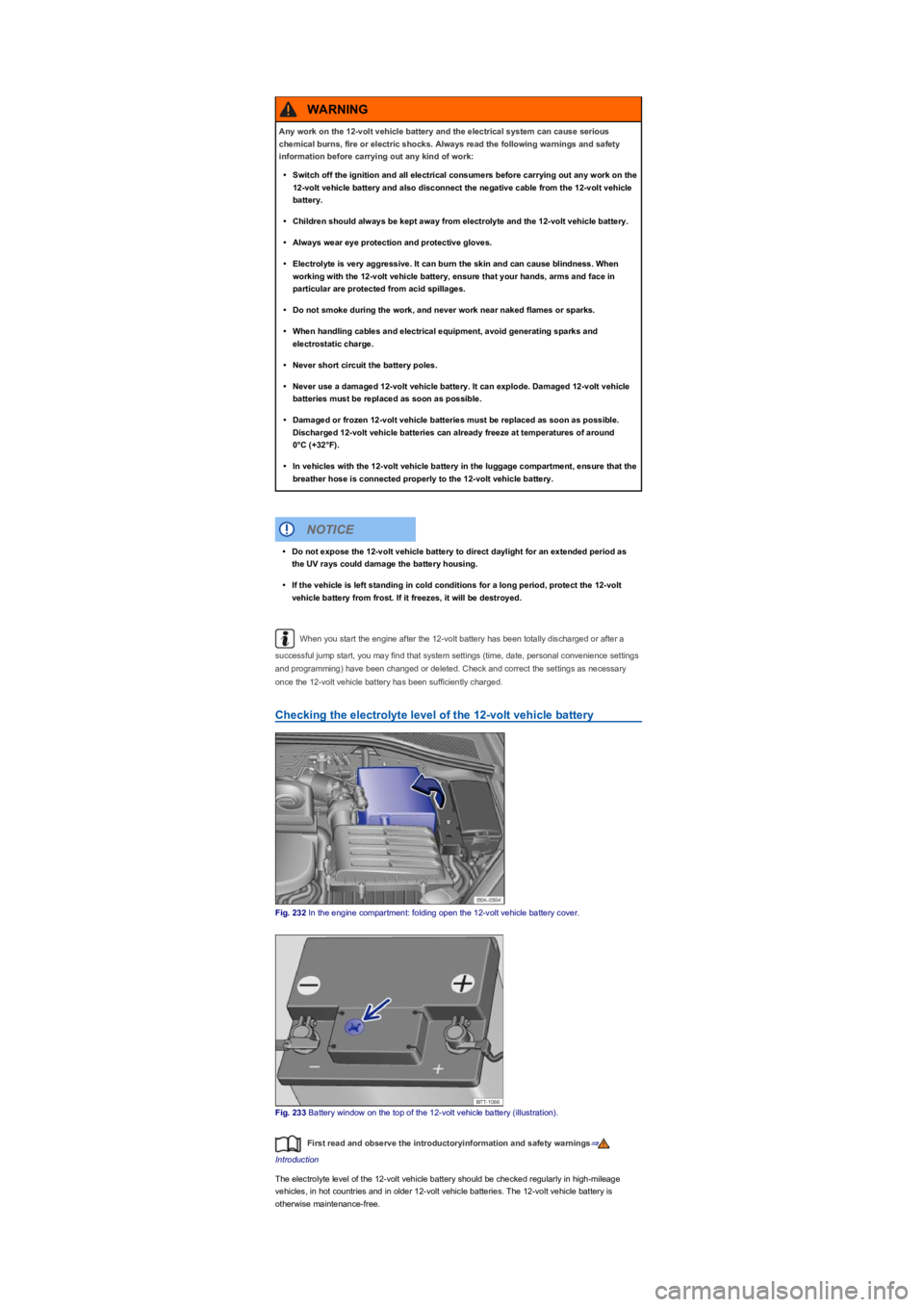
Fig. 232 In the engine compartment: folding open the 12-volt vehicle battery cover.
Fig. 233 Battery window on the top of the 12-volt vehicle battery (illustration).
First read and observe the introductoryinformation and safety warnings⇒
Introduction
The electrolyte level of the 12-volt vehicle battery should be checked regularly in high-mileage
vehicles, in hot countries and in older 12-volt vehicle batteries. The 12-volt vehicle battery is
otherwise maintenance-free.
Any work on the 12-volt vehicle battery and the electrical system can cause serious
chemical burns, fire or electric shocks. Always read the following warnings and safety
information before carrying out any kind of work:
•Switch off the ignition and all electrical consumers before carrying out any work on the
12-volt vehicle battery and also disconnect the negative cable from the 12-volt vehicle
battery.
•Children should always be kept away from electrolyte and the 12-volt vehicle battery.
•Always wear eye protection and protective gloves.
•Electrolyte is very aggressive. It can burn the skin and can cause blindness. When
working with the 12-volt vehicle battery, ensure that your hands, arms and face in
particular are protected from acid spillages.
•Do not smoke during the work, and never work near naked flames or sparks.
•When handling cables and electrical equipment, avoid generating sparks and
electrostatic charge.
•Never short circuit the battery poles.
•Never use a damaged 12-volt vehicle battery. It can explode. Damaged 12-volt vehicle
batteries must be replaced as soon as possible.
•Damaged or frozen 12-volt vehicle batteries must be replaced as soon as possible.
Discharged 12-volt vehicle batteries can already freeze at temperatures of around
0°C (+32°F).
•In vehicles with the 12-volt vehicle battery in the luggage compartment, ensure that the
breather hose is connected properly to the 12-volt vehicle battery.
WARNING
•Do not expose the 12-volt vehicle battery to direct daylight for an extended period as
the UV rays could damage the battery housing.
•If the vehicle is left standing in cold conditions for a long period, protect the 12-volt
vehicle battery from frost. If it freezes, it will be destroyed.
NOTICE
Page 287 of 341
Vehicles with auxiliary heater ⇒ Auxiliary heater and ventilation and vehicles with the 12-volt
battery in the luggage compartment are fitted with special batteries. The acid level of these 12-volt
vehicle batteries cannot be checked for technical reasons. Go to a qualified workshop to have the
12-volt vehicle battery checked.
Preparation (vehicles with 12-volt battery in the engine compartment)
•Preparing the vehicle for working in the engine compartment ⇒ In the engine compartment.
•Open the bonnet ⇒ In the engine compartment.
Opening the cover of the 12-volt vehicle battery
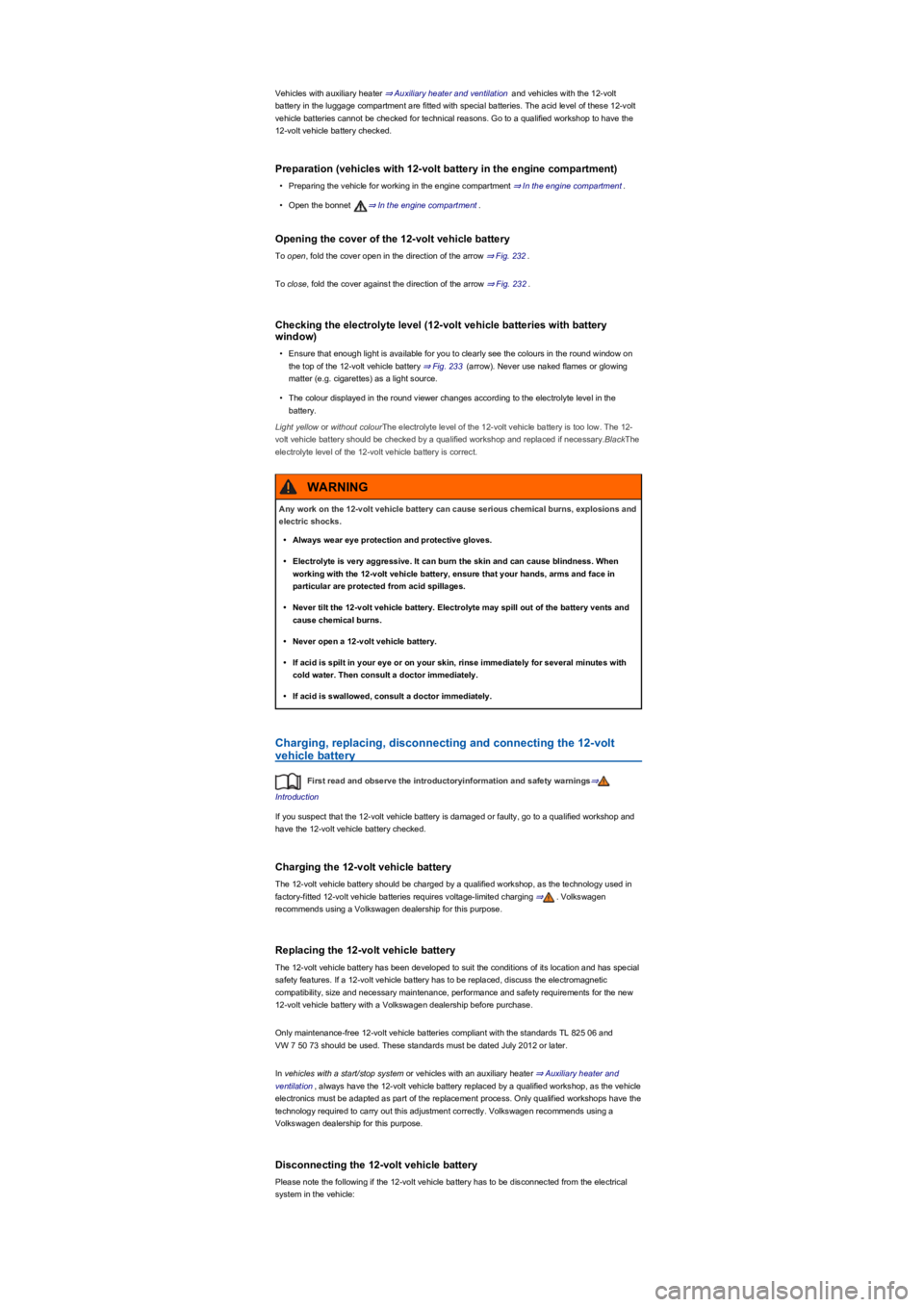
To open, fold the cover open in the direction of the arrow ⇒ Fig. 232.
To close, fold the cover against the direction of the arrow ⇒ Fig. 232.
Checking the electrolyte level (12-volt vehicle batteries with battery
window)
•Ensure that enough light is available for you to clearly see the colours in the round window on
the top of the 12-volt vehicle battery ⇒ Fig. 233 (arrow). Never use naked flames or glowing
matter (e.g. cigarettes) as a light source.
•The colour displayed in the round viewer changes according to the electrolyte level in the
battery.
Light yellow or without colourThe electrolyte level of the 12-volt vehicle battery is too low. The 12-
volt vehicle battery should be checked by a qualified workshop and replaced if necessary.BlackThe
electrolyte level of the 12-volt vehicle battery is correct.
Charging, replacing, disconnecting and connecting the 12-volt
vehicle battery
First read and observe the introductoryinformation and safety warnings⇒
Introduction
If you suspect that the 12-volt vehicle battery is damaged or faulty, go to a qualified workshop and
have the 12-volt vehicle battery checked.
Charging the 12-volt vehicle battery
The 12-volt vehicle battery should be charged by a qualified workshop, as the technology used in
factory-fitted 12-volt vehicle batteries requires voltage-limited charging ⇒. Volkswagen
recommends using a Volkswagen dealership for this purpose.
Replacing the 12-volt vehicle battery
The 12-volt vehicle battery has been developed to suit the conditions of its location and has special
safety features. If a 12-volt vehicle battery has to be replaced, discuss the electromagnetic
compatibility, size and necessary maintenance, performance and safety requirements for the new
12-volt vehicle battery with a Volkswagen dealership before purchase.
Only maintenance-free 12-volt vehicle batteries compliant with the standards TL 825 06 and
VW 7 50 73 should be used. These standards must be dated July 2012 or later.
In vehicles with a start/stop system or vehicles with an auxiliary heater ⇒ Auxiliary heater and
ventilation, always have the 12-volt vehicle battery replaced by a qualified workshop, as the vehicle
electronics must be adapted as part of the replacement process. Only qualified workshops have the
technology required to carry out this adjustment correctly. Volkswagen recommends using a
Volkswagen dealership for this purpose.
Disconnecting the 12-volt vehicle battery
Please note the following if the 12-volt vehicle battery has to be disconnected from the electrical
system in the vehicle:
Any work on the 12-volt vehicle battery can cause serious chemical burns, explosions and
electric shocks.
•Always wear eye protection and protective gloves.
•Electrolyte is very aggressive. It can burn the skin and can cause blindness. When
working with the 12-volt vehicle battery, ensure that your hands, arms and face in
particular are protected from acid spillages.
•Never tilt the 12-volt vehicle battery. Electrolyte may spill out of the battery vents and
cause chemical burns.
•Never open a 12-volt vehicle battery.
•If acid is spilt in your eye or on your skin, rinse immediately for several minutes with
cold water. Then consult a doctor immediately.
•If acid is swallowed, consult a doctor immediately.
WARNING
Page 288 of 341
•Switch off all electrical consumers and the ignition.
•Unlock the vehicle before disconnecting the battery in order to avoid triggering the anti-theft
alarm.
•First disconnect the negative cable and then the positive cable ⇒.
Connecting the 12-volt vehicle battery
•Switch off all electrical consumers and the ignition before reconnecting the 12-volt vehicle
battery.
•First reconnect the positive cable and then the negative cable ⇒.
Various indicator lamps may light up after the 12-volt vehicle battery has been connected and the
ignition is switched on. They will go out if you drive a short distance at a speed of approximately
15 – 20 km/h (10 – 12 mph). If the indicator lamps remain lit up, the vehicle should be checked by a
qualified workshop.
If the 12-volt vehicle battery was disconnected for an extended period, the system may not able to
calculate or correctly display the time when the next service is due ⇒ Instrument cluster. Observe
the maximum permissible service intervals ⇒ Service.
Vehicles with Keyless Access:⇒ Central locking system: if the ignition cannot be switched on after
connecting the 12-volt vehicle battery, lock and unlock the vehicle from the outside. Then try to start
the ignition again. Please contact an expert if the ignition cannot be switched on.
Automatic switch-off for electrical consumers
The intelligent vehicle electrical system management automatically implements a range of
measures to prevent the 12-volt battery from discharging under high loads:
•The idling speed is increased so that the alternator provides more electricity.
•The performance of large electrical consumers may be reduced or they may be switched off
completely.
•The power supply to the 12-volt socket and the cigarette lighter is interrupted temporarily while
the engine is being started.
The vehicle electrical system management function cannot always prevent the 12-volt vehicle
battery from discharging. For example when the ignition is switched on for an extended period with
the engine off, or when the side or parking lights are on when the vehicle is parked for an extended
period.
Battery switch-off in an accident in which the airbag is triggered
In vehicles with 12-volt vehicle battery in the luggage compartment, the electrical connection to the
12-volt vehicle battery is disconnected pyrotechnically in the event of an accident in which the
airbags are triggered. This prevents short-circuiting.
What can cause the 12-volt vehicle battery to discharge?
•Long periods at a standstill in which the engine is not running, especially if the ignition is
switched on.
•The use of electrical consumers when the engine is switched off.
•When the auxiliary heater is being used ⇒ Auxiliary heater and ventilation.
Page 289 of 341
Dispose of the 12-volt vehicle battery in accordance with the regulations. 12-volt vehicle
batteries may contain toxic substances such as sulphuric acid and lead.
Electrolyte can pollute the environment. Clean up any service fluid leakages and dispose of
them properly.
Troubleshooting
First read and observe the introductoryinformation and safety warnings⇒
Introduction
12-volt vehicle battery
Fault in the alternator. Go to a qualified workshop. Have the electrical system checked. Switch
off any electrical consumers that are not required. The 12-volt vehicle battery will not be charged by
the alternator while the vehicle is in motion. The start/stop system cannot start the engine.
⇒ Start/stop system
Wheels and tyres
Tyre monitoring systems
Introduction
This chapter contains information on the followingsubjects:
⇒ Types of tyre monitoring systems
⇒ Tyre Pressure Loss Indicator
⇒ Tyre Pressure Monitoring System
⇒ Troubleshooting for the Tyre Pressure Loss Indicator
⇒ Troubleshooting for the Tyre Pressure Monitoring System
The tyre monitoring system warns the
driver when the tyre pressures get too
low.
Incorrectly securing the battery and using incorrect 12-volt vehicle batteries can cause
short circuits, fire and serious injuries.
•Always use maintenance-free and leak-proof 12-volt vehicle batteries that have the
same properties, specifications and dimensions as the factory-fitted 12-volt vehicle
battery.
•In vehicles with the 12-volt vehicle battery in the luggage compartment, ensure that the
breather hose is connected properly to the 12-volt vehicle battery. Make sure that no
open gas discharge openings are located in the area around the positive battery
terminal. If there is an open breather opening in this area, it must be closed off with a
sealing plug. The breather hose must be connected to the open breather opening in the
area of the negative terminal.
WARNING
A highly explosive mixture of gases is given off when the 12-volt vehicle battery is being
charged.
•12-volt vehicle batteries should only be charged in well-ventilated spaces.
•Never charge a 12-volt vehicle battery that is frozen or that has thawed. Discharged 12-
volt vehicle batteries can already freeze at temperatures of around 0°C (+32°F).
•The 12-volt vehicle battery must be replaced if it has ever been frozen.
•Incorrectly connected cables can cause a short circuit. First connect the positive cable
and then the negative cable.
WARNING
•Never connect or disconnect 12-volt vehicle batteries if the ignition is switched on or
the engine is running. Never use a 12-volt vehicle battery that does not correspond with
the vehicle's specifications. This can damage the electrical system or electronic
components, which can cause electrical faults.
•Never connect equipment that supplies electric power, such as solar panels or a
battery charger, to the 12-volt socket or to the cigarette lighter to charge the 12-volt
vehicle battery. This can damage the vehicle electrical system.
NOTICE