display VOLKSWAGEN TIGUAN 2017 Owner´s Manual
[x] Cancel search | Manufacturer: VOLKSWAGEN, Model Year: 2017, Model line: TIGUAN, Model: VOLKSWAGEN TIGUAN 2017Pages: 341, PDF Size: 9.14 MB
Page 293 of 341
Driving on unpaved roads for long periods, or a sporty driving style, can temporarily
deactivate the Tyre Pressure Loss Indicator. The indicator lamp shows the malfunction, but
disappears if the road conditions or driving style change.
Troubleshooting for the Tyre Pressure Monitoring System
First read and observe the introductoryinformation and safety warnings⇒
Introduction
Lit up
•Do not drive on!
•Check all wheels for exterior damage or foreign bodies that have entered the tyres.
•Check the tyre pressure for all tyres ⇒ Tyre pressure.
•Change the wheel or drive at a low speed to the nearest qualified workshop.
•Check and adjust the tyre pressure for all tyres ⇒ Tyre pressure.
•Change the wheel or drive at a low speed to the nearest qualified workshop.
•Avoid long journeys and high speeds as long as the warning is displayed.
•Check ⇒ Tyre pressure and adjust the tyre pressure for all tyres.
Flashes
•Switch off or avoid any disruptive sources, e.g. two-way radios, remote controls or children's
toys.
•Switch the ignition off and then back on again. If the problem persists, seek expert assistance.
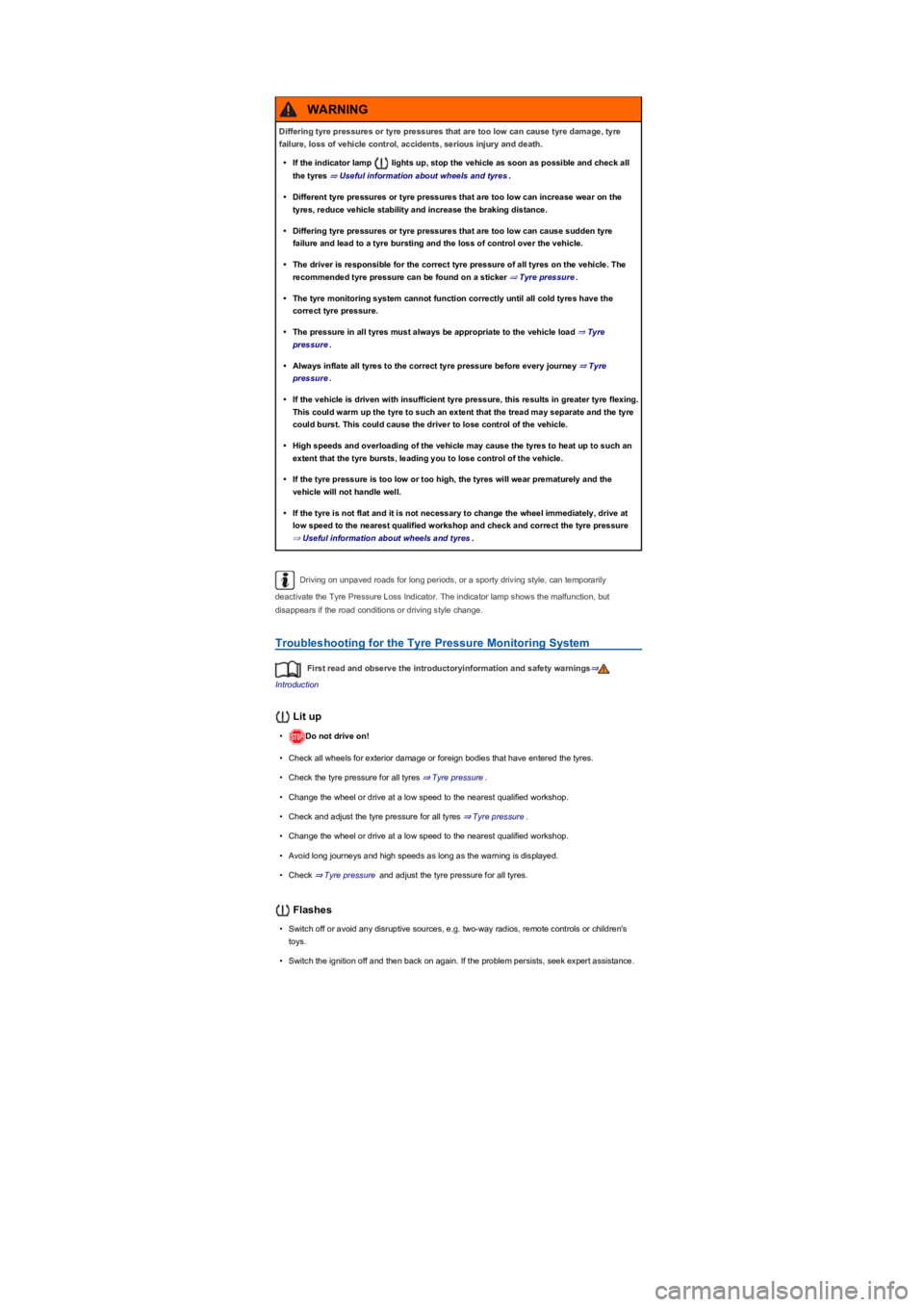
Differing tyre pressures or tyre pressures that are too low can cause tyre damage, tyre
failure, loss of vehicle control, accidents, serious injury and death.
•If the indicator lamp lights up, stop the vehicle as soon as possible and check all
the tyres ⇒ Useful information about wheels and tyres.
•Different tyre pressures or tyre pressures that are too low can increase wear on the
tyres, reduce vehicle stability and increase the braking distance.
•Differing tyre pressures or tyre pressures that are too low can cause sudden tyre
failure and lead to a tyre bursting and the loss of control over the vehicle.
•The driver is responsible for the correct tyre pressure of all tyres on the vehicle. The
recommended tyre pressure can be found on a sticker ⇒ Tyre pressure.
•The tyre monitoring system cannot function correctly until all cold tyres have the
correct tyre pressure.
•The pressure in all tyres must always be appropriate to the vehicle load ⇒ Tyre
pressure.
•Always inflate all tyres to the correct tyre pressure before every journey ⇒ Tyre
pressure.
•If the vehicle is driven with insufficient tyre pressure, this results in greater tyre flexing.
This could warm up the tyre to such an extent that the tread may separate and the tyre
could burst. This could cause the driver to lose control of the vehicle.
•High speeds and overloading of the vehicle may cause the tyres to heat up to such an
extent that the tyre bursts, leading you to lose control of the vehicle.
•If the tyre pressure is too low or too high, the tyres will wear prematurely and the
vehicle will not handle well.
•If the tyre is not flat and it is not necessary to change the wheel immediately, drive at
low speed to the nearest qualified workshop and check and correct the tyre pressure
⇒ Useful information about wheels and tyres.
WARNING
Page 301 of 341
Removing the spare wheel
•Open the boot lid.
•Raise or fold forward the luggage compartment floor ⇒ Boot lid.
•Pull the wedge of the locating element ⇒ Fig. 239① upwards and out.
•Unscrew the handwheel in the middle of the spare wheel ② anticlockwise fully and remove the
spare wheel.
Storing the removed wheel
•Open the boot lid and raise the luggage compartment floor or fold it forwards.
•Place the removed wheel into the spare wheel well with the rim facing downwards so that the
central hole in the rim positioned exactly above the threaded pin.
•Screw the handwheel ⇒ Fig. 239② clockwise onto the threaded pin until the replaced wheel is
firmly secured.
•Insert the locating element wedge ① into the slot of the threaded pin so that the handwheel can
no longer be turned.
If the spare wheel tyre is not the same as the tyres that are mounted on
the vehicle
If the spare wheel tyre differs from the other tyres on the vehicle, the spare wheel must be used
only in the event of a tyre failure and for a short time ⇒.
Follow these guidelines:
•Do not drive faster than 80 km/h (50 mph).
•Avoid full acceleration, sudden braking and fast driving through bends in the road.
•Do not use snow chains on the temporary spare wheel ⇒ Snow chains.
•The tyre pressure must be checked as soon as possible after fitting the spare wheel or
temporary spare wheel ⇒ Tyre pressure.
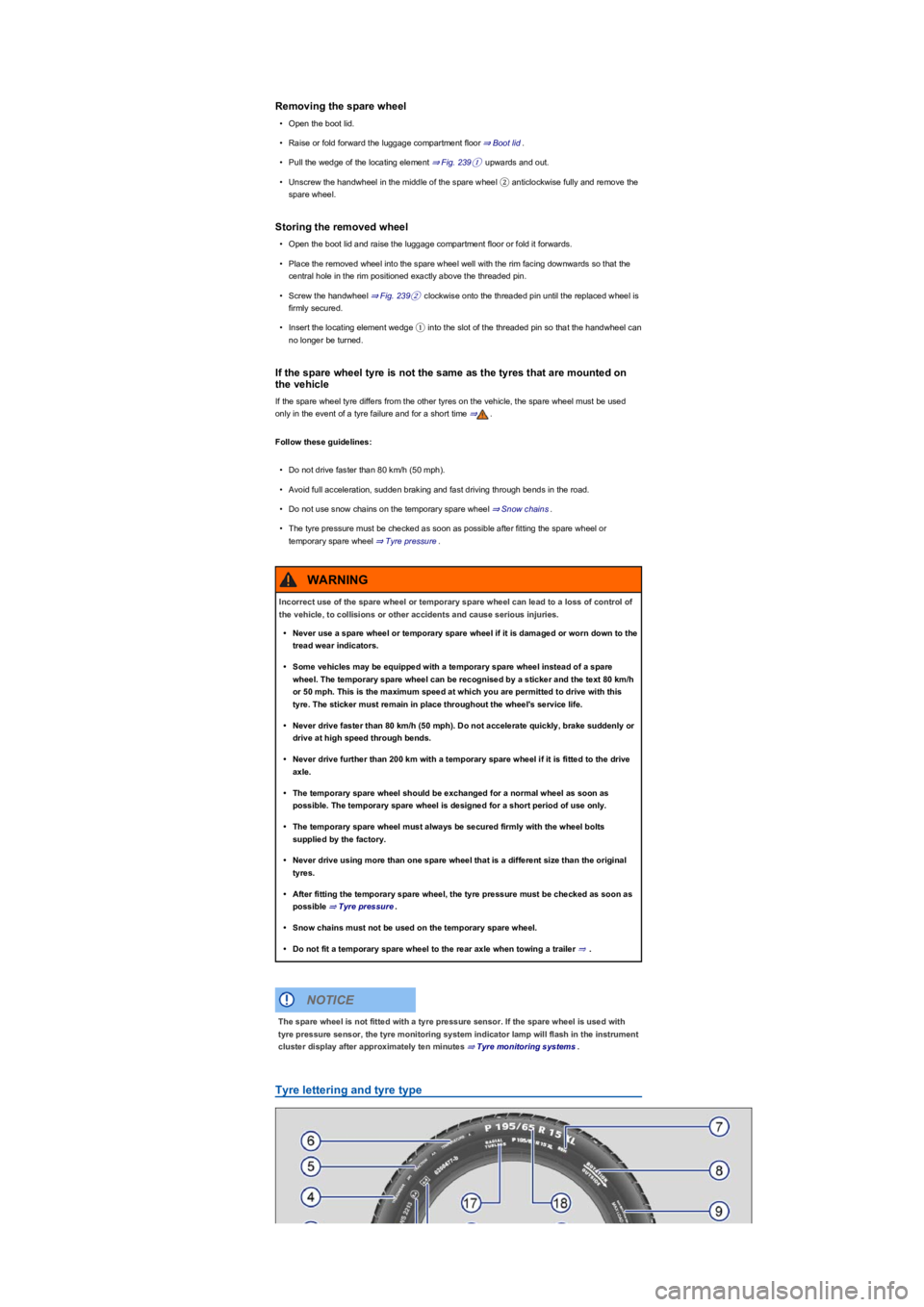
Tyre lettering and tyre type
Incorrect use of the spare wheel or temporary spare wheel can lead to a loss of control of
the vehicle, to collisions or other accidents and cause serious injuries.
•Never use a spare wheel or temporary spare wheel if it is damaged or worn down to the
tread wear indicators.
•Some vehicles may be equipped with a temporary spare wheel instead of a spare
wheel. The temporary spare wheel can be recognised by a sticker and the text 80 km/h
or 50 mph. This is the maximum speed at which you are permitted to drive with this
tyre. The sticker must remain in place throughout the wheel's service life.
•Never drive faster than 80 km/h (50 mph). Do not accelerate quickly, brake suddenly or
drive at high speed through bends.
•Never drive further than 200 km with a temporary spare wheel if it is fitted to the drive
axle.
•The temporary spare wheel should be exchanged for a normal wheel as soon as
possible. The temporary spare wheel is designed for a short period of use only.
•The temporary spare wheel must always be secured firmly with the wheel bolts
supplied by the factory.
•Never drive using more than one spare wheel that is a different size than the original
tyres.
•After fitting the temporary spare wheel, the tyre pressure must be checked as soon as
possible ⇒ Tyre pressure.
•Snow chains must not be used on the temporary spare wheel.
•Do not fit a temporary spare wheel to the rear axle when towing a trailer ⇒.
WARNING
The spare wheel is not fitted with a tyre pressure sensor. If the spare wheel is used with
tyre pressure sensor, the tyre monitoring system indicator lamp will flash in the instrument
cluster display after approximately ten minutes ⇒ Tyre monitoring systems.
NOTICE
Page 304 of 341
Maximum load and speed range for tyres
First read and observe the introductoryinformation and safety warnings⇒
Introduction
Vehicles in the EU and the so-called EU user states are issued an EC Certificate of Conformity.
This details the size, diameter and speed range of all tyres approved by Volkswagen for the
relevant vehicle type.
The type plate shows whether there is an EC certificate of conformity for this particular vehicle. The
type plate can be seen on the lower part of the door pillar when the door is open ⇒ Technical data.
•If the type plate has a row marked Permit then the vehicle does have an EC certificate of
conformity.
•If there is no type plate, or no row marked Permit the vehicle does not have an EC certificate of
conformity.
Winter tyres
First read and observe the introductoryinformation and safety warnings⇒
Introduction
Winter or all-year tyres improve the handling and brake response in winter conditions. Volkswagen
recommends that winter tyres be fitted to the vehicle at temperatures below +7°C (+45°F) or in
winter road conditions.
Winter tyres and all-year tyres lose a large degree of their effectiveness for winter conditions when
the tread is worn down to a depth of 4 mm.
The following applies when using winter tyres:
•Observe any country-specific legal requirements.
•Use winter tyres on all four wheels at the same time.
•Only use in winter road conditions.
•Only use the sizes of tyre that have been approved for the vehicle.
•Winter tyres must have the same belt type, size and the same tread pattern.
•Observe the maximum speed permitted by the speed index ⇒.
Speed limitation
Winter tyres have a speed limit depending on the speed index ⇒ Tyre lettering and tyre type.
Speed warning settings can be made and adjusted in the Infotainment system using the
button and the and Tyres function buttons ⇒ Operation and display in the
Infotainment system.
If you use V-rated tyres, the speed limits and required tyre pressure will be determined by the
engine size. You must ask a Volkswagen dealership about the maximum permitted speed and
required tyre pressure.
Four-wheel drive (4MOTION)
Thanks to its four-wheel drive, the vehicle will have plenty of traction in winter conditions, even with
the standard tyres. Nevertheless, Volkswagen still recommends that winter tyres or all-year tyres
should be fitted on all 4 wheels in winter, mainly because this will give a better braking response.
Observe information on snow chains⇒ Snow chains.
Summer tyres should be fitted in good time at the end of the winter. The vehicle handling is
better if summer tyres are fitted at temperatures above +7°C (+45°F). They are quieter, do not wear
so quickly and reduce fuel consumption.
In vehicles with a Tyre Pressure Loss Indicator, the system has to re-synchronise after
wheels are changed ⇒ Tyre monitoring systems.
Volkswagen dealerships can provide details on permissible winter tyre sizes.
The improved winter driving characteristics afforded by the winter tyres should not
encourage you to take any risks.
•Adapt your speed and driving style to suit visibility, weather, road and traffic
conditions.
•Never exceed the top speed and load permitted for the winter tyres that are fitted.
WARNING
Page 312 of 341
Dispose of used or out-of-date sealant in accordance with legal requirements.
You can get a new tyre filler bottle from a Volkswagen dealership.
Observe the separate instructions from the manufacturer of the breakdown set.
Contents of the breakdown set
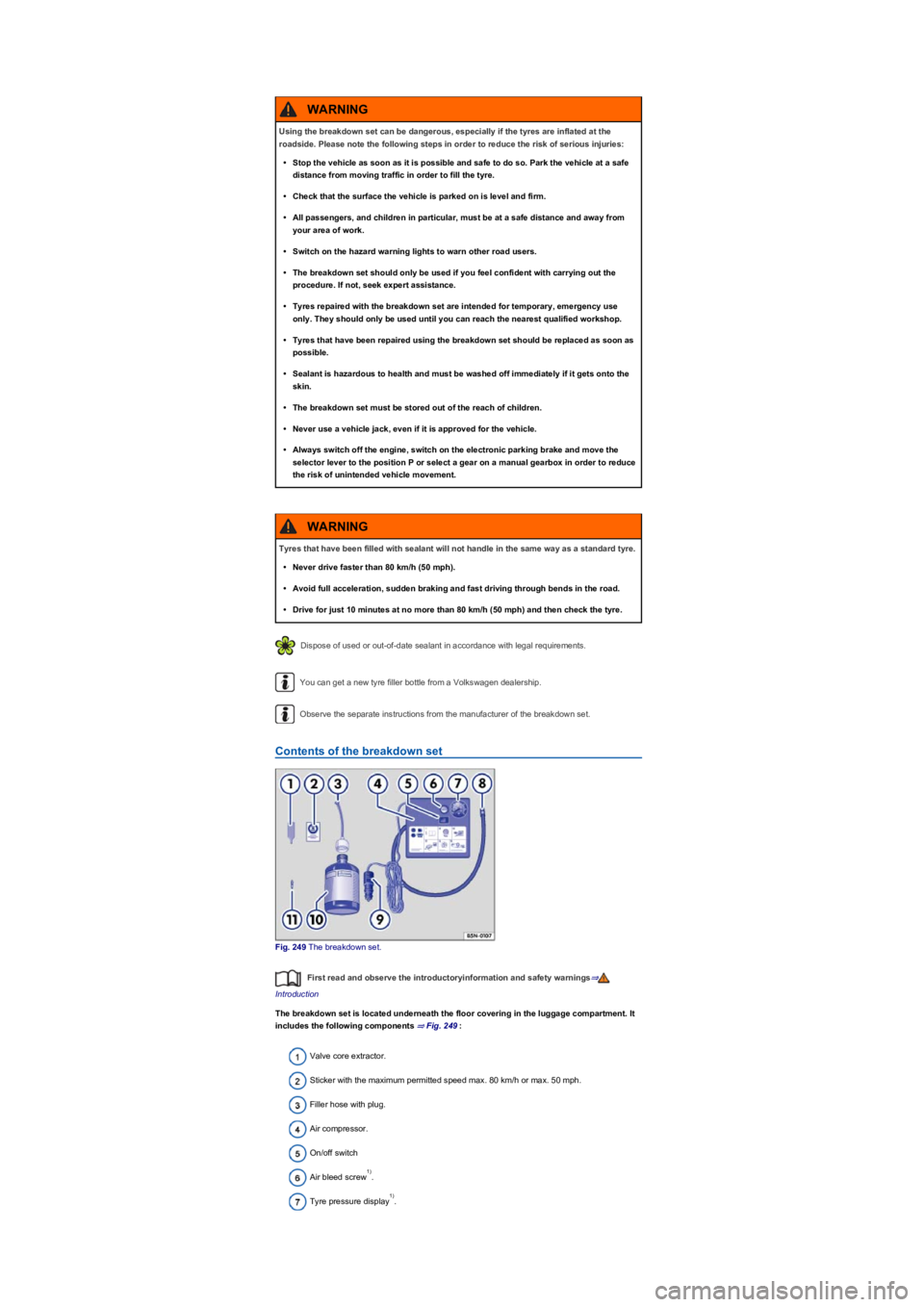
Fig. 249 The breakdown set.
First read and observe the introductoryinformation and safety warnings⇒
Introduction
The breakdown set is located underneath the floor covering in the luggage compartment. It
includes the following components ⇒ Fig. 249:
Valve core extractor.
Sticker with the maximum permitted speed max. 80 km/h or max. 50 mph.
Filler hose with plug.
Air compressor.
On/off switch
Air bleed screw.
Tyre pressure display.
Using the breakdown set can be dangerous, especially if the tyres are inflated at the
roadside. Please note the following steps in order to reduce the risk of serious injuries:
•Stop the vehicle as soon as it is possible and safe to do so. Park the vehicle at a safe
distance from moving traffic in order to fill the tyre.
•Check that the surface the vehicle is parked on is level and firm.
•All passengers, and children in particular, must be at a safe distance and away from
your area of work.
•Switch on the hazard warning lights to warn other road users.
•The breakdown set should only be used if you feel confident with carrying out the
procedure. If not, seek expert assistance.
•Tyres repaired with the breakdown set are intended for temporary, emergency use
only. They should only be used until you can reach the nearest qualified workshop.
•Tyres that have been repaired using the breakdown set should be replaced as soon as
possible.
•Sealant is hazardous to health and must be washed off immediately if it gets onto the
skin.
•The breakdown set must be stored out of the reach of children.
•Never use a vehicle jack, even if it is approved for the vehicle.
•Always switch off the engine, switch on the electronic parking brake and move the
selector lever to the position P or select a gear on a manual gearbox in order to reduce
the risk of unintended vehicle movement.
WARNING
Tyres that have been filled with sealant will not handle in the same way as a standard tyre.
•Never drive faster than 80 km/h (50 mph).
•Avoid full acceleration, sudden braking and fast driving through bends in the road.
•Drive for just 10 minutes at no more than 80 km/h (50 mph) and then check the tyre.
WARNING
1)
1)
Page 314 of 341
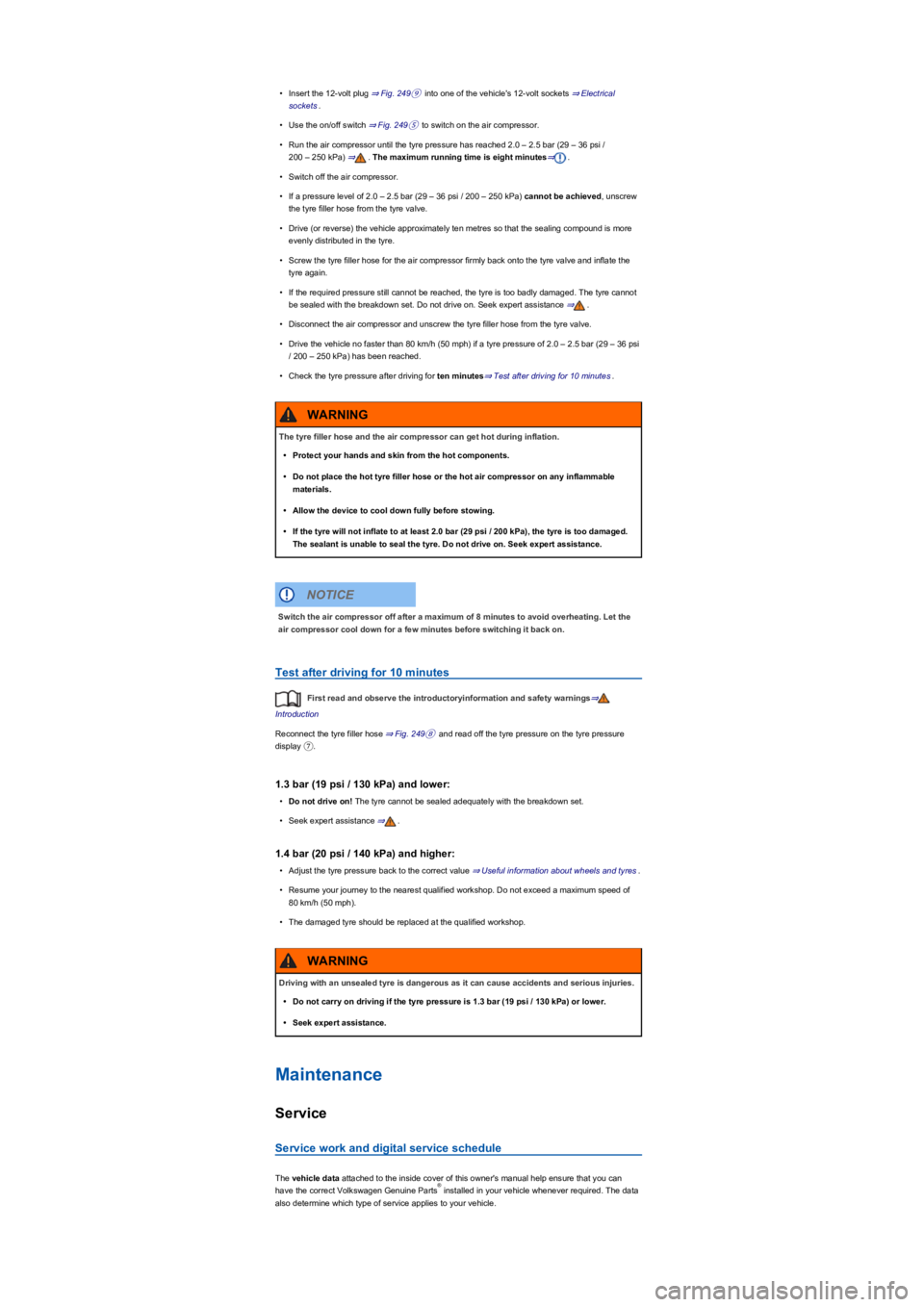
•Insert the 12-volt plug ⇒ Fig. 249⑨ into one of the vehicle's 12-volt sockets ⇒ Electrical
sockets.
•Use the on/off switch ⇒ Fig. 249⑤ to switch on the air compressor.
•Run the air compressor until the tyre pressure has reached 2.0 – 2.5 bar (29 – 36 psi /
200 – 250 kPa) ⇒. The maximum running time is eight minutes⇒.
•Switch off the air compressor.
•If a pressure level of 2.0 – 2.5 bar (29 – 36 psi / 200 – 250 kPa) cannot be achieved, unscrew
the tyre filler hose from the tyre valve.
•Drive (or reverse) the vehicle approximately ten metres so that the sealing compound is more
evenly distributed in the tyre.
•Screw the tyre filler hose for the air compressor firmly back onto the tyre valve and inflate the
tyre again.
•If the required pressure still cannot be reached, the tyre is too badly damaged. The tyre cannot
be sealed with the breakdown set. Do not drive on. Seek expert assistance ⇒.
•Disconnect the air compressor and unscrew the tyre filler hose from the tyre valve.
•Drive the vehicle no faster than 80 km/h (50 mph) if a tyre pressure of 2.0 – 2.5 bar (29 – 36 psi
/ 200 – 250 kPa) has been reached.
•Check the tyre pressure after driving for ten minutes⇒ Test after driving for 10 minutes.
Test after driving for 10 minutes
First read and observe the introductoryinformation and safety warnings⇒
Introduction
Reconnect the tyre filler hose ⇒ Fig. 249⑧ and read off the tyre pressure on the tyre pressure
display ⑦.
1.3 bar (19 psi / 130 kPa) and lower:
•Do not drive on! The tyre cannot be sealed adequately with the breakdown set.
•Seek expert assistance ⇒.
1.4 bar (20 psi / 140 kPa) and higher:
•Adjust the tyre pressure back to the correct value ⇒ Useful information about wheels and tyres.
•Resume your journey to the nearest qualified workshop. Do not exceed a maximum speed of
80 km/h (50 mph).
•The damaged tyre should be replaced at the qualified workshop.
Maintenance
Service
Service work and digital service schedule
The vehicle data attached to the inside cover of this owner's manual help ensure that you can
have the correct Volkswagen Genuine Parts installed in your vehicle whenever required. The data
also determine which type of service applies to your vehicle.
The tyre filler hose and the air compressor can get hot during inflation.
•Protect your hands and skin from the hot components.
•Do not place the hot tyre filler hose or the hot air compressor on any inflammable
materials.
•Allow the device to cool down fully before stowing.
•If the tyre will not inflate to at least 2.0 bar (29 psi / 200 kPa), the tyre is too damaged.
The sealant is unable to seal the tyre. Do not drive on. Seek expert assistance.
WARNING
Switch the air compressor off after a maximum of 8 minutes to avoid overheating. Let the
air compressor cool down for a few minutes before switching it back on.
NOTICE
Driving with an unsealed tyre is dangerous as it can cause accidents and serious injuries.
•Do not carry on driving if the tyre pressure is 1.3 bar (19 psi / 130 kPa) or lower.
•Seek expert assistance.
WARNING
®
Page 315 of 341
The vehicle data sticker confirms when the vehicle was first registered or delivered, when the
delivery inspection was carried out, and thus the date from which your vehicle is covered by our
warranty.
Saving the service operations performed (digital service schedule)
Each service record is stored by your Volkswagen dealership and qualified workshop in a central
system. This transparent documentation of the service history allows the service operations
performed to be reproduced at any time. Each time you have your vehicle serviced, Volkswagen
recommends asking for a printed service record, which contains all service work stored in the
system.
With every service, the printout of the previous service record is replaced by a current printout.
The digital service schedule is not available in some markets. In this case, your Volkswagen
dealership will inform you about the documentation process for service work.
Service work
The following information is documented in the digital service schedule by your Volkswagen
dealership or qualified workshop:
•When which service was carried out.
•Whether any repairs are recommended, such as replacement of the brake pads in the near
future.
•Whether you had any special requests before or during the maintenance work (your service
advisor will note these on the order).
•Which components or service fluids were changed.
•When your next service is scheduled for.
The LongLife mobility guarantee is valid until the next inspection is due. Documentation takes place
at every due inspection.
The type and scope of service work may differ from vehicle to vehicle. Information on specific work
for your vehicle can be requested from a qualified workshop.
Regular servicing of your vehicle not only maintains its value, it also ensures that your
vehicle remains roadworthy and in working order. You should therefore have your vehicle serviced
according to the Volkswagen guidelines.
Fixed service or flexible service
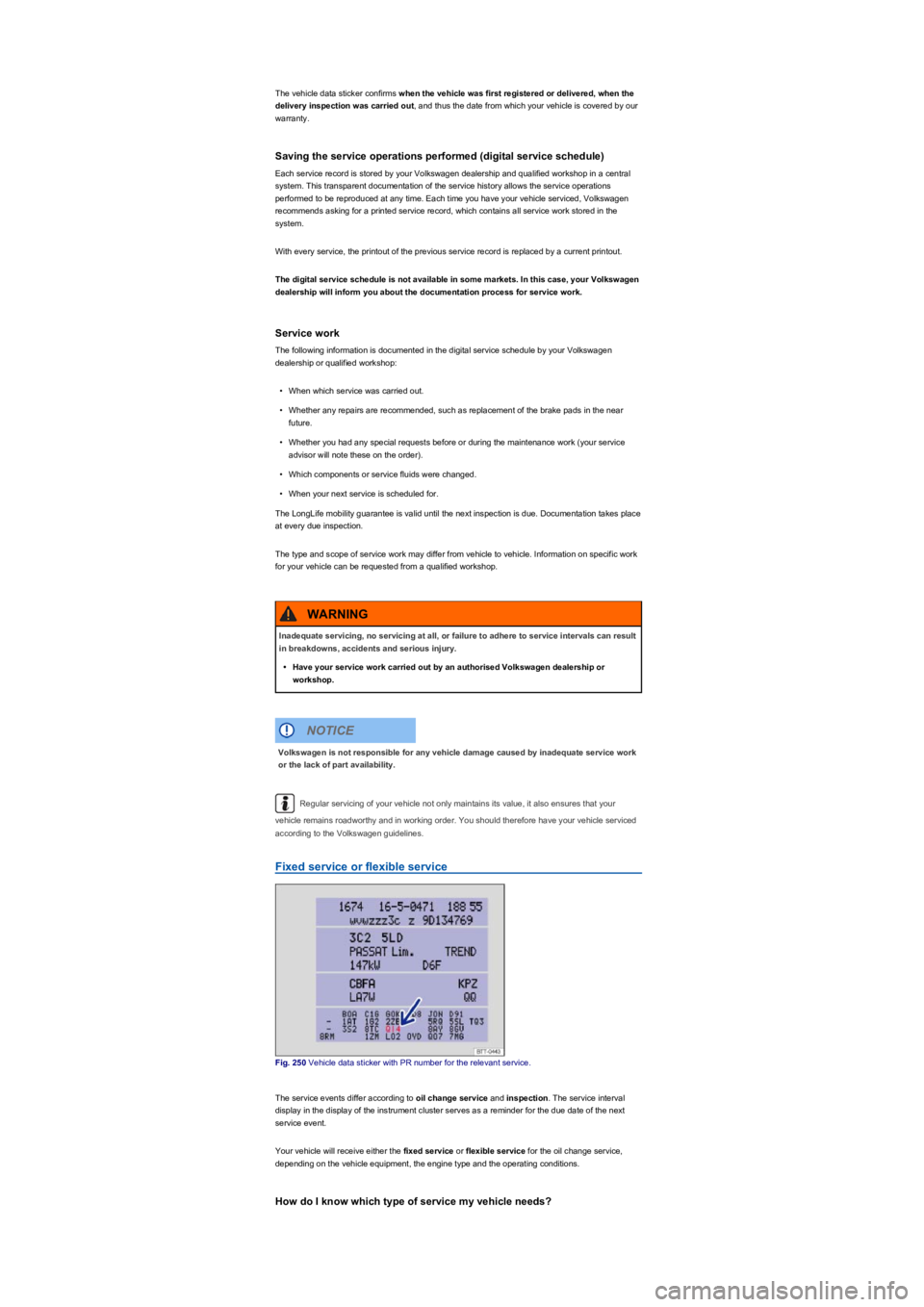
Fig. 250 Vehicle data sticker with PR number for the relevant service.
The service events differ according to oil change service and inspection. The service interval
display in the display of the instrument cluster serves as a reminder for the due date of the next
service event.
Your vehicle will receive either the fixed service or flexible service for the oil change service,
depending on the vehicle equipment, the engine type and the operating conditions.
How do I know which type of service my vehicle needs?
Inadequate servicing, no servicing at all, or failure to adhere to service intervals can result
in breakdowns, accidents and serious injury.
•Have your service work carried out by an authorised Volkswagen dealership or
workshop.
WARNING
Volkswagen is not responsible for any vehicle damage caused by inadequate service work
or the lack of part availability.
NOTICE
Page 316 of 341
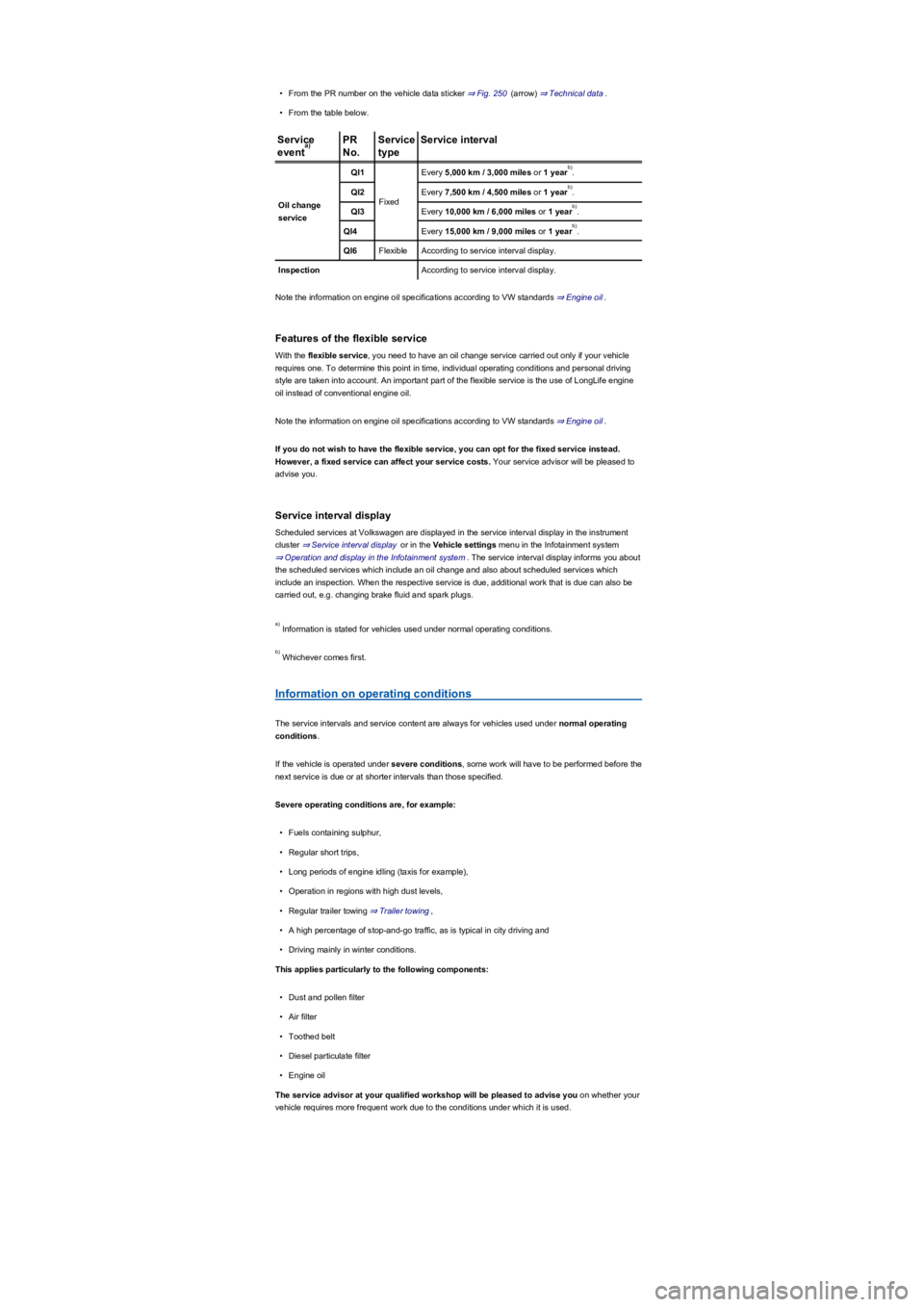
•From the PR number on the vehicle data sticker ⇒ Fig. 250 (arrow) ⇒ Technical data.
•From the table below.
Service
event
PR
No.
Service
type
Service interval
Oil change
service
QI1
Fixed
Every 5,000 km / 3,000 miles or 1 year.
QI2Every 7,500 km / 4,500 miles or 1 year.
QI3Every 10,000 km / 6,000 miles or 1 year.
QI4Every 15,000 km / 9,000 miles or 1 year.
QI6FlexibleAccording to service interval display.
InspectionAccording to service interval display.
Note the information on engine oil specifications according to VW standards ⇒ Engine oil.
Features of the flexible service
With the flexible service, you need to have an oil change service carried out only if your vehicle
requires one. To determine this point in time, individual operating conditions and personal driving
style are taken into account. An important part of the flexible service is the use of LongLife engine
oil instead of conventional engine oil.
Note the information on engine oil specifications according to VW standards ⇒ Engine oil.
If you do not wish to have the flexible service, you can opt for the fixed service instead.
However, a fixed service can affect your service costs. Your service advisor will be pleased to
advise you.
Service interval display
Scheduled services at Volkswagen are displayed in the service interval display in the instrument
cluster ⇒ Service interval display or in the Vehicle settings menu in the Infotainment system
⇒ Operation and display in the Infotainment system. The service interval display informs you about
the scheduled services which include an oil change and also about scheduled services which
include an inspection. When the respective service is due, additional work that is due can also be
carried out, e.g. changing brake fluid and spark plugs.
Information is stated for vehicles used under normal operating conditions.
Whichever comes first.
Information on operating conditions
The service intervals and service content are always for vehicles used under normal operating
conditions.
If the vehicle is operated under severe conditions, some work will have to be performed before the
next service is due or at shorter intervals than those specified.
Severe operating conditions are, for example:
•Fuels containing sulphur,
•Regular short trips,
•Long periods of engine idling (taxis for example),
•Operation in regions with high dust levels,
•Regular trailer towing ⇒ Trailer towing,
•A high percentage of stop-and-go traffic, as is typical in city driving and
•Driving mainly in winter conditions.
This applies particularly to the following components:
•Dust and pollen filter
•Air filter
•Toothed belt
•Diesel particulate filter
•Engine oil
The service advisor at your qualified workshop will be pleased to advise you on whether your
vehicle requires more frequent work due to the conditions under which it is used.
a)
b)
b)
b)
b)
a)
b)
Page 317 of 341
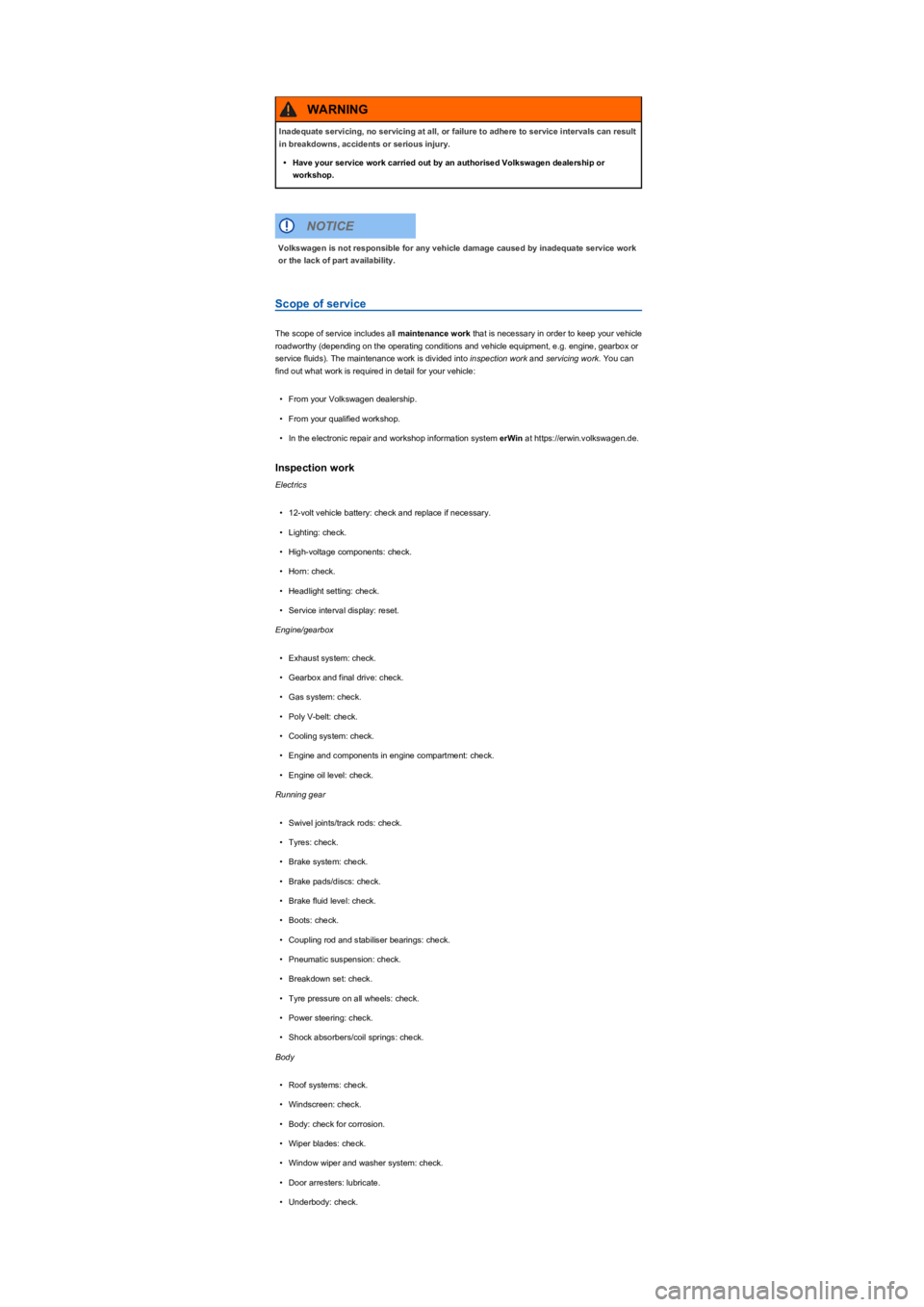
Scope of service
The scope of service includes all maintenance work that is necessary in order to keep your vehicle
roadworthy (depending on the operating conditions and vehicle equipment, e.g. engine, gearbox or
service fluids). The maintenance work is divided into inspection work and servicing work. You can
find out what work is required in detail for your vehicle:
•From your Volkswagen dealership.
•From your qualified workshop.
•In the electronic repair and workshop information system erWin at https://erwin.volkswagen.de.
Inspection work
Electrics
•12-volt vehicle battery: check and replace if necessary.
•Lighting: check.
•High-voltage components: check.
•Horn: check.
•Headlight setting: check.
•Service interval display: reset.
Engine/gearbox
•Exhaust system: check.
•Gearbox and final drive: check.
•Gas system: check.
•Poly V-belt: check.
•Cooling system: check.
•Engine and components in engine compartment: check.
•Engine oil level: check.
Running gear
•Swivel joints/track rods: check.
•Tyres: check.
•Brake system: check.
•Brake pads/discs: check.
•Brake fluid level: check.
•Boots: check.
•Coupling rod and stabiliser bearings: check.
•Pneumatic suspension: check.
•Breakdown set: check.
•Tyre pressure on all wheels: check.
•Power steering: check.
•Shock absorbers/coil springs: check.
Body
•Roof systems: check.
•Windscreen: check.
•Body: check for corrosion.
•Wiper blades: check.
•Window wiper and washer system: check.
•Door arresters: lubricate.
•Underbody: check.
Inadequate servicing, no servicing at all, or failure to adhere to service intervals can result
in breakdowns, accidents or serious injury.
•Have your service work carried out by an authorised Volkswagen dealership or
workshop.
WARNING
Volkswagen is not responsible for any vehicle damage caused by inadequate service work
or the lack of part availability.
NOTICE
Page 323 of 341
Displays: use a Volkswagen Genuine cleaning cloth (- 000 096 166 A -) with a little water, a
suitable glass cleaner or LCD cleaner. Do not clean displays with a dry cloth.
Rubber seals: clean with a soft, lint-free cloth and plenty of water. Treat with Volkswagen Genuine
rubber care agent (- 000 096 310 -) on a regular basis.
Seat belts: carefully pull the seat belt right out and leave it out ⇒. Remove large particles of dirt
with a soft brush. Clean the seat belt with a mild soap solution. Leave the belt fabric to dry
completely and then allow it to roll up.
Wooden trims: clean with a soft cloth and some mild soap solution.
Cleaning upholstery fabrics
If clothing that is not sufficiently colour-fast, e.g. denim, leaves stains on the seat cushion, this does
not a defect in the cover fabric. The seat padding may contain components for the airbag system
and electrical connections. Seat padding that is damaged, incorrectly cleaned or treated, or that
becomes wet, may cause damage to the vehicle electrical system or trigger a fault in the airbag
system ⇒.
Depending on the equipment, seat cushions with seat heating feature electrical components and
connectors that may be damaged in the event of incorrect cleaning or treatment ⇒. This can
also result in damage to other parts of the vehicle electrics.
•Do not use high-pressure cleaners, steam cleaners or coolant spray.
•Do not switch on the seat heating to dry the seats.
•Do not use washing paste or fine detergent solutions.
•Avoid getting the seat wet.
•In the event of uncertainty, contact a Volkswagen dealership.
Mild soap solution: a maximum of two tablespoons of neutral soap diluted in one litre of water.
Accessories, modifications, repairs and renewal of
parts
Accessories and parts
Volkswagen recommends that you seek advice from a Volkswagen dealership before purchasing
accessories, replacement parts or service fluids, for example if the vehicle is to be retrofitted with
accessories or if parts have to be renewed. Volkswagen dealerships can recommend accessories,
parts and service fluids suitable for your requirements. They can also answer any questions you
might have regarding official regulations.
Volkswagen recommends you use only approved Volkswagen accessories and Volkswagen
Genuine Parts. These parts and accessories have been specially tested by Volkswagen for
suitability, reliability and safety. And Volkswagen dealerships are qualified to install them correctly.
Although the market is constantly scrutinised, Volkswagen cannot assume responsibility for the
reliability, safety and suitability of products Volkswagen has not approved. Volkswagen can
therefore assume no responsibility for these parts, even if they have been approved by an official
testing agency or are covered by an official approval certificate.
Any retro-fitted equipment which has a direct effect on the control of the vehicle must be
approved by Volkswagen for use in your vehicle and bear the e mark (the European Union's
1)
Failure to clean the parts properly can cause damage to the seat belts, the fastenings and
the belt retractor.
•Never use chemical cleaning agents on the seat belts or their components. The seat
belts must also not come into contact with corrosive fluids, solvents or sharp objects.
•Dry the cleaned seat belt fully before allowing it to retract.
•Avoid allowing foreign bodies or liquids to enter the slot for the seat belt buckle.
•Never try to repair, modify or remove the seat belts yourself.
WARNING
Incorrect cleaning and care may cause vehicle damage.
•Sharp objects, such as zips, rivets on clothing or belts may damage surfaces. Open
Velcro fasteners can also cause damage.
•Do not use a steam cleaner, brushes or hard sponges etc. for cleaning under any
circumstances.
•To avoid damage, stubborn stains should be removed by a specialist cleaning
company.
NOTICE
1)
®
Page 328 of 341
Data storage and services
Your vehicle is fitted with electronic control units. Some of these are required to make sure your
vehicle remains safe while others provide support while driving (driver assist systems).
Furthermore, your vehicle is equipped with convenience and Infotainment functions, which are also
made possible using electronic control units.
Electronic control units contain data memories that can store information regarding the vehicle
status, component load levels, maintenance requirements, technical events and faults on a
temporary or permanent basis. This information generally documents the status of a component, a
module, a system or the environment, e.g.:
•Operating states of system components, e.g. filling levels, tyre pressure, battery status.
•Status messages from the vehicle or its individual components, e.g. wheel revolutions or speed,
deceleration, lateral acceleration, display of fastened seat belts.
•Faults or malfunctions in important system components, e.g. lights, brakes.
•Information on events which damaged the vehicle.
•System reactions to specific driving situations, triggering of an airbag, intervention the stability
control systems.
•Ambient conditions, e.g. temperature, rain.
As well as performing the actual control unit functions, these data are also used to detect and
rectify faults and help Volkswagen to improve vehicle functions. The majority of these data are
temporary are processed only within the vehicle itself. Only a very small amount of data is stored in
the event memories or possibly on the vehicle key.
Reading out the vehicle's event memory
There is a diagnostic interface in the vehicle interior for reading out the event memories (on-board
diagnostic system) ⇒.
If you have service work performed on your vehicle, the technical data can be read out of the
vehicle together with the vehicle identification number by service employees, e.g. workshops, or
third parties such as breakdown services. Service work includes, for example, repairs,
maintenance, warranty work or quality assurance measures. The service workshop or third party
collects, processes and uses the data. The data document the vehicle's technical status, help in
troubleshooting and in improving quality and may be sent to Volkswagen in some cases.
Furthermore, the manufacturer is subject to legal product safety requirements. To make sure it
complies with these requirements, the manufacturer requires technical data from the vehicles.
Event memories in the vehicle can be reset by a service workshop as part of repair or service work.
The event memory should only be read and reset by a qualified workshop. Additional information on
the stored data is available from qualified workshops.
After a fault has been rectified, the information in the memory pertaining to the fault is deleted.
Other memory content is overwritten on an ongoing basis.
Event data recorder
This vehicle is equipped with an event data recorder. The main task of an event data recorder is to
record data in particular accident scenarios or accident-like situations, e.g. in the event of airbags
being triggered or a collision with an obstacle on the road. These data help in analysis of how a
vehicle system behaved in these situations. The event data recorder records data relating to driving
dynamics and the restraint system for a short period of 10 s or less. This information includes, for
example:
•how various systems in your vehicle have functioned.
•whether the seat belts of the driver and front passenger were fastened.
•the extent to which the driver pressed the brake or accelerator pedal.
•how fast the vehicle was travelling.
These data help to obtain a better understanding of the circumstances in the situations where
accidents and injuries have occurred.
Data from driver assist systems are also recorded. In addition to information about whether the
systems were switched on or off, available only to a restricted extent or inactive, it is also possible
to determine whether these functions steered, accelerated or braked the vehicle in the above-
described situations. Depending on the vehicle equipment, these systems include the following:
•Adaptive Cruise Control (ACC).
•Lane keeping system (Lane Assist).
•Park Assist.
•Park Distance Control.
•Emergency braking functions (Front Assist).
The data of the event data recorder are recorded only if a particular accident-like situation occurs.
No recordings occur under normal driving conditions. Audio or video data from the vehicle interior
or vehicle surroundings are not stored. Personal data such as name, gender age or accident
location are also not recorded at any time. However, third parties such as law enforcement
agencies can use corresponding means to link the content of the event data recorder with other
sources of data and thus establish a reference to persons as part of an accident investigation.