Off VOLKSWAGEN TIGUAN 2017 Owner´s Manual
[x] Cancel search | Manufacturer: VOLKSWAGEN, Model Year: 2017, Model line: TIGUAN, Model: VOLKSWAGEN TIGUAN 2017Pages: 341, PDF Size: 9.14 MB
Page 307 of 341
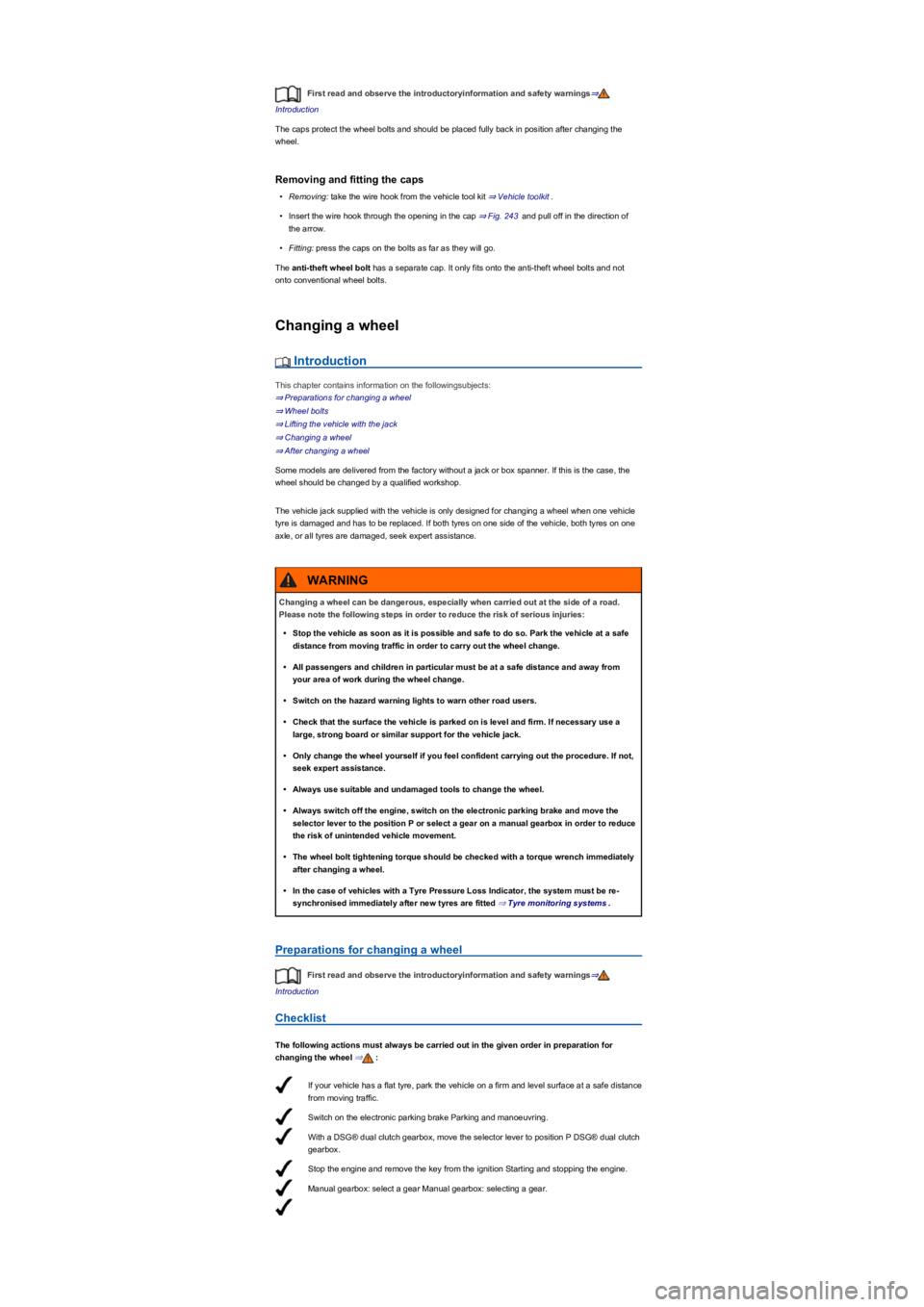
If your vehicle has a flat tyre, park the vehicle on a firm and level surface at a safe distance
from moving traffic.
Switch on the electronic parking brake Parking and manoeuvring.
With a DSG® dual clutch gearbox, move the selector lever to position P DSG® dual clutch
gearbox.
Stop the engine and remove the key from the ignition Starting and stopping the engine.
Manual gearbox: select a gear Manual gearbox: selecting a gear.
First read and observe the introductoryinformation and safety warnings⇒
Introduction
The caps protect the wheel bolts and should be placed fully back in position after changing the
wheel.
Removing and fitting the caps
•Removing: take the wire hook from the vehicle tool kit ⇒ Vehicle toolkit.
•Insert the wire hook through the opening in the cap ⇒ Fig. 243 and pull off in the direction of
the arrow.
•Fitting: press the caps on the bolts as far as they will go.
The anti-theft wheel bolt has a separate cap. It only fits onto the anti-theft wheel bolts and not
onto conventional wheel bolts.
Changing a wheel
Introduction
This chapter contains information on the followingsubjects:
⇒ Preparations for changing a wheel
⇒ Wheel bolts
⇒ Lifting the vehicle with the jack
⇒ Changing a wheel
⇒ After changing a wheel
Some models are delivered from the factory without a jack or box spanner. If this is the case, the
wheel should be changed by a qualified workshop.
The vehicle jack supplied with the vehicle is only designed for changing a wheel when one vehicle
tyre is damaged and has to be replaced. If both tyres on one side of the vehicle, both tyres on one
axle, or all tyres are damaged, seek expert assistance.
Preparations for changing a wheel
First read and observe the introductoryinformation and safety warnings⇒
Introduction
Checklist
The following actions must always be carried out in the given order in preparation for
changing the wheel ⇒:
Changing a wheel can be dangerous, especially when carried out at the side of a road.
Please note the following steps in order to reduce the risk of serious injuries:
•Stop the vehicle as soon as it is possible and safe to do so. Park the vehicle at a safe
distance from moving traffic in order to carry out the wheel change.
•All passengers and children in particular must be at a safe distance and away from
your area of work during the wheel change.
•Switch on the hazard warning lights to warn other road users.
•Check that the surface the vehicle is parked on is level and firm. If necessary use a
large, strong board or similar support for the vehicle jack.
•Only change the wheel yourself if you feel confident carrying out the procedure. If not,
seek expert assistance.
•Always use suitable and undamaged tools to change the wheel.
•Always switch off the engine, switch on the electronic parking brake and move the
selector lever to the position P or select a gear on a manual gearbox in order to reduce
the risk of unintended vehicle movement.
•The wheel bolt tightening torque should be checked with a torque wrench immediately
after changing a wheel.
•In the case of vehicles with a Tyre Pressure Loss Indicator, the system must be re-
synchronised immediately after new tyres are fitted ⇒ Tyre monitoring systems.
WARNING
Page 310 of 341
Crank the jack further until the wheel is just clear of the ground.
Changing a wheel
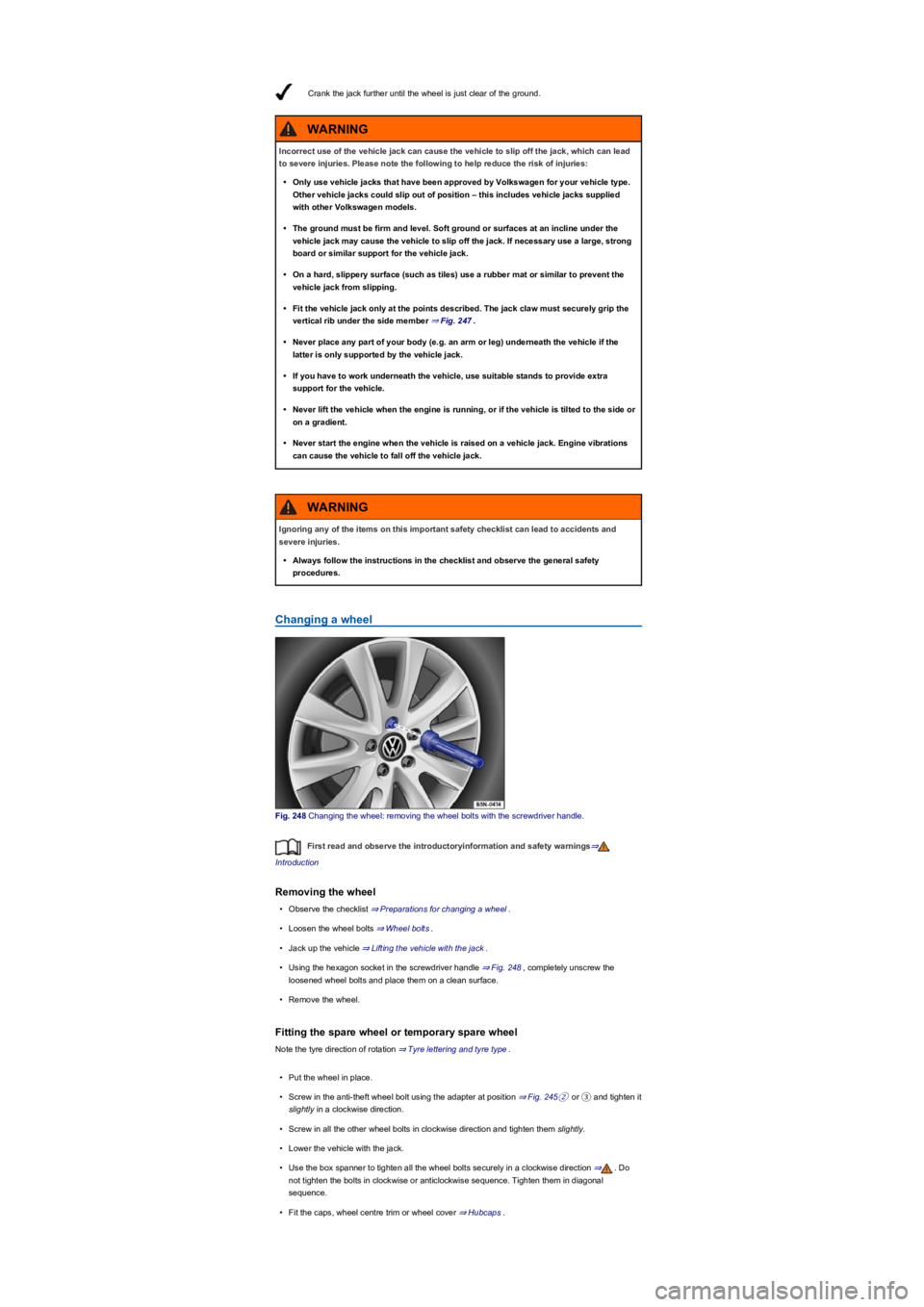
Fig. 248 Changing the wheel: removing the wheel bolts with the screwdriver handle.
First read and observe the introductoryinformation and safety warnings⇒
Introduction
Removing the wheel
•Observe the checklist ⇒ Preparations for changing a wheel.
•Loosen the wheel bolts ⇒ Wheel bolts.
•Jack up the vehicle ⇒ Lifting the vehicle with the jack.
•Using the hexagon socket in the screwdriver handle ⇒ Fig. 248, completely unscrew the
loosened wheel bolts and place them on a clean surface.
•Remove the wheel.
Fitting the spare wheel or temporary spare wheel
Note the tyre direction of rotation ⇒ Tyre lettering and tyre type.
•Put the wheel in place.
•Screw in the anti-theft wheel bolt using the adapter at position ⇒ Fig. 245② or ③ and tighten it
slightly in a clockwise direction.
•Screw in all the other wheel bolts in clockwise direction and tighten them slightly.
•Lower the vehicle with the jack.
•Use the box spanner to tighten all the wheel bolts securely in a clockwise direction ⇒. Do
not tighten the bolts in clockwise or anticlockwise sequence. Tighten them in diagonal
sequence.
•Fit the caps, wheel centre trim or wheel cover ⇒ Hubcaps.
Incorrect use of the vehicle jack can cause the vehicle to slip off the jack, which can lead
to severe injuries. Please note the following to help reduce the risk of injuries:
•Only use vehicle jacks that have been approved by Volkswagen for your vehicle type.
Other vehicle jacks could slip out of position – this includes vehicle jacks supplied
with other Volkswagen models.
•The ground must be firm and level. Soft ground or surfaces at an incline under the
vehicle jack may cause the vehicle to slip off the jack. If necessary use a large, strong
board or similar support for the vehicle jack.
•On a hard, slippery surface (such as tiles) use a rubber mat or similar to prevent the
vehicle jack from slipping.
•Fit the vehicle jack only at the points described. The jack claw must securely grip the
vertical rib under the side member ⇒ Fig. 247.
•Never place any part of your body (e.g. an arm or leg) underneath the vehicle if the
latter is only supported by the vehicle jack.
•If you have to work underneath the vehicle, use suitable stands to provide extra
support for the vehicle.
•Never lift the vehicle when the engine is running, or if the vehicle is tilted to the side or
on a gradient.
•Never start the engine when the vehicle is raised on a vehicle jack. Engine vibrations
can cause the vehicle to fall off the vehicle jack.
WARNING
Ignoring any of the items on this important safety checklist can lead to accidents and
severe injuries.
•Always follow the instructions in the checklist and observe the general safety
procedures.
WARNING
Page 312 of 341
Dispose of used or out-of-date sealant in accordance with legal requirements.
You can get a new tyre filler bottle from a Volkswagen dealership.
Observe the separate instructions from the manufacturer of the breakdown set.
Contents of the breakdown set
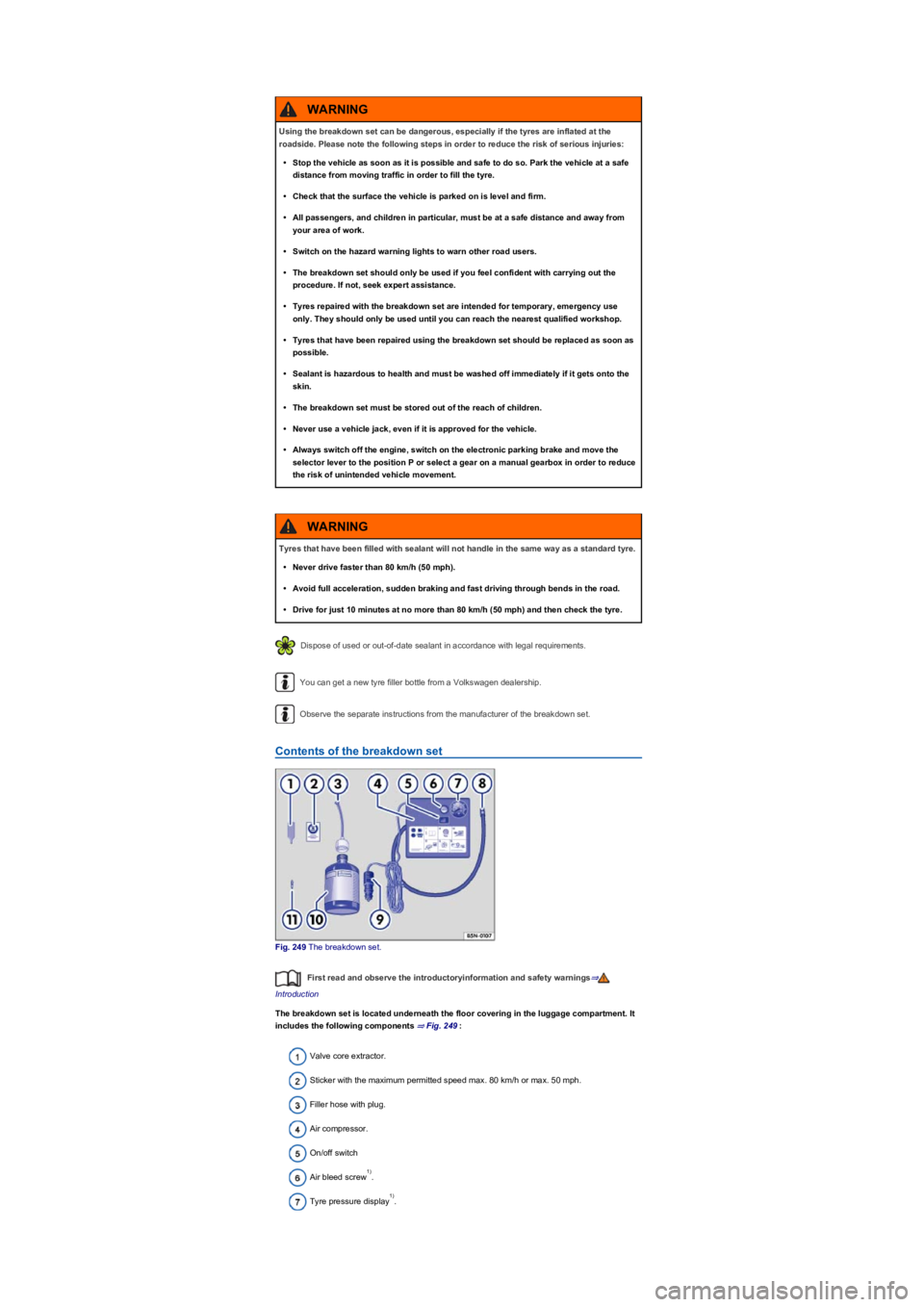
Fig. 249 The breakdown set.
First read and observe the introductoryinformation and safety warnings⇒
Introduction
The breakdown set is located underneath the floor covering in the luggage compartment. It
includes the following components ⇒ Fig. 249:
Valve core extractor.
Sticker with the maximum permitted speed max. 80 km/h or max. 50 mph.
Filler hose with plug.
Air compressor.
On/off switch
Air bleed screw.
Tyre pressure display.
Using the breakdown set can be dangerous, especially if the tyres are inflated at the
roadside. Please note the following steps in order to reduce the risk of serious injuries:
•Stop the vehicle as soon as it is possible and safe to do so. Park the vehicle at a safe
distance from moving traffic in order to fill the tyre.
•Check that the surface the vehicle is parked on is level and firm.
•All passengers, and children in particular, must be at a safe distance and away from
your area of work.
•Switch on the hazard warning lights to warn other road users.
•The breakdown set should only be used if you feel confident with carrying out the
procedure. If not, seek expert assistance.
•Tyres repaired with the breakdown set are intended for temporary, emergency use
only. They should only be used until you can reach the nearest qualified workshop.
•Tyres that have been repaired using the breakdown set should be replaced as soon as
possible.
•Sealant is hazardous to health and must be washed off immediately if it gets onto the
skin.
•The breakdown set must be stored out of the reach of children.
•Never use a vehicle jack, even if it is approved for the vehicle.
•Always switch off the engine, switch on the electronic parking brake and move the
selector lever to the position P or select a gear on a manual gearbox in order to reduce
the risk of unintended vehicle movement.
WARNING
Tyres that have been filled with sealant will not handle in the same way as a standard tyre.
•Never drive faster than 80 km/h (50 mph).
•Avoid full acceleration, sudden braking and fast driving through bends in the road.
•Drive for just 10 minutes at no more than 80 km/h (50 mph) and then check the tyre.
WARNING
1)
1)
Page 314 of 341
•Insert the 12-volt plug ⇒ Fig. 249⑨ into one of the vehicle's 12-volt sockets ⇒ Electrical
sockets.
•Use the on/off switch ⇒ Fig. 249⑤ to switch on the air compressor.
•Run the air compressor until the tyre pressure has reached 2.0 – 2.5 bar (29 – 36 psi /
200 – 250 kPa) ⇒. The maximum running time is eight minutes⇒.
•Switch off the air compressor.
•If a pressure level of 2.0 – 2.5 bar (29 – 36 psi / 200 – 250 kPa) cannot be achieved, unscrew
the tyre filler hose from the tyre valve.
•Drive (or reverse) the vehicle approximately ten metres so that the sealing compound is more
evenly distributed in the tyre.
•Screw the tyre filler hose for the air compressor firmly back onto the tyre valve and inflate the
tyre again.
•If the required pressure still cannot be reached, the tyre is too badly damaged. The tyre cannot
be sealed with the breakdown set. Do not drive on. Seek expert assistance ⇒.
•Disconnect the air compressor and unscrew the tyre filler hose from the tyre valve.
•Drive the vehicle no faster than 80 km/h (50 mph) if a tyre pressure of 2.0 – 2.5 bar (29 – 36 psi
/ 200 – 250 kPa) has been reached.
•Check the tyre pressure after driving for ten minutes⇒ Test after driving for 10 minutes.
Test after driving for 10 minutes
First read and observe the introductoryinformation and safety warnings⇒
Introduction
Reconnect the tyre filler hose ⇒ Fig. 249⑧ and read off the tyre pressure on the tyre pressure
display ⑦.
1.3 bar (19 psi / 130 kPa) and lower:
•Do not drive on! The tyre cannot be sealed adequately with the breakdown set.
•Seek expert assistance ⇒.
1.4 bar (20 psi / 140 kPa) and higher:
•Adjust the tyre pressure back to the correct value ⇒ Useful information about wheels and tyres.
•Resume your journey to the nearest qualified workshop. Do not exceed a maximum speed of
80 km/h (50 mph).
•The damaged tyre should be replaced at the qualified workshop.
Maintenance
Service
Service work and digital service schedule
The vehicle data attached to the inside cover of this owner's manual help ensure that you can
have the correct Volkswagen Genuine Parts installed in your vehicle whenever required. The data
also determine which type of service applies to your vehicle.
The tyre filler hose and the air compressor can get hot during inflation.
•Protect your hands and skin from the hot components.
•Do not place the hot tyre filler hose or the hot air compressor on any inflammable
materials.
•Allow the device to cool down fully before stowing.
•If the tyre will not inflate to at least 2.0 bar (29 psi / 200 kPa), the tyre is too damaged.
The sealant is unable to seal the tyre. Do not drive on. Seek expert assistance.
WARNING
Switch the air compressor off after a maximum of 8 minutes to avoid overheating. Let the
air compressor cool down for a few minutes before switching it back on.
NOTICE
Driving with an unsealed tyre is dangerous as it can cause accidents and serious injuries.
•Do not carry on driving if the tyre pressure is 1.3 bar (19 psi / 130 kPa) or lower.
•Seek expert assistance.
WARNING
®
Page 319 of 341
Suitable accessories are available from your Volkswagen dealership. Follow the usage
instructions on the packaging.
Washing the vehicle
Also wash the underside of the vehicle on a regular basis to remove road salt or seawater residue.
Automatic car washes
Always observe all the car wash operator's specifications, in particular if your vehicle features add-
on parts ⇒.
•Preferably use car washes without brushes.
•Preclean the vehicle by rinsing with water.
•The steering column must not lock when driving through automatic car washes ⇒ Steering.
•Always switch off the Auto Hold function ⇒ Electronic parking brake, the wipers ⇒ Wipers and
the rain/light sensor before entering the car wash.
•Fold in the exterior mirrors.
•If your vehicle has decorative and protective films, do not select a wash program with hot wax.
High-pressure cleaners
Observe the manufacturer's information for the high-pressure cleaner. Never use rotating nozzles
⇒.
•Only use water with a maximum temperature of +60°C (+140°F).
•Do not clean windows that are iced over or covered in snow with a high-pressure cleaner.
•Move the jet of water uniformly so that the nozzle is at least 50 cm away from the side windows
and other vehicle components.
•Do not point the water jet at the same location for too long. Instead, leave stubborn dirt to soak.
•If possible, do not direct the water jet at seals, e.g. side windows, decorative trim, tyres, rubber
hoses, insulation materials or any other sensitive components, e.g. door locks.
•Sensors, camera lenses, and decorative and protective films should be sprayed directly only for
brief periods of time.
Washing the car by hand
Washing the car by hand is always the more gentle way to clean it. However, there are also some
things to note for this ⇒.
•Before washing the vehicle, soak the dirt with plenty of water and then rinse it off thoroughly.
•Clean the vehicle with a soft sponge, a wash mitt or a brush applying only light pressure. Start
with the roof and work from the top to the bottom.
•Rinse the sponge, wash mitt or brush thoroughly at regular short intervals.
•Clean the wheels, sill panels etc. last. Use a second sponge for this.
Use a shampoo for very stubborn dirt only.
Car care products can be toxic and hazardous. Unsuitable care products and incorrect use
of care products can cause accidents, serious injuries, burns or poisoning.
•Care products must be kept in the original, sealed container only.
•Read the manufacturer's instructions.
•Never use empty food cans, bottles or other containers for storing care products.
•Keep children away from care products.
•The products can give off harmful fumes during use. They should therefore only be
used outside or in well-ventilated spaces.
•Never use fuel, turpentine, engine oil, nail varnish remover or other volatile fluids to
wash, clean or care for your vehicle. These substances are toxic and highly
inflammable.
WARNING
Stains, dirt and other deposits containing aggressive and solvent-based ingredients attack
the material and may cause irreparable damage, even if only left for a short time.
•Stains, dirt and other deposits should always be removed as quickly as possible and
not allowed to dry in.
•Have stubborn stains removed by a qualified workshop.
NOTICE
1)
Page 320 of 341
Waxing
Waxing protects the paintwork. At the latest when water no longer clearly forms small drops and
runs off the paintwork when the vehicle is clean, you should re-wax the vehicle with a good wax
solution.
Even if a preservative wax is applied regularly in the automatic car wash, Volkswagen recommends
protecting the vehicle paintwork at least twice a year using Volkswagen Genuine hard wax (-
000 096 317 -).
Polishing
Polishing is only necessary if the paint has lost its shine, and the gloss cannot be brought back by
applying wax.
Wash the vehicle only in specially provided wash bays This prevents waste water
contaminated with oil, grease or fuel from entering the sewerage system.
Caring for and cleaning the vehicle exterior
Fig. 251 Between the engine compartment and the windscreen: plenum chamber (illustration).
Fig. 252 In the rear of the vehicle: rear view camera in the Volkswagen badge or in the number
plate lighting.
The following overview contains recommendations for cleaning and care of individual vehicle
components ⇒.
Windows, glass surfaces: remove wax residue, e.g. from care products, using the Volkswagen
Genuine cleaning cloth - 000 096 166 A - or a suitable glass cleaner.
Use a hand brush to remove snow and ice. If you use a plastic scraper, move it in one direction
only.
After the car has been washed, the braking effect could set in later than normal and extend
the braking distance as the brake discs and brake pads will be wet, or iced up in winter.
•You can dry and de-ice the brakes by performing careful braking manoeuvres. Ensure
that you do not endanger any other road users or violate any legal regulations when
doing so.
WARNING
Incorrectly washing the vehicle can cause serious damage to the vehicle.
•Always follow the instructions exactly.
•Never wash the vehicle in direct sunshine.
•Never aim a water jet directly at locks, doors or the boot lid in cold weather. The locks
and seals could freeze.
NOTICE
Painted parts and surfaces with a matt finish, unpainted plastic parts, headlight lenses and
tail light clusters can be damaged if the vehicle is not washed correctly.
•Use only brushless car washes for matt-painted surfaces.
•Do not use hard or abrasive brushes.
NOTICE
Page 322 of 341
The durability and colourfastness of decorative and protective films can be affected by
environmental influences such as direct sunlight, moisture, air pollution, stone impact etc.
Decorative films may show signs of wear or ageing after about one to three years, protective films
after about two to three years. In very warm environments, decorative films may fade slightly after
one year and protective films after two.
Mild soap solution: a maximum of two tablespoons of neutral soap diluted in one litre of water.
Vehicle interior care and cleaning
The following overview contains recommendations for cleaning and care of individual vehicle
components ⇒.
Windows: clean with a glass cleaner, then wipe dry with a clean chamois leather or with a lint-free
cloth.
Textiles, microfibre cloth, artificial leather: remove any dirt with Volkswagen Genuine interior
cleaning agent (- 000 096 301 -). Never treat materials with leather care agents, solvents, wax
polish, shoe cream, stain removers or similar substances.
•Dirt particles adhering to surfaces: remove with a vacuum cleaner on a regular basis so that the
material is not permanently damaged by abrasion.
•Grease stains, e.g. oil: use Volkswagen Genuine interior cleaning agent (- 000 096 301 -). Dab
off dissolved grease and colour particles with an absorbent cloth and then treat with water if
necessary.
•Special soiling, e.g. ballpoint pen, nail varnish: use Volkswagen Genuine interior cleaning agent
(- 000 096 301 -) and then treat afterwards with a mild soap solution if necessary.
Natural leather: remove fresh soiling with a cotton cloth and mild soap solution. Do not allow
fluids to seep into the seams.
Treat any dried spots with Volkswagen Genuine leather cleaner (- 000 096 323 -).
Regularly and each time after having finished cleaning, apply care cream with light protection and
impregnating properties. Use a special coloured leather cream if necessary. If the vehicle is parked
outdoors for long periods, you should cover the leather to protect it from direct sunlight.
Never treat leather with solvents, wax polish, shoe cream, stain removers or similar.
•Grease-based soiling, e.g. oil: remove fresh stains with an absorbent cloth.
•Special soiling, e.g. ballpoint pen, nail varnish and dried stains: treat with Volkswagen Genuine
leather cleaner (- 000 096 323 -).
Plastic parts: use a soft, moist cloth.
Remove stubborn stains with a soft cloth and a mild soap solution. If necessary, use a solvent-free
plastic cleaning agent, e.g. Volkswagen Genuine plastic cleaner (- 000 096 314 -).
Trim parts, trim strips made of chrome, aluminium or stainless steel: clean in a dust-free
environment using a clean, soft cloth and a mild soap solution.
Anodised surfaces: do not use chrome cleaning products.
Controls: remove coarse dirt and other dirt that is difficult to reach using a soft brush. Then use a
clean, soft cloth and a mild soap solution. Do not allow liquids to come into contact with control
elements.
The engine compartment of any motor vehicle is a hazardous area. All work in the engine
compartment carries the risk of injury, scalding, accidents and fire.
•Before carrying out any work, ensure that you are familiar with the requisite
procedures and general safety regulations ⇒ In the engine compartment.
•Volkswagen recommends having the work carried out by a qualified workshop.
WARNING
Incorrect cleaning and care may cause vehicle damage.
•Always heed the instructions precisely.
•Do not use any excessively harsh, abrasive cleaning products.
NOTICE
The drains of the plenum chamber may become blocked by leaves and dirt. Water that
does not drain away can enter the vehicle interior.
•Have the area under the perforated cover cleaned by a qualified workshop.
NOTICE
1)
1)
1)
1)
1)
1)
Page 323 of 341
Displays: use a Volkswagen Genuine cleaning cloth (- 000 096 166 A -) with a little water, a
suitable glass cleaner or LCD cleaner. Do not clean displays with a dry cloth.
Rubber seals: clean with a soft, lint-free cloth and plenty of water. Treat with Volkswagen Genuine
rubber care agent (- 000 096 310 -) on a regular basis.
Seat belts: carefully pull the seat belt right out and leave it out ⇒. Remove large particles of dirt
with a soft brush. Clean the seat belt with a mild soap solution. Leave the belt fabric to dry
completely and then allow it to roll up.
Wooden trims: clean with a soft cloth and some mild soap solution.
Cleaning upholstery fabrics
If clothing that is not sufficiently colour-fast, e.g. denim, leaves stains on the seat cushion, this does
not a defect in the cover fabric. The seat padding may contain components for the airbag system
and electrical connections. Seat padding that is damaged, incorrectly cleaned or treated, or that
becomes wet, may cause damage to the vehicle electrical system or trigger a fault in the airbag
system ⇒.
Depending on the equipment, seat cushions with seat heating feature electrical components and
connectors that may be damaged in the event of incorrect cleaning or treatment ⇒. This can
also result in damage to other parts of the vehicle electrics.
•Do not use high-pressure cleaners, steam cleaners or coolant spray.
•Do not switch on the seat heating to dry the seats.
•Do not use washing paste or fine detergent solutions.
•Avoid getting the seat wet.
•In the event of uncertainty, contact a Volkswagen dealership.
Mild soap solution: a maximum of two tablespoons of neutral soap diluted in one litre of water.
Accessories, modifications, repairs and renewal of
parts
Accessories and parts
Volkswagen recommends that you seek advice from a Volkswagen dealership before purchasing
accessories, replacement parts or service fluids, for example if the vehicle is to be retrofitted with
accessories or if parts have to be renewed. Volkswagen dealerships can recommend accessories,
parts and service fluids suitable for your requirements. They can also answer any questions you
might have regarding official regulations.
Volkswagen recommends you use only approved Volkswagen accessories and Volkswagen
Genuine Parts. These parts and accessories have been specially tested by Volkswagen for
suitability, reliability and safety. And Volkswagen dealerships are qualified to install them correctly.
Although the market is constantly scrutinised, Volkswagen cannot assume responsibility for the
reliability, safety and suitability of products Volkswagen has not approved. Volkswagen can
therefore assume no responsibility for these parts, even if they have been approved by an official
testing agency or are covered by an official approval certificate.
Any retro-fitted equipment which has a direct effect on the control of the vehicle must be
approved by Volkswagen for use in your vehicle and bear the e mark (the European Union's
1)
Failure to clean the parts properly can cause damage to the seat belts, the fastenings and
the belt retractor.
•Never use chemical cleaning agents on the seat belts or their components. The seat
belts must also not come into contact with corrosive fluids, solvents or sharp objects.
•Dry the cleaned seat belt fully before allowing it to retract.
•Avoid allowing foreign bodies or liquids to enter the slot for the seat belt buckle.
•Never try to repair, modify or remove the seat belts yourself.
WARNING
Incorrect cleaning and care may cause vehicle damage.
•Sharp objects, such as zips, rivets on clothing or belts may damage surfaces. Open
Velcro fasteners can also cause damage.
•Do not use a steam cleaner, brushes or hard sponges etc. for cleaning under any
circumstances.
•To avoid damage, stubborn stains should be removed by a specialist cleaning
company.
NOTICE
1)
®
Page 324 of 341
authorization symbol). These devices include cruise control systems or an electronically controlled
suspension.
Any additional electrical components fitted that do not serve to control the vehicle itself must
bear the mark (manufacturer conformity declaration in the European Union). Such devices
include refrigerator boxes, laptops and ventilator fans.
Repairs and technical modifications
Repairs and technical modifications must always be carried out according to Volkswagen
specifications⇒.
Unauthorised modifications to the electronic components or software in the vehicle may cause
malfunctions. As the electronic components are linked together in networks, these faults may
indirectly affect the working of other systems. This can seriously impair safety, lead to excessive
wear of components, and also invalidate the type approval for the vehicle.
The Volkswagen dealership cannot be held liable for any damage caused by technical
modifications and/or work performed incorrectly.
The Volkswagen dealership is not responsible for damage caused by technical modifications and/or
work performed incorrectly. Such damage is not covered by the Volkswagen guarantee.
Volkswagen recommends that all repairs and technical modifications be performed by an
authorised Volkswagen workshop using Volkswagen Genuine Parts.
Volkswagen repair information
Volkswagen Service information and official Volkswagen repair information can be purchased for a
fee.
Customers in Europe, Asia, Australia, Africa, Central and South America: please contact a
Volkswagen dealership or qualified workshop or register on the online portal erWin (electronic
repair and workshop information):
https://erwin.volkswagen.de
erWin is available in numerous languages.
Vehicles with special auxiliary equipment or body parts
The manufacturer of these components must ensure that these parts (fittings) adhere to the
stipulated environmental laws and regulations, particularly the EU directive 2000/53/EC concerning
end-of-life vehicles and EU directive 2003/11/EC concerning the restriction on the marketing and
use of certain dangerous substances and preparations.
The vehicle owner should keep all assembly documentation for these auxiliary fittings, and pass it
on to any scrapping company later engaged. This is to facilitate environmentally responsible
disposal for all vehicles, including refitted vehicles.
Windscreen repairs
To function properly, some items of equipment require an electrical or electronic module, which is
located on the inside of the windscreen near the interior mirror. If the windscreen has been
damaged in the viewing field of the electrical or electronic module, e.g. by stone impact, the
windscreen must be replaced. Repairing the crack can lead to malfunctions or functional faults in
the equipment.
After changing the windscreen, the camera and sensors must be set up and calibrated by a
qualified workshop.
Impairment or damage to sensors and cameras
Incorrect repairs, retrofit structural modifications to the vehicle, e.g. lowering the body, add-on parts
on the vehicle or trailer ⇒ Trailer towing, or changes to the trim may lead to the sensors or
cameras being disrupted or damaged. This can also be caused by collisions, e.g. when parking.
Failure to observe this may impair important functions (driver assist systems) and damage the
vehicle.
The area in front of and around the sensors and cameras must not be covered by stickers,
additional headlights, trim frames for number plates or similar.
Incorrectly performed repairs or modifications to your vehicle can impair the effectiveness
of the airbags, cause malfunctions, accidents and fatal injury.
•Never secure or mount objects such as drink holders or telephone holders either on or
next to the airbag covers or within the deployment zones of the airbag modules.
•Objects either on or next to the airbag module covers or are in the deployment zone of
the airbags can cause serious or even fatal injuries should the airbags be activated.
WARNING
®
Page 326 of 341
Mobile communication in the vehicle
Electromagnetic radiation
If a mobile telephone or radio device is used without being connected to the external aerial, the
electromagnetic radiation will not be optimally directed to the outside of the vehicle. Increased
levels of radiation in the vehicle interior can occur in particular in the event of poor reception, e.g. in
rural areas. This could constitute a health hazard ⇒.
Depending on the equipment, you may be able to use a suitable mobile phone interface to connect
the mobile telephone to the external aerial ⇒BookletInfotainment system,. The connection quality is
improved and the range of the mobile communication device is increased.
Using a telephone
Many countries require a hands-free system to be used when using a telephone inside the vehicle,
e.g. via a Bluetooth connection. Before use, secure the mobile telephone to a suitable bracket ⇒
or stow it in a storage compartment so that it cannot slip around, e.g. in the centre console.
Use a compatible mobile telephone if the mobile phone interface uses the remote SIM Access
Profile (rSAP) technology.
Two-way radios
Observe legal regulations and the manufacturer's operating instructions for operation of two-way
radios. Approval is required for retrofitting two-way radio systems.
Ask your Volkswagen dealership for further information on installation of two-way radio systems.
Customer information
Incorrect repairs and modifications can cause malfunctions and damage to the vehicle
and impair the effectiveness of the airbag system. This can result in accidents and serious
or even fatal injuries.
•Repairs and modifications to your vehicle should only be carried out by a qualified
workshop.
•Airbag modules cannot be repaired. They must be replaced.
•Never use recycled airbag components or components that have been taken from end-
of-life vehicles in your vehicle.
WARNING
Modifications to the vehicle's suspension, including the use of unsuitable tyre/rim
combinations, can cause the airbag system to work differently and increase the risk of
serious or fatal injuries in the event of an accident.
•Never install any components in the suspension system that do not have the same
characteristics as the original factory-fitted components.
•Never use tyre/rim combinations that have not been approved by Volkswagen.
WARNING
®
Mobile telephones which are loosely placed in the vehicle or not properly secured could
be flung through the vehicle interior and cause injuries during a sudden driving or braking
manoeuvre, or in the event of an accident.
•Secure any mobile telephones and accessories located beyond the deployment zone of
the airbags, or stow them safely.
WARNING
If mobile telephones or two-way radios that are not connected to an external aerial are
used, electromagnetic radiation in the vehicle could exceed limit values and thus be a
health hazard for drivers and other vehicle occupants. This also applies to external aerials
which have not been correctly installed.
•Keep a distance of at least 20 cm between a device's aerial and an active medical
implant, e.g. a pacemaker.
•Do not carry an operational device close to or directly above an active medical implant,
e.g. in a breast pocket.
•Switch off the device immediately if you suspect it may be interfering with an active
medical implant or any other medical device.
WARNING