Off VOLKSWAGEN TIGUAN 2017 Owner´s Manual
[x] Cancel search | Manufacturer: VOLKSWAGEN, Model Year: 2017, Model line: TIGUAN, Model: VOLKSWAGEN TIGUAN 2017Pages: 341, PDF Size: 9.14 MB
Page 286 of 341
When you start the engine after the 12-volt battery has been totally discharged or after a
successful jump start, you may find that system settings (time, date, personal convenience settings
and programming) have been changed or deleted. Check and correct the settings as necessary
once the 12-volt vehicle battery has been sufficiently charged.
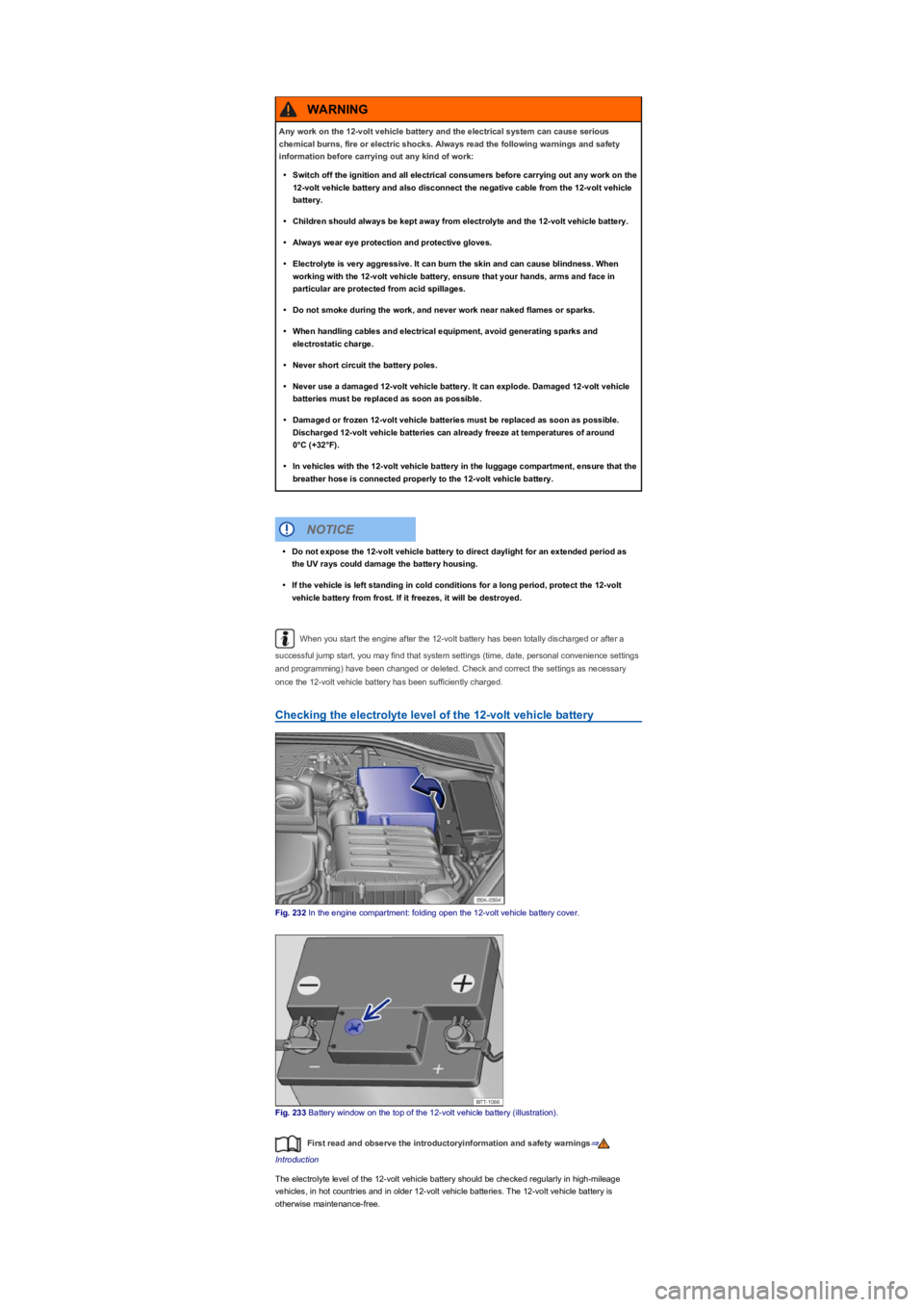
Checking the electrolyte level of the 12-volt vehicle battery
Fig. 232 In the engine compartment: folding open the 12-volt vehicle battery cover.
Fig. 233 Battery window on the top of the 12-volt vehicle battery (illustration).
First read and observe the introductoryinformation and safety warnings⇒
Introduction
The electrolyte level of the 12-volt vehicle battery should be checked regularly in high-mileage
vehicles, in hot countries and in older 12-volt vehicle batteries. The 12-volt vehicle battery is
otherwise maintenance-free.
Any work on the 12-volt vehicle battery and the electrical system can cause serious
chemical burns, fire or electric shocks. Always read the following warnings and safety
information before carrying out any kind of work:
•Switch off the ignition and all electrical consumers before carrying out any work on the
12-volt vehicle battery and also disconnect the negative cable from the 12-volt vehicle
battery.
•Children should always be kept away from electrolyte and the 12-volt vehicle battery.
•Always wear eye protection and protective gloves.
•Electrolyte is very aggressive. It can burn the skin and can cause blindness. When
working with the 12-volt vehicle battery, ensure that your hands, arms and face in
particular are protected from acid spillages.
•Do not smoke during the work, and never work near naked flames or sparks.
•When handling cables and electrical equipment, avoid generating sparks and
electrostatic charge.
•Never short circuit the battery poles.
•Never use a damaged 12-volt vehicle battery. It can explode. Damaged 12-volt vehicle
batteries must be replaced as soon as possible.
•Damaged or frozen 12-volt vehicle batteries must be replaced as soon as possible.
Discharged 12-volt vehicle batteries can already freeze at temperatures of around
0°C (+32°F).
•In vehicles with the 12-volt vehicle battery in the luggage compartment, ensure that the
breather hose is connected properly to the 12-volt vehicle battery.
WARNING
•Do not expose the 12-volt vehicle battery to direct daylight for an extended period as
the UV rays could damage the battery housing.
•If the vehicle is left standing in cold conditions for a long period, protect the 12-volt
vehicle battery from frost. If it freezes, it will be destroyed.
NOTICE
Page 288 of 341
•Switch off all electrical consumers and the ignition.
•Unlock the vehicle before disconnecting the battery in order to avoid triggering the anti-theft
alarm.
•First disconnect the negative cable and then the positive cable ⇒.
Connecting the 12-volt vehicle battery
•Switch off all electrical consumers and the ignition before reconnecting the 12-volt vehicle
battery.
•First reconnect the positive cable and then the negative cable ⇒.
Various indicator lamps may light up after the 12-volt vehicle battery has been connected and the
ignition is switched on. They will go out if you drive a short distance at a speed of approximately
15 – 20 km/h (10 – 12 mph). If the indicator lamps remain lit up, the vehicle should be checked by a
qualified workshop.
If the 12-volt vehicle battery was disconnected for an extended period, the system may not able to
calculate or correctly display the time when the next service is due ⇒ Instrument cluster. Observe
the maximum permissible service intervals ⇒ Service.
Vehicles with Keyless Access:⇒ Central locking system: if the ignition cannot be switched on after
connecting the 12-volt vehicle battery, lock and unlock the vehicle from the outside. Then try to start
the ignition again. Please contact an expert if the ignition cannot be switched on.
Automatic switch-off for electrical consumers
The intelligent vehicle electrical system management automatically implements a range of
measures to prevent the 12-volt battery from discharging under high loads:
•The idling speed is increased so that the alternator provides more electricity.
•The performance of large electrical consumers may be reduced or they may be switched off
completely.
•The power supply to the 12-volt socket and the cigarette lighter is interrupted temporarily while
the engine is being started.
The vehicle electrical system management function cannot always prevent the 12-volt vehicle
battery from discharging. For example when the ignition is switched on for an extended period with
the engine off, or when the side or parking lights are on when the vehicle is parked for an extended
period.
Battery switch-off in an accident in which the airbag is triggered
In vehicles with 12-volt vehicle battery in the luggage compartment, the electrical connection to the
12-volt vehicle battery is disconnected pyrotechnically in the event of an accident in which the
airbags are triggered. This prevents short-circuiting.
What can cause the 12-volt vehicle battery to discharge?
•Long periods at a standstill in which the engine is not running, especially if the ignition is
switched on.
•The use of electrical consumers when the engine is switched off.
•When the auxiliary heater is being used ⇒ Auxiliary heater and ventilation.
Page 289 of 341
Dispose of the 12-volt vehicle battery in accordance with the regulations. 12-volt vehicle
batteries may contain toxic substances such as sulphuric acid and lead.
Electrolyte can pollute the environment. Clean up any service fluid leakages and dispose of
them properly.
Troubleshooting
First read and observe the introductoryinformation and safety warnings⇒
Introduction
12-volt vehicle battery
Fault in the alternator. Go to a qualified workshop. Have the electrical system checked. Switch
off any electrical consumers that are not required. The 12-volt vehicle battery will not be charged by
the alternator while the vehicle is in motion. The start/stop system cannot start the engine.
⇒ Start/stop system
Wheels and tyres
Tyre monitoring systems
Introduction
This chapter contains information on the followingsubjects:
⇒ Types of tyre monitoring systems
⇒ Tyre Pressure Loss Indicator
⇒ Tyre Pressure Monitoring System
⇒ Troubleshooting for the Tyre Pressure Loss Indicator
⇒ Troubleshooting for the Tyre Pressure Monitoring System
The tyre monitoring system warns the
driver when the tyre pressures get too
low.
Incorrectly securing the battery and using incorrect 12-volt vehicle batteries can cause
short circuits, fire and serious injuries.
•Always use maintenance-free and leak-proof 12-volt vehicle batteries that have the
same properties, specifications and dimensions as the factory-fitted 12-volt vehicle
battery.
•In vehicles with the 12-volt vehicle battery in the luggage compartment, ensure that the
breather hose is connected properly to the 12-volt vehicle battery. Make sure that no
open gas discharge openings are located in the area around the positive battery
terminal. If there is an open breather opening in this area, it must be closed off with a
sealing plug. The breather hose must be connected to the open breather opening in the
area of the negative terminal.
WARNING
A highly explosive mixture of gases is given off when the 12-volt vehicle battery is being
charged.
•12-volt vehicle batteries should only be charged in well-ventilated spaces.
•Never charge a 12-volt vehicle battery that is frozen or that has thawed. Discharged 12-
volt vehicle batteries can already freeze at temperatures of around 0°C (+32°F).
•The 12-volt vehicle battery must be replaced if it has ever been frozen.
•Incorrectly connected cables can cause a short circuit. First connect the positive cable
and then the negative cable.
WARNING
•Never connect or disconnect 12-volt vehicle batteries if the ignition is switched on or
the engine is running. Never use a 12-volt vehicle battery that does not correspond with
the vehicle's specifications. This can damage the electrical system or electronic
components, which can cause electrical faults.
•Never connect equipment that supplies electric power, such as solar panels or a
battery charger, to the 12-volt socket or to the cigarette lighter to charge the 12-volt
vehicle battery. This can damage the vehicle electrical system.
NOTICE
Page 290 of 341
If the tyre pressure is too low, this will increase fuel consumption and tyre wear.
When new tyres are driven at high speeds for the first time, they can expand slightly and
trigger a one-off pressure warning.
Old tyres should only be replaced by tyres that have been approved by Volkswagen for the
vehicle type.
Do not rely solely on the tyre monitoring system. Check your tyres regularly to ensure that
they are properly inflated and have no signs of damage, such as punctures, cuts, cracks, and
blisters. Remove any objects that become embedded in the tyre tread but have not penetrated into
the body of the tyre itself.
Types of tyre monitoring systems
First read and observe the introductoryinformation and safety warnings⇒
Introduction
There are two different tyre monitoring systems available for this vehicle. Their differing features are
described below:
Tyre Pressure Loss Indicator
•Monitoring of various parameters (for example rolling circumference) of all wheels using ABS
sensors (indirect measurement).
Tyre Pressure Monitoring System
•Monitoring of the tyre pressure by means of pressure sensors on each tyre valve (direct
measurement). Tyre valve made of metal.
Tyre Pressure Loss Indicator
First read and observe the introductoryinformation and safety warnings⇒
Introduction
Functional description
The Tyre Pressure Loss Indicator uses data from the ABS sensors and other functions to check the
speed of rotation and the rolling circumference of the individual wheels.
The rolling circumference can change:
•If the tyre pressure has been changed.
•If the tyre pressure is too low.
•If the tyre has structural damage.
•If the vehicle is loaded more heavily on one side.
•If snow chains have been fitted.
•If a temporary spare wheel has been fitted.
•If one wheel per axle has been changed.
The Tyre Pressure Loss Indicator may react with a delay or not display anything at all in the
event of a sporty driving style, when driving on snow-covered or icy roads or unpaved roads or
when driving with snow chains.
Synchronising the Tyre Pressure Loss Indicator
•Switch on the ignition.
•Press the button or function button, depending on version ⇒ Vehicle settings menu.
The intelligent tyre monitoring system technology cannot overcome the laws of physics,
and functions only within the limits of the system. Incorrect handling of the wheels and
tyres can lead to a sudden loss of pressure in the tyres, tread separation and even tyre
blow-out.
•Check tyre pressures regularly and always maintain the specified tyre pressure value
⇒ Tyre pressure. If the tyre pressure is too low, it is possible that the tyre temperature
will increase to such an extent that the tread peels off and the tyre bursts.
•Always maintain the correct cold tyre pressure as specified on the sticker ⇒ Tyre
pressure.
•Check the tyre pressure regularly when the tyres are cold. If necessary, adjust the tyre
pressure in the cold tyre to the recommended tyre pressure for the tyres installed on
your vehicle ⇒ Tyre pressure.
•Check your tyres regularly for signs of wear or damage.
•Never exceed the top speed and load permitted for the fitted tyres.
WARNING
Page 291 of 341
•Open the Vehicle settings menu in the Infotainment system.
•Touch the Tyres function button.
•Touch the SET function button.
•When all four tyre pressures correspond to the required values, touch the Confirm function
button.
After an extended driving time with driving at different speeds, the system will automatically learn
the new values and monitor them.
•If the tyre pressures have been changed.
•If one or more wheels have been changed.
•If the wheels have been swapped round, e.g. from front to rear ⇒ Rotating wheels front to rear.
The Tyre Pressure Loss Indicator stops working if there is a fault in the ESC or ABS ⇒ Brake
support systems.
After a warning about the tyre pressure being too low, switch the ignition off and then back
on again. The Tyre Pressure Loss Indicator can only then be re-synchronised.
Tyre Pressure Monitoring System
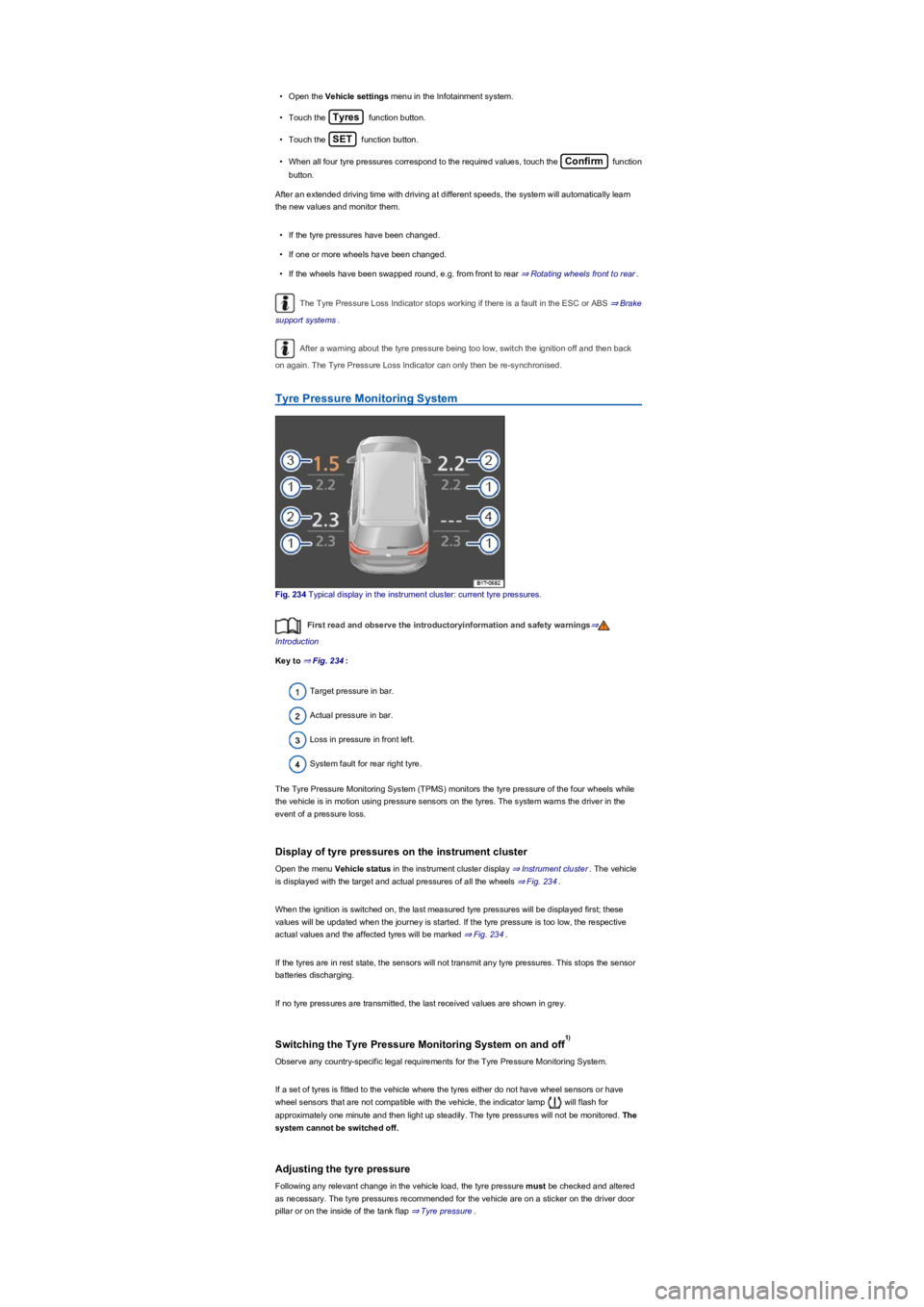
Fig. 234 Typical display in the instrument cluster: current tyre pressures.
First read and observe the introductoryinformation and safety warnings⇒
Introduction
Key to ⇒ Fig. 234:
Target pressure in bar.
Actual pressure in bar.
Loss in pressure in front left.
System fault for rear right tyre.
The Tyre Pressure Monitoring System (TPMS) monitors the tyre pressure of the four wheels while
the vehicle is in motion using pressure sensors on the tyres. The system warns the driver in the
event of a pressure loss.
Display of tyre pressures on the instrument cluster
Open the menu Vehicle status in the instrument cluster display ⇒ Instrument cluster. The vehicle
is displayed with the target and actual pressures of all the wheels ⇒ Fig. 234.
When the ignition is switched on, the last measured tyre pressures will be displayed first; these
values will be updated when the journey is started. If the tyre pressure is too low, the respective
actual values and the affected tyres will be marked ⇒ Fig. 234.
If the tyres are in rest state, the sensors will not transmit any tyre pressures. This stops the sensor
batteries discharging.
If no tyre pressures are transmitted, the last received values are shown in grey.
Switching the Tyre Pressure Monitoring System on and off
Observe any country-specific legal requirements for the Tyre Pressure Monitoring System.
If a set of tyres is fitted to the vehicle where the tyres either do not have wheel sensors or have
wheel sensors that are not compatible with the vehicle, the indicator lamp will flash for
approximately one minute and then light up steadily. The tyre pressures will not be monitored. The
system cannot be switched off.
Adjusting the tyre pressure
Following any relevant change in the vehicle load, the tyre pressure must be checked and altered
as necessary. The tyre pressures recommended for the vehicle are on a sticker on the driver door
pillar or on the inside of the tank flap ⇒ Tyre pressure.
1)
Page 292 of 341
There may be differences between readings on the pressure gauge when filling the tyres and the
values determined by the Tyre Pressure Monitoring System. The Tyre Pressure Monitoring System
is more precise.
Selecting target pressures for partial or full vehicle load
The driver must select the appropriate target pressure depending on the vehicle load level.
•Switch on the ignition.
•Press the button or function button, depending on version ⇒ Vehicle settings menu.
•Touch the Vehicle status function button.
•Touch the Settings function button.
•Select the Tyres menu option.
•Select the load level.
Selecting the tyre type
While the dimensions of the tyres are changed, it may be necessary to adjust the target pressure
for the new tyres. If no adjustment is necessary, the selection menu will not be available.
•Switch on the ignition.
•Press the button or function button, depending on version ⇒ Vehicle settings menu.
•Touch the Vehicle status function button.
•Touch the Settings function button.
•Select the Tyres menu option.
•Select the appropriate tyre size.
If the tyre sizes are fitted that do not correspond to the factory-specified sizes, the corresponding
target tyre pressures can be entered by a Volkswagen dealer.
Spare wheel or temporary spare wheel
The tyre pressure of the spare wheel or the temporary spare wheel in the luggage compartment is
not monitored.
Depends on the vehicle.
Troubleshooting for the Tyre Pressure Loss Indicator
First read and observe the introductoryinformation and safety warnings⇒
Introduction
Lit up
•Do not drive on!
•Check and adjust all tyre pressures ⇒ Tyre pressure.
•The damaged tyre should be replaced.
•Re-synchronise the Tyre Pressure Loss Indicator ⇒ Tyre Pressure Loss Indicator.
•If the problem persists, seek expert assistance.
Flashes
•Do not drive on!
•Switch the ignition off and then back on again.
•Re-synchronise the Tyre Pressure Loss Indicator ⇒ Tyre Pressure Loss Indicator.
•If the problem persists, seek expert assistance.
•The pressure sensors are secured to special aluminium valves that are screwed rigidly
in place. When inflating the tyres and checking the pressure, do not bend the valves
into position.
•Missing valve caps could lead to damage to the valve and the sensors. Always make
sure that all valve caps are fully screwed on. Do not use metal valve caps.
•Do not use convenience valve caps as they do not form a proper seal. This can cause
damage to the sensors.
NOTICE
1)
Page 293 of 341
Driving on unpaved roads for long periods, or a sporty driving style, can temporarily
deactivate the Tyre Pressure Loss Indicator. The indicator lamp shows the malfunction, but
disappears if the road conditions or driving style change.
Troubleshooting for the Tyre Pressure Monitoring System
First read and observe the introductoryinformation and safety warnings⇒
Introduction
Lit up
•Do not drive on!
•Check all wheels for exterior damage or foreign bodies that have entered the tyres.
•Check the tyre pressure for all tyres ⇒ Tyre pressure.
•Change the wheel or drive at a low speed to the nearest qualified workshop.
•Check and adjust the tyre pressure for all tyres ⇒ Tyre pressure.
•Change the wheel or drive at a low speed to the nearest qualified workshop.
•Avoid long journeys and high speeds as long as the warning is displayed.
•Check ⇒ Tyre pressure and adjust the tyre pressure for all tyres.
Flashes
•Switch off or avoid any disruptive sources, e.g. two-way radios, remote controls or children's
toys.
•Switch the ignition off and then back on again. If the problem persists, seek expert assistance.
Differing tyre pressures or tyre pressures that are too low can cause tyre damage, tyre
failure, loss of vehicle control, accidents, serious injury and death.
•If the indicator lamp lights up, stop the vehicle as soon as possible and check all
the tyres ⇒ Useful information about wheels and tyres.
•Different tyre pressures or tyre pressures that are too low can increase wear on the
tyres, reduce vehicle stability and increase the braking distance.
•Differing tyre pressures or tyre pressures that are too low can cause sudden tyre
failure and lead to a tyre bursting and the loss of control over the vehicle.
•The driver is responsible for the correct tyre pressure of all tyres on the vehicle. The
recommended tyre pressure can be found on a sticker ⇒ Tyre pressure.
•The tyre monitoring system cannot function correctly until all cold tyres have the
correct tyre pressure.
•The pressure in all tyres must always be appropriate to the vehicle load ⇒ Tyre
pressure.
•Always inflate all tyres to the correct tyre pressure before every journey ⇒ Tyre
pressure.
•If the vehicle is driven with insufficient tyre pressure, this results in greater tyre flexing.
This could warm up the tyre to such an extent that the tread may separate and the tyre
could burst. This could cause the driver to lose control of the vehicle.
•High speeds and overloading of the vehicle may cause the tyres to heat up to such an
extent that the tyre bursts, leading you to lose control of the vehicle.
•If the tyre pressure is too low or too high, the tyres will wear prematurely and the
vehicle will not handle well.
•If the tyre is not flat and it is not necessary to change the wheel immediately, drive at
low speed to the nearest qualified workshop and check and correct the tyre pressure
⇒ Useful information about wheels and tyres.
WARNING
Page 295 of 341
Handling wheels and tyres
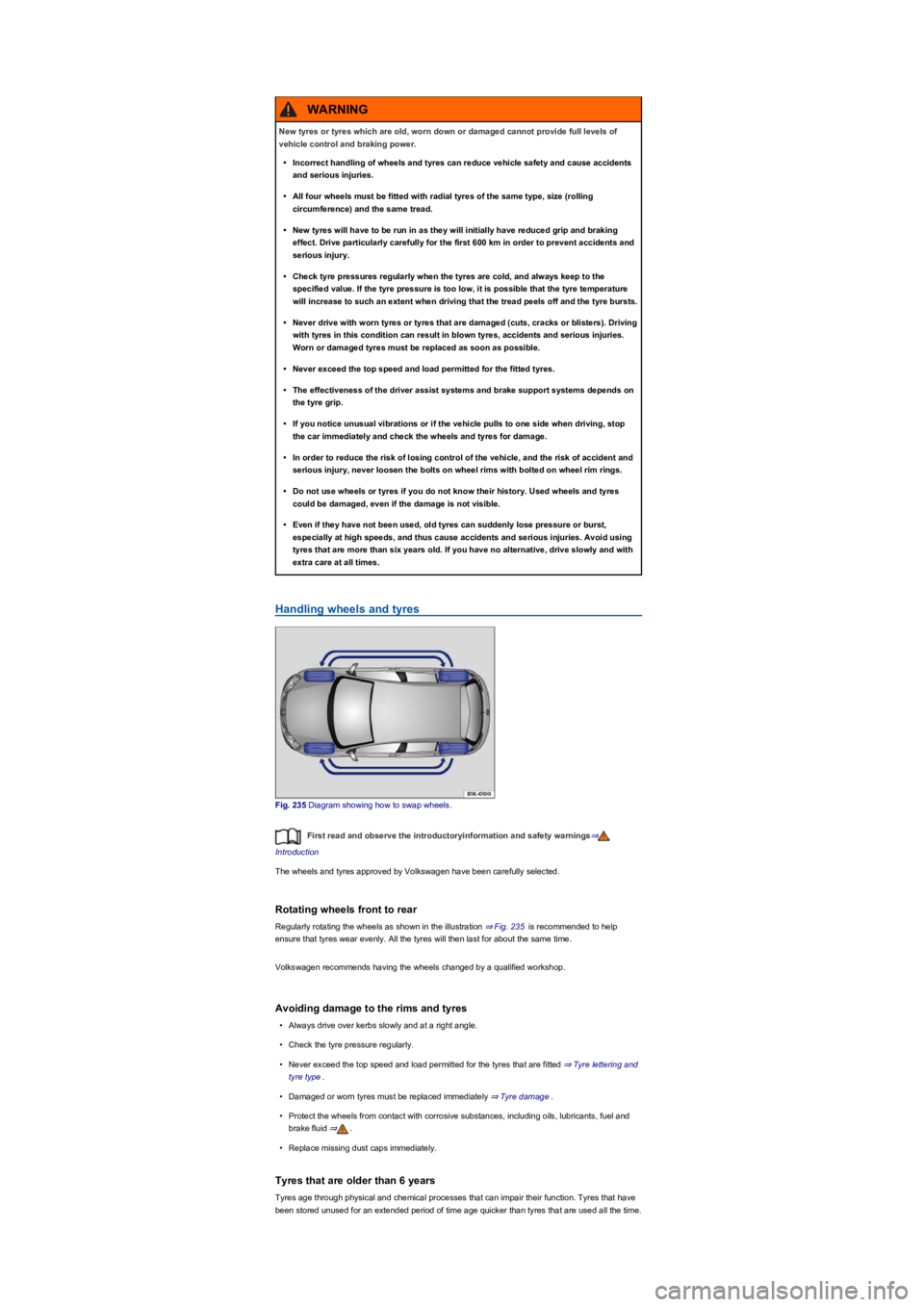
Fig. 235 Diagram showing how to swap wheels.
First read and observe the introductoryinformation and safety warnings⇒
Introduction
The wheels and tyres approved by Volkswagen have been carefully selected.
Rotating wheels front to rear
Regularly rotating the wheels as shown in the illustration ⇒ Fig. 235 is recommended to help
ensure that tyres wear evenly. All the tyres will then last for about the same time.
Volkswagen recommends having the wheels changed by a qualified workshop.
Avoiding damage to the rims and tyres
•Always drive over kerbs slowly and at a right angle.
•Check the tyre pressure regularly.
•Never exceed the top speed and load permitted for the tyres that are fitted ⇒ Tyre lettering and
tyre type.
•Damaged or worn tyres must be replaced immediately ⇒ Tyre damage.
•Protect the wheels from contact with corrosive substances, including oils, lubricants, fuel and
brake fluid ⇒.
•Replace missing dust caps immediately.
Tyres that are older than 6 years
Tyres age through physical and chemical processes that can impair their function. Tyres that have
been stored unused for an extended period of time age quicker than tyres that are used all the time.
New tyres or tyres which are old, worn down or damaged cannot provide full levels of
vehicle control and braking power.
•Incorrect handling of wheels and tyres can reduce vehicle safety and cause accidents
and serious injuries.
•All four wheels must be fitted with radial tyres of the same type, size (rolling
circumference) and the same tread.
•New tyres will have to be run in as they will initially have reduced grip and braking
effect. Drive particularly carefully for the first 600 km in order to prevent accidents and
serious injury.
•Check tyre pressures regularly when the tyres are cold, and always keep to the
specified value. If the tyre pressure is too low, it is possible that the tyre temperature
will increase to such an extent when driving that the tread peels off and the tyre bursts.
•Never drive with worn tyres or tyres that are damaged (cuts, cracks or blisters). Driving
with tyres in this condition can result in blown tyres, accidents and serious injuries.
Worn or damaged tyres must be replaced as soon as possible.
•Never exceed the top speed and load permitted for the fitted tyres.
•The effectiveness of the driver assist systems and brake support systems depends on
the tyre grip.
•If you notice unusual vibrations or if the vehicle pulls to one side when driving, stop
the car immediately and check the wheels and tyres for damage.
•In order to reduce the risk of losing control of the vehicle, and the risk of accident and
serious injury, never loosen the bolts on wheel rims with bolted on wheel rim rings.
•Do not use wheels or tyres if you do not know their history. Used wheels and tyres
could be damaged, even if the damage is not visible.
•Even if they have not been used, old tyres can suddenly lose pressure or burst,
especially at high speeds, and thus cause accidents and serious injuries. Avoid using
tyres that are more than six years old. If you have no alternative, drive slowly and with
extra care at all times.
WARNING
Page 299 of 341
•Always check the tyre pressure when the tyres are cold. The specified tyre pressure applies to
cold tyres. Tyre pressure is always higher in warm tyres than it is in cold tyres. For this reason,
never reduce the pressure in warm tyres to adjust the tyre pressure.
•Always adjust the tyre pressure to the load level ⇒ Fig. 236④.
•After adjusting the tyre pressures, always screw the caps onto the valves and observe the
information on the tyre monitoring system ⇒ Tyre monitoring systems.
•Always use the tyre pressure specified on the sticker. Never exceed the maximum tyre pressure
which is given on the sidewall of the tyre
Underinflated tyres will result in increased fuel consumption.
Tread depth and wear indicators
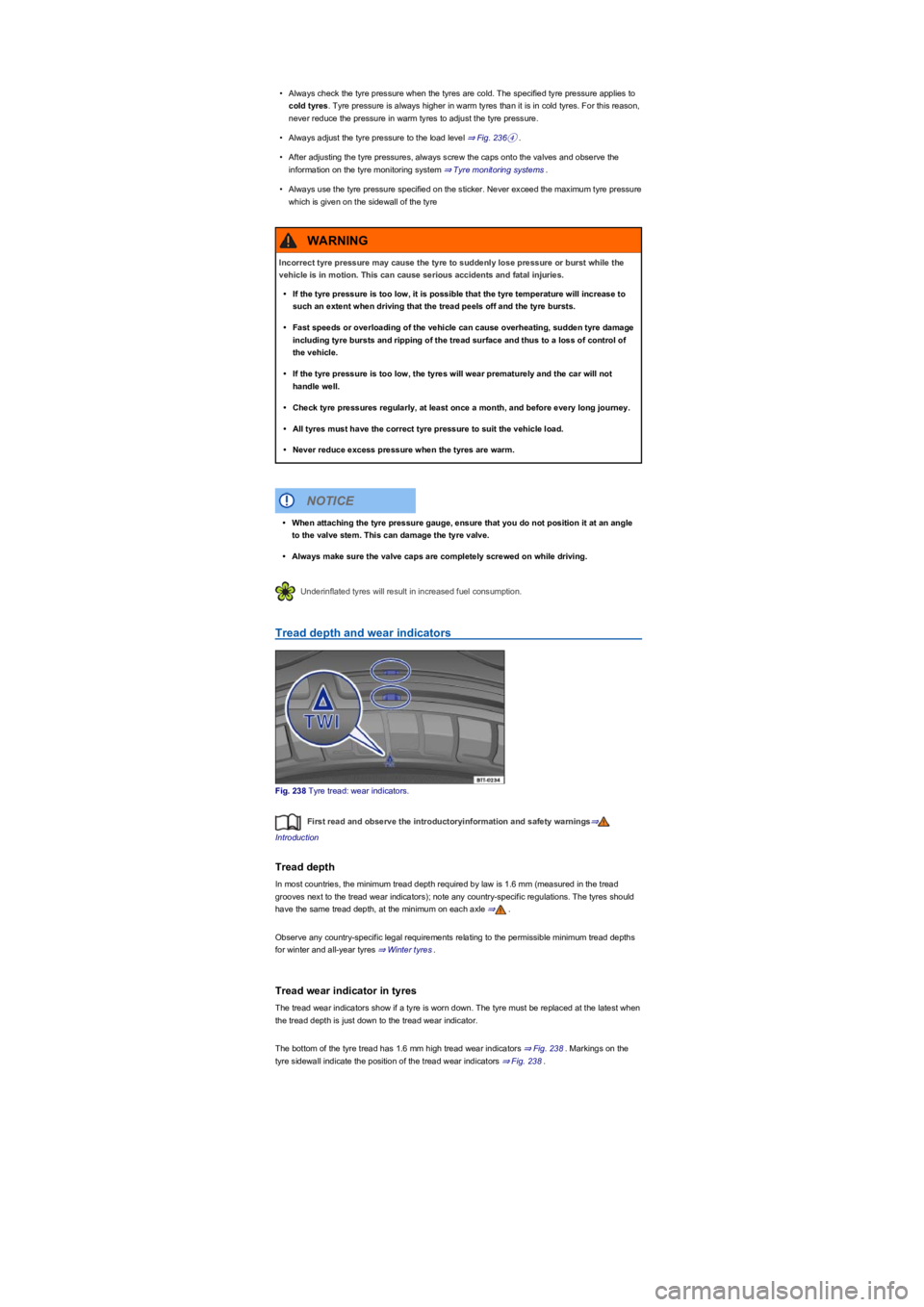
Fig. 238 Tyre tread: wear indicators.
First read and observe the introductoryinformation and safety warnings⇒
Introduction
Tread depth
In most countries, the minimum tread depth required by law is 1.6 mm (measured in the tread
grooves next to the tread wear indicators); note any country-specific regulations. The tyres should
have the same tread depth, at the minimum on each axle ⇒.
Observe any country-specific legal requirements relating to the permissible minimum tread depths
for winter and all-year tyres ⇒ Winter tyres.
Tread wear indicator in tyres
The tread wear indicators show if a tyre is worn down. The tyre must be replaced at the latest when
the tread depth is just down to the tread wear indicator.
The bottom of the tyre tread has 1.6 mm high tread wear indicators ⇒ Fig. 238. Markings on the
tyre sidewall indicate the position of the tread wear indicators ⇒ Fig. 238.
Incorrect tyre pressure may cause the tyre to suddenly lose pressure or burst while the
vehicle is in motion. This can cause serious accidents and fatal injuries.
•If the tyre pressure is too low, it is possible that the tyre temperature will increase to
such an extent when driving that the tread peels off and the tyre bursts.
•Fast speeds or overloading of the vehicle can cause overheating, sudden tyre damage
including tyre bursts and ripping of the tread surface and thus to a loss of control of
the vehicle.
•If the tyre pressure is too low, the tyres will wear prematurely and the car will not
handle well.
•Check tyre pressures regularly, at least once a month, and before every long journey.
•All tyres must have the correct tyre pressure to suit the vehicle load.
•Never reduce excess pressure when the tyres are warm.
WARNING
•When attaching the tyre pressure gauge, ensure that you do not position it at an angle
to the valve stem. This can damage the tyre valve.
•Always make sure the valve caps are completely screwed on while driving.
NOTICE
Page 305 of 341
Snow chains
First read and observe the introductoryinformation and safety warnings⇒
Introduction
Please observe legislation and also the maximum permitted speed when driving your vehicle with
snow chains.
On icy or snow-covered roads, snow chains will improve traction and braking response.
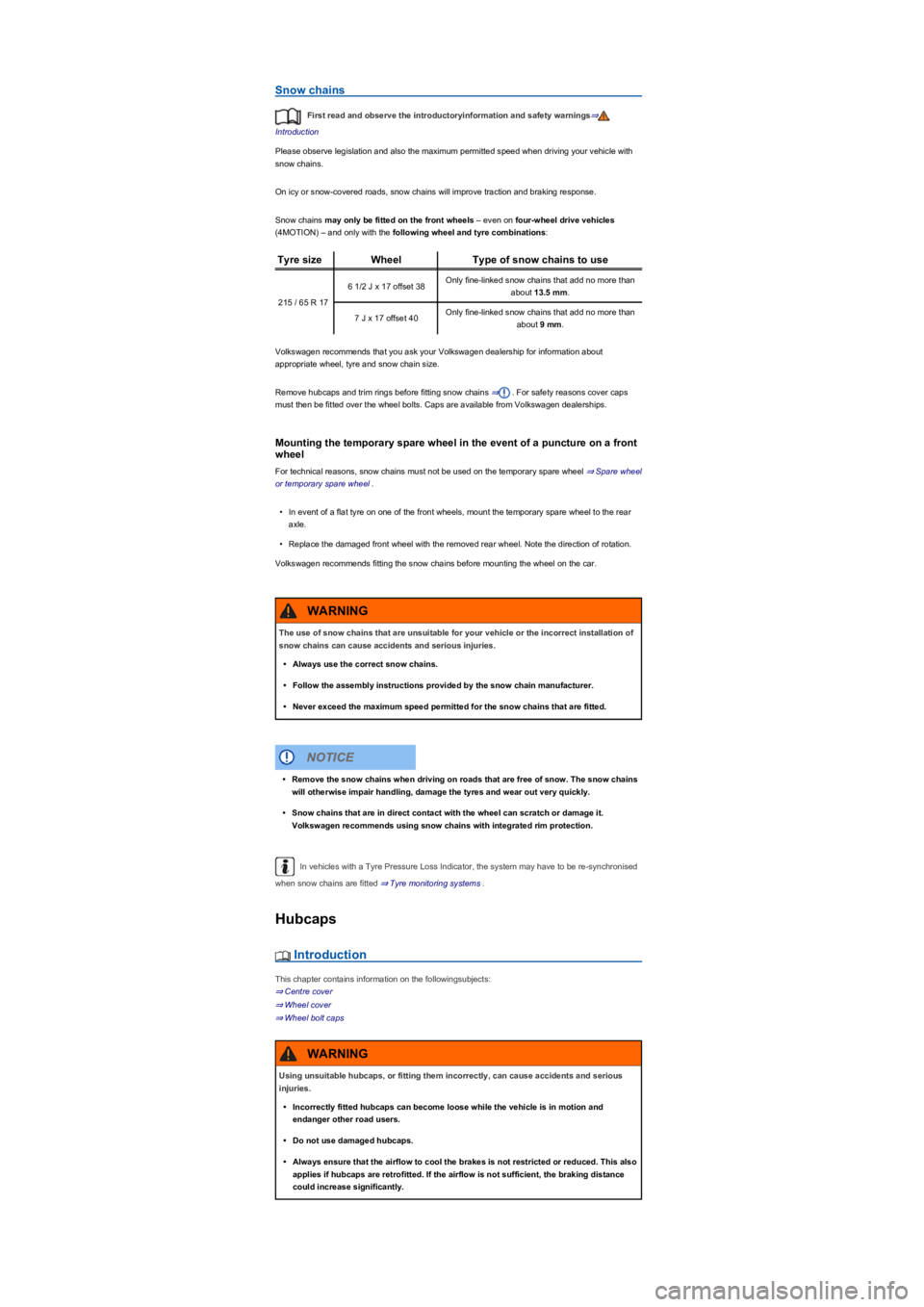
Snow chains may only be fitted on the front wheels – even on four-wheel drive vehicles
(4MOTION) – and only with the following wheel and tyre combinations:
Tyre sizeWheelType of snow chains to use
215 / 65 R 17
6 1/2 J x 17 offset 38Only fine-linked snow chains that add no more than
about 13.5 mm.
7 J x 17 offset 40Only fine-linked snow chains that add no more than
about 9 mm.
Volkswagen recommends that you ask your Volkswagen dealership for information about
appropriate wheel, tyre and snow chain size.
Remove hubcaps and trim rings before fitting snow chains ⇒. For safety reasons cover caps
must then be fitted over the wheel bolts. Caps are available from Volkswagen dealerships.
Mounting the temporary spare wheel in the event of a puncture on a front
wheel
For technical reasons, snow chains must not be used on the temporary spare wheel ⇒ Spare wheel
or temporary spare wheel.
•In event of a flat tyre on one of the front wheels, mount the temporary spare wheel to the rear
axle.
•Replace the damaged front wheel with the removed rear wheel. Note the direction of rotation.
Volkswagen recommends fitting the snow chains before mounting the wheel on the car.
In vehicles with a Tyre Pressure Loss Indicator, the system may have to be re-synchronised
when snow chains are fitted ⇒ Tyre monitoring systems.
Hubcaps
Introduction
This chapter contains information on the followingsubjects:
⇒ Centre cover
⇒ Wheel cover
⇒ Wheel bolt caps
The use of snow chains that are unsuitable for your vehicle or the incorrect installation of
snow chains can cause accidents and serious injuries.
•Always use the correct snow chains.
•Follow the assembly instructions provided by the snow chain manufacturer.
•Never exceed the maximum speed permitted for the snow chains that are fitted.
WARNING
•Remove the snow chains when driving on roads that are free of snow. The snow chains
will otherwise impair handling, damage the tyres and wear out very quickly.
•Snow chains that are in direct contact with the wheel can scratch or damage it.
Volkswagen recommends using snow chains with integrated rim protection.
NOTICE
Using unsuitable hubcaps, or fitting them incorrectly, can cause accidents and serious
injuries.
•Incorrectly fitted hubcaps can become loose while the vehicle is in motion and
endanger other road users.
•Do not use damaged hubcaps.
•Always ensure that the airflow to cool the brakes is not restricted or reduced. This also
applies if hubcaps are retrofitted. If the airflow is not sufficient, the braking distance
could increase significantly.
WARNING