children VOLKSWAGEN TIGUAN 2017 Owner´s Manual
[x] Cancel search | Manufacturer: VOLKSWAGEN, Model Year: 2017, Model line: TIGUAN, Model: VOLKSWAGEN TIGUAN 2017Pages: 341, PDF Size: 9.14 MB
Page 86 of 341
Remove leaves and other loose items from the glass roof guide rails at regular intervals
using a vacuum cleaner, or by hand.
The roll-back function will not work properly if there is a malfunction with the glass roof. Go to
a qualified workshop.
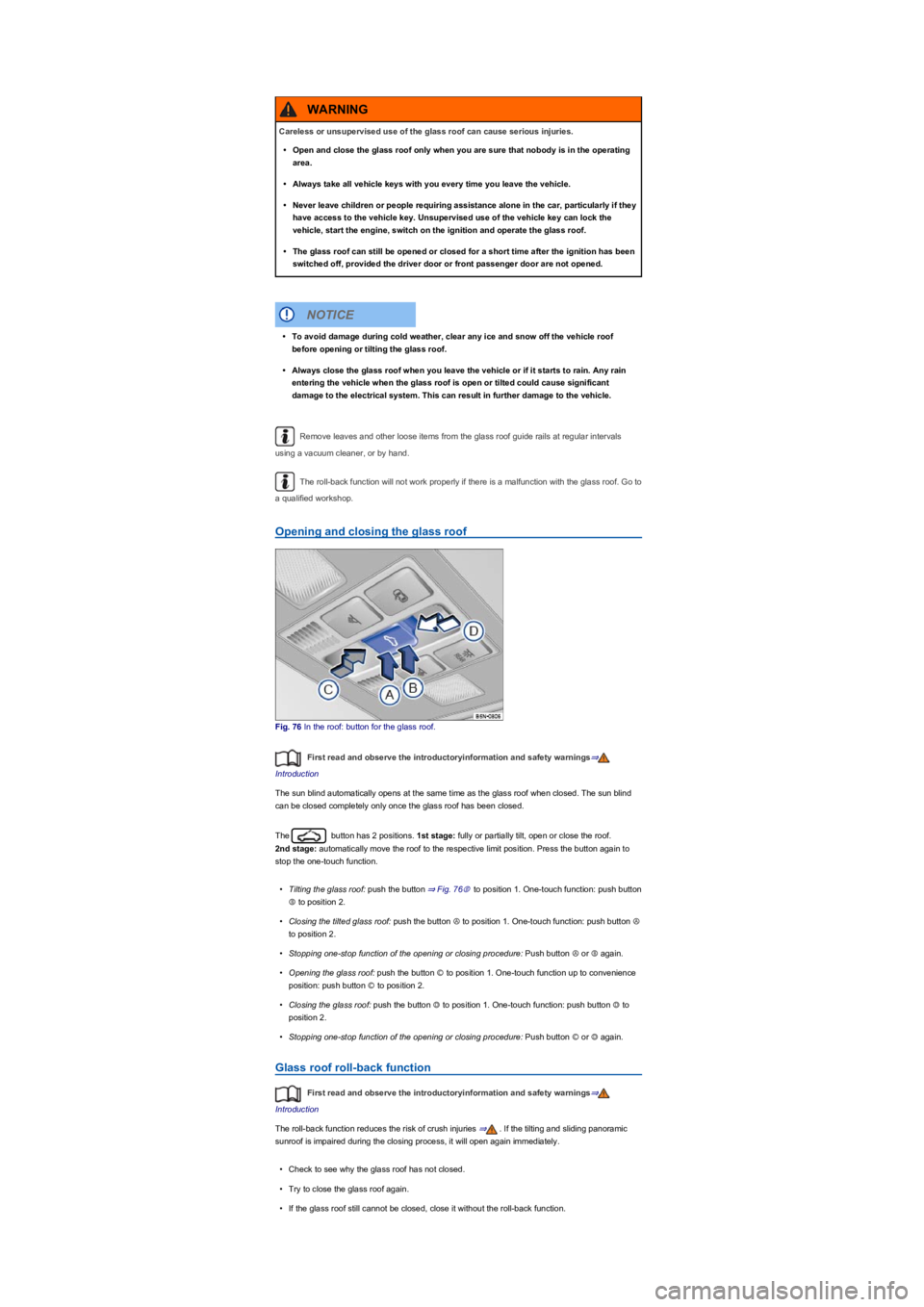
Opening and closing the glass roof
Fig. 76 In the roof: button for the glass roof.
First read and observe the introductoryinformation and safety warnings⇒
Introduction
The sun blind automatically opens at the same time as the glass roof when closed. The sun blind
can be closed completely only once the glass roof has been closed.
The button has 2 positions. 1st stage: fully or partially tilt, open or close the roof.
2nd stage: automatically move the roof to the respective limit position. Press the button again to
stop the one-touch function.
•Tilting the glass roof: push the button ⇒ Fig. 76Ⓑ to position 1. One-touch function: push button
Ⓑ to position 2.
•Closing the tilted glass roof: push the button Ⓐ to position 1. One-touch function: push button Ⓐ
to position 2.
•Stopping one-stop function of the opening or closing procedure: Push button Ⓐ or Ⓑ again.
•Opening the glass roof: push the button Ⓒ to position 1. One-touch function up to convenience
position: push button Ⓒ to position 2.
•Closing the glass roof: push the button Ⓓ to position 1. One-touch function: push button Ⓓ to
position 2.
•Stopping one-stop function of the opening or closing procedure: Push button Ⓒ or Ⓓ again.
Glass roof roll-back function
First read and observe the introductoryinformation and safety warnings⇒
Introduction
The roll-back function reduces the risk of crush injuries ⇒. If the tilting and sliding panoramic
sunroof is impaired during the closing process, it will open again immediately.
•Check to see why the glass roof has not closed.
•Try to close the glass roof again.
•If the glass roof still cannot be closed, close it without the roll-back function.
Careless or unsupervised use of the glass roof can cause serious injuries.
•Open and close the glass roof only when you are sure that nobody is in the operating
area.
•Always take all vehicle keys with you every time you leave the vehicle.
•Never leave children or people requiring assistance alone in the car, particularly if they
have access to the vehicle key. Unsupervised use of the vehicle key can lock the
vehicle, start the engine, switch on the ignition and operate the glass roof.
•The glass roof can still be opened or closed for a short time after the ignition has been
switched off, provided the driver door or front passenger door are not opened.
WARNING
•To avoid damage during cold weather, clear any ice and snow off the vehicle roof
before opening or tilting the glass roof.
•Always close the glass roof when you leave the vehicle or if it starts to rain. Any rain
entering the vehicle when the glass roof is open or tilted could cause significant
damage to the electrical system. This can result in further damage to the vehicle.
NOTICE
Page 91 of 341
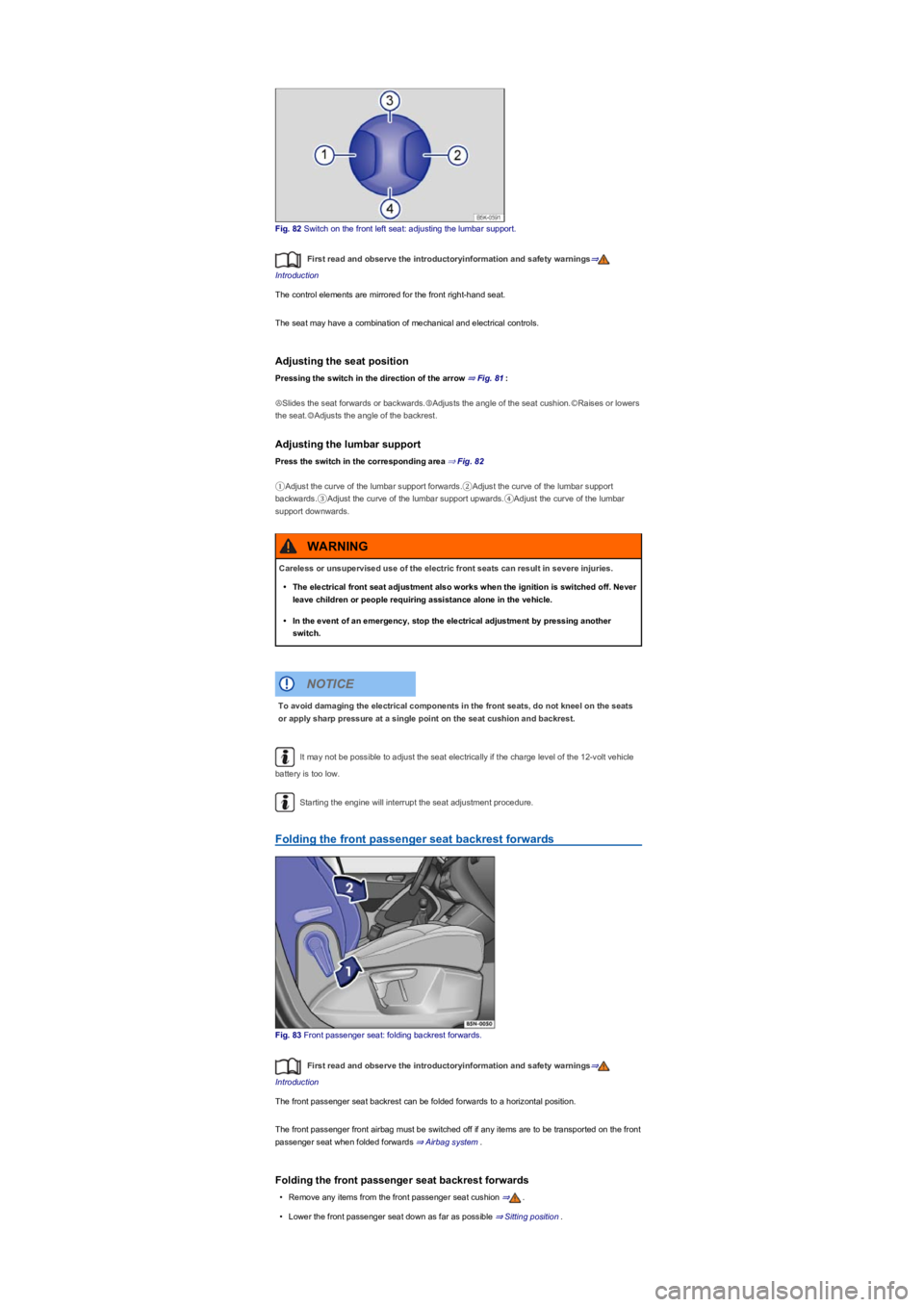
Fig. 82 Switch on the front left seat: adjusting the lumbar support.
First read and observe the introductoryinformation and safety warnings⇒
Introduction
The control elements are mirrored for the front right-hand seat.
The seat may have a combination of mechanical and electrical controls.
Adjusting the seat position
Pressing the switch in the direction of the arrow ⇒ Fig. 81:
ⒶSlides the seat forwards or backwards.ⒷAdjusts the angle of the seat cushion.ⒸRaises or lowers
the seat.ⒹAdjusts the angle of the backrest.
Adjusting the lumbar support
Press the switch in the corresponding area ⇒ Fig. 82
①Adjust the curve of the lumbar support forwards.②Adjust the curve of the lumbar support
backwards.③Adjust the curve of the lumbar support upwards.④Adjust the curve of the lumbar
support downwards.
It may not be possible to adjust the seat electrically if the charge level of the 12-volt vehicle
battery is too low.
Starting the engine will interrupt the seat adjustment procedure.
Folding the front passenger seat backrest forwards
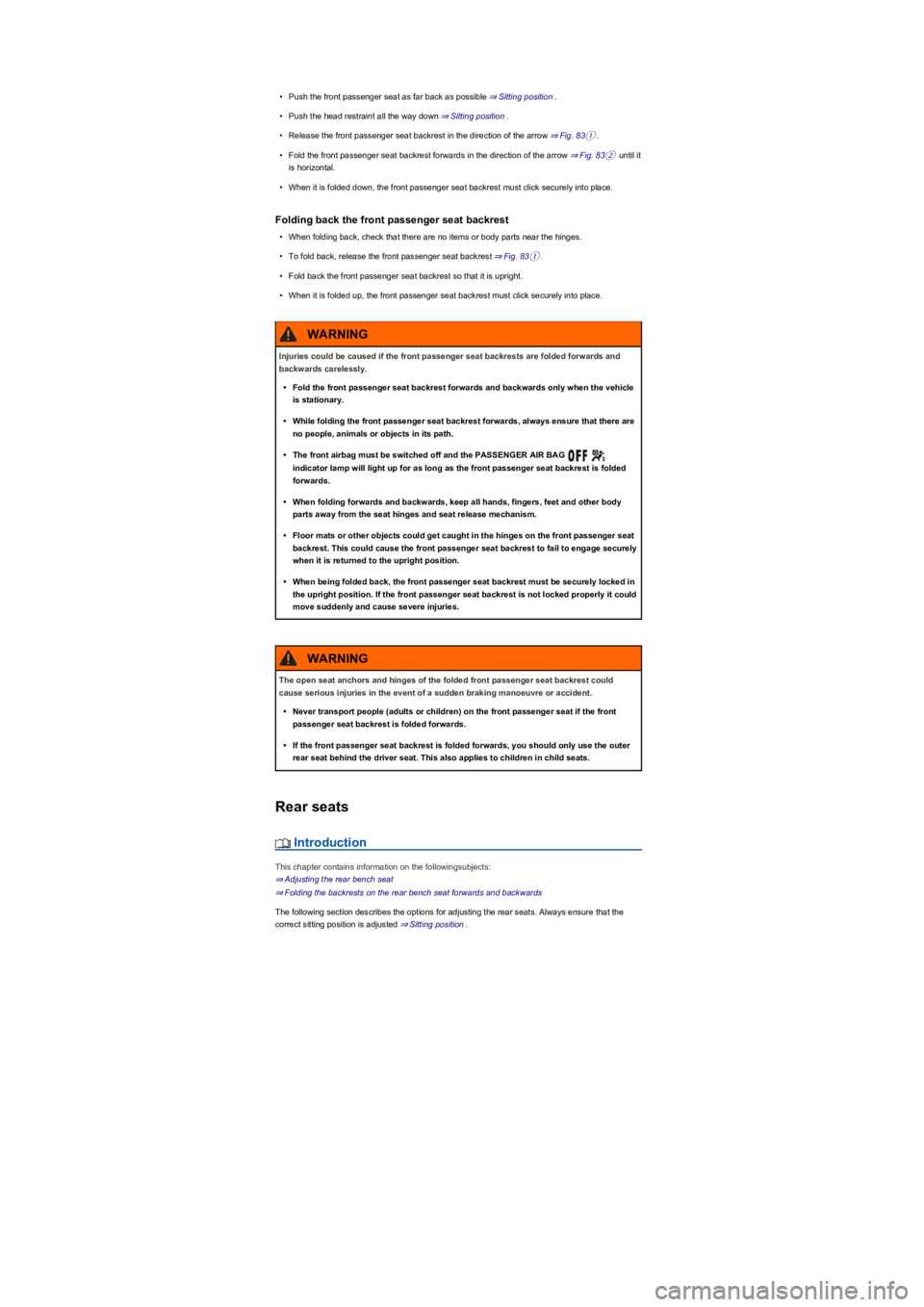
Fig. 83 Front passenger seat: folding backrest forwards.
First read and observe the introductoryinformation and safety warnings⇒
Introduction
The front passenger seat backrest can be folded forwards to a horizontal position.
The front passenger front airbag must be switched off if any items are to be transported on the front
passenger seat when folded forwards ⇒ Airbag system.
Folding the front passenger seat backrest forwards
•Remove any items from the front passenger seat cushion ⇒.
•Lower the front passenger seat down as far as possible ⇒ Sitting position.
Careless or unsupervised use of the electric front seats can result in severe injuries.
•The electrical front seat adjustment also works when the ignition is switched off. Never
leave children or people requiring assistance alone in the vehicle.
•In the event of an emergency, stop the electrical adjustment by pressing another
switch.
WARNING
To avoid damaging the electrical components in the front seats, do not kneel on the seats
or apply sharp pressure at a single point on the seat cushion and backrest.
NOTICE
Page 92 of 341
•Push the front passenger seat as far back as possible ⇒ Sitting position.
•Push the head restraint all the way down ⇒ Sitting position.
•Release the front passenger seat backrest in the direction of the arrow ⇒ Fig. 83①.
•Fold the front passenger seat backrest forwards in the direction of the arrow ⇒ Fig. 83② until it
is horizontal.
•When it is folded down, the front passenger seat backrest must click securely into place.
Folding back the front passenger seat backrest
•When folding back, check that there are no items or body parts near the hinges.
•To fold back, release the front passenger seat backrest ⇒ Fig. 83①.
•Fold back the front passenger seat backrest so that it is upright.
•When it is folded up, the front passenger seat backrest must click securely into place.
Rear seats
Introduction
This chapter contains information on the followingsubjects:
⇒ Adjusting the rear bench seat
⇒ Folding the backrests on the rear bench seat forwards and backwards
The following section describes the options for adjusting the rear seats. Always ensure that the
correct sitting position is adjusted ⇒ Sitting position.
Injuries could be caused if the front passenger seat backrests are folded forwards and
backwards carelessly.
•Fold the front passenger seat backrest forwards and backwards only when the vehicle
is stationary.
•While folding the front passenger seat backrest forwards, always ensure that there are
no people, animals or objects in its path.
•The front airbag must be switched off and the PASSENGER AIR BAG
indicator lamp will light up for as long as the front passenger seat backrest is folded
forwards.
•When folding forwards and backwards, keep all hands, fingers, feet and other body
parts away from the seat hinges and seat release mechanism.
•Floor mats or other objects could get caught in the hinges on the front passenger seat
backrest. This could cause the front passenger seat backrest to fail to engage securely
when it is returned to the upright position.
•When being folded back, the front passenger seat backrest must be securely locked in
the upright position. If the front passenger seat backrest is not locked properly it could
move suddenly and cause severe injuries.
WARNING
The open seat anchors and hinges of the folded front passenger seat backrest could
cause serious injuries in the event of a sudden braking manoeuvre or accident.
•Never transport people (adults or children) on the front passenger seat if the front
passenger seat backrest is folded forwards.
•If the front passenger seat backrest is folded forwards, you should only use the outer
rear seat behind the driver seat. This also applies to children in child seats.
WARNING
Page 95 of 341
Head restraints
Introduction
This chapter contains information on the followingsubjects:
⇒ Adjusting the head restraints
⇒ Removing and fitting head restraints
The following section describes the options for adjusting and removing the head restraints. Always
ensure that the correct sitting position is adjusted ⇒ Sitting position.
Every seat is fitted with a head restraint. The centre head restraint at the rear is designed solely for
use with the centre rear bench seat. Therefore you should not install the head restraint in any of the
other positions.
Correct head restraint setting
Adjust the head restraint so that its upper edge is at the same height as the top of the head, but not
lower than eye level. Position the back of your head as close to the head restraint as possible.
In vehicles with head restraints that can be adjusted in the longitudinal direction, push the head
restraints on the front seats as close as possible to the back of your head.
Head restraint setting for shorter people
Push the head restraint all the way down, even if the head is then underneath the top edge of the
head restraint. There may be a small gap between the head restraint and backrest in the lowest
position.
Head restraint setting for taller people
Push the head restraint up as far as it will go.
Injuries can be caused if the rear backrests are folded forwards and backwards carelessly.
•While folding the rear backrest, always make sure that no people, animals or items are
in the path.
•Never fold the rear seat backrest forwards or backwards while the vehicle is in motion.
•Ensure that the seat belt is not trapped or damaged when folding back the rear seat
backrest.
•Always keep hands, fingers, feet or other body parts away from the seat area when
folding the rear seat backrest forwards and backwards.
•Ensure that the rear seat backrest engages securely, otherwise the seat belts for the
rear seats will not work properly. This applies to the centre seat of the rear bench seat
in particular. If a seat is occupied and the rear seat backrest has not engaged securely
into place, the seat occupant and rear seat backrest may move forwards in the event of
a sudden braking or driving manoeuvre or during accidents.
•Passengers (adults and children) must not use seats if the backrest is folded forwards
or is not clicked securely into place.
WARNING
Damage to the vehicle or to other objects could be caused if the rear bench seat backrest
is folded forwards and backwards in an uncontrolled way or without taking appropriate
care.
•Before folding the rear seat backrests forwards, always adjust the front seats so that
the rear head restraints or rear seat backrest cushions do not rub against the front
seats.
•Before folding down the rear seat backrest, always ensure that there are no objects
located in its path.
NOTICE
Page 100 of 341
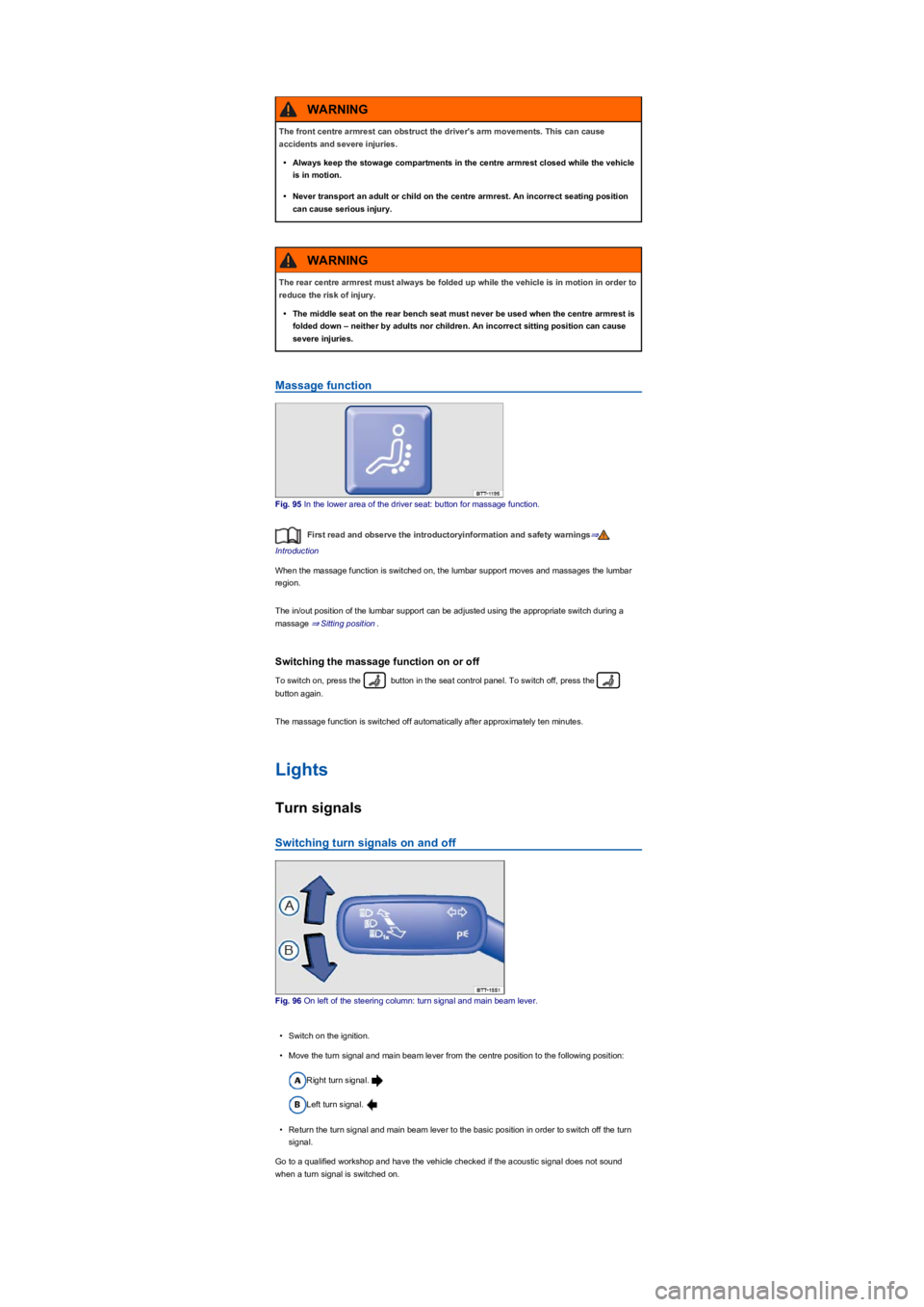
Massage function
Fig. 95 In the lower area of the driver seat: button for massage function.
First read and observe the introductoryinformation and safety warnings⇒
Introduction
When the massage function is switched on, the lumbar support moves and massages the lumbar
region.
The in/out position of the lumbar support can be adjusted using the appropriate switch during a
massage ⇒ Sitting position.
Switching the massage function on or off
To switch on, press the button in the seat control panel. To switch off, press the
button again.
The massage function is switched off automatically after approximately ten minutes.
Lights
Turn signals
Switching turn signals on and off
Fig. 96 On left of the steering column: turn signal and main beam lever.
•Switch on the ignition.
•Move the turn signal and main beam lever from the centre position to the following position:
Right turn signal.
Left turn signal.
•Return the turn signal and main beam lever to the basic position in order to switch off the turn
signal.
Go to a qualified workshop and have the vehicle checked if the acoustic signal does not sound
when a turn signal is switched on.
The front centre armrest can obstruct the driver's arm movements. This can cause
accidents and severe injuries.
•Always keep the stowage compartments in the centre armrest closed while the vehicle
is in motion.
•Never transport an adult or child on the centre armrest. An incorrect seating position
can cause serious injury.
WARNING
The rear centre armrest must always be folded up while the vehicle is in motion in order to
reduce the risk of injury.
•The middle seat on the rear bench seat must never be used when the centre armrest is
folded down – neither by adults nor children. An incorrect sitting position can cause
severe injuries.
WARNING
Page 127 of 341
•Lever open the battery cover in upward direction using the object.
•Push the battery cover slightly in the direction of the arrow.
•Remove the battery cover.
•Remove the button cell.
•Insert a new button cell of the same type, paying attention to the correct polarity.
•Insert the battery in the housing of the remote control.
•Push the battery cover in the opposite direction to the arrow ⇒ Fig. 112 until it engages.
Dispose of discharged batteries in accordance with regulations governing the protection of
the environment.
The battery in the remote control may contain perchlorate. Please comply with legislation
regarding disposal.
Driving
Notes on driving
Introduction
This chapter contains information on the followingsubjects:
⇒ Pedals
⇒ Gear-change indicator
⇒ Driving economically
⇒ Think Blue. Trainer.
⇒ Information on the brakes
⇒ Driving with a loaded vehicle
⇒ Driving with an open boot lid
⇒ Driving through water on roads
⇒ Running in the engine
⇒ Using the vehicle in other countries and continents
⇒ Troubleshooting
Pedals
Swallowing batteries with a diameter of 20 mm, or other button cells, can result in severe
or even fatal injuries within a very short period of time.
•Always keep the remote control key, key ring with batteries, spare batteries, round
cells and other batteries that are larger than 20 mm out of the reach of children.
•Call for medical help immediately you suspect that someone has swallowed a battery.
DANGER
•The remote control contains electronic components. Protect the remote control from
moisture, excessive vibration and direct sunlight.
•Unsuitable batteries can damage the remote control. Replace discharged batteries only
with new batteries of the same voltage rating, size and specification.
•Ensure that the battery is fitted the right way round.
NOTICE
Driving under the influence of alcohol, drugs, medication or narcotics can cause serious
accidents and fatal injuries.
•Alcohol, drugs, medication and narcotics can severely impair perception, reaction
times and driving safety. This could cause you to lose control of the vehicle.
WARNING
Rapid acceleration can cause loss of traction and skidding, particularly on slippery roads.
This can cause you to lose control of the vehicle, which can lead to accidents and serious
injuries.
•Always adjust your driving style in accordance with the flow of traffic.
•The kickdown function or fast acceleration should only be used if the visibility,
weather, road and traffic conditions permit.
WARNING
Page 137 of 341
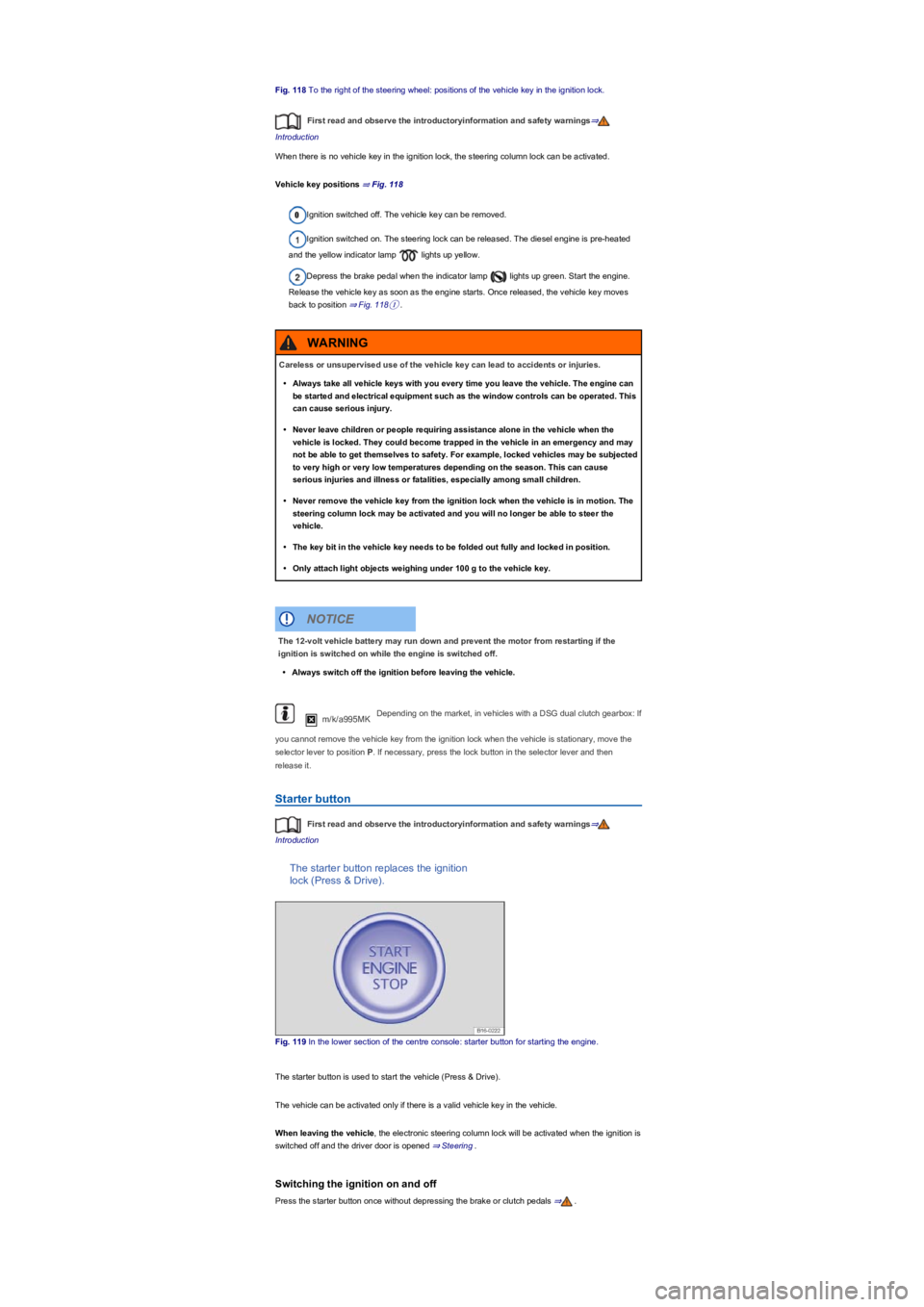
Fig. 118 To the right of the steering wheel: positions of the vehicle key in the ignition lock.
First read and observe the introductoryinformation and safety warnings⇒
Introduction
When there is no vehicle key in the ignition lock, the steering column lock can be activated.
Vehicle key positions ⇒ Fig. 118
Ignition switched off. The vehicle key can be removed.
Ignition switched on. The steering lock can be released. The diesel engine is pre-heated
and the yellow indicator lamp lights up yellow.
Depress the brake pedal when the indicator lamp lights up green. Start the engine.
Release the vehicle key as soon as the engine starts. Once released, the vehicle key moves
back to position ⇒ Fig. 118①.
m/k/a995MKDepending on the market, in vehicles with a DSG dual clutch gearbox: If
you cannot remove the vehicle key from the ignition lock when the vehicle is stationary, move the
selector lever to position P. If necessary, press the lock button in the selector lever and then
release it.
Starter button
First read and observe the introductoryinformation and safety warnings⇒
Introduction
The starter button replaces the ignition
lock (Press & Drive).
Fig. 119 In the lower section of the centre console: starter button for starting the engine.
The starter button is used to start the vehicle (Press & Drive).
The vehicle can be activated only if there is a valid vehicle key in the vehicle.
When leaving the vehicle, the electronic steering column lock will be activated when the ignition is
switched off and the driver door is opened ⇒ Steering.
Switching the ignition on and off
Press the starter button once without depressing the brake or clutch pedals ⇒.
Careless or unsupervised use of the vehicle key can lead to accidents or injuries.
•Always take all vehicle keys with you every time you leave the vehicle. The engine can
be started and electrical equipment such as the window controls can be operated. This
can cause serious injury.
•Never leave children or people requiring assistance alone in the vehicle when the
vehicle is locked. They could become trapped in the vehicle in an emergency and may
not be able to get themselves to safety. For example, locked vehicles may be subjected
to very high or very low temperatures depending on the season. This can cause
serious injuries and illness or fatalities, especially among small children.
•Never remove the vehicle key from the ignition lock when the vehicle is in motion. The
steering column lock may be activated and you will no longer be able to steer the
vehicle.
•The key bit in the vehicle key needs to be folded out fully and locked in position.
•Only attach light objects weighing under 100 g to the vehicle key.
WARNING
The 12-volt vehicle battery may run down and prevent the motor from restarting if the
ignition is switched on while the engine is switched off.
•Always switch off the ignition before leaving the vehicle.
NOTICE
Page 138 of 341
Automatic ignition switch-off
The ignition switches off automatically after a short time if the driver moves away from the vehicle
with the vehicle key when the ignition is switched on. If the dipped beam headlights were switched
on at the time, the side lights will remain switched on for approximately 30 minutes. The side lights
can be switched off manually ⇒ Lights or by locking the vehicle ⇒ Central and manual locking.
Once the vehicle detects that the driver is absent when the engine stop is active, the ignition will
switched off automatically after a certain period of time.
Automatic ignition switch-off in vehicles with a start/stop system
When all the following conditions are fulfilled at the same time, the vehicle ignition will be switched
off automatically when engine stop is active and when the vehicle is stationary:
•The driver removes their seat belt.
•No pedals are depressed.
•The driver door is opened.
If the ignition is deactivated automatically while the dipped beam headlights are switched on ,
the side lights remain switched on for around 30 minutes.
The side lights can be switched off manually or will go off when the vehicle is locked.
Engine restart function
If no valid vehicle key is detected in the vehicle interior once the engine has been switched off, the
engine can be restarted within approximately 5 seconds. A corresponding message appears on the
instrument cluster display.
After this time, the engine cannot be re-started without a valid vehicle key in the vehicle interior.
Before leaving the vehicle, always switch off the ignition manually and observe any
information shown in the instrument cluster display.
Leaving the vehicle stationary for long periods with the ignition switched on can discharge
the 12-volt vehicle battery so that the engine can no longer be started.
The engine cannot, for example, be started with the starter button if the button cell in the
vehicle key is weak or flat. In this case, use the emergency start function ⇒ Emergency start
function.
Starting the engine
First read and observe the introductoryinformation and safety warnings⇒
Introduction
•m/k/a995MKVehicles with ignition lock: Turn the vehicle key to position ⇒ Fig. 118①.
The ignition is switched on.
•m/k/a995MKVehicles with a starter button: Press the starter button once. The ignition is
switched on.
•m/k/a995MK Vehicles with a diesel engine: During the diesel engine preheating phase,
the indicator lamp in the instrument cluster lights up.
•Depress and hold the brake pedal until the electronic parking brake has been switched off.
•m/k/a995MKVehicles with manual gearbox: fully depress the clutch pedal and hold it
until the engine has been started. Move the gear lever to neutral position.
•m/k/a995MKVehicles with DSG dual clutch gearbox: move the selector lever to
position P or N.
Unintentional vehicle movements can cause serious injury.
•Do not depress the brake or clutch pedal when switching on the ignition as the engine
will then start immediately.
WARNING
Careless or unsupervised use of the vehicle key can lead to accidents or injuries.
•Always take all vehicle keys with you every time you leave the vehicle. Children or third
parties could lock the vehicle, start the engine, switch on the ignition or operate
electrical equipment such as the electric windows.
WARNING
Page 190 of 341
Parking and manoeuvring
Parking
Stopping the vehicle
Always park the vehicle in the specified order.
Always stop the vehicle on a suitable surface ⇒.
•Bring the vehicle to a stop. On vehicles with a manual gearbox, fully depress the clutch.
•Press and hold the brake pedal.
•With a DSG dual clutch gearbox, move the selector lever to position P.
•Switch on the electronic parking brake ⇒ Electronic parking brake.
•Stop the engine and switch off the ignition ⇒ Starting and stopping the engine. The indicator
lamp in the instrument cluster display must light up red.
•With a manual gearbox, select first gear for flat ground and uphill inclines, or reverse gear for
downhill inclines, and then release the clutch.
•Locking the steering column ⇒ Steering
•Take your left foot off the brake.
•Make sure that all vehicle occupants leave the vehicle.
•Get out of the vehicle. Take all vehicle keys with you.
•Lock the vehicle.
Parking on uphill and downhill gradients
Turn the steering wheel so that the front wheels will roll against the kerb if the parked vehicle starts
to move.
Please adhere to relevant legislation when stopping and parking your vehicle.
®
The components of the exhaust system become very hot. This can cause fires and serious
injuries.
•Never park the vehicle where parts of the exhaust system can come into contact with
inflammable material underneath the vehicle, e.g. undergrowth, leaves, dry grass, spilt
fuel, oil etc.
WARNING
The vehicle may roll away if you leave and park the vehicle incorrectly. This can cause
accidents and serious injuries.
•Before leaving the vehicle, make sure that the electronic parking brake is switched on
and that the indicator light lights up red on the instrument cluster display when
the ignition is switched off.
•Never remove the vehicle key from the ignition lock when the vehicle is in motion. The
steering lock may be activated and you will no longer be able to steer or control the
vehicle.
•Never leave children or people requiring assistance alone in the vehicle. They could
switch off the electronic parking brake, or move the selector lever or gearshift lever,
and thus set the vehicle in motion.
•Always take all vehicle keys with you every time you leave the vehicle. The engine can
be started and electrical equipment such as the window controls can be operated. This
can cause serious injury.
•Never leave children or people requiring assistance alone in the vehicle. They could
become trapped in the vehicle in an emergency and may not be able to get themselves
to safety. For example, locked vehicles may be subjected to very high or very low
temperatures depending on the season. This can cause serious injuries and illness or
fatalities, especially among small children.
WARNING
•Always take care when driving in car parks with protruding kerbstones or bollards.
Objects that protrude from the ground can damage the bumper and other components
when parking the vehicle or driving out of a parking space. Stop before the wheels
touch the fixed boundaries or kerbs.
•Drive carefully through dips in the road, over driveways, ramps, kerbstones and other
objects. Low-lying vehicle components such as the bumper, spoiler and parts of the
running gear, engine or exhaust system could be damaged.
NOTICE
Page 219 of 341
The cigarette lighter socket can also be used as a 12-volt socket ⇒ Electrical sockets.
Electrical sockets
Introduction
This chapter contains information on the followingsubjects:
⇒ Sockets in the vehicle
Electrical equipment can be connected to the sockets in the vehicle.
The electrical devices must be in good condition. Do not use faulty devices.
The 12-volt socket will work only when the ignition is switched on.
Using electrical consumers with the engine switched off and the ignition switched on will
drain the 12-volt battery.
Unshielded devices can cause interference in the Infotainment system and vehicle
electronics.
Sockets in the vehicle
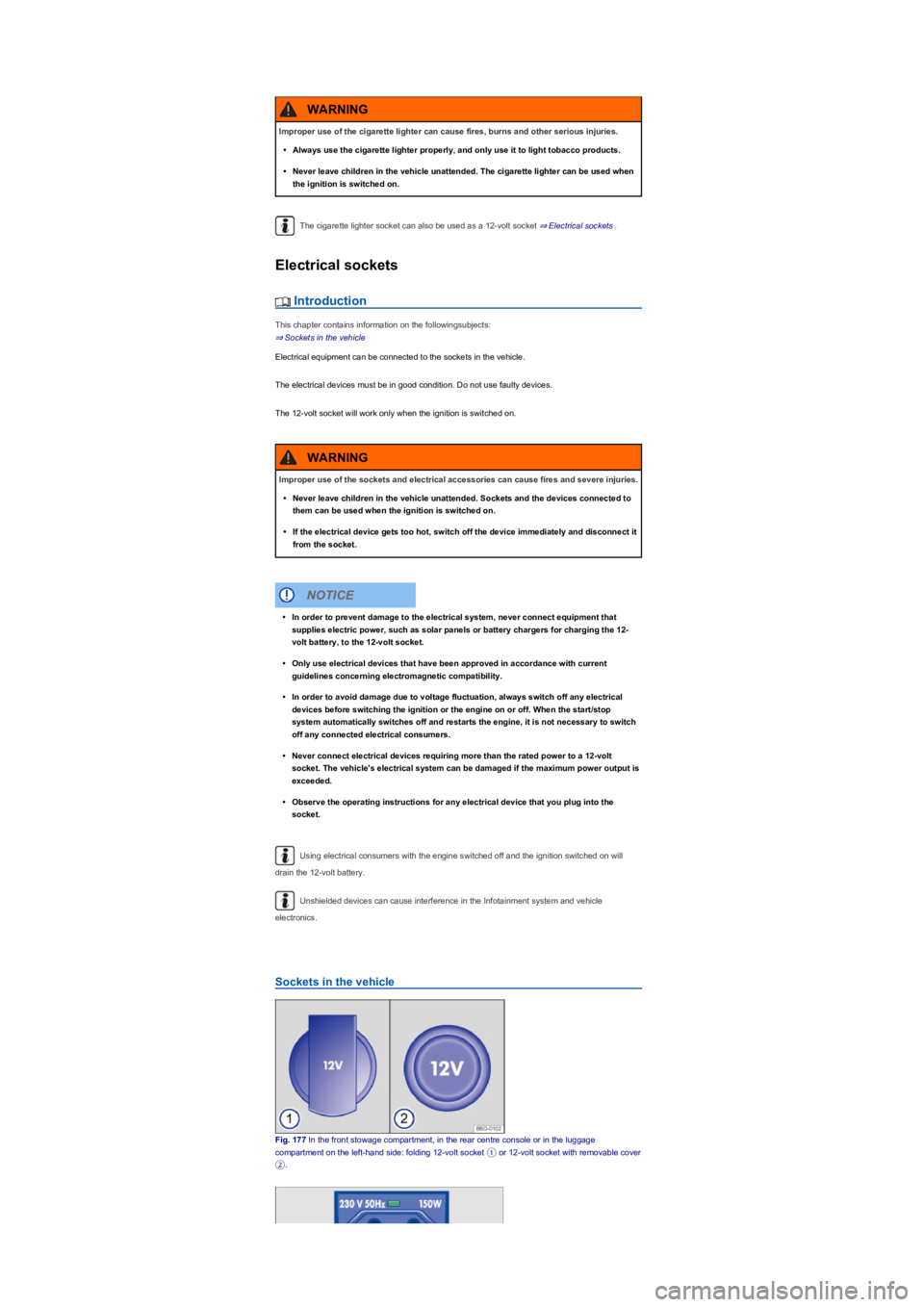
Fig. 177 In the front stowage compartment, in the rear centre console or in the luggage
compartment on the left-hand side: folding 12-volt socket ① or 12-volt socket with removable cover
②.
Improper use of the cigarette lighter can cause fires, burns and other serious injuries.
•Always use the cigarette lighter properly, and only use it to light tobacco products.
•Never leave children in the vehicle unattended. The cigarette lighter can be used when
the ignition is switched on.
WARNING
Improper use of the sockets and electrical accessories can cause fires and severe injuries.
•Never leave children in the vehicle unattended. Sockets and the devices connected to
them can be used when the ignition is switched on.
•If the electrical device gets too hot, switch off the device immediately and disconnect it
from the socket.
WARNING
•In order to prevent damage to the electrical system, never connect equipment that
supplies electric power, such as solar panels or battery chargers for charging the 12-
volt battery, to the 12-volt socket.
•Only use electrical devices that have been approved in accordance with current
guidelines concerning electromagnetic compatibility.
•In order to avoid damage due to voltage fluctuation, always switch off any electrical
devices before switching the ignition or the engine on or off. When the start/stop
system automatically switches off and restarts the engine, it is not necessary to switch
off any connected electrical consumers.
•Never connect electrical devices requiring more than the rated power to a 12-volt
socket. The vehicle's electrical system can be damaged if the maximum power output is
exceeded.
•Observe the operating instructions for any electrical device that you plug into the
socket.
NOTICE