infotainment VOLKSWAGEN TIGUAN 2017 Owner´s Manual
[x] Cancel search | Manufacturer: VOLKSWAGEN, Model Year: 2017, Model line: TIGUAN, Model: VOLKSWAGEN TIGUAN 2017Pages: 341, PDF Size: 9.14 MB
Page 32 of 341
Adapting the display areas to the driving situation
Choose the three possible instruments corresponding to your individual driving style and the driving
situation.
Due to the principle of performance determination available in the vehicle, the physical
accuracy of the displayed values is not guaranteed.
Lap timer
First read and observe the introductoryinformation and safety warnings⇒
Introduction
The lap timer provides you with the
option of timing your own laps manually
in the vehicle on a race track, storing
the times and comparing them with
previously measured best times.
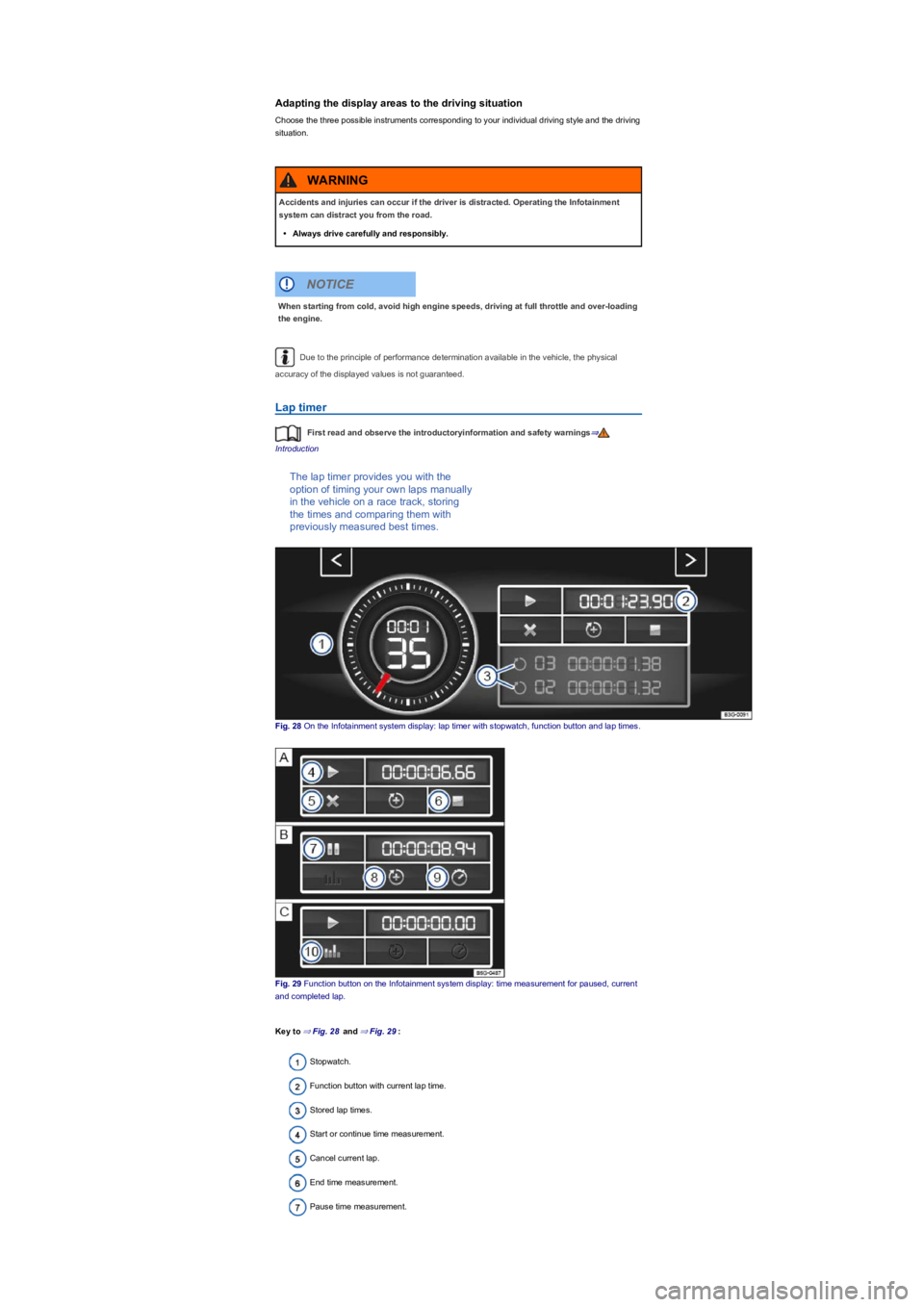
Fig. 28 On the Infotainment system display: lap timer with stopwatch, function button and lap times.
Fig. 29 Function button on the Infotainment system display: time measurement for paused, current
and completed lap.
Key to ⇒ Fig. 28 and ⇒ Fig. 29:
Stopwatch.
Function button with current lap time.
Stored lap times.
Start or continue time measurement.
Cancel current lap.
End time measurement.
Pause time measurement.
Accidents and injuries can occur if the driver is distracted. Operating the Infotainment
system can distract you from the road.
•Always drive carefully and responsibly.
WARNING
When starting from cold, avoid high engine speeds, driving at full throttle and over-loading
the engine.
NOTICE
Page 33 of 341
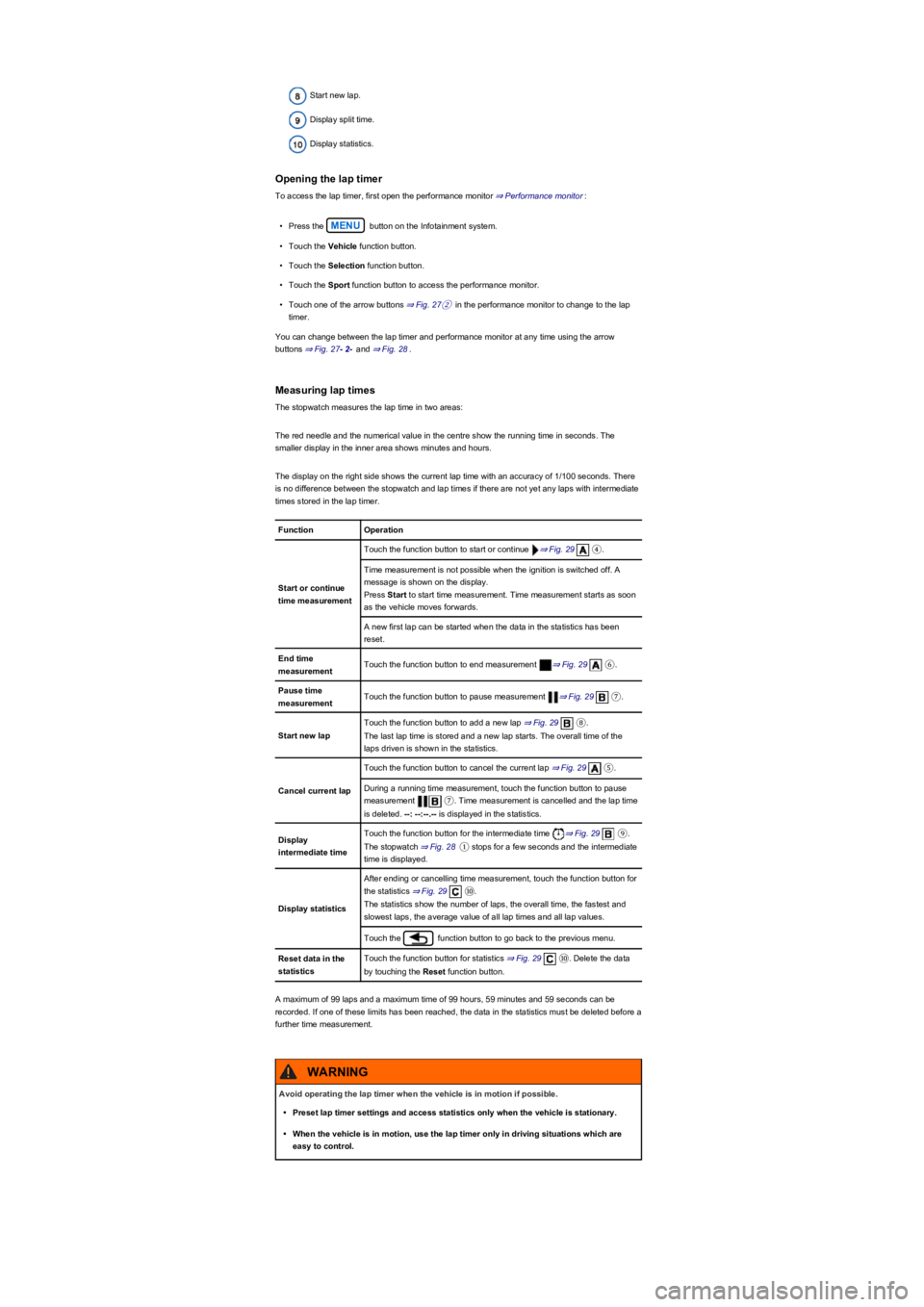
Start new lap.
Display split time.
Display statistics.
Opening the lap timer
To access the lap timer, first open the performance monitor ⇒ Performance monitor:
•Press the MENU button on the Infotainment system.
•Touch the Vehicle function button.
•Touch the Selection function button.
•Touch the Sport function button to access the performance monitor.
•Touch one of the arrow buttons ⇒ Fig. 27② in the performance monitor to change to the lap
timer.
You can change between the lap timer and performance monitor at any time using the arrow
buttons ⇒ Fig. 27- 2- and ⇒ Fig. 28.
Measuring lap times
The stopwatch measures the lap time in two areas:
The red needle and the numerical value in the centre show the running time in seconds. The
smaller display in the inner area shows minutes and hours.
The display on the right side shows the current lap time with an accuracy of 1/100 seconds. There
is no difference between the stopwatch and lap times if there are not yet any laps with intermediate
times stored in the lap timer.
FunctionOperation
Start or continue
time measurement
Touch the function button to start or continue ⇒ Fig. 29④.
Time measurement is not possible when the ignition is switched off. A
message is shown on the display.
Press Start to start time measurement. Time measurement starts as soon
as the vehicle moves forwards.
A new first lap can be started when the data in the statistics has been
reset.
End time
measurementTouch the function button to end measurement ⇒ Fig. 29⑥.
Pause time
measurementTouch the function button to pause measurement ⇒ Fig. 29⑦.
Start new lap
Touch the function button to add a new lap ⇒ Fig. 29⑧.
The last lap time is stored and a new lap starts. The overall time of the
laps driven is shown in the statistics.
Cancel current lap
Touch the function button to cancel the current lap ⇒ Fig. 29⑤.
During a running time measurement, touch the function button to pause
measurement ⑦. Time measurement is cancelled and the lap time
is deleted. --: --:--.-- is displayed in the statistics.
Display
intermediate time
Touch the function button for the intermediate time ⇒ Fig. 29⑨.
The stopwatch ⇒ Fig. 28① stops for a few seconds and the intermediate
time is displayed.
Display statistics
After ending or cancelling time measurement, touch the function button for
the statistics ⇒ Fig. 29⑩.
The statistics show the number of laps, the overall time, the fastest and
slowest laps, the average value of all lap times and all lap values.
Touch the function button to go back to the previous menu.
Reset data in the
statistics
Touch the function button for statistics ⇒ Fig. 29⑩. Delete the data
by touching the Reset function button.
A maximum of 99 laps and a maximum time of 99 hours, 59 minutes and 59 seconds can be
recorded. If one of these limits has been reached, the data in the statistics must be deleted before a
further time measurement.
Avoid operating the lap timer when the vehicle is in motion if possible.
•Preset lap timer settings and access statistics only when the vehicle is stationary.
•When the vehicle is in motion, use the lap timer only in driving situations which are
easy to control.
WARNING
Page 34 of 341
Personalisation
First read and observe the introductoryinformation and safety warnings⇒
Introduction
The personalisation function allows personalised vehicle settings, such as air conditioning system,
instrument cluster or lighting settings, to be saved in a user account. You have four user accounts
available. Users are identified using the vehicle key upon unlocking the vehicle. One user account
is assigned to each vehicle key.
Changes to the setup will be assigned to the active user account and saved upon locking the
vehicle or changing the user account.
Welcome and user account selection
When personalisation is activated, the name of the current user account appears on the instrument
cluster display for approximately ten seconds after you switch on the ignition.
During this time, you can select a user account using the buttons on the wiper lever or multifunction
steering wheel ⇒ Operation and display in the Infotainment system.
When you select a user account, the saved vehicle settings are activated.
User management and setup
When the ignition is switched on you can use the Personalisation menu in the Infotainment system
for user management and setup. Please proceed as follows to access the menu:
•Press the button or function button.
•Touch the Vehicle, function buttons and select Personalisation.
If the checkbox in the function button is ticked , the respective function is switched on.
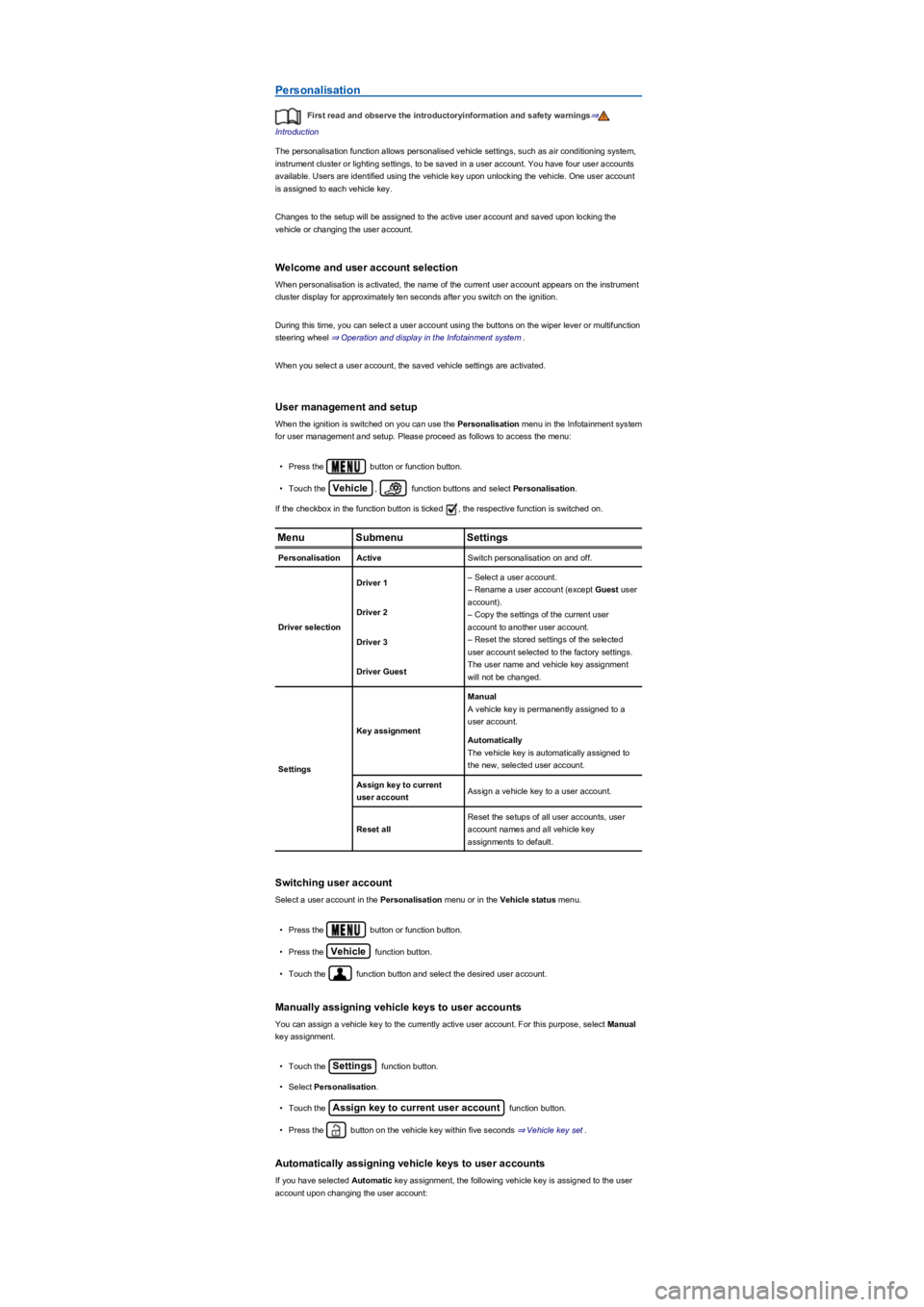
MenuSubmenuSettings
PersonalisationActiveSwitch personalisation on and off.
Driver selection
Driver 1– Select a user account.
– Rename a user account (except Guest user
account).
– Copy the settings of the current user
account to another user account.
– Reset the stored settings of the selected
user account selected to the factory settings.
The user name and vehicle key assignment
will not be changed.
Driver 2
Driver 3
Driver Guest
Settings
Key assignment
Manual
A vehicle key is permanently assigned to a
user account.
Automatically
The vehicle key is automatically assigned to
the new, selected user account.
Assign key to current
user accountAssign a vehicle key to a user account.
Reset all
Reset the setups of all user accounts, user
account names and all vehicle key
assignments to default.
Switching user account
Select a user account in the Personalisation menu or in the Vehicle status menu.
•Press the button or function button.
•Press the Vehicle function button.
•Touch the function button and select the desired user account.
Manually assigning vehicle keys to user accounts
You can assign a vehicle key to the currently active user account. For this purpose, select Manual
key assignment.
•Touch the Settings function button.
•Select Personalisation.
•Touch the Assign key to current user account function button.
•Press the button on the vehicle key within five seconds ⇒ Vehicle key set.
Automatically assigning vehicle keys to user accounts
If you have selected Automatic key assignment, the following vehicle key is assigned to the user
account upon changing the user account:
Page 35 of 341
Check that all lights and turn signals are working properly.
Check the tyre pressure and fuel level Wheels and tyres, Fuel types and refuelling.
Ensure that you have a good, clear view through all of the windows.
Air intake to the engine must not be obstructed, and the engine must not be covered with
any kind of insulating materials In the engine compartment.
Secure any objects and luggage in the stowage compartments, the luggage compartment
or on the roof Transporting.
Ensure that you are able to operate the pedals freely at all times.
Secure any children travelling in the vehicle in a restraint system suitable for their weight
and size Safe transport of children.
Adjust the front seats, head restraints and mirrors properly in accordance with the size of
the occupants Sitting position, Mirrors.
Wear shoes that provide good grip for your feet when using the pedals.
The floor mat in the footwell on the driver side must leave the pedal area free and must be
securely fastened.
Assume a correct sitting position before setting off and maintain this position while driving.
This also applies to all passengers Sitting position.
Fasten your seat belt correctly before setting off and keep it properly fastened throughout
the journey. This also applies to all passengers Seat belts.
Each vehicle occupant must sit in a seat of their own and must have their own seat belt.
Never drive if your driving ability is impaired, e.g. by medication, alcohol or drugs.
Do not allow yourself to be distracted from the traffic, e.g. by passengers, telephone calls,
opening menus and making adjustments to settings.
Always adapt your speed and driving style to suit visibility, weather, road and traffic
conditions.
Observe traffic regulations and speed limits.
Take regular breaks when travelling long distances – at least every two hours.
Secure animals in the vehicle using a system that is suitable for their weight and size.
Does the vehicle need any technical modifications for driving abroad, e.g. masking or
switching the headlights over?
Are the necessary tools, diagnostic equipment and spare parts available for service and
repair work?
Are there any Volkswagen dealerships in the destination country?
•Vehicles without Keyless Access: vehicle key used to unlock the vehicle.
•Vehicles with Keyless Access: vehicle key that is identified first by the personalisation function
upon opening the driver door.
Personalised vehicle setup
The vehicle equipment and functions that can be personalised include the following:
•Open and close (single door unlocking, window convenience opening etc.)
•Light and vision (daytime running lights, cornering light, convenience turn signal etc.)
•Air conditioning system (temperature settings, ventilation etc.)
•Assistance systems (Park Distance Control, ACC, Dynamic Road Sign Display etc.)
•Driver profile selection (driver profiles etc.)
•Multifunction display and instrument cluster (selection of displays)
•Infotainment system (brightness and saved stations)
•Seat setup (seat position)
A new vehicle key will be assigned to the current user account. To assign the vehicle key to
a different user account, select the user account you want and manually assign it to the vehicle key.
Safety
General notes
Checklist
Observe the following information both before and during every journey to ensure your own
safety, and the safety of all passengers and other road users ⇒:
Checklist
In some countries, special safety standards and emissions-related regulations apply that the
vehicle may not comply with. Volkswagen recommends that you visit your Volkswagen
dealership before travelling abroad to find out about any legal requirements and the
following issues at your destination:
Page 36 of 341
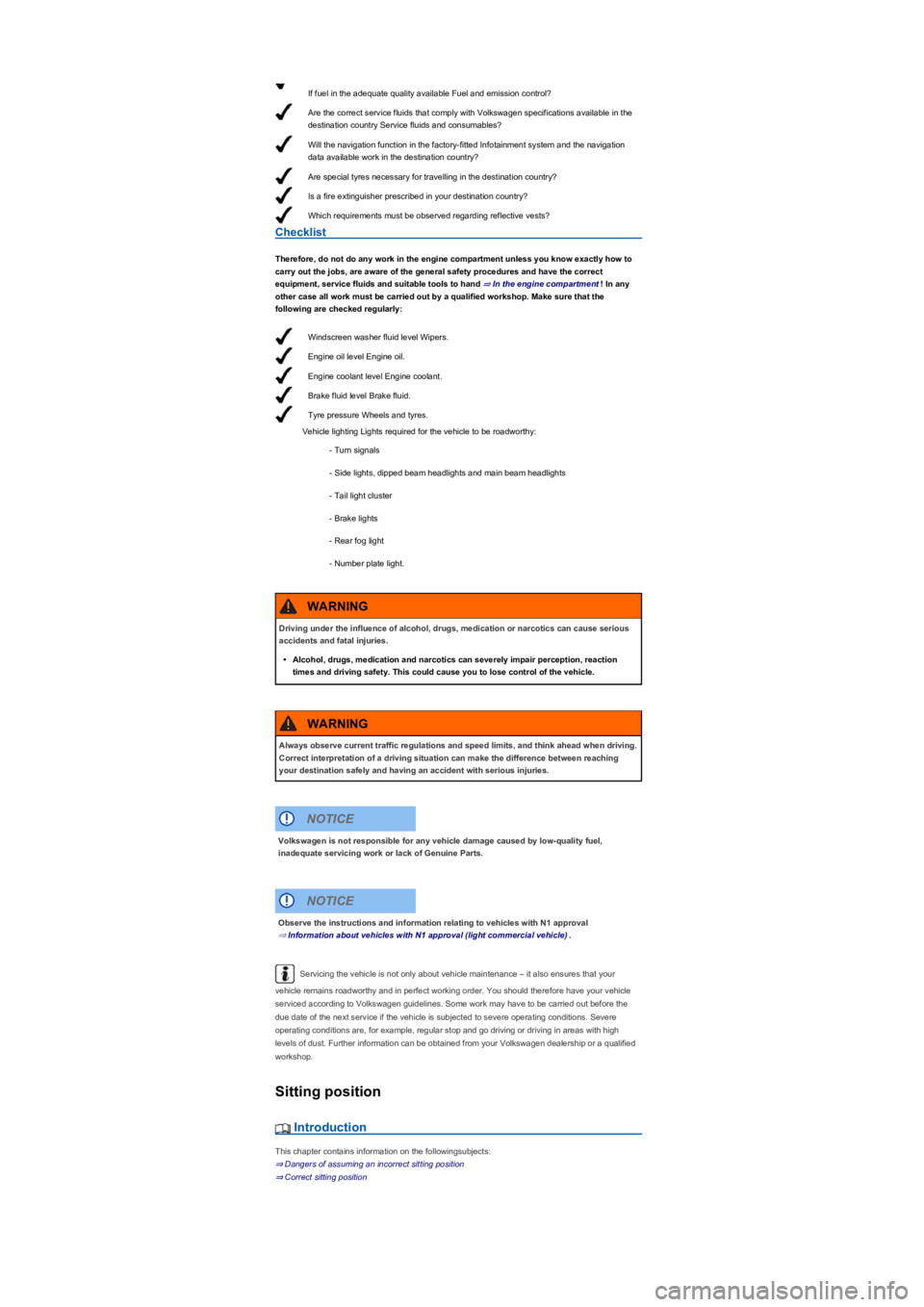
If fuel in the adequate quality available Fuel and emission control?
Are the correct service fluids that comply with Volkswagen specifications available in the
destination country Service fluids and consumables?
Will the navigation function in the factory-fitted Infotainment system and the navigation
data available work in the destination country?
Are special tyres necessary for travelling in the destination country?
Is a fire extinguisher prescribed in your destination country?
Which requirements must be observed regarding reflective vests?
Windscreen washer fluid level Wipers.
Engine oil level Engine oil.
Engine coolant level Engine coolant.
Brake fluid level Brake fluid.
Tyre pressure Wheels and tyres.
Checklist
Therefore, do not do any work in the engine compartment unless you know exactly how to
carry out the jobs, are aware of the general safety procedures and have the correct
equipment, service fluids and suitable tools to hand ⇒ In the engine compartment! In any
other case all work must be carried out by a qualified workshop. Make sure that the
following are checked regularly:
Vehicle lighting Lights required for the vehicle to be roadworthy:
- Turn signals
- Side lights, dipped beam headlights and main beam headlights
- Tail light cluster
- Brake lights
- Rear fog light
- Number plate light.
Servicing the vehicle is not only about vehicle maintenance – it also ensures that your
vehicle remains roadworthy and in perfect working order. You should therefore have your vehicle
serviced according to Volkswagen guidelines. Some work may have to be carried out before the
due date of the next service if the vehicle is subjected to severe operating conditions. Severe
operating conditions are, for example, regular stop and go driving or driving in areas with high
levels of dust. Further information can be obtained from your Volkswagen dealership or a qualified
workshop.
Sitting position
Introduction
This chapter contains information on the followingsubjects:
⇒ Dangers of assuming an incorrect sitting position
⇒ Correct sitting position
Driving under the influence of alcohol, drugs, medication or narcotics can cause serious
accidents and fatal injuries.
•Alcohol, drugs, medication and narcotics can severely impair perception, reaction
times and driving safety. This could cause you to lose control of the vehicle.
WARNING
Always observe current traffic regulations and speed limits, and think ahead when driving.
Correct interpretation of a driving situation can make the difference between reaching
your destination safely and having an accident with serious injuries.
WARNING
Volkswagen is not responsible for any vehicle damage caused by low-quality fuel,
inadequate servicing work or lack of Genuine Parts.
NOTICE
Observe the instructions and information relating to vehicles with N1 approval
⇒ Information about vehicles with N1 approval (light commercial vehicle).
NOTICE
Page 46 of 341
The airbag modules and belt tensioners may contain perchlorate. Please comply with
legislation regarding disposal.
Proactive occupant protection system
First read and observe the introductoryinformation and safety warnings⇒
Introduction
The proactive occupant protection system is an assistance system that initiates action to protect
vehicle occupants in dangerous situations. However, the system cannot prevent a collision.
The full range of functions of the proactive occupant protection system will be available only if the
function has been activated in the Infotainment system, no special driving profile has been selected
and there are no malfunctions ⇒ Driving profile selection and 4MOTION Active Control, ⇒ Function
limitations.
Basic functions
Depending on country-specific legal requirements and also on the vehicle equipment, the following
functions may be initiated, either individually or jointly, in critical situations (e.g. emergency braking
or in the case of oversteering or understeering) as of a speed of approximately 30 km/h (19 mph):
•Temporary tensioning of the fastened front seat belts.
•Automatic closing of the glass roof and side windows down to a gap, depending on the vehicle
equipment.
The belts may be tensioned individually or together depending on the respective critical driving
situations.
Additional information for vehicles with an area monitoring system (Front
Assist)
In vehicles fitted with the area monitoring system (Front Assist) ⇒ Area monitoring system (Front
Assist), the probability of a collision with the vehicle ahead is also calculated within the system
limits. The system can trigger the proactive occupant protection system if it detects a probable
collision or initiates strong braking.
Settings in the Infotainment system
The full range of functions of the proactive occupant protection system can be activated and
deactivated in the Infotainment system ⇒ Operation and display in the Infotainment system.
The proactive occupant protection system will be reactivated every time the ignition is switched on.
It may not be possible to operate the setting function if the proactive occupant protection system
has already been adapted to the specific vehicle setup.
Setting in driving profile selection
In vehicles with driving profile selection, the proactive occupant protection system is adapted to the
special vehicle setup of the respective driving profile ⇒ Driving profile selection and 4MOTION
Active Control.
Function limitations
The proactive occupant protection system will not be available, or will only be available to a limited
extent, in the following situations:
•If there is a fault in the ESC, belt tensioner or in the airbag control unit ⇒ Seat belts or ⇒ Airbag
system.
•When the TCS or ESC are switched off, and when the vehicle is reversing ⇒ Brake support
systems.
•The temporary tensioning for the front passenger seat is switched off if the front passenger front
airbag is deactivated.
•If there is a system fault in the area monitoring system (Front Assist) ⇒ Area monitoring system
(Front Assist).
The risk of severe or fatal injuries may be increased if the seat belts, automatic belt
retractors and belt tensioners are not used correctly, or if they are repaired by a non-
professional. As a result, the belt tensioners may not be triggered when they should, or
they may be triggered unexpectedly.
•Any repairs, adjustments or removal and refitting of parts in the belt tensioners or seat
belts should always be carried out by a qualified workshop and never by yourself
⇒ Accessories, modifications, repairs and renewal of parts.
•Belt tensioners and automatic belt retractors cannot be repaired. They must be
replaced.
WARNING
Page 47 of 341
Troubleshooting
If there is a malfunction in the proactive occupant protection system, the message Proactive
occupant protection unavailable or Proactive occupant protection: function restricted is
shown permanently on the instrument cluster display.
Go to a qualified workshop and have the system checked.
Airbag system
Introduction
This chapter contains information on the followingsubjects:
⇒ Types of front passenger front airbag system
⇒ Indicator lamp
⇒ Description and function of the airbags
⇒ Front airbags
⇒ Switching the front passenger front airbag on and off
⇒ Side airbags
⇒ Curtain airbags
⇒ Knee airbags
The vehicle is equipped with a front airbag for the driver and front passenger. The front airbags can
provide front seat occupants with additional chest and head protection if the seat, seat belts, head
restraints and, in the case of the driver, steering wheel are adjusted and used correctly. Airbags are
meant only for additional protection. The airbags are not a substitute for seat belts. Seat belts must
always be worn, even when the front seats are equipped with front airbags.
The intelligent technology of the proactive occupant protection system cannot overcome
the laws of physics, and functions only within the limits of the system. Never let the extra
convenience afforded by the proactive occupant protection system tempt you into taking
any risks when driving. The system cannot prevent a collision. The system is not a
substitute for the full concentration of the driver.
•Adapt your speed and distance from the vehicles ahead to suit visibility, weather, road
and traffic conditions.
•The system cannot detect objects in all situations.
•The proactive occupant protection system does not react to people, animals, objects
crossing in front of the vehicle, or objects which are hard to make out.
•Reflective objects such as safety barriers, tunnel entrances, heavy rain and ice can
impair the function of the proactive occupant protection system and thus prevent it
from detecting a collision risk.
•Incorrect system activation can occur.
WARNING
Accidents and injuries can occur if the driver is distracted.
•Never change settings in the Infotainment system when the vehicle is in motion.
WARNING
Failure to observe illuminated warning lamps and text messages can lead to your vehicle
breaking down in traffic, and can cause accidents and serious injuries.
•Never ignore any illuminated warning lamps or text messages.
•Stop the vehicle as soon as it is possible and safe to do so.
WARNING
Failure to observe illuminated indicator lamps and text messages can lead to your vehicle
being damaged.
NOTICE
Page 66 of 341
•Lit up green: voice services are available. System is OK.
•Flashing green: active connection to a voice service.
Information call
•The information call enables you to call the Volkswagen AG hotline.
•The information call function is available only in some sales regions.
•The telephone call centre communicates in the language registered for the vehicle in Car-Net.
Breakdown call
•The breakdown call allows you to seek professional assistance should your vehicle break down.
•Some vehicle data, e.g. the current location, is transmitted parallel to the voice call.
•The telephone call centre communicates in the language registered for the vehicle in Car-Net.
Emergency Call Service
•If an emergency call is placed manually or automatically after an accident where an airbag was
triggered, data relevant for the emergency call, e.g. the current vehicle location, will be
transmitted automatically ⇒ Customer information.
•The telephone call centre communicates in the language set up in the vehicle's Infotainment
system. English is used if this language is not available at the location of the emergency.
Back-up 112 emergency call service
In some cases, the Emergency call service may be restricted or unavailable so the general
emergency call number 112 is used to conduct an emergency call. In this case, only a voice-based
connection is established. No data will be transmitted, e.g. regarding the vehicle or its location.
The following circumstances may restrict access to the Emergency call service and lead to the call
being forwarded to the 112 emergency number:
•Your current emergency call location is in an area with no or insufficient mobile communications
and GPS reception. This can also include tunnels, streets with tall buildings, garages,
underpasses, mountains and valleys.
•You are in an area with sufficient mobile communications and GPS reception but the
telecommunications provider's mobile network is not available.
•The Emergency call service is prohibited by law in some countries.
•There is no valid licence for using the Emergency call service.
•The components in the vehicle required for the Emergency call service are damaged or do not
have a sufficient power supply.
Please also observe the other information on Volkswagen Car-Net ⇒ Mobile online services.
Opening and closing
Vehicle key set
Introduction
This chapter contains information on the followingsubjects:
⇒ Vehicle key
⇒ Changing the button cell
⇒ Troubleshooting
Page 69 of 341
Central and manual locking
Introduction
This chapter contains information on the followingsubjects:
⇒ Indicator lamp
⇒ Central locking system
⇒ Locking and unlocking the vehicle from the outside
⇒ Locking and unlocking the vehicle from the inside
⇒ Locking and unlocking the vehicle with
⇒ SAFELOCK
⇒ Anti-theft alarm
⇒ Interior monitoring system and anti-tow alarm
⇒ Locking the vehicle after the airbag has been triggered
⇒ Troubleshooting
The central locking system locks all doors and the boot lid of the vehicle. The vehicle cannot be
locked if the driver door is open.
The vehicle can only be locked if the ignition has been switched off or the driver has switched off
the engine before leaving the vehicle.
Automatic locking (anti-theft protection)
The vehicle will lock itself again automatically after around 45 seconds if one of the following
conditions applies:
•The vehicle was unlocked but not opened.
•The ignition was not switched on.
•The boot lid was not opened.
•The vehicle has been unlocked using the lock cylinder.
•The vehicle was locked with the central locking button in the vehicle interior.
Indicator lamp
First read and observe the introductoryinformation and safety warnings⇒
Introduction
The central locking indicator lamp is located in the driver door ⇒ Driver door.
Vehicle locked: red LED flashes at short intervals for approximately two seconds, and then more
slowly. The indicator lamp does not flash if the vehicle was locked with the central locking button in
the driver door ⇒ Locking and unlocking the vehicle from the inside.
Central locking system
First read and observe the introductoryinformation and safety warnings⇒
Introduction
The central locking system enables you to lock or unlock all the doors, the boot lid and the tank flap
from one point.
Settings for the central locking system can be adjusted in the Infotainment system ⇒ Operation and
display in the Infotainment system.
Automatic locking (Auto Lock)
The vehicle may lock itself automatically at speeds of approximately 15 km/h (9 mph) and above
⇒ Operation and display in the Infotainment system. The indicator lamp in the central locking
button will light up yellow when the vehicle is locked.
Improper use of the central locking system could lead to serious injury.
•The central locking system locks all doors. Locking the vehicle from the inside can
prevent accidental opening of the doors and unauthorised persons from entering the
vehicle. However, locked doors can delay assistance to passengers inside the vehicle
in the event of an accident or emergency.
•Never leave children or people requiring assistance alone in the vehicle. All doors can
be locked from the inside using the central locking button. This may mean that people
lock themselves in the vehicle. People locked in the vehicle may be subjected to very
high or very low temperatures.
•Temperatures inside a locked vehicle may reach extremes of heat or cold, according to
season. This can cause serious injuries and illness or fatalities, especially to small
children.
•Never leave anyone inside a locked vehicle. People in the vehicle could become
trapped in an emergency and may not be able to get themselves to safety.
•Doors and the boot lid should therefore be opened or closed only when you are sure
that nobody is in their path.
WARNING
Page 70 of 341
Automatic unlocking (Auto Unlock)
All doors and the boot lid are automatically unlocked if one of the following conditions applies:
•The vehicle is at a standstill and the vehicle key has been removed.
•m/k/a995MKIn vehicles with a DSG dual clutch gearbox: the selector lever is in
position P and the ignition has been switched off.
•OR: the vehicle is stationary and the button has been pressed.
•OR: the door release lever has been operated.
•OR: In an accident where the airbags have been triggered ⇒ Locking the vehicle after the
airbag has been triggered.
Automatic unlocking provides access to the vehicle if assistance is required.
Even if single door unlocking has already taken place, the entire vehicle will be unlocked
when the sensors are touched twice. The entire vehicle must be locked.
Locking and unlocking the vehicle from the outside
Fig. 63 Vehicle key: central locking system.
First read and observe the introductoryinformation and safety warnings⇒
Introduction
•Unlock: press the button. Press and hold for convenience opening.
•Lock: press the button. Press and hold for convenience closing.
•Vehicles with the keyless access locking and starting system: touch the sensors ⇒ Locking and
unlocking the vehicle with keyless access. Individual doors or the entire vehicle are unlocked.
•Press the button ⇒ Boot lid. The boot lid is released.
Vehicles with SAFELOCK: press the button once to lock the vehicle using SAFELOCK
⇒ SAFELOCK. Press the button twice to lock the vehicle without SAFELOCK.
Please note: depending on the settings made for the central locking in the Infotainment system
⇒ Operation and display in the Infotainment system, it may be the case that all of the doors and the
boot lid are unlocked only once the button has been pressed twice.
•Locking: all turn signals will flash once as confirmation.
•Unlocking: all turn signals will flash twice as confirmation.
Convenience opening and closing
•See Windows – Functions ⇒ Windows.
Depending on the mirror function selected in the Infotainment system, the exterior mirrors
fold out when the vehicle is unlocked using the button and surround lighting is switched on.
Locking and unlocking the vehicle from the inside
Fig. 64 In the driver door: central locking button.