infotainment VOLKSWAGEN TIGUAN 2017 Owner´s Manual
[x] Cancel search | Manufacturer: VOLKSWAGEN, Model Year: 2017, Model line: TIGUAN, Model: VOLKSWAGEN TIGUAN 2017Pages: 341, PDF Size: 9.14 MB
Page 156 of 341
•Proactive occupant protection system
In vehicles with a DSG dual clutch gearbox, the system automatically changes to gear
position S when the Sport driving profile is selected. The system automatically switches to gear
position D when the Eco driving profile is selected. Since coasting is active in the Eco driving
profile, the gearbox programme E is additionally displayed on the instrument cluster display.
The driver can adjust certain vehicle functions irrespective of the selected driving profile. For
example, the driver can switch to gear position S when the Eco driving profile is selected.
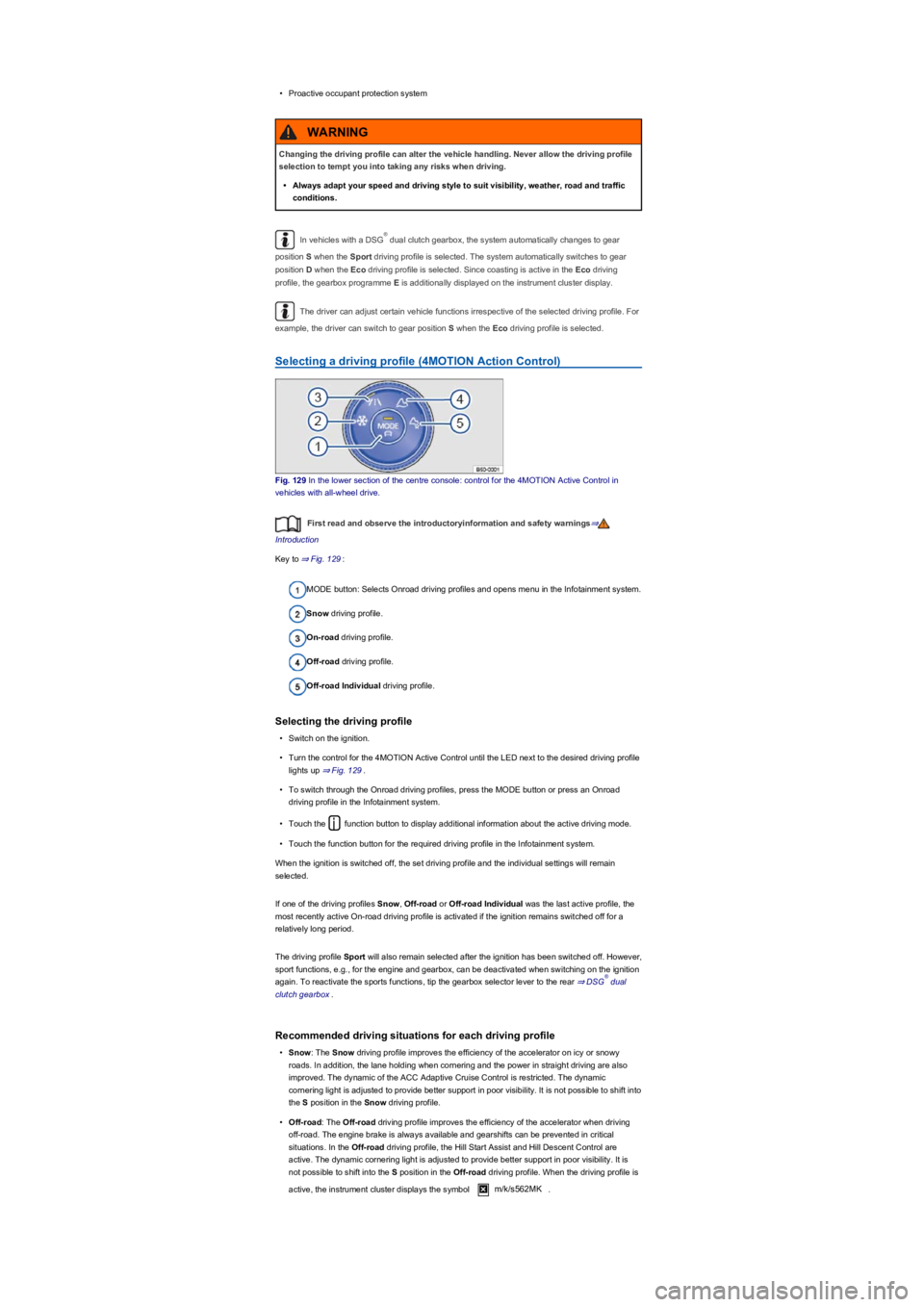
Selecting a driving profile (4MOTION Action Control)
Fig. 129 In the lower section of the centre console: control for the 4MOTION Active Control in
vehicles with all-wheel drive.
First read and observe the introductoryinformation and safety warnings⇒
Introduction
Key to ⇒ Fig. 129:
MODE button: Selects Onroad driving profiles and opens menu in the Infotainment system.
Snow driving profile.
On-road driving profile.
Off-road driving profile.
Off-road Individual driving profile.
Selecting the driving profile
•Switch on the ignition.
•Turn the control for the 4MOTION Active Control until the LED next to the desired driving profile
lights up ⇒ Fig. 129.
•To switch through the Onroad driving profiles, press the MODE button or press an Onroad
driving profile in the Infotainment system.
•Touch the function button to display additional information about the active driving mode.
•Touch the function button for the required driving profile in the Infotainment system.
When the ignition is switched off, the set driving profile and the individual settings will remain
selected.
If one of the driving profiles Snow, Off-road or Off-road Individual was the last active profile, the
most recently active On-road driving profile is activated if the ignition remains switched off for a
relatively long period.
The driving profile Sport will also remain selected after the ignition has been switched off. However,
sport functions, e.g., for the engine and gearbox, can be deactivated when switching on the ignition
again. To reactivate the sports functions, tip the gearbox selector lever to the rear ⇒ DSG dual
clutch gearbox.
Recommended driving situations for each driving profile
•Snow: The Snow driving profile improves the efficiency of the accelerator on icy or snowy
roads. In addition, the lane holding when cornering and the power in straight driving are also
improved. The dynamic of the ACC Adaptive Cruise Control is restricted. The dynamic
cornering light is adjusted to provide better support in poor visibility. It is not possible to shift into
the S position in the Snow driving profile.
•Off-road: The Off-road driving profile improves the efficiency of the accelerator when driving
off-road. The engine brake is always available and gearshifts can be prevented in critical
situations. In the Off-road driving profile, the Hill Start Assist and Hill Descent Control are
active. The dynamic cornering light is adjusted to provide better support in poor visibility. It is
not possible to shift into the S position in the Off-road driving profile. When the driving profile is
active, the instrument cluster displays the symbol m/k/s562MK.
Changing the driving profile can alter the vehicle handling. Never allow the driving profile
selection to tempt you into taking any risks when driving.
•Always adapt your speed and driving style to suit visibility, weather, road and traffic
conditions.
WARNING
®
®
Page 157 of 341
•Off-road Individual: Enhanced version of the off-road driving profile that can be adjusted to the
driver's needs ⇒ Adjusting the driving profile to suit your requirements. When the driving profile
is active, the instrument cluster displays the symbol m/k/s562MK.
•Onroad:The Onroad driving profile enables you to choose between Eco, Comfort, Normal,
Sport and Individual.
Adjusting the driving profile to suit your requirements
First read and observe the introductoryinformation and safety warnings⇒
Introduction
Selecting the Individual driving profile
•Switch on the ignition.
•Switch on the Infotainment system.
•Press the driving profile selection button or turn the control for 4MOTION Active Control
until the LED next to the Onroad driving profile ⇒ Fig. 129③ lights up.
•Touch the Change function button to open the Individual menu.
Selecting the Off-road Individual driving profile
•Switch on the ignition.
•Switch on the Infotainment system.
•If necessary, turn the control ⇒ Fig. 129 for the 4MOTION Active Control until the LED next to
the Off-road Individual driving profile ⇒ Fig. 129⑤ lights up.
•If the Off-road Individual driving profile is already selected, press the MODE button on the
control ⇒ Fig. 129.
•Touch the Change function button to open the Individual menu.
Troubleshooting
First read and observe the introductoryinformation and safety warnings⇒
Introduction
Fault in adaptive chassis control (DCC): go to a qualified workshop and have the system checked.
If there is a fault in the adaptive chassis control (DCC), the message Fault: damping control may
be shown on the instrument cluster display.
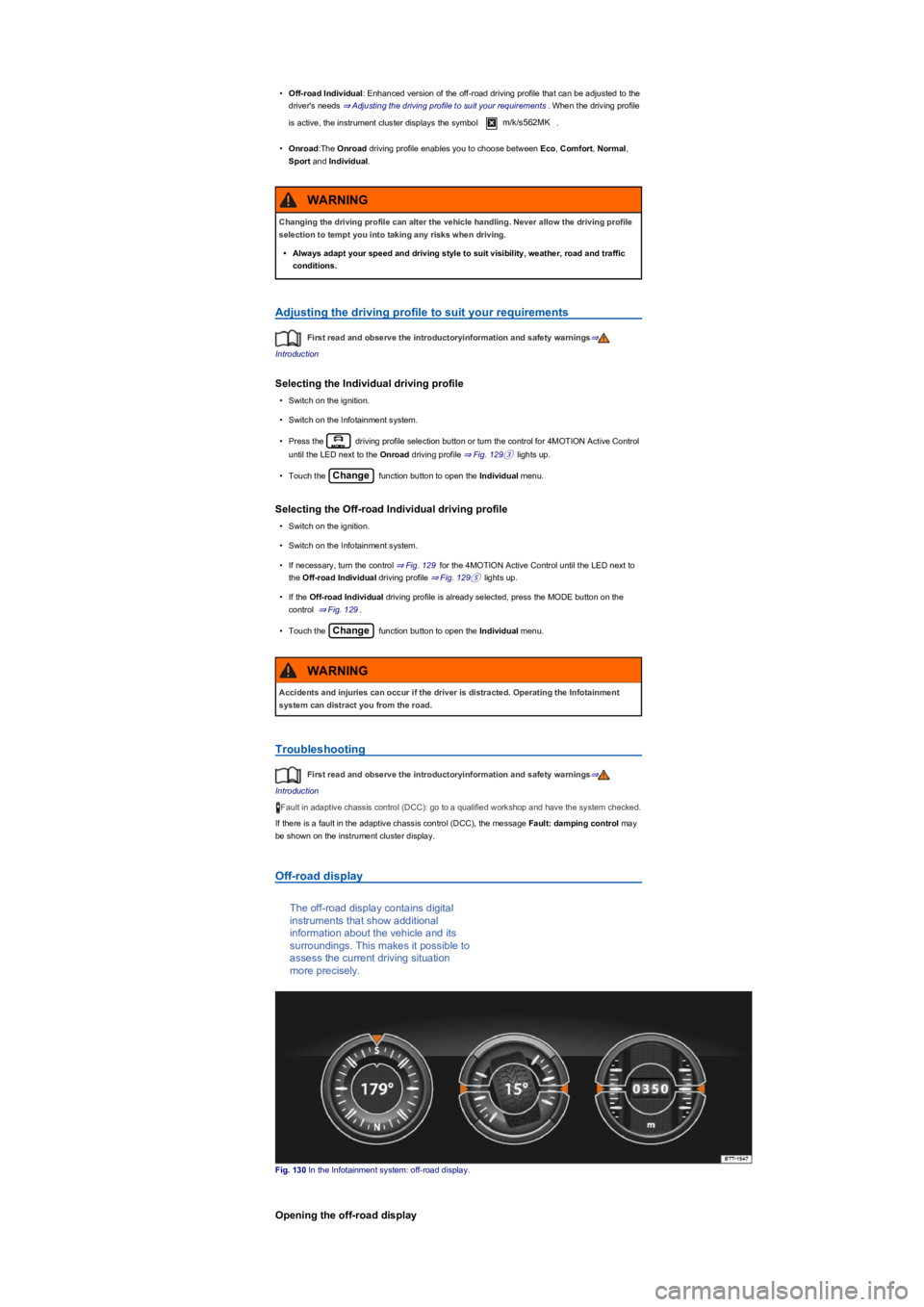
Off-road display
The off-road display contains digital
instruments that show additional
information about the vehicle and its
surroundings. This makes it possible to
assess the current driving situation
more precisely.
Fig. 130 In the Infotainment system: off-road display.
Opening the off-road display
Changing the driving profile can alter the vehicle handling. Never allow the driving profile
selection to tempt you into taking any risks when driving.
•Always adapt your speed and driving style to suit visibility, weather, road and traffic
conditions.
WARNING
Accidents and injuries can occur if the driver is distracted. Operating the Infotainment
system can distract you from the road.
WARNING
Page 158 of 341
•Press the button in the Infotainment system.
•Touch the Vehicle function button.
•Touch the Selection function button.
•Touch the Off-road function button.
Selecting instruments and setting units
The display shows various instruments ⇒ Fig. 130.
To change instruments, swipe vertically over the display.
The units can be adjusted for some instruments in the Infotainment system ⇒ Operation and
display in the Infotainment system.
Instruments in the off-road display (depends on the vehicle's equipment):
•Altitude: The altitude function shows the current height above sea level.
•Steering angle display: the steering angle of the vehicle is displayed in the range between -
49° and 49°. The value is positive for a left steering angle and negative for a right steering
angle.
•Compass: the compass shows the current driving direction.
•Coolant temperature display: the display corresponds to the temperature display on the
instrument cluster ⇒ Coolant temperature display. At high engine loads and with high outside
temperatures, the needle will move clockwise. This is no cause for concern unless the
indicator lamp in the instrument cluster is lit up or flashing.
•Oil temperature display: the needle is in the middle when the engine has reached operating
temperature. If the needle is in the bottom left area, this means that the engine has not yet
reached its operating temperature. At high engine loads and with high outside temperatures, the
needle will move clockwise. This is no cause for concern unless the indicator lamp in
the instrument cluster is lit up or flashing ⇒ Engine oil.
Adapting the display areas to the driving situation
The displayed instruments can be selected depending on the driving situation, the ambient
conditions and the off-road conditions:
•Sandy terrain: oil, steering angle and coolant temperature display
•Inclines: steering angle and coolant temperature display, altimeter
•Alpine terrain: steering angle display, altimeter, compass
Off-road driving situations
Introduction
This chapter contains information on the followingsubjects:
⇒ Safety notes for driving off-road
⇒ Explanation of some technical terms
⇒ Checklist: Before driving off-road
⇒ General rules and driving tips
⇒ Useful accessories for off-road driving
⇒ Changing gear
⇒ Up hill and down dale
⇒ Driving through water
⇒ Off-road driving in snow
⇒ Driving in sand and mud
⇒ Driving in steep terrain
⇒ Traversing a slope
⇒ Driving through ditches
⇒ If your vehicle gets stuck
⇒ After off-road driving
You can also drive four-wheel drive vehicles off-road in addition to normal roads. It is very important
to read the contents of this section before driving off-road.
The vehicle is not built for expeditions.
The examples given in this chapter are an aid for safe off-road driving. However, we cannot predict
whether these guidelines will be valid for all situations that could occur.
The large variety of landscapes and the associated risks and dangers make it impossible to
describe all possible driving situations. The examples are only general guidelines designed to help
you drive off-road safely. It is crucial that you know what to expect when you drive into off-road
terrain you are unfamiliar with. This will enable you to assess potential danger in advance.
Accidents and injuries can occur if the driver is distracted. Operating the Infotainment
system can distract you from the road.
•Always drive carefully and responsibly.
WARNING
Page 174 of 341
Speed range
ACC controls the vehicle in the speed range between 30 km/h (20 mph) and 160 km/h (100 mph)
or 210 km/h (130 mph). This speed range may differ in certain markets.
Radar sensor
ACC detects driving situations by means of the radar sensor at the front of the vehicle ⇒ Front
view. The range of the radar sensor is up to approximately 120 m.
Does the vehicle have ACC?
The vehicle is equipped with ACC if you can make settings for ACC in the vehicle settings of the
Infotainment system ⇒ Vehicle settings menu.
If the vehicle has ACC, the cruise control system is not available as an independent system.
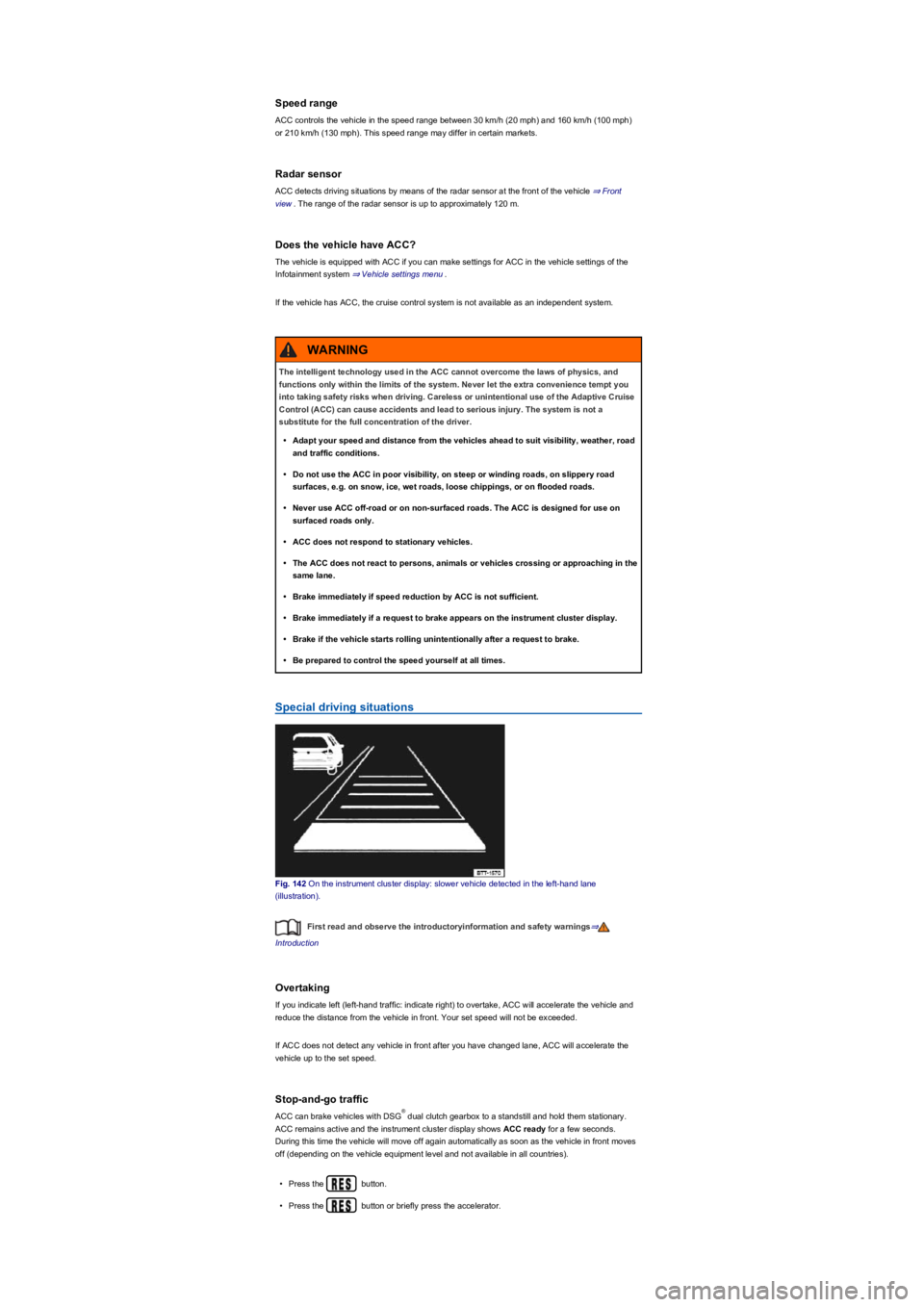
Special driving situations
Fig. 142 On the instrument cluster display: slower vehicle detected in the left-hand lane
(illustration).
First read and observe the introductoryinformation and safety warnings⇒
Introduction
Overtaking
If you indicate left (left-hand traffic: indicate right) to overtake, ACC will accelerate the vehicle and
reduce the distance from the vehicle in front. Your set speed will not be exceeded.
If ACC does not detect any vehicle in front after you have changed lane, ACC will accelerate the
vehicle up to the set speed.
Stop-and-go traffic
ACC can brake vehicles with DSG dual clutch gearbox to a standstill and hold them stationary.
ACC remains active and the instrument cluster display shows ACC ready for a few seconds.
During this time the vehicle will move off again automatically as soon as the vehicle in front moves
off (depending on the vehicle equipment level and not available in all countries).
•Press the button.
•Press the button or briefly press the accelerator.
The intelligent technology used in the ACC cannot overcome the laws of physics, and
functions only within the limits of the system. Never let the extra convenience tempt you
into taking safety risks when driving. Careless or unintentional use of the Adaptive Cruise
Control (ACC) can cause accidents and lead to serious injury. The system is not a
substitute for the full concentration of the driver.
•Adapt your speed and distance from the vehicles ahead to suit visibility, weather, road
and traffic conditions.
•Do not use the ACC in poor visibility, on steep or winding roads, on slippery road
surfaces, e.g. on snow, ice, wet roads, loose chippings, or on flooded roads.
•Never use ACC off-road or on non-surfaced roads. The ACC is designed for use on
surfaced roads only.
•ACC does not respond to stationary vehicles.
•The ACC does not react to persons, animals or vehicles crossing or approaching in the
same lane.
•Brake immediately if speed reduction by ACC is not sufficient.
•Brake immediately if a request to brake appears on the instrument cluster display.
•Brake if the vehicle starts rolling unintentionally after a request to brake.
•Be prepared to control the speed yourself at all times.
WARNING
®
Page 177 of 341
•Press the button.
ACC is switched off.
Setting ACC
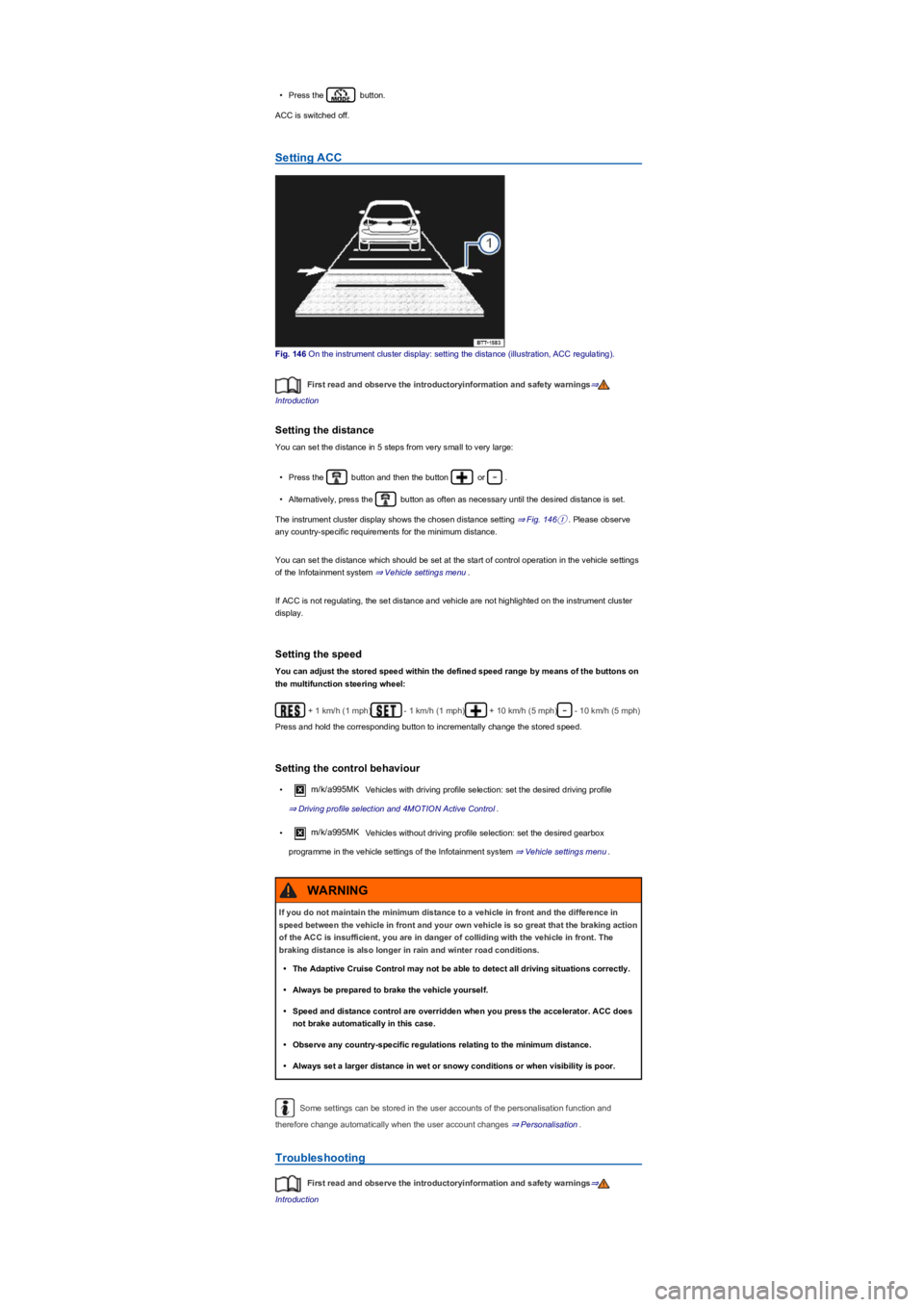
Fig. 146 On the instrument cluster display: setting the distance (illustration, ACC regulating).
First read and observe the introductoryinformation and safety warnings⇒
Introduction
Setting the distance
You can set the distance in 5 steps from very small to very large:
•Press the button and then the button or .
•Alternatively, press the button as often as necessary until the desired distance is set.
The instrument cluster display shows the chosen distance setting ⇒ Fig. 146①. Please observe
any country-specific requirements for the minimum distance.
You can set the distance which should be set at the start of control operation in the vehicle settings
of the Infotainment system ⇒ Vehicle settings menu.
If ACC is not regulating, the set distance and vehicle are not highlighted on the instrument cluster
display.
Setting the speed
You can adjust the stored speed within the defined speed range by means of the buttons on
the multifunction steering wheel:
+ 1 km/h (1 mph)- 1 km/h (1 mph)+ 10 km/h (5 mph)- 10 km/h (5 mph)
Press and hold the corresponding button to incrementally change the stored speed.
Setting the control behaviour
•m/k/a995MK Vehicles with driving profile selection: set the desired driving profile
⇒ Driving profile selection and 4MOTION Active Control.
•m/k/a995MK Vehicles without driving profile selection: set the desired gearbox
programme in the vehicle settings of the Infotainment system ⇒ Vehicle settings menu.
Some settings can be stored in the user accounts of the personalisation function and
therefore change automatically when the user account changes ⇒ Personalisation.
Troubleshooting
First read and observe the introductoryinformation and safety warnings⇒
Introduction
If you do not maintain the minimum distance to a vehicle in front and the difference in
speed between the vehicle in front and your own vehicle is so great that the braking action
of the ACC is insufficient, you are in danger of colliding with the vehicle in front. The
braking distance is also longer in rain and winter road conditions.
•The Adaptive Cruise Control may not be able to detect all driving situations correctly.
•Always be prepared to brake the vehicle yourself.
•Speed and distance control are overridden when you press the accelerator. ACC does
not brake automatically in this case.
•Observe any country-specific regulations relating to the minimum distance.
•Always set a larger distance in wet or snowy conditions or when visibility is poor.
WARNING
Page 180 of 341
City Emergency Braking System
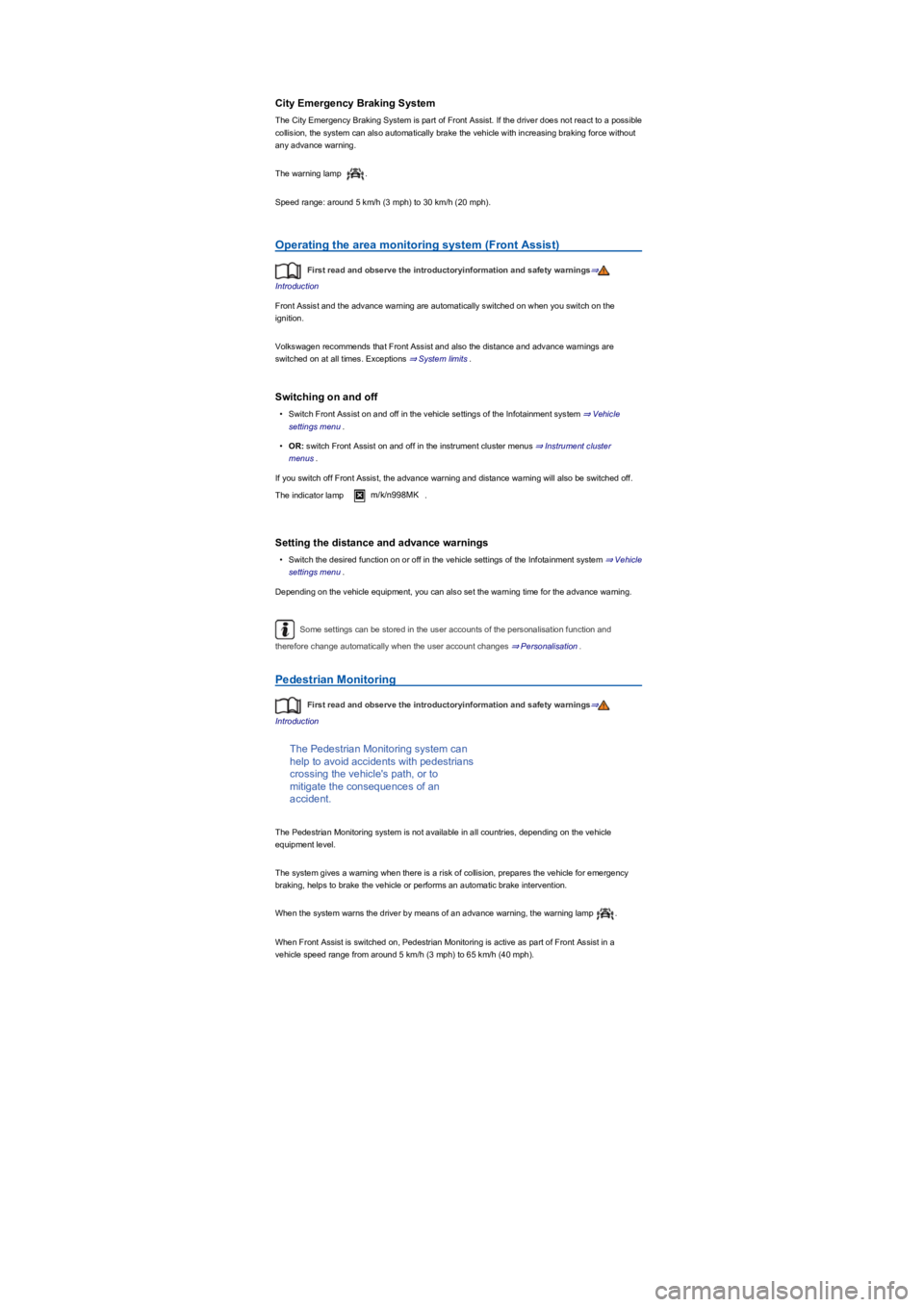
The City Emergency Braking System is part of Front Assist. If the driver does not react to a possible
collision, the system can also automatically brake the vehicle with increasing braking force without
any advance warning.
The warning lamp .
Speed range: around 5 km/h (3 mph) to 30 km/h (20 mph).
Operating the area monitoring system (Front Assist)
First read and observe the introductoryinformation and safety warnings⇒
Introduction
Front Assist and the advance warning are automatically switched on when you switch on the
ignition.
Volkswagen recommends that Front Assist and also the distance and advance warnings are
switched on at all times. Exceptions ⇒ System limits.
Switching on and off
•Switch Front Assist on and off in the vehicle settings of the Infotainment system ⇒ Vehicle
settings menu.
•OR: switch Front Assist on and off in the instrument cluster menus ⇒ Instrument cluster
menus.
If you switch off Front Assist, the advance warning and distance warning will also be switched off.
The indicator lamp m/k/n998MK.
Setting the distance and advance warnings
•Switch the desired function on or off in the vehicle settings of the Infotainment system ⇒ Vehicle
settings menu.
Depending on the vehicle equipment, you can also set the warning time for the advance warning.
Some settings can be stored in the user accounts of the personalisation function and
therefore change automatically when the user account changes ⇒ Personalisation.
Pedestrian Monitoring
First read and observe the introductoryinformation and safety warnings⇒
Introduction
The Pedestrian Monitoring system can
help to avoid accidents with pedestrians
crossing the vehicle's path, or to
mitigate the consequences of an
accident.
The Pedestrian Monitoring system is not available in all countries, depending on the vehicle
equipment level.
The system gives a warning when there is a risk of collision, prepares the vehicle for emergency
braking, helps to brake the vehicle or performs an automatic brake intervention.
When the system warns the driver by means of an advance warning, the warning lamp .
When Front Assist is switched on, Pedestrian Monitoring is active as part of Front Assist in a
vehicle speed range from around 5 km/h (3 mph) to 65 km/h (40 mph).
Page 182 of 341
Troubleshooting
First read and observe the introductoryinformation and safety warnings⇒
Introduction
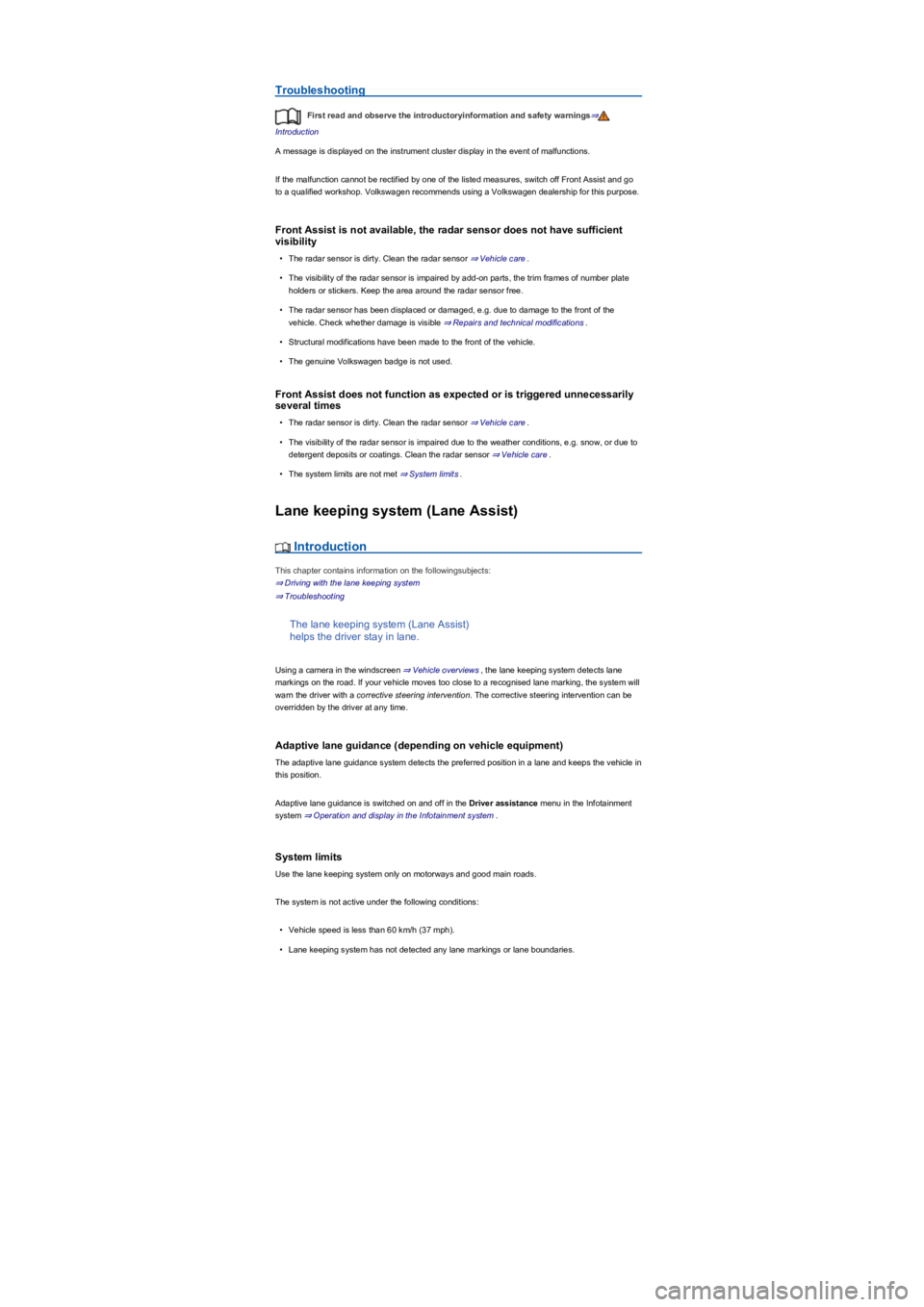
A message is displayed on the instrument cluster display in the event of malfunctions.
If the malfunction cannot be rectified by one of the listed measures, switch off Front Assist and go
to a qualified workshop. Volkswagen recommends using a Volkswagen dealership for this purpose.
Front Assist is not available, the radar sensor does not have sufficient
visibility
•The radar sensor is dirty. Clean the radar sensor ⇒ Vehicle care.
•The visibility of the radar sensor is impaired by add-on parts, the trim frames of number plate
holders or stickers. Keep the area around the radar sensor free.
•The radar sensor has been displaced or damaged, e.g. due to damage to the front of the
vehicle. Check whether damage is visible ⇒ Repairs and technical modifications.
•Structural modifications have been made to the front of the vehicle.
•The genuine Volkswagen badge is not used.
Front Assist does not function as expected or is triggered unnecessarily
several times
•The radar sensor is dirty. Clean the radar sensor ⇒ Vehicle care.
•The visibility of the radar sensor is impaired due to the weather conditions, e.g. snow, or due to
detergent deposits or coatings. Clean the radar sensor ⇒ Vehicle care.
•The system limits are not met ⇒ System limits.
Lane keeping system (Lane Assist)
Introduction
This chapter contains information on the followingsubjects:
⇒ Driving with the lane keeping system
⇒ Troubleshooting
The lane keeping system (Lane Assist)
helps the driver stay in lane.
Using a camera in the windscreen ⇒ Vehicle overviews, the lane keeping system detects lane
markings on the road. If your vehicle moves too close to a recognised lane marking, the system will
warn the driver with a corrective steering intervention. The corrective steering intervention can be
overridden by the driver at any time.
Adaptive lane guidance (depending on vehicle equipment)
The adaptive lane guidance system detects the preferred position in a lane and keeps the vehicle in
this position.
Adaptive lane guidance is switched on and off in the Driver assistance menu in the Infotainment
system ⇒ Operation and display in the Infotainment system.
System limits
Use the lane keeping system only on motorways and good main roads.
The system is not active under the following conditions:
•Vehicle speed is less than 60 km/h (37 mph).
•Lane keeping system has not detected any lane markings or lane boundaries.
Page 183 of 341
Driving with the lane keeping system
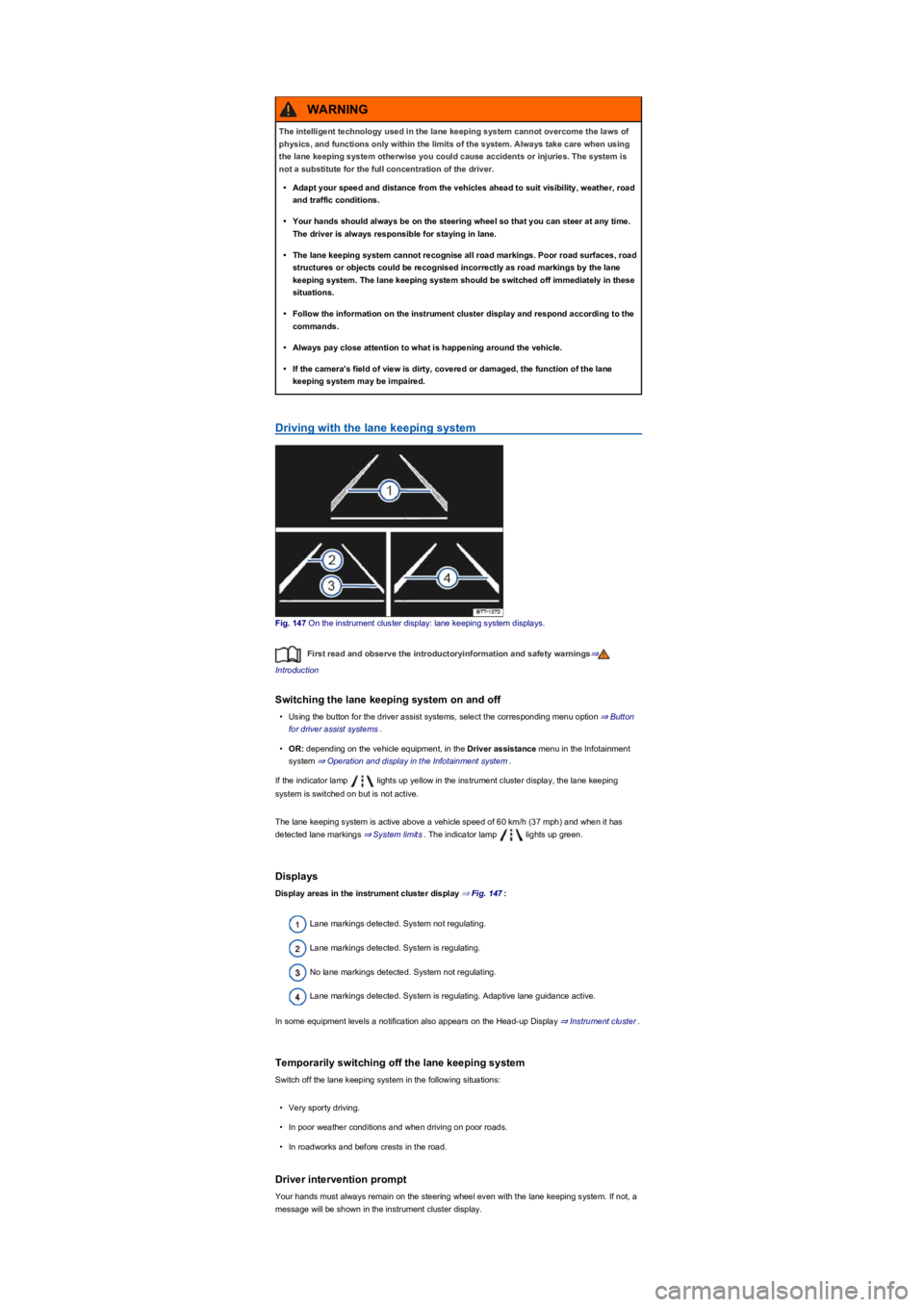
Fig. 147 On the instrument cluster display: lane keeping system displays.
First read and observe the introductoryinformation and safety warnings⇒
Introduction
Switching the lane keeping system on and off
•Using the button for the driver assist systems, select the corresponding menu option ⇒ Button
for driver assist systems.
•OR: depending on the vehicle equipment, in the Driver assistance menu in the Infotainment
system ⇒ Operation and display in the Infotainment system.
If the indicator lamp lights up yellow in the instrument cluster display, the lane keeping
system is switched on but is not active.
The lane keeping system is active above a vehicle speed of 60 km/h (37 mph) and when it has
detected lane markings ⇒ System limits. The indicator lamp lights up green.
Displays
Display areas in the instrument cluster display ⇒ Fig. 147:
Lane markings detected. System not regulating.
Lane markings detected. System is regulating.
No lane markings detected. System not regulating.
Lane markings detected. System is regulating. Adaptive lane guidance active.
In some equipment levels a notification also appears on the Head-up Display ⇒ Instrument cluster.
Temporarily switching off the lane keeping system
Switch off the lane keeping system in the following situations:
•Very sporty driving.
•In poor weather conditions and when driving on poor roads.
•In roadworks and before crests in the road.
Driver intervention prompt
Your hands must always remain on the steering wheel even with the lane keeping system. If not, a
message will be shown in the instrument cluster display.
The intelligent technology used in the lane keeping system cannot overcome the laws of
physics, and functions only within the limits of the system. Always take care when using
the lane keeping system otherwise you could cause accidents or injuries. The system is
not a substitute for the full concentration of the driver.
•Adapt your speed and distance from the vehicles ahead to suit visibility, weather, road
and traffic conditions.
•Your hands should always be on the steering wheel so that you can steer at any time.
The driver is always responsible for staying in lane.
•The lane keeping system cannot recognise all road markings. Poor road surfaces, road
structures or objects could be recognised incorrectly as road markings by the lane
keeping system. The lane keeping system should be switched off immediately in these
situations.
•Follow the information on the instrument cluster display and respond according to the
commands.
•Always pay close attention to what is happening around the vehicle.
•If the camera's field of view is dirty, covered or damaged, the function of the lane
keeping system may be impaired.
WARNING
Page 184 of 341
If the driver does not respond, the system will give another warning by initiating a quick jolt of the
brake before switching to passive or activating Emergency Assist (depending on the equipment)
⇒ Emergency Assist.
Behaviour when changing lanes
There is no steering intervention when the turn signal is switched on in vehicles without lane
keeping system.
In vehicles with lane keeping system, a steering intervention takes place if the turn signal is
switched on in critical situations ⇒ Lane change system (Side Assist) incl. Rear Traffic Alert.
Steering wheel vibration
If the steering wheel vibrates, the driver must actively take over steering.
Troubleshooting
First read and observe the introductoryinformation and safety warnings⇒
Introduction
No camera visibility, error message, system switches itself off
•Clean the camera or remove stickers or accessories from the camera ⇒ Caring for and cleaning
the vehicle exterior.
•Check whether any damage is visible.
The system is not responding as expected
•The camera is dirty ⇒ Caring for and cleaning the vehicle exterior. The camera visibility may be
impaired by dirt and snow or also residue from cleaning agents or coatings.
•The camera is covered by water.
•The vehicle is damaged in the area of the camera.
•Changes have been made to the paintwork around the camera or the construction has been
modified, e.g. vehicle front end or the running gear.
Traffic Jam Assist
Traffic Jam Assist helps the driver to
keep in lane, and also provides
assistance when following other
vehicles in congestion or slow-moving
traffic.
Traffic Jam Assist is an extension of the lane keeping system (Lane Assist) ⇒ Lane keeping system
(Lane Assist) for vehicles with a DSG dual clutch gearbox and combines this function with the
Adaptive Cruise Control (ACC) ⇒ Adaptive Cruise Control (ACC). Please therefore read both these
chapters and observe the information about the system limits and warnings.
Traffic Jam Assist function
At speeds under 60 km/h (37 mph), Traffic Jam Assist can maintain a time interval set by the driver
to a vehicle in front and help the vehicle to stay in lane ⇒.
The system automatically controls acceleration, braking, steering and, if required, will decelerate to
a stop behind a vehicle that is stopping, and then drive away again automatically.
Use Traffic Jam Assist only on motorways and good main roads. Do not use Traffic Jam Assist in
urban traffic.
Switching Traffic Jam Assist on and off
Traffic Jam Assist is switched on and off together with adaptive lane guidance ⇒ Lane keeping
system (Lane Assist) in the Infotainment system ⇒ Operation and display in the Infotainment
system.
Traffic Jam Assist can also be switched off together with the lane keeping system by pressing the
button for driver assist systems ⇒ Button for driver assist systems.
Technical requirements for using Traffic Jam Assist
•The lane keeping system is switched on and active together with adaptive lane guidance
⇒ Lane keeping system (Lane Assist).
•Adaptive Cruise Control (ACC) is switched on and active ⇒ Adaptive Cruise Control (ACC).
•The selector lever is in position D/S or in the Tiptronic gate.
•The system has detected a lane marking on both the right and left sides of the vehicle
⇒ Fig. 147.
•The speed is under 60 km/h (37 mph).
®
Page 187 of 341
The integrated Rear Traffic Alert provides assistance when reversing out of a parking space and
manoeuvring.
System limits
Use the lane keeping system only on paved roads.
The lane change system may interpret the traffic situation incorrectly in the following driving
situations, for example:
•In tight bends.
•When driving in the middle of two lanes.
•When road lanes are of varying width.
•At the brow of a hill.
•In poor weather conditions.
•Where there are special roadside structures, e.g. high or offset crash barriers.
You can save some settings in the user accounts of the personalisation function
⇒ Personalisation.
Driving with the lane change system
Fig. 148 In the exterior mirror housing: visual displays for the lane change system.
First read and observe the introductoryinformation and safety warnings⇒
Introduction
Switching on and off
•By means of the Assist systems menu in the instrument cluster ⇒ Instrument cluster
operation.
•OR: depending on the vehicle equipment, by means of the button for the driver assist systems
⇒ Button for driver assist systems.
•OR: depending on the vehicle equipment, in the Driver assistance menu in the Infotainment
system ⇒ Operation and display in the Infotainment system.
When the lane change system is switched on, the yellow indicator lamp in the exterior mirror
housing lights up once briefly ⇒ Fig. 148.
This most recent system setting is retained even after the ignition has been switched off and on.
Function
When switched on, the lane change system is active from a speed of around 15 km/h (9 mph). The
lane change system is deactivated at a vehicle speed below 10 km/h (6 mph).
The intelligent technology of the lane change system including Rear Traffic Alert cannot
overcome the laws of physics, and functions only within the limits of the system. Never let
the extra convenience afforded by the lane change system including Rear Traffic Alert
tempt you into taking any risks when driving. Always take care when using the lane
change system and the Rear Traffic Alert as you could otherwise cause accidents or
injuries. The system is not a substitute for the full concentration of the driver.
•Adapt your speed and distance from the vehicles ahead to suit visibility, weather, road
and traffic conditions.
•Your hands should always be on the steering wheel so that you can steer at any time.
•Pay attention to the visual displays in the exterior mirror housing and in the instrument
cluster display, and respond to the commands.
•Always pay close attention to what is happening around the vehicle.
•Never use the lane change system including Rear Traffic Alert if the radar sensors are
dirty, covered or damaged. These circumstances can impair the proper functioning of
the system.
•It may be hard to see the display in the exterior mirror in direct sunlight.
WARNING