Service VOLKSWAGEN TIGUAN 2017 Owner´s Manual
[x] Cancel search | Manufacturer: VOLKSWAGEN, Model Year: 2017, Model line: TIGUAN, Model: VOLKSWAGEN TIGUAN 2017Pages: 341, PDF Size: 9.14 MB
Page 316 of 341
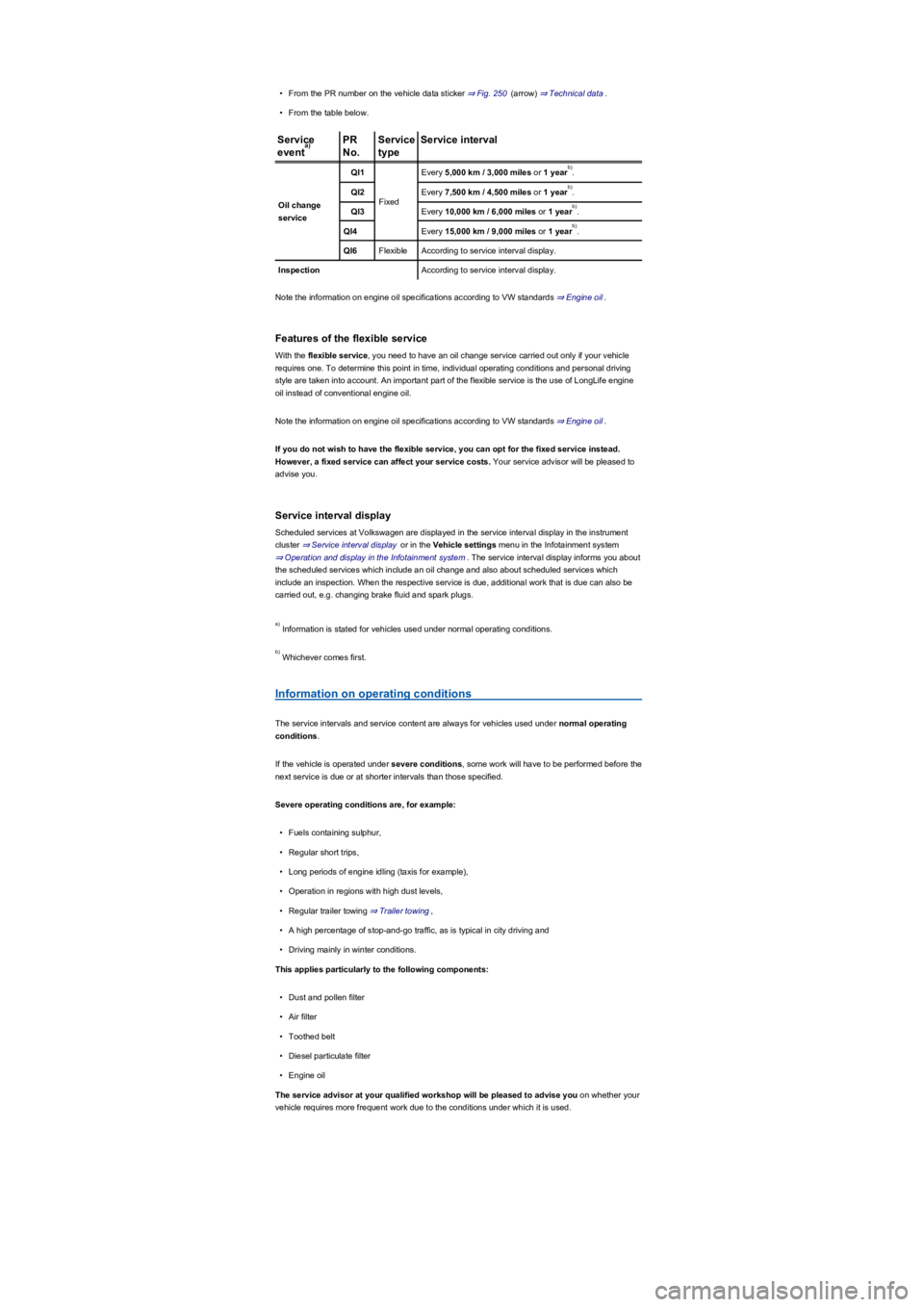
•From the PR number on the vehicle data sticker ⇒ Fig. 250 (arrow) ⇒ Technical data.
•From the table below.
Service
event
PR
No.
Service
type
Service interval
Oil change
service
QI1
Fixed
Every 5,000 km / 3,000 miles or 1 year.
QI2Every 7,500 km / 4,500 miles or 1 year.
QI3Every 10,000 km / 6,000 miles or 1 year.
QI4Every 15,000 km / 9,000 miles or 1 year.
QI6FlexibleAccording to service interval display.
InspectionAccording to service interval display.
Note the information on engine oil specifications according to VW standards ⇒ Engine oil.
Features of the flexible service
With the flexible service, you need to have an oil change service carried out only if your vehicle
requires one. To determine this point in time, individual operating conditions and personal driving
style are taken into account. An important part of the flexible service is the use of LongLife engine
oil instead of conventional engine oil.
Note the information on engine oil specifications according to VW standards ⇒ Engine oil.
If you do not wish to have the flexible service, you can opt for the fixed service instead.
However, a fixed service can affect your service costs. Your service advisor will be pleased to
advise you.
Service interval display
Scheduled services at Volkswagen are displayed in the service interval display in the instrument
cluster ⇒ Service interval display or in the Vehicle settings menu in the Infotainment system
⇒ Operation and display in the Infotainment system. The service interval display informs you about
the scheduled services which include an oil change and also about scheduled services which
include an inspection. When the respective service is due, additional work that is due can also be
carried out, e.g. changing brake fluid and spark plugs.
Information is stated for vehicles used under normal operating conditions.
Whichever comes first.
Information on operating conditions
The service intervals and service content are always for vehicles used under normal operating
conditions.
If the vehicle is operated under severe conditions, some work will have to be performed before the
next service is due or at shorter intervals than those specified.
Severe operating conditions are, for example:
•Fuels containing sulphur,
•Regular short trips,
•Long periods of engine idling (taxis for example),
•Operation in regions with high dust levels,
•Regular trailer towing ⇒ Trailer towing,
•A high percentage of stop-and-go traffic, as is typical in city driving and
•Driving mainly in winter conditions.
This applies particularly to the following components:
•Dust and pollen filter
•Air filter
•Toothed belt
•Diesel particulate filter
•Engine oil
The service advisor at your qualified workshop will be pleased to advise you on whether your
vehicle requires more frequent work due to the conditions under which it is used.
a)
b)
b)
b)
b)
a)
b)
Page 317 of 341
Scope of service
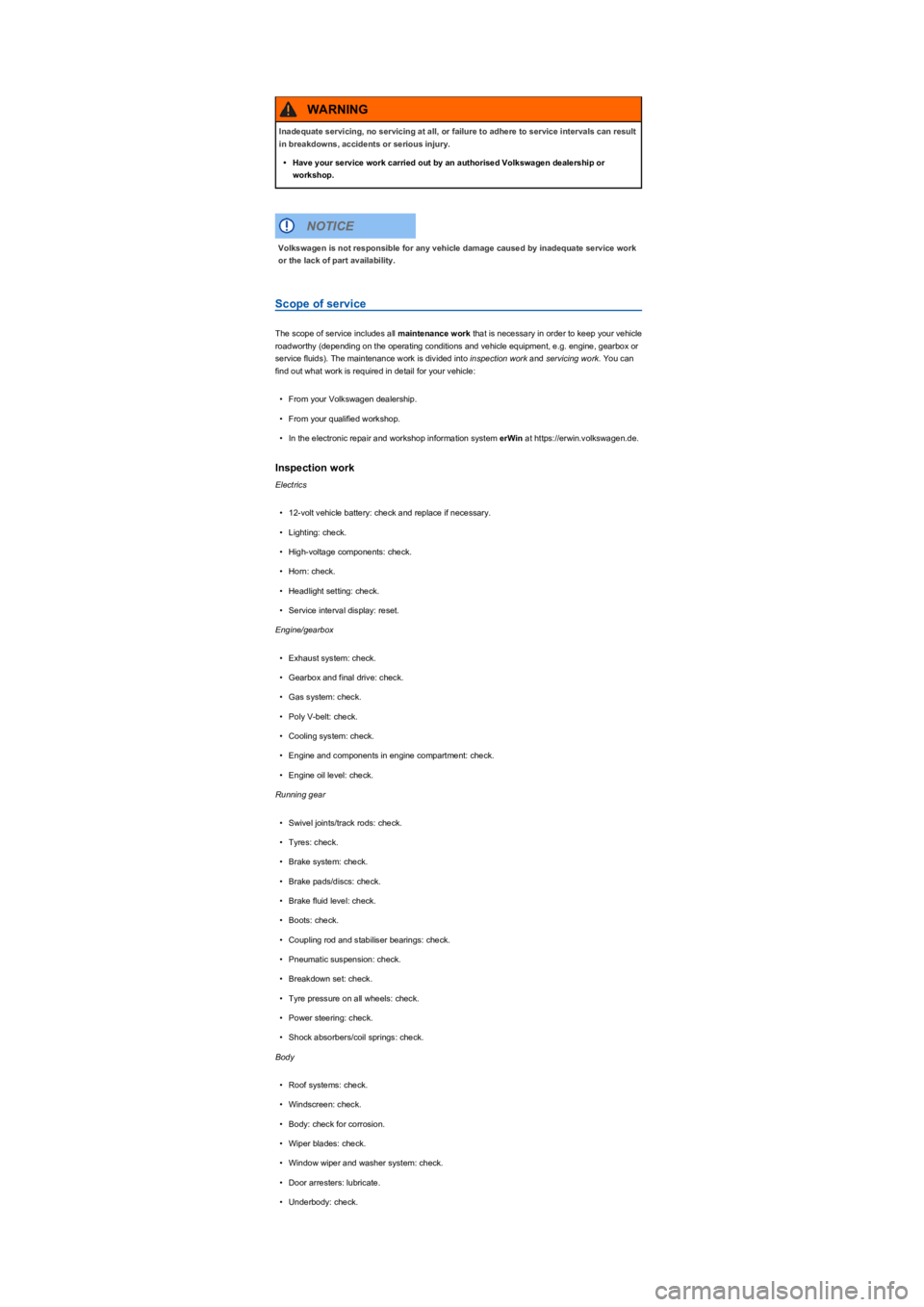
The scope of service includes all maintenance work that is necessary in order to keep your vehicle
roadworthy (depending on the operating conditions and vehicle equipment, e.g. engine, gearbox or
service fluids). The maintenance work is divided into inspection work and servicing work. You can
find out what work is required in detail for your vehicle:
•From your Volkswagen dealership.
•From your qualified workshop.
•In the electronic repair and workshop information system erWin at https://erwin.volkswagen.de.
Inspection work
Electrics
•12-volt vehicle battery: check and replace if necessary.
•Lighting: check.
•High-voltage components: check.
•Horn: check.
•Headlight setting: check.
•Service interval display: reset.
Engine/gearbox
•Exhaust system: check.
•Gearbox and final drive: check.
•Gas system: check.
•Poly V-belt: check.
•Cooling system: check.
•Engine and components in engine compartment: check.
•Engine oil level: check.
Running gear
•Swivel joints/track rods: check.
•Tyres: check.
•Brake system: check.
•Brake pads/discs: check.
•Brake fluid level: check.
•Boots: check.
•Coupling rod and stabiliser bearings: check.
•Pneumatic suspension: check.
•Breakdown set: check.
•Tyre pressure on all wheels: check.
•Power steering: check.
•Shock absorbers/coil springs: check.
Body
•Roof systems: check.
•Windscreen: check.
•Body: check for corrosion.
•Wiper blades: check.
•Window wiper and washer system: check.
•Door arresters: lubricate.
•Underbody: check.
Inadequate servicing, no servicing at all, or failure to adhere to service intervals can result
in breakdowns, accidents or serious injury.
•Have your service work carried out by an authorised Volkswagen dealership or
workshop.
WARNING
Volkswagen is not responsible for any vehicle damage caused by inadequate service work
or the lack of part availability.
NOTICE
Page 318 of 341
•Water drains: check.
•Road test: perform.
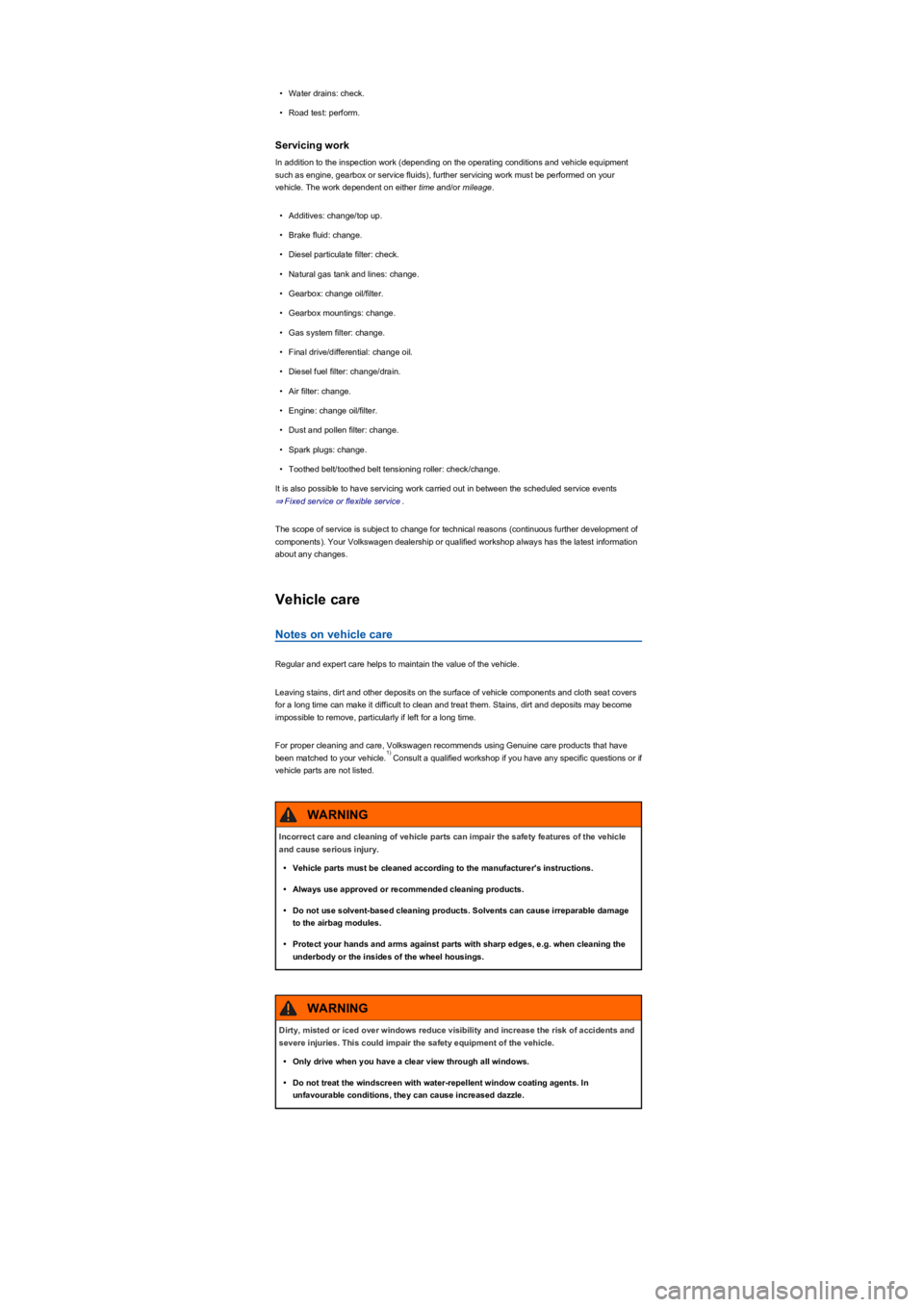
Servicing work
In addition to the inspection work (depending on the operating conditions and vehicle equipment
such as engine, gearbox or service fluids), further servicing work must be performed on your
vehicle. The work dependent on either time and/or mileage.
•Additives: change/top up.
•Brake fluid: change.
•Diesel particulate filter: check.
•Natural gas tank and lines: change.
•Gearbox: change oil/filter.
•Gearbox mountings: change.
•Gas system filter: change.
•Final drive/differential: change oil.
•Diesel fuel filter: change/drain.
•Air filter: change.
•Engine: change oil/filter.
•Dust and pollen filter: change.
•Spark plugs: change.
•Toothed belt/toothed belt tensioning roller: check/change.
It is also possible to have servicing work carried out in between the scheduled service events
⇒ Fixed service or flexible service.
The scope of service is subject to change for technical reasons (continuous further development of
components). Your Volkswagen dealership or qualified workshop always has the latest information
about any changes.
Vehicle care
Notes on vehicle care
Regular and expert care helps to maintain the value of the vehicle.
Leaving stains, dirt and other deposits on the surface of vehicle components and cloth seat covers
for a long time can make it difficult to clean and treat them. Stains, dirt and deposits may become
impossible to remove, particularly if left for a long time.
For proper cleaning and care, Volkswagen recommends using Genuine care products that have
been matched to your vehicle. Consult a qualified workshop if you have any specific questions or if
vehicle parts are not listed.
1)
Incorrect care and cleaning of vehicle parts can impair the safety features of the vehicle
and cause serious injury.
•Vehicle parts must be cleaned according to the manufacturer's instructions.
•Always use approved or recommended cleaning products.
•Do not use solvent-based cleaning products. Solvents can cause irreparable damage
to the airbag modules.
•Protect your hands and arms against parts with sharp edges, e.g. when cleaning the
underbody or the insides of the wheel housings.
WARNING
Dirty, misted or iced over windows reduce visibility and increase the risk of accidents and
severe injuries. This could impair the safety equipment of the vehicle.
•Only drive when you have a clear view through all windows.
•Do not treat the windscreen with water-repellent window coating agents. In
unfavourable conditions, they can cause increased dazzle.
WARNING
Page 321 of 341
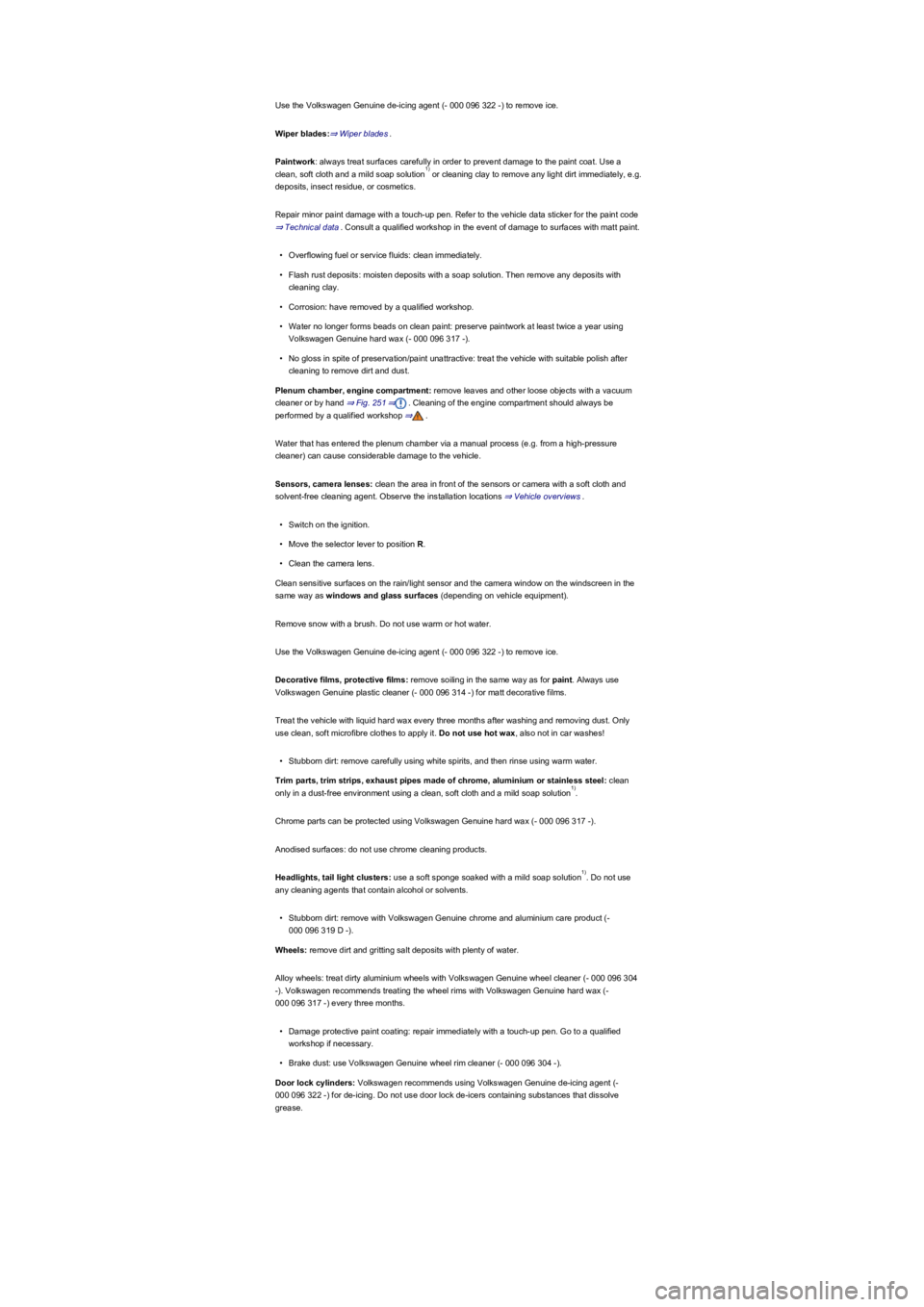
Use the Volkswagen Genuine de-icing agent (- 000 096 322 -) to remove ice.
Wiper blades:⇒ Wiper blades.
Paintwork: always treat surfaces carefully in order to prevent damage to the paint coat. Use a
clean, soft cloth and a mild soap solution or cleaning clay to remove any light dirt immediately, e.g.
deposits, insect residue, or cosmetics.
Repair minor paint damage with a touch-up pen. Refer to the vehicle data sticker for the paint code
⇒ Technical data. Consult a qualified workshop in the event of damage to surfaces with matt paint.
•Overflowing fuel or service fluids: clean immediately.
•Flash rust deposits: moisten deposits with a soap solution. Then remove any deposits with
cleaning clay.
•Corrosion: have removed by a qualified workshop.
•Water no longer forms beads on clean paint: preserve paintwork at least twice a year using
Volkswagen Genuine hard wax (- 000 096 317 -).
•No gloss in spite of preservation/paint unattractive: treat the vehicle with suitable polish after
cleaning to remove dirt and dust.
Plenum chamber, engine compartment: remove leaves and other loose objects with a vacuum
cleaner or by hand ⇒ Fig. 251⇒. Cleaning of the engine compartment should always be
performed by a qualified workshop ⇒.
Water that has entered the plenum chamber via a manual process (e.g. from a high-pressure
cleaner) can cause considerable damage to the vehicle.
Sensors, camera lenses: clean the area in front of the sensors or camera with a soft cloth and
solvent-free cleaning agent. Observe the installation locations ⇒ Vehicle overviews.
•Switch on the ignition.
•Move the selector lever to position R.
•Clean the camera lens.
Clean sensitive surfaces on the rain/light sensor and the camera window on the windscreen in the
same way as windows and glass surfaces (depending on vehicle equipment).
Remove snow with a brush. Do not use warm or hot water.
Use the Volkswagen Genuine de-icing agent (- 000 096 322 -) to remove ice.
Decorative films, protective films: remove soiling in the same way as for paint. Always use
Volkswagen Genuine plastic cleaner (- 000 096 314 -) for matt decorative films.
Treat the vehicle with liquid hard wax every three months after washing and removing dust. Only
use clean, soft microfibre clothes to apply it. Do not use hot wax, also not in car washes!
•Stubborn dirt: remove carefully using white spirits, and then rinse using warm water.
Trim parts, trim strips, exhaust pipes made of chrome, aluminium or stainless steel: clean
only in a dust-free environment using a clean, soft cloth and a mild soap solution.
Chrome parts can be protected using Volkswagen Genuine hard wax (- 000 096 317 -).
Anodised surfaces: do not use chrome cleaning products.
Headlights, tail light clusters: use a soft sponge soaked with a mild soap solution. Do not use
any cleaning agents that contain alcohol or solvents.
•Stubborn dirt: remove with Volkswagen Genuine chrome and aluminium care product (-
000 096 319 D -).
Wheels: remove dirt and gritting salt deposits with plenty of water.
Alloy wheels: treat dirty aluminium wheels with Volkswagen Genuine wheel cleaner (- 000 096 304
-). Volkswagen recommends treating the wheel rims with Volkswagen Genuine hard wax (-
000 096 317 -) every three months.
•Damage protective paint coating: repair immediately with a touch-up pen. Go to a qualified
workshop if necessary.
•Brake dust: use Volkswagen Genuine wheel rim cleaner (- 000 096 304 -).
Door lock cylinders: Volkswagen recommends using Volkswagen Genuine de-icing agent (-
000 096 322 -) for de-icing. Do not use door lock de-icers containing substances that dissolve
grease.
1)
1)
1)
Page 323 of 341
Displays: use a Volkswagen Genuine cleaning cloth (- 000 096 166 A -) with a little water, a
suitable glass cleaner or LCD cleaner. Do not clean displays with a dry cloth.
Rubber seals: clean with a soft, lint-free cloth and plenty of water. Treat with Volkswagen Genuine
rubber care agent (- 000 096 310 -) on a regular basis.
Seat belts: carefully pull the seat belt right out and leave it out ⇒. Remove large particles of dirt
with a soft brush. Clean the seat belt with a mild soap solution. Leave the belt fabric to dry
completely and then allow it to roll up.
Wooden trims: clean with a soft cloth and some mild soap solution.
Cleaning upholstery fabrics
If clothing that is not sufficiently colour-fast, e.g. denim, leaves stains on the seat cushion, this does
not a defect in the cover fabric. The seat padding may contain components for the airbag system
and electrical connections. Seat padding that is damaged, incorrectly cleaned or treated, or that
becomes wet, may cause damage to the vehicle electrical system or trigger a fault in the airbag
system ⇒.
Depending on the equipment, seat cushions with seat heating feature electrical components and
connectors that may be damaged in the event of incorrect cleaning or treatment ⇒. This can
also result in damage to other parts of the vehicle electrics.
•Do not use high-pressure cleaners, steam cleaners or coolant spray.
•Do not switch on the seat heating to dry the seats.
•Do not use washing paste or fine detergent solutions.
•Avoid getting the seat wet.
•In the event of uncertainty, contact a Volkswagen dealership.
Mild soap solution: a maximum of two tablespoons of neutral soap diluted in one litre of water.
Accessories, modifications, repairs and renewal of
parts
Accessories and parts
Volkswagen recommends that you seek advice from a Volkswagen dealership before purchasing
accessories, replacement parts or service fluids, for example if the vehicle is to be retrofitted with
accessories or if parts have to be renewed. Volkswagen dealerships can recommend accessories,
parts and service fluids suitable for your requirements. They can also answer any questions you
might have regarding official regulations.
Volkswagen recommends you use only approved Volkswagen accessories and Volkswagen
Genuine Parts. These parts and accessories have been specially tested by Volkswagen for
suitability, reliability and safety. And Volkswagen dealerships are qualified to install them correctly.
Although the market is constantly scrutinised, Volkswagen cannot assume responsibility for the
reliability, safety and suitability of products Volkswagen has not approved. Volkswagen can
therefore assume no responsibility for these parts, even if they have been approved by an official
testing agency or are covered by an official approval certificate.
Any retro-fitted equipment which has a direct effect on the control of the vehicle must be
approved by Volkswagen for use in your vehicle and bear the e mark (the European Union's
1)
Failure to clean the parts properly can cause damage to the seat belts, the fastenings and
the belt retractor.
•Never use chemical cleaning agents on the seat belts or their components. The seat
belts must also not come into contact with corrosive fluids, solvents or sharp objects.
•Dry the cleaned seat belt fully before allowing it to retract.
•Avoid allowing foreign bodies or liquids to enter the slot for the seat belt buckle.
•Never try to repair, modify or remove the seat belts yourself.
WARNING
Incorrect cleaning and care may cause vehicle damage.
•Sharp objects, such as zips, rivets on clothing or belts may damage surfaces. Open
Velcro fasteners can also cause damage.
•Do not use a steam cleaner, brushes or hard sponges etc. for cleaning under any
circumstances.
•To avoid damage, stubborn stains should be removed by a specialist cleaning
company.
NOTICE
1)
®
Page 324 of 341
authorization symbol). These devices include cruise control systems or an electronically controlled
suspension.
Any additional electrical components fitted that do not serve to control the vehicle itself must
bear the mark (manufacturer conformity declaration in the European Union). Such devices
include refrigerator boxes, laptops and ventilator fans.
Repairs and technical modifications
Repairs and technical modifications must always be carried out according to Volkswagen
specifications⇒.
Unauthorised modifications to the electronic components or software in the vehicle may cause
malfunctions. As the electronic components are linked together in networks, these faults may
indirectly affect the working of other systems. This can seriously impair safety, lead to excessive
wear of components, and also invalidate the type approval for the vehicle.
The Volkswagen dealership cannot be held liable for any damage caused by technical
modifications and/or work performed incorrectly.
The Volkswagen dealership is not responsible for damage caused by technical modifications and/or
work performed incorrectly. Such damage is not covered by the Volkswagen guarantee.
Volkswagen recommends that all repairs and technical modifications be performed by an
authorised Volkswagen workshop using Volkswagen Genuine Parts.
Volkswagen repair information
Volkswagen Service information and official Volkswagen repair information can be purchased for a
fee.
Customers in Europe, Asia, Australia, Africa, Central and South America: please contact a
Volkswagen dealership or qualified workshop or register on the online portal erWin (electronic
repair and workshop information):
https://erwin.volkswagen.de
erWin is available in numerous languages.
Vehicles with special auxiliary equipment or body parts
The manufacturer of these components must ensure that these parts (fittings) adhere to the
stipulated environmental laws and regulations, particularly the EU directive 2000/53/EC concerning
end-of-life vehicles and EU directive 2003/11/EC concerning the restriction on the marketing and
use of certain dangerous substances and preparations.
The vehicle owner should keep all assembly documentation for these auxiliary fittings, and pass it
on to any scrapping company later engaged. This is to facilitate environmentally responsible
disposal for all vehicles, including refitted vehicles.
Windscreen repairs
To function properly, some items of equipment require an electrical or electronic module, which is
located on the inside of the windscreen near the interior mirror. If the windscreen has been
damaged in the viewing field of the electrical or electronic module, e.g. by stone impact, the
windscreen must be replaced. Repairing the crack can lead to malfunctions or functional faults in
the equipment.
After changing the windscreen, the camera and sensors must be set up and calibrated by a
qualified workshop.
Impairment or damage to sensors and cameras
Incorrect repairs, retrofit structural modifications to the vehicle, e.g. lowering the body, add-on parts
on the vehicle or trailer ⇒ Trailer towing, or changes to the trim may lead to the sensors or
cameras being disrupted or damaged. This can also be caused by collisions, e.g. when parking.
Failure to observe this may impair important functions (driver assist systems) and damage the
vehicle.
The area in front of and around the sensors and cameras must not be covered by stickers,
additional headlights, trim frames for number plates or similar.
Incorrectly performed repairs or modifications to your vehicle can impair the effectiveness
of the airbags, cause malfunctions, accidents and fatal injury.
•Never secure or mount objects such as drink holders or telephone holders either on or
next to the airbag covers or within the deployment zones of the airbag modules.
•Objects either on or next to the airbag module covers or are in the deployment zone of
the airbags can cause serious or even fatal injuries should the airbags be activated.
WARNING
®
Page 327 of 341
Warranty and LongLife mobility guarantee
Volkswagen dealership warranty
Volkswagen dealerships guarantee that all vehicles purchased from them are free of faults.
Volkswagen dealerships provide a warranty that new Volkswagen vehicles are free of faults
Details of warranty conditions and the warranty periods can be found in your sales contract.
Please ask your Volkswagen dealership for further information.
You are advised that natural wear and damage caused by abnormally rough or improper use, or
unauthorised modifications are not covered by this warranty.
If your vehicle does break down, please contact your nearest available Volkswagen dealership.
Warranty for the paintwork and body
Volkswagen dealerships provide a warranty on the paintwork and body of all vehicles purchased
from them.
In addition to the warranty conditions for new Volkswagen vehicles (as detailed in the purchase
contract), the Volkswagen dealership guarantees that the body of any vehicles it sells will not be
affected by paint defects or corrosion perforation for a specified period:
•a 3-year warranty on paint defects and
•a 12-year corrosion perforation warranty. Here, corrosion perforation refers to rust forming on
the inside (cavity) of the body and causing holes in the sheet metal.
In the unlikely event that this type of damage occurs, it will be repaired free of charge for parts and
labour by any Volkswagen dealership.
Warranty claims will not be accepted in the following circumstances:
•If damage is caused by external influence or insufficient care.
•Defects on the body or paintwork are not repaired promptly according to manufacturer
specifications.
•The cause of corrosion perforation is related to body repairs not being carried out according to
manufacturer specifications.
If the body is repaired or painted, your Volkswagen dealership will confirm your warranty against
corrosion perforation for the repaired area.
LongLife mobility guarantee
With the delivery of your new vehicle you have acquired the comprehensive LongLife mobility
guarantee (available in many European countries), which will be renewed after every inspection.
In many European markets, your new vehicle includes the comprehensive LongLife mobility
guarantee which will be renewed after every inspection.
The selling Volkswagen dealership will issue a comprehensive LongLife mobility guarantee for
every new vehicle which applies from the time of delivery until the first due inspection. If you
purchase your new vehicle directly from Volkswagen AG, Volkswagen AG will issue the LongLife
mobility guarantee from the time of delivery until the first due inspection.
Your Volkswagen service partner will extend the LongLife mobility guarantee until the following
inspection when the due inspection is carried out at that workshop. The service costs include the
entire guarantee package.
The comprehensive LongLife mobility guarantee includes the following services:
If your vehicle can no longer be driven due to a technical defect, corresponding assistance will be
provided in the case of breakdown or accident. The LongLife mobility guarantee provides with you
protection and mobility.
The inspection is not only about car maintenance - it also ensures that your car remains roadworthy
and in perfect working order. For this reason, servicing should be carried out regularly in
accordance with the manufacturer's service schedule.
Your entitlement to the LongLife mobility guarantee is documented in the digital service schedule
each time your car is serviced. A full service history shows that your car has been professionally
maintained and cared for.
A vehicle which can no longer be driven is a vehicle which cannot reach a workshop under its
own power.
1)
1)
Page 328 of 341
Data storage and services
Your vehicle is fitted with electronic control units. Some of these are required to make sure your
vehicle remains safe while others provide support while driving (driver assist systems).
Furthermore, your vehicle is equipped with convenience and Infotainment functions, which are also
made possible using electronic control units.
Electronic control units contain data memories that can store information regarding the vehicle
status, component load levels, maintenance requirements, technical events and faults on a
temporary or permanent basis. This information generally documents the status of a component, a
module, a system or the environment, e.g.:
•Operating states of system components, e.g. filling levels, tyre pressure, battery status.
•Status messages from the vehicle or its individual components, e.g. wheel revolutions or speed,
deceleration, lateral acceleration, display of fastened seat belts.
•Faults or malfunctions in important system components, e.g. lights, brakes.
•Information on events which damaged the vehicle.
•System reactions to specific driving situations, triggering of an airbag, intervention the stability
control systems.
•Ambient conditions, e.g. temperature, rain.
As well as performing the actual control unit functions, these data are also used to detect and
rectify faults and help Volkswagen to improve vehicle functions. The majority of these data are
temporary are processed only within the vehicle itself. Only a very small amount of data is stored in
the event memories or possibly on the vehicle key.
Reading out the vehicle's event memory
There is a diagnostic interface in the vehicle interior for reading out the event memories (on-board
diagnostic system) ⇒.
If you have service work performed on your vehicle, the technical data can be read out of the
vehicle together with the vehicle identification number by service employees, e.g. workshops, or
third parties such as breakdown services. Service work includes, for example, repairs,
maintenance, warranty work or quality assurance measures. The service workshop or third party
collects, processes and uses the data. The data document the vehicle's technical status, help in
troubleshooting and in improving quality and may be sent to Volkswagen in some cases.
Furthermore, the manufacturer is subject to legal product safety requirements. To make sure it
complies with these requirements, the manufacturer requires technical data from the vehicles.
Event memories in the vehicle can be reset by a service workshop as part of repair or service work.
The event memory should only be read and reset by a qualified workshop. Additional information on
the stored data is available from qualified workshops.
After a fault has been rectified, the information in the memory pertaining to the fault is deleted.
Other memory content is overwritten on an ongoing basis.
Event data recorder
This vehicle is equipped with an event data recorder. The main task of an event data recorder is to
record data in particular accident scenarios or accident-like situations, e.g. in the event of airbags
being triggered or a collision with an obstacle on the road. These data help in analysis of how a
vehicle system behaved in these situations. The event data recorder records data relating to driving
dynamics and the restraint system for a short period of 10 s or less. This information includes, for
example:
•how various systems in your vehicle have functioned.
•whether the seat belts of the driver and front passenger were fastened.
•the extent to which the driver pressed the brake or accelerator pedal.
•how fast the vehicle was travelling.
These data help to obtain a better understanding of the circumstances in the situations where
accidents and injuries have occurred.
Data from driver assist systems are also recorded. In addition to information about whether the
systems were switched on or off, available only to a restricted extent or inactive, it is also possible
to determine whether these functions steered, accelerated or braked the vehicle in the above-
described situations. Depending on the vehicle equipment, these systems include the following:
•Adaptive Cruise Control (ACC).
•Lane keeping system (Lane Assist).
•Park Assist.
•Park Distance Control.
•Emergency braking functions (Front Assist).
The data of the event data recorder are recorded only if a particular accident-like situation occurs.
No recordings occur under normal driving conditions. Audio or video data from the vehicle interior
or vehicle surroundings are not stored. Personal data such as name, gender age or accident
location are also not recorded at any time. However, third parties such as law enforcement
agencies can use corresponding means to link the content of the event data recorder with other
sources of data and thus establish a reference to persons as part of an accident investigation.
Page 329 of 341
Special equipment, access to the legally prescribed diagnostic interface (on-board diagnostics) and
switched-on ignition are required in order to read data out of the event data recorder.
Volkswagen will not access, read out or process data from the event data recorder unless the
vehicle owner (or lessee in the case of leasing) grants their permission. Exceptions to this are
contractual or legal provisions.
Due to its legal product monitoring obligations, Volkswagen is entitled to use the data for field
monitoring and also for research purposes and quality improvements. For research purposes,
Volkswagen makes the data available to third parties in anonymous form, in other words without
any reference to the individual vehicle, vehicle owner or lessee.
Reprogramming control units
All data for the control of components are stored in the control units. Some convenience functions,
such as lane change flash, single door unlocking and displays, can be reprogrammed using special
workshop equipment. If the convenience functions are reprogrammed, the descriptions in your
vehicle wallet will no longer match the original functions. Volkswagen recommends having any
reprogramming entered into the digital service schedule by a Volkswagen dealership or qualified
workshop.
Information about possible reprogramming can be obtained from the Volkswagen dealership.
Convenience and Infotainment functions
Depending on the equipment selected, you can store your own data in the vehicle's Infotainment
functions. This includes, for example:
•Media files for playing music, films or photos in the Infotainment system.
•Address book data for use with a hands-free system or navigation system.
•Entered navigation destinations.
•Data on the use of online services.
These data can be stored locally in the vehicle or located on a device that you have connected to
the vehicle, e.g. mobile device, USB stick or MP3 player. If these data are stored in the vehicle, you
can delete them at any time. These data are transmitted to third parties only at your request, in
particular in relation to the use of online services and in accordance with your personal settings.
You can store convenience settings (personalisation) in the vehicle and change them at any time.
Depending on the equipment in the vehicle, this includes, for example:
•Seat position settings.
•Running gear and air conditioning system settings.
•Personalised settings such as mirror adjustment or background lighting.
Integration of mobile devices
If your vehicle contains the necessary equipment, you can connect your mobile device or any other
mobile end device to your vehicle so that you can control this device via the controls integrated in
the vehicle when the corresponding functions are available. For example, images and sounds from
the mobile device can be output through the Infotainment system. At the same time, certain
information is sent to your mobile device. This includes location data and further general vehicle
information, depending on the type of integration. For more details, refer to the information about
display of apps in the Infotainment system ⇒ Mobile online services.
This enables selected apps on the mobile device to be used in the vehicle, e.g. navigation or music
player. The mobile device and vehicle do not interact in any other ways than those described here,
in particular the device does not actively access vehicle data. The type of further data processing
depends on the app provider. The settings that you can make here depend on the app in question
and the operating system on your mobile device.
Third party providers
If your vehicle is equipped with a connection to a mobile network, your vehicle will be able to
exchange data with other systems. The vehicle can be connected to a mobile network using a
transmitter and receiver unit in the vehicle or using your own mobile device. This mobile network
connection enables you to use online functions. This includes online services and apps provided by
Volkswagen or other third-party providers.
Manufacturer services
In the case of online services provided by Volkswagen, the respective functions are described by
Volkswagen in a suitable location, e.g. in a separate service description or on a website ⇒ Mobile
online services along with the relevant data protection policies. Personal data may be required to
provide online services. For this, data are exchanged over a secure connection, e.g. using the
designated IT systems of the manufacturer. Any collection, processing and use of personal data
that goes beyond the provision of the service takes place exclusively according to legal regulations,
contractual agreements or the necessary permission.
You can activate and deactivate the services and functions, some of which are subject to a fee, and
in some cases also disable the vehicle's entire data connection. This does not apply to any
functions and services required by law, e.g. emergency call systems.
Page 330 of 341
Third-party services
If you are able to use online services provided by a party other than the manufacturer, these
services are the sole responsibility of the provider in question and are subject to this provider's data
protection policy and terms and conditions of use. Volkswagen has no influence over the content
exchanged in these services.
Please refer to the provider in question for information about the type, scope and purpose of the
collection and use of personal data related to third-party services.
Please note the further information on Volkswagen Car-Net services ⇒ Mobile online
services.
Information stickers and plates
Safety certificates, stickers and plates showing important vehicle operation information are factory-
fitted in the engine compartment and on certain vehicle parts, such as the tank flap, front passenger
sun visor, driver door pillar or under/on the luggage compartment floor.
•Never remove or damage the safety certificates, stickers and plates. They must remain legible
at all times.
•If vehicle parts bearing safety certificates, stickers or plates are removed from the vehicle,
replacement safety certificates, stickers or plates with the same information must be applied
properly to the new parts by the qualified workshop.
Safety certificate
There is a safety certificate on the door pillar of the driver door which states that all necessary
safety standards and specifications from the transport safety authorities of the particular country
were met at the time of production. The month and year of production and the chassis number may
also be listed. Observe notes in the owner's manual.
Fluids in the air conditioning system
Refrigerant in the air conditioning system
The sticker in the engine compartment contains information regarding the type and quantity of
refrigerant used in the vehicle's air conditioning system. The sticker is located at the front of the
engine compartment, close to the coolant filler neck.
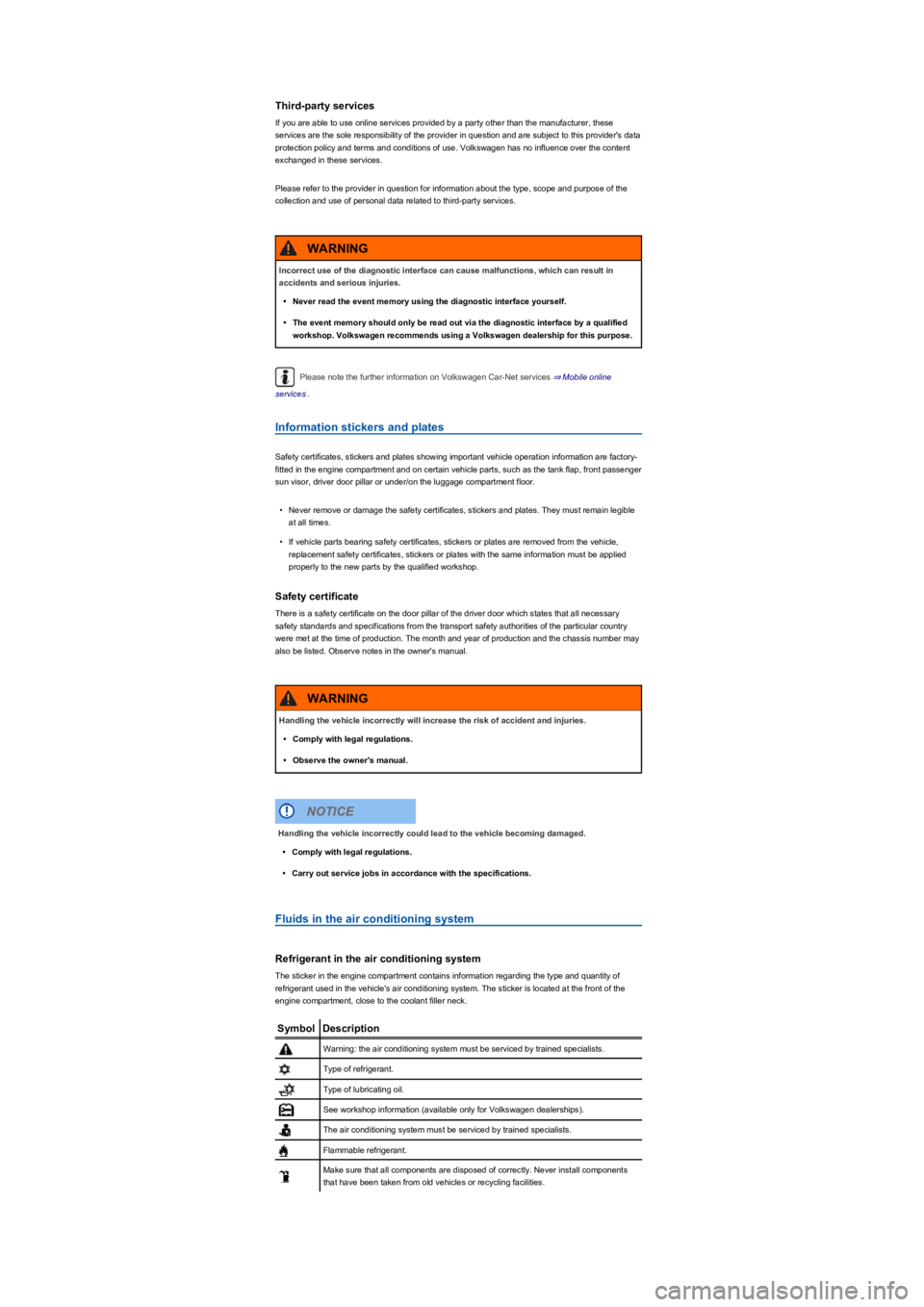
SymbolDescription
Warning: the air conditioning system must be serviced by trained specialists.
Type of refrigerant.
Type of lubricating oil.
See workshop information (available only for Volkswagen dealerships).
The air conditioning system must be serviced by trained specialists.
Flammable refrigerant.
Make sure that all components are disposed of correctly. Never install components
that have been taken from old vehicles or recycling facilities.
Incorrect use of the diagnostic interface can cause malfunctions, which can result in
accidents and serious injuries.
•Never read the event memory using the diagnostic interface yourself.
•The event memory should only be read out via the diagnostic interface by a qualified
workshop. Volkswagen recommends using a Volkswagen dealership for this purpose.
WARNING
Handling the vehicle incorrectly will increase the risk of accident and injuries.
•Comply with legal regulations.
•Observe the owner's manual.
WARNING
Handling the vehicle incorrectly could lead to the vehicle becoming damaged.
•Comply with legal regulations.
•Carry out service jobs in accordance with the specifications.
NOTICE