change time VOLKSWAGEN TIGUAN 2017 Owner´s Manual
[x] Cancel search | Manufacturer: VOLKSWAGEN, Model Year: 2017, Model line: TIGUAN, Model: VOLKSWAGEN TIGUAN 2017Pages: 341, PDF Size: 9.14 MB
Page 255 of 341
Check to see if a fuse has blown Changing fuses.
Follow the instructions to change the affected bulb . Always use identical bulbs with the
same designation. The designation is inscribed on the bulb, either on the glass part or on
the base.
Do not touch the glass part of the bulb with unprotected fingers. The heat of the bulb would
cause the fingerprint to evaporate and condense on the reflector. This will impair the
brightness of the headlight.
After changing the bulb, check to ensure that the bulb is working properly. If the bulb is not
working properly, the bulb may not have been inserted properly or may have failed again,
or the connector may have been inserted incorrectly.
Any time you change a bulb in the front of the vehicle, the headlight settings should be
checked by a qualified workshop.
Changing bulbs in the headlights (halogen bulbs)
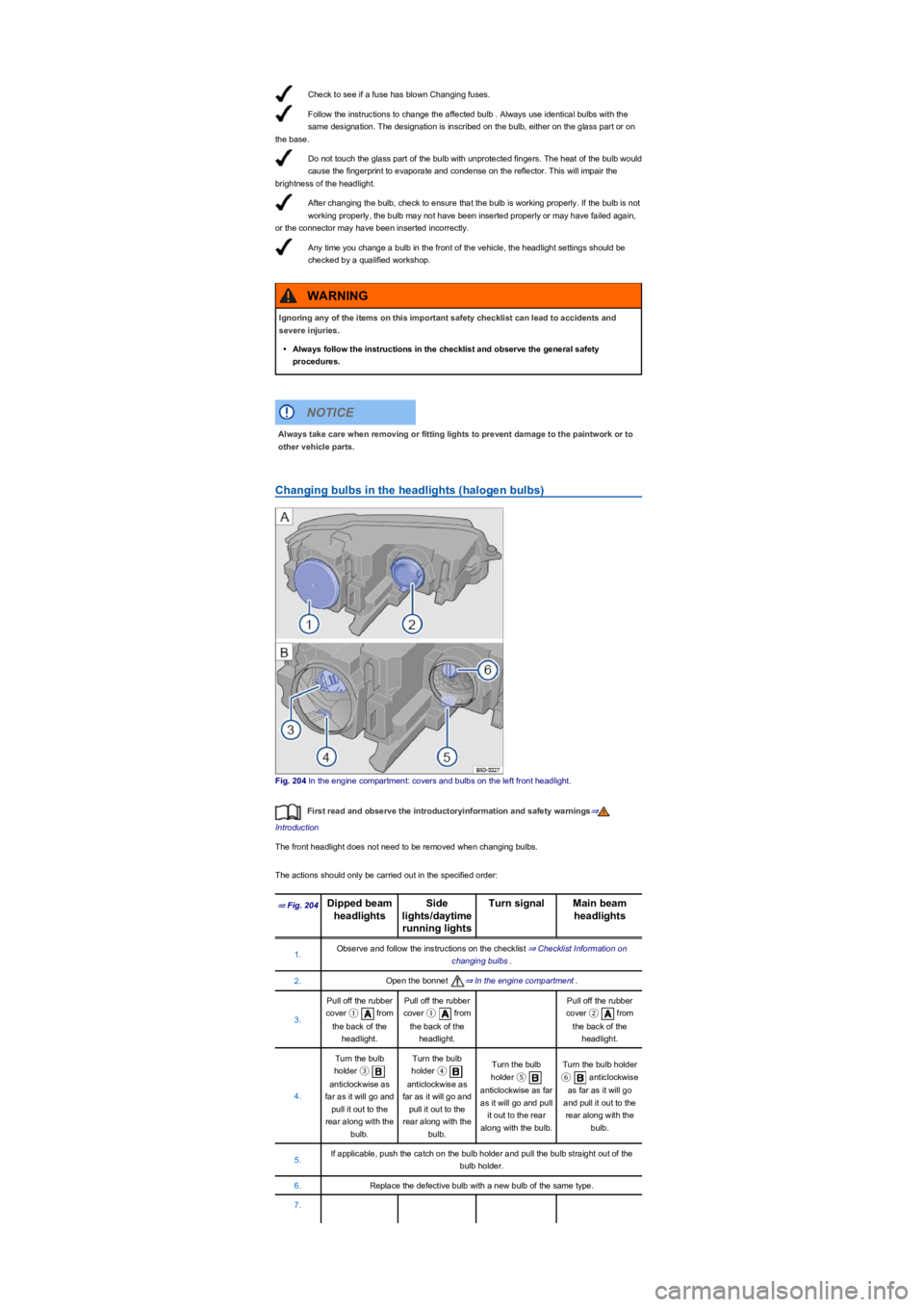
Fig. 204 In the engine compartment: covers and bulbs on the left front headlight.
First read and observe the introductoryinformation and safety warnings⇒
Introduction
The front headlight does not need to be removed when changing bulbs.
The actions should only be carried out in the specified order:
⇒ Fig. 204Dipped beam
headlights
Side
lights/daytime
running lights
Turn signalMain beam
headlights
1.Observe and follow the instructions on the checklist ⇒ Checklist Information on
changing bulbs.
2.Open the bonnet ⇒ In the engine compartment.
3.
Pull off the rubber
cover ① from
the back of the
headlight.
Pull off the rubber
cover ① from
the back of the
headlight.
Pull off the rubber
cover ② from
the back of the
headlight.
4.
Turn the bulb
holder ③
anticlockwise as
far as it will go and
pull it out to the
rear along with the
bulb.
Turn the bulb
holder ④
anticlockwise as
far as it will go and
pull it out to the
rear along with the
bulb.
Turn the bulb
holder ⑤
anticlockwise as far
as it will go and pull
it out to the rear
along with the bulb.
Turn the bulb holder
⑥ anticlockwise
as far as it will go
and pull it out to the
rear along with the
bulb.
5.If applicable, push the catch on the bulb holder and pull the bulb straight out of the
bulb holder.
6.Replace the defective bulb with a new bulb of the same type.
7.
Ignoring any of the items on this important safety checklist can lead to accidents and
severe injuries.
•Always follow the instructions in the checklist and observe the general safety
procedures.
WARNING
Always take care when removing or fitting lights to prevent damage to the paintwork or to
other vehicle parts.
NOTICE
Page 256 of 341
⇒ Fig. 204Dipped beam
headlights
Side
lights/daytime
running lights
Turn signalMain beam
headlights
Insert the bulb
holder ③ into
the headlight and
turn it clockwise as
far as it will go.
Insert the bulb
holder ④ into
the headlight and
turn it clockwise as
far as it will go.
Insert the bulb
holder ⑤ into
the headlight and
turn it clockwise as
far as it will go.
Insert the bulb holder
⑥ into the
headlight and turn it
clockwise as far as it
will go.
8.Fit the rubber
cover ①.
Fit the rubber
cover ①.
Fit the rubber cover
②.
9.Close the bonnet ⇒ In the engine compartment.
The illustrations show the left-hand headlight from the rear. The right-hand headlight is a
mirror image of the one shown.
There are various types of headlight, so the position and design of covers, bulbs and bulb
holders may vary from those shown in the illustrations.
It is not possible for customers to change the LEDs in daytime running lights with LED
technology. Go to a qualified workshop.
Changing bulbs in the front bumper
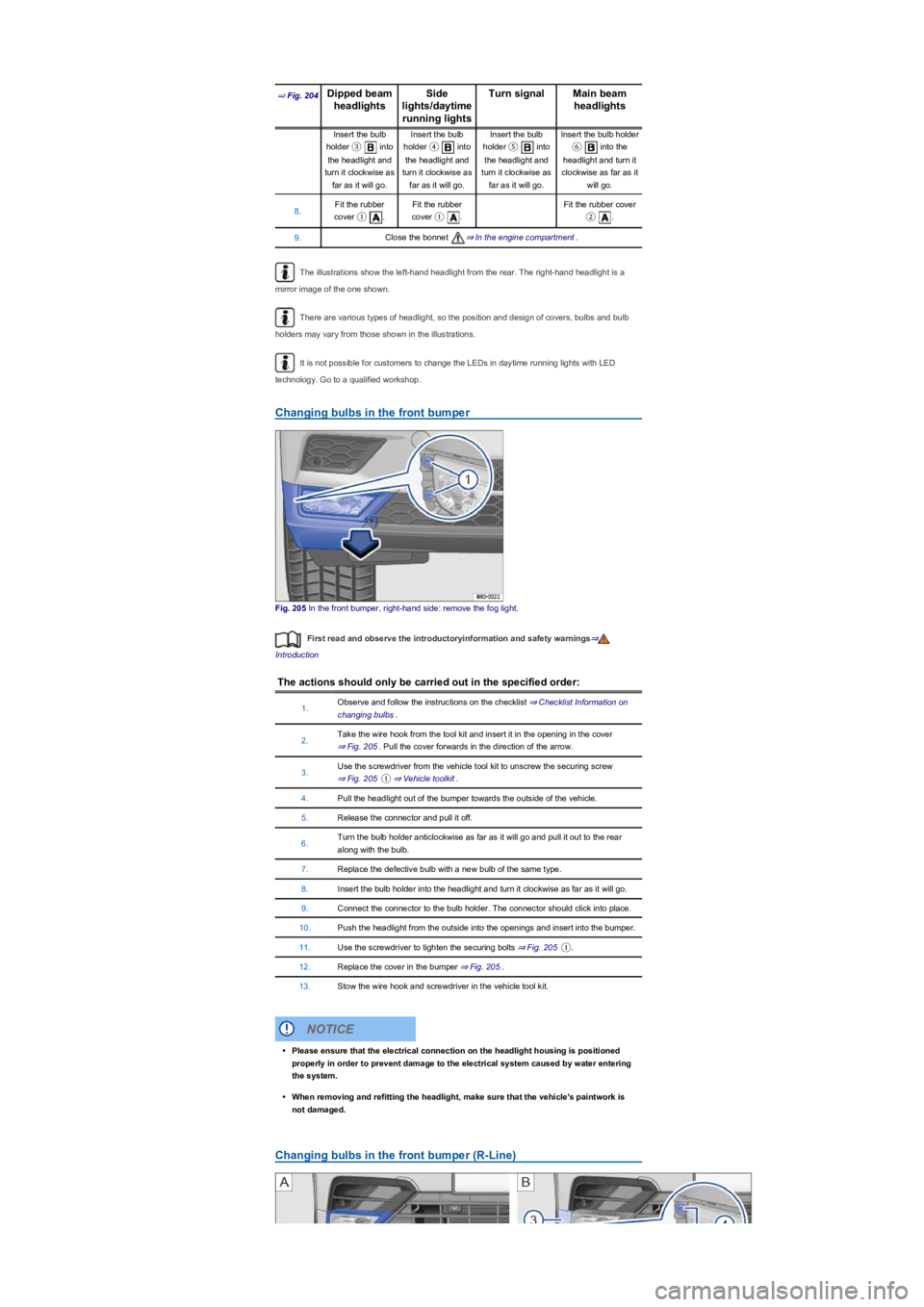
Fig. 205 In the front bumper, right-hand side: remove the fog light.
First read and observe the introductoryinformation and safety warnings⇒
Introduction
The actions should only be carried out in the specified order:
1.Observe and follow the instructions on the checklist ⇒ Checklist Information on
changing bulbs.
2.Take the wire hook from the tool kit and insert it in the opening in the cover
⇒ Fig. 205. Pull the cover forwards in the direction of the arrow.
3.Use the screwdriver from the vehicle tool kit to unscrew the securing screw
⇒ Fig. 205①⇒ Vehicle toolkit.
4.Pull the headlight out of the bumper towards the outside of the vehicle.
5.Release the connector and pull it off.
6.Turn the bulb holder anticlockwise as far as it will go and pull it out to the rear
along with the bulb.
7.Replace the defective bulb with a new bulb of the same type.
8.Insert the bulb holder into the headlight and turn it clockwise as far as it will go.
9.Connect the connector to the bulb holder. The connector should click into place.
10.Push the headlight from the outside into the openings and insert into the bumper.
11.Use the screwdriver to tighten the securing bolts ⇒ Fig. 205①.
12.Replace the cover in the bumper ⇒ Fig. 205.
13.Stow the wire hook and screwdriver in the vehicle tool kit.
Changing bulbs in the front bumper (R-Line)
•Please ensure that the electrical connection on the headlight housing is positioned
properly in order to prevent damage to the electrical system caused by water entering
the system.
•When removing and refitting the headlight, make sure that the vehicle's paintwork is
not damaged.
NOTICE
Page 258 of 341
Changing the bulb
7.Turn the bulb holder anticlockwise as far as it will go and carefully pull it out of the tail
light cluster together with the bulb.
9.Replace the defective bulb with a new bulb of the same type.
10.Carefully insert the bulb holder into the tail light cluster and turn it anticlockwise until
the bulb holder engages.
Fitting the tail light cluster
11.Carefully put the tail light cluster into the opening in the body.
12.Use one hand to hold the tail light in the fitting position while using the other hand to
screw the securing bolt firmly back in ⇒ Fig. 207③.
13.Check that the tail light cluster is positioned correctly and securely.
14.Connect the connector to the bulb holder and press into place.
15.Close the section of side trim in the luggage compartment near the tail light cluster
against the direction of the arrow
16.Close the boot lid ⇒ Boot lid.
The illustrations show the left-hand tail light cluster. The right-hand tail light cluster housing is
a mirror image of the one shown.
There are various types of tail light cluster, so the position and design of covers, bulbs and
bulb holders may vary from those shown in the illustrations.
In tail light clusters with LEDs, some light elements may be fitted with normal bulbs. These
bulbs can be changed.
Troubleshooting
First read and observe the introductoryinformation and safety warnings⇒
Introduction
Lighting
Vehicle lighting not working partially or completely. A separate display appears in the
instrument cluster if there is a cornering light fault.A trailer turn signal or all trailer lights have
stopped working.
Check the exterior lighting and change the appropriate bulb as required ⇒ Changing bulbs. If all
bulbs are OK or there is a fault in the dynamic cornering light, go to a qualified workshop.
Monitoring the lights on a connected trailer
For vehicles with a factory-fitted towing bracket, the vehicle will also monitor certain bulbs on a
trailer which has been connected properly via the trailer socket.
If a trailer turn signal or all the trailer lights fail, the indicator lamp in the instrument cluster will
go out.
Changing fuses
Introduction
This chapter contains information on the followingsubjects:
⇒ Fuses in the dash panel
⇒ Fuses in the engine compartment
⇒ Fuse table for fuses in the dash panel
⇒ Fuse tables for fuses in the engine compartment
⇒ Changing a blown fuse
At the time of print we are unable to provide an complete overview of the locations of the fuses for
the electrical consumers. This is because the vehicle is under constant development, because
fuses are assigned differently depending on the vehicle equipment level and because several
consumers may use a single fuse. You can get more information about the fuse layout from a
Volkswagen dealership.
Several electrical consumers could share a single fuse. Conversely, a single consumer could have
more than one fuse.
Therefore fuses should only be replaced when the cause of the fault has been rectified. If a new
fuse blows shortly after insertion, have the electrical system checked by a qualified workshop as
soon as possible.
Page 278 of 341
The use of engine oils compliant with the VW 504 00, VW 507 00 and VW 508 00 specifications
requires a fuel quality compliant with EN 228 (petrol) and EN 590 (diesel), or fuel of an equivalent
quality. Engine oils compliant with VW 504 00, VW 507 00 and VW 508 00 are therefore
unsuitable for use in a large number of markets.
If the engine has been filled with engine oil in accordance with the standards W 502 00, VW 504 00
and VW 507 00, a sticker with the relevant information will be located on the lock carrier in the
engine compartment. Observe this information!
Permitted engine oil specifications ⇒Alternative engine
oil
specifications⇒
Engine typeFlexible
service QI6
(LongLife)
Fixed service QI1,
QI2, QI3, QI4, QI7
(based on
time/distance
travelled)
Only in the EU,
Switzerland,
Norway, Japan
and Australia.
Petrol engines
VW 508 00
Alternatively:
VW 504 00
VW 502 00VW 504 00
Diesel engines with
diesel particulate
filter
VW 507 00VW 507 00–
Diesel engines
without diesel
particulate filter
VW 507 00VW 505 01VW 507 00
Volkswagen recommends . Volkswagen recommends Volkswagen genuine engine
oils.
Alternative engine oil specifications may only be used in fixed services QI1, QI2, QI3, QI4 and
QI7, and only when fuel of a quality compliant with EN 228 (petrol) and EN 590 (diesel), or fuel of
an equivalent quality, is available in the particular country.
The engine oil VW 502 00 must be used if the fuel grade does not comply with EN 228.
Using VW 504 00 instead of VW 508 00 may cause the vehicle's emissions values to increase
slightly.
You can also check with a qualified workshop if you are unsure whether your vehicle is equipped
with a diesel particulate filter. Volkswagen recommends using a Volkswagen dealership for this
purpose.
Changing the engine oil
First read and observe the introductoryinformation and safety warnings⇒
Introduction
The engine oil must be changed on a regular basis. Always observe the service intervals applicable
for your vehicle ⇒ Service.
The engine oil and filter change should be carried out by a qualified workshop due to the special
tools and knowledge required, this also applies to the disposal of used oil. Volkswagen
recommends using a Volkswagen dealership for this purpose.
Please read the notes on the service intervals ⇒ Service.
Additives in the engine oil can cause new engine oil to discolour quickly. This is normal and does
not mean that the engine oil should be changed more frequently.
a)
b)
c)
d)
d)
•Do not add any additional lubricants to the engine oil. Any damage caused by the use
of such additives is not covered by the warranty.
•Only those engine oil specifications that have been approved for use with the engine
should be used. Using other engine oils can cause engine damage.
•Another engine oil can be used in the event of an emergency if the listed engine oils are
not available. To avoid damaging the engine, a maximum quantity of 0.5 litres of the
following engine oil may be used only once until the next oil change:
- Petrol engines: standards ACEAA3/B4 or API SN (API SM).
- Diesel engines: standards ACEA C3 or API CJ-4.
NOTICE
a)
b)
c)
d)
Page 284 of 341
Fig. 231 In the engine compartment: cap on the brake fluid container.
Brake fluid will gradually absorb water from the surrounding air. The brake system will be damaged
if there is too much water in the brake fluid. The boiling point of the brake fluid is also considerably
reduced by the water content. Heavy use of the brakes may cause a vapour lock in the brake
system if the water content is too high. Vapour locks reduce levels of braking power, considerably
increase braking distance and can even cause the brake system to fail completely. Your own safety
and that of other road users depends on having a brake system that functions properly at all times
⇒.
Brake fluid specification
Volkswagen has developed a brake fluid that has been optimised for the brake system in the
vehicle. To ensure optimal operation of the brake system, Volkswagen expressly recommends the
use of brake fluid compliant with VW standard 501 14.
Before using a particular brake fluid, check that the specifications printed on the container
correspond to the vehicle requirements.
Brake fluid that is compliant with VW standard 501 14 is available from Volkswagen dealerships.
If this brake fluid is not available and it is necessary to use another high-quality brake fluid instead,
brake fluid that is compliant with DIN ISO 4925 CLASS 4 or US standard FMVSS 116 DOT 4 can
be used.
Not all brake fluids that are compliant with DIN ISO 4925 CLASS 4 or US standard FMVSS 116
DOT 4 have the same chemical composition. Some of these brake fluids may contain chemicals
that can damage or destroy brake system components over time.
Volkswagen therefore recommends the use of brake fluid that is compliant with
VW standard 501 14 to ensure sustained optimal operation of the brake system.
Brake fluid that is compliant with VW standard 501 14 fulfils the requirements of DIN ISO 4925
CLASS 4 or US standard FMVSS 116 DOT 4.
Brake fluid level
Brake fluid level is too low. Do not drive on! Check the brake fluid level.
The brake fluid level must always be between the MIN and MAX marking on the brake fluid
reservoir or above the MIN marking ⇒.
The brake fluid level cannot be checked accurately in all models as engine components may
partially conceal the brake fluid container. If the brake fluid level cannot be read exactly, please go
to a qualified workshop.
The brake fluid level drops slightly when the vehicle is being used as the brake pads wear and the
brakes are automatically adjusted.
Changing the brake fluid
The brake fluid should be changed by a qualified workshop. Volkswagen recommends using a
Volkswagen dealership for this purpose. Only brake fluid that conforms with the required
specification should be used.
Page 286 of 341
When you start the engine after the 12-volt battery has been totally discharged or after a
successful jump start, you may find that system settings (time, date, personal convenience settings
and programming) have been changed or deleted. Check and correct the settings as necessary
once the 12-volt vehicle battery has been sufficiently charged.
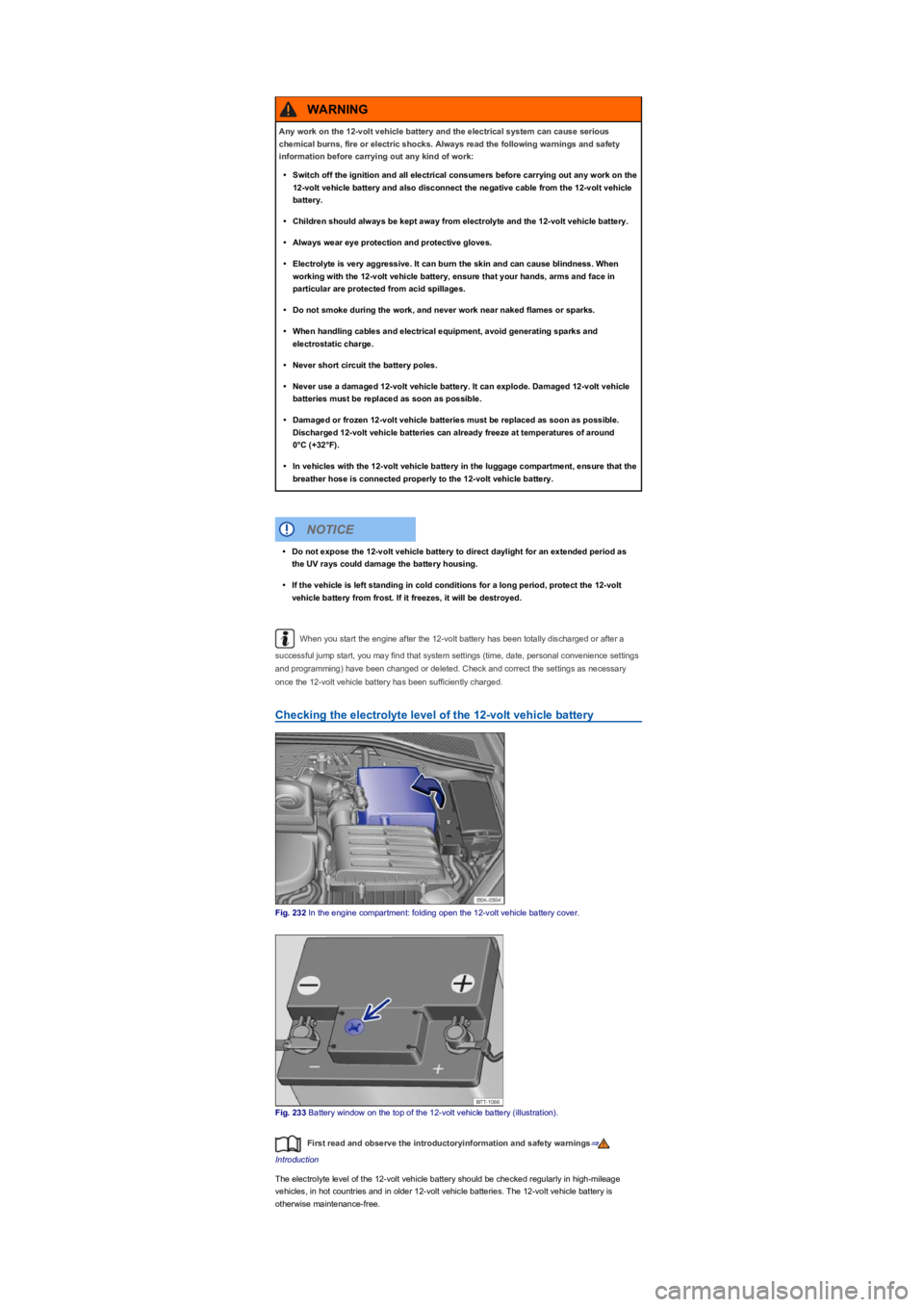
Checking the electrolyte level of the 12-volt vehicle battery
Fig. 232 In the engine compartment: folding open the 12-volt vehicle battery cover.
Fig. 233 Battery window on the top of the 12-volt vehicle battery (illustration).
First read and observe the introductoryinformation and safety warnings⇒
Introduction
The electrolyte level of the 12-volt vehicle battery should be checked regularly in high-mileage
vehicles, in hot countries and in older 12-volt vehicle batteries. The 12-volt vehicle battery is
otherwise maintenance-free.
Any work on the 12-volt vehicle battery and the electrical system can cause serious
chemical burns, fire or electric shocks. Always read the following warnings and safety
information before carrying out any kind of work:
•Switch off the ignition and all electrical consumers before carrying out any work on the
12-volt vehicle battery and also disconnect the negative cable from the 12-volt vehicle
battery.
•Children should always be kept away from electrolyte and the 12-volt vehicle battery.
•Always wear eye protection and protective gloves.
•Electrolyte is very aggressive. It can burn the skin and can cause blindness. When
working with the 12-volt vehicle battery, ensure that your hands, arms and face in
particular are protected from acid spillages.
•Do not smoke during the work, and never work near naked flames or sparks.
•When handling cables and electrical equipment, avoid generating sparks and
electrostatic charge.
•Never short circuit the battery poles.
•Never use a damaged 12-volt vehicle battery. It can explode. Damaged 12-volt vehicle
batteries must be replaced as soon as possible.
•Damaged or frozen 12-volt vehicle batteries must be replaced as soon as possible.
Discharged 12-volt vehicle batteries can already freeze at temperatures of around
0°C (+32°F).
•In vehicles with the 12-volt vehicle battery in the luggage compartment, ensure that the
breather hose is connected properly to the 12-volt vehicle battery.
WARNING
•Do not expose the 12-volt vehicle battery to direct daylight for an extended period as
the UV rays could damage the battery housing.
•If the vehicle is left standing in cold conditions for a long period, protect the 12-volt
vehicle battery from frost. If it freezes, it will be destroyed.
NOTICE
Page 290 of 341
If the tyre pressure is too low, this will increase fuel consumption and tyre wear.
When new tyres are driven at high speeds for the first time, they can expand slightly and
trigger a one-off pressure warning.
Old tyres should only be replaced by tyres that have been approved by Volkswagen for the
vehicle type.
Do not rely solely on the tyre monitoring system. Check your tyres regularly to ensure that
they are properly inflated and have no signs of damage, such as punctures, cuts, cracks, and
blisters. Remove any objects that become embedded in the tyre tread but have not penetrated into
the body of the tyre itself.
Types of tyre monitoring systems
First read and observe the introductoryinformation and safety warnings⇒
Introduction
There are two different tyre monitoring systems available for this vehicle. Their differing features are
described below:
Tyre Pressure Loss Indicator
•Monitoring of various parameters (for example rolling circumference) of all wheels using ABS
sensors (indirect measurement).
Tyre Pressure Monitoring System
•Monitoring of the tyre pressure by means of pressure sensors on each tyre valve (direct
measurement). Tyre valve made of metal.
Tyre Pressure Loss Indicator
First read and observe the introductoryinformation and safety warnings⇒
Introduction
Functional description
The Tyre Pressure Loss Indicator uses data from the ABS sensors and other functions to check the
speed of rotation and the rolling circumference of the individual wheels.
The rolling circumference can change:
•If the tyre pressure has been changed.
•If the tyre pressure is too low.
•If the tyre has structural damage.
•If the vehicle is loaded more heavily on one side.
•If snow chains have been fitted.
•If a temporary spare wheel has been fitted.
•If one wheel per axle has been changed.
The Tyre Pressure Loss Indicator may react with a delay or not display anything at all in the
event of a sporty driving style, when driving on snow-covered or icy roads or unpaved roads or
when driving with snow chains.
Synchronising the Tyre Pressure Loss Indicator
•Switch on the ignition.
•Press the button or function button, depending on version ⇒ Vehicle settings menu.
The intelligent tyre monitoring system technology cannot overcome the laws of physics,
and functions only within the limits of the system. Incorrect handling of the wheels and
tyres can lead to a sudden loss of pressure in the tyres, tread separation and even tyre
blow-out.
•Check tyre pressures regularly and always maintain the specified tyre pressure value
⇒ Tyre pressure. If the tyre pressure is too low, it is possible that the tyre temperature
will increase to such an extent that the tread peels off and the tyre bursts.
•Always maintain the correct cold tyre pressure as specified on the sticker ⇒ Tyre
pressure.
•Check the tyre pressure regularly when the tyres are cold. If necessary, adjust the tyre
pressure in the cold tyre to the recommended tyre pressure for the tyres installed on
your vehicle ⇒ Tyre pressure.
•Check your tyres regularly for signs of wear or damage.
•Never exceed the top speed and load permitted for the fitted tyres.
WARNING
Page 291 of 341
•Open the Vehicle settings menu in the Infotainment system.
•Touch the Tyres function button.
•Touch the SET function button.
•When all four tyre pressures correspond to the required values, touch the Confirm function
button.
After an extended driving time with driving at different speeds, the system will automatically learn
the new values and monitor them.
•If the tyre pressures have been changed.
•If one or more wheels have been changed.
•If the wheels have been swapped round, e.g. from front to rear ⇒ Rotating wheels front to rear.
The Tyre Pressure Loss Indicator stops working if there is a fault in the ESC or ABS ⇒ Brake
support systems.
After a warning about the tyre pressure being too low, switch the ignition off and then back
on again. The Tyre Pressure Loss Indicator can only then be re-synchronised.
Tyre Pressure Monitoring System
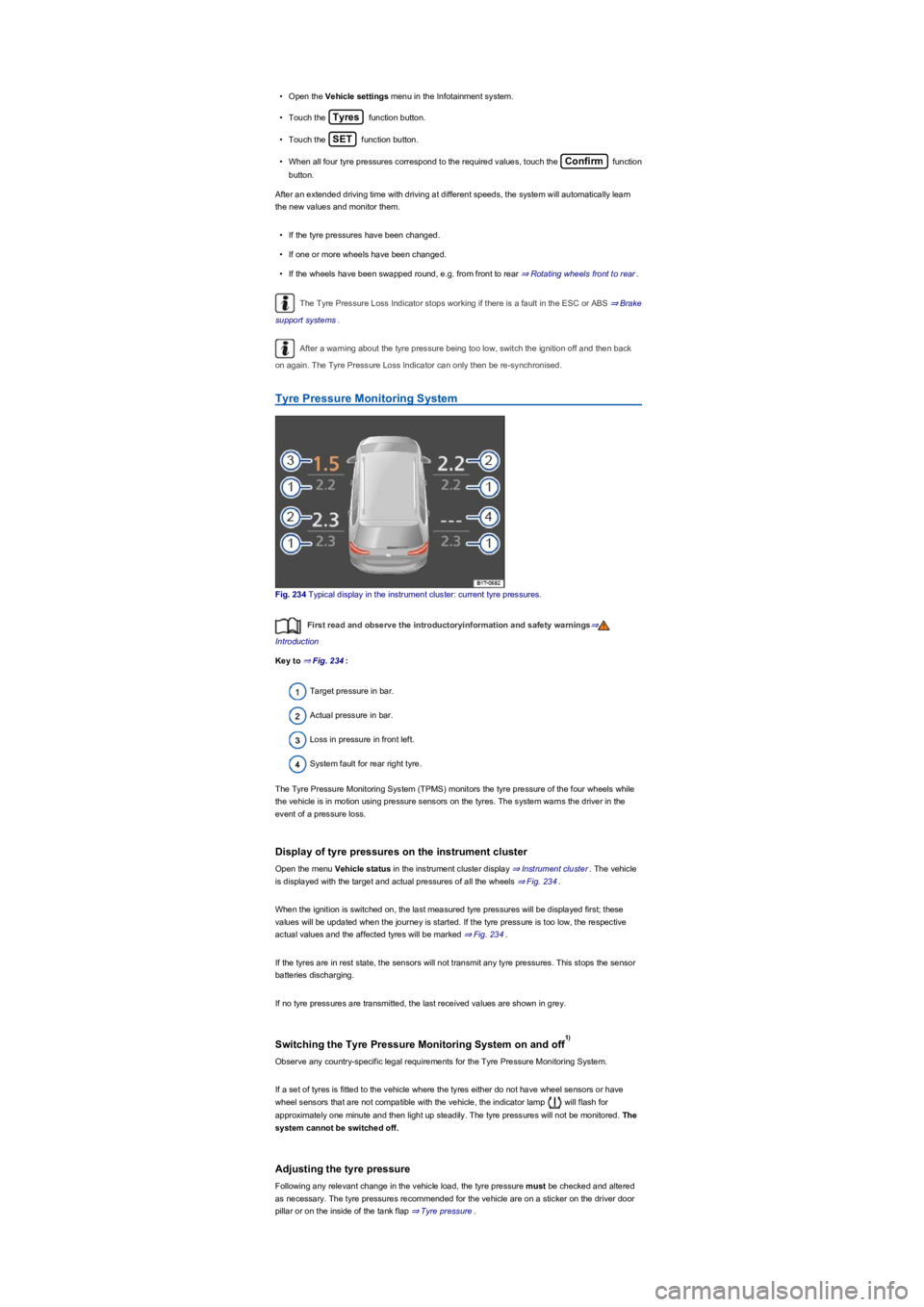
Fig. 234 Typical display in the instrument cluster: current tyre pressures.
First read and observe the introductoryinformation and safety warnings⇒
Introduction
Key to ⇒ Fig. 234:
Target pressure in bar.
Actual pressure in bar.
Loss in pressure in front left.
System fault for rear right tyre.
The Tyre Pressure Monitoring System (TPMS) monitors the tyre pressure of the four wheels while
the vehicle is in motion using pressure sensors on the tyres. The system warns the driver in the
event of a pressure loss.
Display of tyre pressures on the instrument cluster
Open the menu Vehicle status in the instrument cluster display ⇒ Instrument cluster. The vehicle
is displayed with the target and actual pressures of all the wheels ⇒ Fig. 234.
When the ignition is switched on, the last measured tyre pressures will be displayed first; these
values will be updated when the journey is started. If the tyre pressure is too low, the respective
actual values and the affected tyres will be marked ⇒ Fig. 234.
If the tyres are in rest state, the sensors will not transmit any tyre pressures. This stops the sensor
batteries discharging.
If no tyre pressures are transmitted, the last received values are shown in grey.
Switching the Tyre Pressure Monitoring System on and off
Observe any country-specific legal requirements for the Tyre Pressure Monitoring System.
If a set of tyres is fitted to the vehicle where the tyres either do not have wheel sensors or have
wheel sensors that are not compatible with the vehicle, the indicator lamp will flash for
approximately one minute and then light up steadily. The tyre pressures will not be monitored. The
system cannot be switched off.
Adjusting the tyre pressure
Following any relevant change in the vehicle load, the tyre pressure must be checked and altered
as necessary. The tyre pressures recommended for the vehicle are on a sticker on the driver door
pillar or on the inside of the tank flap ⇒ Tyre pressure.
1)
Page 295 of 341
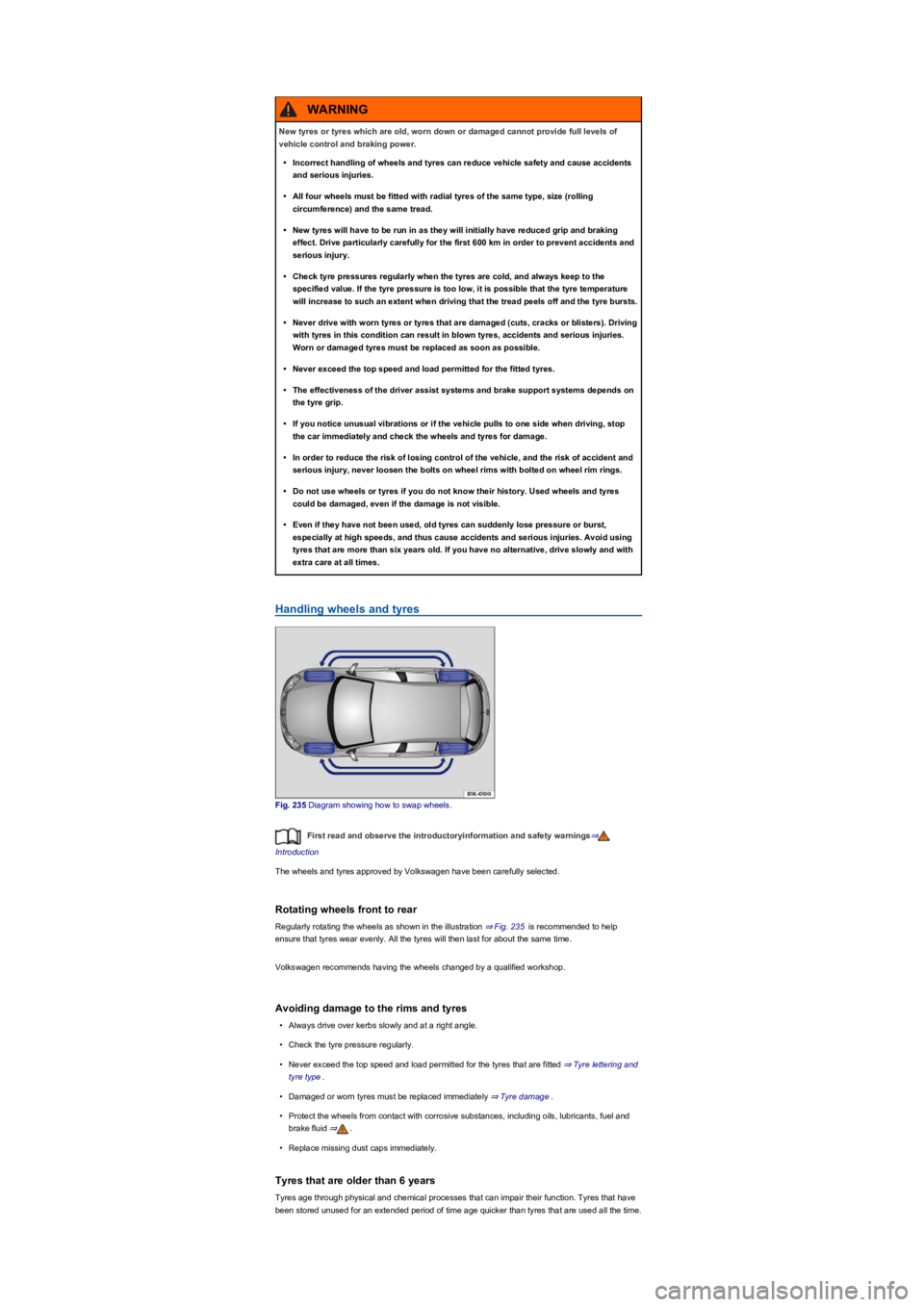
Handling wheels and tyres
Fig. 235 Diagram showing how to swap wheels.
First read and observe the introductoryinformation and safety warnings⇒
Introduction
The wheels and tyres approved by Volkswagen have been carefully selected.
Rotating wheels front to rear
Regularly rotating the wheels as shown in the illustration ⇒ Fig. 235 is recommended to help
ensure that tyres wear evenly. All the tyres will then last for about the same time.
Volkswagen recommends having the wheels changed by a qualified workshop.
Avoiding damage to the rims and tyres
•Always drive over kerbs slowly and at a right angle.
•Check the tyre pressure regularly.
•Never exceed the top speed and load permitted for the tyres that are fitted ⇒ Tyre lettering and
tyre type.
•Damaged or worn tyres must be replaced immediately ⇒ Tyre damage.
•Protect the wheels from contact with corrosive substances, including oils, lubricants, fuel and
brake fluid ⇒.
•Replace missing dust caps immediately.
Tyres that are older than 6 years
Tyres age through physical and chemical processes that can impair their function. Tyres that have
been stored unused for an extended period of time age quicker than tyres that are used all the time.
New tyres or tyres which are old, worn down or damaged cannot provide full levels of
vehicle control and braking power.
•Incorrect handling of wheels and tyres can reduce vehicle safety and cause accidents
and serious injuries.
•All four wheels must be fitted with radial tyres of the same type, size (rolling
circumference) and the same tread.
•New tyres will have to be run in as they will initially have reduced grip and braking
effect. Drive particularly carefully for the first 600 km in order to prevent accidents and
serious injury.
•Check tyre pressures regularly when the tyres are cold, and always keep to the
specified value. If the tyre pressure is too low, it is possible that the tyre temperature
will increase to such an extent when driving that the tread peels off and the tyre bursts.
•Never drive with worn tyres or tyres that are damaged (cuts, cracks or blisters). Driving
with tyres in this condition can result in blown tyres, accidents and serious injuries.
Worn or damaged tyres must be replaced as soon as possible.
•Never exceed the top speed and load permitted for the fitted tyres.
•The effectiveness of the driver assist systems and brake support systems depends on
the tyre grip.
•If you notice unusual vibrations or if the vehicle pulls to one side when driving, stop
the car immediately and check the wheels and tyres for damage.
•In order to reduce the risk of losing control of the vehicle, and the risk of accident and
serious injury, never loosen the bolts on wheel rims with bolted on wheel rim rings.
•Do not use wheels or tyres if you do not know their history. Used wheels and tyres
could be damaged, even if the damage is not visible.
•Even if they have not been used, old tyres can suddenly lose pressure or burst,
especially at high speeds, and thus cause accidents and serious injuries. Avoid using
tyres that are more than six years old. If you have no alternative, drive slowly and with
extra care at all times.
WARNING
Page 301 of 341
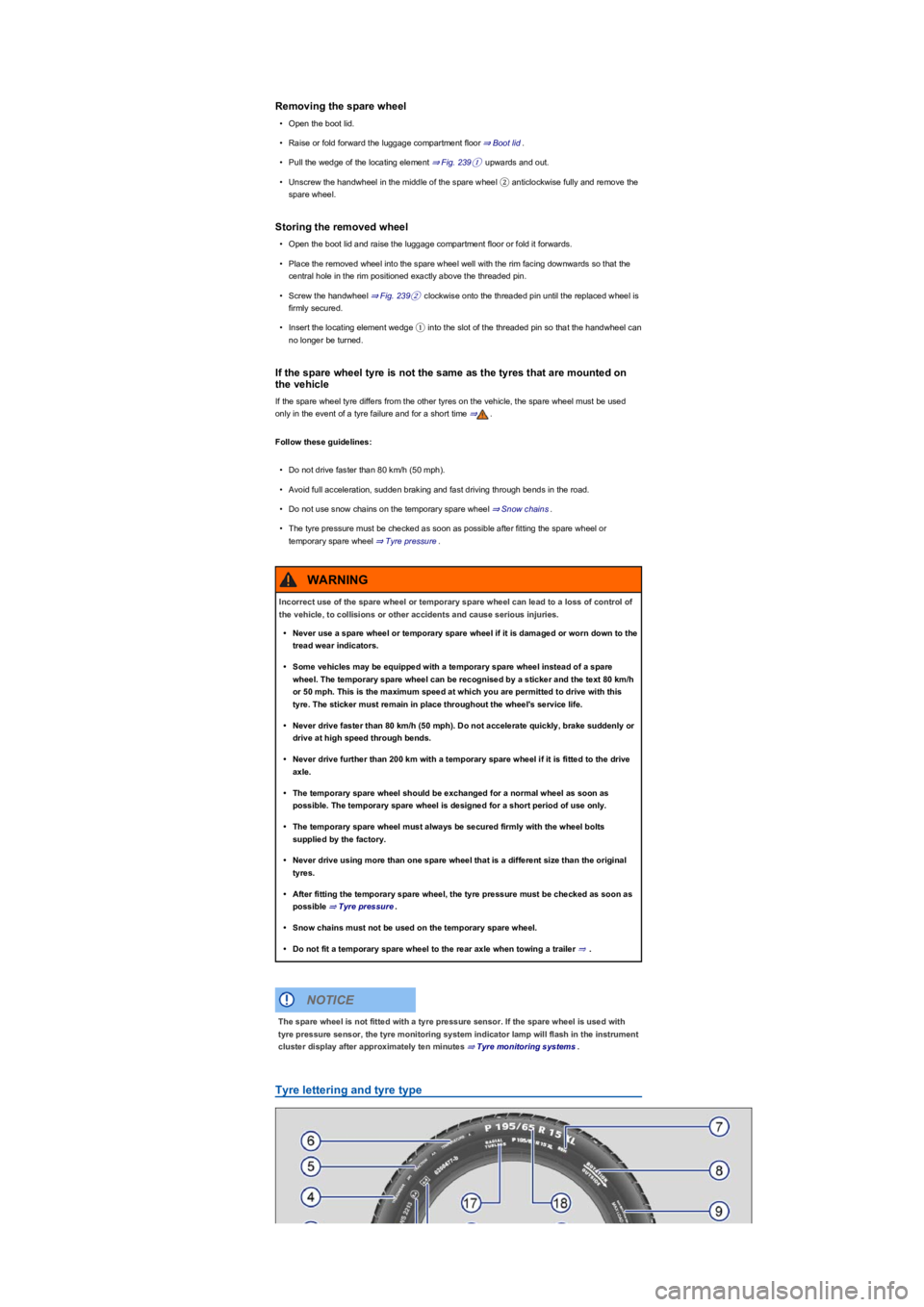
Removing the spare wheel
•Open the boot lid.
•Raise or fold forward the luggage compartment floor ⇒ Boot lid.
•Pull the wedge of the locating element ⇒ Fig. 239① upwards and out.
•Unscrew the handwheel in the middle of the spare wheel ② anticlockwise fully and remove the
spare wheel.
Storing the removed wheel
•Open the boot lid and raise the luggage compartment floor or fold it forwards.
•Place the removed wheel into the spare wheel well with the rim facing downwards so that the
central hole in the rim positioned exactly above the threaded pin.
•Screw the handwheel ⇒ Fig. 239② clockwise onto the threaded pin until the replaced wheel is
firmly secured.
•Insert the locating element wedge ① into the slot of the threaded pin so that the handwheel can
no longer be turned.
If the spare wheel tyre is not the same as the tyres that are mounted on
the vehicle
If the spare wheel tyre differs from the other tyres on the vehicle, the spare wheel must be used
only in the event of a tyre failure and for a short time ⇒.
Follow these guidelines:
•Do not drive faster than 80 km/h (50 mph).
•Avoid full acceleration, sudden braking and fast driving through bends in the road.
•Do not use snow chains on the temporary spare wheel ⇒ Snow chains.
•The tyre pressure must be checked as soon as possible after fitting the spare wheel or
temporary spare wheel ⇒ Tyre pressure.
Tyre lettering and tyre type
Incorrect use of the spare wheel or temporary spare wheel can lead to a loss of control of
the vehicle, to collisions or other accidents and cause serious injuries.
•Never use a spare wheel or temporary spare wheel if it is damaged or worn down to the
tread wear indicators.
•Some vehicles may be equipped with a temporary spare wheel instead of a spare
wheel. The temporary spare wheel can be recognised by a sticker and the text 80 km/h
or 50 mph. This is the maximum speed at which you are permitted to drive with this
tyre. The sticker must remain in place throughout the wheel's service life.
•Never drive faster than 80 km/h (50 mph). Do not accelerate quickly, brake suddenly or
drive at high speed through bends.
•Never drive further than 200 km with a temporary spare wheel if it is fitted to the drive
axle.
•The temporary spare wheel should be exchanged for a normal wheel as soon as
possible. The temporary spare wheel is designed for a short period of use only.
•The temporary spare wheel must always be secured firmly with the wheel bolts
supplied by the factory.
•Never drive using more than one spare wheel that is a different size than the original
tyres.
•After fitting the temporary spare wheel, the tyre pressure must be checked as soon as
possible ⇒ Tyre pressure.
•Snow chains must not be used on the temporary spare wheel.
•Do not fit a temporary spare wheel to the rear axle when towing a trailer ⇒.
WARNING
The spare wheel is not fitted with a tyre pressure sensor. If the spare wheel is used with
tyre pressure sensor, the tyre monitoring system indicator lamp will flash in the instrument
cluster display after approximately ten minutes ⇒ Tyre monitoring systems.
NOTICE