change time VOLKSWAGEN TIGUAN 2017 Owner´s Manual
[x] Cancel search | Manufacturer: VOLKSWAGEN, Model Year: 2017, Model line: TIGUAN, Model: VOLKSWAGEN TIGUAN 2017Pages: 341, PDF Size: 9.14 MB
Page 304 of 341
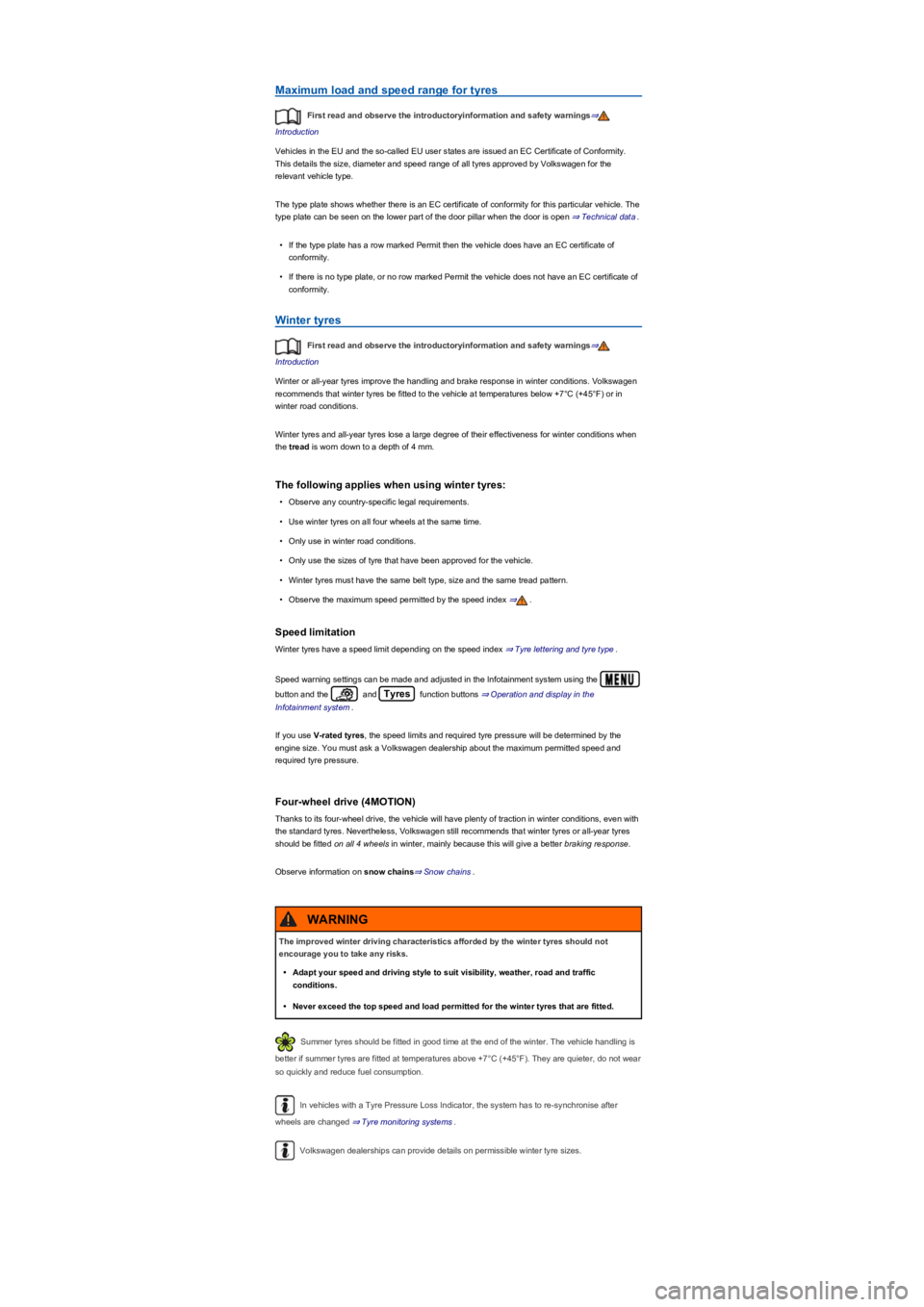
Maximum load and speed range for tyres
First read and observe the introductoryinformation and safety warnings⇒
Introduction
Vehicles in the EU and the so-called EU user states are issued an EC Certificate of Conformity.
This details the size, diameter and speed range of all tyres approved by Volkswagen for the
relevant vehicle type.
The type plate shows whether there is an EC certificate of conformity for this particular vehicle. The
type plate can be seen on the lower part of the door pillar when the door is open ⇒ Technical data.
•If the type plate has a row marked Permit then the vehicle does have an EC certificate of
conformity.
•If there is no type plate, or no row marked Permit the vehicle does not have an EC certificate of
conformity.
Winter tyres
First read and observe the introductoryinformation and safety warnings⇒
Introduction
Winter or all-year tyres improve the handling and brake response in winter conditions. Volkswagen
recommends that winter tyres be fitted to the vehicle at temperatures below +7°C (+45°F) or in
winter road conditions.
Winter tyres and all-year tyres lose a large degree of their effectiveness for winter conditions when
the tread is worn down to a depth of 4 mm.
The following applies when using winter tyres:
•Observe any country-specific legal requirements.
•Use winter tyres on all four wheels at the same time.
•Only use in winter road conditions.
•Only use the sizes of tyre that have been approved for the vehicle.
•Winter tyres must have the same belt type, size and the same tread pattern.
•Observe the maximum speed permitted by the speed index ⇒.
Speed limitation
Winter tyres have a speed limit depending on the speed index ⇒ Tyre lettering and tyre type.
Speed warning settings can be made and adjusted in the Infotainment system using the
button and the and Tyres function buttons ⇒ Operation and display in the
Infotainment system.
If you use V-rated tyres, the speed limits and required tyre pressure will be determined by the
engine size. You must ask a Volkswagen dealership about the maximum permitted speed and
required tyre pressure.
Four-wheel drive (4MOTION)
Thanks to its four-wheel drive, the vehicle will have plenty of traction in winter conditions, even with
the standard tyres. Nevertheless, Volkswagen still recommends that winter tyres or all-year tyres
should be fitted on all 4 wheels in winter, mainly because this will give a better braking response.
Observe information on snow chains⇒ Snow chains.
Summer tyres should be fitted in good time at the end of the winter. The vehicle handling is
better if summer tyres are fitted at temperatures above +7°C (+45°F). They are quieter, do not wear
so quickly and reduce fuel consumption.
In vehicles with a Tyre Pressure Loss Indicator, the system has to re-synchronise after
wheels are changed ⇒ Tyre monitoring systems.
Volkswagen dealerships can provide details on permissible winter tyre sizes.
The improved winter driving characteristics afforded by the winter tyres should not
encourage you to take any risks.
•Adapt your speed and driving style to suit visibility, weather, road and traffic
conditions.
•Never exceed the top speed and load permitted for the winter tyres that are fitted.
WARNING
Page 315 of 341
The vehicle data sticker confirms when the vehicle was first registered or delivered, when the
delivery inspection was carried out, and thus the date from which your vehicle is covered by our
warranty.
Saving the service operations performed (digital service schedule)
Each service record is stored by your Volkswagen dealership and qualified workshop in a central
system. This transparent documentation of the service history allows the service operations
performed to be reproduced at any time. Each time you have your vehicle serviced, Volkswagen
recommends asking for a printed service record, which contains all service work stored in the
system.
With every service, the printout of the previous service record is replaced by a current printout.
The digital service schedule is not available in some markets. In this case, your Volkswagen
dealership will inform you about the documentation process for service work.
Service work
The following information is documented in the digital service schedule by your Volkswagen
dealership or qualified workshop:
•When which service was carried out.
•Whether any repairs are recommended, such as replacement of the brake pads in the near
future.
•Whether you had any special requests before or during the maintenance work (your service
advisor will note these on the order).
•Which components or service fluids were changed.
•When your next service is scheduled for.
The LongLife mobility guarantee is valid until the next inspection is due. Documentation takes place
at every due inspection.
The type and scope of service work may differ from vehicle to vehicle. Information on specific work
for your vehicle can be requested from a qualified workshop.
Regular servicing of your vehicle not only maintains its value, it also ensures that your
vehicle remains roadworthy and in working order. You should therefore have your vehicle serviced
according to the Volkswagen guidelines.
Fixed service or flexible service
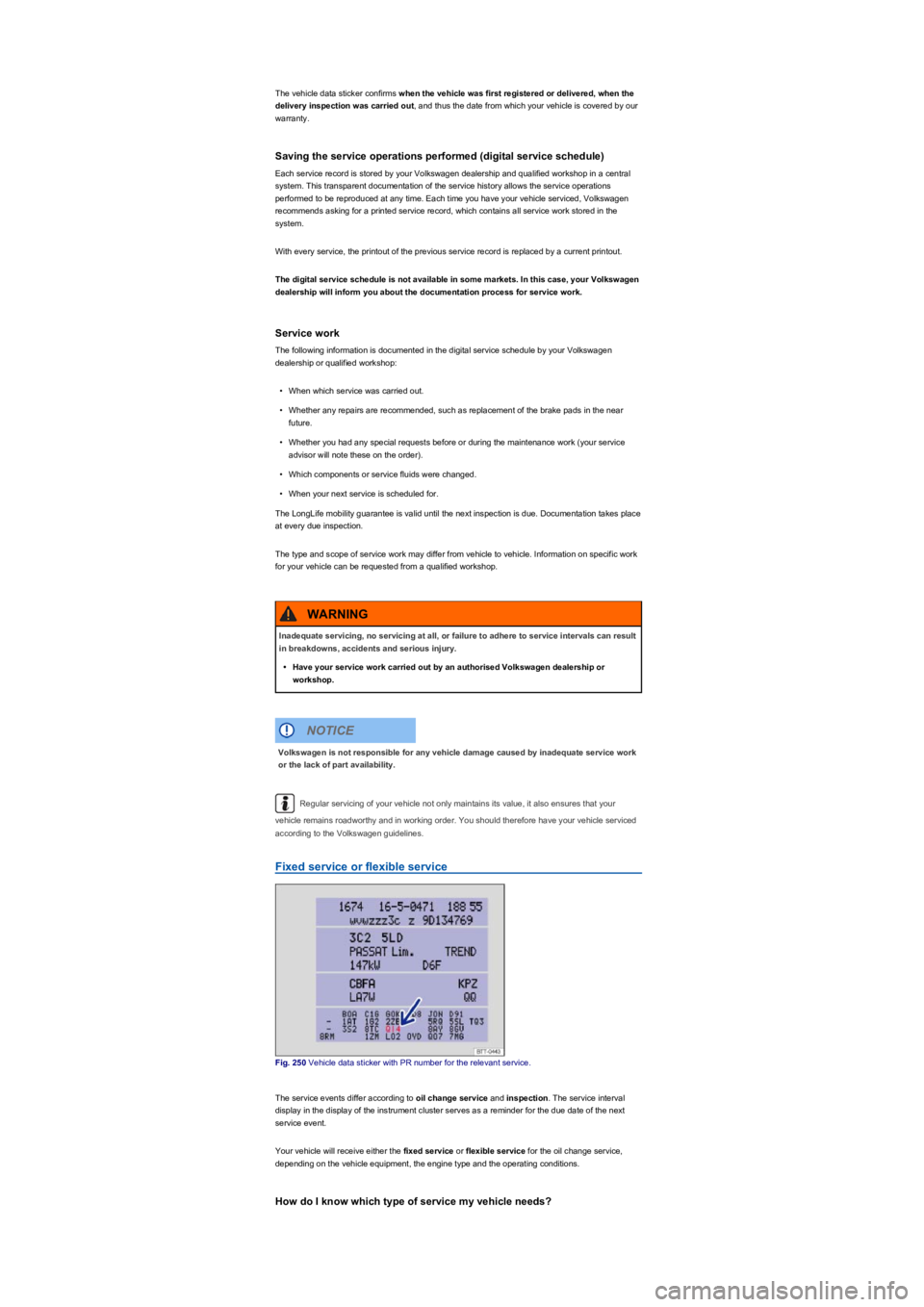
Fig. 250 Vehicle data sticker with PR number for the relevant service.
The service events differ according to oil change service and inspection. The service interval
display in the display of the instrument cluster serves as a reminder for the due date of the next
service event.
Your vehicle will receive either the fixed service or flexible service for the oil change service,
depending on the vehicle equipment, the engine type and the operating conditions.
How do I know which type of service my vehicle needs?
Inadequate servicing, no servicing at all, or failure to adhere to service intervals can result
in breakdowns, accidents and serious injury.
•Have your service work carried out by an authorised Volkswagen dealership or
workshop.
WARNING
Volkswagen is not responsible for any vehicle damage caused by inadequate service work
or the lack of part availability.
NOTICE
Page 316 of 341
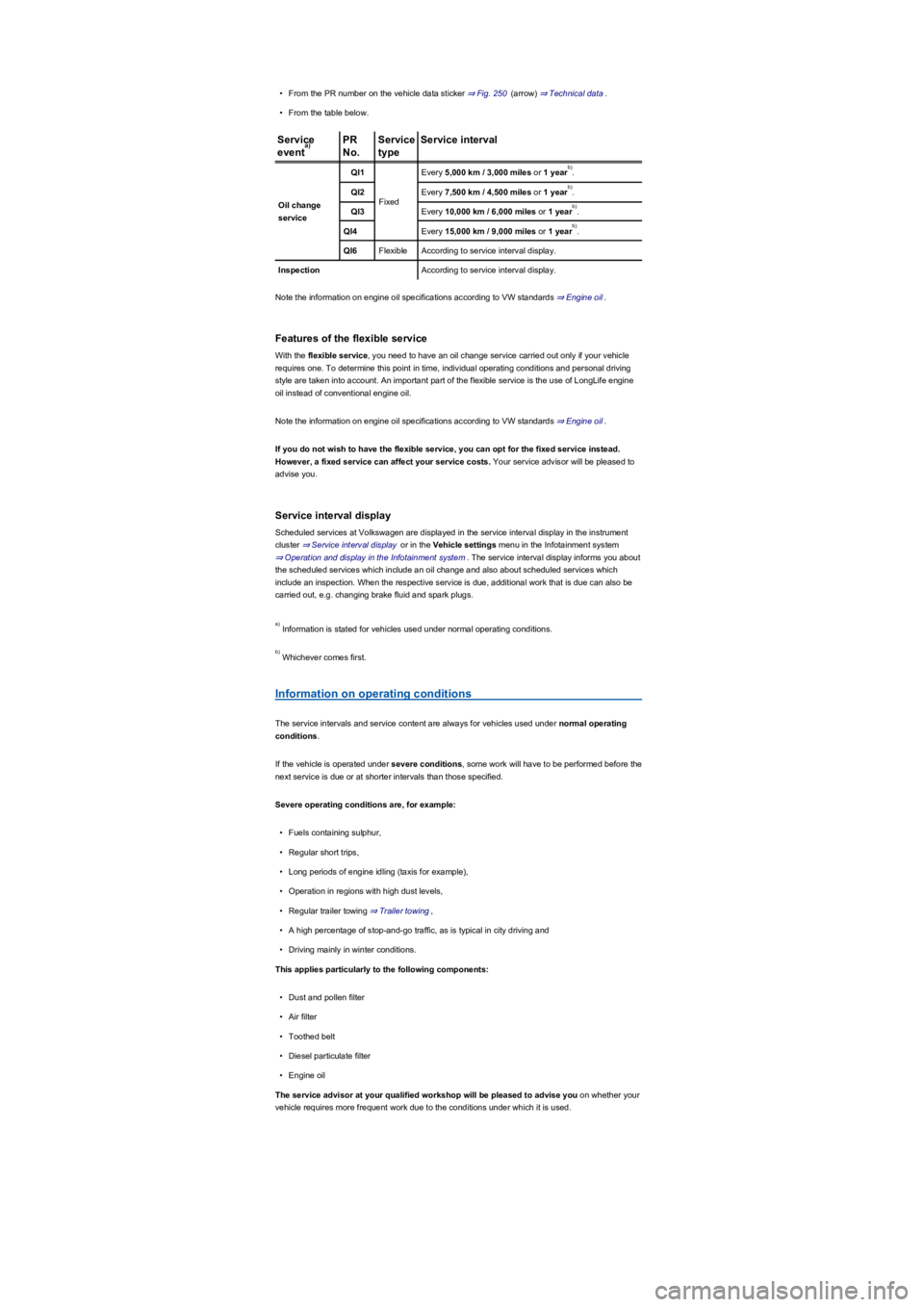
•From the PR number on the vehicle data sticker ⇒ Fig. 250 (arrow) ⇒ Technical data.
•From the table below.
Service
event
PR
No.
Service
type
Service interval
Oil change
service
QI1
Fixed
Every 5,000 km / 3,000 miles or 1 year.
QI2Every 7,500 km / 4,500 miles or 1 year.
QI3Every 10,000 km / 6,000 miles or 1 year.
QI4Every 15,000 km / 9,000 miles or 1 year.
QI6FlexibleAccording to service interval display.
InspectionAccording to service interval display.
Note the information on engine oil specifications according to VW standards ⇒ Engine oil.
Features of the flexible service
With the flexible service, you need to have an oil change service carried out only if your vehicle
requires one. To determine this point in time, individual operating conditions and personal driving
style are taken into account. An important part of the flexible service is the use of LongLife engine
oil instead of conventional engine oil.
Note the information on engine oil specifications according to VW standards ⇒ Engine oil.
If you do not wish to have the flexible service, you can opt for the fixed service instead.
However, a fixed service can affect your service costs. Your service advisor will be pleased to
advise you.
Service interval display
Scheduled services at Volkswagen are displayed in the service interval display in the instrument
cluster ⇒ Service interval display or in the Vehicle settings menu in the Infotainment system
⇒ Operation and display in the Infotainment system. The service interval display informs you about
the scheduled services which include an oil change and also about scheduled services which
include an inspection. When the respective service is due, additional work that is due can also be
carried out, e.g. changing brake fluid and spark plugs.
Information is stated for vehicles used under normal operating conditions.
Whichever comes first.
Information on operating conditions
The service intervals and service content are always for vehicles used under normal operating
conditions.
If the vehicle is operated under severe conditions, some work will have to be performed before the
next service is due or at shorter intervals than those specified.
Severe operating conditions are, for example:
•Fuels containing sulphur,
•Regular short trips,
•Long periods of engine idling (taxis for example),
•Operation in regions with high dust levels,
•Regular trailer towing ⇒ Trailer towing,
•A high percentage of stop-and-go traffic, as is typical in city driving and
•Driving mainly in winter conditions.
This applies particularly to the following components:
•Dust and pollen filter
•Air filter
•Toothed belt
•Diesel particulate filter
•Engine oil
The service advisor at your qualified workshop will be pleased to advise you on whether your
vehicle requires more frequent work due to the conditions under which it is used.
a)
b)
b)
b)
b)
a)
b)
Page 318 of 341
•Water drains: check.
•Road test: perform.
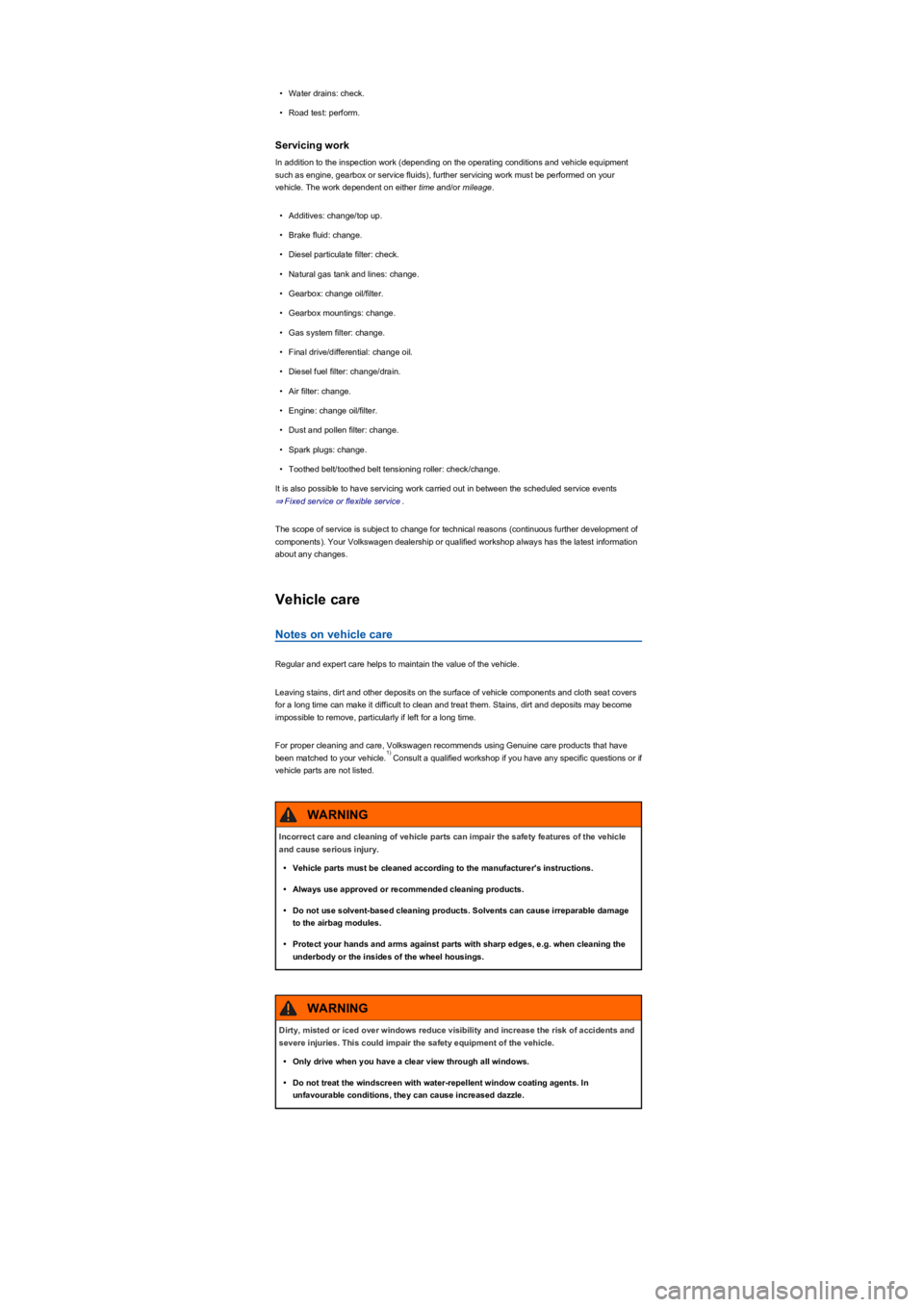
Servicing work
In addition to the inspection work (depending on the operating conditions and vehicle equipment
such as engine, gearbox or service fluids), further servicing work must be performed on your
vehicle. The work dependent on either time and/or mileage.
•Additives: change/top up.
•Brake fluid: change.
•Diesel particulate filter: check.
•Natural gas tank and lines: change.
•Gearbox: change oil/filter.
•Gearbox mountings: change.
•Gas system filter: change.
•Final drive/differential: change oil.
•Diesel fuel filter: change/drain.
•Air filter: change.
•Engine: change oil/filter.
•Dust and pollen filter: change.
•Spark plugs: change.
•Toothed belt/toothed belt tensioning roller: check/change.
It is also possible to have servicing work carried out in between the scheduled service events
⇒ Fixed service or flexible service.
The scope of service is subject to change for technical reasons (continuous further development of
components). Your Volkswagen dealership or qualified workshop always has the latest information
about any changes.
Vehicle care
Notes on vehicle care
Regular and expert care helps to maintain the value of the vehicle.
Leaving stains, dirt and other deposits on the surface of vehicle components and cloth seat covers
for a long time can make it difficult to clean and treat them. Stains, dirt and deposits may become
impossible to remove, particularly if left for a long time.
For proper cleaning and care, Volkswagen recommends using Genuine care products that have
been matched to your vehicle. Consult a qualified workshop if you have any specific questions or if
vehicle parts are not listed.
1)
Incorrect care and cleaning of vehicle parts can impair the safety features of the vehicle
and cause serious injury.
•Vehicle parts must be cleaned according to the manufacturer's instructions.
•Always use approved or recommended cleaning products.
•Do not use solvent-based cleaning products. Solvents can cause irreparable damage
to the airbag modules.
•Protect your hands and arms against parts with sharp edges, e.g. when cleaning the
underbody or the insides of the wheel housings.
WARNING
Dirty, misted or iced over windows reduce visibility and increase the risk of accidents and
severe injuries. This could impair the safety equipment of the vehicle.
•Only drive when you have a clear view through all windows.
•Do not treat the windscreen with water-repellent window coating agents. In
unfavourable conditions, they can cause increased dazzle.
WARNING
Page 329 of 341
Special equipment, access to the legally prescribed diagnostic interface (on-board diagnostics) and
switched-on ignition are required in order to read data out of the event data recorder.
Volkswagen will not access, read out or process data from the event data recorder unless the
vehicle owner (or lessee in the case of leasing) grants their permission. Exceptions to this are
contractual or legal provisions.
Due to its legal product monitoring obligations, Volkswagen is entitled to use the data for field
monitoring and also for research purposes and quality improvements. For research purposes,
Volkswagen makes the data available to third parties in anonymous form, in other words without
any reference to the individual vehicle, vehicle owner or lessee.
Reprogramming control units
All data for the control of components are stored in the control units. Some convenience functions,
such as lane change flash, single door unlocking and displays, can be reprogrammed using special
workshop equipment. If the convenience functions are reprogrammed, the descriptions in your
vehicle wallet will no longer match the original functions. Volkswagen recommends having any
reprogramming entered into the digital service schedule by a Volkswagen dealership or qualified
workshop.
Information about possible reprogramming can be obtained from the Volkswagen dealership.
Convenience and Infotainment functions
Depending on the equipment selected, you can store your own data in the vehicle's Infotainment
functions. This includes, for example:
•Media files for playing music, films or photos in the Infotainment system.
•Address book data for use with a hands-free system or navigation system.
•Entered navigation destinations.
•Data on the use of online services.
These data can be stored locally in the vehicle or located on a device that you have connected to
the vehicle, e.g. mobile device, USB stick or MP3 player. If these data are stored in the vehicle, you
can delete them at any time. These data are transmitted to third parties only at your request, in
particular in relation to the use of online services and in accordance with your personal settings.
You can store convenience settings (personalisation) in the vehicle and change them at any time.
Depending on the equipment in the vehicle, this includes, for example:
•Seat position settings.
•Running gear and air conditioning system settings.
•Personalised settings such as mirror adjustment or background lighting.
Integration of mobile devices
If your vehicle contains the necessary equipment, you can connect your mobile device or any other
mobile end device to your vehicle so that you can control this device via the controls integrated in
the vehicle when the corresponding functions are available. For example, images and sounds from
the mobile device can be output through the Infotainment system. At the same time, certain
information is sent to your mobile device. This includes location data and further general vehicle
information, depending on the type of integration. For more details, refer to the information about
display of apps in the Infotainment system ⇒ Mobile online services.
This enables selected apps on the mobile device to be used in the vehicle, e.g. navigation or music
player. The mobile device and vehicle do not interact in any other ways than those described here,
in particular the device does not actively access vehicle data. The type of further data processing
depends on the app provider. The settings that you can make here depend on the app in question
and the operating system on your mobile device.
Third party providers
If your vehicle is equipped with a connection to a mobile network, your vehicle will be able to
exchange data with other systems. The vehicle can be connected to a mobile network using a
transmitter and receiver unit in the vehicle or using your own mobile device. This mobile network
connection enables you to use online functions. This includes online services and apps provided by
Volkswagen or other third-party providers.
Manufacturer services
In the case of online services provided by Volkswagen, the respective functions are described by
Volkswagen in a suitable location, e.g. in a separate service description or on a website ⇒ Mobile
online services along with the relevant data protection policies. Personal data may be required to
provide online services. For this, data are exchanged over a secure connection, e.g. using the
designated IT systems of the manufacturer. Any collection, processing and use of personal data
that goes beyond the provision of the service takes place exclusively according to legal regulations,
contractual agreements or the necessary permission.
You can activate and deactivate the services and functions, some of which are subject to a fee, and
in some cases also disable the vehicle's entire data connection. This does not apply to any
functions and services required by law, e.g. emergency call systems.
Page 330 of 341
Third-party services
If you are able to use online services provided by a party other than the manufacturer, these
services are the sole responsibility of the provider in question and are subject to this provider's data
protection policy and terms and conditions of use. Volkswagen has no influence over the content
exchanged in these services.
Please refer to the provider in question for information about the type, scope and purpose of the
collection and use of personal data related to third-party services.
Please note the further information on Volkswagen Car-Net services ⇒ Mobile online
services.
Information stickers and plates
Safety certificates, stickers and plates showing important vehicle operation information are factory-
fitted in the engine compartment and on certain vehicle parts, such as the tank flap, front passenger
sun visor, driver door pillar or under/on the luggage compartment floor.
•Never remove or damage the safety certificates, stickers and plates. They must remain legible
at all times.
•If vehicle parts bearing safety certificates, stickers or plates are removed from the vehicle,
replacement safety certificates, stickers or plates with the same information must be applied
properly to the new parts by the qualified workshop.
Safety certificate
There is a safety certificate on the door pillar of the driver door which states that all necessary
safety standards and specifications from the transport safety authorities of the particular country
were met at the time of production. The month and year of production and the chassis number may
also be listed. Observe notes in the owner's manual.
Fluids in the air conditioning system
Refrigerant in the air conditioning system
The sticker in the engine compartment contains information regarding the type and quantity of
refrigerant used in the vehicle's air conditioning system. The sticker is located at the front of the
engine compartment, close to the coolant filler neck.
SymbolDescription
Warning: the air conditioning system must be serviced by trained specialists.
Type of refrigerant.
Type of lubricating oil.
See workshop information (available only for Volkswagen dealerships).
The air conditioning system must be serviced by trained specialists.
Flammable refrigerant.
Make sure that all components are disposed of correctly. Never install components
that have been taken from old vehicles or recycling facilities.
Incorrect use of the diagnostic interface can cause malfunctions, which can result in
accidents and serious injuries.
•Never read the event memory using the diagnostic interface yourself.
•The event memory should only be read out via the diagnostic interface by a qualified
workshop. Volkswagen recommends using a Volkswagen dealership for this purpose.
WARNING
Handling the vehicle incorrectly will increase the risk of accident and injuries.
•Comply with legal regulations.
•Observe the owner's manual.
WARNING
Handling the vehicle incorrectly could lead to the vehicle becoming damaged.
•Comply with legal regulations.
•Carry out service jobs in accordance with the specifications.
NOTICE
Page 332 of 341
Information in accordance with the EU Chemicals Regulation
REACH
In accordance with the European regulations on chemicals, known as REACH, Volkswagen would
like to inform you about the substances that may be found in your vehicle.
You can access this information online using your vehicle identification number ⇒ Technical data:
https://reachinfo.volkswagen.com
Declaration of conformity
The individual manufacturer declares herewith that the following products conform, at the time of
vehicle production, with the basic requirements and other relevant laws and regulations, including
FCC Part 15.19, FCC Part 15.21 and RSS-Gen Issue 1:
Radio-based equipment
•Electronic immobiliser.
•Vehicle key.
•Keyless Access locking and starting system.
•Adaptive Cruise Control (ACC).
•Area monitoring system (Front Assist) including City Emergency Brake.
•Lane change system (Side Assist)
•Remote control for the auxiliary heater ⇒ Auxiliary heater and ventilation.
•Trailer manoeuvring system (Trailer Assist) ⇒ Trailer Assist
Electrical equipment
•12-volt socket.
•230-volt Euro socket, 115-volt socket, 100-volt socket.
Recycling and scrapping end-of-life vehicles
Recycling end-of-life vehicles
Volkswagen has already made provision for you to recycle your vehicle in an environmentally
responsible manner. The recycling system operating in many European countries will take back
your vehicle at the end of its useful life. Once the vehicle has been recycled, a certificate of
destruction will be issued to show that the vehicle has been disposed of correctly.
End-of-life vehicles are recycled free of charge, provided that national legislation is complied with.
Further information on the recycling of end-of-life vehicles can be found at a Volkswagen
dealership.
Scrapping
The relevant safety requirements must be observed when the vehicle or components of the airbag
and the belt tensioners are scrapped. Qualified workshops are familiar with these requirements.
Information about vehicles with N1 approval (light commercial
vehicle)
Please observe the following information for vehicles used to transport goods with a maximum
permitted weight of up to 3.5 t (N1 approval in Europe):
Variants and number of seats
N1 vehicles based on a Volkswagen passenger car models are available in different versions. The
number of seats may be restricted to two or four.
Vehicles with two seats: there is no floor covering in the rear of the vehicle interior because there is
no rear bench seat ⇒.
Vehicles with four seats: the centre seat on the rear bench seat cannot be used⇒.
Safe transport of children
Like in vehicles with passenger car approval (M1), approved child restraint systems can be used on
the seats ⇒ Safe transport of children.
Towing a trailer
If the vehicle is approved for towing a trailer, observe any local regulations for driving with a trailer
and using a towing bracket.