towing VOLKSWAGEN TIGUAN 2017 Owner´s Manual
[x] Cancel search | Manufacturer: VOLKSWAGEN, Model Year: 2017, Model line: TIGUAN, Model: VOLKSWAGEN TIGUAN 2017Pages: 341, PDF Size: 9.14 MB
Page 271 of 341
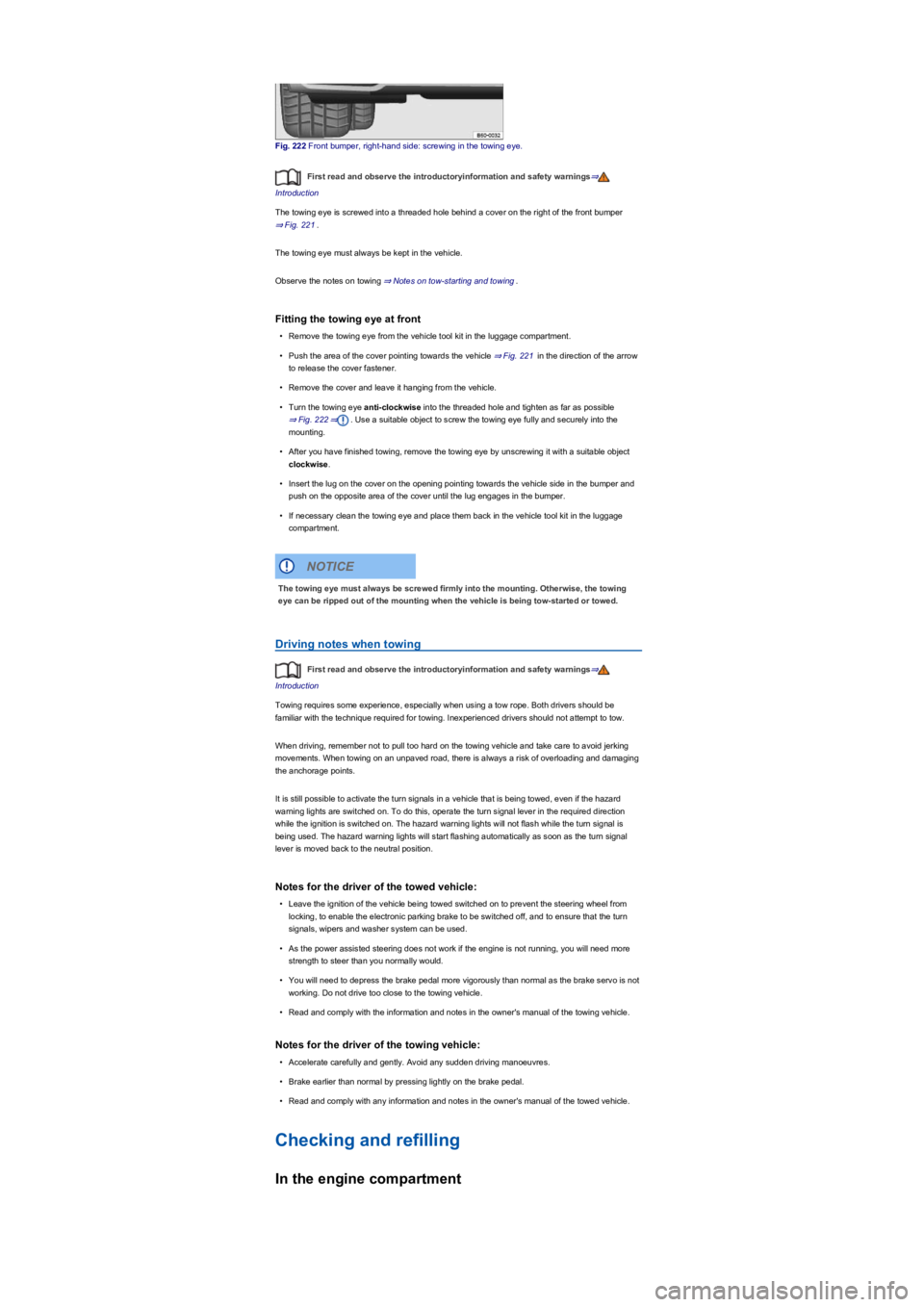
Fig. 222 Front bumper, right-hand side: screwing in the towing eye.
First read and observe the introductoryinformation and safety warnings⇒
Introduction
The towing eye is screwed into a threaded hole behind a cover on the right of the front bumper
⇒ Fig. 221.
The towing eye must always be kept in the vehicle.
Observe the notes on towing ⇒ Notes on tow-starting and towing.
Fitting the towing eye at front
•Remove the towing eye from the vehicle tool kit in the luggage compartment.
•Push the area of the cover pointing towards the vehicle ⇒ Fig. 221 in the direction of the arrow
to release the cover fastener.
•Remove the cover and leave it hanging from the vehicle.
•Turn the towing eye anti-clockwise into the threaded hole and tighten as far as possible
⇒ Fig. 222⇒. Use a suitable object to screw the towing eye fully and securely into the
mounting.
•After you have finished towing, remove the towing eye by unscrewing it with a suitable object
clockwise.
•Insert the lug on the cover on the opening pointing towards the vehicle side in the bumper and
push on the opposite area of the cover until the lug engages in the bumper.
•If necessary clean the towing eye and place them back in the vehicle tool kit in the luggage
compartment.
Driving notes when towing
First read and observe the introductoryinformation and safety warnings⇒
Introduction
Towing requires some experience, especially when using a tow rope. Both drivers should be
familiar with the technique required for towing. Inexperienced drivers should not attempt to tow.
When driving, remember not to pull too hard on the towing vehicle and take care to avoid jerking
movements. When towing on an unpaved road, there is always a risk of overloading and damaging
the anchorage points.
It is still possible to activate the turn signals in a vehicle that is being towed, even if the hazard
warning lights are switched on. To do this, operate the turn signal lever in the required direction
while the ignition is switched on. The hazard warning lights will not flash while the turn signal is
being used. The hazard warning lights will start flashing automatically as soon as the turn signal
lever is moved back to the neutral position.
Notes for the driver of the towed vehicle:
•Leave the ignition of the vehicle being towed switched on to prevent the steering wheel from
locking, to enable the electronic parking brake to be switched off, and to ensure that the turn
signals, wipers and washer system can be used.
•As the power assisted steering does not work if the engine is not running, you will need more
strength to steer than you normally would.
•You will need to depress the brake pedal more vigorously than normal as the brake servo is not
working. Do not drive too close to the towing vehicle.
•Read and comply with the information and notes in the owner's manual of the towing vehicle.
Notes for the driver of the towing vehicle:
•Accelerate carefully and gently. Avoid any sudden driving manoeuvres.
•Brake earlier than normal by pressing lightly on the brake pedal.
•Read and comply with any information and notes in the owner's manual of the towed vehicle.
Checking and refilling
In the engine compartment
The towing eye must always be screwed firmly into the mounting. Otherwise, the towing
eye can be ripped out of the mounting when the vehicle is being tow-started or towed.
NOTICE
Page 279 of 341
Before changing the engine oil, first find out where old oil can be disposed of properly near
you.
Used oil must be disposed of in accordance with regulations governing the protection of the
environment. Never dispose of old oil in locations such as gardens, woods, sewerage systems, on
streets and roads, or in rivers and waterways.
Engine oil consumption
First read and observe the introductoryinformation and safety warnings⇒
Introduction
Engine oil consumption can vary from engine to engine and can change during the working life of
an engine.
The vehicle may consume up to 1.0 litre of engine oil per 2,000 km, depending on how you drive
and the conditions in which the car is used. In new vehicles, consumption is likely to be higher for
the first 5,000 km. The engine oil level must therefore be checked at regular intervals, preferably
when refuelling and before long journeys.
When the engine is working hard, the engine oil level should be kept within the upper permissible
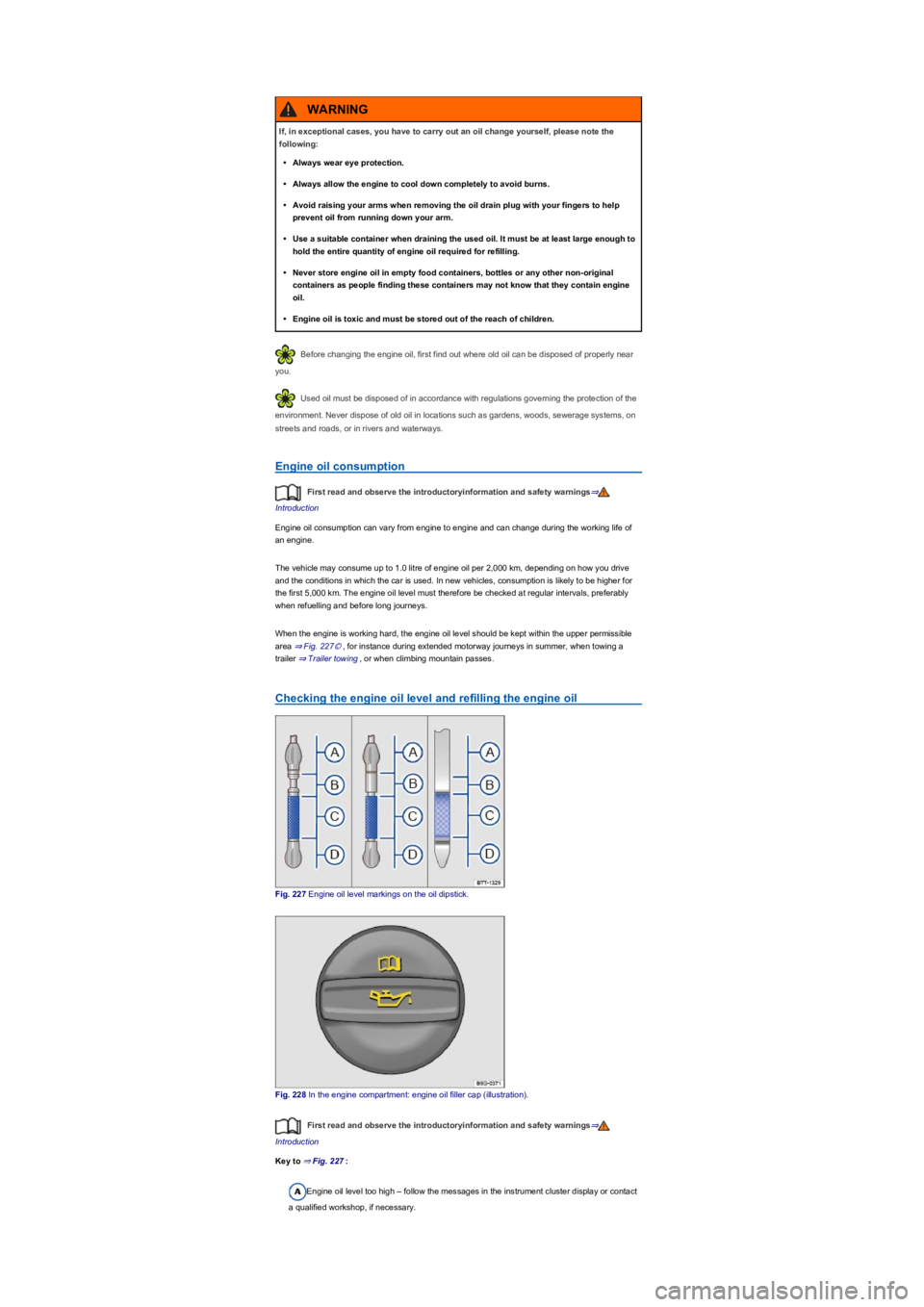
area ⇒ Fig. 227Ⓒ, for instance during extended motorway journeys in summer, when towing a
trailer ⇒ Trailer towing, or when climbing mountain passes.
Checking the engine oil level and refilling the engine oil
Fig. 227 Engine oil level markings on the oil dipstick.
Fig. 228 In the engine compartment: engine oil filler cap (illustration).
First read and observe the introductoryinformation and safety warnings⇒
Introduction
Key to ⇒ Fig. 227:
Engine oil level too high – follow the messages in the instrument cluster display or contact
a qualified workshop, if necessary.
If, in exceptional cases, you have to carry out an oil change yourself, please note the
following:
•Always wear eye protection.
•Always allow the engine to cool down completely to avoid burns.
•Avoid raising your arms when removing the oil drain plug with your fingers to help
prevent oil from running down your arm.
•Use a suitable container when draining the used oil. It must be at least large enough to
hold the entire quantity of engine oil required for refilling.
•Never store engine oil in empty food containers, bottles or any other non-original
containers as people finding these containers may not know that they contain engine
oil.
•Engine oil is toxic and must be stored out of the reach of children.
WARNING
Page 301 of 341
Removing the spare wheel
•Open the boot lid.
•Raise or fold forward the luggage compartment floor ⇒ Boot lid.
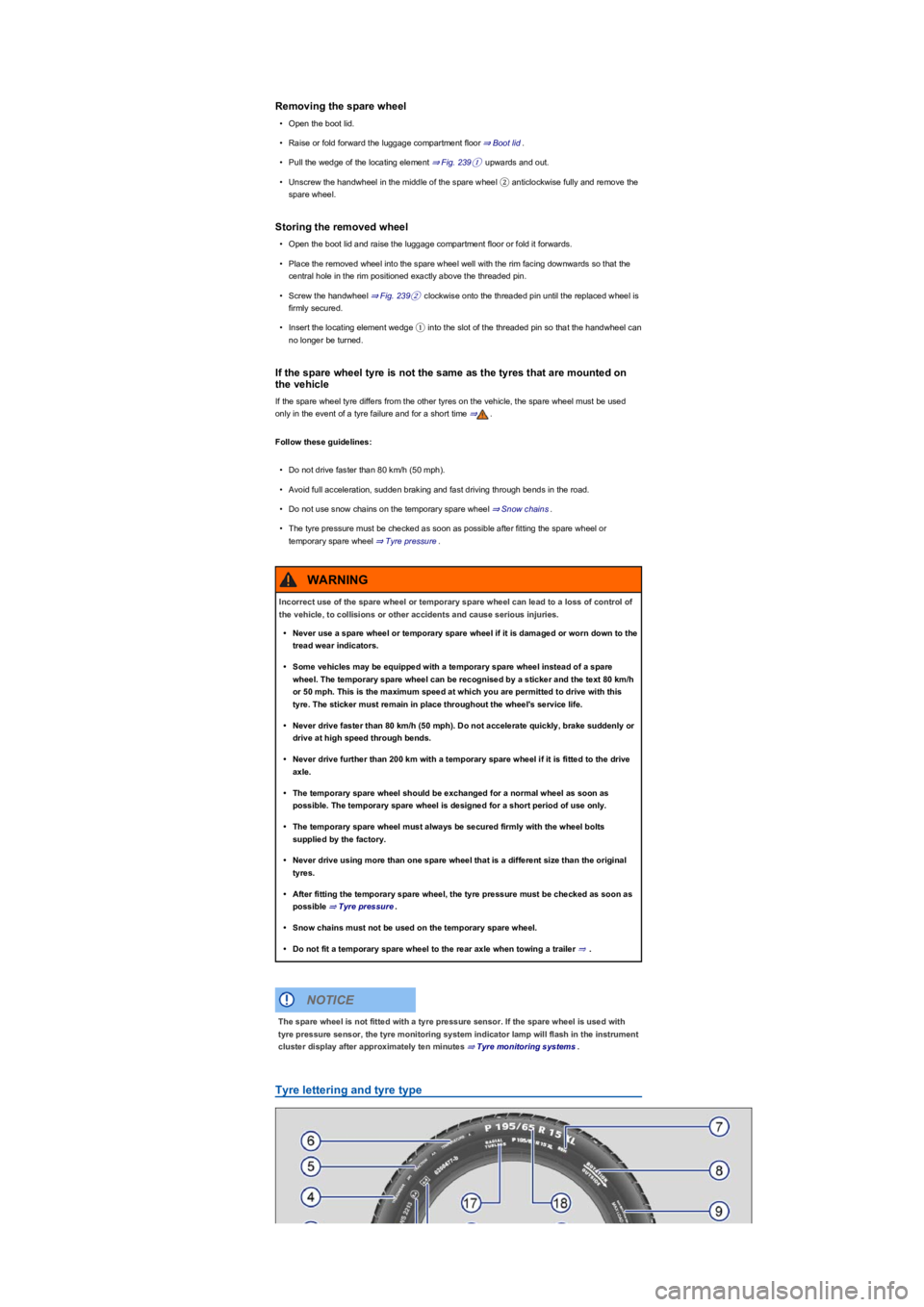
•Pull the wedge of the locating element ⇒ Fig. 239① upwards and out.
•Unscrew the handwheel in the middle of the spare wheel ② anticlockwise fully and remove the
spare wheel.
Storing the removed wheel
•Open the boot lid and raise the luggage compartment floor or fold it forwards.
•Place the removed wheel into the spare wheel well with the rim facing downwards so that the
central hole in the rim positioned exactly above the threaded pin.
•Screw the handwheel ⇒ Fig. 239② clockwise onto the threaded pin until the replaced wheel is
firmly secured.
•Insert the locating element wedge ① into the slot of the threaded pin so that the handwheel can
no longer be turned.
If the spare wheel tyre is not the same as the tyres that are mounted on
the vehicle
If the spare wheel tyre differs from the other tyres on the vehicle, the spare wheel must be used
only in the event of a tyre failure and for a short time ⇒.
Follow these guidelines:
•Do not drive faster than 80 km/h (50 mph).
•Avoid full acceleration, sudden braking and fast driving through bends in the road.
•Do not use snow chains on the temporary spare wheel ⇒ Snow chains.
•The tyre pressure must be checked as soon as possible after fitting the spare wheel or
temporary spare wheel ⇒ Tyre pressure.
Tyre lettering and tyre type
Incorrect use of the spare wheel or temporary spare wheel can lead to a loss of control of
the vehicle, to collisions or other accidents and cause serious injuries.
•Never use a spare wheel or temporary spare wheel if it is damaged or worn down to the
tread wear indicators.
•Some vehicles may be equipped with a temporary spare wheel instead of a spare
wheel. The temporary spare wheel can be recognised by a sticker and the text 80 km/h
or 50 mph. This is the maximum speed at which you are permitted to drive with this
tyre. The sticker must remain in place throughout the wheel's service life.
•Never drive faster than 80 km/h (50 mph). Do not accelerate quickly, brake suddenly or
drive at high speed through bends.
•Never drive further than 200 km with a temporary spare wheel if it is fitted to the drive
axle.
•The temporary spare wheel should be exchanged for a normal wheel as soon as
possible. The temporary spare wheel is designed for a short period of use only.
•The temporary spare wheel must always be secured firmly with the wheel bolts
supplied by the factory.
•Never drive using more than one spare wheel that is a different size than the original
tyres.
•After fitting the temporary spare wheel, the tyre pressure must be checked as soon as
possible ⇒ Tyre pressure.
•Snow chains must not be used on the temporary spare wheel.
•Do not fit a temporary spare wheel to the rear axle when towing a trailer ⇒.
WARNING
The spare wheel is not fitted with a tyre pressure sensor. If the spare wheel is used with
tyre pressure sensor, the tyre monitoring system indicator lamp will flash in the instrument
cluster display after approximately ten minutes ⇒ Tyre monitoring systems.
NOTICE
Page 308 of 341
Ask all vehicle occupants to leave the vehicle and stand at a safe distance away from moving
traffic.
Chock the wheel diagonally opposite the wheel being worked on with a stone, collapsible
chocks or another suitable object.
When towing a trailer: unhitch the trailer from the vehicle and park it properly .
Remove any items of luggage from the luggage compartment.
Remove the spare wheel or temporary spare wheel and the vehicle tool kit from the
luggage compartment.
Remove the hubcaps Hubcaps.
Wheel bolts
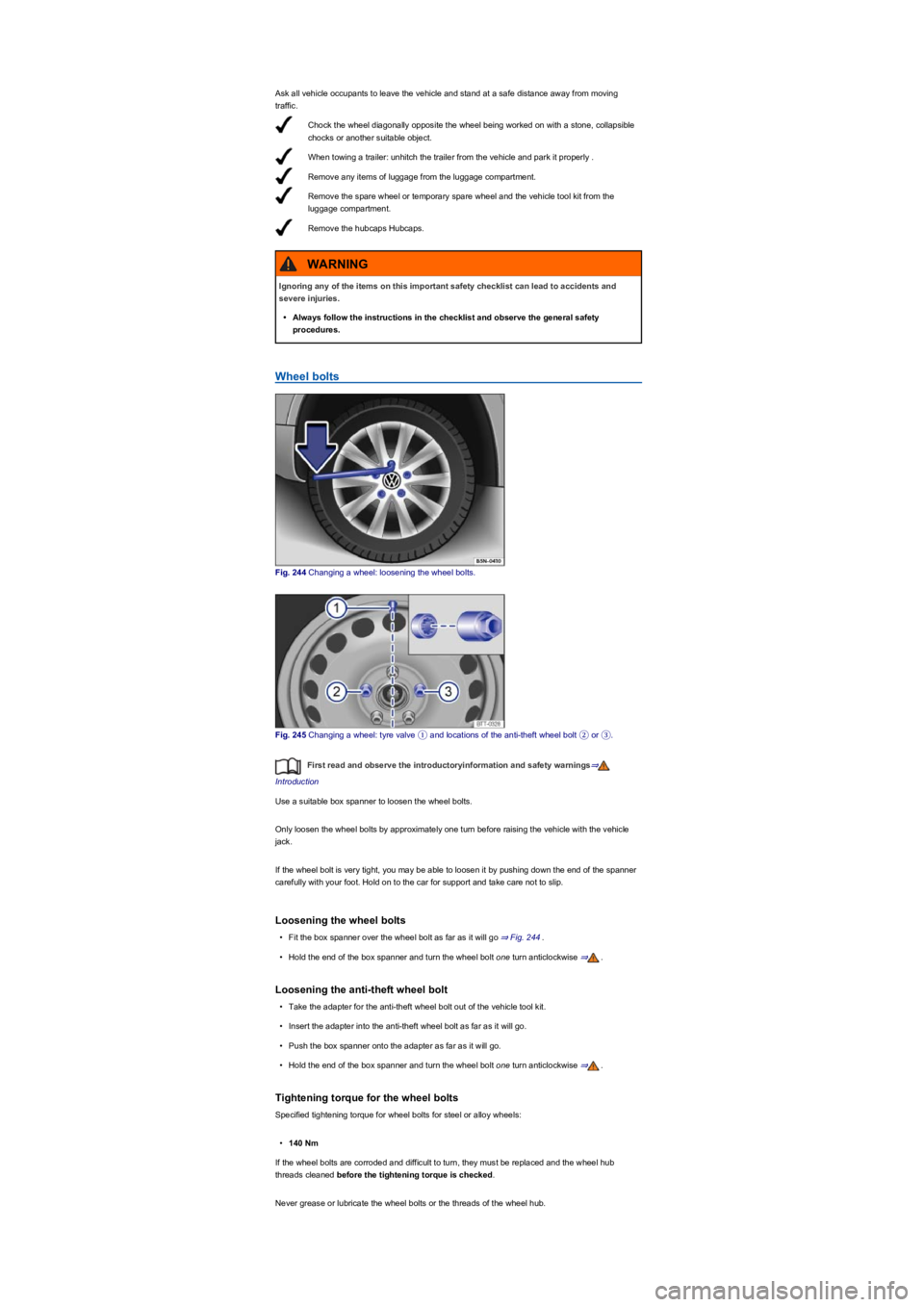
Fig. 244 Changing a wheel: loosening the wheel bolts.
Fig. 245 Changing a wheel: tyre valve ① and locations of the anti-theft wheel bolt ② or ③.
First read and observe the introductoryinformation and safety warnings⇒
Introduction
Use a suitable box spanner to loosen the wheel bolts.
Only loosen the wheel bolts by approximately one turn before raising the vehicle with the vehicle
jack.
If the wheel bolt is very tight, you may be able to loosen it by pushing down the end of the spanner
carefully with your foot. Hold on to the car for support and take care not to slip.
Loosening the wheel bolts
•Fit the box spanner over the wheel bolt as far as it will go ⇒ Fig. 244.
•Hold the end of the box spanner and turn the wheel bolt one turn anticlockwise ⇒.
Loosening the anti-theft wheel bolt
•Take the adapter for the anti-theft wheel bolt out of the vehicle tool kit.
•Insert the adapter into the anti-theft wheel bolt as far as it will go.
•Push the box spanner onto the adapter as far as it will go.
•Hold the end of the box spanner and turn the wheel bolt one turn anticlockwise ⇒.
Tightening torque for the wheel bolts
Specified tightening torque for wheel bolts for steel or alloy wheels:
•140 Nm
If the wheel bolts are corroded and difficult to turn, they must be replaced and the wheel hub
threads cleaned before the tightening torque is checked.
Never grease or lubricate the wheel bolts or the threads of the wheel hub.
Ignoring any of the items on this important safety checklist can lead to accidents and
severe injuries.
•Always follow the instructions in the checklist and observe the general safety
procedures.
WARNING
Page 313 of 341
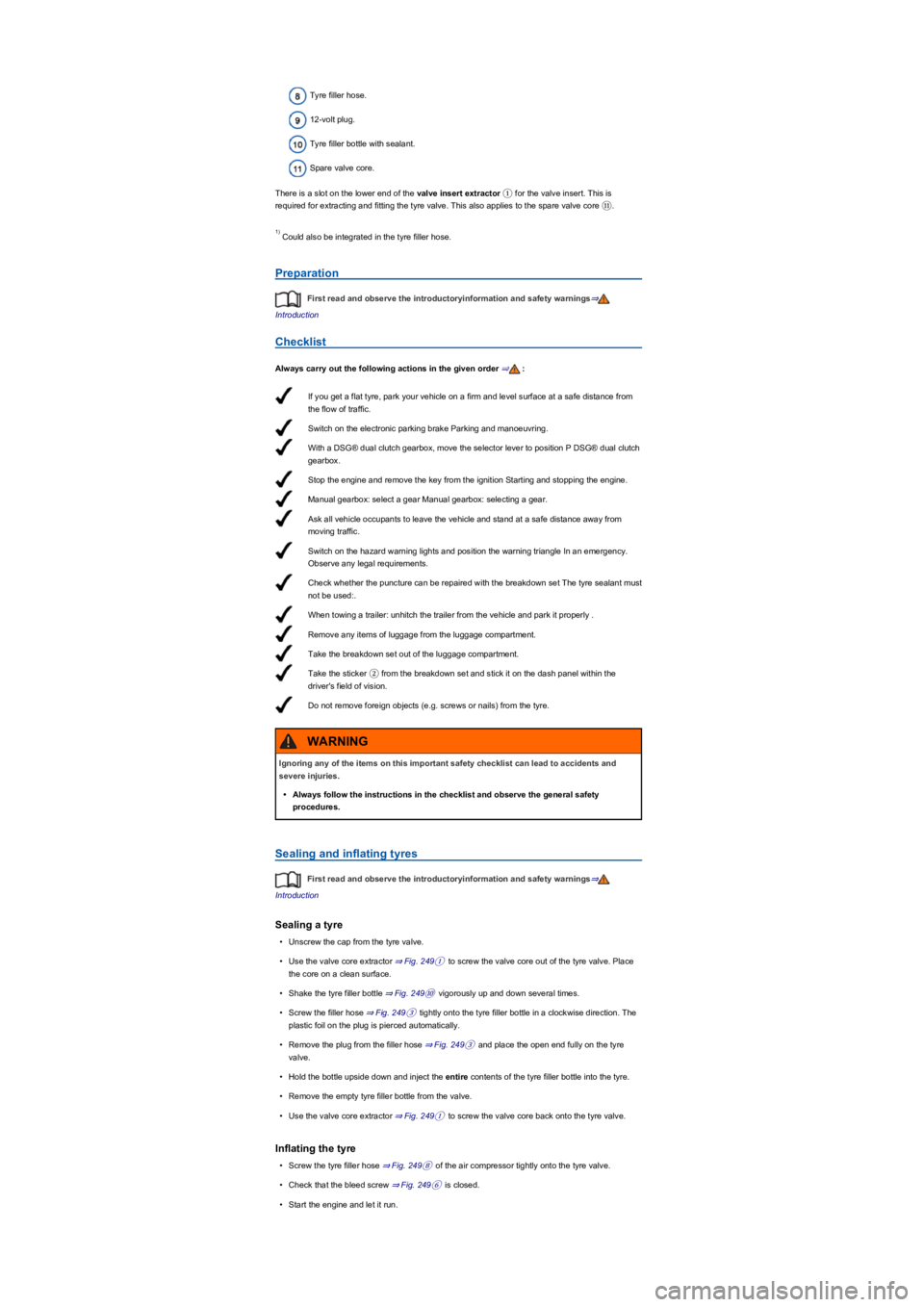
If you get a flat tyre, park your vehicle on a firm and level surface at a safe distance from
the flow of traffic.
Switch on the electronic parking brake Parking and manoeuvring.
With a DSG® dual clutch gearbox, move the selector lever to position P DSG® dual clutch
gearbox.
Stop the engine and remove the key from the ignition Starting and stopping the engine.
Manual gearbox: select a gear Manual gearbox: selecting a gear.
Ask all vehicle occupants to leave the vehicle and stand at a safe distance away from
moving traffic.
Switch on the hazard warning lights and position the warning triangle In an emergency.
Observe any legal requirements.
Check whether the puncture can be repaired with the breakdown set The tyre sealant must
not be used:.
When towing a trailer: unhitch the trailer from the vehicle and park it properly .
Remove any items of luggage from the luggage compartment.
Take the breakdown set out of the luggage compartment.
Take the sticker ② from the breakdown set and stick it on the dash panel within the
driver's field of vision.
Do not remove foreign objects (e.g. screws or nails) from the tyre.
Tyre filler hose.
12-volt plug.
Tyre filler bottle with sealant.
Spare valve core.
There is a slot on the lower end of the valve insert extractor① for the valve insert. This is
required for extracting and fitting the tyre valve. This also applies to the spare valve core ⑪.
Could also be integrated in the tyre filler hose.
Preparation
First read and observe the introductoryinformation and safety warnings⇒
Introduction
Checklist
Always carry out the following actions in the given order ⇒:
Sealing and inflating tyres
First read and observe the introductoryinformation and safety warnings⇒
Introduction
Sealing a tyre
•Unscrew the cap from the tyre valve.
•Use the valve core extractor ⇒ Fig. 249① to screw the valve core out of the tyre valve. Place
the core on a clean surface.
•Shake the tyre filler bottle ⇒ Fig. 249⑩ vigorously up and down several times.
•Screw the filler hose ⇒ Fig. 249③ tightly onto the tyre filler bottle in a clockwise direction. The
plastic foil on the plug is pierced automatically.
•Remove the plug from the filler hose ⇒ Fig. 249③ and place the open end fully on the tyre
valve.
•Hold the bottle upside down and inject the entire contents of the tyre filler bottle into the tyre.
•Remove the empty tyre filler bottle from the valve.
•Use the valve core extractor ⇒ Fig. 249① to screw the valve core back onto the tyre valve.
Inflating the tyre
•Screw the tyre filler hose ⇒ Fig. 249⑧ of the air compressor tightly onto the tyre valve.
•Check that the bleed screw ⇒ Fig. 249⑥ is closed.
•Start the engine and let it run.
1)
Ignoring any of the items on this important safety checklist can lead to accidents and
severe injuries.
•Always follow the instructions in the checklist and observe the general safety
procedures.
WARNING
Page 314 of 341
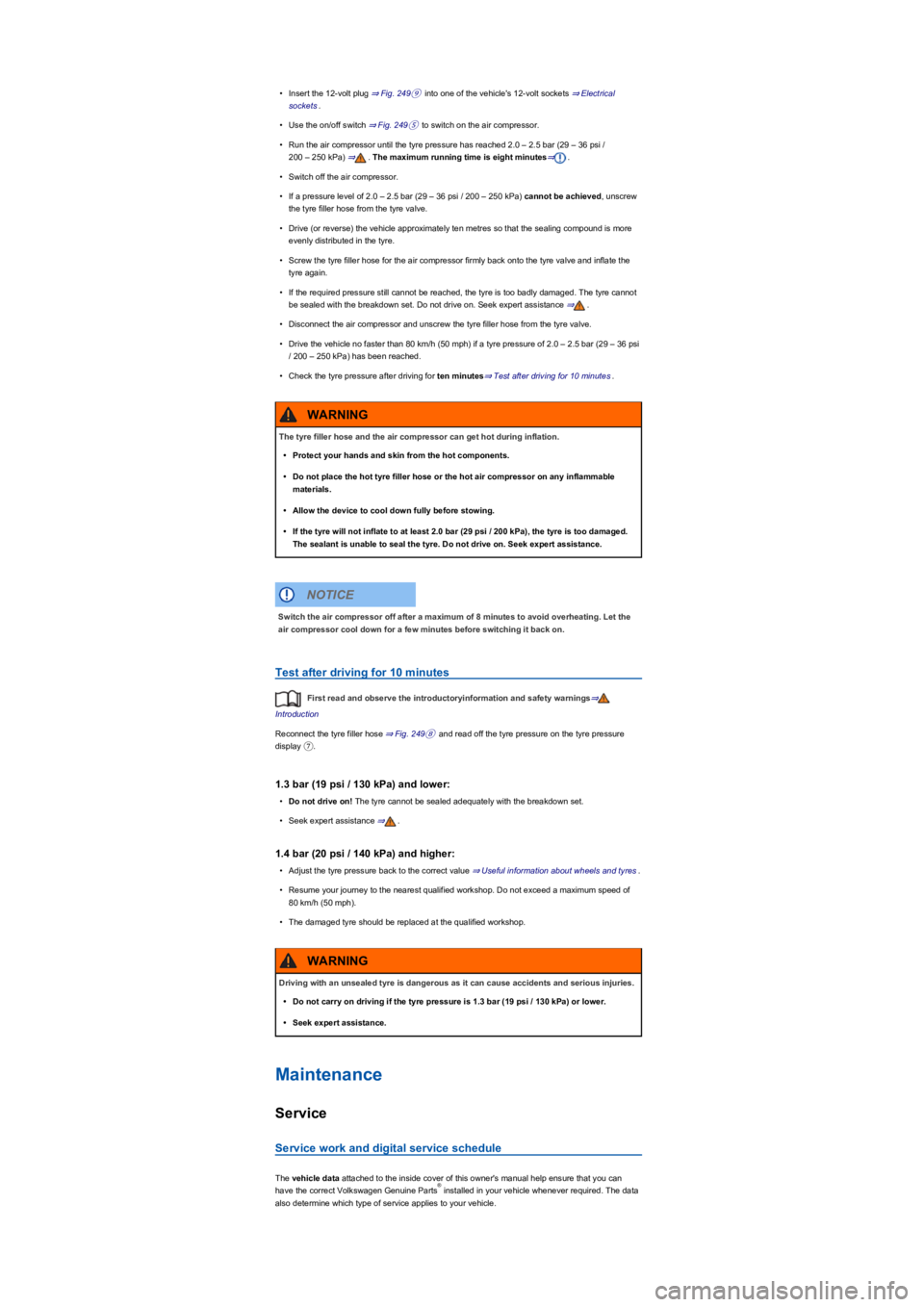
•Insert the 12-volt plug ⇒ Fig. 249⑨ into one of the vehicle's 12-volt sockets ⇒ Electrical
sockets.
•Use the on/off switch ⇒ Fig. 249⑤ to switch on the air compressor.
•Run the air compressor until the tyre pressure has reached 2.0 – 2.5 bar (29 – 36 psi /
200 – 250 kPa) ⇒. The maximum running time is eight minutes⇒.
•Switch off the air compressor.
•If a pressure level of 2.0 – 2.5 bar (29 – 36 psi / 200 – 250 kPa) cannot be achieved, unscrew
the tyre filler hose from the tyre valve.
•Drive (or reverse) the vehicle approximately ten metres so that the sealing compound is more
evenly distributed in the tyre.
•Screw the tyre filler hose for the air compressor firmly back onto the tyre valve and inflate the
tyre again.
•If the required pressure still cannot be reached, the tyre is too badly damaged. The tyre cannot
be sealed with the breakdown set. Do not drive on. Seek expert assistance ⇒.
•Disconnect the air compressor and unscrew the tyre filler hose from the tyre valve.
•Drive the vehicle no faster than 80 km/h (50 mph) if a tyre pressure of 2.0 – 2.5 bar (29 – 36 psi
/ 200 – 250 kPa) has been reached.
•Check the tyre pressure after driving for ten minutes⇒ Test after driving for 10 minutes.
Test after driving for 10 minutes
First read and observe the introductoryinformation and safety warnings⇒
Introduction
Reconnect the tyre filler hose ⇒ Fig. 249⑧ and read off the tyre pressure on the tyre pressure
display ⑦.
1.3 bar (19 psi / 130 kPa) and lower:
•Do not drive on! The tyre cannot be sealed adequately with the breakdown set.
•Seek expert assistance ⇒.
1.4 bar (20 psi / 140 kPa) and higher:
•Adjust the tyre pressure back to the correct value ⇒ Useful information about wheels and tyres.
•Resume your journey to the nearest qualified workshop. Do not exceed a maximum speed of
80 km/h (50 mph).
•The damaged tyre should be replaced at the qualified workshop.
Maintenance
Service
Service work and digital service schedule
The vehicle data attached to the inside cover of this owner's manual help ensure that you can
have the correct Volkswagen Genuine Parts installed in your vehicle whenever required. The data
also determine which type of service applies to your vehicle.
The tyre filler hose and the air compressor can get hot during inflation.
•Protect your hands and skin from the hot components.
•Do not place the hot tyre filler hose or the hot air compressor on any inflammable
materials.
•Allow the device to cool down fully before stowing.
•If the tyre will not inflate to at least 2.0 bar (29 psi / 200 kPa), the tyre is too damaged.
The sealant is unable to seal the tyre. Do not drive on. Seek expert assistance.
WARNING
Switch the air compressor off after a maximum of 8 minutes to avoid overheating. Let the
air compressor cool down for a few minutes before switching it back on.
NOTICE
Driving with an unsealed tyre is dangerous as it can cause accidents and serious injuries.
•Do not carry on driving if the tyre pressure is 1.3 bar (19 psi / 130 kPa) or lower.
•Seek expert assistance.
WARNING
®
Page 316 of 341
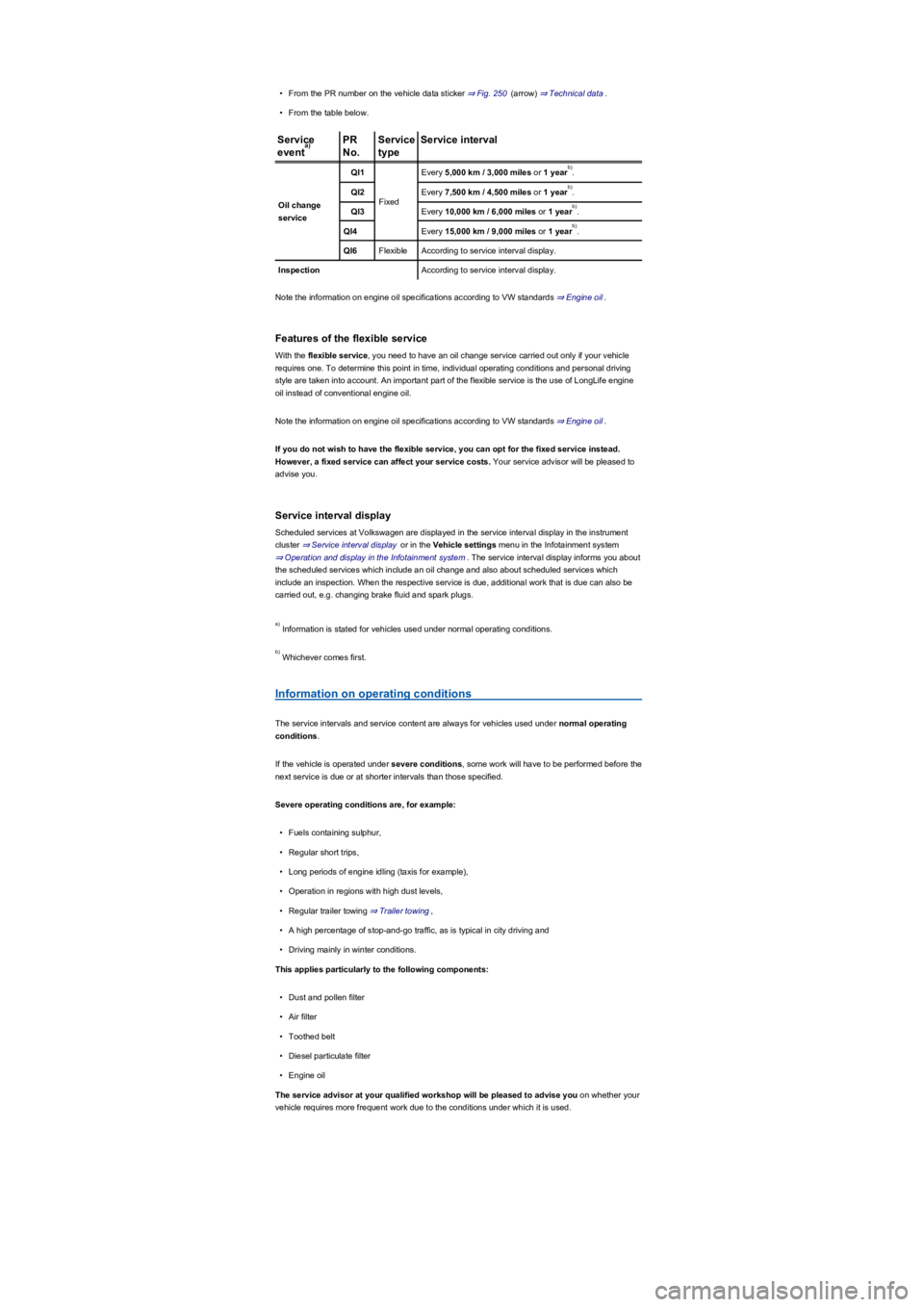
•From the PR number on the vehicle data sticker ⇒ Fig. 250 (arrow) ⇒ Technical data.
•From the table below.
Service
event
PR
No.
Service
type
Service interval
Oil change
service
QI1
Fixed
Every 5,000 km / 3,000 miles or 1 year.
QI2Every 7,500 km / 4,500 miles or 1 year.
QI3Every 10,000 km / 6,000 miles or 1 year.
QI4Every 15,000 km / 9,000 miles or 1 year.
QI6FlexibleAccording to service interval display.
InspectionAccording to service interval display.
Note the information on engine oil specifications according to VW standards ⇒ Engine oil.
Features of the flexible service
With the flexible service, you need to have an oil change service carried out only if your vehicle
requires one. To determine this point in time, individual operating conditions and personal driving
style are taken into account. An important part of the flexible service is the use of LongLife engine
oil instead of conventional engine oil.
Note the information on engine oil specifications according to VW standards ⇒ Engine oil.
If you do not wish to have the flexible service, you can opt for the fixed service instead.
However, a fixed service can affect your service costs. Your service advisor will be pleased to
advise you.
Service interval display
Scheduled services at Volkswagen are displayed in the service interval display in the instrument
cluster ⇒ Service interval display or in the Vehicle settings menu in the Infotainment system
⇒ Operation and display in the Infotainment system. The service interval display informs you about
the scheduled services which include an oil change and also about scheduled services which
include an inspection. When the respective service is due, additional work that is due can also be
carried out, e.g. changing brake fluid and spark plugs.
Information is stated for vehicles used under normal operating conditions.
Whichever comes first.
Information on operating conditions
The service intervals and service content are always for vehicles used under normal operating
conditions.
If the vehicle is operated under severe conditions, some work will have to be performed before the
next service is due or at shorter intervals than those specified.
Severe operating conditions are, for example:
•Fuels containing sulphur,
•Regular short trips,
•Long periods of engine idling (taxis for example),
•Operation in regions with high dust levels,
•Regular trailer towing ⇒ Trailer towing,
•A high percentage of stop-and-go traffic, as is typical in city driving and
•Driving mainly in winter conditions.
This applies particularly to the following components:
•Dust and pollen filter
•Air filter
•Toothed belt
•Diesel particulate filter
•Engine oil
The service advisor at your qualified workshop will be pleased to advise you on whether your
vehicle requires more frequent work due to the conditions under which it is used.
a)
b)
b)
b)
b)
a)
b)
Page 324 of 341
authorization symbol). These devices include cruise control systems or an electronically controlled
suspension.
Any additional electrical components fitted that do not serve to control the vehicle itself must
bear the mark (manufacturer conformity declaration in the European Union). Such devices
include refrigerator boxes, laptops and ventilator fans.
Repairs and technical modifications
Repairs and technical modifications must always be carried out according to Volkswagen
specifications⇒.
Unauthorised modifications to the electronic components or software in the vehicle may cause
malfunctions. As the electronic components are linked together in networks, these faults may
indirectly affect the working of other systems. This can seriously impair safety, lead to excessive
wear of components, and also invalidate the type approval for the vehicle.
The Volkswagen dealership cannot be held liable for any damage caused by technical
modifications and/or work performed incorrectly.
The Volkswagen dealership is not responsible for damage caused by technical modifications and/or
work performed incorrectly. Such damage is not covered by the Volkswagen guarantee.
Volkswagen recommends that all repairs and technical modifications be performed by an
authorised Volkswagen workshop using Volkswagen Genuine Parts.
Volkswagen repair information
Volkswagen Service information and official Volkswagen repair information can be purchased for a
fee.
Customers in Europe, Asia, Australia, Africa, Central and South America: please contact a
Volkswagen dealership or qualified workshop or register on the online portal erWin (electronic
repair and workshop information):
https://erwin.volkswagen.de
erWin is available in numerous languages.
Vehicles with special auxiliary equipment or body parts
The manufacturer of these components must ensure that these parts (fittings) adhere to the
stipulated environmental laws and regulations, particularly the EU directive 2000/53/EC concerning
end-of-life vehicles and EU directive 2003/11/EC concerning the restriction on the marketing and
use of certain dangerous substances and preparations.
The vehicle owner should keep all assembly documentation for these auxiliary fittings, and pass it
on to any scrapping company later engaged. This is to facilitate environmentally responsible
disposal for all vehicles, including refitted vehicles.
Windscreen repairs
To function properly, some items of equipment require an electrical or electronic module, which is
located on the inside of the windscreen near the interior mirror. If the windscreen has been
damaged in the viewing field of the electrical or electronic module, e.g. by stone impact, the
windscreen must be replaced. Repairing the crack can lead to malfunctions or functional faults in
the equipment.
After changing the windscreen, the camera and sensors must be set up and calibrated by a
qualified workshop.
Impairment or damage to sensors and cameras
Incorrect repairs, retrofit structural modifications to the vehicle, e.g. lowering the body, add-on parts
on the vehicle or trailer ⇒ Trailer towing, or changes to the trim may lead to the sensors or
cameras being disrupted or damaged. This can also be caused by collisions, e.g. when parking.
Failure to observe this may impair important functions (driver assist systems) and damage the
vehicle.
The area in front of and around the sensors and cameras must not be covered by stickers,
additional headlights, trim frames for number plates or similar.
Incorrectly performed repairs or modifications to your vehicle can impair the effectiveness
of the airbags, cause malfunctions, accidents and fatal injury.
•Never secure or mount objects such as drink holders or telephone holders either on or
next to the airbag covers or within the deployment zones of the airbag modules.
•Objects either on or next to the airbag module covers or are in the deployment zone of
the airbags can cause serious or even fatal injuries should the airbags be activated.
WARNING
®
Page 332 of 341
Information in accordance with the EU Chemicals Regulation
REACH
In accordance with the European regulations on chemicals, known as REACH, Volkswagen would
like to inform you about the substances that may be found in your vehicle.
You can access this information online using your vehicle identification number ⇒ Technical data:
https://reachinfo.volkswagen.com
Declaration of conformity
The individual manufacturer declares herewith that the following products conform, at the time of
vehicle production, with the basic requirements and other relevant laws and regulations, including
FCC Part 15.19, FCC Part 15.21 and RSS-Gen Issue 1:
Radio-based equipment
•Electronic immobiliser.
•Vehicle key.
•Keyless Access locking and starting system.
•Adaptive Cruise Control (ACC).
•Area monitoring system (Front Assist) including City Emergency Brake.
•Lane change system (Side Assist)
•Remote control for the auxiliary heater ⇒ Auxiliary heater and ventilation.
•Trailer manoeuvring system (Trailer Assist) ⇒ Trailer Assist
Electrical equipment
•12-volt socket.
•230-volt Euro socket, 115-volt socket, 100-volt socket.
Recycling and scrapping end-of-life vehicles
Recycling end-of-life vehicles
Volkswagen has already made provision for you to recycle your vehicle in an environmentally
responsible manner. The recycling system operating in many European countries will take back
your vehicle at the end of its useful life. Once the vehicle has been recycled, a certificate of
destruction will be issued to show that the vehicle has been disposed of correctly.
End-of-life vehicles are recycled free of charge, provided that national legislation is complied with.
Further information on the recycling of end-of-life vehicles can be found at a Volkswagen
dealership.
Scrapping
The relevant safety requirements must be observed when the vehicle or components of the airbag
and the belt tensioners are scrapped. Qualified workshops are familiar with these requirements.
Information about vehicles with N1 approval (light commercial
vehicle)
Please observe the following information for vehicles used to transport goods with a maximum
permitted weight of up to 3.5 t (N1 approval in Europe):
Variants and number of seats
N1 vehicles based on a Volkswagen passenger car models are available in different versions. The
number of seats may be restricted to two or four.
Vehicles with two seats: there is no floor covering in the rear of the vehicle interior because there is
no rear bench seat ⇒.
Vehicles with four seats: the centre seat on the rear bench seat cannot be used⇒.
Safe transport of children
Like in vehicles with passenger car approval (M1), approved child restraint systems can be used on
the seats ⇒ Safe transport of children.
Towing a trailer
If the vehicle is approved for towing a trailer, observe any local regulations for driving with a trailer
and using a towing bracket.
Page 333 of 341
If the vehicle exceeds the permitted gross weight or axle load for the rear axle, a speed of 80 km/h
must not be exceeded when towing a trailer. This also applies to countries where higher speeds are
permitted. Always obey speed limits. In some areas speed limits for vehicles towing trailers are
lower than for vehicles without trailers.
Any permitted excess loads for the vehicle are entered in the vehicle documents. If no permitted
excess load is entered, the permitted driving speed limit is 100 km/h taking into account country-
specific legislation.
Technical data
Refer to the vehicle documents for the technical data.
Technical data
Information on technical data
Unless otherwise indicated or listed separately, the technical data for the basic model apply.
Optional equipment, different vehicle equipment, special vehicles and country-specific vehicle
equipment levels can result in different values. All data in the official vehicle documents take
precedence over these data.
Observe the instructions and information relating to vehicles with N1 approval ⇒ Information about
vehicles with N1 approval (light commercial vehicle).
Engine
The vehicle data sticker or the vehicle registration documents show which engine is installed in your
vehicle.
Weight
The values for the kerb weight in the following tables apply to the road-ready vehicle with driver
(75 kg), service fluids including fuel tank carrying 90% of its capacity and, if applicable, tool kit and
spare tyre ⇒. Additional equipment and retrofitted accessories increase the kerb weight stated
and reduce the maximum permitted load accordingly.
The load comprises the weights of the following:
•Vehicle occupants
•All luggage
•Roof load including the mounts or roof bars and the load carrier system
•Drawbar load when towing a trailer ⇒ Trailer towing.
Performance figures
For reasons of vehicle registration and vehicle taxation, the power output and performance of some
engines may vary in some countries from the information given in this booklet.
In certain vehicles with heavy duty suspension, the engine could be governed to provide a
maximum speed of 210 km/h.
Danger of injuries and electric shock from exposed cables.
•Have the luggage compartment completed at the latest after delivery so that the cables
in the rear area of the vehicle are covered during use of the vehicle.
WARNING
Danger of serious injury due to incorrect transport of persons.
•Never transport a person or child in the middle of the rear bench seat.
•The lack of restraint systems such as seat belt and head restraint can result in serious
or fatal injury in the event of an accident.
WARNING
Danger of serious and fatal injury.
•Do not transport people in the luggage compartment.
•Observe the safety instructions and information on the luggage compartment and
transporting items ⇒ Transporting.
WARNING