steering wheel VOLKSWAGEN TIGUAN 2017 Owner´s Manual
[x] Cancel search | Manufacturer: VOLKSWAGEN, Model Year: 2017, Model line: TIGUAN, Model: VOLKSWAGEN TIGUAN 2017Pages: 341, PDF Size: 9.14 MB
Page 300 of 341
Tyre damage
First read and observe the introductoryinformation and safety warnings⇒
Introduction
Damage to tyres and wheel rims is often hidden ⇒.
•If you suspect that a wheel is damaged, stop the vehicle as soon as it is safe to do so.
•Check the tyres and rims for damage.
•If a tyre is damaged, do not drive on. Seek expert assistance.
•If there is no visible damage, drive slowly and cautiously to the next qualified workshop in order
to have the vehicle checked.
Foreign bodies in the tyre
•Leave the foreign body in the tyre if it has entered the inner tyre. Foreign bodies that are stuck
between the tyre tread blocks can be removed.
•Replace the damaged wheel ⇒ Changing a wheel or seal the tyre with the breakdown set and
inflate it ⇒ Breakdown set. Seek professional assistance for this if necessary.
•Check and adjust the tyre pressure.
•Go to a qualified workshop. Volkswagen recommends using a Volkswagen dealership for this
purpose.
Tyre wear
Fast cornering, heavy acceleration and hard braking all increase tyre wear.
Wheel imbalance may develop when the vehicle is driven; you will notice this by nervous steering
response. Unbalanced wheels will affect the level of tyre wear. In this case the wheels should be
balanced again.
Incorrect wheel alignment causes excessive tyre wear, impairing the safety of the vehicle. The
wheel alignment should be checked by a qualified workshop if tyres show excessive wear.
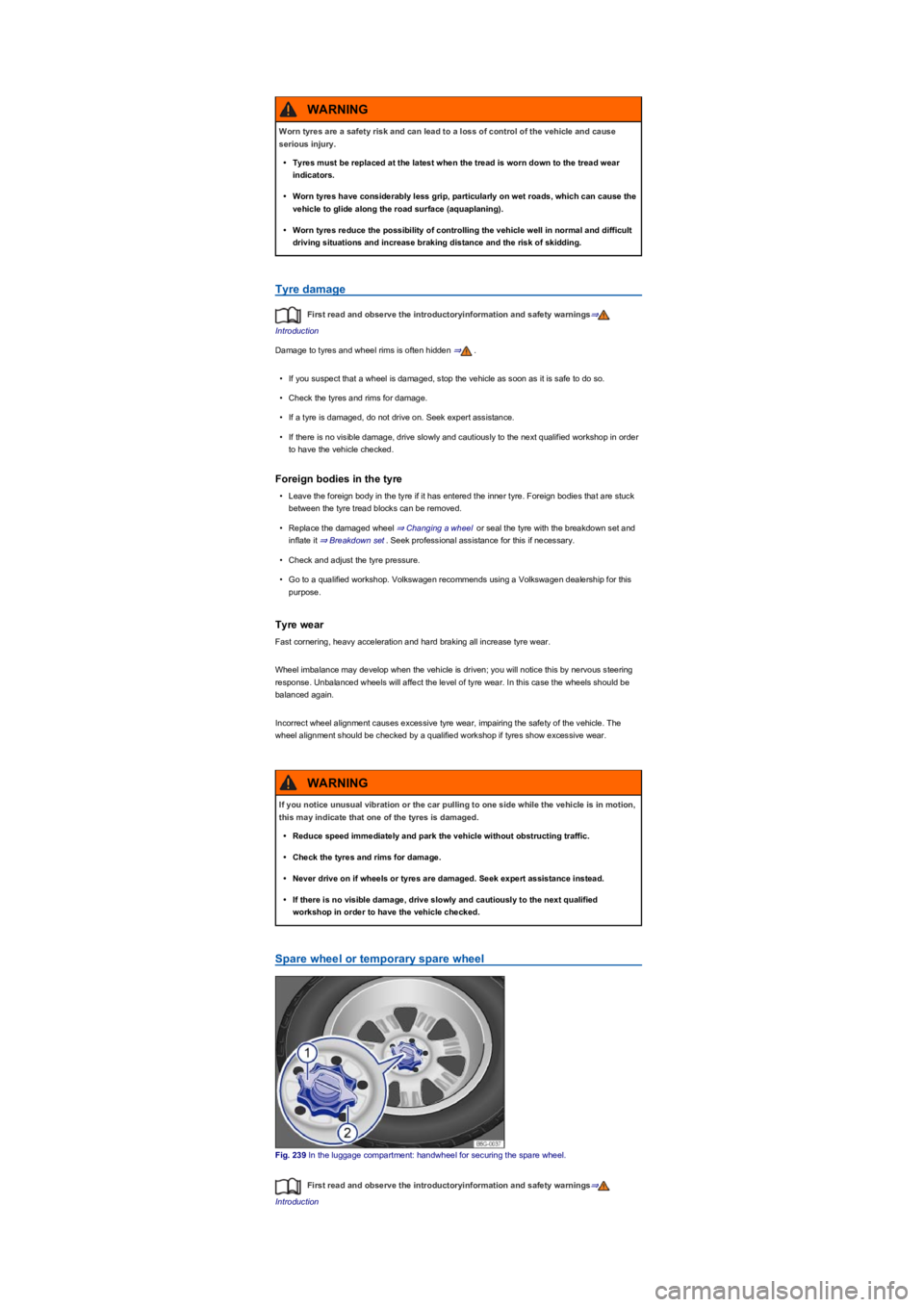
Spare wheel or temporary spare wheel
Fig. 239 In the luggage compartment: handwheel for securing the spare wheel.
First read and observe the introductoryinformation and safety warnings⇒
Introduction
Worn tyres are a safety risk and can lead to a loss of control of the vehicle and cause
serious injury.
•Tyres must be replaced at the latest when the tread is worn down to the tread wear
indicators.
•Worn tyres have considerably less grip, particularly on wet roads, which can cause the
vehicle to glide along the road surface (aquaplaning).
•Worn tyres reduce the possibility of controlling the vehicle well in normal and difficult
driving situations and increase braking distance and the risk of skidding.
WARNING
If you notice unusual vibration or the car pulling to one side while the vehicle is in motion,
this may indicate that one of the tyres is damaged.
•Reduce speed immediately and park the vehicle without obstructing traffic.
•Check the tyres and rims for damage.
•Never drive on if wheels or tyres are damaged. Seek expert assistance instead.
•If there is no visible damage, drive slowly and cautiously to the next qualified
workshop in order to have the vehicle checked.
WARNING
Page 317 of 341
Scope of service
The scope of service includes all maintenance work that is necessary in order to keep your vehicle
roadworthy (depending on the operating conditions and vehicle equipment, e.g. engine, gearbox or
service fluids). The maintenance work is divided into inspection work and servicing work. You can
find out what work is required in detail for your vehicle:
•From your Volkswagen dealership.
•From your qualified workshop.
•In the electronic repair and workshop information system erWin at https://erwin.volkswagen.de.
Inspection work
Electrics
•12-volt vehicle battery: check and replace if necessary.
•Lighting: check.
•High-voltage components: check.
•Horn: check.
•Headlight setting: check.
•Service interval display: reset.
Engine/gearbox
•Exhaust system: check.
•Gearbox and final drive: check.
•Gas system: check.
•Poly V-belt: check.
•Cooling system: check.
•Engine and components in engine compartment: check.
•Engine oil level: check.
Running gear
•Swivel joints/track rods: check.
•Tyres: check.
•Brake system: check.
•Brake pads/discs: check.
•Brake fluid level: check.
•Boots: check.
•Coupling rod and stabiliser bearings: check.
•Pneumatic suspension: check.
•Breakdown set: check.
•Tyre pressure on all wheels: check.
•Power steering: check.
•Shock absorbers/coil springs: check.
Body
•Roof systems: check.
•Windscreen: check.
•Body: check for corrosion.
•Wiper blades: check.
•Window wiper and washer system: check.
•Door arresters: lubricate.
•Underbody: check.
Inadequate servicing, no servicing at all, or failure to adhere to service intervals can result
in breakdowns, accidents or serious injury.
•Have your service work carried out by an authorised Volkswagen dealership or
workshop.
WARNING
Volkswagen is not responsible for any vehicle damage caused by inadequate service work
or the lack of part availability.
NOTICE
Page 319 of 341
Suitable accessories are available from your Volkswagen dealership. Follow the usage
instructions on the packaging.
Washing the vehicle
Also wash the underside of the vehicle on a regular basis to remove road salt or seawater residue.
Automatic car washes
Always observe all the car wash operator's specifications, in particular if your vehicle features add-
on parts ⇒.
•Preferably use car washes without brushes.
•Preclean the vehicle by rinsing with water.
•The steering column must not lock when driving through automatic car washes ⇒ Steering.
•Always switch off the Auto Hold function ⇒ Electronic parking brake, the wipers ⇒ Wipers and
the rain/light sensor before entering the car wash.
•Fold in the exterior mirrors.
•If your vehicle has decorative and protective films, do not select a wash program with hot wax.
High-pressure cleaners
Observe the manufacturer's information for the high-pressure cleaner. Never use rotating nozzles
⇒.
•Only use water with a maximum temperature of +60°C (+140°F).
•Do not clean windows that are iced over or covered in snow with a high-pressure cleaner.
•Move the jet of water uniformly so that the nozzle is at least 50 cm away from the side windows
and other vehicle components.
•Do not point the water jet at the same location for too long. Instead, leave stubborn dirt to soak.
•If possible, do not direct the water jet at seals, e.g. side windows, decorative trim, tyres, rubber
hoses, insulation materials or any other sensitive components, e.g. door locks.
•Sensors, camera lenses, and decorative and protective films should be sprayed directly only for
brief periods of time.
Washing the car by hand
Washing the car by hand is always the more gentle way to clean it. However, there are also some
things to note for this ⇒.
•Before washing the vehicle, soak the dirt with plenty of water and then rinse it off thoroughly.
•Clean the vehicle with a soft sponge, a wash mitt or a brush applying only light pressure. Start
with the roof and work from the top to the bottom.
•Rinse the sponge, wash mitt or brush thoroughly at regular short intervals.
•Clean the wheels, sill panels etc. last. Use a second sponge for this.
Use a shampoo for very stubborn dirt only.
Car care products can be toxic and hazardous. Unsuitable care products and incorrect use
of care products can cause accidents, serious injuries, burns or poisoning.
•Care products must be kept in the original, sealed container only.
•Read the manufacturer's instructions.
•Never use empty food cans, bottles or other containers for storing care products.
•Keep children away from care products.
•The products can give off harmful fumes during use. They should therefore only be
used outside or in well-ventilated spaces.
•Never use fuel, turpentine, engine oil, nail varnish remover or other volatile fluids to
wash, clean or care for your vehicle. These substances are toxic and highly
inflammable.
WARNING
Stains, dirt and other deposits containing aggressive and solvent-based ingredients attack
the material and may cause irreparable damage, even if only left for a short time.
•Stains, dirt and other deposits should always be removed as quickly as possible and
not allowed to dry in.
•Have stubborn stains removed by a qualified workshop.
NOTICE
1)