Fan VOLKSWAGEN TIGUAN 2017 Owner´s Manual
[x] Cancel search | Manufacturer: VOLKSWAGEN, Model Year: 2017, Model line: TIGUAN, Model: VOLKSWAGEN TIGUAN 2017Pages: 341, PDF Size: 9.14 MB
Page 57 of 341
•Weight class 0/0+: group 0/0+ or 0/1 rear-facing infant carriers ⇒ Fig. 52 are the best option
for the period from birth to about 18 months.
•Weight class 1: group 1 (up to about four years old) or group 1/2 (up to about seven years old)
with an integral belt system are best for children over the relevant weight limit.
•Weight classes 2/3: groups 2 and 3 include child seats with a backrest, and booster seats with
no backrest. Child seats with a backrest have integrated seat routing and side cushions, and so
provide better protection than booster seats with no backrest. Volkswagen therefore
recommends the use of child seats with a backrest. Group 2 child seats are for children up to
the age of about seven, group 3 child seats for those older than seven.
Not every child will fit in the child seat specified for their weight group. Likewise, not every seat will
fit in every vehicle. Therefore it is vital to check that the child fits properly in their child seat and that
the child seat can be securely fastened in the vehicle.
Child seat approval categories
Child seats can be classified as universal, semi-universal or vehicle-specific (all in accordance with
regulation ECE-R 44), or as i-Size (in accordance with regulation ECE-R 129).
•Universal: child seats with universal approval are approved for use in all vehicles. No type list
is required. ISOFIX child seats with universal approval must also be securing using a strap over
the top of the vehicle seat (top tether).
•Semi-universal: semi-universal approval requires other safety devices for attaching the seat
(that require additional testing) in addition to the standard requirements for universal approval.
Child seats with semi-universal approval come with a type list. The seats should only be used in
vehicles that are included on this list.
•Vehicle-specific: child seats with vehicle specific approval must have undergone dynamic
testing in each model of vehicle for which it is approved. These child seats also come with a
type list.
•i-Size: child seats classified as i-Size must conform to the installation and safety requirements
prescribed in regulation ECE-R 129. Contact the child seat manufacturer to find out which child
seats are approved for this vehicle in accordance with i-Size.
Regulation ECE-R 129 has not yet been implemented by the state authorities in all countries.
Installing and using child seats
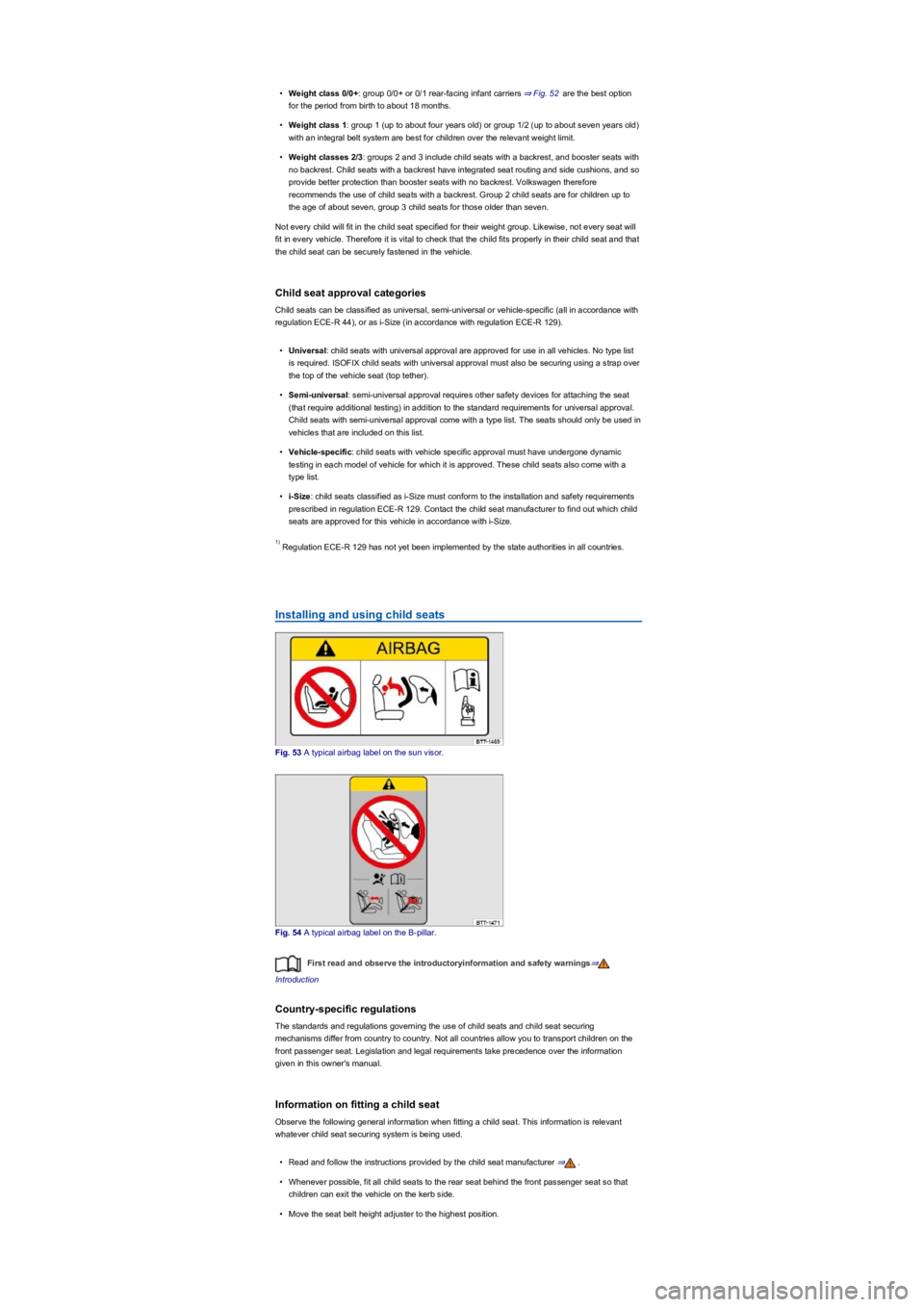
Fig. 53 A typical airbag label on the sun visor.
Fig. 54 A typical airbag label on the B-pillar.
First read and observe the introductoryinformation and safety warnings⇒
Introduction
Country-specific regulations
The standards and regulations governing the use of child seats and child seat securing
mechanisms differ from country to country. Not all countries allow you to transport children on the
front passenger seat. Legislation and legal requirements take precedence over the information
given in this owner's manual.
Information on fitting a child seat
Observe the following general information when fitting a child seat. This information is relevant
whatever child seat securing system is being used.
•Read and follow the instructions provided by the child seat manufacturer ⇒.
•Whenever possible, fit all child seats to the rear seat behind the front passenger seat so that
children can exit the vehicle on the kerb side.
•Move the seat belt height adjuster to the highest position.
1)
Page 59 of 341
Securing systems
First read and observe the introductoryinformation and safety warnings⇒
Introduction
Different countries use different securing systems for safely fitting child seats in the vehicle.
Key terms for securing systems
•ISOFIX: ISOFIX is a standardised securing system for fitting child seats in the vehicle quickly
and safely. The ISOFIX attachment system creates a rigid connection between the child seat
and the car body.
Compatible child seats have two rigid attachment arms that click into ISOFIX attachment points at
the bottom of the backrest (on the outer rear seats). The ISOFIX securing system as described
here is specific to Europe ⇒ Securing child seats with ISOFIX. An upper strap (top tether) and/or
support foot may sometimes have to be used in addition to the ISOFIX anchor points described
above.
•Three-point automatic seat belt. It is better to secure child seats using the ISOFIX system, if
available, rather than with a three-point automatic seat belt ⇒ Securing child seats with a seat
belt.
Additional securing points:
•Top tether: the strap at the top of the child seat is routed over the vehicle seat backrest and
hooked to an anchor ring on the back of the rear seats ⇒ Securing child seats with top tether
upper strap. Top tether anchor points are marked with an anchor symbol.
•Support foot: some child seats are propped up with a support foot resting on the floor of the
vehicle. This support foot helps prevent the child seat tipping forward in a crash. Child seats
with a support foot can be used only on the front passenger seat and the outer rear seats ⇒.
Recommended child seat securing systems
Volkswagen recommends that child seats are secured as follows:
•Infant carrier or rear-facing child seat: ISOFIX and support foot.
•Front-facing child seat: ISOFIX and top tether and possibly support foot also.
Securing child seats with ISOFIX
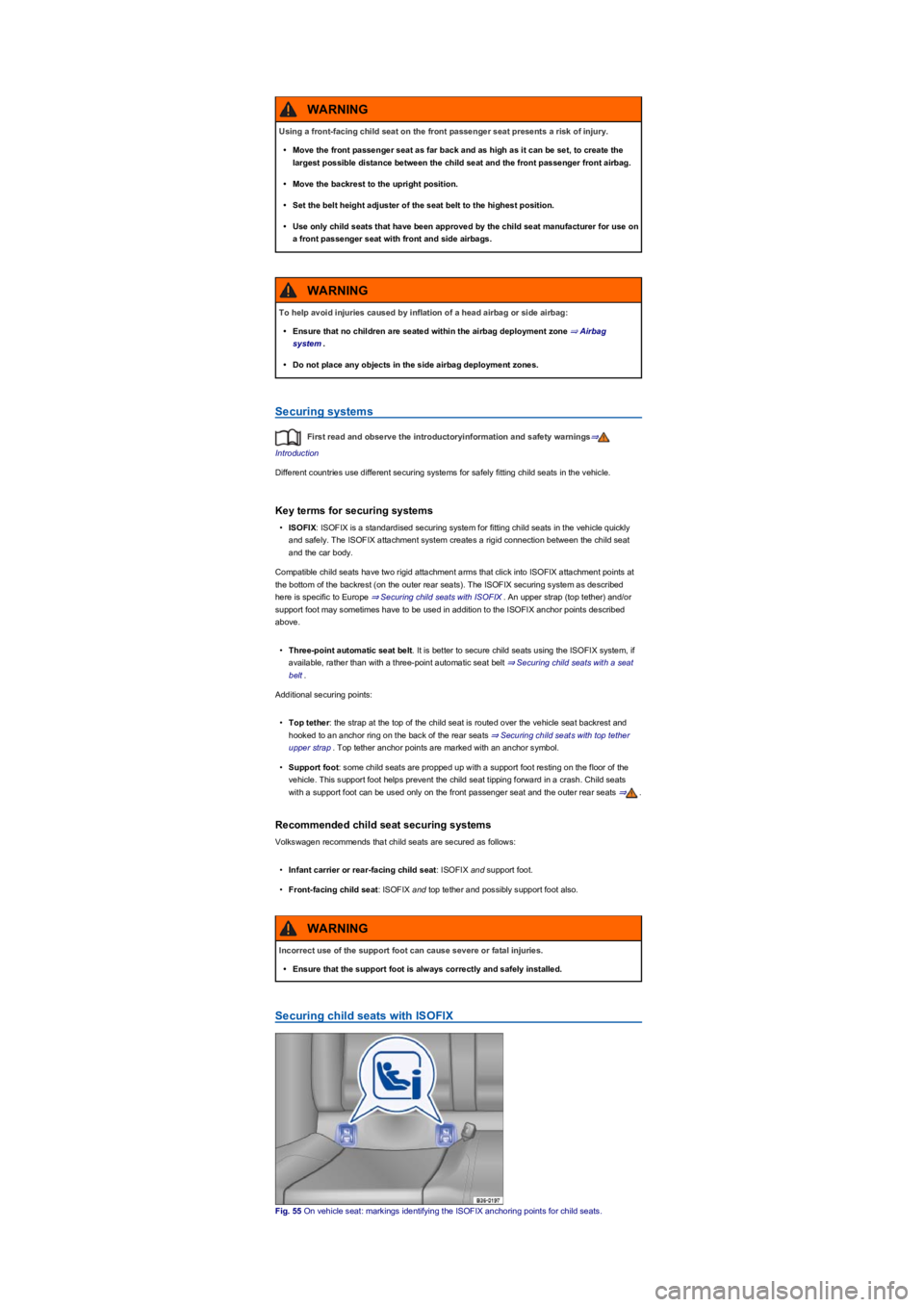
Fig. 55 On vehicle seat: markings identifying the ISOFIX anchoring points for child seats.
Using a front-facing child seat on the front passenger seat presents a risk of injury.
•Move the front passenger seat as far back and as high as it can be set, to create the
largest possible distance between the child seat and the front passenger front airbag.
•Move the backrest to the upright position.
•Set the belt height adjuster of the seat belt to the highest position.
•Use only child seats that have been approved by the child seat manufacturer for use on
a front passenger seat with front and side airbags.
WARNING
To help avoid injuries caused by inflation of a head airbag or side airbag:
•Ensure that no children are seated within the airbag deployment zone ⇒ Airbag
system.
•Do not place any objects in the side airbag deployment zones.
WARNING
Incorrect use of the support foot can cause severe or fatal injuries.
•Ensure that the support foot is always correctly and safely installed.
WARNING
Page 140 of 341
•m/k/a995MKVehicles with a starter button: Press the starter button briefly ⇒ Fig. 119. If
the engine cannot be switched off, carry out the emergency switch-off procedure ⇒ Emergency
deactivation.
•Observe the instructions in the instrument cluster ⇒ Instrument cluster.
Warning before leaving the vehicle
In order to indicate an active ignition when leaving the vehicle, an acoustic warning signal sounds
when opening the driver door and corresponding warning messages appear on the display of the
instrument cluster. The ignition also switches off automatically after a certain period in order to
prevent unintentional discharge of the 12-volt vehicle battery.
m/k/a995MK Vehicles with DSG dual clutch gearbox: if the selector lever is not in position P,
an acoustic warning signal will sound when the driver door is opened and the warning
message Please move selector lever to position P. will be shown on the instrument cluster
display. In this way, a warning is given that the vehicle could potentially roll away. The electronic
parking brake is also activated.
After the engine is switched off, the radiator fan in the engine compartment may run on for
some minutes, even if the ignition is switched off or the vehicle key has been removed. The radiator
fan will switch itself off automatically.
Electronic immobiliser
First read and observe the introductoryinformation and safety warnings⇒
Introduction
The immobiliser helps to prevent the engine from being started and driven with an unauthorised
vehicle key.
There is a chip in the key. This is used to automatically deactivate the immobiliser when a valid
vehicle key is inserted into the ignition lock.
The electronic immobiliser is automatically activated when the vehicle key is removed from the
ignition lock. In vehicles with keyless locking and starting system Keyless Access, the vehicle key
must be outside the vehicle ⇒ Central and manual locking.
The engine can only be started using a genuine Volkswagen vehicle key with the correct code.
Coded vehicle keys are available from a Volkswagen dealership ⇒ Vehicle key set.
The vehicle cannot be operated properly if you do not have a genuine Volkswagen key.
Troubleshooting
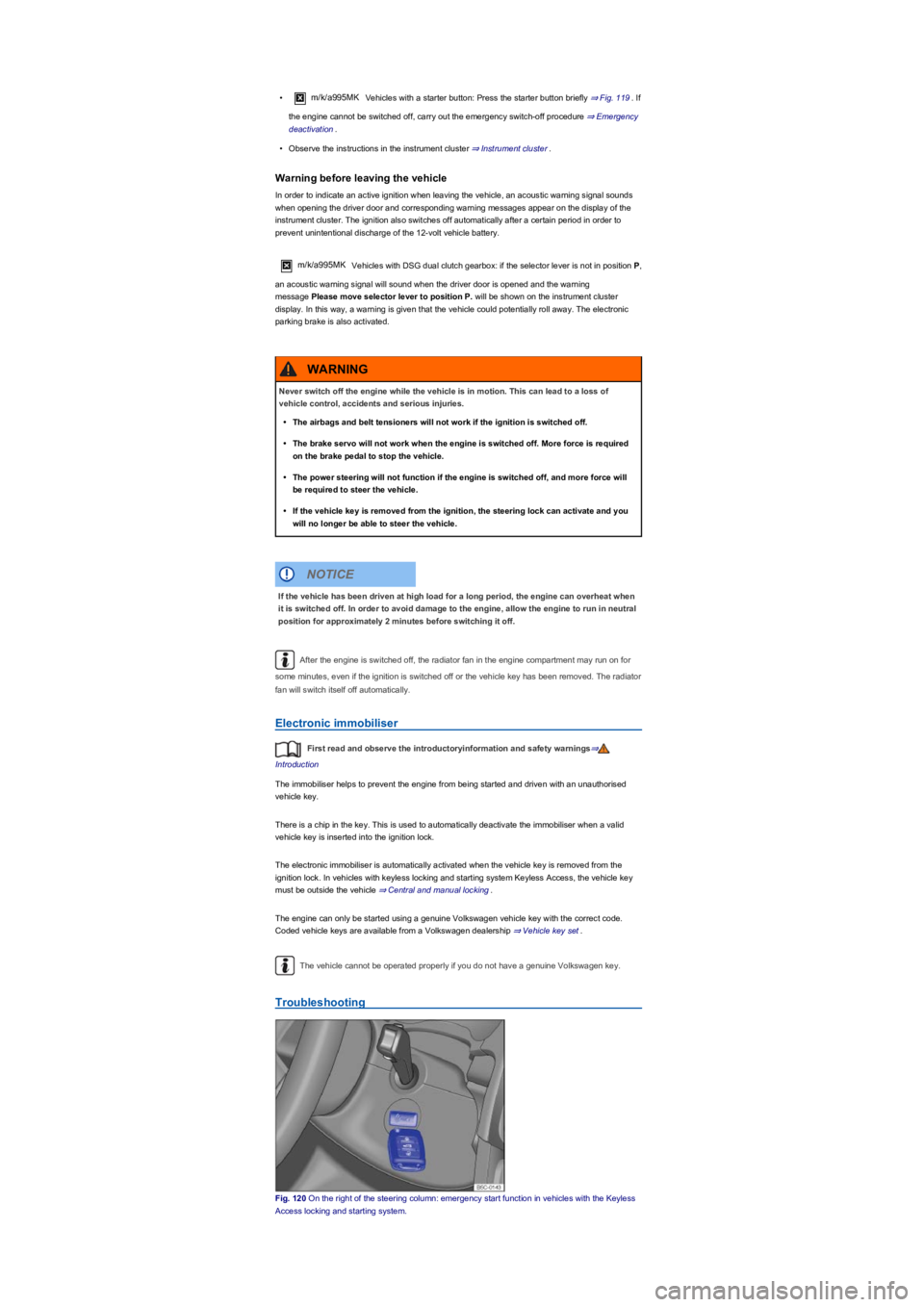
Fig. 120 On the right of the steering column: emergency start function in vehicles with the Keyless
Access locking and starting system.
Never switch off the engine while the vehicle is in motion. This can lead to a loss of
vehicle control, accidents and serious injuries.
•The airbags and belt tensioners will not work if the ignition is switched off.
•The brake servo will not work when the engine is switched off. More force is required
on the brake pedal to stop the vehicle.
•The power steering will not function if the engine is switched off, and more force will
be required to steer the vehicle.
•If the vehicle key is removed from the ignition, the steering lock can activate and you
will no longer be able to steer the vehicle.
WARNING
If the vehicle has been driven at high load for a long period, the engine can overheat when
it is switched off. In order to avoid damage to the engine, allow the engine to run in neutral
position for approximately 2 minutes before switching it off.
NOTICE
Page 194 of 341
Volkswagen recommends that drivers practise using the parking systems in a traffic-calmed
area or car park to allow them to familiarise themselves with the systems and their functions.
Park Distance Control
Introduction
This chapter contains information on the followingsubjects:
⇒ Switching on and off
⇒ Display representation
⇒ Settings
⇒ Troubleshooting
The Park Distance Control system
assists the driver when manoeuvring
and parking.
Park Distance Control detects the distance from an obstacle by means of sensors in the front and
rear bumpers ⇒ Vehicle overviews. If there is an obstacle in the detection range of the sensors, the
system indicates this on the Infotainment system and by means of signal tones.
System limits
The sensors may not always be able to detect objects such as trailer drawbars, thin rails, fences,
posts, trees, very low or high obstacles and open or opening boot lids.
In some cases, dirt and ice on the sensors could be registered as an obstacle.
Switching on and off
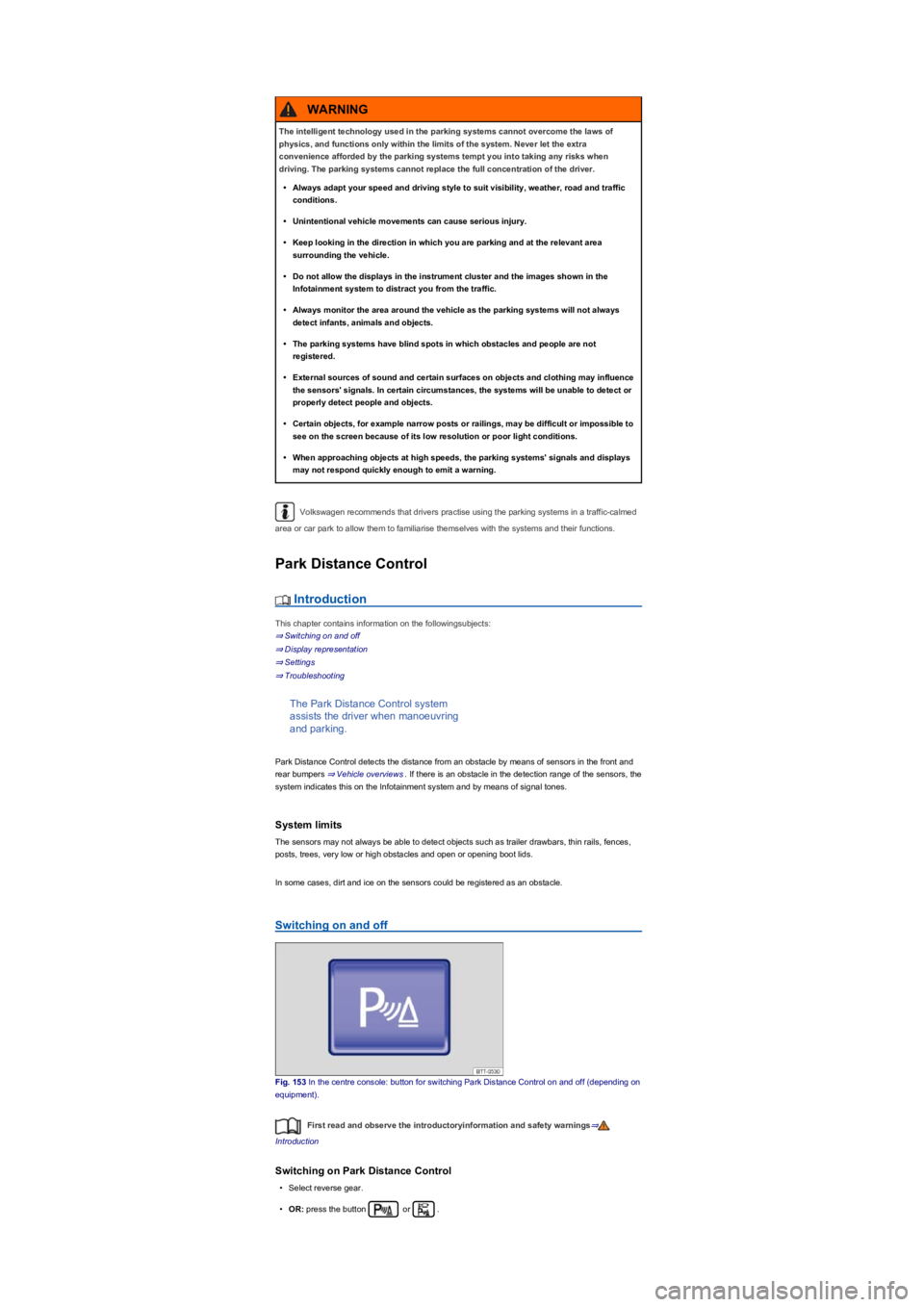
Fig. 153 In the centre console: button for switching Park Distance Control on and off (depending on
equipment).
First read and observe the introductoryinformation and safety warnings⇒
Introduction
Switching on Park Distance Control
•Select reverse gear.
•OR: press the button or .
The intelligent technology used in the parking systems cannot overcome the laws of
physics, and functions only within the limits of the system. Never let the extra
convenience afforded by the parking systems tempt you into taking any risks when
driving. The parking systems cannot replace the full concentration of the driver.
•Always adapt your speed and driving style to suit visibility, weather, road and traffic
conditions.
•Unintentional vehicle movements can cause serious injury.
•Keep looking in the direction in which you are parking and at the relevant area
surrounding the vehicle.
•Do not allow the displays in the instrument cluster and the images shown in the
Infotainment system to distract you from the traffic.
•Always monitor the area around the vehicle as the parking systems will not always
detect infants, animals and objects.
•The parking systems have blind spots in which obstacles and people are not
registered.
•External sources of sound and certain surfaces on objects and clothing may influence
the sensors' signals. In certain circumstances, the systems will be unable to detect or
properly detect people and objects.
•Certain objects, for example narrow posts or railings, may be difficult or impossible to
see on the screen because of its low resolution or poor light conditions.
•When approaching objects at high speeds, the parking systems' signals and displays
may not respond quickly enough to emit a warning.
WARNING
Page 249 of 341
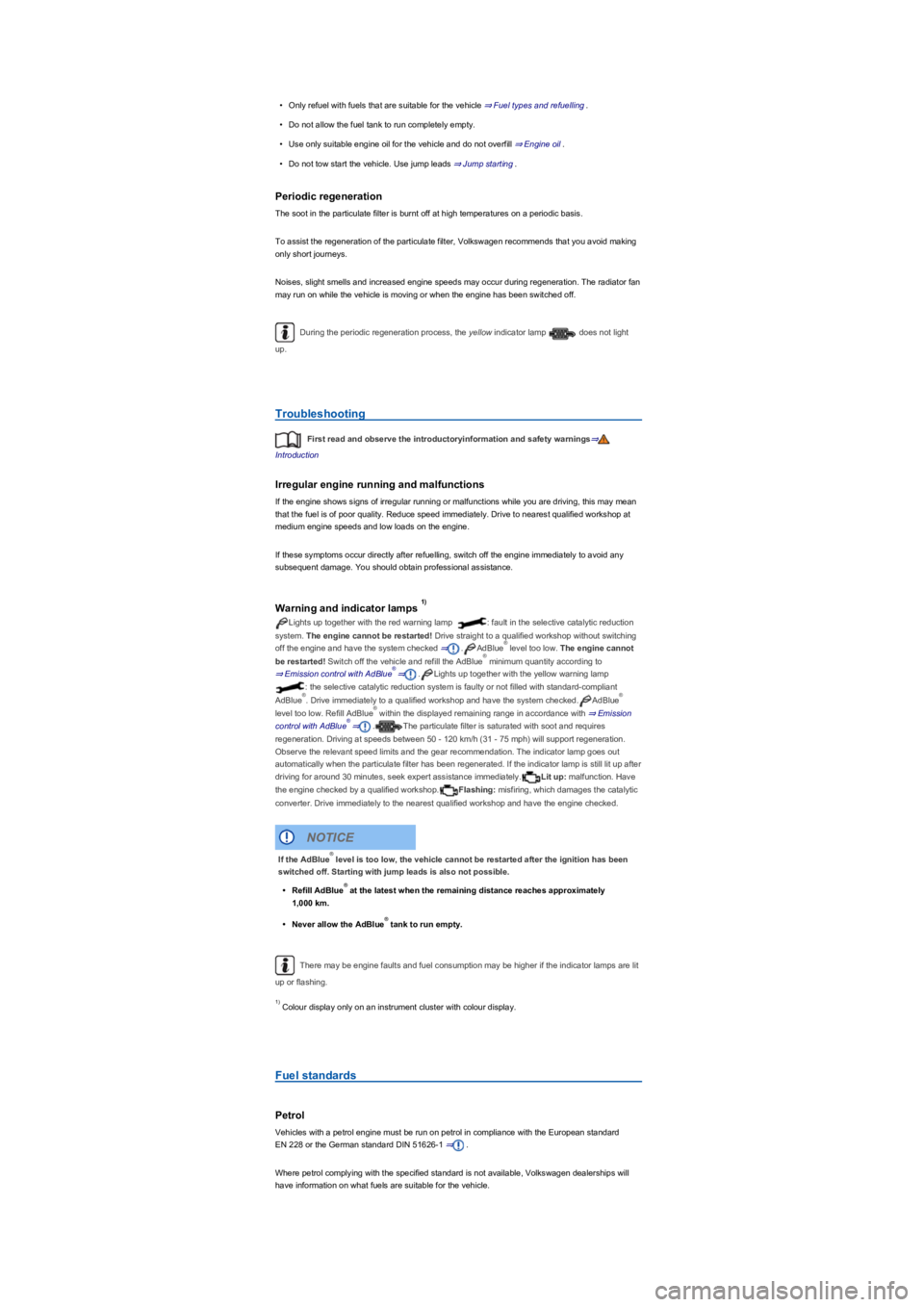
•Only refuel with fuels that are suitable for the vehicle ⇒ Fuel types and refuelling.
•Do not allow the fuel tank to run completely empty.
•Use only suitable engine oil for the vehicle and do not overfill ⇒ Engine oil.
•Do not tow start the vehicle. Use jump leads ⇒ Jump starting.
Periodic regeneration
The soot in the particulate filter is burnt off at high temperatures on a periodic basis.
To assist the regeneration of the particulate filter, Volkswagen recommends that you avoid making
only short journeys.
Noises, slight smells and increased engine speeds may occur during regeneration. The radiator fan
may run on while the vehicle is moving or when the engine has been switched off.
During the periodic regeneration process, the yellow indicator lamp does not light
up.
Troubleshooting
First read and observe the introductoryinformation and safety warnings⇒
Introduction
Irregular engine running and malfunctions
If the engine shows signs of irregular running or malfunctions while you are driving, this may mean
that the fuel is of poor quality. Reduce speed immediately. Drive to nearest qualified workshop at
medium engine speeds and low loads on the engine.
If these symptoms occur directly after refuelling, switch off the engine immediately to avoid any
subsequent damage. You should obtain professional assistance.
Warning and indicator lamps
Lights up together with the red warning lamp : fault in the selective catalytic reduction
system. The engine cannot be restarted! Drive straight to a qualified workshop without switching
off the engine and have the system checked ⇒.AdBlue level too low. The engine cannot
be restarted! Switch off the vehicle and refill the AdBlue minimum quantity according to
⇒ Emission control with AdBlue⇒.Lights up together with the yellow warning lamp
: the selective catalytic reduction system is faulty or not filled with standard-compliant
AdBlue. Drive immediately to a qualified workshop and have the system checked.AdBlue
level too low. Refill AdBlue within the displayed remaining range in accordance with ⇒ Emission
control with AdBlue⇒.The particulate filter is saturated with soot and requires
regeneration. Driving at speeds between 50 - 120 km/h (31 - 75 mph) will support regeneration.
Observe the relevant speed limits and the gear recommendation. The indicator lamp goes out
automatically when the particulate filter has been regenerated. If the indicator lamp is still lit up after
driving for around 30 minutes, seek expert assistance immediately.Lit up: malfunction. Have
the engine checked by a qualified workshop.Flashing: misfiring, which damages the catalytic
converter. Drive immediately to the nearest qualified workshop and have the engine checked.
There may be engine faults and fuel consumption may be higher if the indicator lamps are lit
up or flashing.
Colour display only on an instrument cluster with colour display.
Fuel standards
Petrol
Vehicles with a petrol engine must be run on petrol in compliance with the European standard
EN 228 or the German standard DIN 51626-1 ⇒.
Where petrol complying with the specified standard is not available, Volkswagen dealerships will
have information on what fuels are suitable for the vehicle.
1)
®
®
®
®®
®
®
If the AdBlue level is too low, the vehicle cannot be restarted after the ignition has been
switched off. Starting with jump leads is also not possible.
•Refill AdBlue at the latest when the remaining distance reaches approximately
1,000 km.
•Never allow the AdBlue tank to run empty.
NOTICE
®
®
®
1)
Page 273 of 341
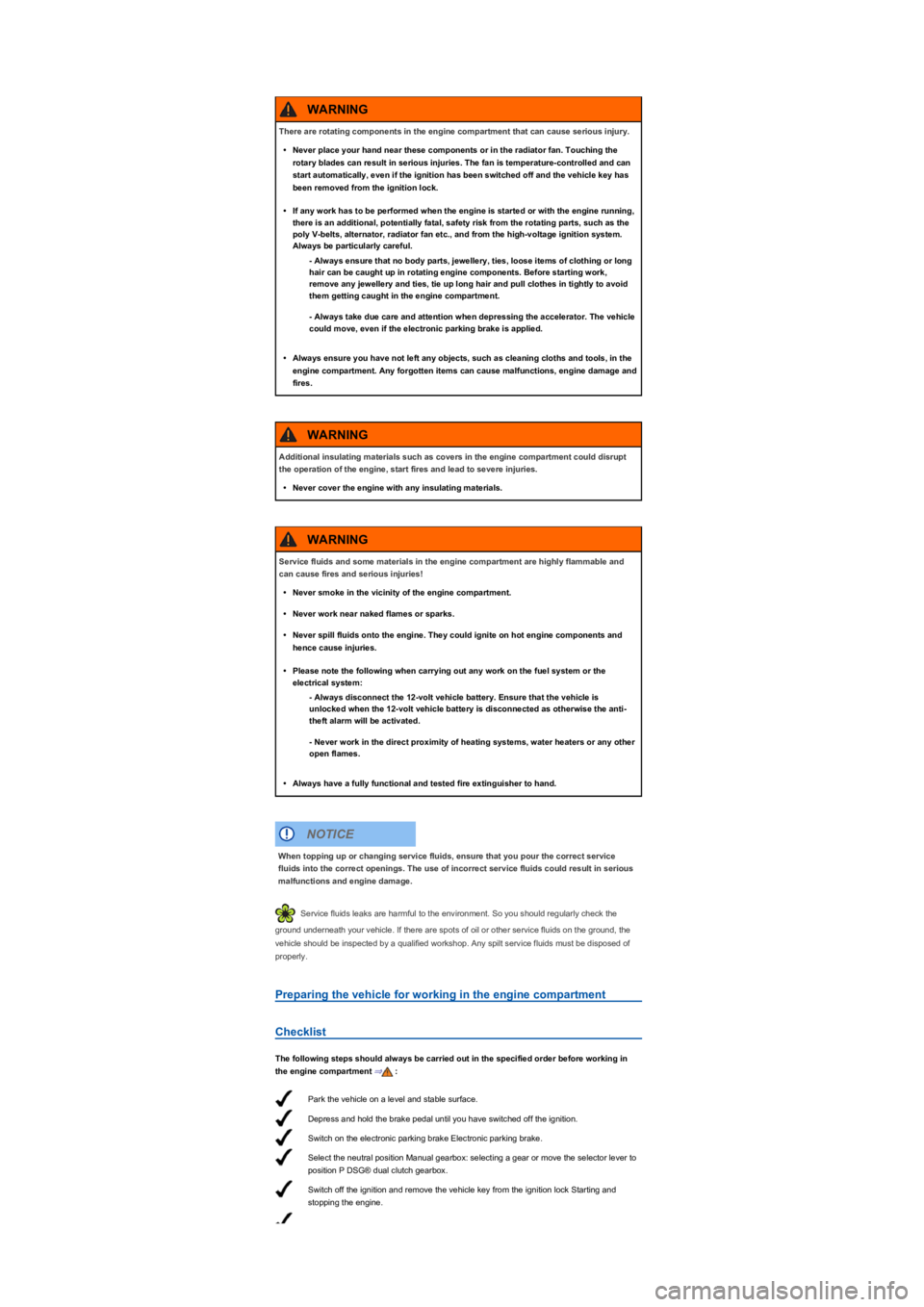
Park the vehicle on a level and stable surface.
Depress and hold the brake pedal until you have switched off the ignition.
Switch on the electronic parking brake Electronic parking brake.
Select the neutral position Manual gearbox: selecting a gear or move the selector lever to
position P DSG® dual clutch gearbox.
Switch off the ignition and remove the vehicle key from the ignition lock Starting and
stopping the engine.
Service fluids leaks are harmful to the environment. So you should regularly check the
ground underneath your vehicle. If there are spots of oil or other service fluids on the ground, the
vehicle should be inspected by a qualified workshop. Any spilt service fluids must be disposed of
properly.
Preparing the vehicle for working in the engine compartment
Checklist
The following steps should always be carried out in the specified order before working in
the engine compartment ⇒:
There are rotating components in the engine compartment that can cause serious injury.
•Never place your hand near these components or in the radiator fan. Touching the
rotary blades can result in serious injuries. The fan is temperature-controlled and can
start automatically, even if the ignition has been switched off and the vehicle key has
been removed from the ignition lock.
•If any work has to be performed when the engine is started or with the engine running,
there is an additional, potentially fatal, safety risk from the rotating parts, such as the
poly V-belts, alternator, radiator fan etc., and from the high-voltage ignition system.
Always be particularly careful.
- Always ensure that no body parts, jewellery, ties, loose items of clothing or long
hair can be caught up in rotating engine components. Before starting work,
remove any jewellery and ties, tie up long hair and pull clothes in tightly to avoid
them getting caught in the engine compartment.
- Always take due care and attention when depressing the accelerator. The vehicle
could move, even if the electronic parking brake is applied.
•Always ensure you have not left any objects, such as cleaning cloths and tools, in the
engine compartment. Any forgotten items can cause malfunctions, engine damage and
fires.
WARNING
Additional insulating materials such as covers in the engine compartment could disrupt
the operation of the engine, start fires and lead to severe injuries.
•Never cover the engine with any insulating materials.
WARNING
Service fluids and some materials in the engine compartment are highly flammable and
can cause fires and serious injuries!
•Never smoke in the vicinity of the engine compartment.
•Never work near naked flames or sparks.
•Never spill fluids onto the engine. They could ignite on hot engine components and
hence cause injuries.
•Please note the following when carrying out any work on the fuel system or the
electrical system:
- Always disconnect the 12-volt vehicle battery. Ensure that the vehicle is
unlocked when the 12-volt vehicle battery is disconnected as otherwise the anti-
theft alarm will be activated.
- Never work in the direct proximity of heating systems, water heaters or any other
open flames.
•Always have a fully functional and tested fire extinguisher to hand.
WARNING
When topping up or changing service fluids, ensure that you pour the correct service
fluids into the correct openings. The use of incorrect service fluids could result in serious
malfunctions and engine damage.
NOTICE
Page 324 of 341
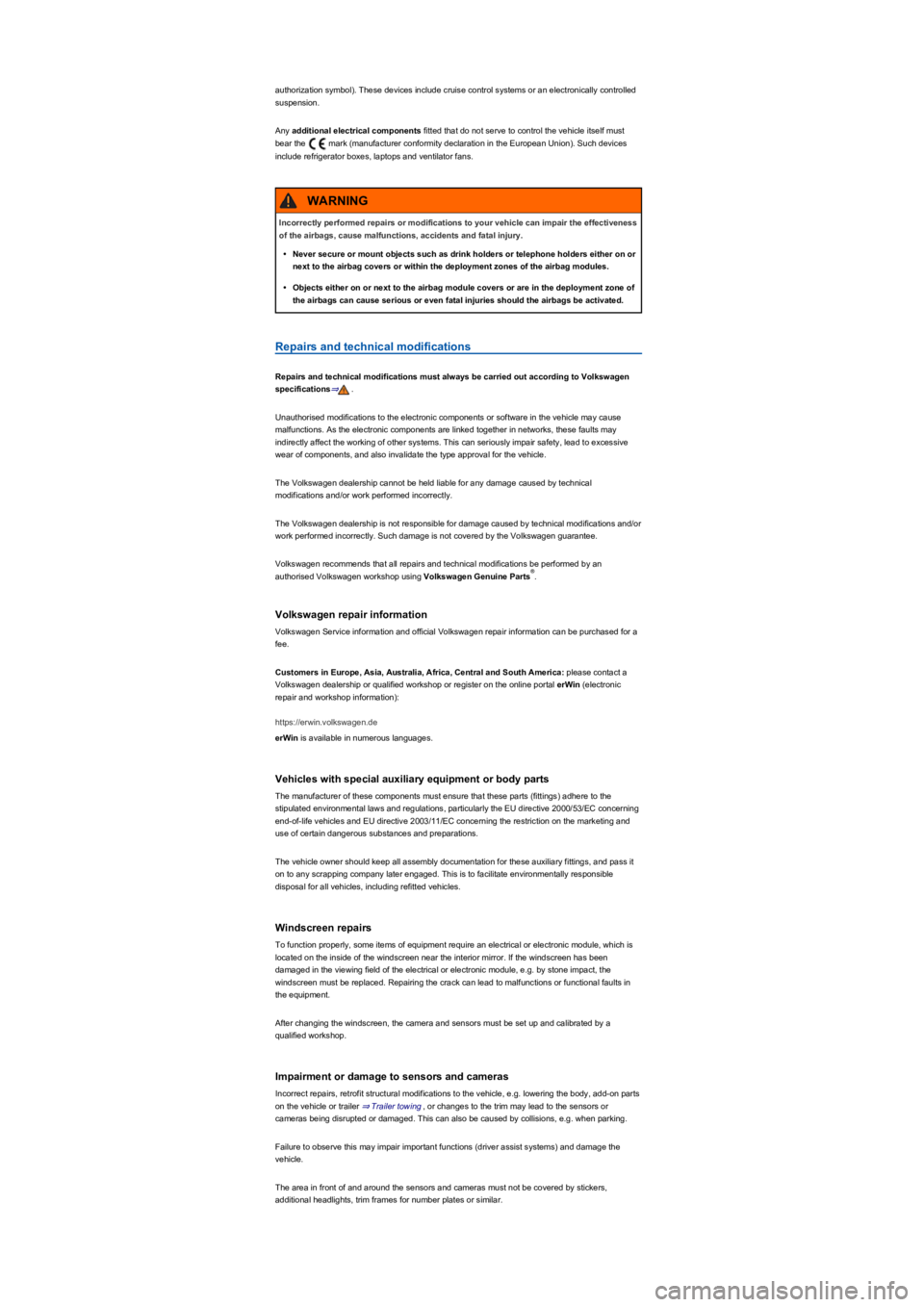
authorization symbol). These devices include cruise control systems or an electronically controlled
suspension.
Any additional electrical components fitted that do not serve to control the vehicle itself must
bear the mark (manufacturer conformity declaration in the European Union). Such devices
include refrigerator boxes, laptops and ventilator fans.
Repairs and technical modifications
Repairs and technical modifications must always be carried out according to Volkswagen
specifications⇒.
Unauthorised modifications to the electronic components or software in the vehicle may cause
malfunctions. As the electronic components are linked together in networks, these faults may
indirectly affect the working of other systems. This can seriously impair safety, lead to excessive
wear of components, and also invalidate the type approval for the vehicle.
The Volkswagen dealership cannot be held liable for any damage caused by technical
modifications and/or work performed incorrectly.
The Volkswagen dealership is not responsible for damage caused by technical modifications and/or
work performed incorrectly. Such damage is not covered by the Volkswagen guarantee.
Volkswagen recommends that all repairs and technical modifications be performed by an
authorised Volkswagen workshop using Volkswagen Genuine Parts.
Volkswagen repair information
Volkswagen Service information and official Volkswagen repair information can be purchased for a
fee.
Customers in Europe, Asia, Australia, Africa, Central and South America: please contact a
Volkswagen dealership or qualified workshop or register on the online portal erWin (electronic
repair and workshop information):
https://erwin.volkswagen.de
erWin is available in numerous languages.
Vehicles with special auxiliary equipment or body parts
The manufacturer of these components must ensure that these parts (fittings) adhere to the
stipulated environmental laws and regulations, particularly the EU directive 2000/53/EC concerning
end-of-life vehicles and EU directive 2003/11/EC concerning the restriction on the marketing and
use of certain dangerous substances and preparations.
The vehicle owner should keep all assembly documentation for these auxiliary fittings, and pass it
on to any scrapping company later engaged. This is to facilitate environmentally responsible
disposal for all vehicles, including refitted vehicles.
Windscreen repairs
To function properly, some items of equipment require an electrical or electronic module, which is
located on the inside of the windscreen near the interior mirror. If the windscreen has been
damaged in the viewing field of the electrical or electronic module, e.g. by stone impact, the
windscreen must be replaced. Repairing the crack can lead to malfunctions or functional faults in
the equipment.
After changing the windscreen, the camera and sensors must be set up and calibrated by a
qualified workshop.
Impairment or damage to sensors and cameras
Incorrect repairs, retrofit structural modifications to the vehicle, e.g. lowering the body, add-on parts
on the vehicle or trailer ⇒ Trailer towing, or changes to the trim may lead to the sensors or
cameras being disrupted or damaged. This can also be caused by collisions, e.g. when parking.
Failure to observe this may impair important functions (driver assist systems) and damage the
vehicle.
The area in front of and around the sensors and cameras must not be covered by stickers,
additional headlights, trim frames for number plates or similar.
Incorrectly performed repairs or modifications to your vehicle can impair the effectiveness
of the airbags, cause malfunctions, accidents and fatal injury.
•Never secure or mount objects such as drink holders or telephone holders either on or
next to the airbag covers or within the deployment zones of the airbag modules.
•Objects either on or next to the airbag module covers or are in the deployment zone of
the airbags can cause serious or even fatal injuries should the airbags be activated.
WARNING
®