wheel VOLKSWAGEN TRANSPORTER 1990 T4 / 4.G Owner's Guide
[x] Cancel search | Manufacturer: VOLKSWAGEN, Model Year: 1990, Model line: TRANSPORTER, Model: VOLKSWAGEN TRANSPORTER 1990 T4 / 4.GPages: 165, PDF Size: 24.87 MB
Page 95 of 165
Downloaded from www.Manualslib.com manuals search engine
VEHICLE
CARE
EXTERIOR
Washing
and
waxing
The
paint on your Volkswagen is very dura ble but must be protected
from
losing its
luster due to outside influences. There
fore, wash and wax your Volkswagen
often. The longer the
dirt
is
left
on the paint, the greater the risk of damaging the
glossy
finish, either by scratching if the
dirt
is
rubbed
into
the paint, or simply by the
chemical
effect
dirt
particles have on the paint surface.
Do not
wash
or wax in
direct
sunlight,
or
when
the
sheet
metal
is hot. Do not use hot
water.
Lukewarm
to cool
water
is
kinder
to the
paint.
WARNING
•
Do not
wash,
wax or dry the
vehicle
with
the
engine
running.
•
Do not
clean
the
underside
of chas
sis,
fenders,
wheel
covers, etc.,
without
protecting
your
hands
and
arms.
You
may cut
yourself
on
sharp-edged
metal
parts.
•
Moisture,
ice and
road
salt
on
brakes
may
affect
braking
efficiency.
Test
the
brakes
carefully
after
each
vehicle
wash.
Do
not aim the water jet directly at door,
hatch or rear lid locks. Tape the key holes
to prevent water
from
seeping
into
the lock
cylinders.
Water in lock cylinders should be removed
with
compressed air. To pre
vent locks
from
freezing in the winter, squirt glycerine or lock de-icer
into
the lock
cylinders.
Do not use any
solution
that
can
damage
the
body
paint.
Use
plenty of water, a car-wash and wax
solution and a soft sponge or hose brush.
Begin
by spraying water over the dry sur
face
to remove all loose
dirt
before apply ing the car-wash and wax solution. Use
plenty of water to rinse the vehicle off.
Wipe
everything dry
with
a chamois to avoid water spots.
When
having your vehicle washed at an automatic car
wash,
be sure to observe all
the precautions suggested by the
esta
blishment.
The
underside of the vehicle picks up d ~
and road salt. To guard against corrosic it is important to remove mud, debris a":
road salt
from
the underside
with
i
powerful jet of water. Be sure to include t"
wheel housings, bumpers, muffler, tailp :- and brackets. This should be done twice
year
and is best accomplished after the \ hide has been driven through a hea
rain.
Let engine and exhaust cool do,"
before washing.
Waxing
is not really needed when y:.
have
used a car-wash and wax solution
you do not use a car-wash liquid
with
wa^ apply wax to preserve the natural shine :
the body paint. To obtain a long last-:
finish,
apply hard wax. Wax again whe
water remains on the surface in lar:-
patches
instead of forming beads a": rolling off.
This
will
make
dirt
easier to remove e :
will
prevent the paint
from
being damage:
from
industrial dust, tree sap or bird drz~-
pings.
Use
a polish when it becomes evident tha:
waxing no longer accomplishes the jot
the polish you are using does not conta
wax, apply hard wax after polishing.
www.westfaliaT3.info - a useful website for owners and enthusiasts of VW Westfalia T25 / T3 Campervans
Page 97 of 165
Downloaded from www.Manualslib.com manuals search engine
VEHICLE
CARE
Weatherstrips
Keep silicone sprays
off the
windshield
to avoid wiper smear
in
rain.
To seal properly, weatherstrips around
hood,
hatch, windows, doors,
etc.,
must
be pliable. Spray with silicone
or
coat with
talcum powder
or
glycerine
to
retain
flexibility
of the
rubber
and to
protect against freezing
in the
winter.
Sliding roof quide rails
To assure that
the
sliding roof* function properly, clean
the
guide rails
and
lubri
cate with silicone spray
at
least once
a
year.
See
your Volkswagen dealer
for
cor rect procedures
and
lubricant.
Dull finishes and plastics
Plastic parts, such
as
light bulb lenses,
decorative stripes, panels, bumpers,
etc.,
will come clean with regular washing. Should additional cleaning
or
spot
re
moval
be
necessary,
use a
soft brush
or
cloth soaked with
a
mild detergent
solu
tion.
Then rinse thoroughly
and im
mediately with clear water.
Do not use anything which could mar the
plastic
or
dull finished surface, such
as
wax, polish, abrasive detergents
or
chemical cleaning solvents.
Sliding door
The sliding door mounting points,
the
guide tracks
and the
roller guides should be lubricated regularly
and as
often
as
necessary.
Bright metal trim
Bright
or
black anodized trim will come
clean with regular washing.
To
protect metal
trim,
use car
wax. Remove spots
or
dirt from chrome
and
stainless steel with
a
chrome cleaner. Apply
a
chrome polish
for
continued luster and protection.
Steel wheels
Always include
the hub
caps
and
whee rims when washing your vehicle
to
remove
road dirt, salt sprays and brake dust.
If
nec
essary,
use a
commercial wheel cleaner
t:
remove accumulated brake dust. Pain:
scratches should
be
touched
up to
prever
corrosion.
Light alloy wheels
To preserve
the
decorative appearance
c-
the light aluminium cast, some specie
care
is
necessary.
In
addition
to
road
dr
and salt sprays, brake metal dust
is
alsc
corrosive.
If
left
on too
long,
brake meta
dust
can
cause pitting. Wash
the
wheels
with
a
sponge
or
hose brush every othe-
week. Road salt should
be
remove:
weekly with
an
acid free cleaning solutior Every three months (after regular clear
ing)
the
wheels should
be
coated
wit-
petroleum jelly
or car
wax.
Rub it in
firml.
with
a
soft cloth. Never
use
abrasive
c
metal polishing cleaning agents.
Remember that moisture,
ice and
roac
salt
on
brakes
may
affect braking
eff
ciency. Test
the
brakes carefully afte'
each washing. Heed warning
on
page
29.
92
*
where applicable
www.westfaliaT3.info - a useful website for owners and enthusiasts of VW Westfalia T25 / T3 Campervans
Page 101 of 165
Downloaded from www.Manualslib.com manuals search engine
VEHICLE CARE
Important
Consideration
for you and your car:
A
thorough and detailed preventive maintenance schedule has been de
veloped
for your vehicle, which if followed
should
help assure you of years of reliable
and
dependable use. We strongly urge
you to give your dealer the opportunity to perform all scheduled maintenance and
necessary
repairs. He has the facilities,
original parts and trained specialists to
keep
your car running properly.
The
increasing use of electronics, sophisti
cated
fuel injection and emission control
systems
together
with
the generally in
creasing
technical complexity of today's automobiles has steadily reduced the
scope
of maintenance and repairs which
can
be carried out by vehicle owners.
Maintenance,
adjustments and repairs
usually
require special tools, testing de
vices
and other equipment by specially
trained workshop personnel in order to as
sure
proper performance, reliability and
safety of the vehicle and its many
sys
tems.
Improper maintenance, adjust ments and repairs can impair the opera
tion and reliability of your car and even
void your vehicle warranty. Above all oper ational safety can be adversely affected
creating unnecessary risks for vehicle oc
cupants and others.
This
section describes a limited number of
procedures
which can be performed upon
your vehicle
with
ordinary tools, should the
need
arise and trained personnel be un
available.
Before performing any of these
procedures,
always thoroughly read all of
the applicable
text
and carefully follow the instructions given. Always rigorously ob
serve
the
WARNINGS
provided.
WARNING
Serious personal
injury
may occur as a
result
of
improperly
performed
main
tenance,
adjustments
or
repairs.
• The
engine
compartment
of any
motor
vehicle
is a
potentially
hazard
ous
area.
• Do not
attempt
any of the
mainten
ance, checks or
repairs
described on
the
following
pages if you are not
fully
familiar
with
these
or
other
procedures
with
respect
to the vehicle, or are un
certain
as to how to proceed.
Have
the necessary
work
done
by your Volks
wagen
dealer
or any
other
properly
equipped
and
qualified
workshop.
•
Always support
your
vehicle
with
safety
stands if it is necessary to
work
underneath
the vehicle. The
jack
supplied
with
the
vehicle
is not
adequate
for
this
purpose. • If you
must
work
underneath
the . =-
hide
without
safety
stands but
with
t--t
wheels
on the ground,
always
ma-: sure the
vehicle
is on
level
ground, tr:
the
wheels
are
always
securely bloc ed and
that
the
engine
cannot
•
started.
Always
remove
the
ignitio-
key.
•
Always
be
extremely
careful
whe-
working
on the vehicle.
Always
folic commonly accepted
safety
practice*
and
general
common sense.
Never
ris• personal
injury.
Note
Incomplete or improper servicing ri
cause
problems in the operation of the r-
hicle
and may reduce or eliminate y;.
warranty coverage. If in doubt about a-
servicing,
have it done by your
Volks/
E-
gen
dealer or any other properly equips
and
qualified workshop.
www.westfaliaT3.info - a useful website for owners and enthusiasts of VW Westfalia T25 / T3 Campervans
Page 119 of 165
Downloaded from www.Manualslib.com manuals search engine
VEHICLE CARE
TIRES/WHEELS
New tires
New
tires
do not
possess
maximum trac
tion
and
should
be
driven
at
moderate
speeds
and
with
caution
for the
first
100
miles (160 kilometers).
Tire traction
WARNING
When driving on wet or slushy roads, a wedge of
water
may build up
between
the tires and the road. This phenome non is known as aquaplaning or hydro
planing and may cause
partial
or
com
plete
loss
of traction, vehicle control or
stopping ability. Always reduce speed
on
wet roads.
Tire service life
The service
life
of
your tires depends
for
the most
part
on the following factors:
Tire pressures
WARNING
•
Incorrect
tire
pressures cause
increased
tire
wear
and adversely
affect
road holding of the vehicle, lead ing to
loss
of control and personal
injury.
•
Incorrect
tire
pressures can also
lead to
sudden
deflation, resulting
in
an
accident and personal injury.
Check
your
tire
pressures twice
a
month,
and especially before taking
a
long
trip.
Be
sure
not to
forget
to
check
the
spare tire.
Always check
tire
pressures when the tires are cold. When
the
tires
are
warm,
the
pressure
will
be
higher.
Do not
reduce
the
pressure
of
warm tires.
Use
an accurate
tire
pressure gauge when
checking inflation pressures.
Do not
exceed
the
maximum
tire
inflation pres sure listed
on the
tire
sidewalk Cold
tire
inflation pressure means: when
a
vehicle
has
been standing
for at
least
3
hours
or
driven
for
less than 1 mile.
Always include the spare
tire
during
a
pres sure check.
Driving habits
Fast
cornering, heavy acceleration
and
hard braking all increase
tire
wear.
Wheel balancing
The
front
wheels
on new
vehicles
are
balanced.
When driving, however, various
conditions can cause
a
wheel
to
become
unbalanced.
This may
be
noticed as vibra
tions
in the
steering.
Since
tire
imbalance
can
cause wear
or
the steering, suspension
and
tires,
you
should have your wheels rebalanced.
A
wheel should always
be
balanced
if a
nev,
tire
has
been mounted
or a
tire
was re
paired.
114
www.westfaliaT3.info - a useful website for owners and enthusiasts of VW Westfalia T25 / T3 Campervans
Page 120 of 165
Downloaded from www.Manualslib.com manuals search engine
VEHICLE CARE
K >i
|B43-155|
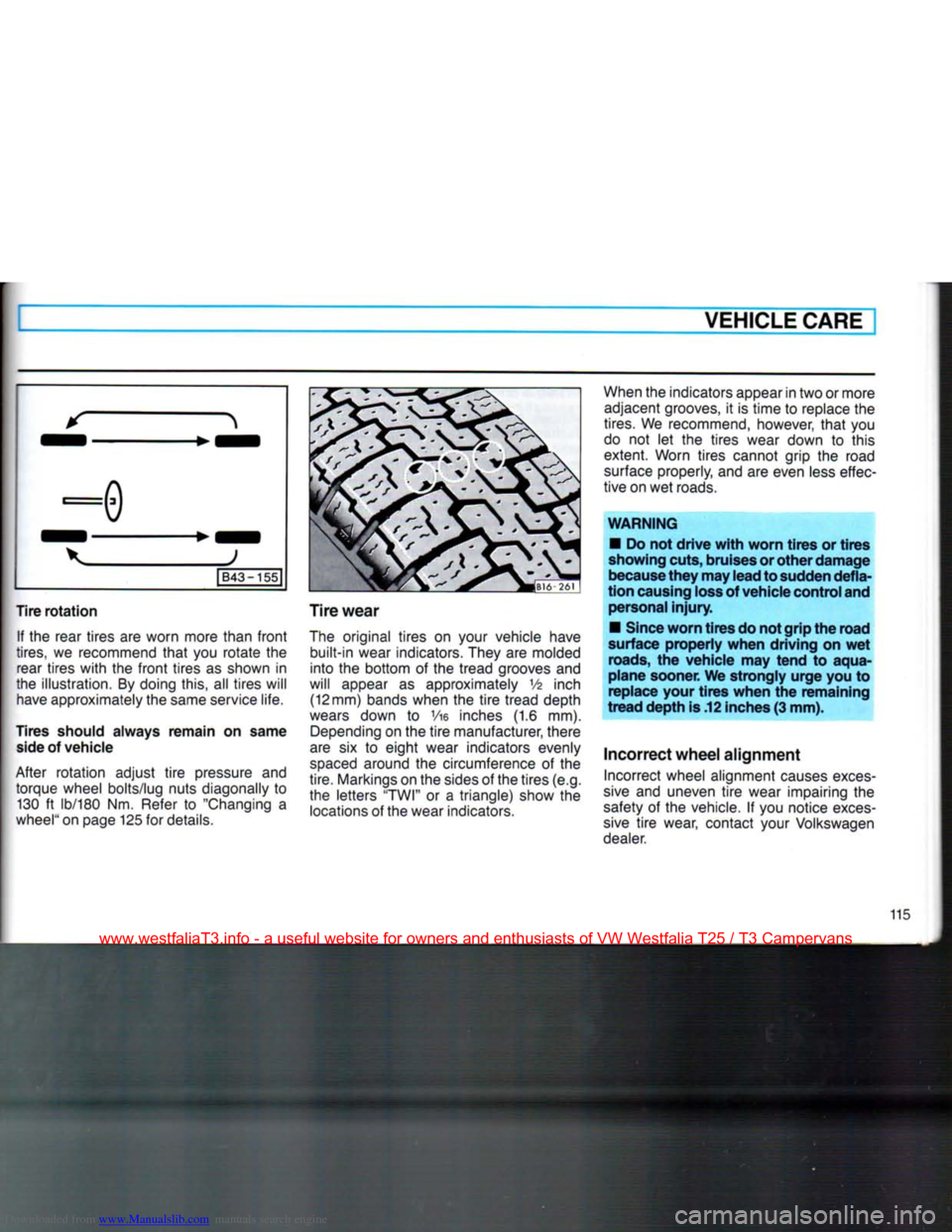
Tire rotation If the
rear tires
are
worn more than
front
tires,
we
recommend
that
you
rotate
the
rear tires
with
the
front
tires
as
shown
in
the illustration.
By
doing this,
all
tires will
have
approximately the same service life.
Tires
should always remain on same
side
of vehicle
After rotation adjust
tire
pressure
and
torque wheel bolts/lug nuts diagonally
to
130
ft
lb/180
Nm.
Refer
to
"Changing
a
wheel"
on page 125
for
details.
Tire
wear
The
original tires
on
your vehicle have
built-in wear indicators. They
are
molded
into
the
bottom
of the
tread grooves
and
will appear
as
approximately
V6
inch (12 mm) bands when
the
tire
tread depth
wears
down
to Vie
inches
(1.6 mm).
Depending
on the
tire
manufacturer, there
are
six to
eight wear indicators evenly
spaced
around
the
circumference
of the
tire. Markings on the sides
of
the tires (e.g.
the letters "TWI"
or a
triangle) show
the
locations
of
the wear indicators.
When
the indicators appear in two
or
more
adjacent grooves,
it is
time
to
replace
the
tires.
We
recommend, however,
that
you
do
not let the
tires wear down
to
this
extent. Worn tires cannot grip
the
road
surface
properly, and are even
less
effec
tive on wet roads.
WARNING
•
Do not drive
with
worn tires or tires
showing
cuts,
bruises
or other damage
because
they may lead to
sudden
defla
tion
causing
loss
of
vehicle
control
and
personal
injury.
•
Since
worn tires do not grip the road
surface
properly when driving on wet
roads,
the vehicle may tend to aqua
plane sooner. We strongly urge you to
replace your tires when the remaining
tread depth is .12
inches
(3 mm).
Incorrect
wheel
alignment
Incorrect wheel alignment
causes
exces
sive
and
uneven
tire
wear impairing
the
safety
of the
vehicle.
If
you notice
exces
sive
tire
wear, contact your Volkswagen
dealer.
115
www.westfaliaT3.info - a useful website for owners and enthusiasts of VW Westfalia T25 / T3 Campervans
Page 121 of 165
Downloaded from www.Manualslib.com manuals search engine
VEHICLE CARE
Tire
care
Inspect your tires at least every 2,000
miles (3,000 km) for wear and damage.
WARNING
• Avoid
damaging
tires
and
wheel
rims.
If you
must
drive
over
a
curb
or
other
obstacle,
drive
slowly
and at an
angle.
Frequently
check
tires
for un
even
wear
and
damage.
•
Remove
imbedded
material.
•
Replace
worn
or
damaged
tires
immediately.
•
Replace
missing
valve
dust
caps.
• Keep oil,
fuel,
brake
fluid,
etc.
away
from
tires.
• Keep
tires
inflated
correctly.
• Mark tires before removing them.
Remount tires on the same vehicle side
because
the rotation direction should stay
the same.
• Store removed tires in a
cool,
dry and
preferably dark place. Tires which are not
on wheels should be stored standing up.
Tires
age even if they are not being
used.
Tires
which are older than 6 years should only be used cautiously in an emergency.
Wheels
and
tire
replacement
Wheels
and tires approved by the manu
facturer have been specially matched to
your vehicle and contribute largely to the road-holding and driving characteristics of
the vehicle.
• Fitting and repairing tires requires
expert knowledge and special tools. This
work should only be performed by a
spe
cialist.
• For safety reasons, tires should be
replaced
in pairs and not individually. The
tires
with
the deepest tread should always be mounted on the
front
wheels.
• In the interest of maximum safety and
best all-around vehicle handling, always
buy replacement radial tires
that
have the
same
specifications
with
regard to
tire
size,
design, load carrying capacity, tread pattern, tread depth etc. This also applies
to Volkswagen recommended alternate replacement tires.
• Never mount used tires if you are not
sure of their previous history.
• Whenever replacing a tubeless tire,
always install a new valve stem. Tire repair
should only be performed by a specialist.
WARNING
•
Never
mix
tires
of
different
design
such as
steel
belted
radials
with
radial
bias
belted
or
bias
ply
tires
etc.
Mixing
tire
types
will
adversely
affect
road
holding
and can
lead
to loss of
vehicle
control
and
personal
injury.
• New
tires
do not possess
maximum
traction.
They
tend
to be
slippery.
Break
new
tires
in by
driving
cautiously
at
moderate
speed for the
first
100
miles
(160
kilometers).
Applies
additionally
to the Syncro:
All
four wheels on the vehicle must always have tires of the same
size,
construction
and tread type so
that
the viscous coupling
does
not abnormally activate the
front
wheel drive. Different tires on the
front
or rear wheels exert additional stress on the
drive
train
components, causing increa
sed
tire
wear and impair vehicle control.
www.westfaliaT3.info - a useful website for owners and enthusiasts of VW Westfalia T25 / T3 Campervans
Page 122 of 165
Downloaded from www.Manualslib.com manuals search engine
VEHICLE
CARE
General notes
The original equipment tires
and
wheel
rims
on
your
vehicle comply with
all
applicable
Federal Motor Vehicle Safety
Standards.
If you
wish
to
equip
your
vehicle with tires
or wheels other than those installed
at the
factory, please note
the
following:
•
If
you plan
to
install other than the
ori
ginal
equipment tires
and
wheel rims,
ask
your
Volkswagen dealer.
•
For
technical reasons
it is not
possi
ble
in
every
case
to use
wheels from
other vehicles
-
under certain condi
tions
not
even wheels from
the
same
vehicle
model.
•
Wheel rims
and
wheel bolts
or lug
nuts are matched to fit
your
Volkswagen.
•
When installing different wheels
(for
example,
wheels with winter tires),
the
correct wheel bolts
or
lug nuts with
the
proper length
and
conical shape must
be used. The secure fit of the wheels and
the proper functioning
of the
brake system are dependent upon this.
•
Using tires and/or wheels which have
not been approved
by
the manufacturer
for
your
vehicle
type
can be detrimental
to vehicle safety.
•
If
wheel trim discs
or a
front
spoiler
are
installed,
make
sure the airflow for cooling
the brakes
is not
obstructed.
•
Before
you
plan
on
exchanging steel
wheels, light alloy wheels,
or
snow tires
already mounted on wheel rims, consult
your
Volkswagen dealer. He has the tech
nical
information necessary
to
advise
you which wheel rims and wheel bolts
or
lug
nuts are compatible with the original
factory installations.
WARNING
•
The
use of the wheel rims and wheel
bolts
or
lug nuts that do not meet
speci
fications
of the
original factory
install
ed equipment will affect the safe oper
ation
of
your
vehicle and may cause an
accident and personal
injury.
Tire specifications
Tire
specifications
are
imprinted
on the
sidewall
of
the tires.
If in
doubt, check with
your
Volkswagen dealer.
All
passenger car and some light trucks tires must conform
to
Federal Safety
Requirements
in
addition
to
these
grades.
Treadwear
The treadwear grade
is a
comparative
rating
based
on the
wear rate
of the
tire
when tested
on a
government test course. For example,
a
tire graded
150
would wear
one
and a
half
(IV2)
times
as
well
as a
tire
graded 100.
The
relative performance
of
tires depends
on
actual conditions
of use,
however,
and may
depart significantly
from
the
norm
due to
variations
in
driving
habits,
service practices
and
differences
in road characteristics and
climate.
Traction A, B, C
The traction grades, from highest
to
lowest,
are A, B and C and
represent
the
tire's ability
to
stop
on wet
pavement
as
measured
on
government test surfaces
of
asphalt
and concrete. Atire marked
C
may
have poor traction performance.
www.westfaliaT3.info - a useful website for owners and enthusiasts of VW Westfalia T25 / T3 Campervans
Page 123 of 165
Downloaded from www.Manualslib.com manuals search engine
VEHICLE CARE
WARNING
The
traction
grade
is based on
brak
ing
(straightahead)
traction
tests
and
does not
include
cornering
(turning)
traction.
Temperature
A, B, C
The temperature grades A (the highest), B and C, represent the tire's resistance to the
generation of heat. Sustained high temperatures can reduce
tire
life, and lead to
sudden
tire
failure. Grade C corresponds
to a performance which all passenger car
tires must meet under the Federal Motor
Vehicle
Safety Standard No. 109.
Grades
B
and A represent higher levels than the minimum required by law.
WARNING
The
temperature
grade
for
this
tire
is
established
for a
tire
that
is
properly
inflated
and not
overloaded.
Excessive
speed,
underinflation,
or excessive loading,
either
separately
or in combi
nation,
can cause
heat
buildup,
possi
ble
tire
failure,
loss of
control
and
per
sonal
injury.
Snow
tires
The tires for your vehicle were selected for optimal performance under normal driving
conditions.
For
winter driving, the roadability of your
vehicle can be improved by installing all
season
tires or radial snow tires (M + S)
with
or
without
studs1).
That applies also to the Syncro - see page 78.
When installing snow tires, please note the following:
• Only radial ply snow tires must be
installed.
Ask your Volkswagen dealer for
the recommended
tire
size.
• Snow tires should be mounted on all
four wheels.
• The
tire
pressures for snow tires are the
same
as for summer tires. However, do not
exceed
the maximum
tire
pressure listed
on the sidewalk
• Snow tires should have the same load
capacity as original equipment tires and
should be mounted on all four wheels. • Snow tires do not
fulfill
their purpose, if
the tread depth is
less
than
%2
in (4 mm).
WARNING
•
Tires
with
badly
worn
treads
and
studs are
very
dangerous.
Make
sure
they
are
replaced
immediately.
•
Never
mix
tires
of
different
design
such as
steel
belted
radials
with
radial
bias
belted
or
bias
ply
tires
etc.
Mixing
tire
types
will
adversely
affect
road
holding
and can
lead
to loss of
vehicle
control
and
personal
injury.
• Snow tires
with
studs should be run at
moderate speeds when new in order to
give the studs time to settle.
Do
not drive a vehicle equipped
with
snow
tires at prolonged high
speed.
Snow tires
do not have the same degree of traction on
dry, wet or snowfree roads as a normal tire. Furthermore, snow tires wear rapidly
under these conditions.
• Where snow tires are compulsory on
certain roads, this also applies to vehicles
with
all-wheel-drive.
118 1)
Check
with
your local Motor Vehicle Bureau for
possible
restrictions.
www.westfaliaT3.info - a useful website for owners and enthusiasts of VW Westfalia T25 / T3 Campervans
Page 124 of 165
Downloaded from www.Manualslib.com manuals search engine
VEHICLE CARE
Snow
chains
Snow
chains
can be used on the rear ./heels only.
Dnly use chains
with
fine pitch links pro
dding no more than V2 in/15 mm
from
tire
"ead
and side walls, including tensioner.
.'/heels
must
rotate
freely
in all
steering
positions
with
chains mounted
to
prevent
damage
to
body, axle
or
brake compo
nents.
Drive slowly and follow the chain
manufacturer's instructions.
Remove
chains when roads are free
of
snow. Otherwise, they can
be
damaged
and impair vehicle handling.
Syncro models only
Conventional snow chains may
not be
used
with
205/70
x
14 tires on
5V2
J
x 14
wheels which
are
mounted
on
your
vehicle.
The
use
of
conventional snow
chains
is
only possible
on
smaller tires (e.g. 185
R
14C). Ask your VW dealer.
Where possible, snow chains should
be
fitted
to
all four wheels.
If
only two chains are available, these must be
fitted
to
the rear wheels.
Cable
type chains may also be
fitted
on all
standard tires
and
wheels (including
205/70
x
14 tires on 5Vz
J x
14 wheels), however, they should only be used when
road conditions require them. Always
remove snow chains when road condi
tions improve. Be sure
to
follow all state and local regulations pertaining to the use
of snow chains.
WARNING
To
prevent personal
injury,
wear
pro
tective gloves when fitting cable
chains
on your wheels. Always follow
the instructions
of
the manufacturer.
www.westfaliaT3.info - a useful website for owners and enthusiasts of VW Westfalia T25 / T3 Campervans
Page 126 of 165
Downloaded from www.Manualslib.com manuals search engine
t'/INTER
DRIVING
VEHICLE CARE
Remember
the following points when
criving in the
winter:
• Winter weather is particularly hard on
ne battery. We recommend having the cattery
checked,
preferably by a
Volks
wagen dealer, before the cold weather starts - see page 110.
If the vehicle is
left
standing for several
iveeks
at extremely low temperatures, the
rattery
should be removed - see page 111
=or
further
details. • Have the antifreeze concentration in
the cooling system checked before the cold weather starts - see page 107.
• The engine oil must have the correct
viscosity grade for the outside tempera
tures to be expected - see page 98.
• The best way to protect the bodywork is
to wash and wax it frequently, especially in
winter - see page 90.
• Always use a windshield washer
fluid
with
antifreeze for the windshield and rear
window washer system in winter - see page 112. • Use a scraper to remove snow and ice
from
the windows - see page 91.
• On winter roads the use of winter tires
or all-weather tires
will
improve handling;
this also applies to vehicles
with
all-wheel
drive - see pages 78 and 118.
• When driving in the mountains in winter
it is best to take along a set of snow chains.
Snow
chains may be compulsory for some
mountain roads, and this restriction also
applies
to vehicles
with
all-wheel drive -
see
pages 78 and 119.
121
www.westfaliaT3.info - a useful website for owners and enthusiasts of VW Westfalia T25 / T3 Campervans