ignition VOLKSWAGEN TRANSPORTER 2012 Owners Manual
[x] Cancel search | Manufacturer: VOLKSWAGEN, Model Year: 2012, Model line: TRANSPORTER, Model: VOLKSWAGEN TRANSPORTER 2012Pages: 486, PDF Size: 69.28 MB
Page 349 of 486
Before continuing the journey
• After refilling, switch on the ignition only.
• Leave the ignition switched on for at least 30 seconds to allow the system to detect the refill procedure.
• Do not start the engine until the 30 seconds have elapsed!
Filling at low temperatures
Ambient temperatures below -11 •c (12.F) may af-fect the filling process.
If the Ad Blue® is frozen and the warning lamp lights up, it may not be possible the complete the filling procedure. Leave the vehicle at a warmer lo-cation until the Ad Blue® is liquid again, or have a qualified workshop fill the Ad Blue®.
A WARNING
Ad Blue® should only be kept In sealed origi-nal containers In a safe place.
• Never store Ad Blue® In empty food con-tainers, bottles or any other non-original con-tainers as people finding these containers may not know that they contain Ad Blue®.
• Ad Blue® must be stored out of the reach of children.
CD
• Only use Ad Blue® which complies with the ISO 22241-1 standard and which Is still in its original packaging.
• Never fill AdBiue® In the diesel tank! Failure to do so can result In engine damage.
• Only refill Ad Blue® into its own tank. Never fill AdBiue® In the diesel tank! Failure to do so can result In engine damage.
• Do not transport the refill bottle in the vehi-cle habitually. The bottle may develop a leak following changes In temperature and damage and the Ad Blue® may damage the vehicle Inte-rior.
CD
Do not continue filling the tank once the filler nozzle stops automatically. The Ad Blue® tank may have been overfilled and AdBiue® could leak out.
CD
When filling with an Ad Blue® filler nozzle, you may notice an odour.
The refill bottle must be disposed of in ac-"'7!1S cordance with regulations governing the pro-tection of the environment.
r::l Suitable Ad Blue® refill bottles are available L!J from a Volkswagen dealership.
Page 350 of 486
Cleaning and maintenance
In the engine compartment
Preparation for working in the engine compartment
ClJ Introduction
This chapter contains information on the following subjects:
Preparing the vehicle for working in the engine compartment . . . . . . . . . . . . . . . . . 352 Opening and closing the bonnet 352
Always park the vehicle on a level and stable sur-face before carrying out any work in the engine compartment.
The engine compartment of a motor vehicle is a hazardous area. Never carry out any work on the engine or in the engine compartment if you are not familiar with the requisite procedures and general safety requirements, or if you only have access to incorrect operating equipment, service fluids, and unsuitable tools &. The work should be carried out by a qualified workshop if you are uncertain. Serious injuries can be caused if work is carried out incorrectly.
Additional information and warnings:
• Exterior views 5
• Wipers/washer 116
• Starting and stopping the engine 257
• Brake fluid 269
• Pull-away assist systems (starUstop system) 282
• Checks when filling the tank 340
• Engine oil 353
• Engine coolant 358
• Battery page 362
• Accessories, modifications, repairs and renewal of parts 394
A wARNING
Unintentional vehicle movements during service work can cause serious injury.
• Never work underneath a vehicle if it is not secured against rolling away. If you are working underneath the vehicle while the wheels are on the ground, the vehicle must
350 I Cleanmg and maintenance
A WARNING (Continued)
be on a level, the wheels must be blocked and the vehicle key must be removed from the ignition lock.
• If you have to work underneath the vehi-cle, use suitable stands to provide extra sup-port for the vehicle. The vehicle jack is not sufficient for this task and can fail, which can lead to serious injuries.
• The start/stop system must have been de-activated.
A WARNING
The engine compartment of any motor vehi-cle is a dangerous area. Serious injuries can be sustained here.
• The utmost care and attention must be paid when carrying out any work and you must follow the general safety rules. Never take any risks.
• Never do any work on the engine or in the engine compartment unless you know exact-ly how to carry it out. If you are uncertain of what to do, the work should be carried out by a qualified workshop. Serious Injuries can re-sult from work that has not been carried out properly.
• Never open the bonnet if you see steam or coolant escaping from the engine compart-ment. Hot steam or coolant can cause seri-ous burns. Always wait until you can no lon-ger see or hear steam or coolant coming from the engine compartment.
• Always allow the engine to cool down be-fore opening the bonnet.
• Hot parts of the engine or exhaust system can burn the skin.
• The following points should be noted be-fore opening the bonnet once it has cooled down.
-Apply the handbrake fully and move the selector lever to position P or move the manual gear lever to the neutral position. .,..
Page 351 of 486
A WARNING (Continued)
-Remove the vehicle key from the igni-tion lock.
-Always keep children away from the en-gine compartment and never leave the ve-hicle unattended.
• The engine cooling system Is under pres-sure when the engine Is hot. Never open the cap of the coolant expansion tank when the engine Is hot. Coolant may spray out and cause serious burns and other Injuries.
-Turn the cap slowly and very carefully anti-clockwise while exerting gentle down-ward pressure on the cap.
-Always protect the face, hands and arms from hot coolant or steam with a large, thick cloth.
• When refilling, do not spill any service flu-ids on engine components or on the exhaust system. The spilt service fluids can start a fire.
A WARNING
High voltages in the electrical system can cause electric shocks, burns, serious injuries and death!
• Never short circuit the electric system. The vehicle battery could explode.
• Please note the following guidelines to help reduce the risk of an electric shock and serious Injuries while the engine is running or being started:
-Never touch the electrical wiring of the Ignition system.
A WARNING
There are rotating components in the engine compartment that can cause serious injury.
• Never place your hand near these compo-nents or In the radiator fan. Touching the ro-tary blades can result in serious injuries. The fan Is temperature-controlled and can start automatically, even if the engine has been switched off and the vehicle key has been re-moved from the ignition lock.
• If any work has to be performed when the engine Is started or with the engine running, there is an additional, potentially fatal, safety risk from the rotating parts, such as the drive belts, alternator, radiator fan, etc., and from the high-voltage ignition system. Always be particularly careful.
A WARNING (Continued)
-Always ensure that no body parts, jew-ellery, ties, loose items of clothing or long hair can be caught up in rotating engine components. Before starting work, re-move any jewellery and ties, tie up long hair and pull clothes In tightly to avoid them getting caught In the engine com-partment.
-Always depress the accelerator careful-ly and never without due consideration. The vehicle can start to move even if the handbrake is applied.
• Always ensure that you have not left any objects, such as cleaning cloths and tools, in the engine compartment. Any forgotten items can cause malfunctions, engine damage and fires.
A WARNING
Additional insulating materials such as cov-ers in the engine compartment could disrupt the operation of the engine, cause damage and lead to severe Injuries.
• Never cover the engine with any Insulating materials.
A WARNING
Service fluids and some materials In the en-glne compartment are highly flammable and can cause fires and serious Injuries!
• Never smoke while working on the vehl-cl e.
• Never work near naked flames or sparks .
• Never spill fluids onto the engine. They could Ignite on hot engine components and hence cause injuries.
• Please note the following when carrying out any work on the fuel system or the elec-trlcal system:
-Always disconnect the vehicle battery. Ensure that the vehicle Is unlocked when the vehicle battery Is disconnected as oth-erwlse the anti-theft alarm will be activa-ted.
-Never work in the direct proximity of heating systems, water heaters or any oth-er open flames.
• Always have a fully functional and tested fire extinguisher to hand.
In the engine compartment I 351
...
Page 352 of 486
CD
When refilling or changing service fluids, please ensure that the correct fluids are added through the correct openings. Incorrect service fluids can cause serious functional problems and engine damage.
r:(ib Service fluids leaks are harmful to the envi-f!f:J ronment. So you should regularly check the ground underneath your vehicle. If there are spots of oil or other fluids on the ground, the vehicle should be inspected by a qualified workshop. Any spilt service fluids must be disposed of properly and with respect to environmental legislation.
1"1'11 First read and observe the Introductory L-.J,::,jJ Information and safety warnings & on page 350.
Checklist
The following steps should always be carried out in the specified order before working In the engine compartment =:-&,:
..( Park the vehicle on a level and stable sur-face.
..! Depress and hold the brake pedal until the engine has stopped.
Apply the handbrake firmly ::-page 269.
Select the neutral position or move the se-lector lever toP =:-page 260 .
..( Stop the engine and remove the key from the ignition =:-page 257.
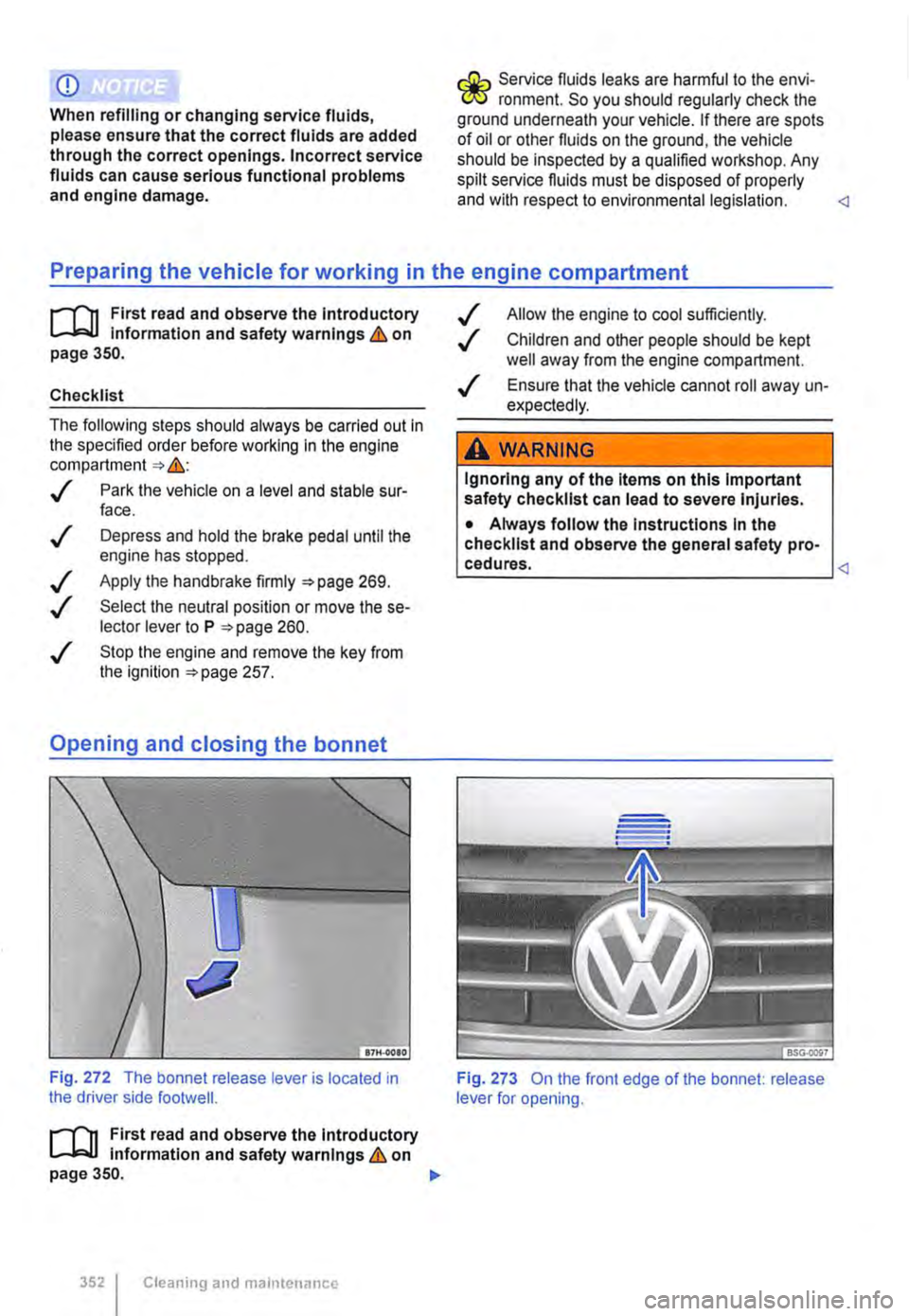
Opening and closing the bonnet
Fig. 272 The bonnet release lever is located in the driver side footwell.
1"1'11 First read and observe the introductory L-.J,::,,J Information and safety warnings & on page 350.
352 I Cleaning and maintenance
Allow the engine to cool sufficiently.
Children and other people should be kept well away from the engine compartment.
Ensure that the vehicle cannot roll away un-expectedly.
A WARNING
Ignoring any of the Items on this Important safety checklist can lead to severe Injuries.
• Always follow the Instructions In the checklist and observe the general safety pro-cedures.
Page 359 of 486
Warning lamp and coolant temperature display
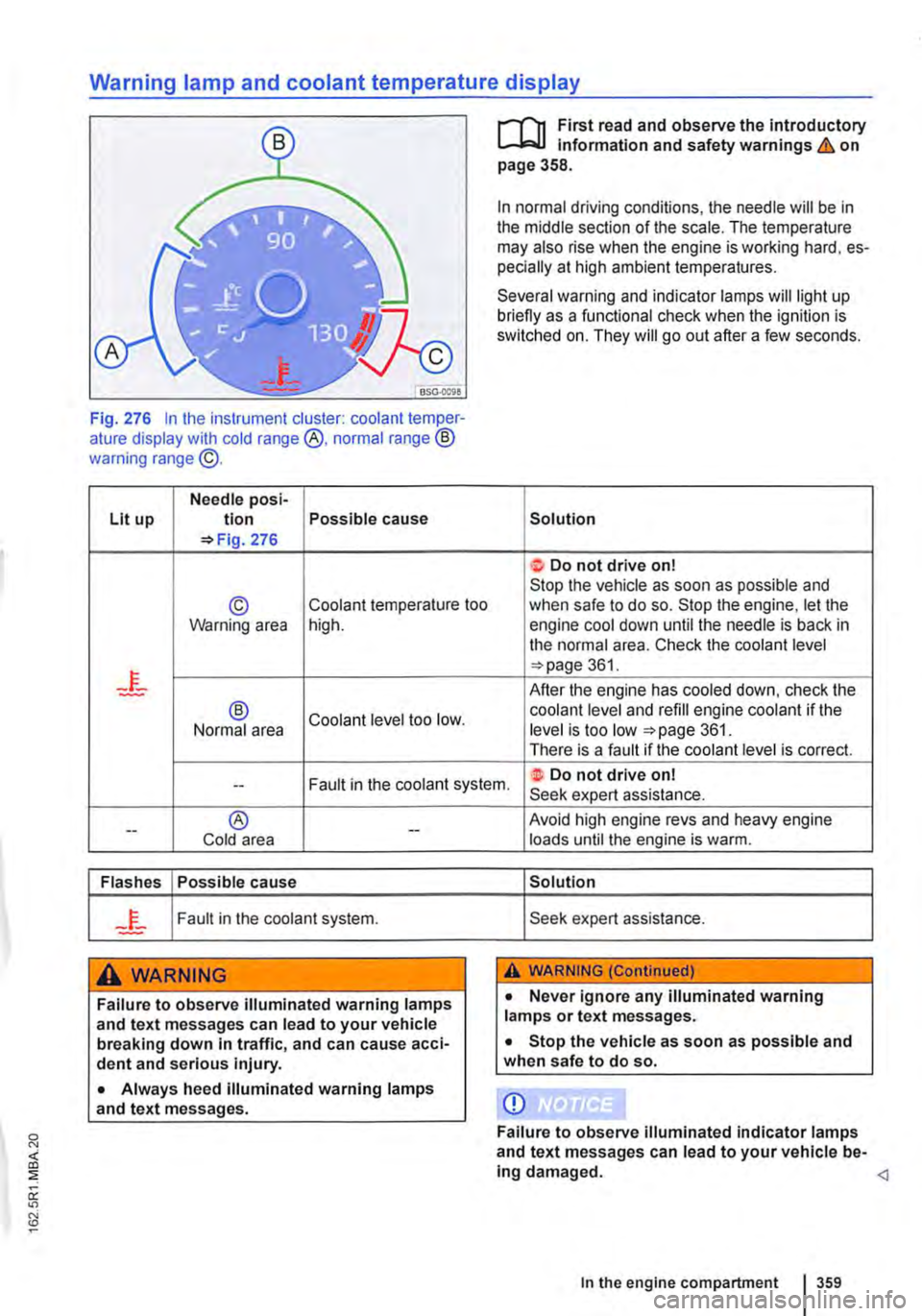
Fig. 276 In the instrument cluster: coolant temper-ature display with cold range @, normal range ® warning range @.
Needle posi-Lit up tion Possible cause =>Fig. 276
© Coolant temperature too Warning area high.
® Coolant level too low. Normal area
r-f"n First read and observe the introductory L,....J.:.lJ Information and safety warnings & on page 358.
In normal driving conditions, the needle will be in the middle section of the scale. The temperature may also rise when the engine is working hard, es-pecially at high ambient temperatures.
Several warning and indicator lamps will light up briefly as a functional check when the ignition is switched on. They will go out after a few seconds.
Solution
t Do not drive on! Stop the vehicle as soon as possible and when safe to do so. Stop the engine, let the engine cool down until the needle is back in the normal area. Check the coolant level =>page 361.
After the engine has cooled down, check the coolant level and refill engine coolant if the level is too low =>page 361. There is a fault if the coolant level is correct.
Fault in the coolant system. ·t Do not drive on! --Seek expert assistance.
--® Cold area --
Flashes Possible cause
Fault in the coolant system.
A WARNING
Failure to observe illuminated warning lamps and text messages can lead to your vehicle breaking down In traffic, and can cause acci-dent and serious injury.
• Always heed illuminated warning lamps and text messages.
Avoid high engine revs and heavy engine loads until the engine is warm.
Solution
Seek expert assistance.
A WARNING (Continued)
• Never ignore any illuminated warning lamps or text messages.
• Stop the vehicle as soon as possible and when safe to do so.
CD
Failure to observe illuminated indicator lamps and text messages can lead to your vehicle be-ing damaged.
Page 363 of 486
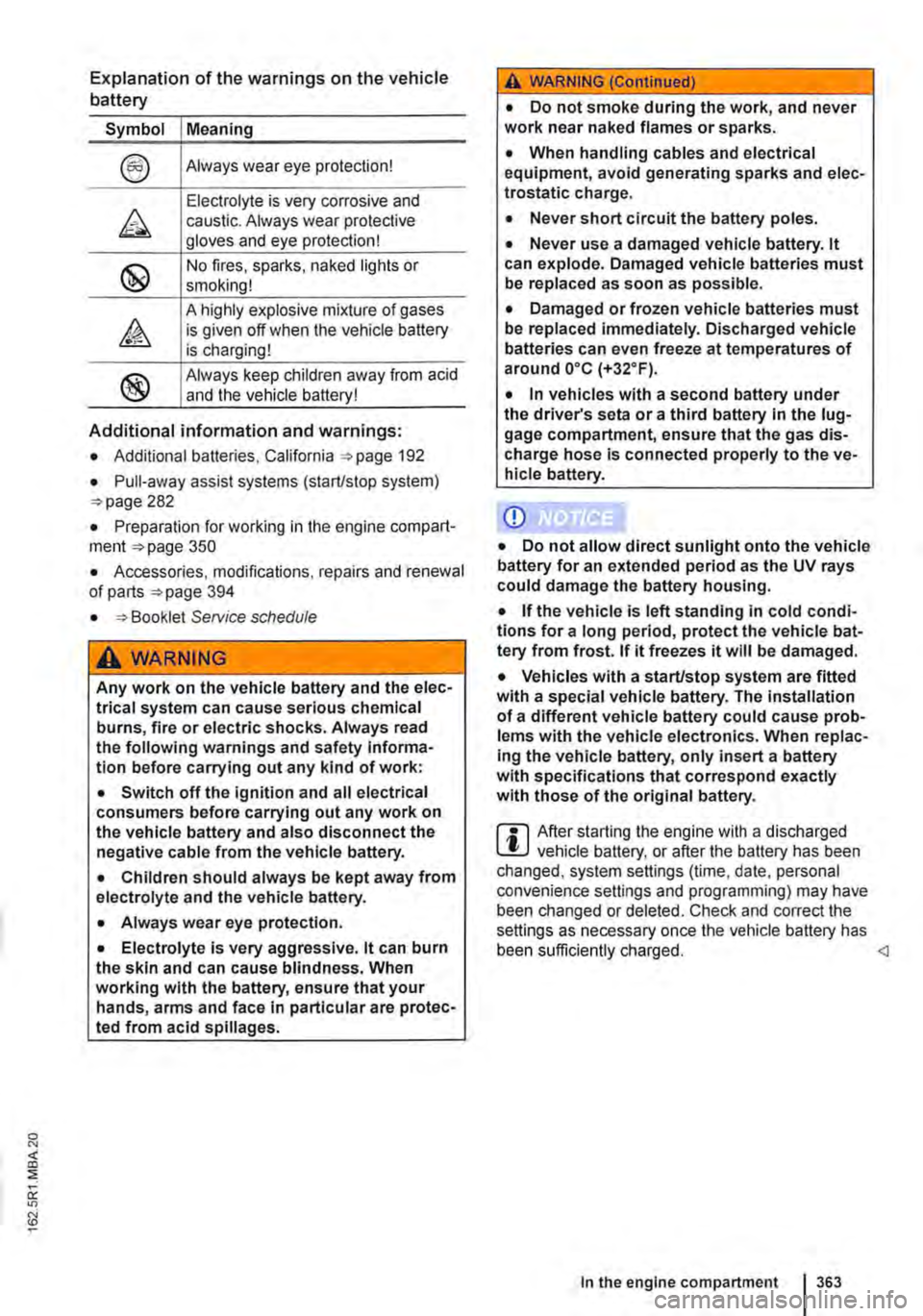
Explanation of the warnings on the vehicle battery
Symbol Meaning
Always wear eye protection!
Electrolyte is very corrosive and caustic. Always wear protective gloves and eye protection!
No fires, sparks, naked lights or smoking!
A highly explosive mixture of gases is given off when the vehicle battery is charging!
Always keep children away from acid and the vehicle battery!
Additional information and warnings:
• Additional batteries, California 192
• Pull-away assist systems (starUstop system) 282
• Preparation for working in the engine compart-ment 350
• Accessories, modifications, repairs and renewal of parts 394
• Service schedule
A WARNING
Any work on the vehicle battery and the elec-trical system can cause serious chemical burns, fire or electric shocks. Always read the following warnings and safety informa-tion before carrying out any kind of work:
• Switch off the ignition and all electrical consumers before carrying out any work on the vehicle battery and also disconnect the negative cable from the vehicle battery.
• Children should always be kept away from electrolyte and the vehicle battery.
• Always wear eye protection.
• Electrolyte Is very aggressive. lt can burn the skin and can cause blindness. When working with the battery, ensure that your hands, arms and face in particular are protec-ted from acid spillages.
A WARNING (Continued)
• Do not smoke during the work, and never work near naked flames or sparks.
• When handling cables and electrical equipment, avoid generating sparks and elec-trostatic charge.
• Never short circuit the battery poles.
• Never use a damaged vehicle battery. it can explode. Damaged vehicle batteries must be replaced as soon as possible.
• Damaged or frozen vehicle batteries must be replaced immediately. Discharged vehicle batteries can even freeze at temperatures of around ooc (+32°F).
• In vehicles with a second battery under the driver's seta or a third battery in the lug-gage compartment, ensure that the gas dis-charge hose is connected properly to the ve-hicle battery.
• If the vehicle is left standing in cold condi-tions for a long period, protect the vehicle bat-tery from frost. If it freezes it wilt be damaged.
• Vehicles with a starUstop system are fitted with a special vehicle battery. The installation of a different vehicle battery could cause prob-lems with the vehicle electronics. When replac-ing the vehicle battery, only insert a battery with specifications that correspond exactly with those of the original battery.
W After starting the engine with a discharged L!J vehicle battery, or after the battery has been changed, system settings (time, date, personal convenience settings and programming) may have been changed or deleted. Check and correct the settings as necessary once the vehicle battery has been sufficiently charged.
Page 364 of 486
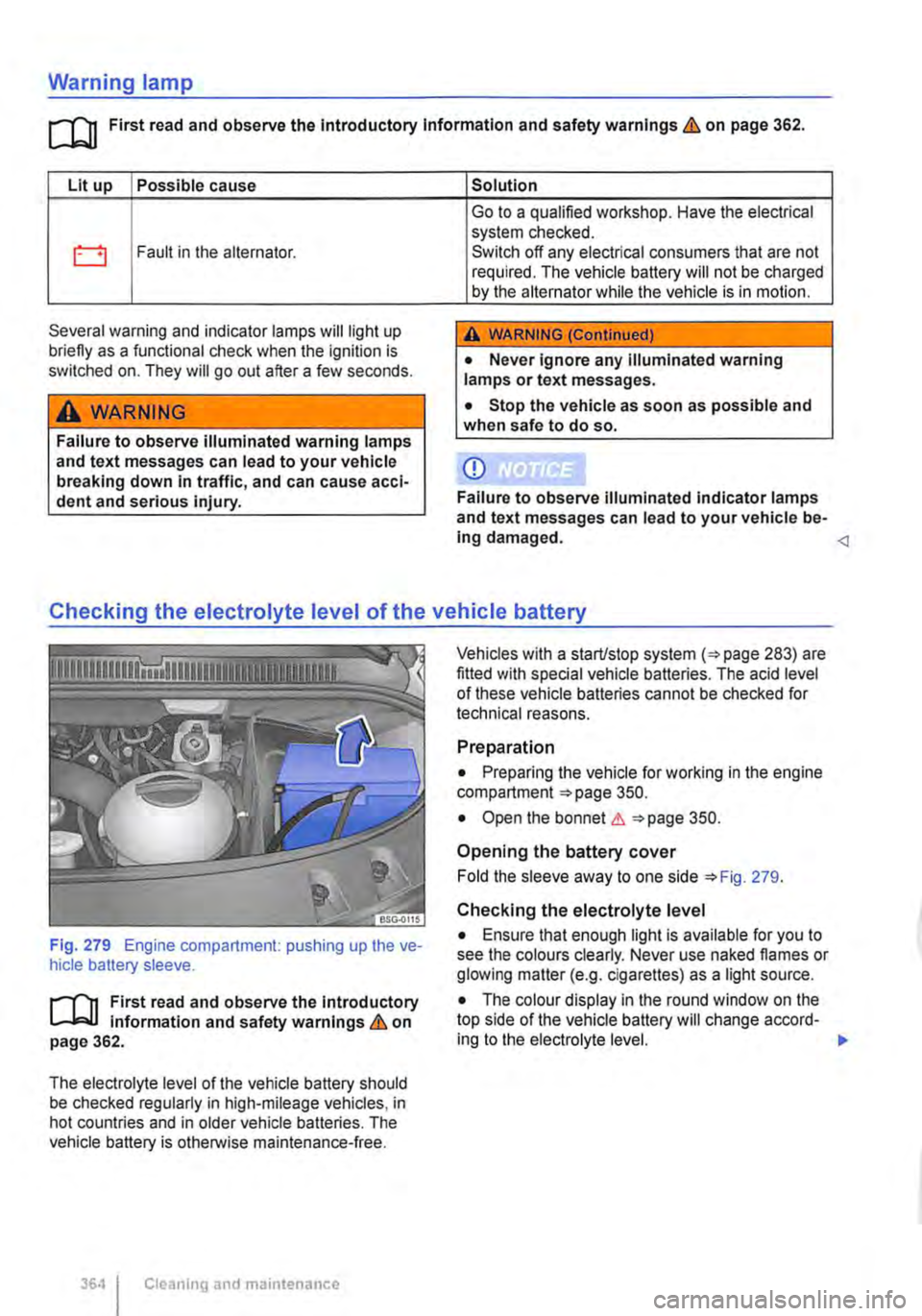
Warning lamp
ro First read and observe the Introductory Information and safety warnings & on page 362.
Lit up Possible cause
0 Fault in the alternator.
Several warning and indicator lamps will light up briefly as a functional check when the ignition is switched on. They will go out after a few seconds.
A WARNING
Failure to observe illuminated warning lamps and text messages can lead to your vehicle breaking down In traffic, and can cause acci-dent and serious injury.
Solution
Go to a qualified workshop. Have the electrical system checked. Switch off any electrical consumers that are not required. The vehicle battery will not be charged by the alternator while the vehicle is in motion.
A WARNING (Continued)
• Never ignore any illuminated warning lamps or text messages.
• Stop the vehicle as soon as possible and when safe to do so.
CD
Failure to observe illuminated indicator lamps and text messages can lead to your vehicle be-Ing damaged. <1
Checking the electrolyte level of the vehicle battery
Fig. 279 Engine compartment: pushing up the ve-hicle battery sleeve.
r-111 First read and observe the Introductory l-Jo=,.lJ Information and safety warnings & on page 362.
The electrolyte level of the vehicle battery should be checked regularly in high-mileage vehicles, in hot countries and in older vehicle batteries. The vehicle battery is otherwise maintenance-free.
364 I Cleaning and maintenance
Vehicles with a starUstop system (=>page 283) are fitted with special vehicle batteries. The acid level of these vehicle batteries cannot be checked for technical reasons.
Preparation
• Preparing the vehicle for working in the engine compartment =>page 350.
• Open the bonnet &::. =>page 350.
Opening the battery cover
Fold the sleeve away to one side =>Fig. 279.
Checking the electrolyte level
• Ensure that enough light is available for you to see the colours clearly. Never use naked flames or glowing matter (e.g. cigarettes) as a light source.
• The colour display in the round window on the top side of the vehicle battery will change accord-ing to the electrolyte level.
Page 365 of 486
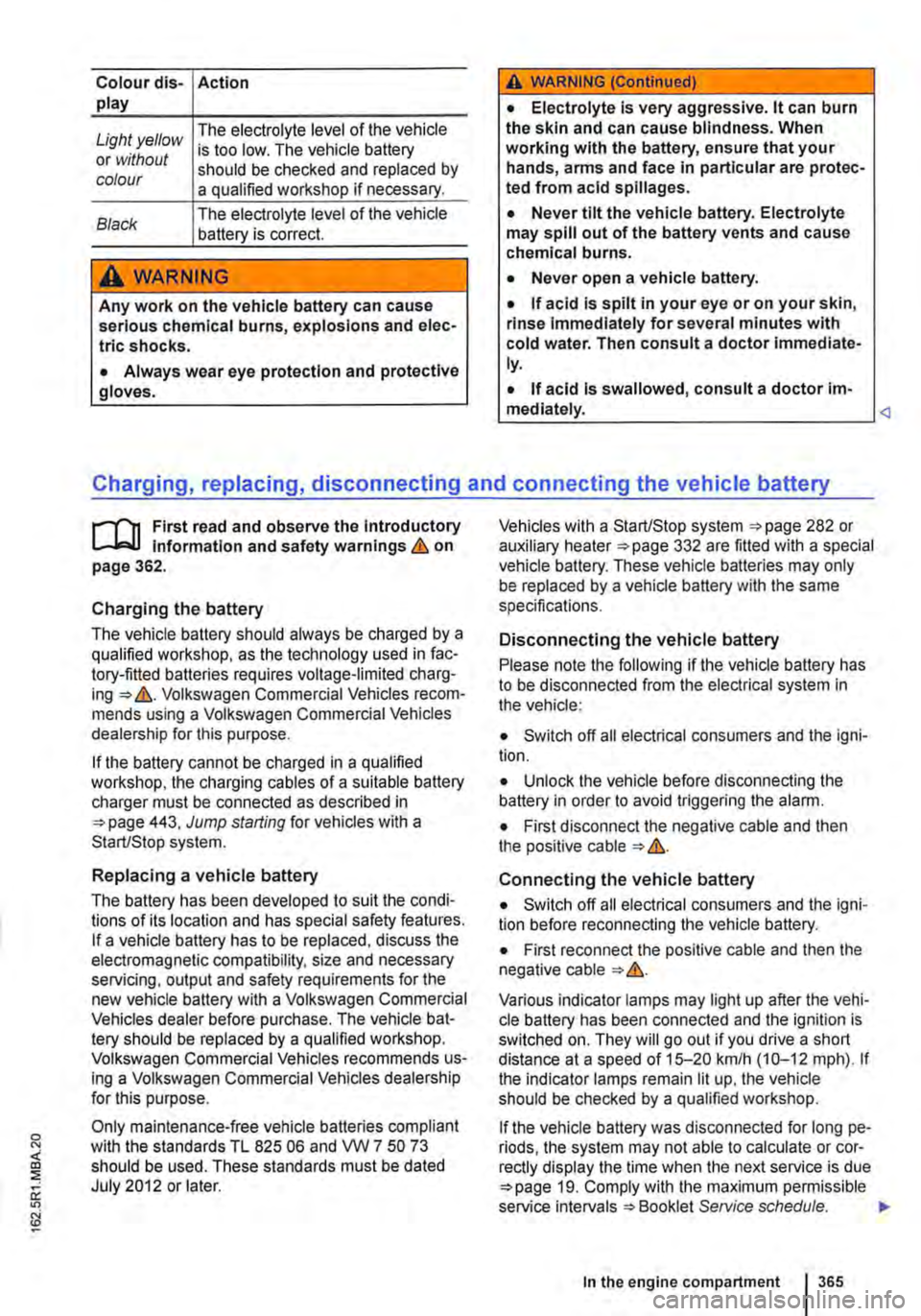
Colour dis-Action play
Light yellow The electrolyte level of the vehicle
or without is too low. The vehicle battery
colour should be checked and replaced by a qualified workshop if necessary.
Black The electrolyte level of the vehicle battery is correct.
A WARNING
Any work on the vehicle battery can cause serious chemical burns, explosions and elec-trlc shocks.
• Always wear eye protection and protective gloves.
A WARNING (Continued)
• Electrolyte is very aggressive. lt can burn the skin and can cause blindness. When working with the battery, ensure that your hands, arms and face in particular are protec-ted from acid spillages.
• Never tilt the vehicle battery. Electrolyte may spill out of the battery vents and cause chemical burns.
• Never open a vehicle battery.
• if acid is spilt in your eye or on your skin, rinse immediately for several minutes with cold water. Then consult a doctor immediate-ly.
• If acid is swallowed, consult a doctor im-mediately.
r-"f'n First read and observe the introductory L-Jo:.l.l information and safety warnings & on page 362.
Charging the battery
The vehicle battery should always be charged by a qualified workshop, as the technology used in fac-tory-fitted batteries requires voltage-limited charg-ing => &. Volkswagen Commercial Vehicles recom-mends using a Volkswagen Commercial Vehicles dealership for this purpose.
If the battery cannot be charged in a qualified workshop, the charging cables of a suitable battery charger must be connected as described in =>page 443, Jump starting for vehicles with a Start/Stop system.
Replacing a vehicle battery
The battery has been developed to suit the condi-tions of its location and has special safety features. If a vehicle battery has to be replaced, discuss the electromagnetic compatibility, size and necessary servicing, output and safety requirements for the new vehicle battery with a Volkswagen Commercial Vehicles dealer before purchase. The vehicle bat-tery should be replaced by a qualified workshop. Volkswagen Commercial Vehicles recommends us-ing a Volkswagen Commercial Vehicles dealership for this purpose.
Only maintenance-free vehicle batteries compliant with the standards TL 825 06 and VVV 7 50 73 should be used. These standards must be dated July 2012 or later.
Vehicles with a Start/Stop system =>page 282 or auxiliary heater =>page 332 are fitted with a special vehicle battery. These vehicle batteries may only be replaced by a vehicle battery with the same specifications.
Disconnecting the vehicle battery
Please note the following if the vehicle battery has to be disconnected from the electrical system in the vehicle:
• Switch off all electrical consumers and the igni-tion.
• Unlock the vehicle before disconnecting the battery in order to avoid triggering the alarm.
• First disconnect the negative cable and then the positive cable => &.
Connecting the vehicle battery
• Switch off all electrical consumers and the igni-tion before reconnecting the vehicle battery.
• First reconnect the positive cable and then the negative cable=>&.
Various indicator lamps may light up after the vehi-cle battery has been connected and the ignition is switched on. They will go out if you drive a short distance at a speed of 15-20 kmlh (10-12 mph). If the indicator lamps remain lit up, the vehicle should be checked by a qualified workshop.
if the vehicle battery was disconnected for long pe-riods, the system may not able to calculate or cor-rectly display the time when the next service is due =>page 19. Comply with the maximum permissible service intervals =>Booklet Service schedule. ""
In the engine compartment 365
Page 366 of 486
Automatic switch-off for electrical consumers
The intelligent vehicle electrical system automati-cally implements a range of measures to prevent the battery from discharging under high loads:
• The idling speed is increased so that the alter-nator provides more electricity.
• The performance of large electrical consumers may be reduced or they may be switched off com-pletely.
• The supply of electricity to the 12-volt sockets and the cigarette lighter is interrupted temporarily while the engine is being started.
The vehicle electrical system cannot always pre-vent the vehicle battery from discharging. For ex-ample, if the ignition is left on for an extended peri-od of time with the engine off, or if the parking light is left on when the vehicle is parked for an exten-ded period.
What can cause the vehicle battery to discharge?
• Long periods at a standstill in which the engine is not running, especially if the ignition is switched on.
• The use of electrical consumers when the en-gine is switched off.
• When the supplementary heater is in operation =>page 332.
A WARNING
Incorrectly attaching the battery and using In-correct vehicle batteries can cause short cir-cuits, fire and serious Injuries.
366 I Cleaning and maintenance
A WARNING (Continued)
• Always use maintenance-free and leak-proof batteries that have the same properties, specifications and dimensions as the factory-fitted vehicle battery.
A WARNING
A highly explosive mixture of gases Is given off when the vehicle battery is being charged.
• Vehicle batteries should only be charged in well-ventilated spaces.
• Never charge a vehicle battery once it has been frozen. Discharged vehicle batteries can even freeze at temperatures of around o•c (+32.FJ.
• The vehicle battery has to be replaced if it has ever been frozen.
• Incorrectly connected cables can cause a short circuit. First connect the positive cable and then the negative cable.
CD
• Never make or break connections between vehicle batteries if the ignition is switched on or the engine is running. Never use a vehicle battery that does not correspond with the vehi-cle's specifications. The vehicle's electrical system or electronic components could be damaged, which could lead to electrical faults, for example In the start/stop system.
• Never connect equipment that provides electricity, such as solar panels or a battery charger, to the 12-volt socket or to the cigarette lighter to charge the vehicle battery. This can damage the vehicle electrical system.
Dispose of the vehicle baltery as required by legislation. Batteries may contain toxic sub-stances such as sulphuric acid and lead.
Electrolyte can pollute the environment. Clean up any service fluid leakages and dis-pose of them property.
Page 405 of 486
A WARNING
Handling the vehicle Incorrectly will Increase the risk of accident and Injuries.
• Comply with legal regulations.
• Observe the owner's manual.
Information stickers and plates
r--('n First read and observe the introductory L-1=.1.1 information and safety warnings & on page 404.
Safety certificates, stickers and plates showing im-portant vehicle operation information are factory-fit-ted in the engine compartment and on certain parts such as the tank flap, front passenger sun visor, the driver door pillar or in the luggage compart-ment floor.
• Never remove or damage the safety certifi-cates, stickers and plates. They must remain legi-ble at all times.
• If vehicle parts bearing safety certificates, stick-ers or plates are removed from the vehicle, re-placement safety certificates, stickers or plates with the same information must be applied properly to the new parts by the qualified workshop.
CD
Handling the vehicle incorrectly could lead to the vehicle becoming damaged.
• Comply with legal regulations.
• Carry out service jobs in accordance with the service schedule.
• Observe the owner's manual.
Safety certificate
A safety certificate on the door pillar of the driver door provides the information that all necessary safety standards and specifications of the transport safety authorities of the individual country have been met at the time of production. The month and year of production and the chassis number may al-so be listed.
High voltage warning sticker
There is a sticker near the bonnet lock showing a warning about the high voltage in the vehicle's electrical system. The vehicle's ignition system ful-fils the requirements of standards that include
r--('n First read and observe the lntrod uctory L-Jo-ll Information and safety warnings & on page 404.
The vehicle has been manufactured specifically for a particular country and complies with the registra-tion regulations that applied in that country at the time of vehicle production.
If you want to use the vehicle abroad for a short period, all relevant information and Instructions should be followed 34, Driving abroad.
If the vehicle is going to be sold in another country or used in another country for an extended period, the legal requirements applicable in that country must be observed.
In some cases, certain equipment will have to be fitted or removed and functions deactivated. The service scope and service types could also be af-
fected. This is particularly important if the vehicle is driven in another climate region for a long period of time.
Because different frequency bands are used in dif-ferent countries, the factory-fitted radio or naviga-tion system may not work in other countries.
Rail transport
Due to differing tunnel heights and loading stand-ards in some countries, there may be restrictions on transporting your vehicle by rail or special measures may be required. Volkswagen Commer-cial Vehicles Service will provide information on
Vehicle care and maintenance 405