ice warning VOLKSWAGEN TRANSPORTER 2014 Workshop Manual
[x] Cancel search | Manufacturer: VOLKSWAGEN, Model Year: 2014, Model line: TRANSPORTER, Model: VOLKSWAGEN TRANSPORTER 2014Pages: 486, PDF Size: 69.28 MB
Page 220 of 486
A WARNING (Continued)
• Help others, especially children, to climb up and down safely.
A WARNING
If the safety net is not fitted or not properly fitted, children could fall off the pop-up roof bed and seriously injure themselves.
Closing the manual pop-up roof
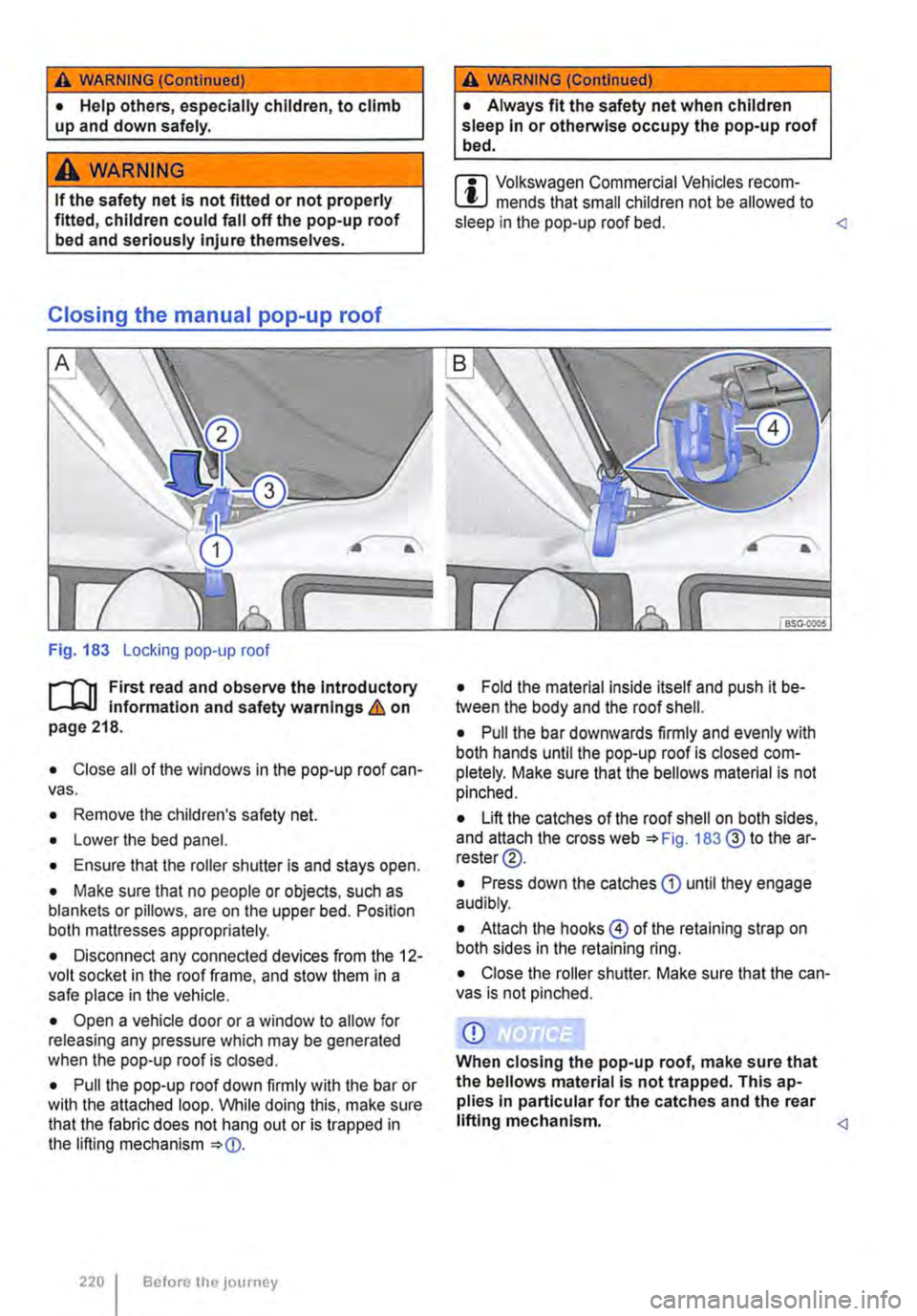
Fig. 183 Locking pop-up roof
,....--('n First read and observe the introductory L-J,::.U information and safety warnings & on page 218.
• Close all of the windows in the pop-up roof can-vas.
• Remove the children's safety net.
• Lower the bed panel.
• Ensure that the roller shutter is and stays open.
• Make sure that no people or objects, such as blankets or pillows, are on the upper bed. Position both mattresses appropriately.
• Disconnect any connected devices from the 12-volt socket in the roof frame, and stow them in a safe place in the vehicle.
• Open a vehicle door or a window to allow for releasing any pressure which may be generated when the pop-up roof is closed.
• Pull the pop-up roof down firmly with the bar or with the attached loop. While doing this, make sure that the fabric does not hang out or is trapped in the lifting mechanism
220 I Before the journey
A WARNING (ConUnued)
• Always fit the safety net when children sleep in or otherwise occupy the pop-up roof bed.
m Volkswagen Commercial Vehicles recom-L!J mends that small children not be allowed to sleep in the pop-up roof bed.
• Pull the bar downwards firmly and evenly with both hands until the pop-up roof is closed com-pletely. Make sure that the bellows material is not pinched.
• Lift the catches of the roof shell on both sides, and attach the cross web 183@ to the ar-rester@.
• Press down the catches CD until they engage audibly.
• Attach the hooks@ of the retaining strap on both sides in the retaining ring.
• Close the roller shutter. Make sure that the can-vas is not pinched.
CD
When closing the pop-up roof, make sure that the bellows material is not trapped. This ap-plies In particular for the catches and the rear lifting mechanism.
Page 223 of 486
Closing the electric pop-up roof
j'"'('n First read and observe the introductory information and safety warnings & on page 221.
• Close all of the windows in the pop-up roof can-vas.
• Remove the children's safety net.
• Lower the bed panel.
• Ensure that the roller shutter is and stays open.
• Make sure that no people or objects, such as blankets or pillows, are on the upper bed. Position the mattress correctly.
• Disconnect any connected devices from the 12-volt socket in the roof frame, and stow them in a safe place in the vehicle.
• Switch on the ignition.
• Open one of the vehicle doors to allow excess air pressure to escape.
• Switch on the central control panel.
• Select the menu option Pop-up roof in the central control panel.
• Select menu option Close (dark background).
• Press and hold the rotary/push knob for ap-proximately four seconds. An acoustic signal is giv-en and the display reads for approximately four seconds Roof bed down? Shutter open? Window open?. All control elements for the pop-up roof are blocked during this safety check.
• Press and hold the rotary/push knob again to continue closing. Make sure that the canvas is not pinched at the front or on the side between the ve-hicle and the roof or the rods.
• Press and hold the rotary/push knob until the hydraulic motor has switched off automatically and the pop-up roof has closed fully. This is shown by the .t symbol in the display. The hydraulic motor has a run-on time of approx. 5 seconds to bleed the hydraulic system.
• Close the roller shutter. Make sure that the can-vas is not pinched.
m The LED lights in the pop-up roof are switch-L!..J ed off automatically as soon as the engine is
Equipment, California I 223
Page 237 of 486
• Keep the knob pressed in for approx. 15 sec-onds to temporarily bridge the igniter safety device. If you let go of the knob too quickly, the gas flame goes out. If this occurs, re-light the burner as de-scribed above.
• Release the regulating knob and adjust the gas flame as required.
Turning off the gas flame
• Turn the appropriate knob@ fully clockwise to turn off the gas flame.
• Close the gas shut-off valve in the kitchen unit.
• Close the safety valve on the gas bottle.
• Remove all objects from the gas cooker and al-low the cooker to cool fully.
• Place the backrest of the left front seat in an upright position or turn the left front seat so that you can close the kitchen unit's cover plate.
• Lower the kitchen unit cover plate and latch it securely. <1
Water supply and disposal, California
n::n Introduction
This chapter contains information on the following subjects:
Fresh water system . . . . . . . . . . . . . . . . . . . . . . 238
Sterilising agent . . . . . . . . . . . . . . . . • . . . . . . . . 239
Cleaning the fresh water tank . . . . . . . . . . . . . 239 Waste water tank . . . . . . . . . . . . . . . . . . . . . . . . 240
Turning the water on and off . . . . . . . . . . . . . . 240
Cleaning the drain . . . . . . . . . . . . . . . . . . . . . . . 241
Additional information:
• Central control panel 204
• Rectifying faults on the camping equipment 254
• Fuses for the camping equipment 249
• Winter conditions 253
• Filling the tank 340
A WARNING
Improper use of the fresh water system can lead to poisoning and illness.
• The fresh water tank should only be filled with drinking water from the public water supply.
• Never fill the fresh water tank from springs or streams. Such water could be con-taminated or contain debris.
• Never use commercially available house-hold cleaners to clean the fresh water tank.
• Never leave water in the fresh water tank for long periods without replacing it with fresh water.
,A WARNING (Continued)
• Drain the fresh water system completely when it will not be used for a long time.
A WARNING
Both the fresh water tank and the waste water tank drain out underneath the vehicle. In very cold conditions this poses a danger from the formation of ice.
• Be especially careful when fresh or waste water are drained during freezing or very cold weather.
CD
In very cold weather the fresh and waste water systems should be emptied to prevent them from becoming damaged if the vehicle is not to be kept heated continuously or Is only to be used for short periods.
CD
Do not allow the water pump to run dry as this will damage the pump.
• Only switch on the water pump when there Is water in the fresh water tank.
m if you do not use the sink for a long period' it L.:!J should be kept dry and free of salt.
m Never confuse the fresh water tank filler neck L.:!J with the fuel tank filler neck. <1
Equipment, California 237
Page 242 of 486
Using the refrigerator box
r--('n First read and observe the introductory information and safety warnings & on page 241.
The suspended basket in the refrigerator box is for cooling food. The temperature is lower under the basket than inside it. Closed containers or glass bottles are less likely to burst if they are stored in the basket rather than on the bottom of the refrig-erator box .& in Introduction on page 241.
The additional battery will discharge if the refriger-ator box is used for a long period while the engine is switched off and the 230-volt connection is not used.
Before the refrigerator box is used for the first time, it should be cleaned thoroughly using lukewarm water and a mild detergent.
Cleaning the refrigerator box
r--f'n First read and observe the introductory information and safety warnings & on page 241.
The refrigerator box works independently of the engine and the ignition. lt is fed exclusively by the additional battery. The refrigerator box is switched on and off and regulated using the central control panel.
As far as possible, keep food and drinks in the re-frigerator box in leak-proof containers. Do not over-fill the refrigerator box such that air circulation is impaired.
Cool the refrigerator box before placing food items and drinks in it. Items you wish to keep in the re-frigerator box should be removed from your house-hold fridge/freezer just before you start your jour-ney. When shopping during a journey, we recom-mend items from shop fridges/freezers be placed in the refrigerator box as quickly as possible.
• To prevent mould and mildew from forming in the refrigerator box when it is not being used for long periods, place a folded dry towel between the box and its lid.
o::JJ Introduction
This chapter contains information on the following subjects:
12-volt socket ........................... 244
230-volt power supply . . . . . . . . . . . . . . • . . . . . 245
230-volt Euro socket, California . . . . . . . . . . . . 245
230-volt grounded safety socket . . . . . . . . . . . 246
Residual current circuit breaker . . . . . . . . . . . . 24 7
Battery charger . . . . . . . . . . . . . . . . . . . . . . . . . 24 7
Additional batteries . . . . . . . . . . . . . . . . . . . . . . 248
Fuses for the camping equipment .. 249
Electrical equipment can be connected to the sock-ets in the vehicle.
The connected devices must be in good condition. Do not use faulty devices.
2421 Before the journey
There are two separate power circuits in the vehi-cle:
• 12-volt DC circuit
• 230-volt AC circuit
12-volt DC circuit
Power is supplied as standard from the additional batteries under the left front seat and in the ward-robe to the following 12-volt consumers:
• Interior lights in the living area
• 12-volt sockets in the living area
• 230-volt Euro socket in the side trim panel be-hind the left front seat
• Central control panel
• Refrigerator box
Page 243 of 486
• Pump for fresh water
• Auxiliary heater
230-volt grounded safety socket
The 230-volt grounded safety socket is supplied with 230 V alternating current via electrical feed from the external socket 242.
The following electrical consumers are supplied from the 230-volt power supply via the external socket:
• Battery charger
• Depending on the vehicle equipment, the 230-volt grounded safety socket is located in the side trim panel behind the left front seat or on the side of the kitchen unit 246.
230-volt Euro socket
The 230-volt Euro socket is supplied via additional batteries or via an inverter and is located in the side trim panel behind the left front seat 245.
Additional information:
• Electrical sockets page 163
• Battery 362
• Cigarette lighter 161
• Accessories, modifications, repairs and renewal of parts 394
• Fuses 429
• Consumer information 404
• Rectifying faults on the camping equipment 254
High voltage in the electrical system!
• Never pour any liquid over the socket.
• Do not plug any adapters or extension ca-bles into the 230-volt Euro socket. Otherwise the built-in child lock will disengage and pow-er will be supplied to the socket.
• Do not insert any items which will conduct electricity, such as knitting needles, into the contacts of the 230-volt Euro socket.
A WARNING
Improper use of the sockets and electrical ac-cessories can cause fires and severe Injuries.
• Never leave children in the vehicle unat-tended. Sockets and the devices connected to them can be used when the ignition is switched on.
A WARNING (Continued)
• If the electrical device gets too hot, switch off the device Immediately and disconnect it from the socket.
CD
• Observe the operating instructions for any device that you plug into the socket.
• Never exceed the maximum power rating as this could damage the whole vehicle electrical system.
• Only use accessories that have been ap-proved in accordance with valid guidelines concerning electromagnetic compatibility.
• Never feed electricity into the socket.
• Do not plug any heavy devices or connec-tions, such as mains adapters, directly Into the socket.
• Only connect devices to the socket with a voltage that matches the voltage of the socket.
CD
• In order to prevent damage to the electrical system, never connect equipment that gener-ates electricity, such as solar panels or battery chargers for charging the vehicle battery, to the 12-volt socket.
• Only use accessories that have been ap-proved in accordance with current guidelines concerning electromagnetic compatibility.
• In order to avoid damage due to voltage fluctuation, always switch any electrical con-sumers connected to the 12-volt sockets off be-fore switching the ignition or the engine on or off. When the start/stop system automatically switches off and restarts the engine, it is not necessary to switch off any connected electri-cal consumers.
• Never connect electrical devices requiring more electrical power to a 12-volt socket. The vehicle's electrical system can be damaged if the maximum power output is exceeded.
CD
• Observe the operating instructions for any device that you plug Into the socket.
• 230-volt Euro socket:
-Do not plug any heavy devices or connec-tions, such as mains adapters, directly into the socket. .,..
Equipment, California I 243
Page 244 of 486
-Only connect devices to the socket with a voltage that matches the voltage of the socket.
-With electrical devices that require a high level of current in the start phase, the built-in excess current switch will prevent the de-vice from being switched on. If this hap-pens, disconnect the device from the power supply and reconnect after waiting approxi-mately 10 seconds.
12-volt socket
·-·
"' -
fi7E.O'i1Q
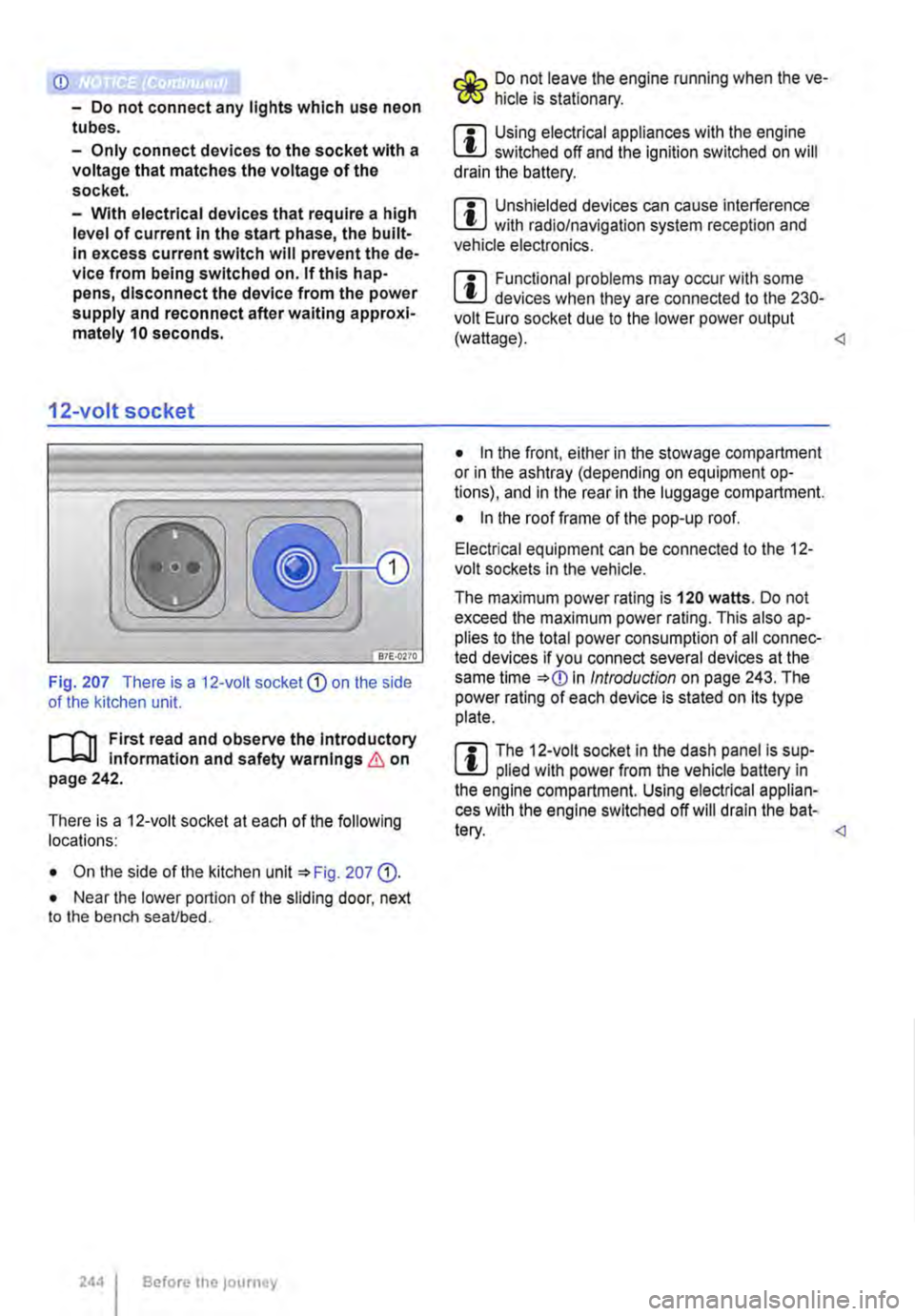
Fig. 207 There is a 12-volt socket CD on the side of the kitchen unit.
l"'"'l'l1 First read and observe the Introductory L-lc.U information and safety warnings & on page 242.
There is a 12-voit socket at each of the following locations:
• On the side of the kitchen unit '*Fig. 207 (D.
• Near the lower portion of the sliding door, next to the bench seaVbed.
2441 Before the journey
Do not leave the engine running when the ve-f!JS hide is stationary.
m Using electrical appliances with the engine W switched off and the ignition switched on will drain the battery.
m Unshielded devices can cause interference W with radio/navigation system reception and vehicle electronics.
m Functional problems may occur with some W devices when they are connected to the 230-volt Euro socket due to the lower power output (wattage).
• In the front, either in the stowage compartment or in the ashtray (depending on equipment op-tions), and in the rear in the luggage compartment.
• In the roof frame of the pop-up roof.
Electrical equipment can be connected to the 12-volt sockets in the vehicle.
The maximum power rating is 120 watts. Do not exceed the maximum power rating. This also ap-plies to the total power consumption of all connec-ted devices if you connect several devices at the same time *
Page 246 of 486
Inserting the Euro plug
• Plug the Euro plug into the Euro socket. The child safety function will disengage at the same time. Electricity will not flow until the child lock has been unlocked.
• Push the Euro plug all the way into the Euro socket so that it is firmly in place and will not fall out as a result of vibration or other vehicle motion.
LEDs above the socket
Constant green light The child lock is disen-gaged. The Euro socket is ready for use.
Flashing red light A fault has occurred. for example cut-off due to excess current or tem-perature.
Compatible devices
Electrical devices with a Euro plug can be connec-ted to the 230-volt Euro socket in the side trim pan-el behind the left front seat.
230-volt grounded safety socket
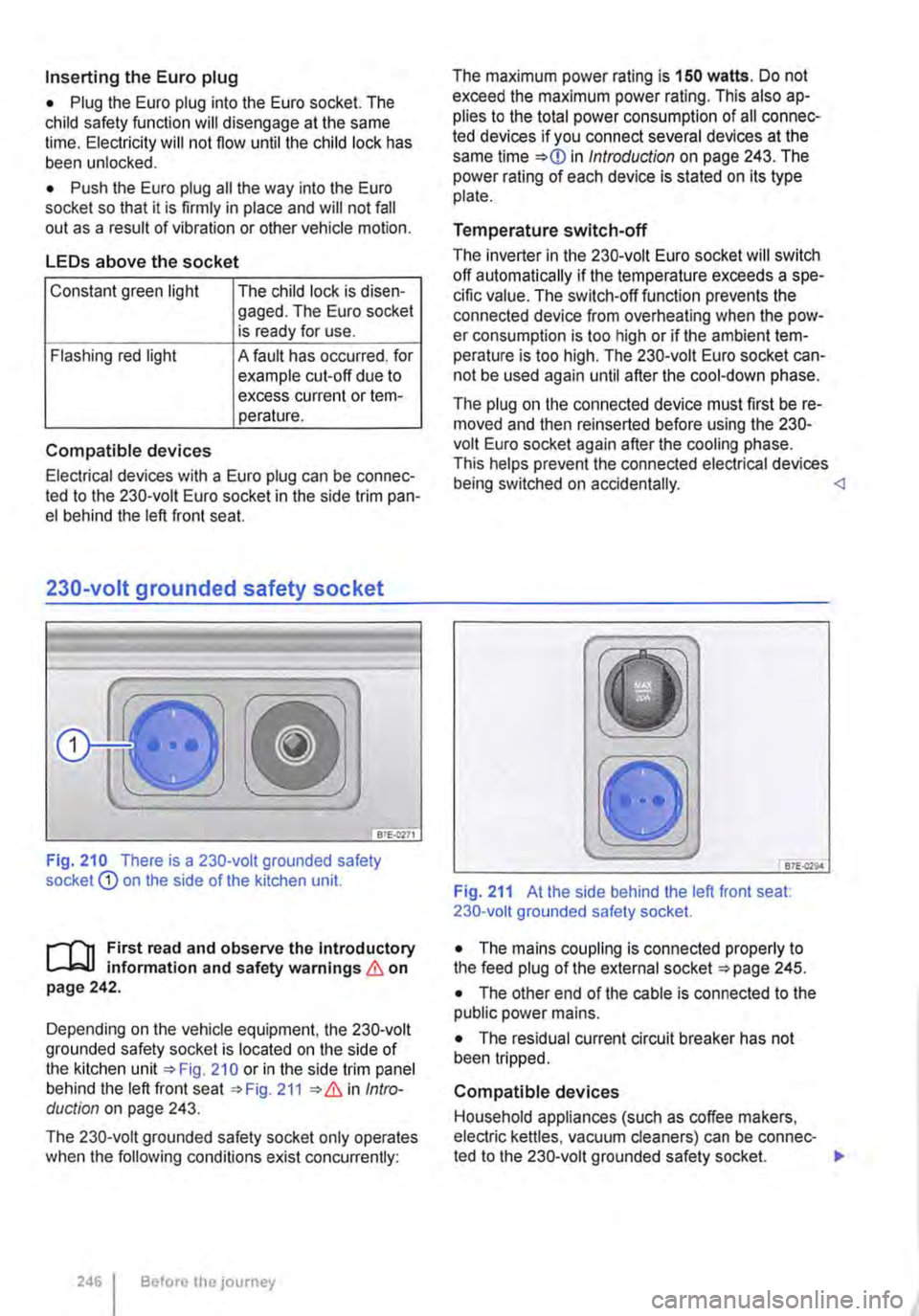
Fig. 210 There is a 230-volt grounded safety socket Q) on the side of the kitchen unit.
r--T'n First read and observe the Introductory L-k.U information and safety warnings & on page 242.
Depending on the vehicle equipment, the 230-volt grounded safety socket is located on the side of the kitchen unit 210 or in the side trim panel behind the left front seat 211 Intro-duction on page 243.
The 230-volt grounded safety socket only operates when the following conditions exist concurrently:
246 I Before the journey
The maximum power rating is 150 watts. Do not exceed the maximum power rating. This also ap-plies to the total power consumption of all connec-ted devices if you connect several devices at the same time in Introduction on page 243. The power rating of each device is stated on its type plate.
Temperature switch-off
The inverter in the 230-volt Euro socket will switch off automatically if the temperature exceeds a spe-cific value. The switch-off function prevents the connected device from overheating when the pow-er consumption is too high or if the ambient tem-perature is too high. The 230-volt Euro socket can-not be used again until after the cool-down phase.
The plug on the connected device must first be re-moved and then reinserted before using the 230-volt Euro socket again after the cooling phase. This helps prevent the connected electrical devices being switched on accidentally. <1
B7E.Q29.4
Fig. 211 At the side behind the left front seat: 230-volt grounded safety socket.
• The mains coupling is connected properly to the feed plug of the external socket 245.
• The other end of the cable is connected to the public power mains.
• The residual current circuit breaker has not been tripped.
Compatible devices
Household appliances (such as coffee makers, electric kettles, vacuum cleaners) can be connec-ted to the 230-volt grounded safety socket. .,.
Page 247 of 486
The maximum power rating is 2500 watts. Do not exceed the maximum power rating. This also ap-plies to the total power consumption of all connec-ted devices if you connect several devices at the
Residual current circuit breaker
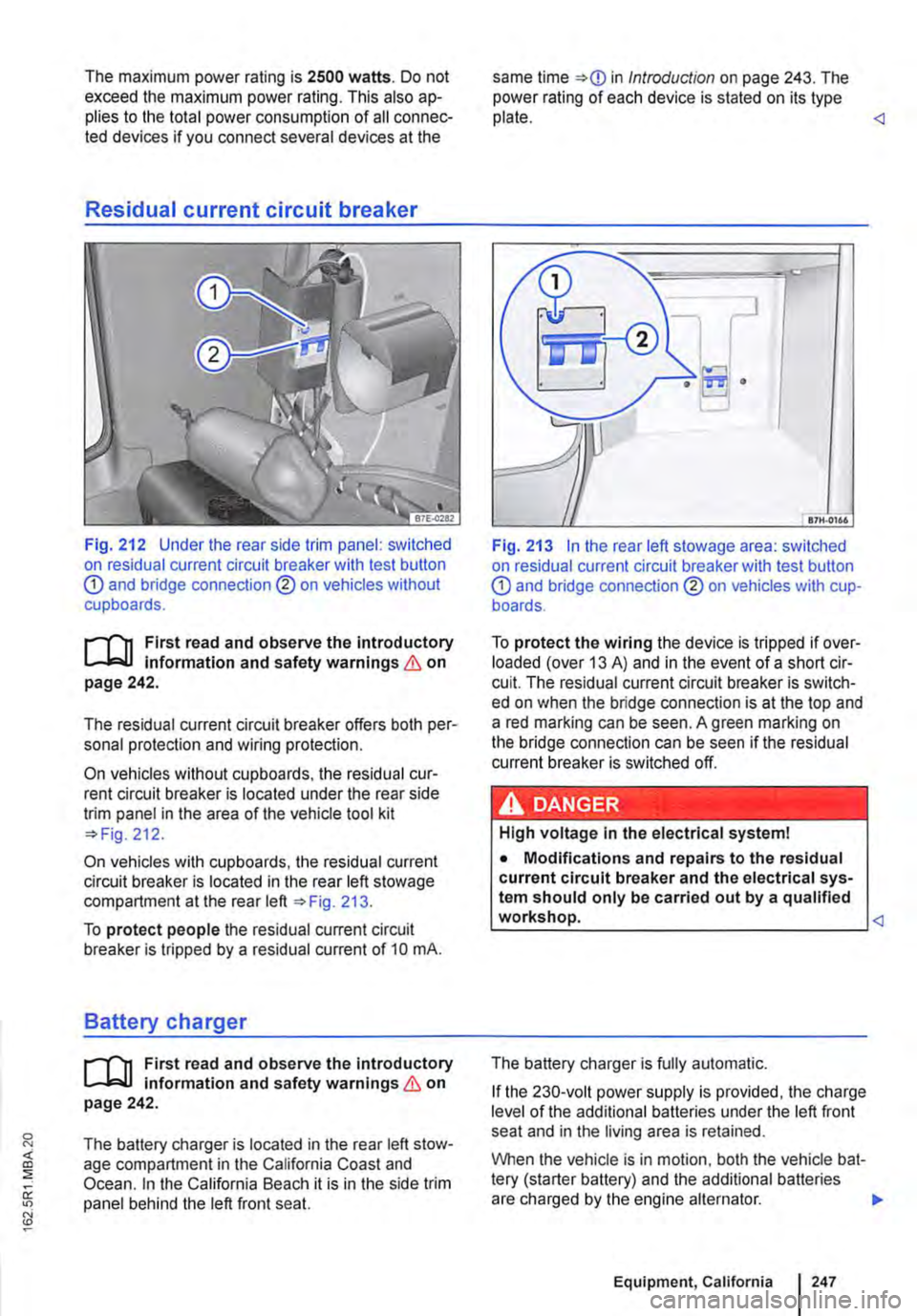
Fig. 212 Under the rear side trim panel: switched on residual current circuit breaker with test button CD and bridge connection ®on vehicles without cupboards.
r-f'n First read and observe the introductory L..-.lo:-ll information and safety warnings & on page 242.
The residual current circuit breaker offers both per-sonal protection and wiring protection.
On vehicles without cupboards, the residual cur-rent circuit breaker is located under the rear side trim panel in the area of the vehicle tool kit 212.
On vehicles with cupboards, the residual current circuit breaker is located in the rear left stowage compartment at the rear left 213.
To protect people the residual current circuit breaker is tripped by a residual current of 10 mA.
Battery charger
r-f'n First read and observe the Introductory L..-.lo:-ll information and safety warnings & on page 242.
The battery charger is located in the rear left stow-age compartment in the California Coast and Ocean. In the California Beach it is in the side trim panel behind the left front seat.
same time in Introduction on page 243. The power rating of each device is stated on its type plate.
Fig. 213 In the rear left stowage area: switched on residual current circuit breaker with test button CD and bridge connection ® on vehicles with cup-boards.
To protect the wiring the device is tripped if over-loaded (over 13 A) and in the event of a short cir-cuit. The residual current circuit breaker is switch-ed on when the bridge connection is at the top and a red marking can be seen. A green marking on the bridge connection can be seen if the residual current breaker is switched off.
High voltage in the electrical system!
• Modifications and repairs to the residual current circuit breaker and the electrical sys-tem should only be carried out by a qualified workshop.
If the 230-volt power supply is provided, the charge level of the additional batteries under the left front seat and in the living area is retained.
When the vehicle is in motion, both the vehicle bat-tery (starter battery) and the additional batteries are charged by the engine alternator.
Equipment, California I 247
Page 252 of 486
A WARNING
Never program the supplementary heating system so that Is switched on and run In un-ventilated or enclosed areas. The fumes from the supplementary heating system contain carbon monoxide, which is an odourless and
Practical tips, California
o::n Introduction
This chapter contains information on the following subjects:
Before setting off . . . . . . . . . . . . . . . . . . . . . . . . 252 Before you take a road trip . . . . . . . . . . 252
Actions to take during thunderstorms 253
Winter conditions . . . . . . . . . . . . . . . . . . 253
Cleaning cupboards, cooker and sink . 253
Cleaning the display of the central control panel . . . . . . . . . . . . . . . . . . . . 254
Before setting off
rl'"'n First read and observe the introductory L..J.:.U Information given on page 252.
Checklist
The following points should be verified in addition to the checklist 33:
..( Close the pop-up roof .
..( Close all drawers, cabinet doors and flaps.
Before you take a road trip
rl'"'n First read and observe the Introductory L..J.:.U Information given on page 252.
Checklist
Observe the following additional suggestions:
../
../
Familiarise yourself with parking and ma-noeuvring the vehicle.
Note the height and width of the vehicle-particularly if any accessories have modified these dimensions.
2521 Before tho journoy
A WARNING (Continued)
colourless poisonous gas. Carbon monoxide can cause people to lose consciousness. it can also cause death.
m All saved switch-on times will be deleted if W you switch off the central control panel or dis-connect the additional battery. They will also be de-leted ifthere is a defective fuse in the control pan-el.
Rectifying faults on the camping equipment . . 254
Technical data. living area . . 255
Additional information:
• Central control panel 204.
• Before setting off =:>page 33.
• Vehicle care and maintenance 380.
..( Retract the awning completely.
..( Remove all vehicle interior shades and open all blinds.
..( Bring all tables into their stowed position .
../ Close all gas shut-off valves.
/ Secure all loose items in the vehicle. _., ______________________________
../
../
../
Check that all items of equipment are in good working order .
Observe the entry and vaccination require-ments of any foreign country you will be vis-iting.
Have the following documents on hand:
-Valid identity cards or passports
-Driving licence and vehicle registration papers ..,.
Page 264 of 486
Dual clutch gearbox DSG®
r-('n First read and observe the Introductory L-.lo:on Information and safety warnings & on page 260.
Description
The DSG® dual clutch gearbox is a gearbox which uses dual-clutch technology to change gear automatically. it uses a dual clutch and two independent gearboxes to enable very fast gear changes with no loss of torque. The DSG® dual clutch gearbox thus combines the performance and economy of a manual gearbox with the com-fort and convenience of a conventional automatic transmission.
How the system works
Engine power is transferred to the drive shafts via the gearbox. In order to change gears, the power transmission between the engine and the gearbox has to be interrupted. This is what the clutch is for.
With the DSG® dual clutch system with its two complementary gearboxes, one gearbox is always connected under load to the engine. When one gear is engaged, another gear is always preselec-
led in the other gearbox. The clutch on the non-driven gear is closed and the other is opened at the same time. This is what makes very fast gear changes possible.
The DSG® dual clutch gearbox is designed to be more efficient than an automatic gearbox. In an au-tomatic gearbox, the torque converter is constantly in use, whereas in the DSG® dual clutch system the idle clutch can be opened, thus saving fuel. With its efficiency, low weight and intelligent control system, the DSG® dual clutch system usually ena-bles fuel consumption equal to or lower than a manual gearbox.
like the manual gearbox, the clutch in the DSG dual clutch system is subject to wear. Regular maintenance is necessary, varying accord-ing to what type of DSG® dual clutch system is in-stalled. For more information see the service schedule. In the DSG® dual clutch system, if one gearbox malfunctions it is deactivated and the oth-er gearbox functions alone *page 267. If this happens, have the system checked as soon as possible by a qualified workshop.
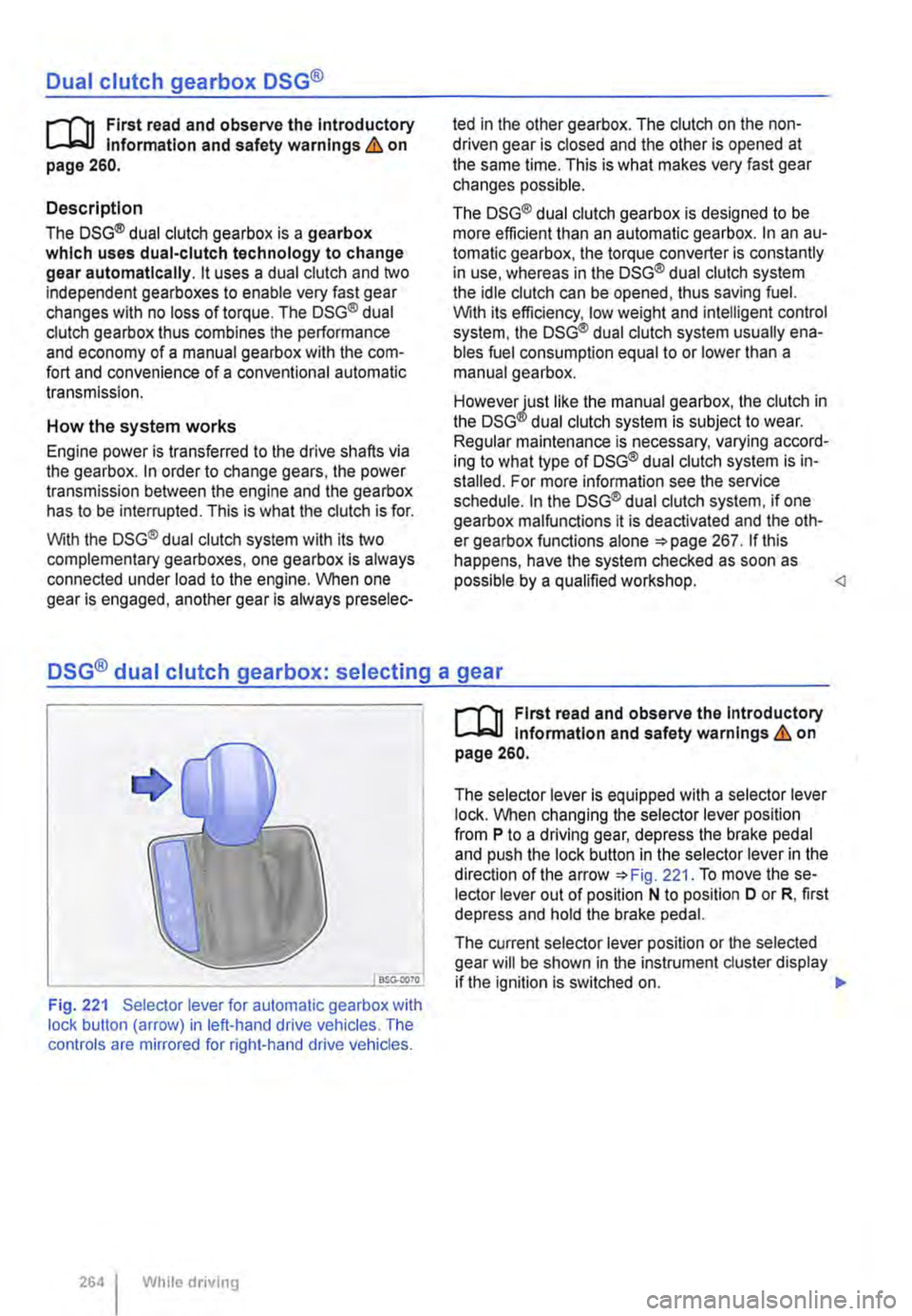
Fig. 221 Selector lever for automatic gearbox with lock button (arrow) in left-hand drive vehicles. The controls are mirrored for right-hand drive vehicles.
264 I While driving
r-('n First read and observe the Introductory L-.lo:on Information and safety warnings & on page 260.
The selector lever is equipped with a selector lever lock. When changing the selector lever position from P to a driving gear, depress the brake pedal and push the lock button in the selector lever in the direction of the arrow *Fig. 221. To move the se-lector lever out of position N to position D or R, first depress and hold the brake pedal.
The current selector lever position or the selected gear will be shown in the instrument duster display if the ignition is switched on. .,..