key VOLKSWAGEN TRANSPORTER 2015 Owner´s Manual
[x] Cancel search | Manufacturer: VOLKSWAGEN, Model Year: 2015, Model line: TRANSPORTER, Model: VOLKSWAGEN TRANSPORTER 2015Pages: 486, PDF Size: 72.17 MB
Page 406 of 486
CD
• Volkswagen Commercial Vehicles Is not re-sponsible for any vehicle damage which Is caused by low-quality fuel, inadequate servic-ing work or lack of availability of Genuine Parts.
Radio reception and aerials
i"""(")1 First read and observe the Introductory l-J.::.U information and safety warnings & on page 404.
The vehicle aerials are located in the exterior mir-rors. If any metallic chrome plates, such as chrome mirror caps, are retrofitted to the exterior mirrors you may experience problems with the radio,
CD
• Volkswagen Commercial Vehicles cannot be held responsible If the vehicle does not comply with or only partly complies with the relevant legal requirements In other countries and conti-nents.
m Interference with AM radio reception could W occur if electrical devices are used in the vi-cinity of the aerial.
i"""(")1 and observe the introductory l-J.::.U mformat1on and safety warnings & on page 404.
Volkswagen Commercial Vehicles Service infonna-tion and official Volkswagen Commercial Vehicles repair infonnation can be purchased from the fol-lowing addresses:
Please contact a Volkswagen Commercial Vehicles dealership or a qualified workshop or order the lit-erature you require from www.erwin.volkswagen.de.
Declaration of conformity
i"""(")1 First read and observe the introductory l-J.::.U information and safety warnings & on page 404.
The individual manufacturer declares herewith that the following products conform, at the time of vehi-cle production, with the basic requirements and other relevant laws and regulations, including FCC Part 15.19, FCC Part 15.21 and RSS-Gen Issue 1:
4061 Clean1ng and mamtenance
A WARNING
Incorrect repairs and modifications can cause functional problems and damage to the vehicle and impair the effectiveness of the driver assist systems and the alrbag sys-tems. This can result In accidents and severe Injuries.
• Repairs and modifications to your vehicle should only be carried out by a qualified workshop.
• Electronic immobilizer.
• Remote control key for the vehicle.
• Remote control for the supplementary heating system (auxiliary heater).
Electrical equipment
• 12-volt socket.
Page 410 of 486
If and when
Practical tips
Frequently asked questions
If you suspect that a vehicle fault has arisen or your vehicle has been damaged, read and observe the following information before contacting a Volkswagen Commercial Vehicles dealership or
qualified workshop. You may also find useful infor-mation in the index under the headings "Things to note" or "Checklist".
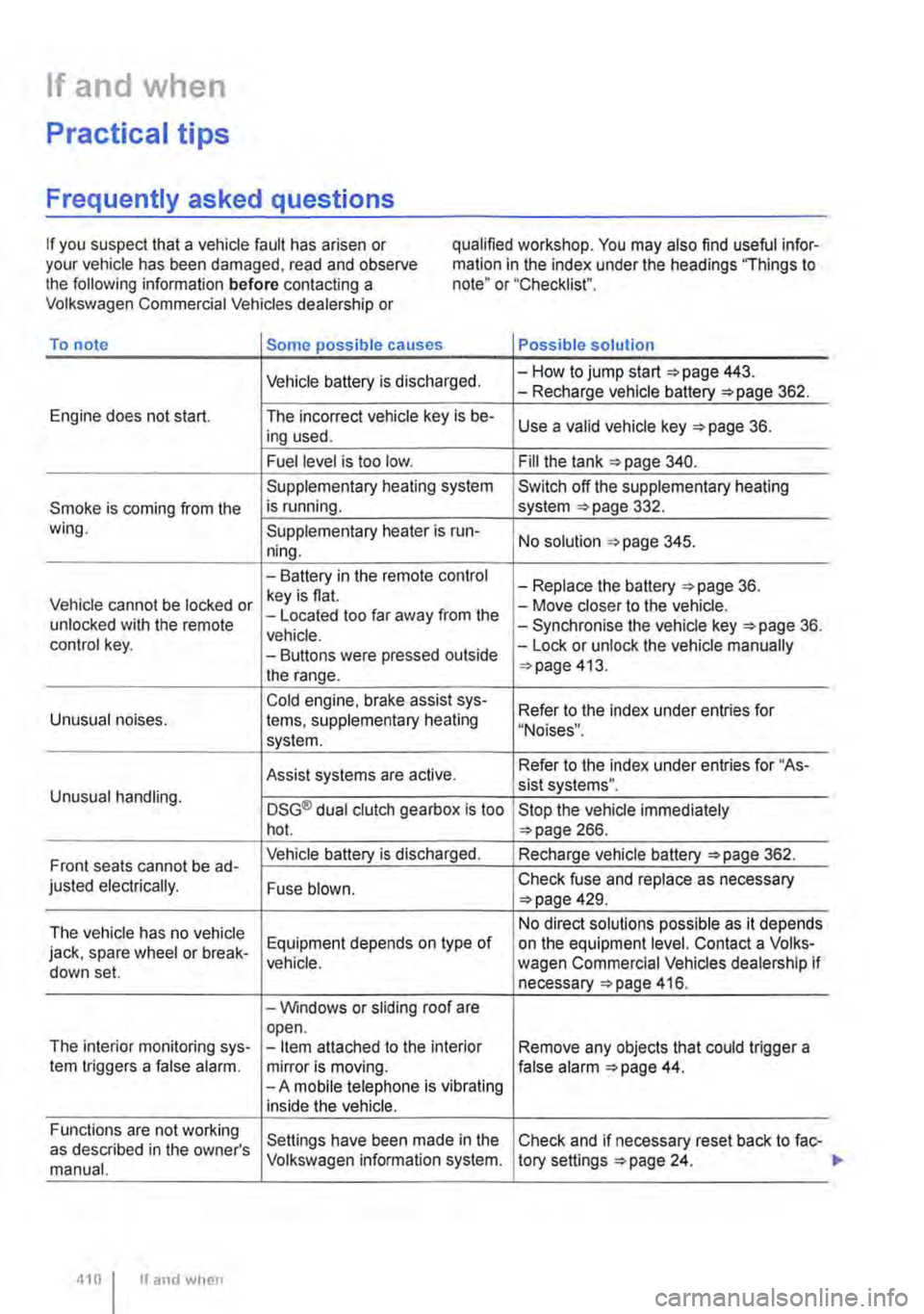
To note Some possible causes Possible solution
Vehicle battery is discharged. -How to jump start =>page 443. -Recharge vehicle battery 362.
Engine does not start. The incorrect vehicle key is be-Use a valid vehicle key 36. ing used.
Fuel level is too low. Fill the tank 340.
Supplementary heating system Switch off the supplementary heating
Smoke is coming from the is running. system 332. wing. Supplementary heater is run-No solution 345. ning.
-Battery in the remote control -Replace the battery 36. Vehicle cannot be locked or key is flat. -Move closer to the vehicle. unlocked with the remote -Located too far away from the -Synchronise the vehicle key =>page 36. vehicle. control key. -Buttons were pressed outside -Lock or unlock the vehicle manually
the range. 413.
Cold engine. brake assist sys-Refer to the index under entries for Unusual noises. tems, supplementary heating "Noises". system.
Assist systems are active. Refer to the index under entries for "As-sist systems". Unusual handling. DSG® dual clutch gearbox is too Stop the vehicle immediately hot. 266.
Front seats cannot be ad-Vehicle battery is discharged. Recharge vehicle battery 362.
justed electrically. Fuse blown. Check fuse and replace as necessary 429.
The vehicle has no vehicle No direct solutions possible as it depends
jack, spare wheel or break-Equipment depends on type of on the equipment level. Contact a Volks-vehicle. wagen Commercial Vehicles dealership if down set. necessary 416.
-Windows or sliding roof are open. The interior monitoring sys--Item attached to the interior Remove any objects that could trigger a tem triggers a false alarm. mirror is moving. false alarm 44. -A mobile telephone is vibrating inside the vehicle.
Functions are not working Settings have been made in the Check and if necessary reset back to fac-as described in the owner's manual. Volkswagen information system. tory settings 24.
410 I If and when
Page 412 of 486
Making you and your vehicle safe
8S0.00)7
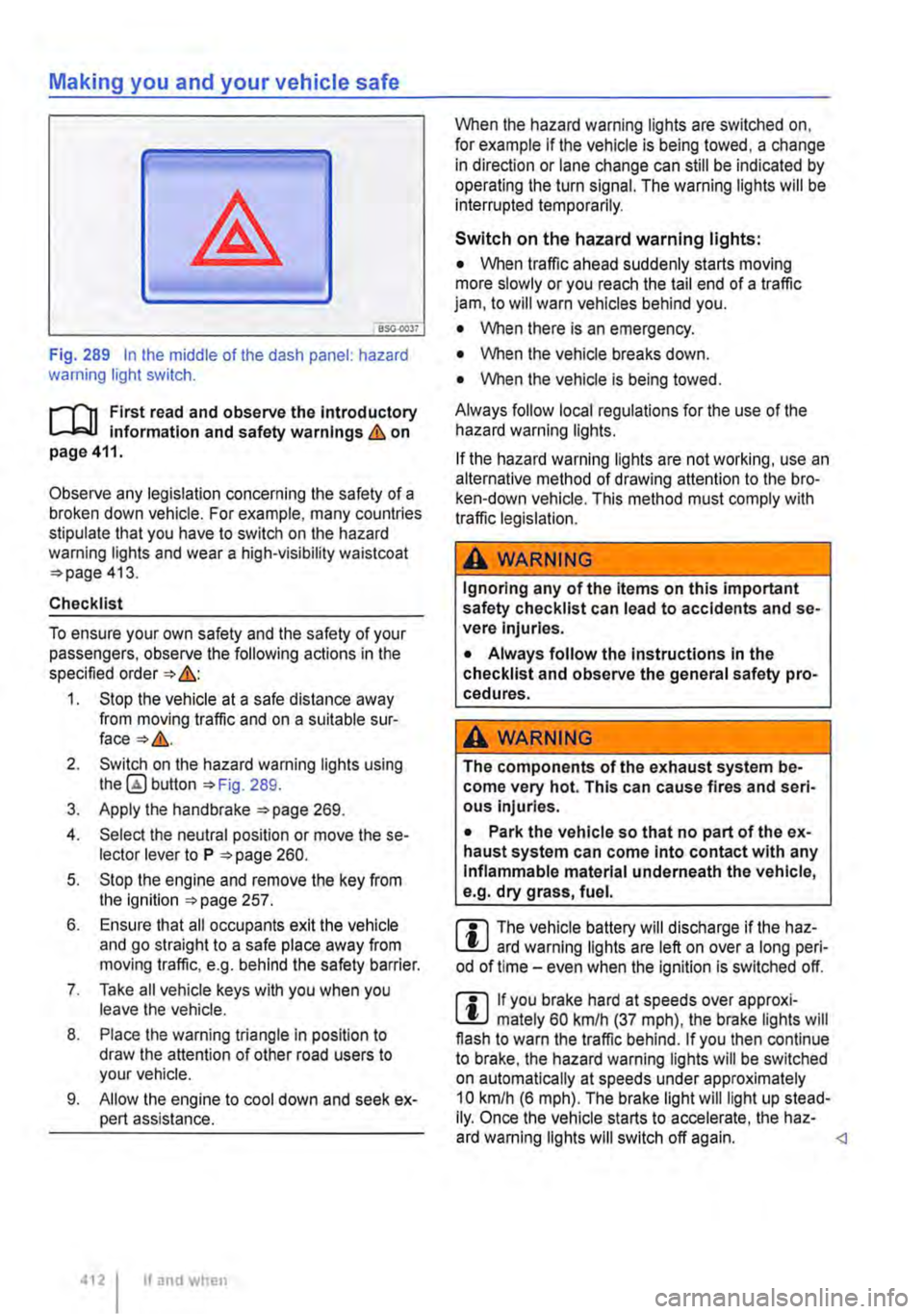
Fig. 289 In the middle of the dash panel: hazard warning light switch.
f"'""'('n First read and observe the Introductory L-lo:.U Information and safety warnings Lb. on page 411.
Observe any legislation concerning the safety of a broken down vehicle. For example, many countries stipulate that you have to switch on the hazard warning lights and wear a high-visibility waistcoat =>page 413.
Checklist
To ensure your own safety and the safety of your passengers, observe the following actions in the specified order => &:
1. Stop the vehicle at a safe distance away from moving traffic and on a suitable sur-face=>&.
2. Switch on the hazard warning lights using button =>Fig. 289.
3. Apply the handbrake =>page 269.
4. Select the neutral position or move the se-lector lever to P =>page 260.
5. Stop the engine and remove the key from the ignition =>page 257.
6. Ensure that all occupants exit the vehicle and go straight to a safe place away from moving traffic, e.g. behind the safety barrier.
7. Take all vehicle keys with you when you leave the vehicle.
8. Place the warning triangle in position to draw the attention of other road users to your vehicle.
9. Allow the engine to cool down and seek ex-pert assistance.
4121 If and when
When the hazard warning lights are switched on, for example if the vehicle is being towed, a change in direction or lane change can still be indicated by operating the turn signal. The warning lights will be interrupted temporarily.
Switch on the hazard warning lights:
• When traffic ahead suddenly starts moving more slowly or you reach the tail end of a traffic jam, to will warn vehicles behind you.
• When there is an emergency.
• When the vehicle breaks down.
• When the vehicle is being towed.
Always follow local regulations for the use of the hazard warning lights.
If the hazard warning lights are not working, use an alternative method of drawing attention to the bro-ken-down vehicle. This method must comply with traffic legislation.
A WARNING
Ignoring any of the items on this important safety checklist can lead to accidents and se-vere Injuries.
• Always follow the Instructions In the checklist and observe the general safety pro-cedures.
A wARNING
The components of the exhaust system be-come very hot. This can cause fires and seri-ous Injuries.
• Park the vehicle so that no part of the ex-haust system can come Into contact with any Inflammable material underneath the vehicle, e.g. dry grass, fuel.
m The vehicle battery will discharge if the haz-L.:!J ard warning lights are left on over a long peri-od of time -even when the Ignition is switched off.
m If you brake hard at speeds over approxi-L.:!J mately 60 km/h (37 mph), the brake lights will flash to warn the traffic behind. If you then continue to brake, the hazard warning lights will be switched on automatically at speeds under approximately 10 km/h (6 mph). The brake light will light up stead-Ily. Once the vehicle starts to accelerate, the haz-ard warning lights will switch off again.
Page 413 of 486
First aid kit, warning triangle, high-visibility waistcoat and fire
extinguisher
l"'""'('n First read and observe the introductory L.-J,::,JI Information and safety warnings & on page 411.
High-visibility waistcoat
In some vehicles there is a stowage compartment for a high-visibility waistcoat in the driver door 9.
Warning triangle
The warning triangle must comply with legal re-quirements.
First aid kit
The first aid kit must comply with legal require-ments. Comply with the expiry dates of the con-tents.
In some vehicles, there is a bag containing the warning triangle and first aid kit next to the vehicle toolkit.
To remove the bag, pull it inwards by the long end at the front while turning it downwards slightly.
Manual opening and closing
COl Introduction
This chapter contains information on the following subjects:
Unlocking the driver door manually . . . . . . . . . 414 Unlocking the tailgate manually ............ 414
Closing the sliding/tilting roof manually . . . . . 415
Unlocking the selector lever lock manually . . . 415
Should the radio signal of the remote control key or the central locking system fails, the doors, tailgate and sliding/tilting roof can be locked and, with some exceptions, unlocked manually.
Additional information and warnings:
• Vehicle key set 36
• Central locking system 39
• Doors 45
• Tailgate 49
• Sliding/tilting roof 58
• Closing the electric pop-up roof manually, Cali-fornia 192
In vehicles with a kitchenette, the first aid kit is lo-cated on the rear panel of the left stowage com-partment in the kitchen unit.
Fire extinguisher
Before using the fire extinguisher, make sure you are familiar with its operation. If an operating man-ual is supplied with the fire extinguisher, place it in the vehicle wallet.
The fire extinguisher must comply with the valid legal requirements. lt must be fully functional and checked regularly. See the test certificate on the fire extinguisher.
A WARNING
In the event of a sudden driving or braking manoeuvre or accident, loose objects could be flung though the vehicle and cause severe Injuries.
• Always secure the fire extinguisher, high-visibility waistcoat, first aid kit and warning triangle safely In the holders.
• In an emergency 411
A WARNING
Careless manual opening and closing can cause serious Injury.
• If the vehicle Is locked from the outside, the doors and windows cannot be opened from the inside.
• Never leave children or people requiring assistance alone In the vehicle. They could become trapped In the vehicle In an emergen-cy and may not be able to get themselves to safety.
• Temperatures Inside a locked vehicle may reach extremes of heat or cold, according to season. This can cause serious Injuries and Illness or fatalities, especially to small chil-dren. .,.
Practical tips 413
Page 414 of 486
A WARNING
The path of the doors, tailgate and sliding/tilt-ing roof is a dangerous area. Injuries could be sustained here.
Unlocking the driver door manually
rl'11 First read and observe the introductory L-J.:.I.I Information and safety warnings & on page 413.
If unlocked manually, only the driver door is un-locked. Observe information on the anti-theft alarm 39.
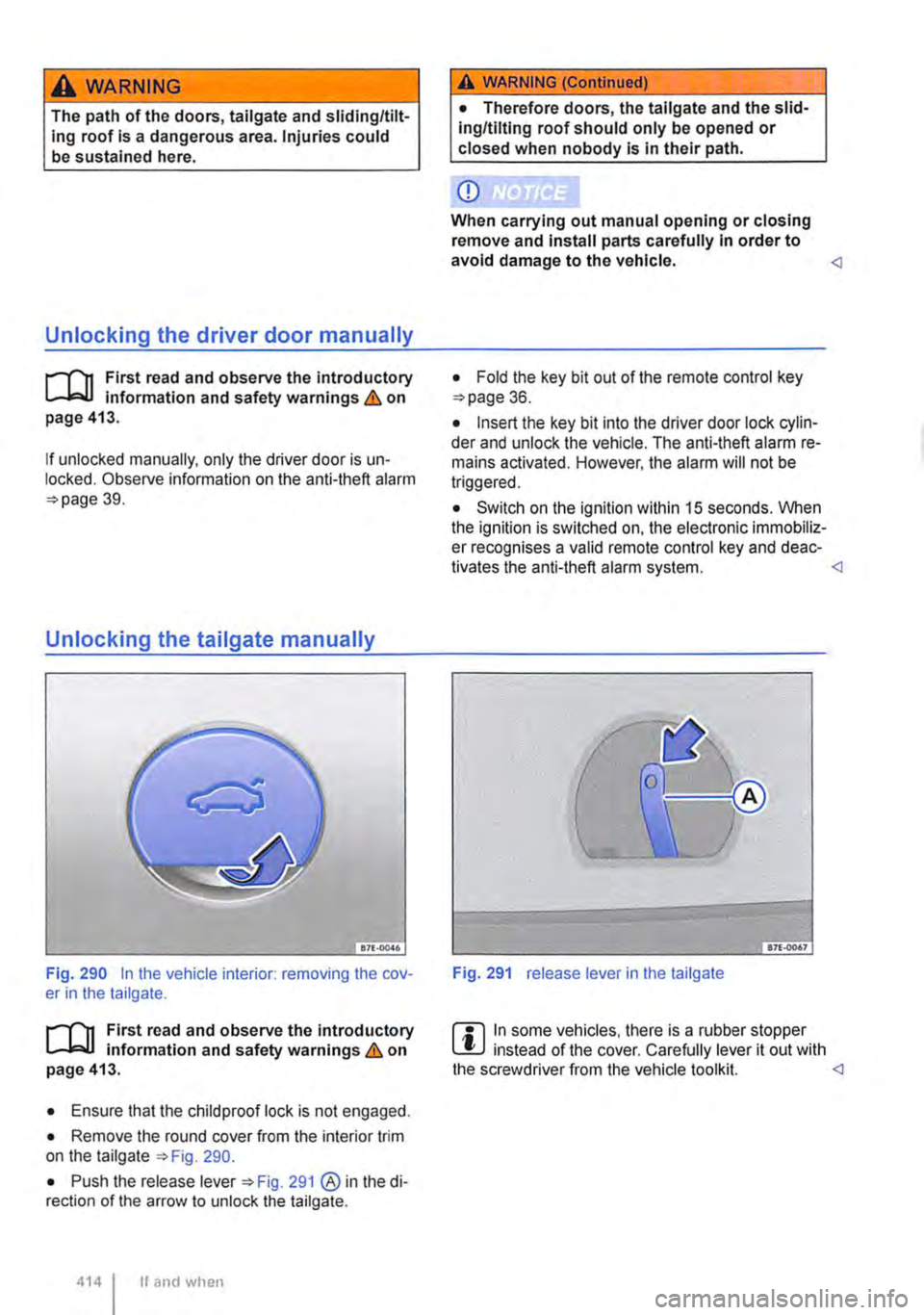
Unlocking the tailgate manually
Fig. 290 In the vehicle interior: removing the cov-er in the tailgate.
rl'11 First read and observe the introductory L-J.:.I.I information and safety warnings & on page 413.
• Ensure that the child proof lock is not engaged.
• Remove the round cover from the interior trim on the tailgate 290.
• Push the release lever 291 @ in the di-rection of the arrow to unlock the tailgate.
4141 If and when
A WARNING (Continued)
• Therefore doors, the tailgate and the slid-ing/tilting roof should only be opened or closed when nobody is in their path.
CD
When carrying out manual opening or closing remove and Install parts carefully In order to avoid damage to the vehicle.
• Insert the key bit into the driver door lock cylin-der and unlock the vehicle. The anti-theft alarm re-mains activated. However, the alarm will not be triggered.
• Switch on the ignition within 15 seconds. When the ignition is switched on, the electronic immobiliz-er recognises a valid remote control key and deac-tivates the anti-theft alarm system.
m In some vehicles, there is a rubber stopper l!.J instead of the cover. Carefully lever it out with the screwdriver from the vehicle toolkit.
Page 415 of 486
Closing the sliding/tilting roof manually
r-111 First read and observe the introductory L-J,.:.U information and safety warnings & on page 413.
• Take the screwdriver from the vehicle tool kit.
• Remove cover with the sliding/tilting roof rotary button. Use the flat blade of the screwdriver side-ways between the cover and the roof console and pull it downwards.
• Fit a commercially available hexagon key1) of the right size in the hexagon socket head bolt and push the hexagon key approximately 2 mm up-wards.
• Turn the hexagon key to close the sliding/tilting roof.
• Remove the hexagon key and fit the cover again. The cover should lie flush with the surround-ing parts.
• The sliding/tilting roof should be checked by a qualified workshop. The functioning and roll-back function of the sliding/tilting roof could malfunction if it is closed manually.
BSG-
r-111 First read and observe the introductory L-J,.:.lJ information and safety warnings & on page 413.
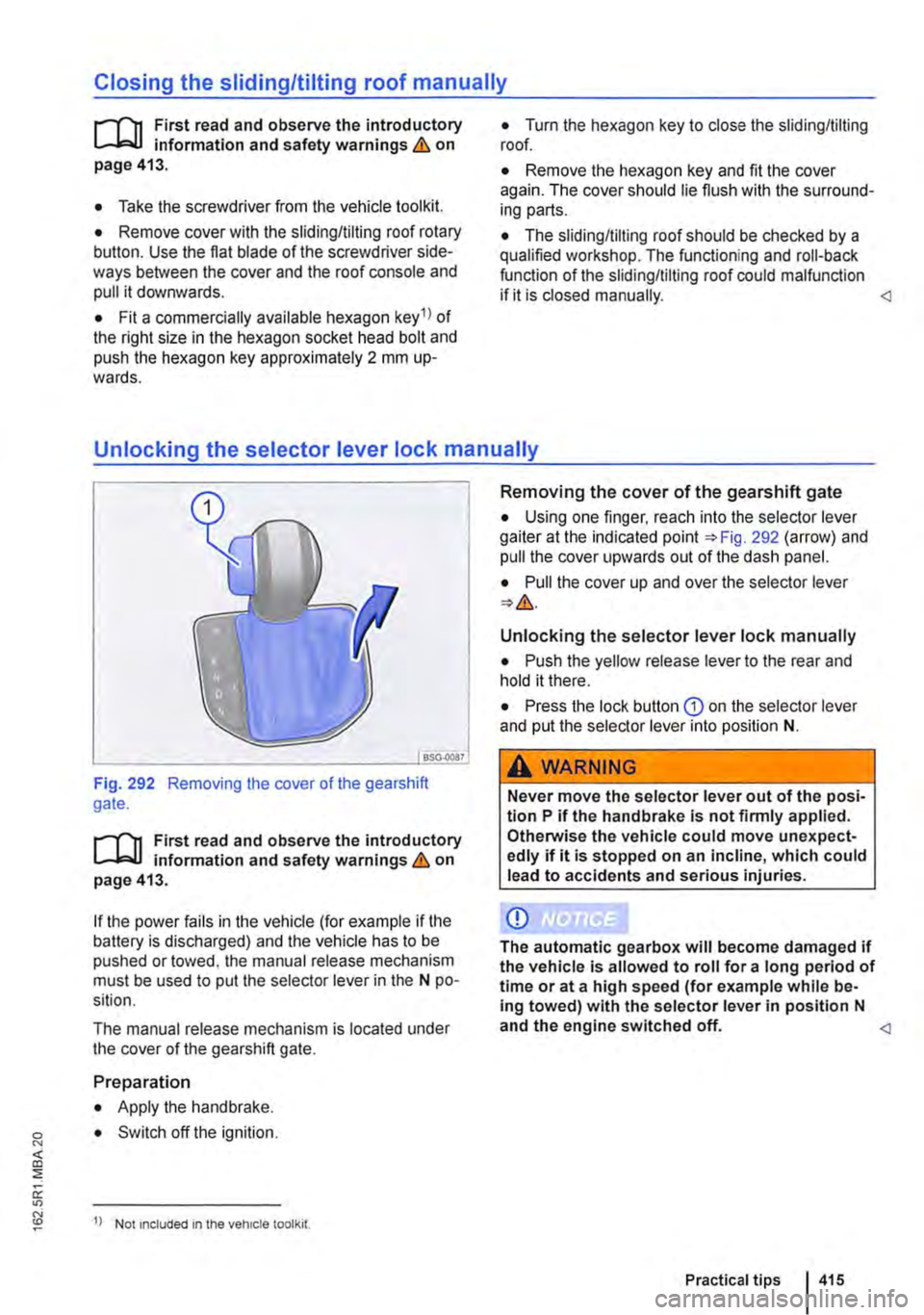
If the power fails in the vehicle (for example if the battery is discharged) and the vehicle has to be pushed or towed, the manual release mechanism must be used to put the selector lever in the N po-sition.
The manual release mechanism is located under the cover of the gearshift gate.
Preparation
• Apply the handbrake.
• Switch off the ignition.
< CD
;;;: "' 1) Not included in the vehicle toolkit.
Removing the cover of the gearshift gate
• Using one finger, reach into the selector lever gaiter at the indicated Fig. 292 (arrow) and pull the cover upwards out of the dash panel.
• Pull the cover up and over the selector lever
Unlocking the selector lever lock manually
• Push the yellow release lever to the rear and hold it there.
• Press the lock button G) on the selector lever and put the selector lever into position N.
A WARNING
Never move the selector lever out of the posi-tion P if the handbrake is not finnly applied. Otherwise the vehicle could move unexpect-edly if it is stopped on an incline, which could lead to accidents and serious injuries.
CD
The automatic gearbox will become damaged if the vehicle is allowed to roll for a long period of time or at a high speed (for example while be-ing towed) with the selector lever in position N and the engine switched off.
Page 420 of 486
Changing a wheel
CllJ Introduction
This chapter contains information on the following subjects:
Preparations for changing a wheel . . . . . . . . . 420
Wheel bolts . . . . . . . . . . . . . . . . . . . 421
Lifting the vehicle with the jack . . . . . . . . . . . . 423
Changing a wheel . . . . . . . . . . . . . . . . . . . . . . . 424
After changing a wheel . . . . . . . . . . . . . 425
Some models are delivered without a factory-fitted jack or box spanner. If this is the case, the wheel should be changed by a qualified workshop.
The vehicle jack supplied with the vehicle is only designed for changing a wheel when one vehicle tyre is damaged and has to be replaced. Seek ex-pert assistance if both tyres on one side of the ve-hicle, both tyres on one axle, or all tyres are dam-aged.
Only change the wheel yourself when the car is parked in a safe place, you are familiar with the necessary steps and safety procedures and you have access to all the correct tools. Seek expert assistance if this is not the case.
Additional information and warnings:
• Exterior views =>page 5
• Vehicle key set =>page 36
• Tyre monitoring system =>page 318
• Wheels and tyres =>page 367
• In an emergency =>page 411
• Vehicle tool kit =>page 416
• Hubcaps =>page 417
Preparations for changing a wheel
1"1'11 First read and observe the introductory L-1o:.U information and safety warnings & on page 420.
Checklist
The following actions must always be carried out in the given order in preparation for changing the wheel=>&:
1. In the event of a flat tyre, park your vehicle on a firm and level surface at a safe dis-tance from the flow of traffic.
2. Apply the handbrake =>page 269.
420 I If and when
A wARNING
Changing a wheel can be dangerous, espe-cially when carried out at the side of a road. Please note the following steps in order to re-duce the risk of serious injuries:
• Stop the vehicle as soon as possible and when safe to do so. Park the vehicle at a safe distance from moving traffic in order to carry out the wheel change.
• All passengers and children in particular must be at a safe distance and away from your area of work during the wheel change.
• Switch on the hazard warning lights to warn other road users.
• Check that the surface the vehicle Is parked on Is level and firm. If necessary use a large, strong board or similar support for the vehicle jack.
• Only change the wheel yourself if you feel confident carrying out the procedure. If not, seek expert assistance.
• Always use suitable and undamaged tools to change the wheel.
• Always switch off the engine, apply the handbrake and move the selector lever to the position P or select a gear on a manual gear-box in order to reduce the risk of unintended vehicle movement.
• The wheel bolt tightening torque should be checked with a torque wrench immediately after changing a wheel.
4. Stop the engine and remove the key from the ignition =>page 257.
5. Manual gearbox: select a gear =>page 260.
6. Make sure all vehicle occupants exit the ve-hicle and move to safety, for instance be-hind the safety barrier.
7. Chock the wheel diagonally opposite the wheel being worked on with a stone or a similar object. ""
Page 426 of 486
• If the tyre pressure is very low or the tyres are flat.
• If the use-by date on the tyre filler bottle has ex-pired.
Additional information and warnings:
• Vehicle key set 36
• Seat functions, front 69
• Stowage 150
• Braking, stopping and parking =>page 269
• Wheels and tyres 367
• In an emergency 411
• Hubcaps 417
A WARNING
Using the breakdown set can be dangerous, especially if the tyres are inflated at the road-side. Please note the following points In or-der to reduce the risk of serious injuries:
• Stop the vehicle as soon as possible and when safe to do so. Park the vehicle at a safe distance from moving traffic in order to fill the tyre.
• Check that the surface the vehicle is parked on is level and firm.
• All passengers, and children in particular, must be at a safe distance and away from your area of work.
• Switch on the hazard warning lights to warn other road users.
• The breakdown set should only be used if you feel confident with carrying out the pro-cedure. If not, seek expert assistance.
Storing
rT'n First read and observe the introductory L-W.I information and safety warnings & on page 425.
Model
Multivan
California
426 I If and when
A WARNING (Continued)
• Tyres repaired with the breakdown set are intended for temporary, emergency use only. They should only be used until you can reach the nearest qualified workshop.
• Tyres that have been repaired using the breakdown set should be replaced as soon as possible.
• Sealant Is hazardous to health and must be washed off Immediately if it gets onto the skin.
• The breakdown set must be stored out of the reach of children.
• Never use a vehicle jack, even If it Is ap-proved for the vehicle.
• Always switch off the engine, apply the handbrake and move the selector lever to the position P or select a gear on a manual gear-box In order to reduce the risk of unintended vehicle movement.
A WARNING
Tyres that have been filled with sealant will not handle In the same way as a standard tyre.
• Never drive faster than 80 km/h (50 mph).
• Avoid full acceleration, sudden braking and fast driving through bends In the road.
• Drive for just 10 minutes at no more than 80 km/h (50 m ph) and then check the tyre.
Dispose of used or out-of-date sealant in ac-W cordance with legal requirements.
m You can get a new tyre filler bottle from a L!:J Volkswagen Commercial Vehicles dealership.
m Observe the separate instructions from the l!:J manufacturer of the breakdown set. <1
The breakdown set can be located in different pla-ces depending on the model.
Stowage
In the drawer in the 3-seat bench or in the drawer of the rear left single seat.
Behind the load-through hatch cover on the side of the bench seat/bed. <1
Page 427 of 486
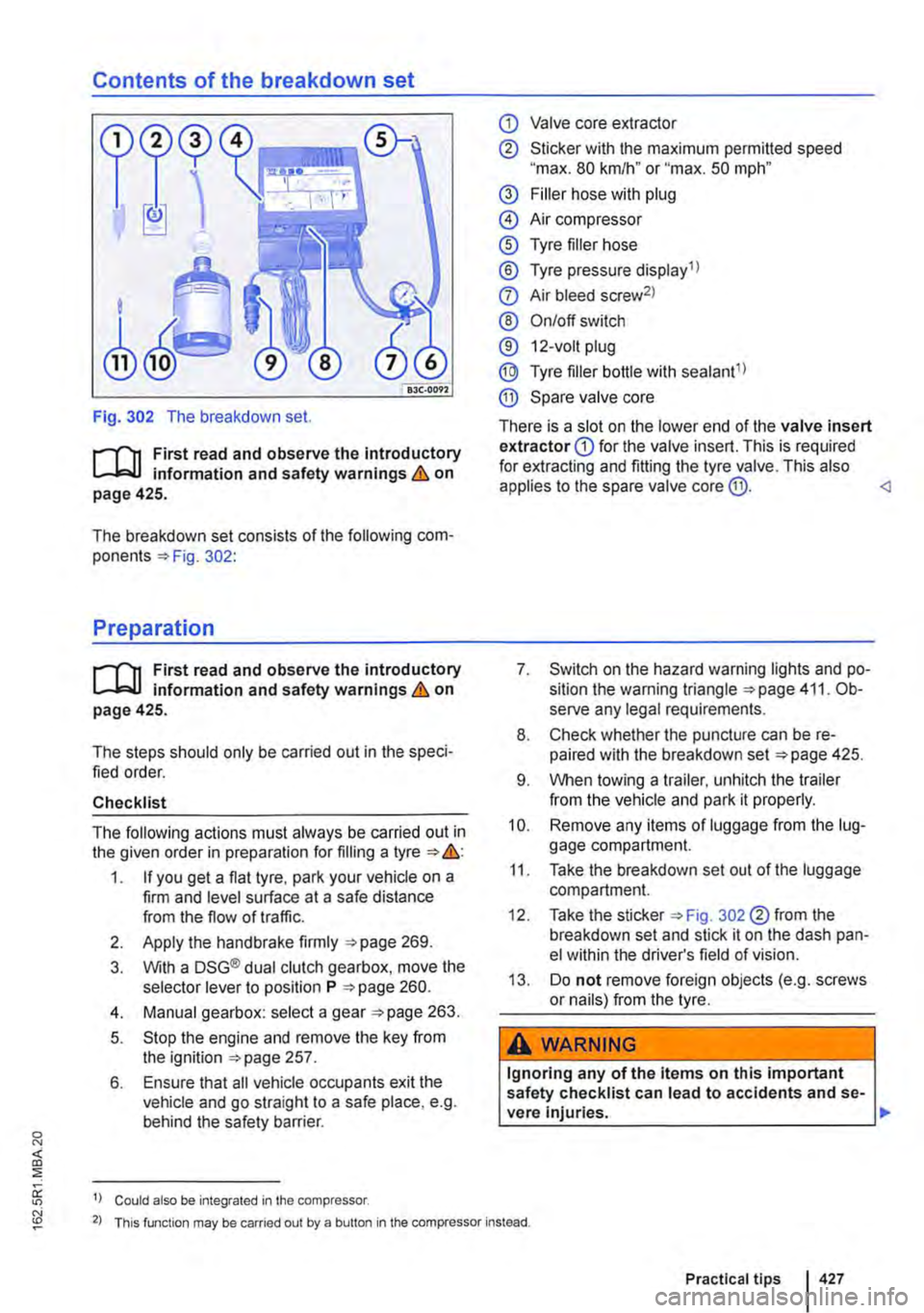
Contents of the breakdown set
Fig. 302 The breakdown set.
r--T'n First read and observe the introductory L-L::.U information and safety warnings & on page 425.
The breakdown set consists of the following com-ponents 302:
Preparation
r--T'n First read and observe the introductory L-L::.U information and safety warnings & on page 425.
The steps should only be carried out in the speci-fied order.
Checklist
The following actions must always be carried out in the given order in preparation for filling a tyre &:
1. If you get a flat tyre, park your vehicle on a firm and level surface at a safe distance from the flow of traffic.
2. Apply the handbrake firmly 269.
3. With a DSG® dual clutch gearbox, move the selector lever to position P 260.
4. Manual gearbox: select a gear 263.
5. Stop the engine and remove the key from the ignition 257.
6. Ensure that all vehicle occupants exit the vehicle and go straight to a safe place, e.g. behind the safety barrier.
1) Could also be integrated in the compressor.
CD Valve core extractor
® Sticker with the maximum permitted speed "max. 80 km/h" or "max. 50 mph"
@ Filler hose with plug
@ Air compressor
® Tyre filler hose
® Tyre pressure display 1 l
0 Air bleed screw2l
® On/off switch
® 12-volt plug
@ Tyre filler bottle with sealant1l
® Spare valve core
There is a slot on the lower end of the valve insert extractor CD for the valve insert. This is required for extracting and fitting the tyre valve. This also applies to the spare valve core @.
8. Check whether the puncture can be re-paired with the breakdown set 425.
9. When towing a trailer, unhitch the trailer from the vehicle and park it properly.
10. Remove any items of luggage from the lug-gage compartment.
11. Take the breakdown set out of the luggage compartment.
12. Take the sticker 302 ®from the breakdown set and stick it on the dash pan-el within the driver's field of vision.
13. Do not remove foreign objects (e.g. screws or nails) from the tyre.
A WARNING
Ignoring any of the items on this important safety checklist can lead to accidents and se-vere Injuries. ,..
2) This function may be carried out by a button in the compressor instead.
Practical tips 427
Page 430 of 486
A WARNING (Continued)
• Never fit fuses that have a higher fuse pro-tection limit. Fuses must always be replaced by a new fuse with the same amp rating (same colour and markings) and size.
• Never repair a fuse.
• Never use a metal strip, paper clip or simi-lar objects to replace a fuse.
Fuse box in the dash panel
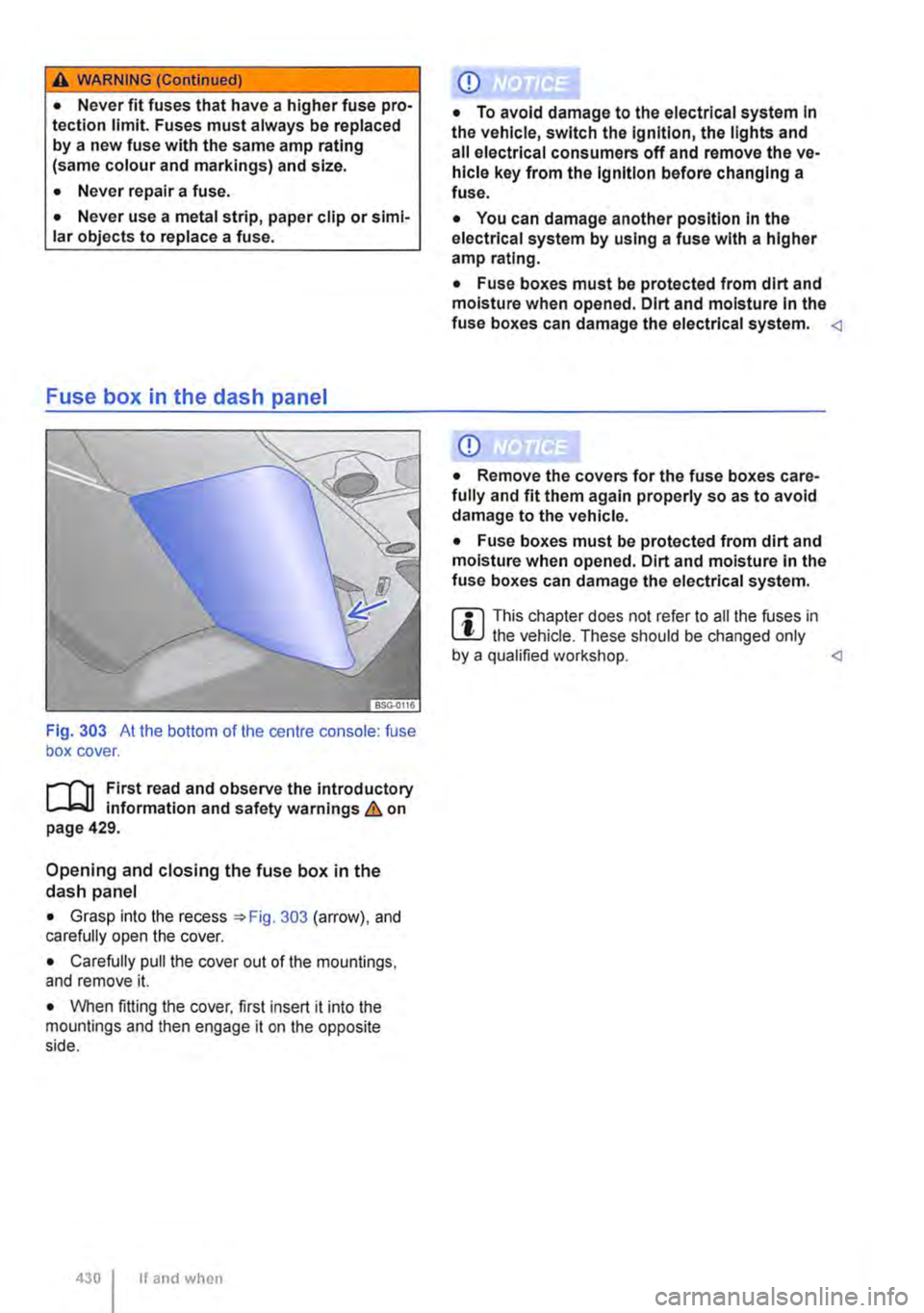
Fig. 303 At the bottom of the centre console: fuse box cover.
r-f"'n First read and observe the introductory information and safety warnings & on page 429.
Opening and closing the fuse box in the dash panel
• Grasp into the recess =>Fig. 303 (arrow), and carefully open the cover.
• Carefully pull the cover out of the mountings, and remove it.
• When fitting the cover. first insert it into the mountings and then engage it on the opposite side.
430 If and when
CD
• To avoid damage to the electrical system in the vehicle, switch the Ignition, the lights and all electrical consumers off and remove the ve-hicle key from the ignition before changing a fuse.
• You can damage another position In the electrical system by using a fuse with a higher amp rating.
• Fuse boxes must be protected from dirt and moisture when opened. Dirt and moisture In the fuse boxes can damage the electrical system. <1
CD
• Remove the covers for the fuse boxes care-fully and fit them again properly so as to avoid damage to the vehicle.
• Fuse boxes must be protected from dirt and moisture when opened. Dirt and moisture in the fuse boxes can damage the electrical system.
m This chapter does not refer to all the fuses in W the vehicle. These should be changed only by a qualified workshop. <1