ACC assist VOLKSWAGEN TRANSPORTER 2015 Owner´s Manual
[x] Cancel search | Manufacturer: VOLKSWAGEN, Model Year: 2015, Model line: TRANSPORTER, Model: VOLKSWAGEN TRANSPORTER 2015Pages: 486, PDF Size: 72.17 MB
Page 350 of 486
Cleaning and maintenance
In the engine compartment
Preparation for working in the engine compartment
ClJ Introduction
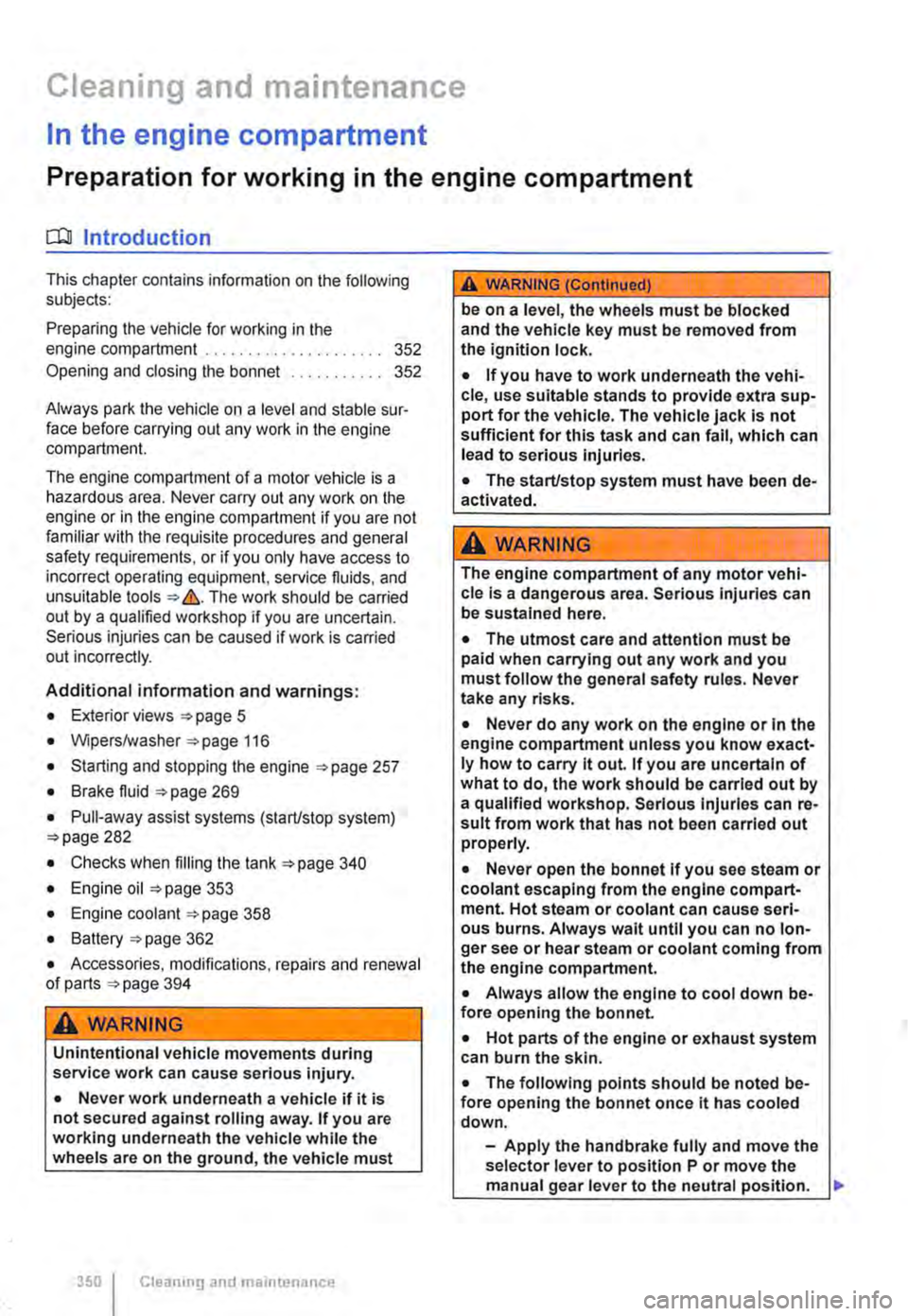
This chapter contains information on the following subjects:
Preparing the vehicle for working in the engine compartment . . . . . . . . . . . . . . . . . 352 Opening and closing the bonnet 352
Always park the vehicle on a level and stable sur-face before carrying out any work in the engine compartment.
The engine compartment of a motor vehicle is a hazardous area. Never carry out any work on the engine or in the engine compartment if you are not familiar with the requisite procedures and general safety requirements, or if you only have access to incorrect operating equipment, service fluids, and unsuitable tools &. The work should be carried out by a qualified workshop if you are uncertain. Serious injuries can be caused if work is carried out incorrectly.
Additional information and warnings:
• Exterior views 5
• Wipers/washer 116
• Starting and stopping the engine 257
• Brake fluid 269
• Pull-away assist systems (starUstop system) 282
• Checks when filling the tank 340
• Engine oil 353
• Engine coolant 358
• Battery page 362
• Accessories, modifications, repairs and renewal of parts 394
A wARNING
Unintentional vehicle movements during service work can cause serious injury.
• Never work underneath a vehicle if it is not secured against rolling away. If you are working underneath the vehicle while the wheels are on the ground, the vehicle must
350 I Cleanmg and maintenance
A WARNING (Continued)
be on a level, the wheels must be blocked and the vehicle key must be removed from the ignition lock.
• If you have to work underneath the vehi-cle, use suitable stands to provide extra sup-port for the vehicle. The vehicle jack is not sufficient for this task and can fail, which can lead to serious injuries.
• The start/stop system must have been de-activated.
A WARNING
The engine compartment of any motor vehi-cle is a dangerous area. Serious injuries can be sustained here.
• The utmost care and attention must be paid when carrying out any work and you must follow the general safety rules. Never take any risks.
• Never do any work on the engine or in the engine compartment unless you know exact-ly how to carry it out. If you are uncertain of what to do, the work should be carried out by a qualified workshop. Serious Injuries can re-sult from work that has not been carried out properly.
• Never open the bonnet if you see steam or coolant escaping from the engine compart-ment. Hot steam or coolant can cause seri-ous burns. Always wait until you can no lon-ger see or hear steam or coolant coming from the engine compartment.
• Always allow the engine to cool down be-fore opening the bonnet.
• Hot parts of the engine or exhaust system can burn the skin.
• The following points should be noted be-fore opening the bonnet once it has cooled down.
-Apply the handbrake fully and move the selector lever to position P or move the manual gear lever to the neutral position. .,..
Page 354 of 486
A WARNING
Incorrect handling of engine oil can cause se-rious burns and other Injuries.
• Always wear eye protection when han-dling engine oil.
• Engine oil is toxic and must be stored out of the reach of children.
• Engine oil must be kept in the closed orig-inal container. This also applies to used oil until it is disposed of.
• Never use empty food containers, bottles or other containers to store engine oil as oth-er people may then drink the engine oil.
Warning and indicator lamps
A WARNING (Continued)
• Regular contact with engine oil can dam-age the skin. Skin that has been in contact with engine oil should be washed thoroughly with water and soap.
• Engine oil becomes extremely hot when the engine is running and can scald skin se-verely. Always allow the engine to cool down.
Leaking or spilt engine oil can pollute the en-(!Jtf vironment. Spilt service fluids must be collec-ted then disposed of properly and in an environ-mentally responsible way.
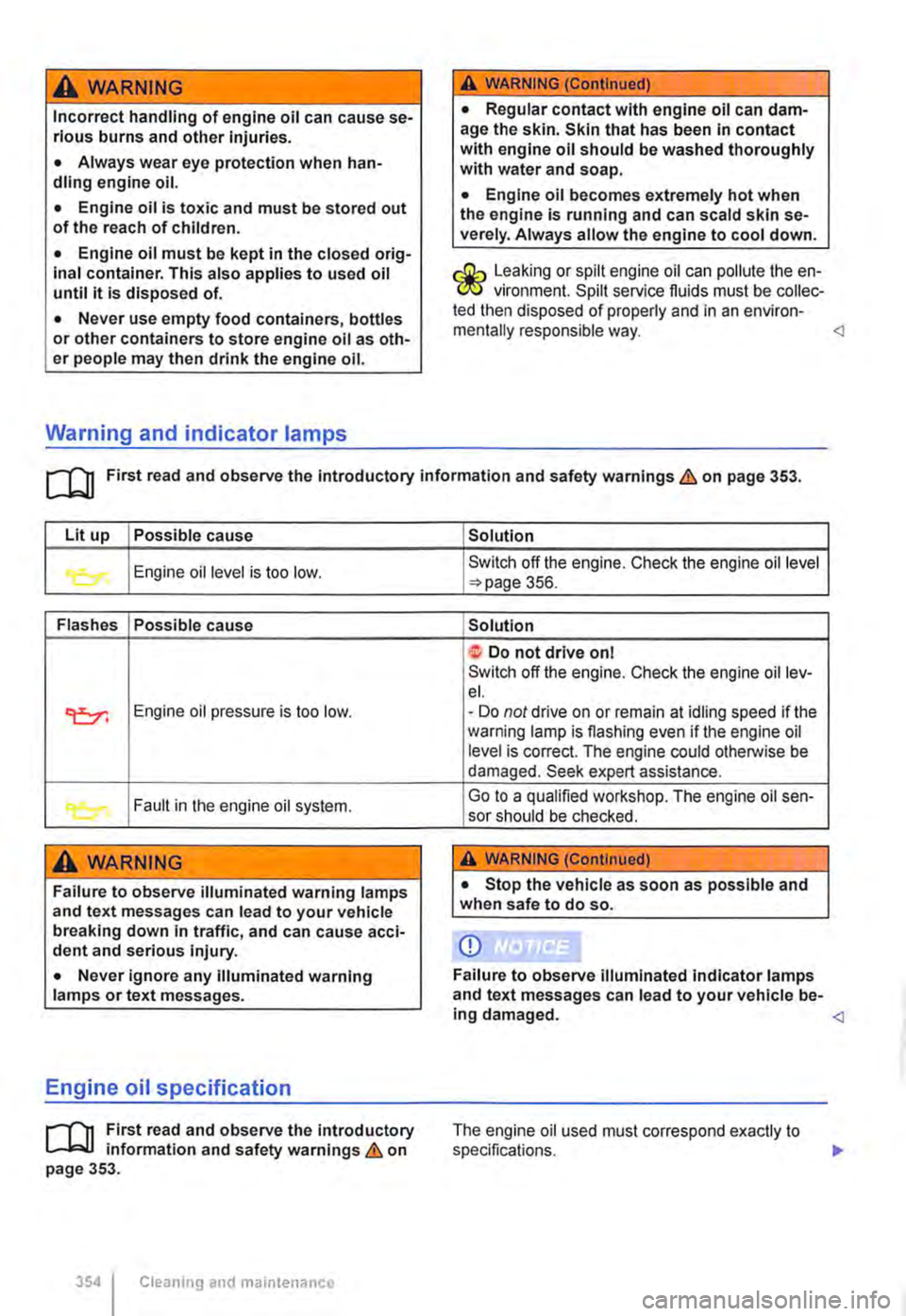
Lit up Possible cause
Engine oil level is too low. -
Flashes Possible cause
c:e:r. Engine oil pressure is too low.
r... Fault in the engine oil system.
A WARNING
Failure to observe illuminated warning lamps and text messages can lead to your vehicle breaking down in traffic, and can cause acci-dent and serious injury.
• Never ignore any illuminated warning lamps or text messages.
Engine oil specification
rT'n First read and observe the introductory L-J,::.U information and safety warnings & on page 353.
354 I Cleaning and maintenance
Solution
Switch off the engine. Check the engine oil level "'Page 356.
Solution
t Do not drive on I Switch off the engine. Check the engine oillev-el. • Do not drive on or remain at idling speed if the warning lamp is flashing even if the engine oil level is correct. The engine could otherwise be damaged. Seek expert assistance.
Go to a qualified workshop. The engine oil sen-sor should be checked.
A WARNING (Continued)
• Stop the vehicle as soon as possible and when safe to do so.
Q)
Failure to observe illuminated Indicator lamps and text messages can lead to your vehicle be-ing damaged.
Page 359 of 486
Warning lamp and coolant temperature display
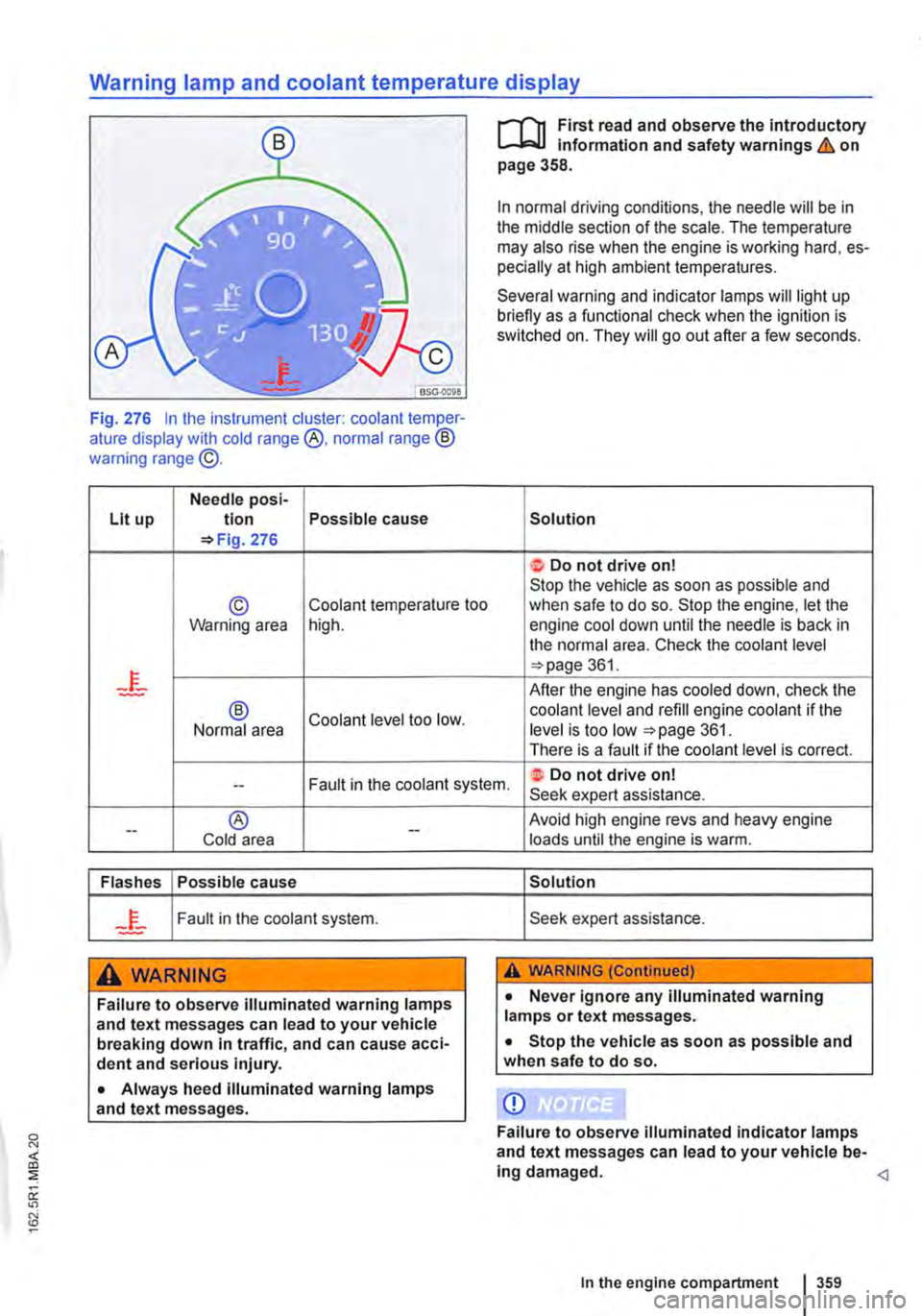
Fig. 276 In the instrument cluster: coolant temper-ature display with cold range @, normal range ® warning range @.
Needle posi-Lit up tion Possible cause =>Fig. 276
© Coolant temperature too Warning area high.
® Coolant level too low. Normal area
r-f"n First read and observe the introductory L,....J.:.lJ Information and safety warnings & on page 358.
In normal driving conditions, the needle will be in the middle section of the scale. The temperature may also rise when the engine is working hard, es-pecially at high ambient temperatures.
Several warning and indicator lamps will light up briefly as a functional check when the ignition is switched on. They will go out after a few seconds.
Solution
t Do not drive on! Stop the vehicle as soon as possible and when safe to do so. Stop the engine, let the engine cool down until the needle is back in the normal area. Check the coolant level =>page 361.
After the engine has cooled down, check the coolant level and refill engine coolant if the level is too low =>page 361. There is a fault if the coolant level is correct.
Fault in the coolant system. ·t Do not drive on! --Seek expert assistance.
--® Cold area --
Flashes Possible cause
Fault in the coolant system.
A WARNING
Failure to observe illuminated warning lamps and text messages can lead to your vehicle breaking down In traffic, and can cause acci-dent and serious injury.
• Always heed illuminated warning lamps and text messages.
Avoid high engine revs and heavy engine loads until the engine is warm.
Solution
Seek expert assistance.
A WARNING (Continued)
• Never ignore any illuminated warning lamps or text messages.
• Stop the vehicle as soon as possible and when safe to do so.
CD
Failure to observe illuminated indicator lamps and text messages can lead to your vehicle be-ing damaged.
Page 361 of 486
Checking the coolant level and refilling coolant
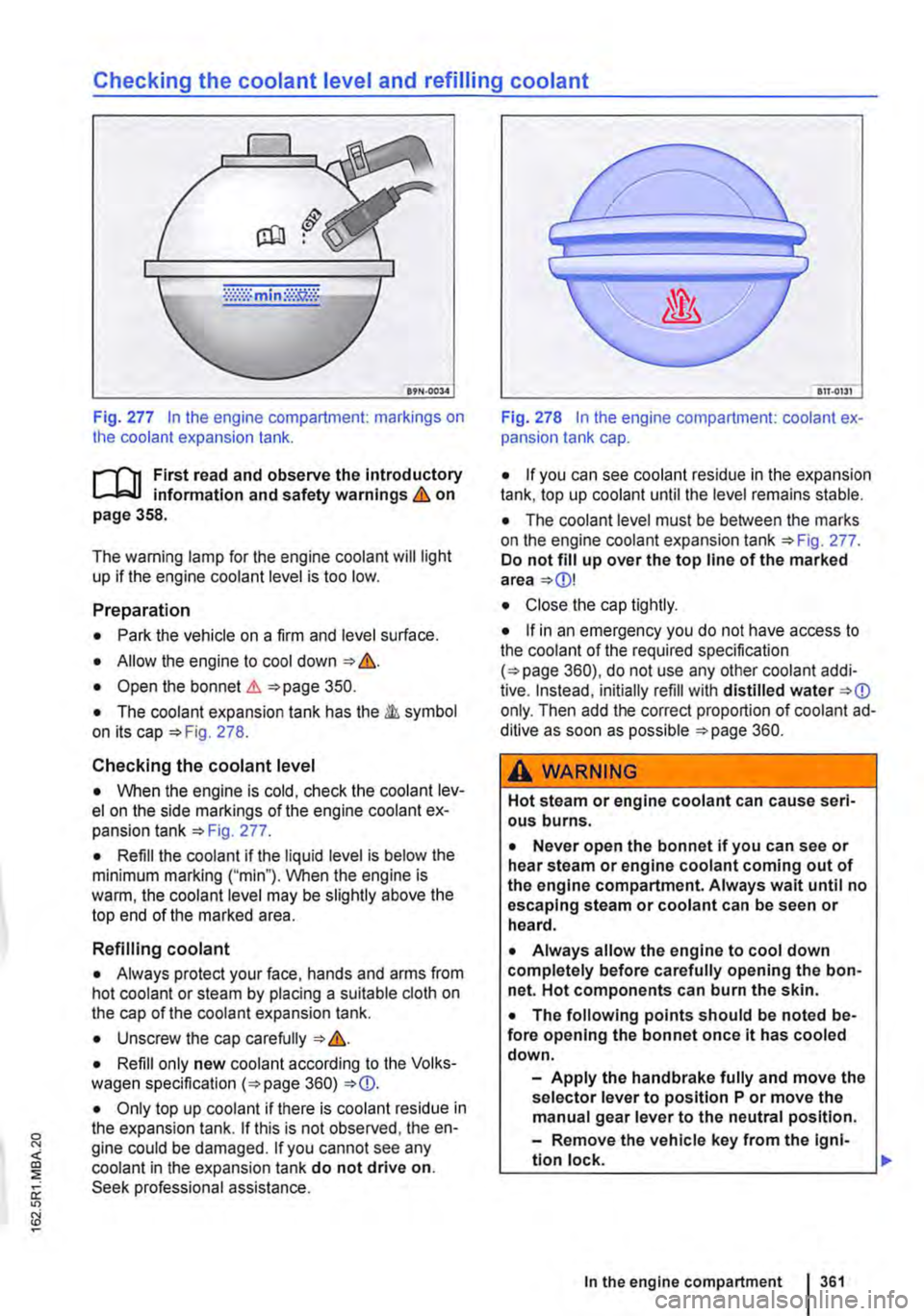
Fig. 277 In the engine compartment: markings on the coolant expansion tank.
r--f'n First read and observe the Introductory information and safety warnings & on page 358.
The warning lamp for the engine coolant will light up if the engine coolant level is too low.
Preparation
• Park the vehicle on a firm and level surface.
• Allow the engine to cool down &.
• Open the bonnet&. 350.
• The coolant expansion tank has the all. symbol on its cap 278.
Checking the coolant level
• When the engine is cold, check the coolant lev-el on the side markings of the engine coolant ex-pansion tank 277.
• Refill the coolant if the liquid level is below the minimum marking ("min"). When the engine is warm, the coolant level may be slightly above the top end of the marked area.
Refilling coolant
• Always protect your face, hands and arms from hot coolant or steam by placing a suitable cloth on the cap of the coolant expansion tank.
• Unscrew the cap carefully &.
• Refill only new coolant according to the Volks-wagen specification 360)
• Only top up coolant if there is coolant residue in the expansion tank. If this is not observed, the en-gine could be damaged. If you cannot see any coolant in the expansion tank do not drive on. Seek professional assistance.
Fig. 278 In the engine compartment: coolant ex-pansion tank cap.
• If you can see coolant residue in the expansion tank, top up coolant until the level remains stable.
• The coolant level must be between the marks on the engine coolant expansion tank 277. Do not fill up over the top line of the marked area
• Close the cap tightly.
• If in an emergency you do not have access to the coolant of the required specification 360), do not use any other coolant addi-tive. Instead, initially refill with distilled water only. Then add the correct proportion of coolant ad-ditive as soon as possible 360.
A WARNING
Hot steam or engine coolant can cause seri-ous burns.
• Never open the bonnet if you can see or hear steam or engine coolant coming out of the engine compartment. Always wait until no escaping steam or coolant can be seen or heard.
• Always allow the engine to cool down completely before carefully opening the bon-net. Hot components can burn the skin.
• The following points should be noted be-fore opening the bonnet once it has cooled down.
-Apply the handbrake fully and move the selector lever to position P or move the manual gear lever to the neutral position.
-Remove the vehicle key from the lgni-
In the engine compartment I 361
Page 363 of 486
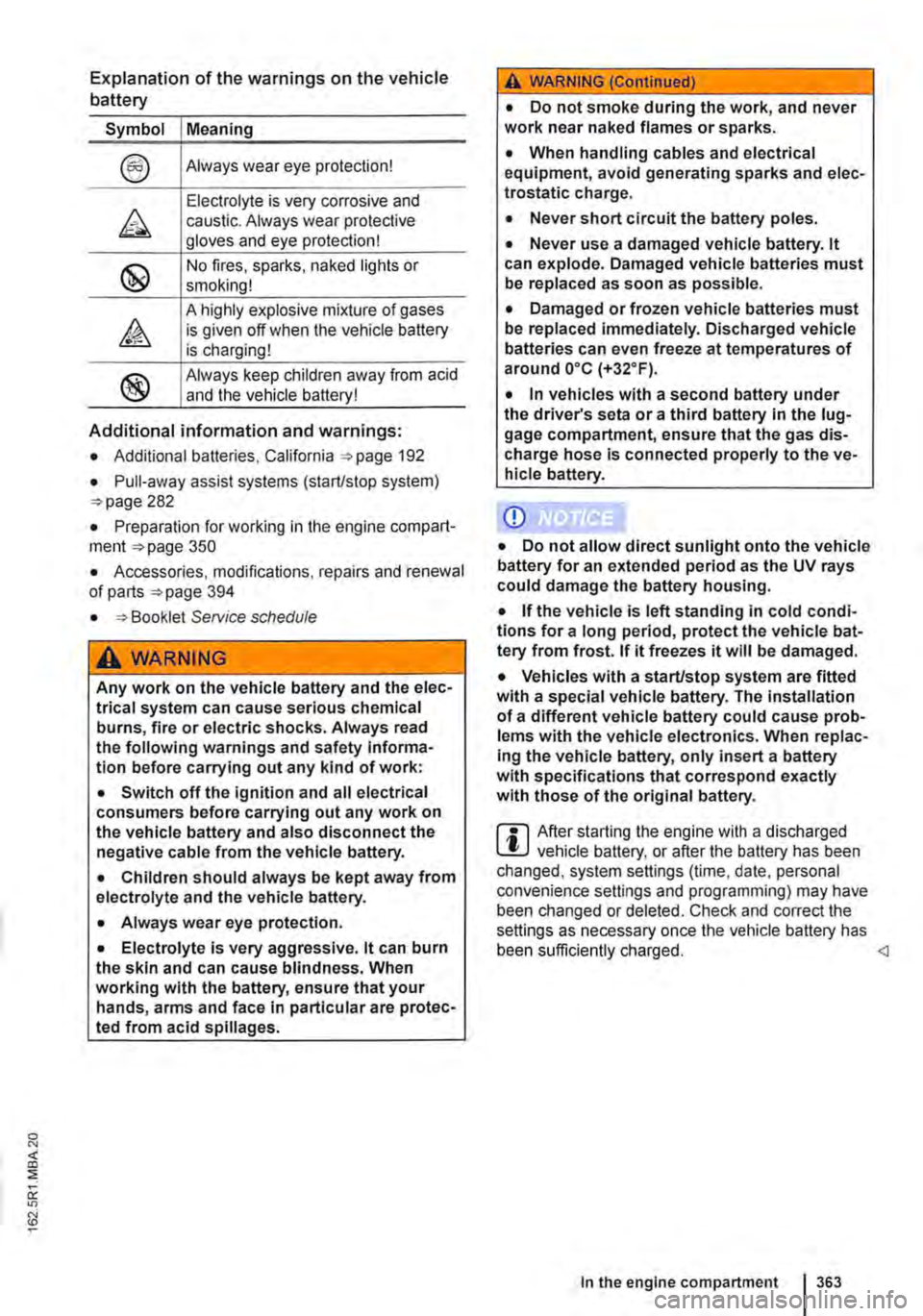
Explanation of the warnings on the vehicle battery
Symbol Meaning
Always wear eye protection!
Electrolyte is very corrosive and caustic. Always wear protective gloves and eye protection!
No fires, sparks, naked lights or smoking!
A highly explosive mixture of gases is given off when the vehicle battery is charging!
Always keep children away from acid and the vehicle battery!
Additional information and warnings:
• Additional batteries, California 192
• Pull-away assist systems (starUstop system) 282
• Preparation for working in the engine compart-ment 350
• Accessories, modifications, repairs and renewal of parts 394
• Service schedule
A WARNING
Any work on the vehicle battery and the elec-trical system can cause serious chemical burns, fire or electric shocks. Always read the following warnings and safety informa-tion before carrying out any kind of work:
• Switch off the ignition and all electrical consumers before carrying out any work on the vehicle battery and also disconnect the negative cable from the vehicle battery.
• Children should always be kept away from electrolyte and the vehicle battery.
• Always wear eye protection.
• Electrolyte Is very aggressive. lt can burn the skin and can cause blindness. When working with the battery, ensure that your hands, arms and face in particular are protec-ted from acid spillages.
A WARNING (Continued)
• Do not smoke during the work, and never work near naked flames or sparks.
• When handling cables and electrical equipment, avoid generating sparks and elec-trostatic charge.
• Never short circuit the battery poles.
• Never use a damaged vehicle battery. it can explode. Damaged vehicle batteries must be replaced as soon as possible.
• Damaged or frozen vehicle batteries must be replaced immediately. Discharged vehicle batteries can even freeze at temperatures of around ooc (+32°F).
• In vehicles with a second battery under the driver's seta or a third battery in the lug-gage compartment, ensure that the gas dis-charge hose is connected properly to the ve-hicle battery.
• If the vehicle is left standing in cold condi-tions for a long period, protect the vehicle bat-tery from frost. If it freezes it wilt be damaged.
• Vehicles with a starUstop system are fitted with a special vehicle battery. The installation of a different vehicle battery could cause prob-lems with the vehicle electronics. When replac-ing the vehicle battery, only insert a battery with specifications that correspond exactly with those of the original battery.
W After starting the engine with a discharged L!J vehicle battery, or after the battery has been changed, system settings (time, date, personal convenience settings and programming) may have been changed or deleted. Check and correct the settings as necessary once the vehicle battery has been sufficiently charged.
Page 367 of 486
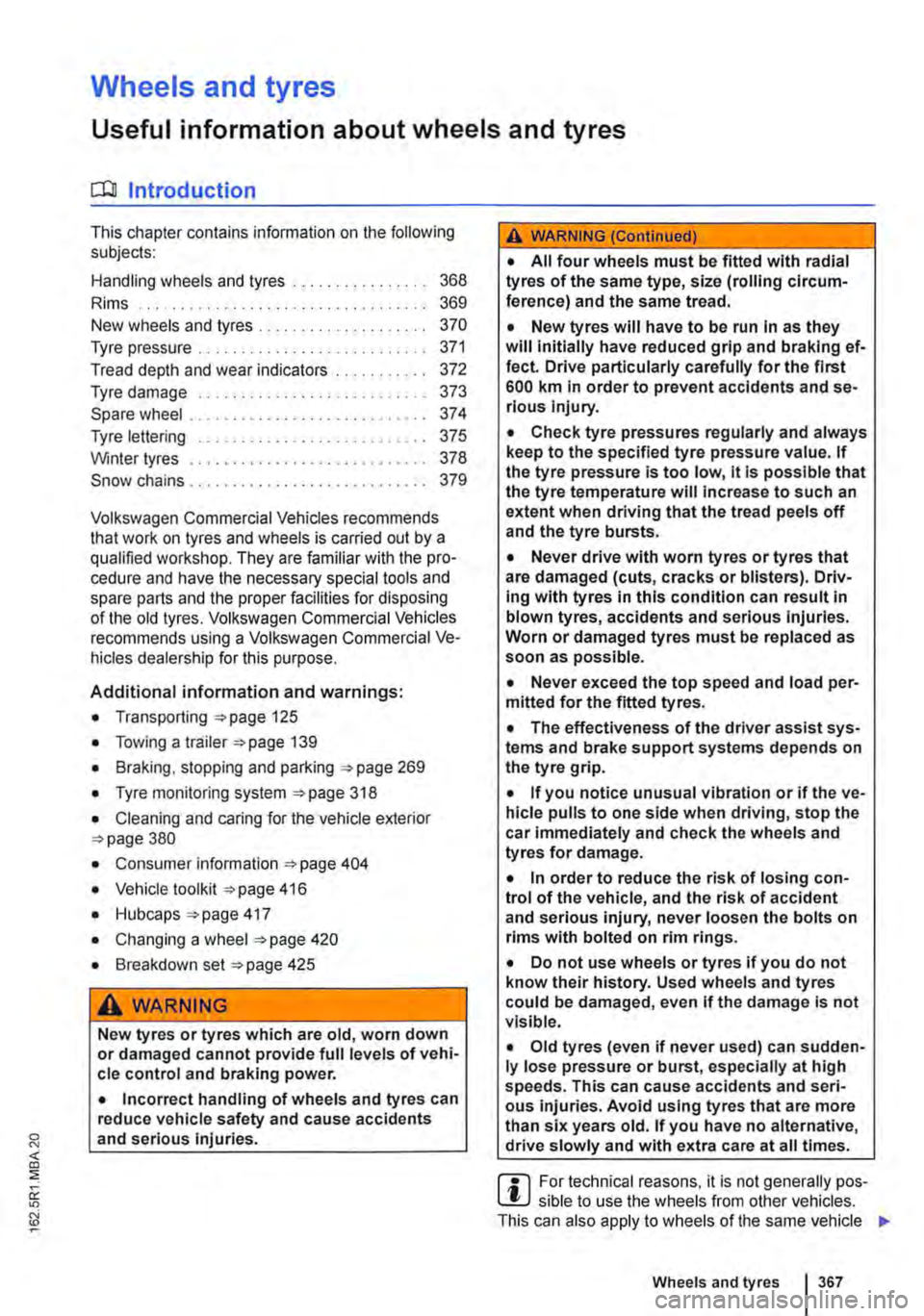
Wheels and tyres
Useful information about wheels and tyres
o:::n Introduction
This chapter contains information on the following subjects:
Handling wheels and tyres .............. .
Rims
368
369
New wheels and tyres . . . . . . . . . . . . . . . . . . . 370 Tyre pressure . . . . . . . . . . . . . . . . 371
Tread depth and wear indicators 372 Tyre damage 373
Spare wheel . . . . . . . . . . . . . . . . . . . . . . . . . . . . 374
Tyre lettering . . . . . . . . . . . . . . . . . . . . . . . . . . . 375
Winter tyres . . . . . . . . . . • . • • . . . . . . . . . . . . 378 Snow chains . . . . . . . . . . . . . . . . . 379
Volkswagen Commercial Vehicles recommends that work on tyres and wheels is carried out by a qualified workshop. They are familiar with the pro-cedure and have the necessary special tools and spare parts and the proper facilities for disposing of the old tyres. Volkswagen Commercial Vehicles recommends using a Volkswagen Commercial Ve-hicles dealership for this purpose.
Additional information and warnings:
• Transporting 125
• Towing a trailer 139
• Braking, stopping and parking 269
• Tyre monitoring system 318
• Cleaning and caring for the vehicle exterior 380
• Consumer information 404
• Vehicle tool kit 416
• Hubcaps 417
• Changing a wheel 420
• Breakdown set 425
A WARNING
New tyres or tyres which are old, worn down or damaged cannot provide full levels of vehi-cle control and braking power.
• Incorrect handling of wheels and tyres can reduce vehicle safety and cause accidents and serious injuries.
A WARNING (Continued)
• All four wheels must be fitted with radial tyres of the same type, size (rolling circum-ference) and the same tread.
• New tyres will have to be run In as they will initially have reduced grip and braking ef-fect. Drive particularly carefully for the first 600 km in order to prevent accidents and se-rious injury.
• Check tyre pressures regularly and always keep to the specified tyre pressure value. If the tyre pressure is too low, it Is possible that the tyre temperature will Increase to such an extent when driving that the tread peels off and the tyre bursts.
• Never drive with worn tyres or tyres that are damaged (cuts, cracks or blisters). Driv-Ing with tyres in this condition can result in blown tyres, accidents and serious Injuries. Worn or damaged tyres must be replaced as soon as possible.
• Never exceed the top speed and load per-mitted for the fitted tyres.
• The effectiveness of the driver assist sys-tems and brake support systems depends on the tyre grip.
• If you notice unusual vibration or if the ve-hicle pulls to one side when driving, stop the car immediately and check the wheels and tyres for damage.
• In order to reduce the risk of losing con-trol of the vehicle, and the risk of accident and serious injury, never loosen the bolts on rims with bolted on rim rings.
• Do not use wheels or tyres if you do not know their history. Used wheels and tyres could be damaged, even If the damage is not visible.
• Old tyres (even if never used) can sudden-ly Jose pressure or burst, especially at high speeds. This can cause accidents and seri-ous injuries. Avoid using tyres that are more than six years old. If you have no alternative, drive slowly and with extra care at all times.
m For technical reasons, it is not generally pos-L!.J sible to use the wheels from other vehicles. This can also apply to wheels of the same vehicle .,.
Wheels and tyres I 367
Page 373 of 486
A WARNING (Continued)
• Worn tyres reduce the possibility of con-trolling the vehicle well in normal and difficult driving situations and Increase braking dis-tance and the risk of sliding.
...--m First read and observe the introductory l-.W.I Information and safety warnings&,. on page 367.
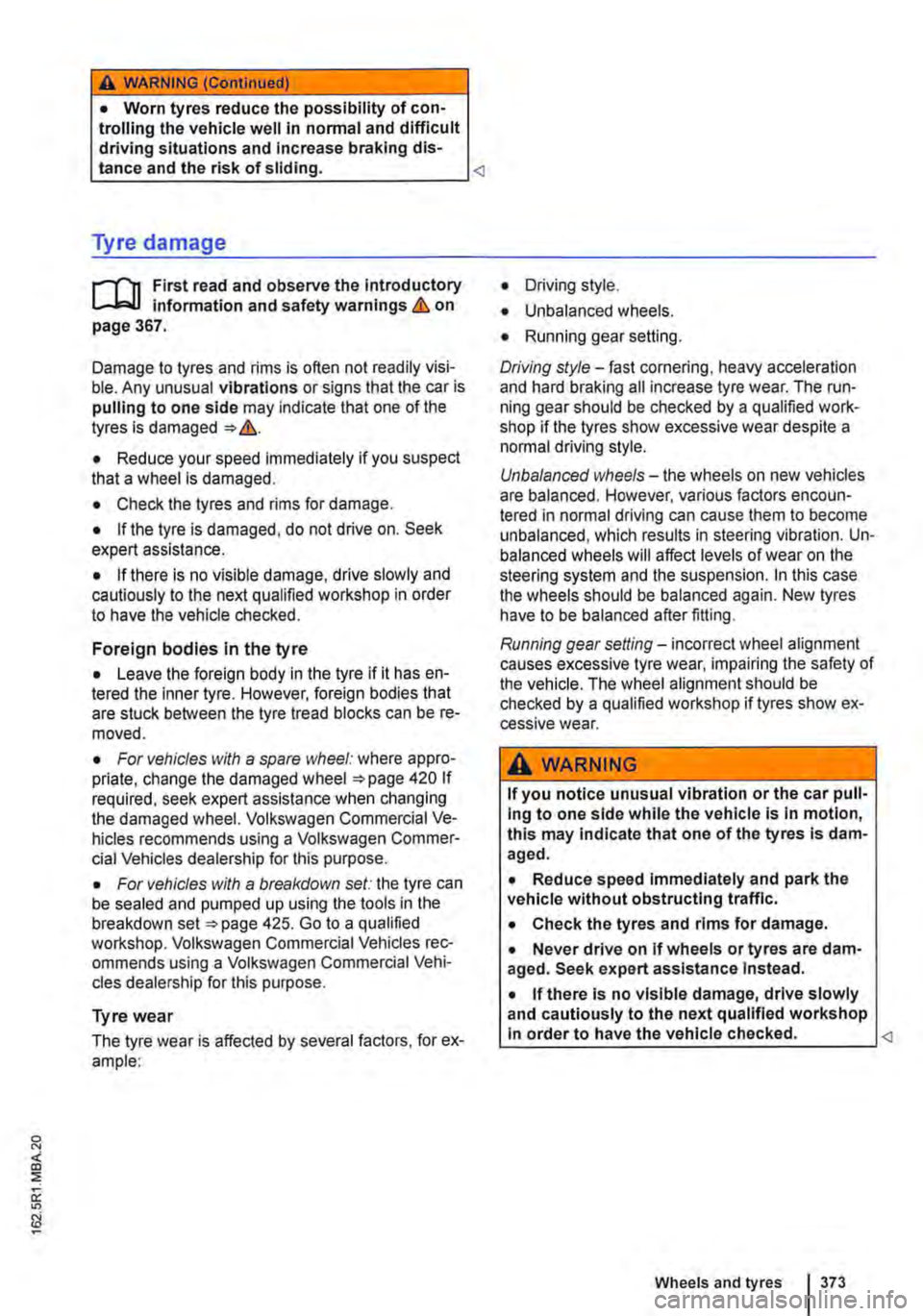
Damage to tyres and rims is often not readily visi-ble. Any unusual vibrations or signs that the car is pulling to one side may indicate that one of the tyres is damaged =:. &,..
• Reduce your speed immediately if you suspect that a wheel is damaged.
• Check the tyres and rims for damage.
• If the tyre is damaged, do not drive on. Seek expert assistance.
• If there is no visible damage, drive slowly and cautiously to the next qualified workshop in order to have the vehicle checked.
Foreign bodies in the tyre
• Leave the foreign body in the tyre if it has en-tered the inner tyre. However, foreign bodies that are stuck between the tyre tread blocks can be re-moved.
• For vehicles with a spare wheel: where appro-priate, change the damaged wheel =:>page 420 If required, seek expert assistance when changing the damaged wheel. Volkswagen Commercial Ve-hicles recommends using a Volkswagen Commer-cial Vehicles dealership for this purpose.
• For vehicles with a breakdown set: the tyre can be sealed and pumped up using the tools in the breakdown set =:.page 425. Go to a qualified workshop. Volkswagen Commercial Vehicles rec-ommends using a Volkswagen Commercial Vehi-cles dealership for this purpose.
Tyre wear
The tyre wear is affected by several factors, for ex-ample:
• Driving style.
• Unbalanced wheels.
• Running gear setting.
Driving style-fast cornering, heavy acceleration and hard braking all increase tyre wear. The run-ning gear should be checked by a qualified work-shop if the tyres show excessive wear despite a normal driving style.
Unbalanced wheels -the wheels on new vehicles are balanced. However, various factors encoun-tered in normal driving can cause them to become unbalanced, which results in steering vibration. Un-balanced wheels will affect levels of wear on the steering system and the suspension. In this case the wheels should be balanced again. New tyres have to be balanced after fitting.
Running gear setting-incorrect wheel alignment causes excessive tyre wear, impairing the safety of the vehicle. The wheel alignment should be checked by a qualified workshop if tyres show ex-cessive wear.
A WARNING
If you notice unusual vibration or the car pull-Ing to one side while the vehicle is In motion, this may indicate that one of the tyres is dam-aged.
• Reduce speed immediately and park the vehicle without obstructing traffic.
• Check the tyres and rims for damage.
• Never drive on if wheels or tyres are dam-aged. Seek expert assistance Instead.
• If there Is no visible damage, drive slowly and cautiously to the next qualified workshop In order to have the vehicle checked.
Page 394 of 486
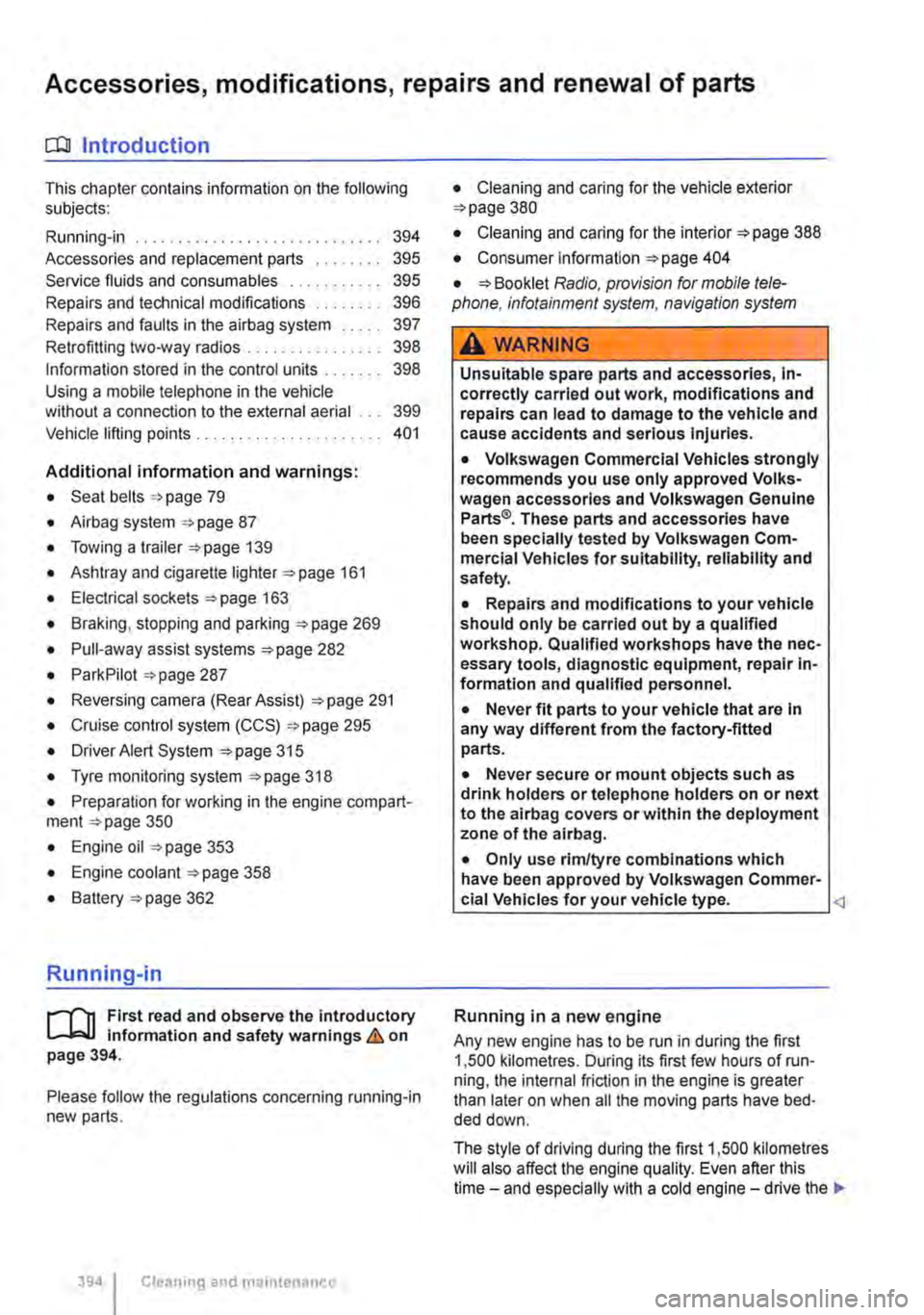
Accessories, modifications, repairs and renewal of parts
o::n Introduction
This chapter contains information on the following subjects:
Running-in 394
Accessories and replacement parts 395 Service fluids and consumables . . . . . . . . . . . 395
Repairs and technical modifications . . . . . . . . 396
Repairs and faults in the airbag system . . . . . 397
Retrofitting two-way radios . . . . . . . . . . . . . . . . 398
Information stored in the control units . . . . . . . 398 Using a mobile telephone in the vehicle without a connection to the external aerial . . 399
Vehicle lifting points 401
Additional information and warnings:
• Seat belts '*page 79
• Airbag system '*page 87
• Towing a trailer 139
• Ashtray and cigarette lighter 161
• Electrical sockets 163
• Braking, stopping and parking '*page 269
• Pull-away assist systems 282
• ParkPilot 287
• Reversing camera (Rear Assist) '*page 291
• Cruise control system (CCS) 295
• Driver Alert System 315
• Tyre monitoring system 318
• Preparation for working in the engine compart-ment page 350
• Engine oil 353
• Engine coolant '*page 358
• Battery 362
Running-in
r--('n First read and observe the introductory L-J.:.lJ information and safety warnings & on page 394.
Please follow the regulations concerning running-in new parts.
394 I Cleaning and maintenance
• Cleaning and caring for the vehicle exterior 380
• Cleaning and caring for the interior 388
• Consumer information 404
• Radio, provision for mobile tele-phone, infotainment system, navigation system
A WARNING
Unsuitable spare parts and accessories, In-correctly carried out work, modifications and repairs can lead to damage to the vehicle and cause accidents and serious Injuries.
• Volkswagen Commercial Vehicles strongly recommends you use only approved Volks-wagen accessories and Volkswagen Genuine Parts®. These parts and accessories have been specially tested by Volkswagen Com-mercial Vehicles for suitability, reliability and safety.
• Repairs and modifications to your vehicle should only be carried out by a qualified workshop. Qualified workshops have the nec-essary tools, diagnostic equipment, repair In-formation and qualified personnel.
• Never fit parts to your vehicle that are In any way different from the factory-fitted parts.
• Never secure or mount objects such as drink holders or telephone holders on or next to the airbag covers or within the deployment zone of the airbag.
• Only use rim/tyre combinations which have been approved by Volkswagen Commer-cial Vehicles for your vehicle type.
Any new engine has to be run in during the first 1 ,500 kilometres. During its first few hours of run-ning, the internal friction in the engine is greater than later on when all the moving parts have bed-ded down.
The style of driving during the first 1 ,500 kilometres will also affect the engine quality. Even after this time-and especially with a cold engine-drive the .,.
Page 397 of 486
or sensors has been damaged, e.g. by stone im-pact, the windscreen must be replaced. Repairing the crack can lead to malfunction or functional faults in the equipment.
After changing the windscreen, the camera and sensors must be set up and calibrated by a quali-fied workshop.
A WARNING
Incorrect repairs and modifications can cause functional problems and damage to the vehicle and impair the effectiveness of the driver assist systems. This can result In acci-dents and severe Injuries.
• Repairs and modifications to your vehicle should only be carried out by a qualified workshop.
Repairs and faults in the airbag system
,....,..,. First read and observe the introductory l.-Jo:-11 Information and safety warnings&. on page 394.
Repairs and modifications must always be car-ried out according to Volkswagen Commercial Vehicles specifications"*&.!
Modifications and repairs to the front bumper, the doors, the front seats, the headliner, or the body-work should be carried out by a qualified work-shop. System components and airbag system sen-sors might be fitted on these vehicle components.
If you work on the airbag system or remove and in-stall parts of the system when performing other re-pair work, parts of the airbag system may be dam-aged. The consequence may be that, in the event of an accident, the airbag inflates incorrectly or does not inflate at all.
Regulations must be observed to ensure that the effectiveness of the airbags is not reduced and that removed parts do not cause any injuries or envi-ronmental pollution. Qualified workshops are famili-ar with these requirements.
Any modifications to the vehicle's suspension could prevent the airbag system from working properly during a collision. For example, using tyre/ rim combinations which have not been approved by Volkswagen Commercial Vehicles, lowering the vehicle, making modifications to the suspension rate including work on the springs, struts and shock absorbers could cause the forces which are measured by the airbag sensors and sent to the electronic control unit to change. Some changes to the suspension could cause the forces measured by the sensors to increase. This can lead to the airbag system being triggered in collision scenarios
where it normally would not be triggered if modifi-cations to the suspension had not been made. Other modifications can cause the forces meas-ured by the sensors to decrease. therefore pre-venting the airbag system from being triggered when it should have been.
A WARNING
Incorrect repairs and modifications can cause function problems and damage to the vehicle and Impair the effectiveness of the alrbag system. This can result In accidents and serious or even fatal injuries.
• Repairs and modifications to your vehicle should only be carried out by a qualified workshop.
• Alrbag modules cannot be repaired. They must be replaced.
• Never use recycled airbag components or components that have been taken from end-of-life vehicles In your vehicle.
A WARNING
Modifications to the vehicle's suspension, in-cluding the use of unsuitable tyre/rim combi-nations, can cause the alrbag system to work differently and increase the risk of serious or fatal injuries In the event of an accident.
• Never install any components in the sus-pension system that do not have the same characteristics as the original factory-fitted components.
• Never use tyre/rim combinations that have not been approved by Volkswagen Commer-cial Vehicles.
Vehicle care and maintenance 397
Page 404 of 486
In the interest of data protection. Depending on which services are activated, any relevant In-formation must also be given to the driver.
m Volkswagen collects, processes, transmits W and uses personal data entered by the user within the framework of legal regulations for the purpose of smooth functioning of individual Volks-wagen Car-Net services and their provision. Data
Applications (apps)
r""('n First read and observe the Introductory 1....-J,:.lJ Information and safety warnings & on page 402.
Many mobile devices have the option to download applications (apps). Apps can display additional in-formation regarding factory-fitted radio and naviga-tion systems or can allow you to activate, manage or deactivate certain functions in the vehicle.
Applications, use of applications and the required mobile network may be subject to fees.
The range of applications available can be wide or they can be vehicle-specific and country-specific =>CD. Content, range and provider of applications can vary. Some applications also depend on avail-ability of services offered by third parties. A mobile network with sufficient signal strength for exchange of data must be available for the use of applica-tions.
The provider of an application may provide a de-scription of it.
Due to the high number of mobile devices and the fast pace of software development, the applica-tions on offer cannot be operated on all mobile de-
Consumer information
CQJ Introduction
This chapter contains information on the following subjects:
Information stickers and plates . . . . . . . . . . . . 405 Using the vehicle in other countries and continents . . . . . . . . . . . . . . . . . . . . . . . . . . 405 Radio reception and aerials . . . . . . . . 406 Volkswagen Commercial Vehicles repair information . . . . . . . . . . . . . . . . . . . . 406
Declaration of conformity 406 Recycling and scrapping end-of-life vehicles . 407
404 Cleaning and maintenance
is not forwarded to third parties. Current terms of use can be found at www.volkswagen-commercial-vehicles-carnet.com.
m Volkswagen Car-Net services is a system W based on a mobile network. If a fault arises despite the fact that all requirements have been fulfilled, please try using the services again at a lat-er stage.
Applications can be changed, set, deactivated, re-activated and expanded without prior notice.
The network or cable connection between the fac-tory-fitted radio or navigation system and mobile device must be adequate and free of interruptions to allow for the use of applications.
Q)
Volkswagen Is not responsible for damage to the vehicle caused by poor quality or faulty ap-plications, Insufficient programming of applica-tions, Insufficient network strength or loss of data during transmission or by misuse of the mobile equipment.
• Exterior views =>page 5
• Pull-away assist systems =>page 282
• Accessories, modifications, repairs and renewal of parts =>page 394
• =>Booklet Service schedule .,.