battery VOLKSWAGEN UP! 2021 Owner´s Manual
[x] Cancel search | Manufacturer: VOLKSWAGEN, Model Year: 2021, Model line: UP!, Model: VOLKSWAGEN UP! 2021Pages: 211, PDF Size: 5.98 MB
Page 98 of 211
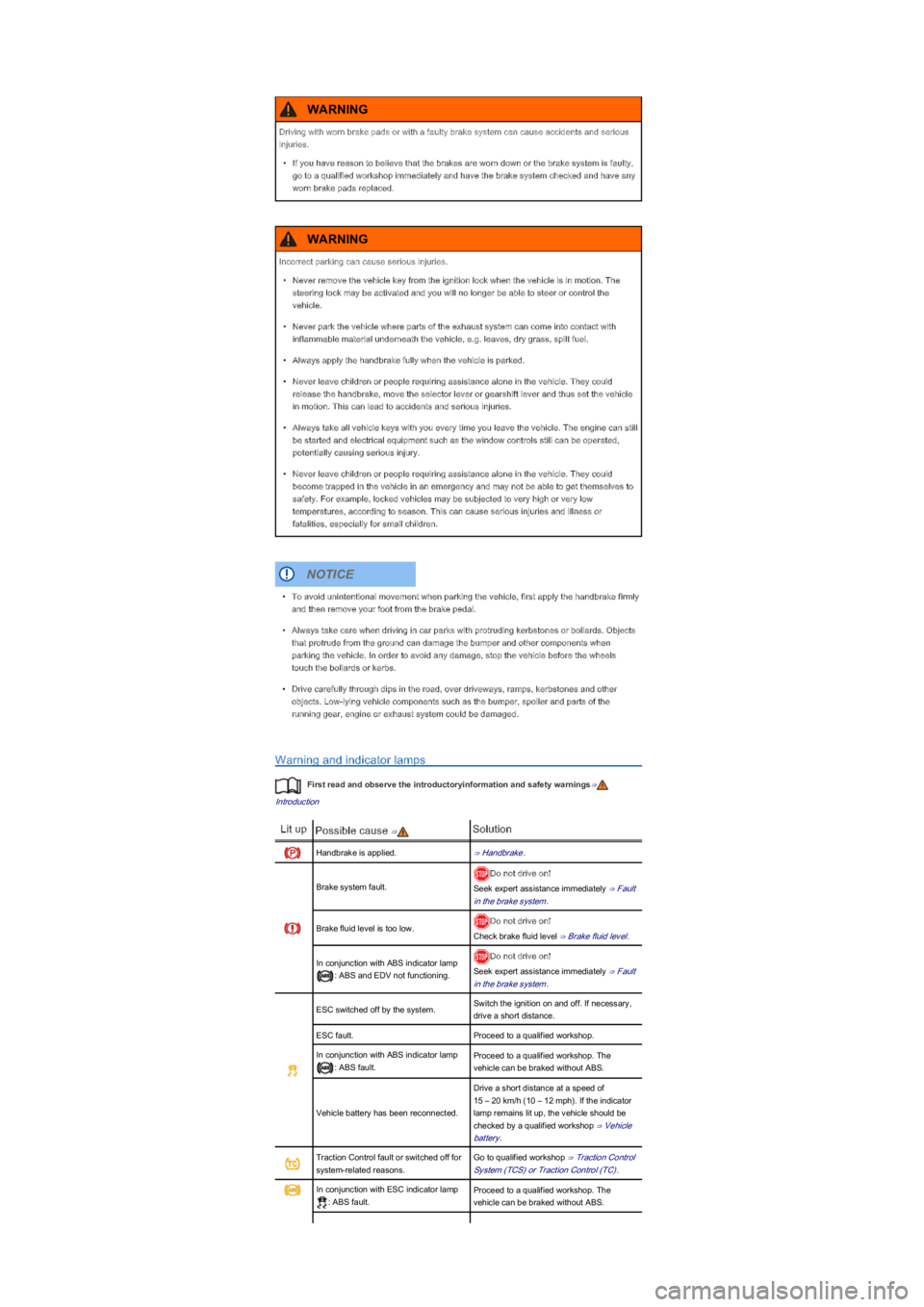
Warning and indicator lamps
First read and observe the introductoryinformation and safety warnings⇒
Introduction
Lit upPossible cause ⇒Solution
Handbrake is applied.⇒ Handbrake.
Brake system fault.
Do not drive on!
Seek expert assistance immediately ⇒ Fault
in the brake system.
Brake fluid level is too low.Do not drive on!
Check brake fluid level ⇒ Brake fluid level.
In conjunction with ABS indicator lamp
: ABS and EDV not functioning.
Do not drive on!
Seek expert assistance immediately ⇒ Fault
in the brake system.
ESC switched off by the system.Switch the ignition on and off. If necessary,
drive a short distance.
ESC fault.Proceed to a qualified workshop.
In conjunction with ABS indicator lamp
: ABS fault.
Proceed to a qualified workshop. The
vehicle can be braked without ABS.
Vehicle battery has been reconnected.
Drive a short distance at a speed of
15 – 20 km/h (10 – 12 mph). If the indicator
lamp remains lit up, the vehicle should be
checked by a qualified workshop ⇒ Vehicle
battery.
Traction Control fault or switched off for
system-related reasons.
Go to qualified workshop ⇒ Traction Control
System (TCS) or Traction Control (TC).
In conjunction with ESC indicator lamp
: ABS fault.
Proceed to a qualified workshop. The
vehicle can be braked without ABS.
Driving with worn brake pads or with a faulty brake system can cause accidents and serious
injuries.
•If you have reason to believe that the brakes are worn down or the brake system is faulty,
go to a qualified workshop immediately and have the brake system checked and have any
worn brake pads replaced.
WARNING
Incorrect parking can cause serious injuries.
•Never remove the vehicle key from the ignition lock when the vehicle is in motion. The
steering lock may be activated and you will no longer be able to steer or control the
vehicle.
•Never park the vehicle where parts of the exhaust system can come into contact with
inflammable material underneath the vehicle, e.g. leaves, dry grass, spilt fuel.
•Always apply the handbrake fully when the vehicle is parked.
•Never leave children or people requiring assistance alone in the vehicle. They could
release the handbrake, move the selector lever or gearshift lever and thus set the vehicle
in motion. This can lead to accidents and serious injuries.
•Always take all vehicle keys with you every time you leave the vehicle. The engine can still
be started and electrical equipment such as the window controls still can be operated,
potentially causing serious injury.
•Never leave children or people requiring assistance alone in the vehicle. They could
become trapped in the vehicle in an emergency and may not be able to get themselves to
safety. For example, locked vehicles may be subjected to very high or very low
temperatures, according to season. This can cause serious injuries and illness or
fatalities, especially for small children.
WARNING
•To avoid unintentional movement when parking the vehicle, first apply the handbrake firmly
and then remove your foot from the brake pedal.
•Always take care when driving in car parks with protruding kerbstones or bollards. Objects
that protrude from the ground can damage the bumper and other components when
parking the vehicle. In order to avoid any damage, stop the vehicle before the wheels
touch the bollards or kerbs.
•Drive carefully through dips in the road, over driveways, ramps, kerbstones and other
objects. Low-lying vehicle components such as the bumper, spoiler and parts of the
running gear, engine or exhaust system could be damaged.
NOTICE
Page 108 of 211
Avoid unnecessary loads
The lighter the vehicle, the more economical and environmentally-friendly it is. An extra weight of
100 kg can increase fuel consumption by up to 0.3 l/100 km.
Remove all unnecessary objects and loads from the vehicle.
Remove any unnecessary special equipment and accessories
The more aerodynamic a vehicle, the lower its fuel consumption. Special equipment and
accessories, such as roof carriers or bicycle carriers, make the vehicle less aerodynamic.
You should therefore remove any special equipment and luggage carriers that are not in use,
especially if you are going to be driving at high speeds.
Steering
Introduction
This chapter contains information on the followingsubjects:
⇒ Warning and indicator lamps
⇒ Information on steering
Depending on its equipment level the vehicle may have power steering.
The power steering is not hydraulic. It is an electromechanical system. The advantage of this
steering system is that no hydraulic hoses, hydraulic oil, pumps, filter or other parts are required.
The electromechanical system reduces fuel consumption. A hydraulic system requires constant oil
pressure in the system, whereas an electromechanical steering system only needs an energy
supply while steering.
The power steering provided by the electromechanical steering system automatically adjusts to the
vehicle speed, steering wheel torque and steering wheel angle. The electromechanical steering
only functions when the engine is running.
Additional information and warnings:
•Starting and stopping the engine ⇒ Starting and stopping the engine
•Battery ⇒ Vehicle battery
•Tow-starting and towing ⇒ Tow-starting and towing
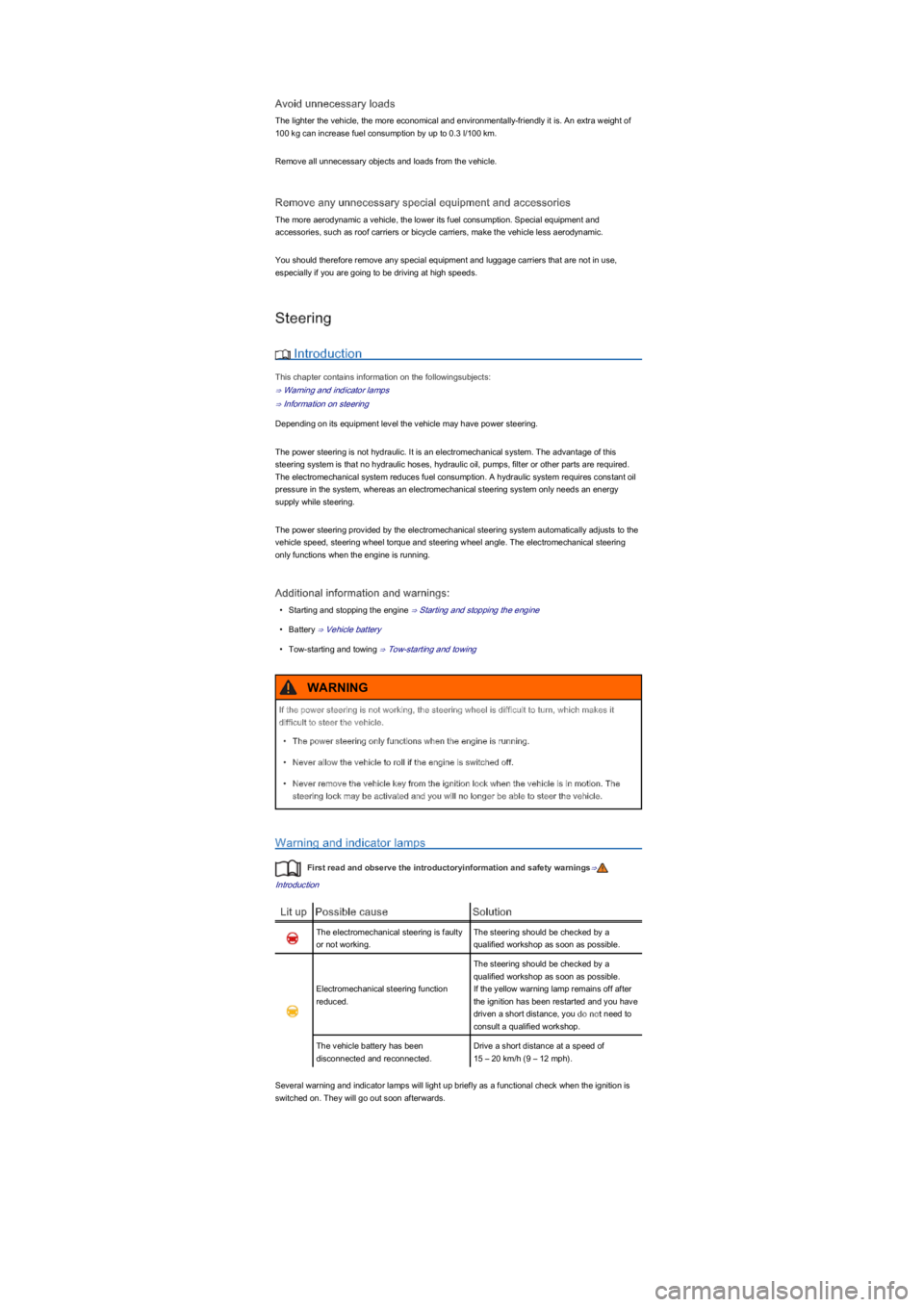
Warning and indicator lamps
First read and observe the introductoryinformation and safety warnings⇒
Introduction
Lit upPossible causeSolution
The electromechanical steering is faulty
or not working.
The steering should be checked by a
qualified workshop as soon as possible.
Electromechanical steering function
reduced.
The steering should be checked by a
qualified workshop as soon as possible.
If the yellow warning lamp remains off after
the ignition has been restarted and you have
driven a short distance, you do not need to
consult a qualified workshop.
The vehicle battery has been
disconnected and reconnected.
Drive a short distance at a speed of
15 – 20 km/h (9 – 12 mph).
Several warning and indicator lamps will light up briefly as a functional check when the ignition is
switched on. They will go out soon afterwards.
If the power steering is not working, the steering wheel is difficult to turn, which makes it
difficult to steer the vehicle.
•The power steering only functions when the engine is running.
•Never allow the vehicle to roll if the engine is switched off.
•Never remove the vehicle key from the ignition lock when the vehicle is in motion. The
steering lock may be activated and you will no longer be able to steer the vehicle.
WARNING
Page 109 of 211
Information on steering
First read and observe the introductoryinformation and safety warnings⇒
Introduction
The steering should be locked every time you leave the vehicle to make it more difficult for the
vehicle to be stolen.
Mechanical steering column lock
The steering column is locked if the vehicle key is removed from the ignition lock when the vehicle
is stationary.
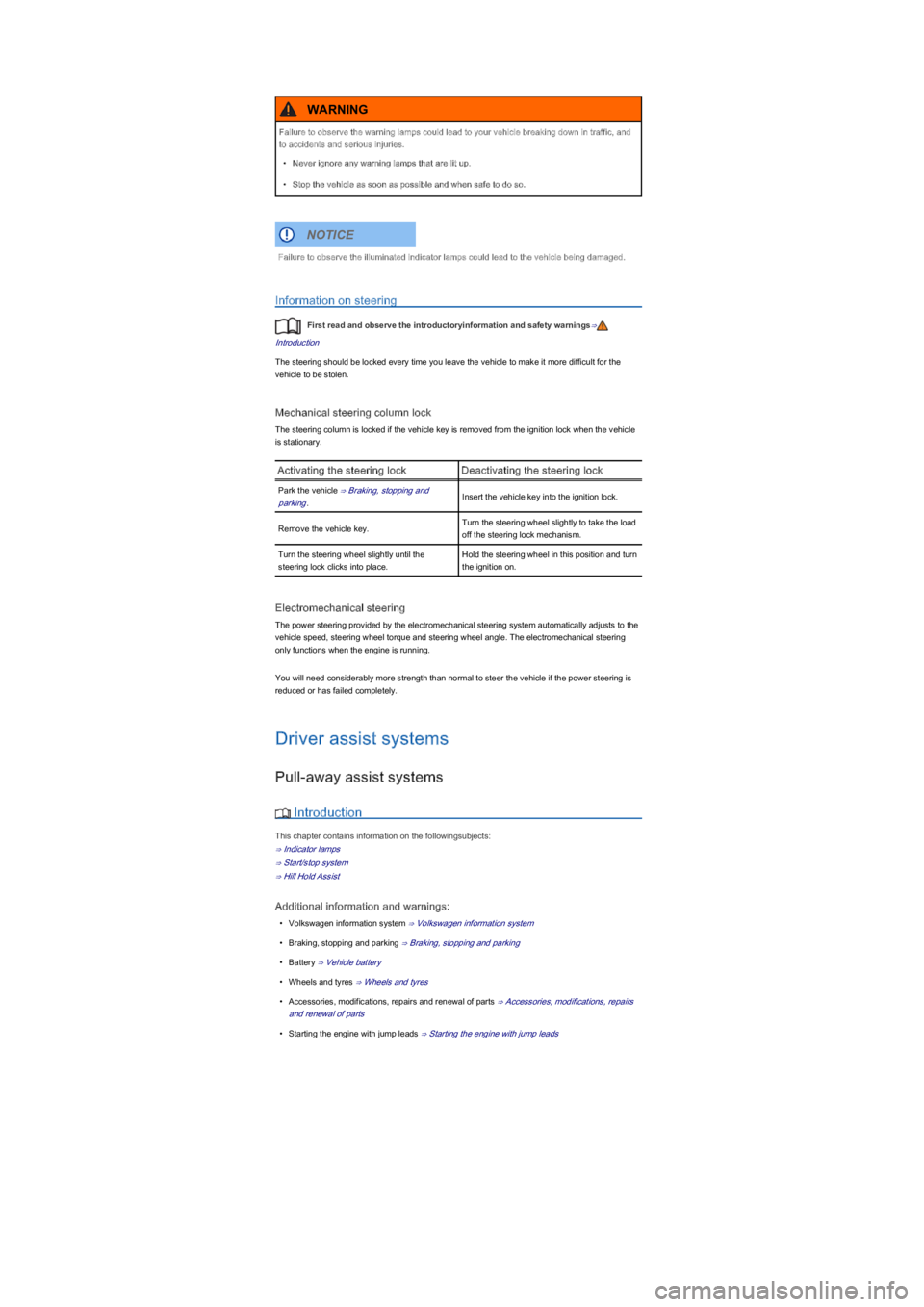
Activating the steering lockDeactivating the steering lock
Park the vehicle ⇒ Braking, stopping and
parking.Insert the vehicle key into the ignition lock.
Remove the vehicle key.Turn the steering wheel slightly to take the load
off the steering lock mechanism.
Turn the steering wheel slightly until the
steering lock clicks into place.
Hold the steering wheel in this position and turn
the ignition on.
Electromechanical steering
The power steering provided by the electromechanical steering system automatically adjusts to the
vehicle speed, steering wheel torque and steering wheel angle. The electromechanical steering
only functions when the engine is running.
You will need considerably more strength than normal to steer the vehicle if the power steering is
reduced or has failed completely.
Driver assist systems
Pull-away assist systems
Introduction
This chapter contains information on the followingsubjects:
⇒ Indicator lamps
⇒ Start/stop system
⇒ Hill Hold Assist
Additional information and warnings:
•Volkswagen information system ⇒ Volkswagen information system
•Braking, stopping and parking ⇒ Braking, stopping and parking
•Battery ⇒ Vehicle battery
•Wheels and tyres ⇒ Wheels and tyres
•Accessories, modifications, repairs and renewal of parts ⇒ Accessories, modifications, repairs
and renewal of parts
•Starting the engine with jump leads ⇒ Starting the engine with jump leads
Failure to observe the warning lamps could lead to your vehicle breaking down in traffic, and
to accidents and serious injuries.
•Never ignore any warning lamps that are lit up.
•Stop the vehicle as soon as possible and when safe to do so.
WARNING
Failure to observe the illuminated indicator lamps could lead to the vehicle being damaged.
NOTICE
Page 110 of 211
Indicator lamps
First read and observe the introductoryinformation and safety warnings⇒
Introduction
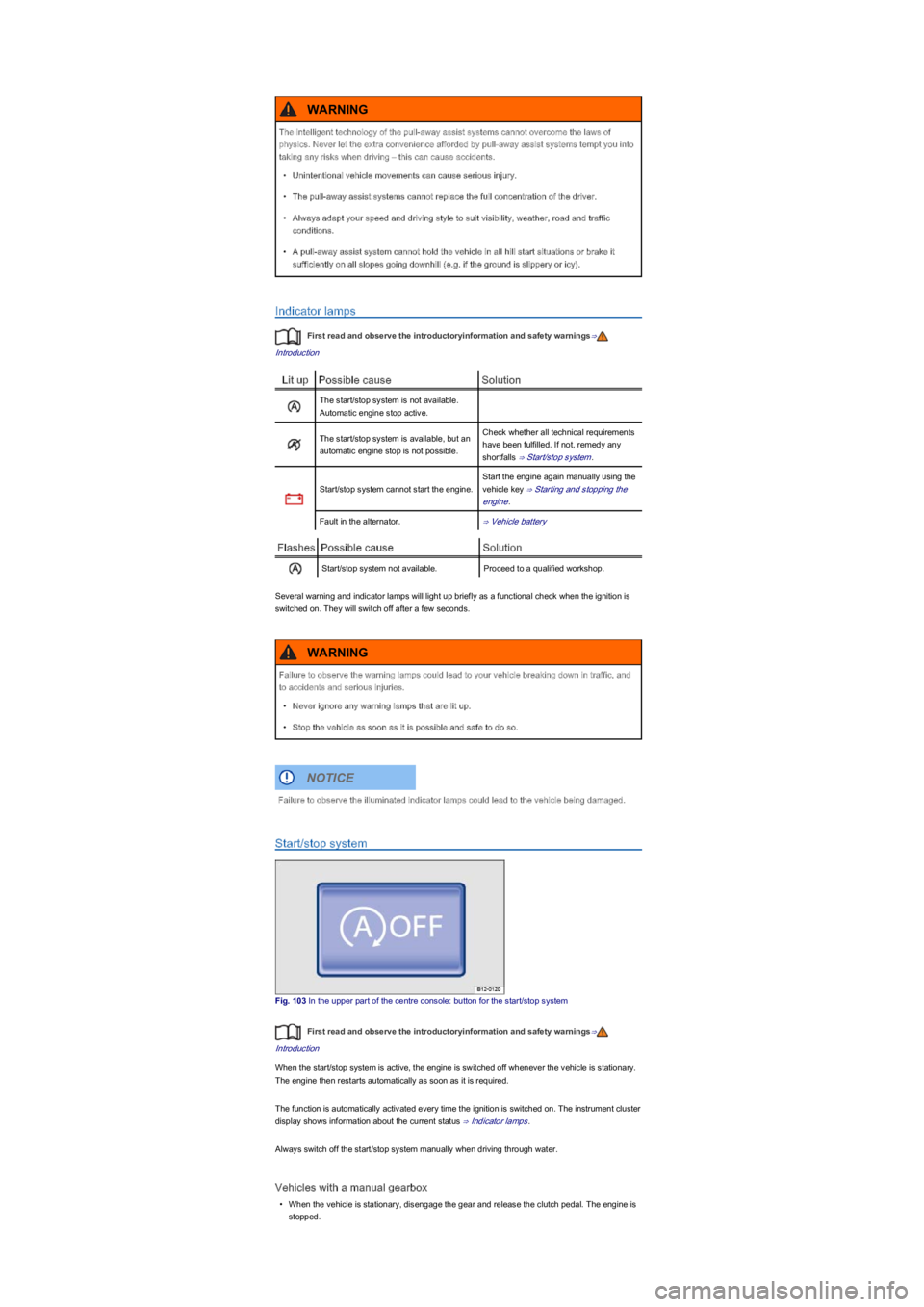
Lit upPossible causeSolution
The start/stop system is not available.
Automatic engine stop active.
The start/stop system is available, but an
automatic engine stop is not possible.
Check whether all technical requirements
have been fulfilled. If not, remedy any
shortfalls ⇒ Start/stop system.
Start/stop system cannot start the engine.
Start the engine again manually using the
vehicle key ⇒ Starting and stopping the
engine.
Fault in the alternator.⇒ Vehicle battery
FlashesPossible causeSolution
Start/stop system not available.Proceed to a qualified workshop.
Several warning and indicator lamps will light up briefly as a functional check when the ignition is
switched on. They will switch off after a few seconds.
Start/stop system
Fig. 103 In the upper part of the centre console: button for the start/stop system
First read and observe the introductoryinformation and safety warnings⇒
Introduction
When the start/stop system is active, the engine is switched off whenever the vehicle is stationary.
The engine then restarts automatically as soon as it is required.
The function is automatically activated every time the ignition is switched on. The instrument cluster
display shows information about the current status ⇒ Indicator lamps.
Always switch off the start/stop system manually when driving through water.
Vehicles with a manual gearbox
•When the vehicle is stationary, disengage the gear and release the clutch pedal. The engine is
stopped.
The intelligent technology of the pull-away assist systems cannot overcome the laws of
physics. Never let the extra convenience afforded by pull-away assist systems tempt you into
taking any risks when driving – this can cause accidents.
•Unintentional vehicle movements can cause serious injury.
•The pull-away assist systems cannot replace the full concentration of the driver.
•Always adapt your speed and driving style to suit visibility, weather, road and traffic
conditions.
•A pull-away assist system cannot hold the vehicle in all hill start situations or brake it
sufficiently on all slopes going downhill (e.g. if the ground is slippery or icy).
WARNING
Failure to observe the warning lamps could lead to your vehicle breaking down in traffic, and
to accidents and serious injuries.
•Never ignore any warning lamps that are lit up.
•Stop the vehicle as soon as it is possible and safe to do so.
WARNING
Failure to observe the illuminated indicator lamps could lead to the vehicle being damaged.
NOTICE
Page 111 of 211
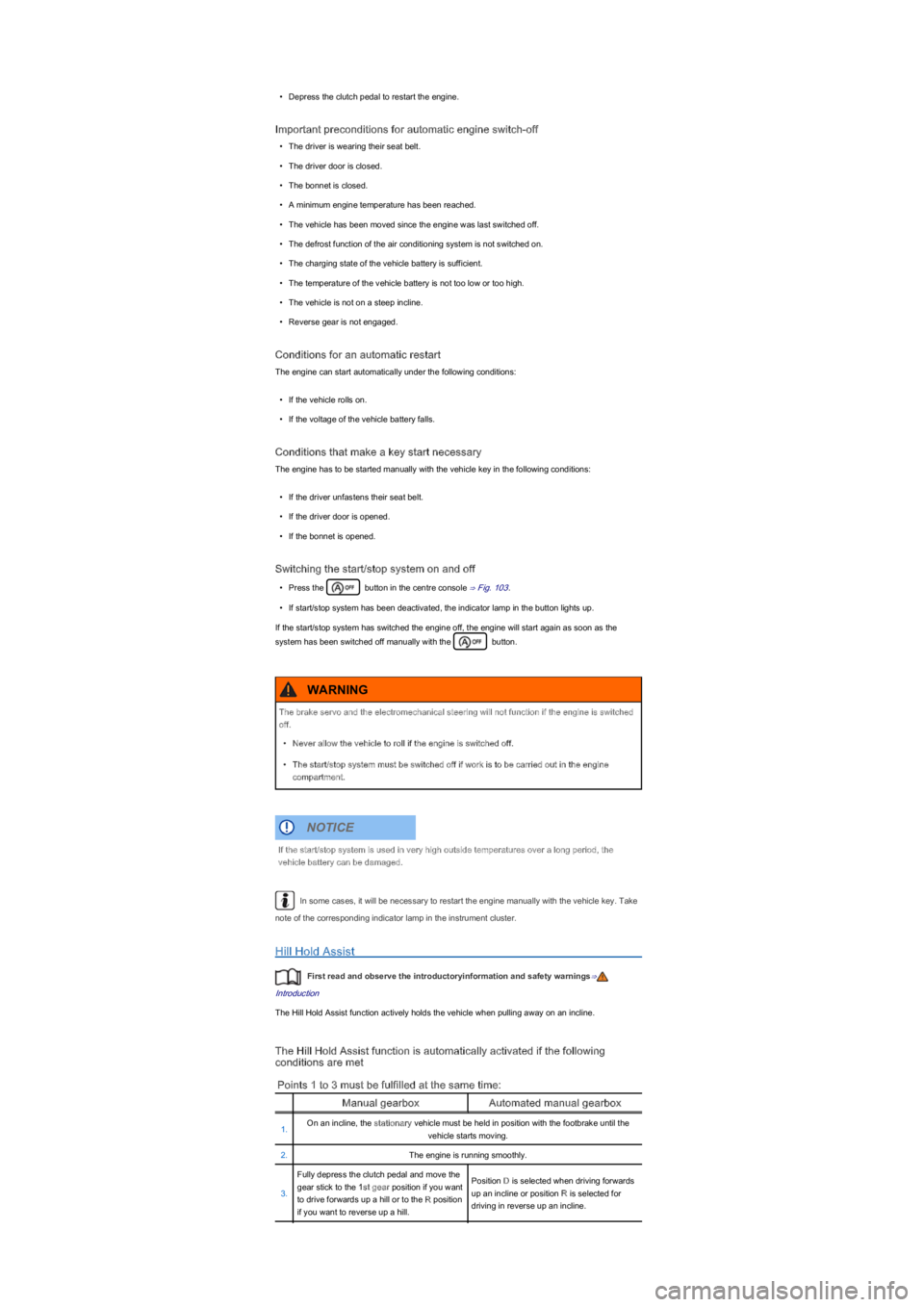
•Depress the clutch pedal to restart the engine.
Important preconditions for automatic engine switch-off
•The driver is wearing their seat belt.
•The driver door is closed.
•The bonnet is closed.
•A minimum engine temperature has been reached.
•The vehicle has been moved since the engine was last switched off.
•The defrost function of the air conditioning system is not switched on.
•The charging state of the vehicle battery is sufficient.
•The temperature of the vehicle battery is not too low or too high.
•The vehicle is not on a steep incline.
•Reverse gear is not engaged.
Conditions for an automatic restart
The engine can start automatically under the following conditions:
•If the vehicle rolls on.
•If the voltage of the vehicle battery falls.
Conditions that make a key start necessary
The engine has to be started manually with the vehicle key in the following conditions:
•If the driver unfastens their seat belt.
•If the driver door is opened.
•If the bonnet is opened.
Switching the start/stop system on and off
•Press the button in the centre console ⇒ Fig. 103.
•If start/stop system has been deactivated, the indicator lamp in the button lights up.
If the start/stop system has switched the engine off, the engine will start again as soon as the
system has been switched off manually with the button.
In some cases, it will be necessary to restart the engine manually with the vehicle key. Take
note of the corresponding indicator lamp in the instrument cluster.
Hill Hold Assist
First read and observe the introductoryinformation and safety warnings⇒
Introduction
The Hill Hold Assist function actively holds the vehicle when pulling away on an incline.
The Hill Hold Assist function is automatically activated if the following
conditions are met
Points 1 to 3 must be fulfilled at the same time:
Manual gearboxAutomated manual gearbox
1.On an incline, the stationary vehicle must be held in position with the footbrake until the
vehicle starts moving.
2.The engine is running smoothly.
3.
Fully depress the clutch pedal and move the
gear stick to the 1st gear position if you want
to drive forwards up a hill or to the R position
if you want to reverse up a hill.
Position D is selected when driving forwards
up an incline or position R is selected for
driving in reverse up an incline.
The brake servo and the electromechanical steering will not function if the engine is switched
off.
•Never allow the vehicle to roll if the engine is switched off.
•The start/stop system must be switched off if work is to be carried out in the engine
compartment.
WARNING
If the start/stop system is used in very high outside temperatures over a long period, the
vehicle battery can be damaged.
NOTICE
Page 131 of 211
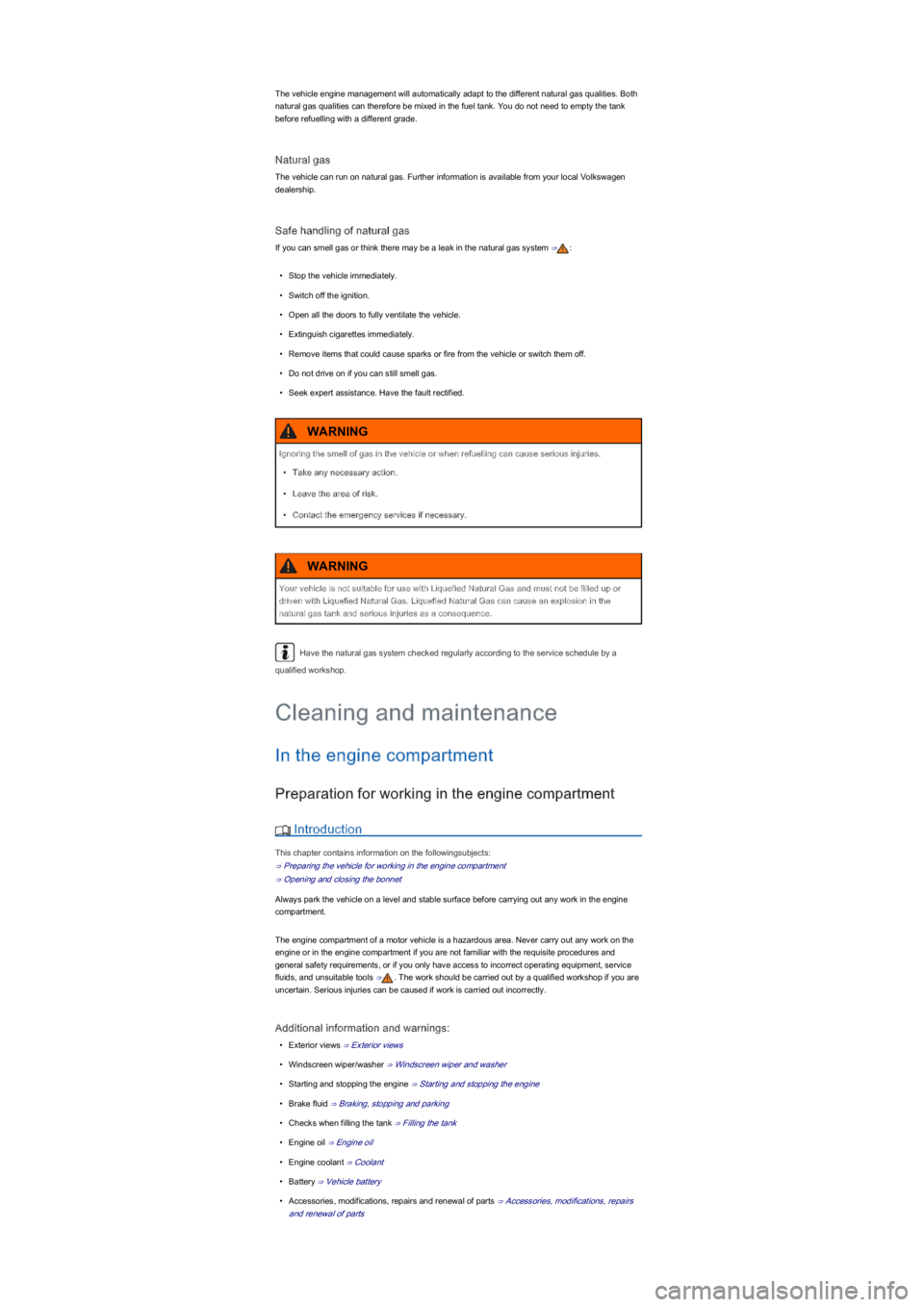
The vehicle engine management will automatically adapt to the different natural gas qualities. Both
natural gas qualities can therefore be mixed in the fuel tank. You do not need to empty the tank
before refuelling with a different grade.
Natural gas
The vehicle can run on natural gas. Further information is available from your local Volkswagen
dealership.
Safe handling of natural gas
If you can smell gas or think there may be a leak in the natural gas system ⇒:
•Stop the vehicle immediately.
•Switch off the ignition.
•Open all the doors to fully ventilate the vehicle.
•Extinguish cigarettes immediately.
•Remove items that could cause sparks or fire from the vehicle or switch them off.
•Do not drive on if you can still smell gas.
•Seek expert assistance. Have the fault rectified.
Have the natural gas system checked regularly according to the service schedule by a
qualified workshop.
In the engine compartment
Preparation for working in the engine compartment
Introduction
This chapter contains information on the followingsubjects:
⇒ Preparing the vehicle for working in the engine compartment
⇒ Opening and closing the bonnet
Always park the vehicle on a level and stable surface before carrying out any work in the engine
compartment.
The engine compartment of a motor vehicle is a hazardous area. Never carry out any work on the
engine or in the engine compartment if you are not familiar with the requisite procedures and
general safety requirements, or if you only have access to incorrect operating equipment, service
fluids, and unsuitable tools ⇒. The work should be carried out by a qualified workshop if you are
uncertain. Serious injuries can be caused if work is carried out incorrectly.
Additional information and warnings:
•Exterior views ⇒ Exterior views
•Windscreen wiper/washer ⇒ Windscreen wiper and washer
•Starting and stopping the engine ⇒ Starting and stopping the engine
•Brake fluid ⇒ Braking, stopping and parking
•Checks when filling the tank ⇒ Filling the tank
•Engine oil ⇒ Engine oil
•Engine coolant ⇒ Coolant
•Battery ⇒ Vehicle battery
•Accessories, modifications, repairs and renewal of parts ⇒ Accessories, modifications, repairs
and renewal of parts
Ignoring the smell of gas in the vehicle or when refuelling can cause serious injuries.
•Take any necessary action.
•Leave the area of risk.
•Contact the emergency services if necessary.
WARNING
Your vehicle is not suitable for use with Liquefied Natural Gas and must not be filled up or
driven with Liquefied Natural Gas. Liquefied Natural Gas can cause an explosion in the
natural gas tank and serious injuries as a consequence.
WARNING
Cleaning and maintenance
Page 132 of 211
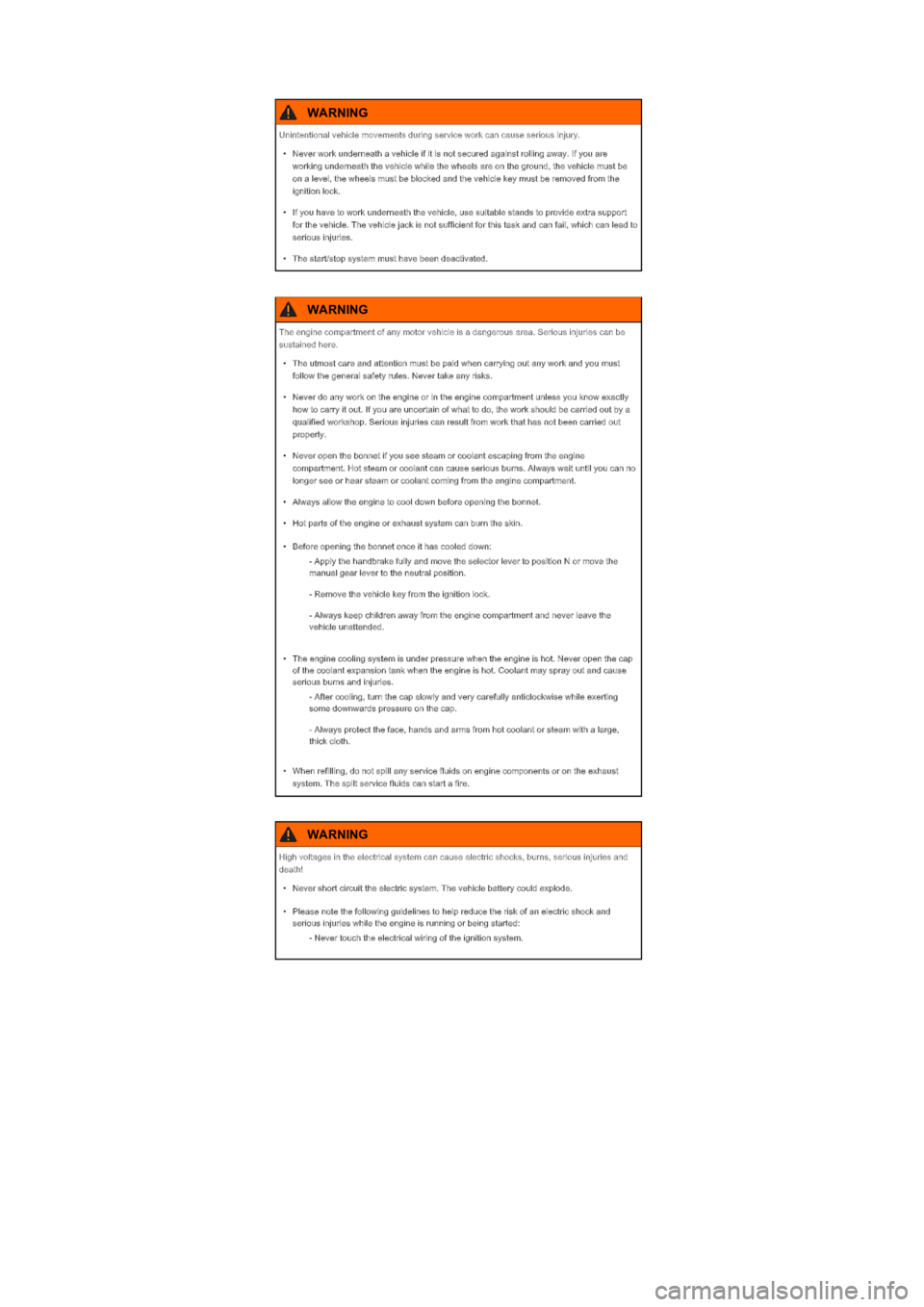
Unintentional vehicle movements during service work can cause serious injury.
•Never work underneath a vehicle if it is not secured against rolling away. If you are
working underneath the vehicle while the wheels are on the ground, the vehicle must be
on a level, the wheels must be blocked and the vehicle key must be removed from the
ignition lock.
•If you have to work underneath the vehicle, use suitable stands to provide extra support
for the vehicle. The vehicle jack is not sufficient for this task and can fail, which can lead to
serious injuries.
•The start/stop system must have been deactivated.
WARNING
The engine compartment of any motor vehicle is a dangerous area. Serious injuries can be
sustained here.
•The utmost care and attention must be paid when carrying out any work and you must
follow the general safety rules. Never take any risks.
•Never do any work on the engine or in the engine compartment unless you know exactly
how to carry it out. If you are uncertain of what to do, the work should be carried out by a
qualified workshop. Serious injuries can result from work that has not been carried out
properly.
•Never open the bonnet if you see steam or coolant escaping from the engine
compartment. Hot steam or coolant can cause serious burns. Always wait until you can no
longer see or hear steam or coolant coming from the engine compartment.
•Always allow the engine to cool down before opening the bonnet.
•Hot parts of the engine or exhaust system can burn the skin.
•Before opening the bonnet once it has cooled down:
- Apply the handbrake fully and move the selector lever to position N or move the
manual gear lever to the neutral position.
- Remove the vehicle key from the ignition lock.
- Always keep children away from the engine compartment and never leave the
vehicle unattended.
•The engine cooling system is under pressure when the engine is hot. Never open the cap
of the coolant expansion tank when the engine is hot. Coolant may spray out and cause
serious burns and injuries.
- After cooling, turn the cap slowly and very carefully anticlockwise while exerting
some downwards pressure on the cap.
- Always protect the face, hands and arms from hot coolant or steam with a large,
thick cloth.
•When refilling, do not spill any service fluids on engine components or on the exhaust
system. The spilt service fluids can start a fire.
WARNING
High voltages in the electrical system can cause electric shocks, burns, serious injuries and
death!
•Never short circuit the electric system. The vehicle battery could explode.
•Please note the following guidelines to help reduce the risk of an electric shock and
serious injuries while the engine is running or being started:
- Never touch the electrical wiring of the ignition system.
WARNING
Page 133 of 211
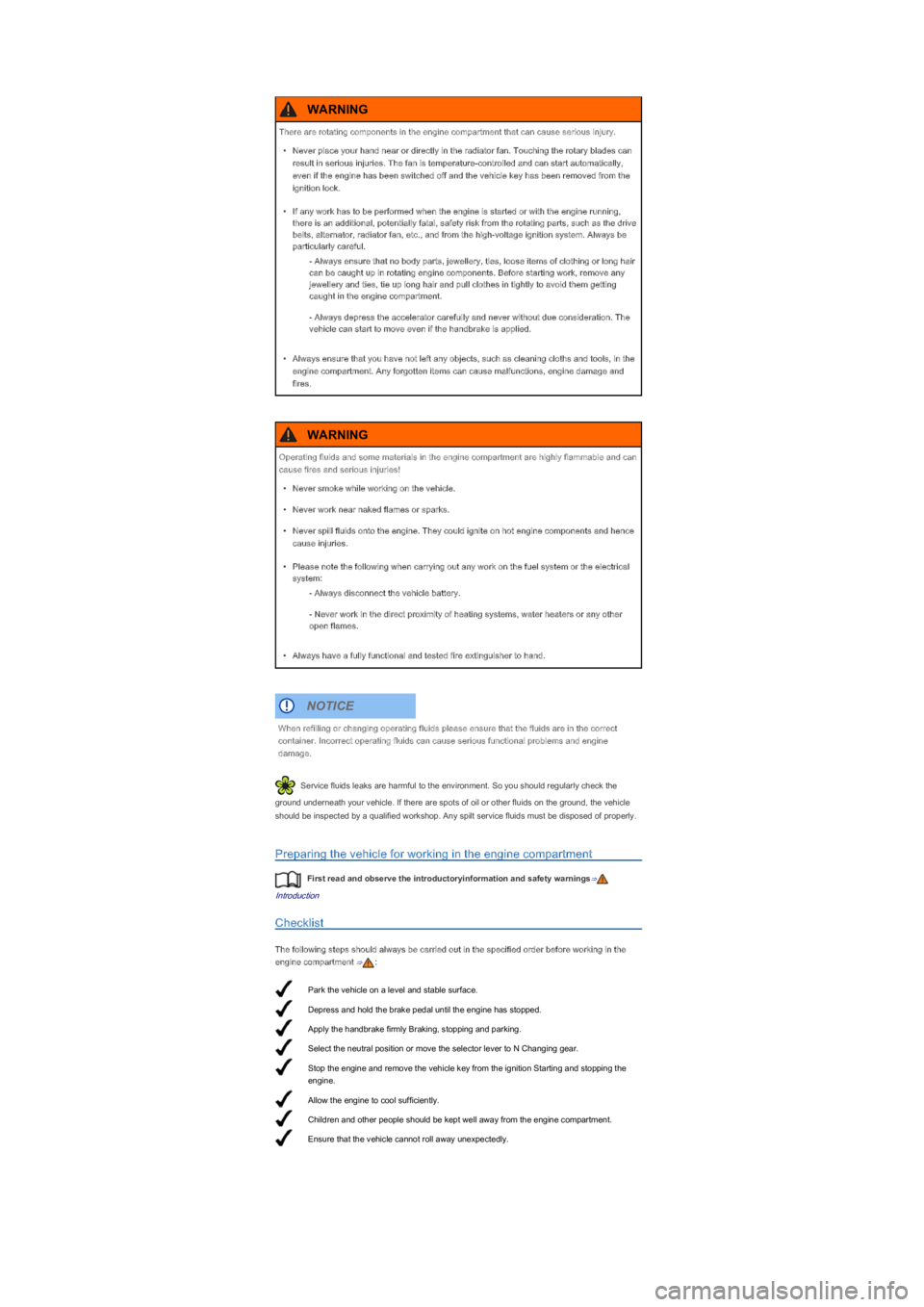
Park the vehicle on a level and stable surface.
Depress and hold the brake pedal until the engine has stopped.
Apply the handbrake firmly Braking, stopping and parking.
Select the neutral position or move the selector lever to N Changing gear.
Stop the engine and remove the vehicle key from the ignition Starting and stopping the
engine.
Allow the engine to cool sufficiently.
Children and other people should be kept well away from the engine compartment.
Ensure that the vehicle cannot roll away unexpectedly.
Service fluids leaks are harmful to the environment. So you should regularly check the
ground underneath your vehicle. If there are spots of oil or other fluids on the ground, the vehicle
should be inspected by a qualified workshop. Any spilt service fluids must be disposed of properly.
Preparing the vehicle for working in the engine compartment
First read and observe the introductoryinformation and safety warnings⇒
Introduction
Checklist
The following steps should always be carried out in the specified order before working in the
engine compartment ⇒:
There are rotating components in the engine compartment that can cause serious injury.
•Never place your hand near or directly in the radiator fan. Touching the rotary blades can
result in serious injuries. The fan is temperature-controlled and can start automatically,
even if the engine has been switched off and the vehicle key has been removed from the
ignition lock.
•If any work has to be performed when the engine is started or with the engine running,
there is an additional, potentially fatal, safety risk from the rotating parts, such as the drive
belts, alternator, radiator fan, etc., and from the high-voltage ignition system. Always be
particularly careful.
- Always ensure that no body parts, jewellery, ties, loose items of clothing or long hair
can be caught up in rotating engine components. Before starting work, remove any
jewellery and ties, tie up long hair and pull clothes in tightly to avoid them getting
caught in the engine compartment.
- Always depress the accelerator carefully and never without due consideration. The
vehicle can start to move even if the handbrake is applied.
•Always ensure that you have not left any objects, such as cleaning cloths and tools, in the
engine compartment. Any forgotten items can cause malfunctions, engine damage and
fires.
WARNING
Operating fluids and some materials in the engine compartment are highly flammable and can
cause fires and serious injuries!
•Never smoke while working on the vehicle.
•Never work near naked flames or sparks.
•Never spill fluids onto the engine. They could ignite on hot engine components and hence
cause injuries.
•Please note the following when carrying out any work on the fuel system or the electrical
system:
- Always disconnect the vehicle battery.
- Never work in the direct proximity of heating systems, water heaters or any other
open flames.
•Always have a fully functional and tested fire extinguisher to hand.
WARNING
When refilling or changing operating fluids please ensure that the fluids are in the correct
container. Incorrect operating fluids can cause serious functional problems and engine
damage.
NOTICE
Page 141 of 211
•Unscrew the cap carefully ⇒.
•Refill only new coolant according to the Volkswagen specification (⇒ Coolant specification) ⇒
.
•The coolant level must be between the marks on the expansion tank ⇒ Fig. 123. Do not fill up
over the top line of the marked area⇒!
•Close the cap tightly.
•If in an emergency you do not have access to the coolant of the required specification
(⇒ Coolant specification), do not use any other coolant additive. Instead, initially refill with
distilled water⇒ only. Then add the correct proportion of coolant additive as soon as
possible ⇒ Coolant specification.
Vehicle battery
Introduction
This chapter contains information on the followingsubjects:
⇒ Warning lamp
⇒ Checking the electrolyte level of the vehicle battery
⇒ Charging, replacing, disconnecting and connecting the vehicle battery
The vehicle battery is a component of the electrical system in the vehicle.
Never carry out any work on the electrical system if you are not familiar with the necessary
procedures and the general safety requirements and only unsuitable tools are available ⇒. The
work should be carried out by a qualified workshop if you are uncertain. Volkswagen recommends
using a Volkswagen dealership for this purpose. Serious injuries can be caused if work is carried
out incorrectly.
Location of the vehicle battery
The vehicle battery is located in the engine compartment.
Hot steam or engine coolant can cause serious burns.
•Never open the bonnet if you can see or hear steam or engine coolant coming out of the
engine compartment. Always wait until no escaping steam or coolant can be seen or
heard.
•Always allow the engine to cool down completely before carefully opening the bonnet. Hot
components can burn the skin.
•Before opening the bonnet once it has cooled down:
- Apply the handbrake fully and move the selector lever to position N or move the
manual gear lever to the neutral position.
- Remove the vehicle key from the ignition lock.
- Always keep children away from the engine compartment and never leave the
vehicle unattended.
•The engine cooling system is under pressure when the engine is hot. Never open the cap
of the coolant expansion tank when the engine is hot. Coolant may spray out and cause
serious burns and injuries.
- Turn the cap slowly and very carefully anticlockwise while exerting some downward
pressure on the cap.
- Always protect the face, hands and arms from hot coolant or steam with a large,
thick cloth.
•When refilling, do not spill any service fluids on engine components or on the exhaust
system. The spilt service fluids can start a fire. In certain circumstances, the ethylene
glycol in the engine can catch fire.
WARNING
•Refill only with distilled water. All other types of water can cause corrosion in the engine
due to the chemical components contained therein. This can also lead to engine failure. If
any other type of water is refilled, the fluid in the engine cooling system should be
completely replaced immediately by a qualified workshop.
•Do not fill coolant above the top of the marked area ⇒ Fig. 123. Otherwise the excess
coolant will be pressed out of the cooling system when the engine is hot and could cause
damage.
•If a large amount of coolant has been lost, do not refill the coolant until the engine has
cooled completely. Heavy coolant loss is an indication of leaks in the engine cooling
system. The engine cooling system should be checked by a qualified workshop as soon as
possible. Failure to do so can result in engine damage.
•When refilling operating fluids, please ensure that the correct container is filled. The use of
incorrect operating fluids could result in serious malfunctions and engine damage!
NOTICE
Page 142 of 211
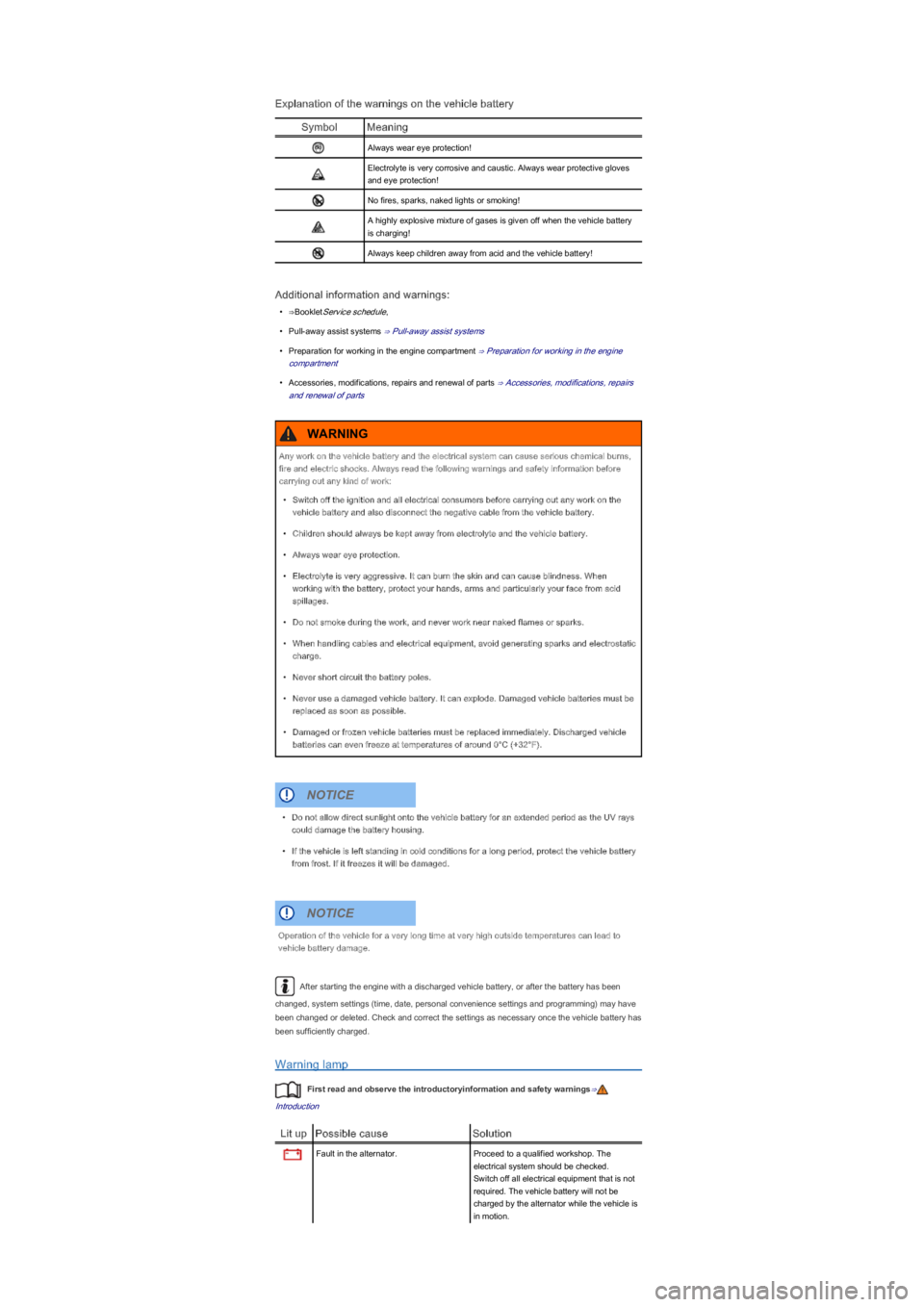
Explanation of the warnings on the vehicle battery
SymbolMeaning
Always wear eye protection!
Electrolyte is very corrosive and caustic. Always wear protective gloves
and eye protection!
No fires, sparks, naked lights or smoking!
A highly explosive mixture of gases is given off when the vehicle battery
is charging!
Always keep children away from acid and the vehicle battery!
Additional information and warnings:
•⇒BookletService schedule,
•Pull-away assist systems ⇒ Pull-away assist systems
•Preparation for working in the engine compartment ⇒ Preparation for working in the engine
compartment
•Accessories, modifications, repairs and renewal of parts ⇒ Accessories, modifications, repairs
and renewal of parts
After starting the engine with a discharged vehicle battery, or after the battery has been
changed, system settings (time, date, personal convenience settings and programming) may have
been changed or deleted. Check and correct the settings as necessary once the vehicle battery has
been sufficiently charged.
Warning lamp
First read and observe the introductoryinformation and safety warnings⇒
Introduction
Lit upPossible causeSolution
Fault in the alternator.Proceed to a qualified workshop. The
electrical system should be checked.
Switch off all electrical equipment that is not
required. The vehicle battery will not be
charged by the alternator while the vehicle is
in motion.
Any work on the vehicle battery and the electrical system can cause serious chemical burns,
fire and electric shocks. Always read the following warnings and safety information before
carrying out any kind of work:
•Switch off the ignition and all electrical consumers before carrying out any work on the
vehicle battery and also disconnect the negative cable from the vehicle battery.
•Children should always be kept away from electrolyte and the vehicle battery.
•Always wear eye protection.
•Electrolyte is very aggressive. It can burn the skin and can cause blindness. When
working with the battery, protect your hands, arms and particularly your face from acid
spillages.
•Do not smoke during the work, and never work near naked flames or sparks.
•When handling cables and electrical equipment, avoid generating sparks and electrostatic
charge.
•Never short circuit the battery poles.
•Never use a damaged vehicle battery. It can explode. Damaged vehicle batteries must be
replaced as soon as possible.
•Damaged or frozen vehicle batteries must be replaced immediately. Discharged vehicle
batteries can even freeze at temperatures of around 0°C (+32°F).
WARNING
•Do not allow direct sunlight onto the vehicle battery for an extended period as the UV rays
could damage the battery housing.
•If the vehicle is left standing in cold conditions for a long period, protect the vehicle battery
from frost. If it freezes it will be damaged.
NOTICE
Operation of the vehicle for a very long time at very high outside temperatures can lead to
vehicle battery damage.
NOTICE