change time VOLKSWAGEN UP! 2021 Owner´s Manual
[x] Cancel search | Manufacturer: VOLKSWAGEN, Model Year: 2021, Model line: UP!, Model: VOLKSWAGEN UP! 2021Pages: 211, PDF Size: 5.98 MB
Page 103 of 211
to assist every time that there is a sudden change in the road surface quality. If a section of dry
road is suddenly covered with water, mud or snow, ESC will not be able to assist in the same
manner as on a dry road. If the vehicle aquaplanes (drives on a layer of water rather than on the
road surface), ESC will not be able to assist in steering the vehicle as the contact to the road
surface has been interrupted and it is therefore no longer possible to steer or brake the vehicle.
Always adapt your speed and driving style to suit visibility, weather, road and traffic conditions. ESC
cannot defy the laws of motion, improve the available power output, or keep the vehicle on the road
if insufficient care and attention on the part of the driver causes the vehicle to leave the road.
Instead, ESC increases the possibility of keeping the vehicle under control and, in extreme on-road
driving situations, it assesses the driver’s steering input and helps the vehicle to continue in the
required direction. If the vehicle is driving at a speed that leads it to leave the road before the ESC
can provide any kind of support, the ESC will be unable to provide any assistance.
The ABS, BAS, TCS and EDL systems are integrated into the ESC. The ESC is always on.
Anti-lock brake system (ABS)
The ABS prevents the wheels from locking when the brakes are applied up until the point where the
vehicle is nearly stationary and assists the driver in steering the vehicle and keeping it under
control. This means that the vehicle is less likely to spin, even when the brakes are depressed fully:
•Depress and hold the brake pedal with force. Do not take your foot off the brake pedal or
reduce the force on the brake pedal!
•Do not pump the brake pedal or reduce the pressure on the brake pedal!
•Steer the vehicle while the brake pedal is fully depressed.
•The ABS will switch off when the brake pedal is released or if the pressure on the brake pedal is
reduced.
If the ABS is taking corrective action, there is a pulsing movement in the brake pedal and some
noise. However, ABS will not necessarily guarantee shorter braking distances in all conditions. The
braking distance could even be longer when braking on gravel or on fresh snow covering an icy or
slippery surface.
Electronic brake pressure distribution system (EBD)
Every vehicle's centre of gravity moves forwards whenever the brake is operated. This means that
the rear wheels are in danger of locking due to the lower traction. The electronic brake pressure
distribution system controls the brake pressure for the rear wheels and thereby ensures the
optimum distribution of brake pressure between the front and rear axles. Under normal conditions,
the system will prevent the rear from breaking away if too much brake pressure if applied to the rear
wheels. The electronic brake pressure distribution system is included in the ABS' scope of
functions.
Brake Assist system (BAS)
The brake assist system can help to reduce the braking distance. The brake assist system
reinforces brake pressure hydraulically when the driver depresses the brake pedal quickly in an
emergency situation. As a result, full braking power is made accessible very quickly, brake pressure
is increased and the braking distance reduced. In this way, the ABS is activated more quickly and
more effectively.
Do not reduce the pressure on the brake pedal. The brake assist system will switch off the
hydraulic brake servo automatically when the brake pedal is released or if the pressure on the
brake pedal is reduced.
Traction Control System (TCS) or Traction Control (TC)
The TCS or TC reduces the engine output if wheelspin occurs and adapts the output to suit road
surface conditions. TCS or TC helps the car to start moving, accelerate and climb gradients in
unfavourable road conditions.
Electronic differential lock (EDL)
The EDL is available for normal driving on straight roads. EDL brakes the wheel that has lost
traction and distributes the driving force to the other drive wheel. To prevent the disc brake of the
braked wheel from overheating, the EDL cuts out automatically if subjected to excessive loads. The
EDL will switch on again automatically when the brake has cooled down.
Page 104 of 211
The ESC or the TCS/TC can only function properly if all four wheels have the same tyres.
Any differences in the rolling radius of the tyres can cause the system to reduce engine power
unexpectedly.
If the ABS fails, the ESC, TCS, TC and EDL will also cease to function.
Control processes running in the systems described may cause operating noises.
Brake fluid
Fig. 101 In the engine compartment: cap on the brake fluid container
First read and observe the introductoryinformation and safety warnings⇒
Introduction
Brake fluid will gradually absorb water from the surrounding air. The brake system will be damaged
if there is too much water in the brake fluid. The boiling point of the brake fluid is also considerably
reduced by the water content. Heavy use of the brakes may cause a vapour lock in the brake
system if the water content is too high. Vapour locks reduce levels of braking power, considerably
increase braking distance and can even cause the brake system to fail completely. Your own safety
and that of other road users depends on having a brake system that functions properly at all times
⇒.
Brake fluid specification
Volkswagen has developed a brake fluid that has been optimised for the brake system in the
vehicle. To ensure optimal operation of the brake system, Volkswagen recommends the use of
brake fluid compliant with VW standard 501 14.
Driving fast on icy, slippery or wet roads can lead to a loss of control of the vehicle and could
cause serious injury to the driver and passengers.
•Adapt your speed and driving style to suit visibility, weather, road and traffic conditions. Do
not let the extra safety afforded by the brake assist systems ABS, BAS, EDL, TCS, TC and
ESC tempt you into taking any risks when driving.
•The brake assist systems cannot defy the laws of motion. Slippery and wet roads will
remain dangerous, even when the ESC and other systems are active.
•Driving too fast on wet roads can cause the wheels to lose contact with the road surface
and aquaplane. A vehicle cannot be braked, steered or controlled once it has lost contact
with the road surface.
•Brake assist systems cannot prevent an accident if, for example, you are driving too close
to the vehicle in front or are driving too fast for the individual situation.
•Although the brake assist systems are very effective and can help to control the vehicle in
difficult driving situations, please always remember that the driving stability of the vehicle
depends on the tyre grip.
•When accelerating on a slippery surface, for example on ice and snow, press the
accelerator carefully. The wheels can spin even with active brake assist systems and this
can lead to a loss of control of the vehicle.
WARNING
ESC will be considerably less effective if other components and systems that affect driving
dynamics are not serviced correctly or are not functioning properly. This also applies, but not
exclusively, to the brakes, tyres and other systems that have already been named.
•Please always note that modifications and changes to the vehicle can affect the function of
the ABS, BAS, TCS, TC, EDL and ESC.
•Alterations to the suspension system or the use of non-approved wheel and tyre
combinations can affect the function of ABS, BAS, TCS, TC, EDL and ESC and reduce
their effectiveness.
•Suitable tyres are also crucial if ESC is to function optimally ⇒ Wheels and tyres.
WARNING
Page 105 of 211
Before using a particular brake fluid, check that the specifications printed on the container
correspond to the vehicle requirements.
Brake fluid that is compliant with VW standard 501 14 is available from Volkswagen dealerships.
If this brake fluid is not available and it is necessary to use another high-quality brake fluid instead,
brake fluid that is compliant with DIN ISO 4925 CLASS 4 or US standard FMVSS 116 DOT 4 can
be used.
Not all brake fluids that are compliant with DIN ISO 4925 CLASS 4 or US standard FMVSS 116
DOT 4 have the same chemical composition. Some of these brake fluids may contain chemicals
that can damage or destroy brake system components over time.
Volkswagen therefore recommends the use of brake fluid that is compliant with
VW standard 501 14 to ensure sustained optimal operation of the brake system.
Brake fluid that is compliant with VW standard 501 14 fulfils the requirements of DIN ISO 4925
CLASS 4 or US standard FMVSS 116 DOT 4.
Brake fluid level
The brake fluid level must always be between the MIN and MAX marking on the brake fluid
container or above the MIN marking ⇒.
The brake fluid level cannot be checked accurately in all models as engine components may
partially conceal the brake fluid container. If the brake fluid level cannot be read exactly, please
proceed to a qualified workshop.
The brake fluid level drops slightly when the vehicle is being used as the brake pads wear and the
brakes are automatically adjusted.
Changing the brake fluid
The brake fluid must be changed as indicated in the service schedule ⇒BookletService schedule,.
The brake fluid should be changed by a qualified workshop. Volkswagen recommends using a
Volkswagen dealership for this purpose. Only brake fluid that conforms with the required
specification should be used.
Brake fluid can pollute the environment. Any spilt service fluids must be cleaned up and
disposed of properly.
Brake failure or reduced braking effect can be caused by the brake fluid level being too low or
by brake fluid that is too old or unsuitable.
•The brake system and brake fluid level must be checked regularly.
•The brake fluid should be changed regularly, according to the service schedule
⇒BookletService schedule,.
•Heavy use of the brakes may cause a vapour lock if the brake fluid is left in the system for
too long. Vapour locks reduce levels of braking power, considerably increase braking
distance and can cause the brake system to fail completely.
•Please ensure that the correct brake fluid is used. Only use brake fluid that is explicitly
compliant with VW standard 501 14.
•Any other brake fluid or a low-quality one can affect the functioning of the brakes and
reduce their effectiveness.
•If a brake fluid compliant with VW standard 501 14 is not available, use a high-quality
brake fluid compliant with DIN ISO 4925 CLASS 4 or the US standard FMVSS 116 DOT 4,
but only in exceptional circumstances.
•The refilled brake fluid must be new.
WARNING
Brake fluid is toxic.
•In order to reduce the risk of poisoning, never use bottles or other containers to store
brake fluid. These containers could encourage other people to drink out of them, even if
they are labelled otherwise.
•Brake fluid must always be stored in its original sealed container and kept out of the reach
of children.
WARNING
Brake fluid that has leaked or been spilt can damage the vehicle paintwork, plastic parts and
tyres. Brake fluid that has leaked or been spilt should be cleaned off the vehicle paintwork and
other components immediately.
NOTICE
Page 106 of 211
Driving with respect for the environment
Introduction
This chapter contains information on the followingsubjects:
⇒ An economic driving style
⇒ Driving in a fuel-efficient manner
Fuel economy, environmental impact and wear on the engine, brakes and tyres depend largely on
three factors:
•Personal driving style.
•Conditions of use (weather, road surface).
•Technical conditions.
Depending on your personal driving style, a few simple measures can help save fuel by up to 25%.
An economic driving style
First read and observe the introductoryinformation and safety warnings⇒
Introduction
Changing gear earlier
In principle, the highest gear is always the most economical gear. A rule of thumb for most vehicles:
at a speed of 30 km/h (19 mph) drive in 3rd gear, at 40 km/h (25 mph) in 4th gear and at 50 km/h
(31 mph) in 5th gear.
If the traffic and driving situation allows it, skipping gears when changing up a gear will also save
fuel.
Do not drive gears to their upper limit. Use first gear only for pulling away then quickly change up to
second gear. Avoid using the kickdown function in vehicles with an automated manual gearbox.
Vehicles with a gear display help to improve fuel economy by indicating the optimum time to
change gear.
Rolling to a stop
Taking your foot off the accelerator will interrupt the supply of fuel to the engine and decrease fuel
consumption.
Therefore, in situations such as approaching a red traffic light, let the vehicle roll without applying
the accelerator. Only press on the clutch pedal to disengage if the vehicle becomes too slow or if
the stopping distance is longer. The engine will then run at idling speed.
Switch off the engine in situations when the vehicle might be stationary for a long time, e.g. at a
level crossing. In vehicles with an active start/stop system, the engine will switch off automatically
when the vehicle is stationary.
Thinking ahead when driving, and driving with the flow of traffic
Applying the brake and accelerator too often will significantly increase fuel consumption. By thinking
ahead when driving and by maintaining a sufficient distance from the vehicle in front, simply
keeping your foot off the accelerator will stop the speed from fluctuating. This means that active
braking and accelerating is not always necessary.
Driving smoothly and evenly
Even more important than speed is smoothness: the more evenly you drive, the lower your fuel
consumption will be.
When driving on a motorway, it is much more effective to drive at a constant moderate speed than
to drive with constant acceleration and braking. As a rule, driving with a constant style will get you
to your destination just as quickly.
The cruise control system will help you to maintain a constant driving style.
Using additional equipment in moderation
It is always important to be comfortable in your vehicle, but it is also important to consider the
environment.
Some equipment will increase fuel consumption when switched on:
Adapt your speed and distance from the vehicles ahead to suit visibility, weather, road and
traffic conditions.
WARNING
Page 117 of 211
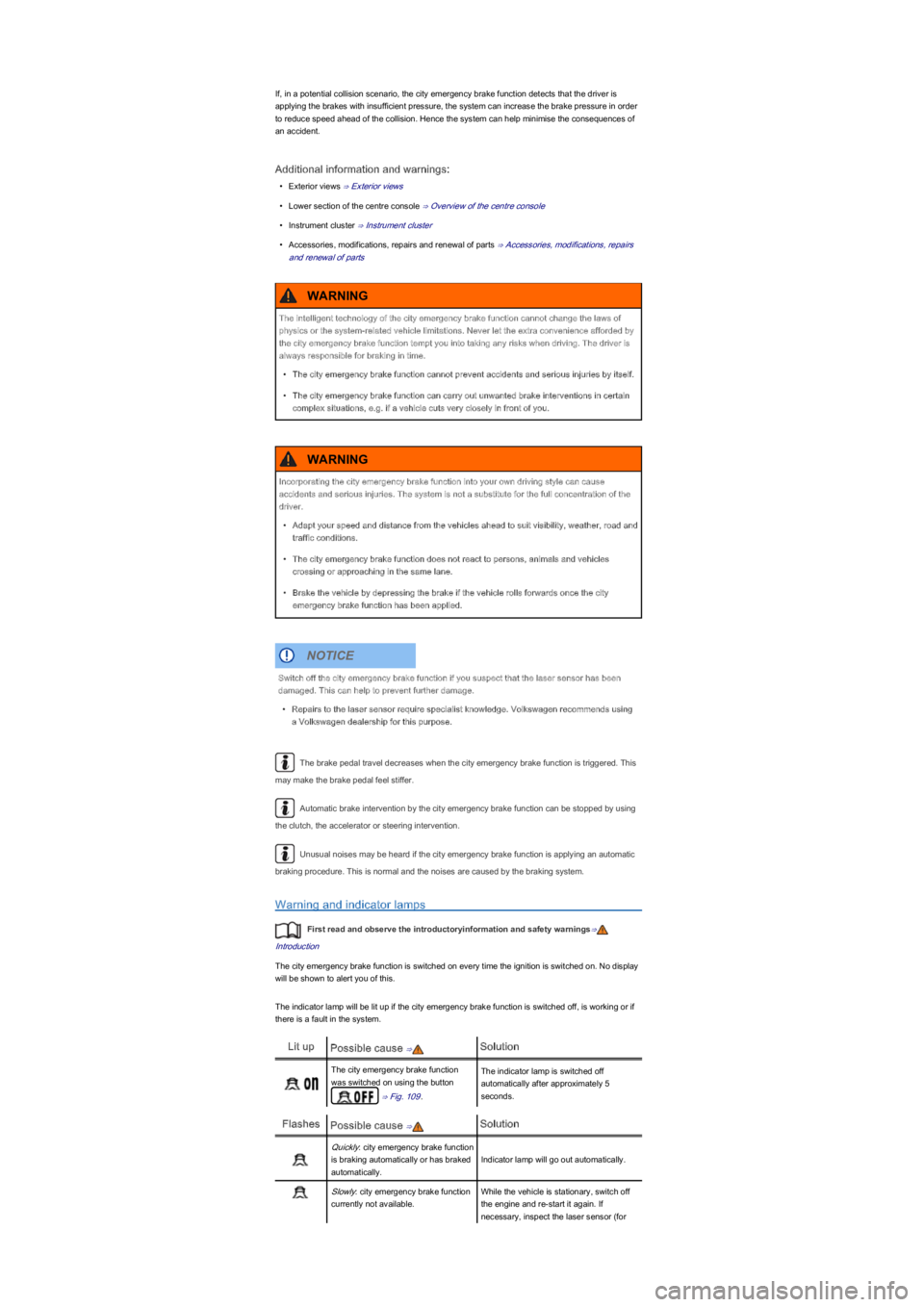
If, in a potential collision scenario, the city emergency brake function detects that the driver is
applying the brakes with insufficient pressure, the system can increase the brake pressure in order
to reduce speed ahead of the collision. Hence the system can help minimise the consequences of
an accident.
Additional information and warnings:
•Exterior views ⇒ Exterior views
•Lower section of the centre console ⇒ Overview of the centre console
•Instrument cluster ⇒ Instrument cluster
•Accessories, modifications, repairs and renewal of parts ⇒ Accessories, modifications, repairs
and renewal of parts
The brake pedal travel decreases when the city emergency brake function is triggered. This
may make the brake pedal feel stiffer.
Automatic brake intervention by the city emergency brake function can be stopped by using
the clutch, the accelerator or steering intervention.
Unusual noises may be heard if the city emergency brake function is applying an automatic
braking procedure. This is normal and the noises are caused by the braking system.
Warning and indicator lamps
First read and observe the introductoryinformation and safety warnings⇒
Introduction
The city emergency brake function is switched on every time the ignition is switched on. No display
will be shown to alert you of this.
The indicator lamp will be lit up if the city emergency brake function is switched off, is working or if
there is a fault in the system.
Lit upPossible cause ⇒Solution
The city emergency brake function
was switched on using the button
⇒ Fig. 109.
The indicator lamp is switched off
automatically after approximately 5
seconds.
FlashesPossible cause ⇒Solution
Quickly: city emergency brake function
is braking automatically or has braked
automatically.
Indicator lamp will go out automatically.
Slowly: city emergency brake function
currently not available.
While the vehicle is stationary, switch off
the engine and re-start it again. If
necessary, inspect the laser sensor (for
The intelligent technology of the city emergency brake function cannot change the laws of
physics or the system-related vehicle limitations. Never let the extra convenience afforded by
the city emergency brake function tempt you into taking any risks when driving. The driver is
always responsible for braking in time.
•The city emergency brake function cannot prevent accidents and serious injuries by itself.
•The city emergency brake function can carry out unwanted brake interventions in certain
complex situations, e.g. if a vehicle cuts very closely in front of you.
WARNING
Incorporating the city emergency brake function into your own driving style can cause
accidents and serious injuries. The system is not a substitute for the full concentration of the
driver.
•Adapt your speed and distance from the vehicles ahead to suit visibility, weather, road and
traffic conditions.
•The city emergency brake function does not react to persons, animals and vehicles
crossing or approaching in the same lane.
•Brake the vehicle by depressing the brake if the vehicle rolls forwards once the city
emergency brake function has been applied.
WARNING
Switch off the city emergency brake function if you suspect that the laser sensor has been
damaged. This can help to prevent further damage.
•Repairs to the laser sensor require specialist knowledge. Volkswagen recommends using
a Volkswagen dealership for this purpose.
NOTICE
Page 136 of 211

If possible, only use Volkswagen-approved engine oil ⇒. The engine oils listed are multigrade
high-lubricity oils.
Engine oils are constantly being developed and improved. A Volkswagen dealership is always kept
up to date on innovations. Volkswagen therefore recommends having engine oil changes done by a
Volkswagen dealership.
The quality of the engine oil is not only tailored to the requirements of engines and exhaust gas
treatment systems, but also to fuel quality. Due to the way in which a combustion engine works,
engine oil always comes into contact with combustion residues and fuel, which has a knock-on
effect on the ageing process of the oil.
The quality of fuels can vary greatly between individual markets and this must be taken into account
when selecting the correct engine oil.
The use of engine oils compliant with the VW 504 00 requires a fuel quality compliant with EN 228
(petrol) or fuel of and equivalent quality. Engine oils compliant with VW 504 00 are therefore
unsuitable for use in a large number of markets.
Permitted engine oil
specifications ⇒
Alternative engine oil
specifications⇒
Engine
type
Fixed service QI1, QI2, QI3,
QI4, QI7 (based on
time/distance travelled)
Only in the EU, Switzerland,
Norway, Japan and Australia
Petrol
enginesVW 502 00VW 504 00
Natural gas
engineVW 502 00-----
Alternative engine oil specifications may only be used in fixed services QI1, QI2, QI3, QI4 and
QI7, and only when fuel of a quality compliant with EN 228 (petrol), or fuel of an equivalent quality,
is available in the particular country.
Checking the engine oil level and refilling engine oil
Fig. 121 Oil dipstick with markings
Fig. 122 In the engine compartment: engine oil filler cap
First read and observe the introductoryinformation and safety warnings⇒
Introduction
a)
•Do not add any additional lubricants to the engine oil. Any damage caused by the use of
such additives is not covered by the warranty.
•Only engine oil specifications that have been approved for use with the engine should be
used. Using other engine oils can cause engine damage.
•Another engine oil can be used in the event of an emergency if the listed engine oils () are
not available. To avoid damaging the engine, a maximum quantity of 0.5 litres of the
following engine oil may be used only once until the next oil change:
- Petrol engines: standards ACEAA3/B4 or API SN (API SM).
NOTICE
a)
Page 142 of 211
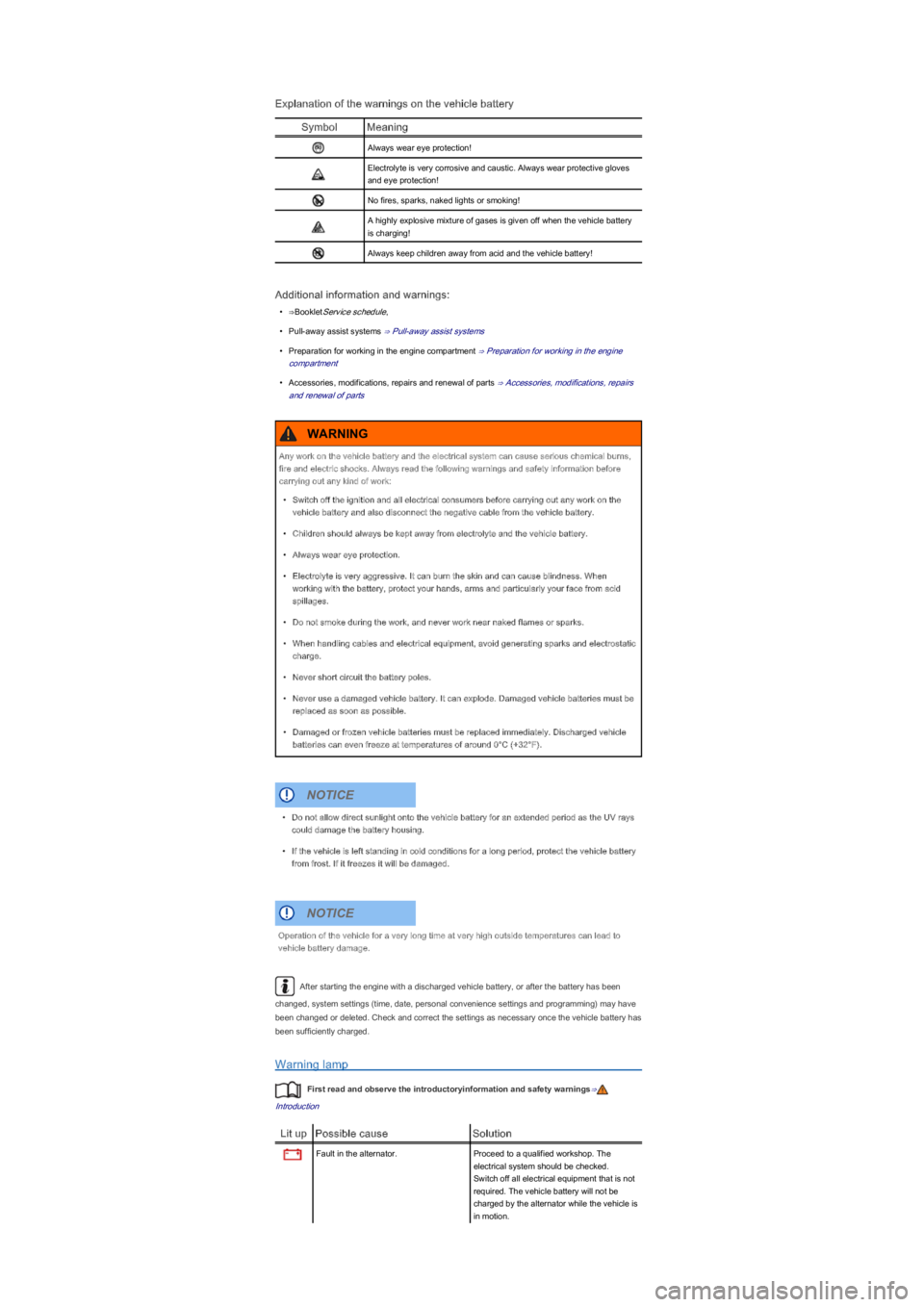
Explanation of the warnings on the vehicle battery
SymbolMeaning
Always wear eye protection!
Electrolyte is very corrosive and caustic. Always wear protective gloves
and eye protection!
No fires, sparks, naked lights or smoking!
A highly explosive mixture of gases is given off when the vehicle battery
is charging!
Always keep children away from acid and the vehicle battery!
Additional information and warnings:
•⇒BookletService schedule,
•Pull-away assist systems ⇒ Pull-away assist systems
•Preparation for working in the engine compartment ⇒ Preparation for working in the engine
compartment
•Accessories, modifications, repairs and renewal of parts ⇒ Accessories, modifications, repairs
and renewal of parts
After starting the engine with a discharged vehicle battery, or after the battery has been
changed, system settings (time, date, personal convenience settings and programming) may have
been changed or deleted. Check and correct the settings as necessary once the vehicle battery has
been sufficiently charged.
Warning lamp
First read and observe the introductoryinformation and safety warnings⇒
Introduction
Lit upPossible causeSolution
Fault in the alternator.Proceed to a qualified workshop. The
electrical system should be checked.
Switch off all electrical equipment that is not
required. The vehicle battery will not be
charged by the alternator while the vehicle is
in motion.
Any work on the vehicle battery and the electrical system can cause serious chemical burns,
fire and electric shocks. Always read the following warnings and safety information before
carrying out any kind of work:
•Switch off the ignition and all electrical consumers before carrying out any work on the
vehicle battery and also disconnect the negative cable from the vehicle battery.
•Children should always be kept away from electrolyte and the vehicle battery.
•Always wear eye protection.
•Electrolyte is very aggressive. It can burn the skin and can cause blindness. When
working with the battery, protect your hands, arms and particularly your face from acid
spillages.
•Do not smoke during the work, and never work near naked flames or sparks.
•When handling cables and electrical equipment, avoid generating sparks and electrostatic
charge.
•Never short circuit the battery poles.
•Never use a damaged vehicle battery. It can explode. Damaged vehicle batteries must be
replaced as soon as possible.
•Damaged or frozen vehicle batteries must be replaced immediately. Discharged vehicle
batteries can even freeze at temperatures of around 0°C (+32°F).
WARNING
•Do not allow direct sunlight onto the vehicle battery for an extended period as the UV rays
could damage the battery housing.
•If the vehicle is left standing in cold conditions for a long period, protect the vehicle battery
from frost. If it freezes it will be damaged.
NOTICE
Operation of the vehicle for a very long time at very high outside temperatures can lead to
vehicle battery damage.
NOTICE
Page 144 of 211
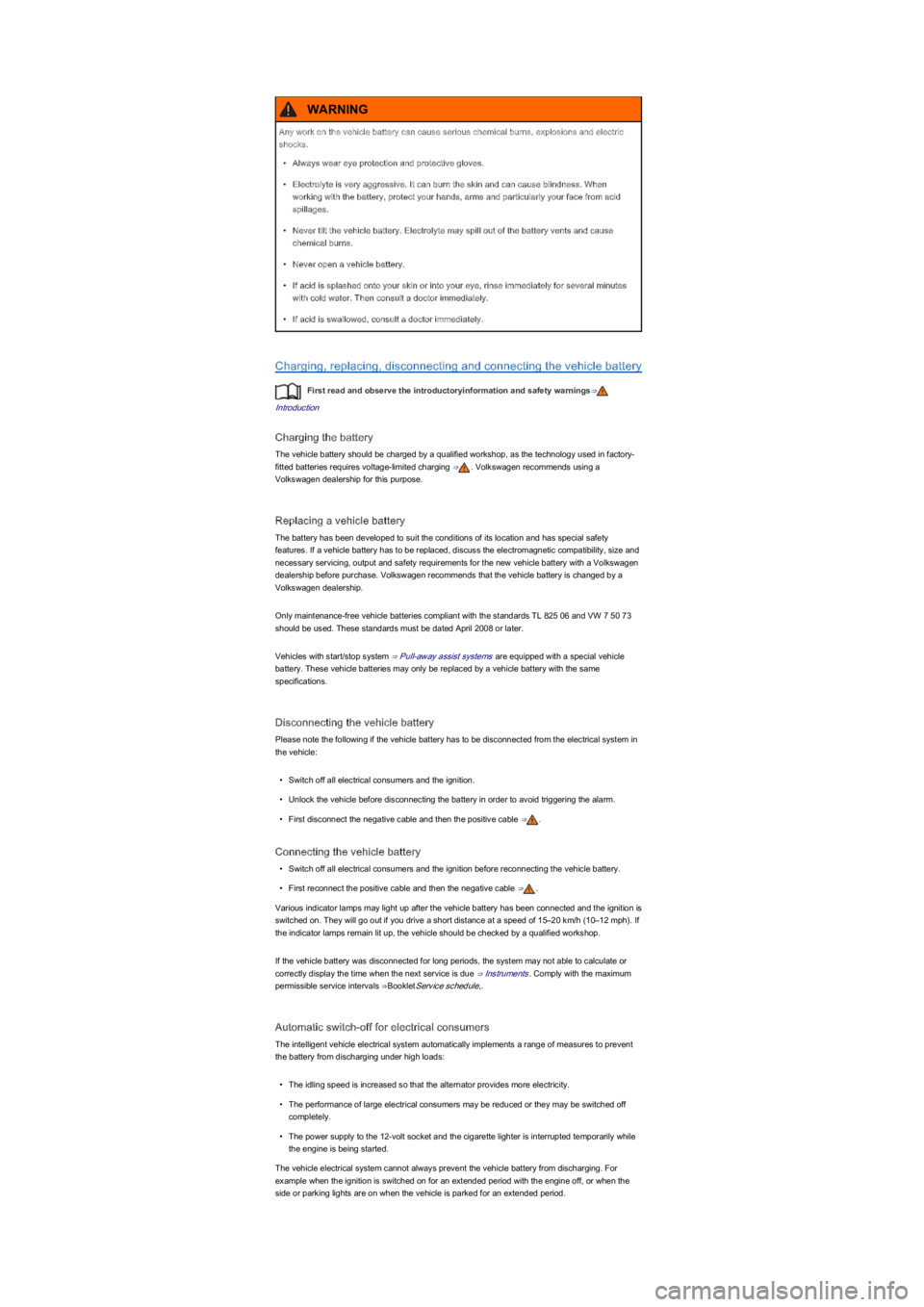
Charging, replacing, disconnecting and connecting the vehicle battery
First read and observe the introductoryinformation and safety warnings⇒
Introduction
Charging the battery
The vehicle battery should be charged by a qualified workshop, as the technology used in factory-
fitted batteries requires voltage-limited charging ⇒. Volkswagen recommends using a
Volkswagen dealership for this purpose.
Replacing a vehicle battery
The battery has been developed to suit the conditions of its location and has special safety
features. If a vehicle battery has to be replaced, discuss the electromagnetic compatibility, size and
necessary servicing, output and safety requirements for the new vehicle battery with a Volkswagen
dealership before purchase. Volkswagen recommends that the vehicle battery is changed by a
Volkswagen dealership.
Only maintenance-free vehicle batteries compliant with the standards TL 825 06 and VW 7 50 73
should be used. These standards must be dated April 2008 or later.
Vehicles with start/stop system ⇒ Pull-away assist systems are equipped with a special vehicle
battery. These vehicle batteries may only be replaced by a vehicle battery with the same
specifications.
Disconnecting the vehicle battery
Please note the following if the vehicle battery has to be disconnected from the electrical system in
the vehicle:
•Switch off all electrical consumers and the ignition.
•Unlock the vehicle before disconnecting the battery in order to avoid triggering the alarm.
•First disconnect the negative cable and then the positive cable ⇒.
Connecting the vehicle battery
•Switch off all electrical consumers and the ignition before reconnecting the vehicle battery.
•First reconnect the positive cable and then the negative cable ⇒.
Various indicator lamps may light up after the vehicle battery has been connected and the ignition is
switched on. They will go out if you drive a short distance at a speed of 15–20 km/h (10–12 mph). If
the indicator lamps remain lit up, the vehicle should be checked by a qualified workshop.
If the vehicle battery was disconnected for long periods, the system may not able to calculate or
correctly display the time when the next service is due ⇒ Instruments. Comply with the maximum
permissible service intervals ⇒BookletService schedule,.
Automatic switch-off for electrical consumers
The intelligent vehicle electrical system automatically implements a range of measures to prevent
the battery from discharging under high loads:
•The idling speed is increased so that the alternator provides more electricity.
•The performance of large electrical consumers may be reduced or they may be switched off
completely.
•The power supply to the 12-volt socket and the cigarette lighter is interrupted temporarily while
the engine is being started.
The vehicle electrical system cannot always prevent the vehicle battery from discharging. For
example when the ignition is switched on for an extended period with the engine off, or when the
side or parking lights are on when the vehicle is parked for an extended period.
Any work on the vehicle battery can cause serious chemical burns, explosions and electric
shocks.
•Always wear eye protection and protective gloves.
•Electrolyte is very aggressive. It can burn the skin and can cause blindness. When
working with the battery, protect your hands, arms and particularly your face from acid
spillages.
•Never tilt the vehicle battery. Electrolyte may spill out of the battery vents and cause
chemical burns.
•Never open a vehicle battery.
•If acid is splashed onto your skin or into your eye, rinse immediately for several minutes
with cold water. Then consult a doctor immediately.
•If acid is swallowed, consult a doctor immediately.
WARNING
Page 150 of 211
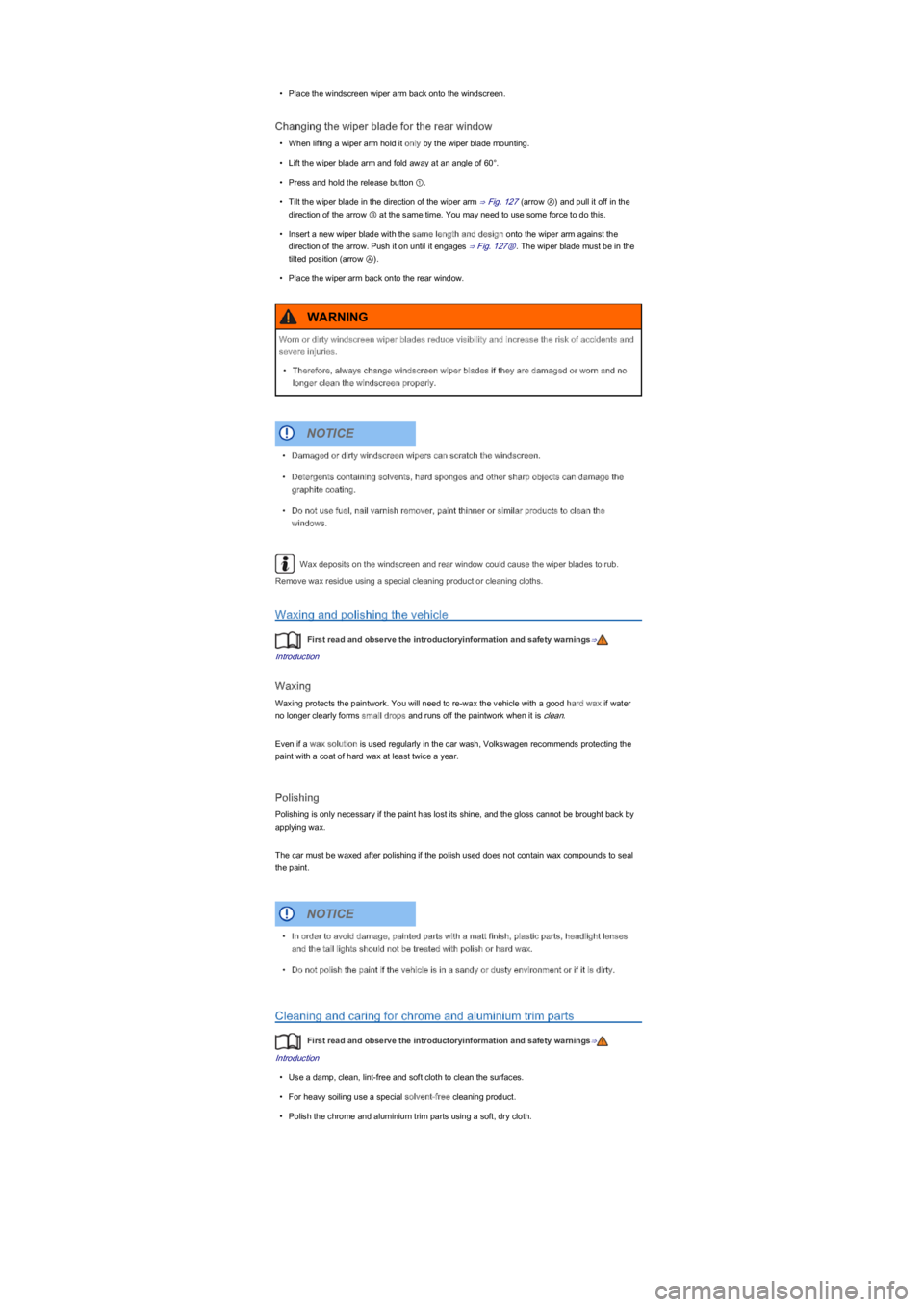
•Place the windscreen wiper arm back onto the windscreen.
Changing the wiper blade for the rear window
•When lifting a wiper arm hold it only by the wiper blade mounting.
•Lift the wiper blade arm and fold away at an angle of 60°.
•Press and hold the release button ①.
•Tilt the wiper blade in the direction of the wiper arm ⇒ Fig. 127 (arrow Ⓐ) and pull it off in the
direction of the arrow Ⓑ at the same time. You may need to use some force to do this.
•Insert a new wiper blade with the same length and design onto the wiper arm against the
direction of the arrow. Push it on until it engages ⇒ Fig. 127Ⓑ. The wiper blade must be in the
tilted position (arrow Ⓐ).
•Place the wiper arm back onto the rear window.
Wax deposits on the windscreen and rear window could cause the wiper blades to rub.
Remove wax residue using a special cleaning product or cleaning cloths.
Waxing and polishing the vehicle
First read and observe the introductoryinformation and safety warnings⇒
Introduction
Waxing
Waxing protects the paintwork. You will need to re-wax the vehicle with a good hard wax if water
no longer clearly forms small drops and runs off the paintwork when it is clean.
Even if a wax solution is used regularly in the car wash, Volkswagen recommends protecting the
paint with a coat of hard wax at least twice a year.
Polishing
Polishing is only necessary if the paint has lost its shine, and the gloss cannot be brought back by
applying wax.
The car must be waxed after polishing if the polish used does not contain wax compounds to seal
the paint.
Cleaning and caring for chrome and aluminium trim parts
First read and observe the introductoryinformation and safety warnings⇒
Introduction
•Use a damp, clean, lint-free and soft cloth to clean the surfaces.
•For heavy soiling use a special solvent-free cleaning product.
•Polish the chrome and aluminium trim parts using a soft, dry cloth.
Worn or dirty windscreen wiper blades reduce visibility and increase the risk of accidents and
severe injuries.
•Therefore, always change windscreen wiper blades if they are damaged or worn and no
longer clean the windscreen properly.
WARNING
•Damaged or dirty windscreen wipers can scratch the windscreen.
•Detergents containing solvents, hard sponges and other sharp objects can damage the
graphite coating.
•Do not use fuel, nail varnish remover, paint thinner or similar products to clean the
windows.
NOTICE
•In order to avoid damage, painted parts with a matt finish, plastic parts, headlight lenses
and the tail lights should not be treated with polish or hard wax.
•Do not polish the paint if the vehicle is in a sandy or dusty environment or if it is dirty.
NOTICE
Page 159 of 211
The tyres and wheel rims are an essential part of the vehicle's design. The tyres and rims approved
by Volkswagen are specifically matched to the characteristics of the vehicle and make a major
contribution to good road holding and safe handling.
Avoiding damage to the tyres
•If you have to drive over a kerb or similar obstacle, drive slowly and at a right angle if possible.
•Inspect the tyres regularly for damage such as cuts, cracks or blisters.
•Remove foreign objects that are in the outer tyre tread and have not penetrated the inner
tyre⇒ Tyre damage.
•Always respond to any warning messages given by the tyre monitoring system.
•Damaged or worn tyres must be replaced immediately ⇒ Tyre damage.
•Regularly check the tyres for hidden damage ⇒ Tyre damage.
•Never exceed the top speed and load permitted for the tyres that are fitted ⇒ Tyre lettering.
•Protect the wheels, including the spare wheel, from contact with corrosive substances, including
oils, lubricants, fuel and brake fluid ⇒.
•Replace missing dust caps immediately.
Tyres with directional tread pattern
Tyres with directional tread pattern have been developed to roll in one direction only. An arrow on
the tyre sidewall indicates the direction of rotation on tyres with directional tread ⇒ Tyre lettering.
The direction of rotation must be adhered to. This is the only guarantee for optimum grip and helps
to avoid aquaplaning, excessive noise and wear.
If, however, the tyre is fitted in the opposite direction to the tread pattern, you must take more care
when driving as the tyre is now no longer being used according to its designation. This is
particularly important on wet roads. The tyres must be replaced as quickly as possible or be fitted
with the tread in the correct direction.
Rotating wheels front to rear
Regularly rotating the wheels as shown in the illustration ⇒ Fig. 130 is recommended to help
ensure that tyres wear evenly. All the tyres will then last for about the same time.
Volkswagen recommends having the wheels changed by a qualified workshop.
Tyres that are older than 6 years
Tyres age through physical and chemical processes that can impair their function. Tyres that are
stored unused for an extended period will harden and become brittle more quickly than tyres which
are in constant use.
Volkswagen recommends replacing tyres that are older than 6 years with new tyres. This also
applies to tyres, including the spare wheel, which appear to still be in good condition and whose
tread depth has not yet reached the minimum value stipulated by legislation ⇒.
The age of a tyre can be determined from the manufacturing date, which is a component of the tyre
identification number () ⇒ Tyre lettering.
Storing tyres
Mark tyres before you remove them to indicate the direction of rotation. This ensures you will be
able to mount them correctly when you replace them (left, right, front, rear). When removed, the
wheels or tyres should be stored in a cool, dry and preferably dark place. Do not store tyres
mounted on the rim vertically.
Any tyres not fitted on rims should be kept in suitable sleeves to protect against dirt and should be
stored vertically (standing on the tread).
Old tyres should be disposed of as required by legislation.
Corrosive liquids and other substances can cause visible and invisible damage to the tyres,
which can cause the tyre to burst.
•Always keep chemicals, oils, lubricants, fuel, brake fluid and other corrosive substances
away from the tyres.
WARNING
Old tyres – even if they have not been used – can suddenly lose pressure or burst, especially
at high speeds, and thus cause accidents and serious injuries.
•Avoid using tyres that are more than six years old. If you have no alternative, drive slowly
and with extra care at all times.
WARNING