child lock VOLKSWAGEN UP! 2021 Owner´s Manual
[x] Cancel search | Manufacturer: VOLKSWAGEN, Model Year: 2021, Model line: UP!, Model: VOLKSWAGEN UP! 2021Pages: 211, PDF Size: 5.98 MB
Page 47 of 211
The belt tensioners are activated by sensors during severe frontal, side and rear collisions. They
tighten the seat belts against the direction in which they are pulled. A loose seat belt is retracted,
which can reduce the forward movement or the movement of the vehicle occupants in the direction
of the impact. The belt tensioner works together with the airbag system. If the side airbags are not
activated, the belt tensioner will not be activated if the vehicle rolls over.
A fine dust may be produced when the airbags are triggered. This is quite normal and does not
mean that there is a fire in the vehicle.
Belt tension limiter
The belt tension limiter reduces the pressure exerted by the seat belt on the body during an
accident.
All safety requirements must be observed when the vehicle or components of the system are
scrapped. Qualified workshops are familiar with these requirements ⇒ Service and disposal of belt
tensioners.
Service and disposal of belt tensioners
First read and observe the introductoryinformation and safety warnings⇒
Introduction
Seat belts may become damaged during any work on the belt tensioners or while removing or
refitting any vehicle parts in conjunction with any other repair work. This damage will not always be
noticeable. The consequence may be that the belt tensioners could function incorrectly, or not
function at all, in the event of an accident.
Regulations must be observed to ensure that the effectiveness of the belt tensioner is not reduced
and that removed parts do not cause any injuries or environmental pollution. Qualified workshops
are familiar with these requirements.
The airbag modules and belt tensioners may contain perchlorate. Please comply with
legislation regarding disposal.
Airbag system
Introduction
This chapter contains information on the followingsubjects:
⇒ Types of front passenger front airbag system
⇒ Indicator lamps
⇒ Description and function of the airbags
⇒ Front airbags
⇒ Switching the front passenger front airbag on and off manually using the key-operated switch
⇒ Side airbags
The vehicle is equipped with a front airbag for the driver and front passenger. The front airbags can
provide front seat occupants with additional chest and head protection if the seat, seat belts, head
restraints and, in the case of the driver, steering wheel are adjusted and used correctly. Airbags are
meant only for additional protection. The airbags are not a substitute for seat belts. Seat belts must
always be worn, even when the front seats are equipped with front airbags.
Additional information and warnings:
•Driving tips ⇒ Driving tips
•Central locking system ⇒ Central locking system
•Correct sitting position ⇒ Adjusting the seat position
•Seat belts ⇒ Seat belts
•Child seats (accessories) ⇒ Child seats (accessories)
•Cleaning and caring for the interior ⇒ Cleaning and caring for the interior
•Accessories, modifications, repairs and renewal of parts ⇒ Accessories, modifications, repairs
and renewal of parts
•Consumer information ⇒ Consumer information
The risk of severe or fatal injuries may be increased if the seat belts, automatic belt retractors
and belt tensioners are not used correctly, or if they are repaired by a non-professional. As a
result, the belt tensioners may not be triggered when they should, or they may be triggered
unexpectedly.
•Any repairs, adjustments or removal and refitting of parts in the belt tensioners or seat
belts should always be carried out by a qualified workshop and never by yourself
⇒ Accessories, modifications, repairs and renewal of parts.
•Belt tensioners and automatic belt retractors cannot be repaired. They must be replaced.
WARNING
Page 57 of 211
Ensure that the front passenger can still maintain a correct sitting position ⇒ Adjusting the seat
position.
Suitable child seats
The child seat must have been approved by the manufacturer for use on the rear bench seat with
side airbag.
Universal child seats in groups 0, 0+, 1, 2, or 3 as specified in ECE-R 44 can be fitted to the rear
seats.
The seats are suitable for child seats with the ISOFIX system that are specially approved for this
vehicle type by ECE-R 44.
ISOFIX child seats approved for use on rear seats
There are different categories of ISOFIX child seats: universal, semi-universal and vehicle-specific.
•If the ISOFIX child seat has universal approval, the child seat must be fastened with the lower
anchoring points and the top tether.
•If ISOFIX child seats have semi-universal or vehicle-specific approval, a check must be made
prior to use in order to find out whether the child seat has been approved for the vehicle. For
this purpose, the child-seat manufacturer supplies the ISOFIX child seat with a list of vehicles
for which the respective ISOFIX child seat has been approved. If necessary, contact the child
seat manufacturer for an up-to-date list of vehicles.
Securing child seats with a seat belt
First read and observe the introductoryinformation and safety warnings⇒
Introduction
It is permissible to fasten child seats with universal written on the orange label to the seats using
the seat belt, but only on the seats marked in the table with a u.
Weight classFront passenger seatSeats on the rear bench
seat
Group 0
up to 10 kguu
Group 0+
up to 13 kguu
Group 1
9 to 18 kguu
Group 2
15 to 25 kguu
Group 3
22 to 36 kguu
Securing a child seat using the seat belt
•Read and follow the child seat manufacturer's instructions.
•When placing the child seat on the front passenger seat, push the seat back as far as possible
and adjust the backrest to an upright position ⇒ Adjusting the seat position.
•Position the child seat on the seat according to the instructions given by the child seat
manufacturer.
•Fasten the seat belt or guide it through the child seat as described in the child seat
manufacturer's instructions.
•Ensure that the seat belt is not twisted.
•Insert the latch plate into the buckle for the appropriate seat and push it down until it locks
securely with a click.
•In vehicles with lockable seat belts: pull the shoulder part of the belt all the way out and let the
belt web roll up on the automatic belt retractor. The belt makes a clicking sound as it rolls up.
•The upper part of the belt must lie snugly and fully over the child seat.
•Pull the seat belt to check that the lower belt strap is locked and can no longer be pulled out.
•In vehicles with lockable seat belts: secure any seat belts that are not being used out of the
reach of the child in the child seat, by guiding the belt behind the head restraint on the
neighbouring seat. When doing this, ensure that the locking mechanism of the seat belt is not
triggered! The belt should not make a clicking sound as it rolls up. Let the belt web roll up on the
automatic belt retractor.
A child in a child seat on the rear bench seat can sustain fatal injuries if they play with
lockable seat belts that are not in use.
•Always secure any lockable seat belts on the rear bench seat that are not in use.
WARNING
Page 59 of 211
•Pull on both sides of the child seat.
Child seats with adjustable attachment belts
•Observe the child seat manufacturer's instructions when fitting or removing the child seat ⇒.
•Position the child seat on the seat cushion and attach the hooks from the attachment belts onto
the retaining rings ⇒ Fig. 59.
•Pull the attachment belts to ensure that they are equally taut. The child seat must fit snugly to
the vehicle seat.
•Pull on both sides of the child seat.
Securing child seats with the top tether
Fig. 60 Example of a fastened top tether
First read and observe the introductoryinformation and safety warnings⇒
Introduction
•Observe the instructions provided by the child seat manufacturer when fitting or removing the
child seat ⇒.
•Release the seat backrest and fold the backrest forwards slightly ⇒ Luggage compartment.
•Remove the head restraint located behind the child seat and stow it securely in the vehicle
⇒ Adjusting the seat position.
•Guide the top tether of the child seat back between the backrest and the luggage compartment
cover into the luggage compartment.
•Fold back the seat backrest and push it firmly to lock it in place.
•Attach the child seat to the lower anchoring points ⇒ Securing child seats using lower anchoring
points (ISOFIX, LATCH).
•Fasten the top tether to the retaining rings in the luggage compartment ⇒ Fig. 60.
•Stretch the belt so that the child seat is positioned high on the backrest.
Reinstall the head restraints after the child seat has been removed⇒ Adjusting the seat position.
Lights and vision
Lights
The lower anchoring points for the child seats are not fastening rings. Fit child seats to the
lower anchoring points only.
WARNING
•In order to avoid permanent marks on the seats, the insert guides should be removed from
the anchoring points when there is no child seat fitted to them.
•In order to avoid damage to the seat covers, the seats or the insert guides, the insert
guides must always be removed from the anchoring points before folding the rear bench
seat forwards.
NOTICE
Child seats attached using the lower anchoring points and top tether must be fitted according
to the instructions from the manufacturer. Failure to do so could lead to severe injuries.
•Never attach more than one top tether from a child seat to one retaining ring in the
luggage compartment.
•Only use the specially fitted retaining rings when attaching the top tether.
•Never fasten the top tether to one of the fastening rings.
WARNING
Page 73 of 211
The ventilation openings between the rear window and the luggage compartment cover must
not be covered as this would prevent stale air escaping from the vehicle.
Folding the backrests on the rear bench seat forwards and backwards
Fig. 72 Rear bench seat: release button Ⓐ; red marking Ⓑ
First read and observe the introductoryinformation and safety warnings⇒
Introduction
The rear seat backrest can be folded forward to extend the luggage compartment.
Folding the rear seat backrest forwards
•Push the head restraint all the way down or remove it, if necessary ⇒ Adjusting the seat position
and stow it in a safe place.
•Pull the release button forwards ⇒ Fig. 72Ⓐ and, at the same time, fold the backrest forwards.
When the vehicle is not in use or is not being supervised, always lock the doors and tailgate
to reduce the risk of severe or fatal injuries.
•Never leave children unattended, especially when the tailgate is open. Children could
make their way into the luggage compartment, close the tailgate and be unable to get out.
This can cause severe or fatal injuries.
•Never let children play in or around the vehicle.
•Do not travel with people in the luggage compartment.
WARNING
Objects that are not secured, or are secured incorrectly, can cause serious injuries in the
event of a sudden driving or braking manoeuvre or accident. This applies particularly if
objects are struck by the airbag when activated and then flung through the vehicle interior.
Please apply the following rules to reduce the risk of accidents:
•Always stow all objects in the vehicle securely. Always stow luggage and heavy objects in
the luggage compartment.
•Always use suitable straps to prevent luggage from being thrown through the vehicle
interior and entering the deployment zone of the side airbags or the front airbag in the
event of a sudden driving or braking manoeuvre or an accident.
•Always keep stowage compartments closed while the vehicle is in motion.
•Do not stow any hard, heavy or sharp objects loose in any of the vehicle's open stowage
areas, on the luggage compartment cover or on the dash panel.
•Remove any hard, heavy or sharp objects from items of clothing and bags inside the
vehicle and stow them securely.
WARNING
Transporting heavy objects changes the vehicle's handling and increases the braking
distance. Heavy loads that are not properly stowed or secured in the vehicle can lead to a
loss of vehicle control and can cause serious injury.
•Transporting heavy objects changes the vehicle's handling and the centre of gravity.
•The payload should be distributed as evenly as possible in the vehicle.
•Always secure heavy objects in the luggage compartment as far in front of the rear axle as
possible.
WARNING
Hard objects could chafe against the wires of the heating element in the rear window and
cause damage.
NOTICE
Page 74 of 211
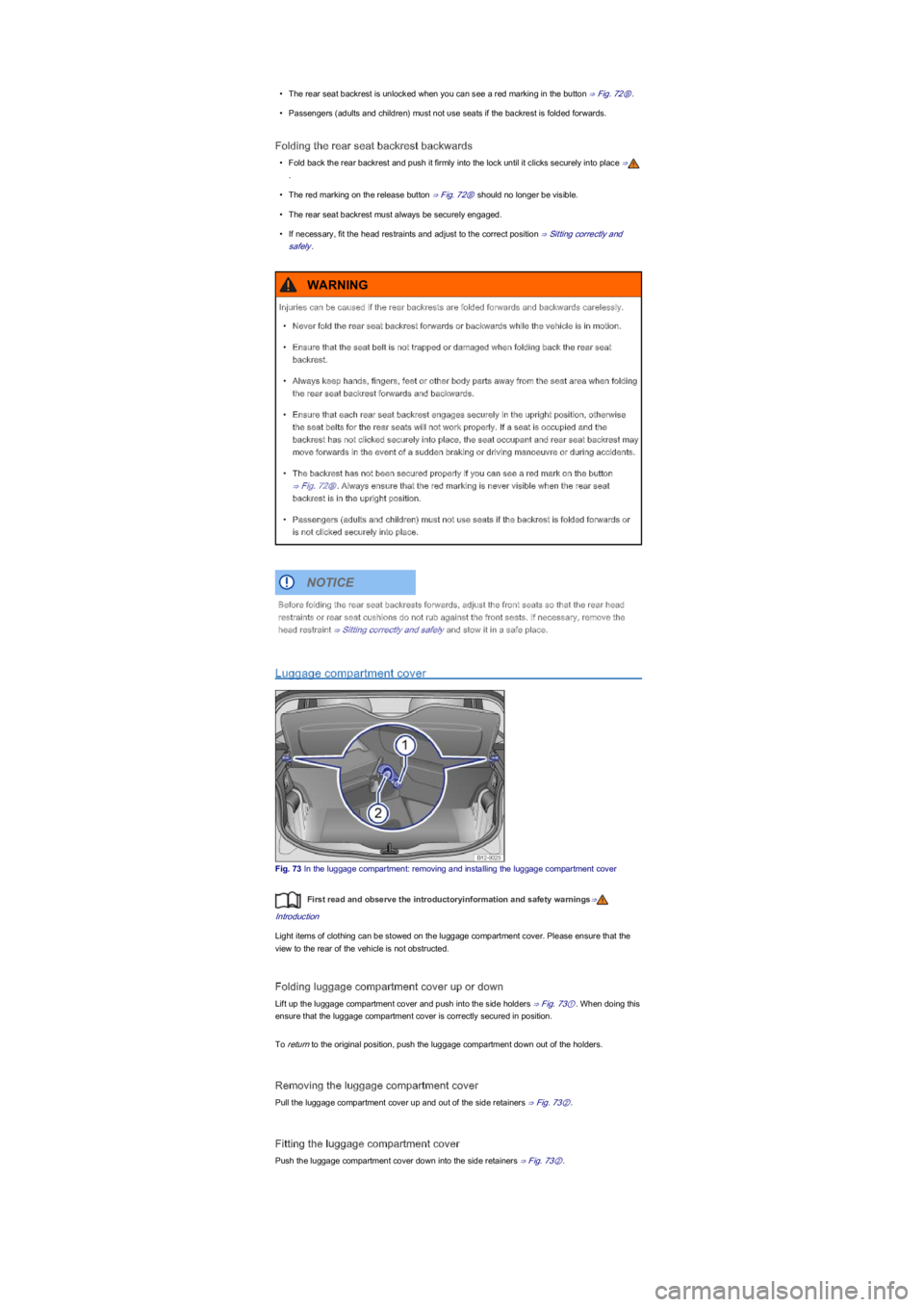
•The rear seat backrest is unlocked when you can see a red marking in the button ⇒ Fig. 72Ⓑ.
•Passengers (adults and children) must not use seats if the backrest is folded forwards.
Folding the rear seat backrest backwards
•Fold back the rear backrest and push it firmly into the lock until it clicks securely into place ⇒
.
•The red marking on the release button ⇒ Fig. 72Ⓑ should no longer be visible.
•The rear seat backrest must always be securely engaged.
•If necessary, fit the head restraints and adjust to the correct position ⇒ Sitting correctly and
safely.
Luggage compartment cover
Fig. 73 In the luggage compartment: removing and installing the luggage compartment cover
First read and observe the introductoryinformation and safety warnings⇒
Introduction
Light items of clothing can be stowed on the luggage compartment cover. Please ensure that the
view to the rear of the vehicle is not obstructed.
Folding luggage compartment cover up or down
Lift up the luggage compartment cover and push into the side holders ⇒ Fig. 73①. When doing this
ensure that the luggage compartment cover is correctly secured in position.
To return to the original position, push the luggage compartment down out of the holders.
Removing the luggage compartment cover
Pull the luggage compartment cover up and out of the side retainers ⇒ Fig. 73②.
Fitting the luggage compartment cover
Push the luggage compartment cover down into the side retainers ⇒ Fig. 73②.
Injuries can be caused if the rear backrests are folded forwards and backwards carelessly.
•Never fold the rear seat backrest forwards or backwards while the vehicle is in motion.
•Ensure that the seat belt is not trapped or damaged when folding back the rear seat
backrest.
•Always keep hands, fingers, feet or other body parts away from the seat area when folding
the rear seat backrest forwards and backwards.
•Ensure that each rear seat backrest engages securely in the upright position, otherwise
the seat belts for the rear seats will not work properly. If a seat is occupied and the
backrest has not clicked securely into place, the seat occupant and rear seat backrest may
move forwards in the event of a sudden braking or driving manoeuvre or during accidents.
•The backrest has not been secured properly if you can see a red mark on the button
⇒ Fig. 72Ⓑ. Always ensure that the red marking is never visible when the rear seat
backrest is in the upright position.
•Passengers (adults and children) must not use seats if the backrest is folded forwards or
is not clicked securely into place.
WARNING
Before folding the rear seat backrests forwards, adjust the front seats so that the rear head
restraints or rear seat cushions do not rub against the front seats. If necessary, remove the
head restraint ⇒ Sitting correctly and safely and stow it in a safe place.
NOTICE
Page 88 of 211
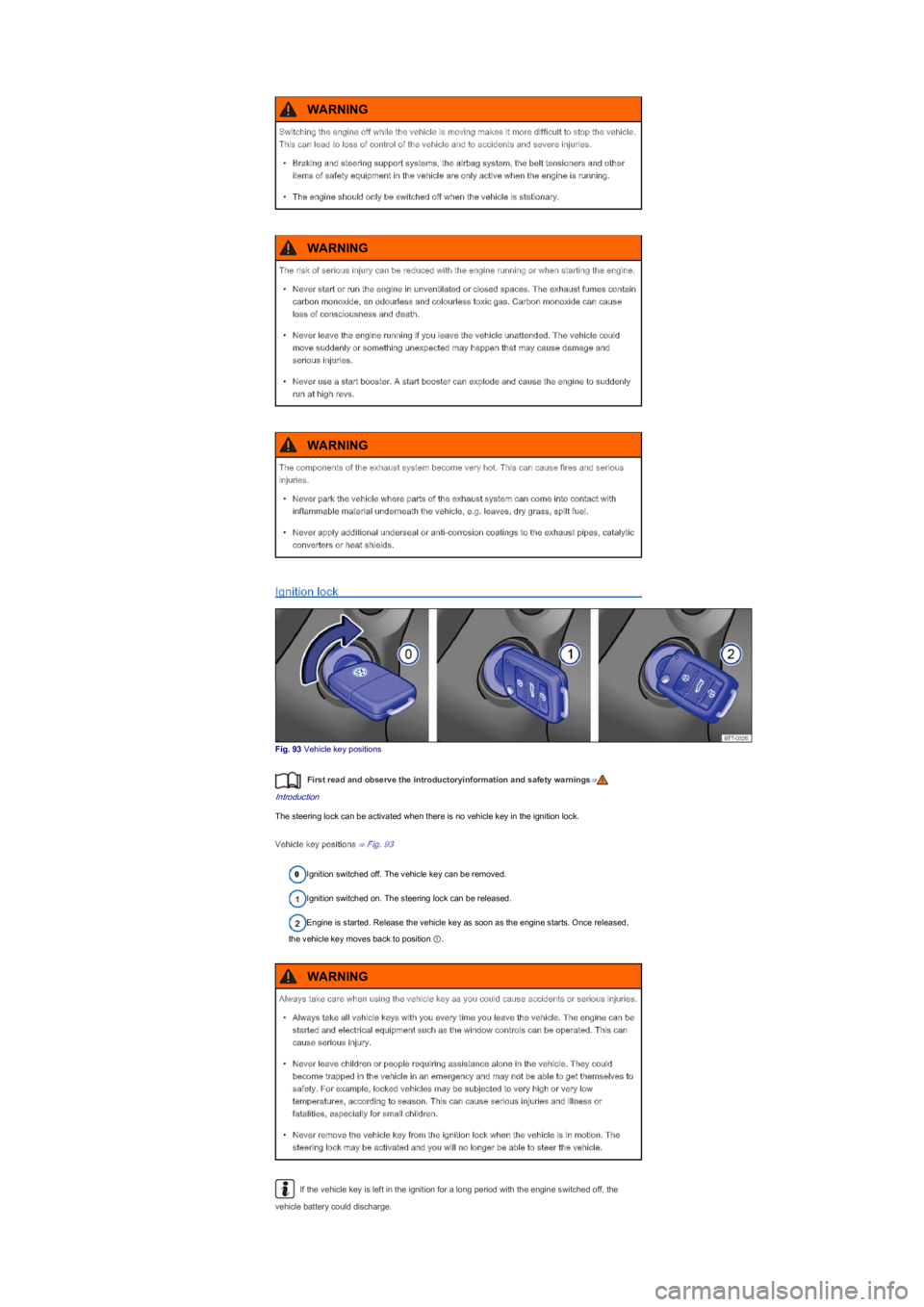
Ignition lock
Fig. 93 Vehicle key positions
First read and observe the introductoryinformation and safety warnings⇒
Introduction
The steering lock can be activated when there is no vehicle key in the ignition lock.
Vehicle key positions ⇒ Fig. 93
Ignition switched off. The vehicle key can be removed.
Ignition switched on. The steering lock can be released.
Engine is started. Release the vehicle key as soon as the engine starts. Once released,
the vehicle key moves back to position ①.
If the vehicle key is left in the ignition for a long period with the engine switched off, the
vehicle battery could discharge.
Switching the engine off while the vehicle is moving makes it more difficult to stop the vehicle.
This can lead to loss of control of the vehicle and to accidents and severe injuries.
•Braking and steering support systems, the airbag system, the belt tensioners and other
items of safety equipment in the vehicle are only active when the engine is running.
•The engine should only be switched off when the vehicle is stationary.
WARNING
The risk of serious injury can be reduced with the engine running or when starting the engine.
•Never start or run the engine in unventilated or closed spaces. The exhaust fumes contain
carbon monoxide, an odourless and colourless toxic gas. Carbon monoxide can cause
loss of consciousness and death.
•Never leave the engine running if you leave the vehicle unattended. The vehicle could
move suddenly or something unexpected may happen that may cause damage and
serious injuries.
•Never use a start booster. A start booster can explode and cause the engine to suddenly
run at high revs.
WARNING
The components of the exhaust system become very hot. This can cause fires and serious
injuries.
•Never park the vehicle where parts of the exhaust system can come into contact with
inflammable material underneath the vehicle, e.g. leaves, dry grass, spilt fuel.
•Never apply additional underseal or anti-corrosion coatings to the exhaust pipes, catalytic
converters or heat shields.
WARNING
Always take care when using the vehicle key as you could cause accidents or serious injuries.
•Always take all vehicle keys with you every time you leave the vehicle. The engine can be
started and electrical equipment such as the window controls can be operated. This can
cause serious injury.
•Never leave children or people requiring assistance alone in the vehicle. They could
become trapped in the vehicle in an emergency and may not be able to get themselves to
safety. For example, locked vehicles may be subjected to very high or very low
temperatures, according to season. This can cause serious injuries and illness or
fatalities, especially for small children.
•Never remove the vehicle key from the ignition lock when the vehicle is in motion. The
steering lock may be activated and you will no longer be able to steer the vehicle.
WARNING
Page 98 of 211
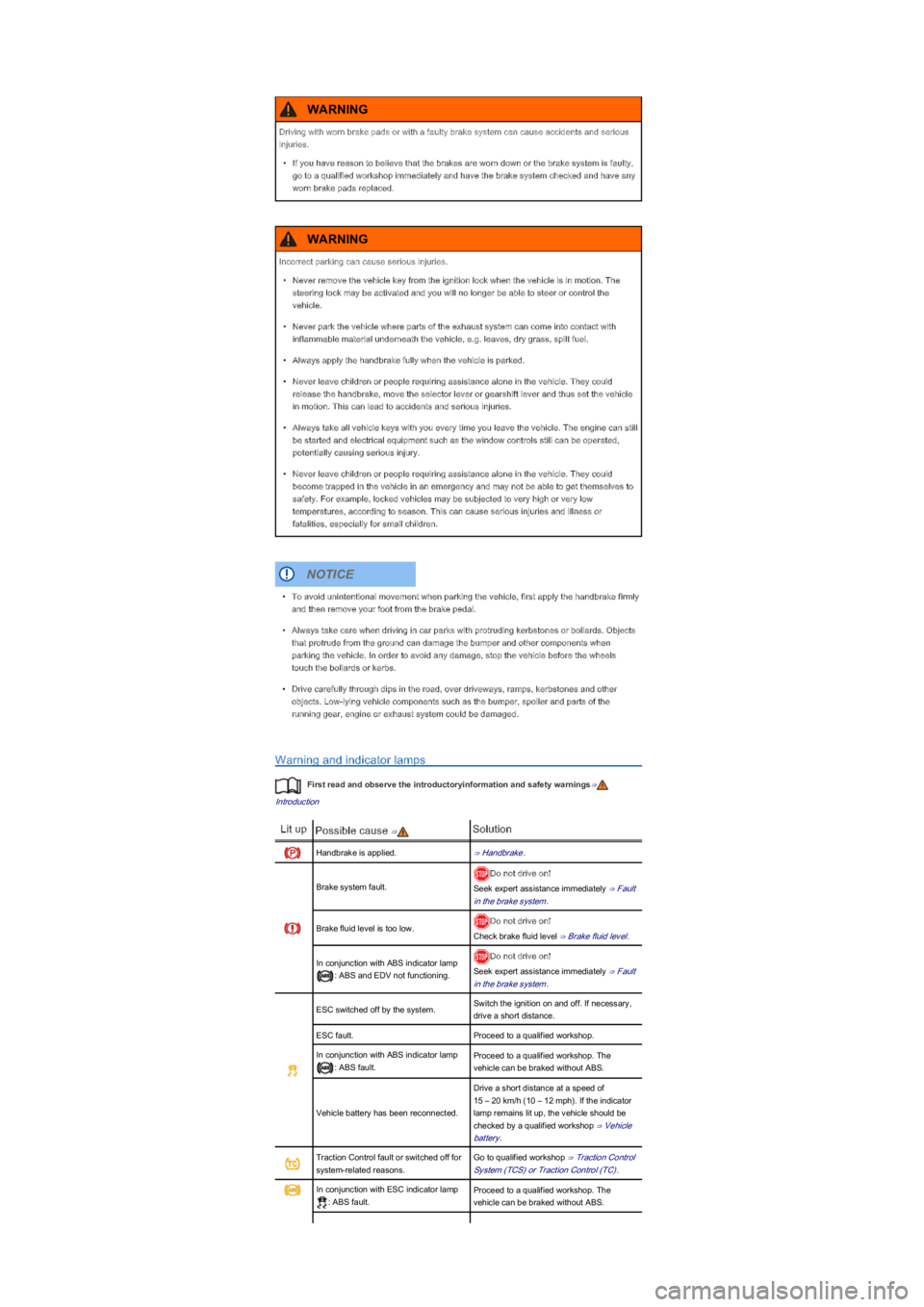
Warning and indicator lamps
First read and observe the introductoryinformation and safety warnings⇒
Introduction
Lit upPossible cause ⇒Solution
Handbrake is applied.⇒ Handbrake.
Brake system fault.
Do not drive on!
Seek expert assistance immediately ⇒ Fault
in the brake system.
Brake fluid level is too low.Do not drive on!
Check brake fluid level ⇒ Brake fluid level.
In conjunction with ABS indicator lamp
: ABS and EDV not functioning.
Do not drive on!
Seek expert assistance immediately ⇒ Fault
in the brake system.
ESC switched off by the system.Switch the ignition on and off. If necessary,
drive a short distance.
ESC fault.Proceed to a qualified workshop.
In conjunction with ABS indicator lamp
: ABS fault.
Proceed to a qualified workshop. The
vehicle can be braked without ABS.
Vehicle battery has been reconnected.
Drive a short distance at a speed of
15 – 20 km/h (10 – 12 mph). If the indicator
lamp remains lit up, the vehicle should be
checked by a qualified workshop ⇒ Vehicle
battery.
Traction Control fault or switched off for
system-related reasons.
Go to qualified workshop ⇒ Traction Control
System (TCS) or Traction Control (TC).
In conjunction with ESC indicator lamp
: ABS fault.
Proceed to a qualified workshop. The
vehicle can be braked without ABS.
Driving with worn brake pads or with a faulty brake system can cause accidents and serious
injuries.
•If you have reason to believe that the brakes are worn down or the brake system is faulty,
go to a qualified workshop immediately and have the brake system checked and have any
worn brake pads replaced.
WARNING
Incorrect parking can cause serious injuries.
•Never remove the vehicle key from the ignition lock when the vehicle is in motion. The
steering lock may be activated and you will no longer be able to steer or control the
vehicle.
•Never park the vehicle where parts of the exhaust system can come into contact with
inflammable material underneath the vehicle, e.g. leaves, dry grass, spilt fuel.
•Always apply the handbrake fully when the vehicle is parked.
•Never leave children or people requiring assistance alone in the vehicle. They could
release the handbrake, move the selector lever or gearshift lever and thus set the vehicle
in motion. This can lead to accidents and serious injuries.
•Always take all vehicle keys with you every time you leave the vehicle. The engine can still
be started and electrical equipment such as the window controls still can be operated,
potentially causing serious injury.
•Never leave children or people requiring assistance alone in the vehicle. They could
become trapped in the vehicle in an emergency and may not be able to get themselves to
safety. For example, locked vehicles may be subjected to very high or very low
temperatures, according to season. This can cause serious injuries and illness or
fatalities, especially for small children.
WARNING
•To avoid unintentional movement when parking the vehicle, first apply the handbrake firmly
and then remove your foot from the brake pedal.
•Always take care when driving in car parks with protruding kerbstones or bollards. Objects
that protrude from the ground can damage the bumper and other components when
parking the vehicle. In order to avoid any damage, stop the vehicle before the wheels
touch the bollards or kerbs.
•Drive carefully through dips in the road, over driveways, ramps, kerbstones and other
objects. Low-lying vehicle components such as the bumper, spoiler and parts of the
running gear, engine or exhaust system could be damaged.
NOTICE
Page 100 of 211
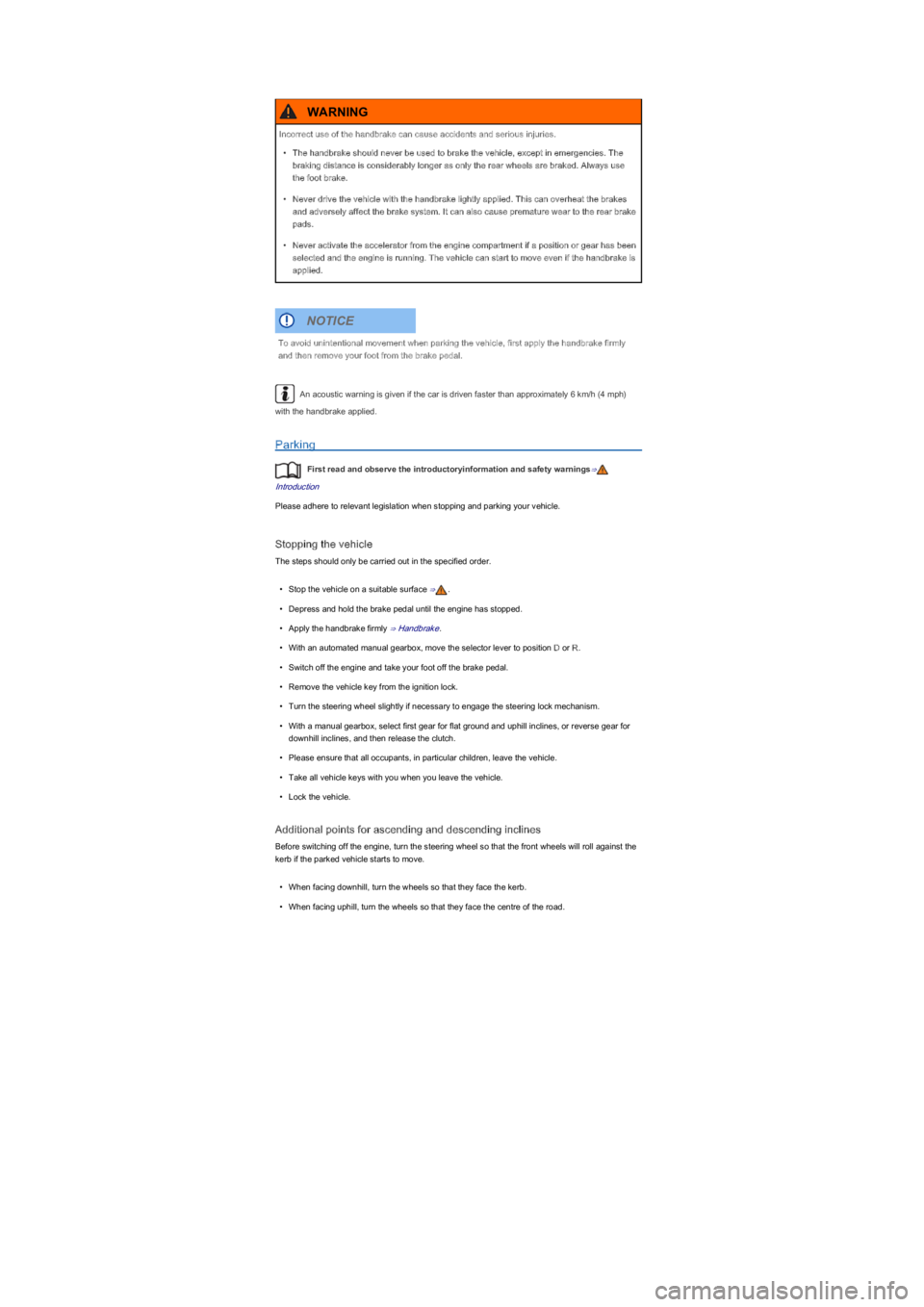
An acoustic warning is given if the car is driven faster than approximately 6 km/h (4 mph)
with the handbrake applied.
Parking
First read and observe the introductoryinformation and safety warnings⇒
Introduction
Please adhere to relevant legislation when stopping and parking your vehicle.
Stopping the vehicle
The steps should only be carried out in the specified order.
•Stop the vehicle on a suitable surface ⇒.
•Depress and hold the brake pedal until the engine has stopped.
•Apply the handbrake firmly ⇒ Handbrake.
•With an automated manual gearbox, move the selector lever to position D or R.
•Switch off the engine and take your foot off the brake pedal.
•Remove the vehicle key from the ignition lock.
•Turn the steering wheel slightly if necessary to engage the steering lock mechanism.
•With a manual gearbox, select first gear for flat ground and uphill inclines, or reverse gear for
downhill inclines, and then release the clutch.
•Please ensure that all occupants, in particular children, leave the vehicle.
•Take all vehicle keys with you when you leave the vehicle.
•Lock the vehicle.
Additional points for ascending and descending inclines
Before switching off the engine, turn the steering wheel so that the front wheels will roll against the
kerb if the parked vehicle starts to move.
•When facing downhill, turn the wheels so that they face the kerb.
•When facing uphill, turn the wheels so that they face the centre of the road.
Incorrect use of the handbrake can cause accidents and serious injuries.
•The handbrake should never be used to brake the vehicle, except in emergencies. The
braking distance is considerably longer as only the rear wheels are braked. Always use
the foot brake.
•Never drive the vehicle with the handbrake lightly applied. This can overheat the brakes
and adversely affect the brake system. It can also cause premature wear to the rear brake
pads.
•Never activate the accelerator from the engine compartment if a position or gear has been
selected and the engine is running. The vehicle can start to move even if the handbrake is
applied.
WARNING
To avoid unintentional movement when parking the vehicle, first apply the handbrake firmly
and then remove your foot from the brake pedal.
NOTICE
Page 105 of 211
Before using a particular brake fluid, check that the specifications printed on the container
correspond to the vehicle requirements.
Brake fluid that is compliant with VW standard 501 14 is available from Volkswagen dealerships.
If this brake fluid is not available and it is necessary to use another high-quality brake fluid instead,
brake fluid that is compliant with DIN ISO 4925 CLASS 4 or US standard FMVSS 116 DOT 4 can
be used.
Not all brake fluids that are compliant with DIN ISO 4925 CLASS 4 or US standard FMVSS 116
DOT 4 have the same chemical composition. Some of these brake fluids may contain chemicals
that can damage or destroy brake system components over time.
Volkswagen therefore recommends the use of brake fluid that is compliant with
VW standard 501 14 to ensure sustained optimal operation of the brake system.
Brake fluid that is compliant with VW standard 501 14 fulfils the requirements of DIN ISO 4925
CLASS 4 or US standard FMVSS 116 DOT 4.
Brake fluid level
The brake fluid level must always be between the MIN and MAX marking on the brake fluid
container or above the MIN marking ⇒.
The brake fluid level cannot be checked accurately in all models as engine components may
partially conceal the brake fluid container. If the brake fluid level cannot be read exactly, please
proceed to a qualified workshop.
The brake fluid level drops slightly when the vehicle is being used as the brake pads wear and the
brakes are automatically adjusted.
Changing the brake fluid
The brake fluid must be changed as indicated in the service schedule ⇒BookletService schedule,.
The brake fluid should be changed by a qualified workshop. Volkswagen recommends using a
Volkswagen dealership for this purpose. Only brake fluid that conforms with the required
specification should be used.
Brake fluid can pollute the environment. Any spilt service fluids must be cleaned up and
disposed of properly.
Brake failure or reduced braking effect can be caused by the brake fluid level being too low or
by brake fluid that is too old or unsuitable.
•The brake system and brake fluid level must be checked regularly.
•The brake fluid should be changed regularly, according to the service schedule
⇒BookletService schedule,.
•Heavy use of the brakes may cause a vapour lock if the brake fluid is left in the system for
too long. Vapour locks reduce levels of braking power, considerably increase braking
distance and can cause the brake system to fail completely.
•Please ensure that the correct brake fluid is used. Only use brake fluid that is explicitly
compliant with VW standard 501 14.
•Any other brake fluid or a low-quality one can affect the functioning of the brakes and
reduce their effectiveness.
•If a brake fluid compliant with VW standard 501 14 is not available, use a high-quality
brake fluid compliant with DIN ISO 4925 CLASS 4 or the US standard FMVSS 116 DOT 4,
but only in exceptional circumstances.
•The refilled brake fluid must be new.
WARNING
Brake fluid is toxic.
•In order to reduce the risk of poisoning, never use bottles or other containers to store
brake fluid. These containers could encourage other people to drink out of them, even if
they are labelled otherwise.
•Brake fluid must always be stored in its original sealed container and kept out of the reach
of children.
WARNING
Brake fluid that has leaked or been spilt can damage the vehicle paintwork, plastic parts and
tyres. Brake fluid that has leaked or been spilt should be cleaned off the vehicle paintwork and
other components immediately.
NOTICE
Page 132 of 211
Unintentional vehicle movements during service work can cause serious injury.
•Never work underneath a vehicle if it is not secured against rolling away. If you are
working underneath the vehicle while the wheels are on the ground, the vehicle must be
on a level, the wheels must be blocked and the vehicle key must be removed from the
ignition lock.
•If you have to work underneath the vehicle, use suitable stands to provide extra support
for the vehicle. The vehicle jack is not sufficient for this task and can fail, which can lead to
serious injuries.
•The start/stop system must have been deactivated.
WARNING
The engine compartment of any motor vehicle is a dangerous area. Serious injuries can be
sustained here.
•The utmost care and attention must be paid when carrying out any work and you must
follow the general safety rules. Never take any risks.
•Never do any work on the engine or in the engine compartment unless you know exactly
how to carry it out. If you are uncertain of what to do, the work should be carried out by a
qualified workshop. Serious injuries can result from work that has not been carried out
properly.
•Never open the bonnet if you see steam or coolant escaping from the engine
compartment. Hot steam or coolant can cause serious burns. Always wait until you can no
longer see or hear steam or coolant coming from the engine compartment.
•Always allow the engine to cool down before opening the bonnet.
•Hot parts of the engine or exhaust system can burn the skin.
•Before opening the bonnet once it has cooled down:
- Apply the handbrake fully and move the selector lever to position N or move the
manual gear lever to the neutral position.
- Remove the vehicle key from the ignition lock.
- Always keep children away from the engine compartment and never leave the
vehicle unattended.
•The engine cooling system is under pressure when the engine is hot. Never open the cap
of the coolant expansion tank when the engine is hot. Coolant may spray out and cause
serious burns and injuries.
- After cooling, turn the cap slowly and very carefully anticlockwise while exerting
some downwards pressure on the cap.
- Always protect the face, hands and arms from hot coolant or steam with a large,
thick cloth.
•When refilling, do not spill any service fluids on engine components or on the exhaust
system. The spilt service fluids can start a fire.
WARNING
High voltages in the electrical system can cause electric shocks, burns, serious injuries and
death!
•Never short circuit the electric system. The vehicle battery could explode.
•Please note the following guidelines to help reduce the risk of an electric shock and
serious injuries while the engine is running or being started:
- Never touch the electrical wiring of the ignition system.
WARNING