heating VOLKSWAGEN UP! 2021 Owner´s Manual
[x] Cancel search | Manufacturer: VOLKSWAGEN, Model Year: 2021, Model line: UP!, Model: VOLKSWAGEN UP! 2021Pages: 211, PDF Size: 5.98 MB
Page 80 of 211
The ventilation openings between the rear window and the luggage compartment cover must
not be covered as this would prevent stale air escaping from the vehicle.
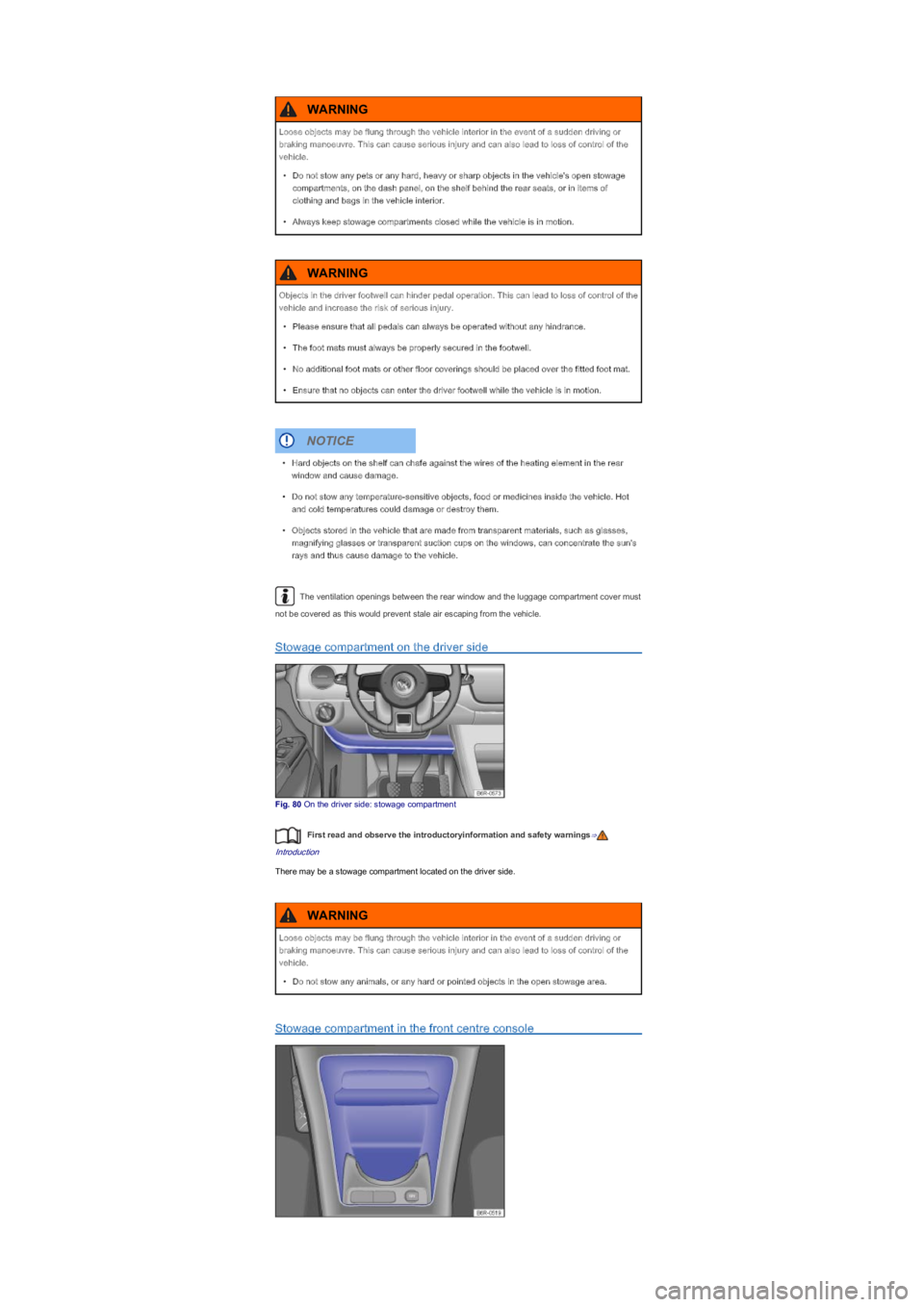
Stowage compartment on the driver side
Fig. 80 On the driver side: stowage compartment
First read and observe the introductoryinformation and safety warnings⇒
Introduction
There may be a stowage compartment located on the driver side.
Stowage compartment in the front centre console
Loose objects may be flung through the vehicle interior in the event of a sudden driving or
braking manoeuvre. This can cause serious injury and can also lead to loss of control of the
vehicle.
•Do not stow any pets or any hard, heavy or sharp objects in the vehicle's open stowage
compartments, on the dash panel, on the shelf behind the rear seats, or in items of
clothing and bags in the vehicle interior.
•Always keep stowage compartments closed while the vehicle is in motion.
WARNING
Objects in the driver footwell can hinder pedal operation. This can lead to loss of control of the
vehicle and increase the risk of serious injury.
•Please ensure that all pedals can always be operated without any hindrance.
•The foot mats must always be properly secured in the footwell.
•No additional foot mats or other floor coverings should be placed over the fitted foot mat.
•Ensure that no objects can enter the driver footwell while the vehicle is in motion.
WARNING
•Hard objects on the shelf can chafe against the wires of the heating element in the rear
window and cause damage.
•Do not stow any temperature-sensitive objects, food or medicines inside the vehicle. Hot
and cold temperatures could damage or destroy them.
•Objects stored in the vehicle that are made from transparent materials, such as glasses,
magnifying glasses or transparent suction cups on the windows, can concentrate the sun's
rays and thus cause damage to the vehicle.
NOTICE
Loose objects may be flung through the vehicle interior in the event of a sudden driving or
braking manoeuvre. This can cause serious injury and can also lead to loss of control of the
vehicle.
•Do not stow any animals, or any hard or pointed objects in the open stowage area.
WARNING
Page 96 of 211
Fault in the automated manual gearbox
First read and observe the introductoryinformation and safety warnings⇒
Introduction
Emergency programme
There may be a fault in the system if warning and indicator lamps for the automated manual
gearbox light up in the vehicle cluster ⇒ Warning and indicator lamp. When certain faults occur, the
automated manual gearbox runs in an emergency programme. The vehicle can still be driven in the
emergency programme, but only at reduced speed and not in all gears.
With an automated manual gearbox it may then be the case that the vehicle can no longer be
driven in all gears.
In all cases the automated manual gearbox should be checked by a qualified workshop
immediately.
Overheating in the automated manual gearbox
The automated manual gearbox can overheat, for example if the vehicle regularly pulls off from the
starting position or in stop-and-go traffic. Overheating is indicated by a warning lamp displayed
in the instrument cluster. An acoustic warning may also be heard. Stop the vehicle and allow the
gearbox to cool down ⇒.
The vehicle does not move forwards or backwards even though a position
has been selected
If the vehicle will not move in the required direction, the system may have selected the position
incorrectly. Depress the brake pedal and reselect the position.
If the vehicle still does not move in the required direction, there is a system fault. Seek expert
assistance and have the system checked.
Gear-change indicator (manual gearbox)
First read and observe the introductoryinformation and safety warnings⇒
Introduction
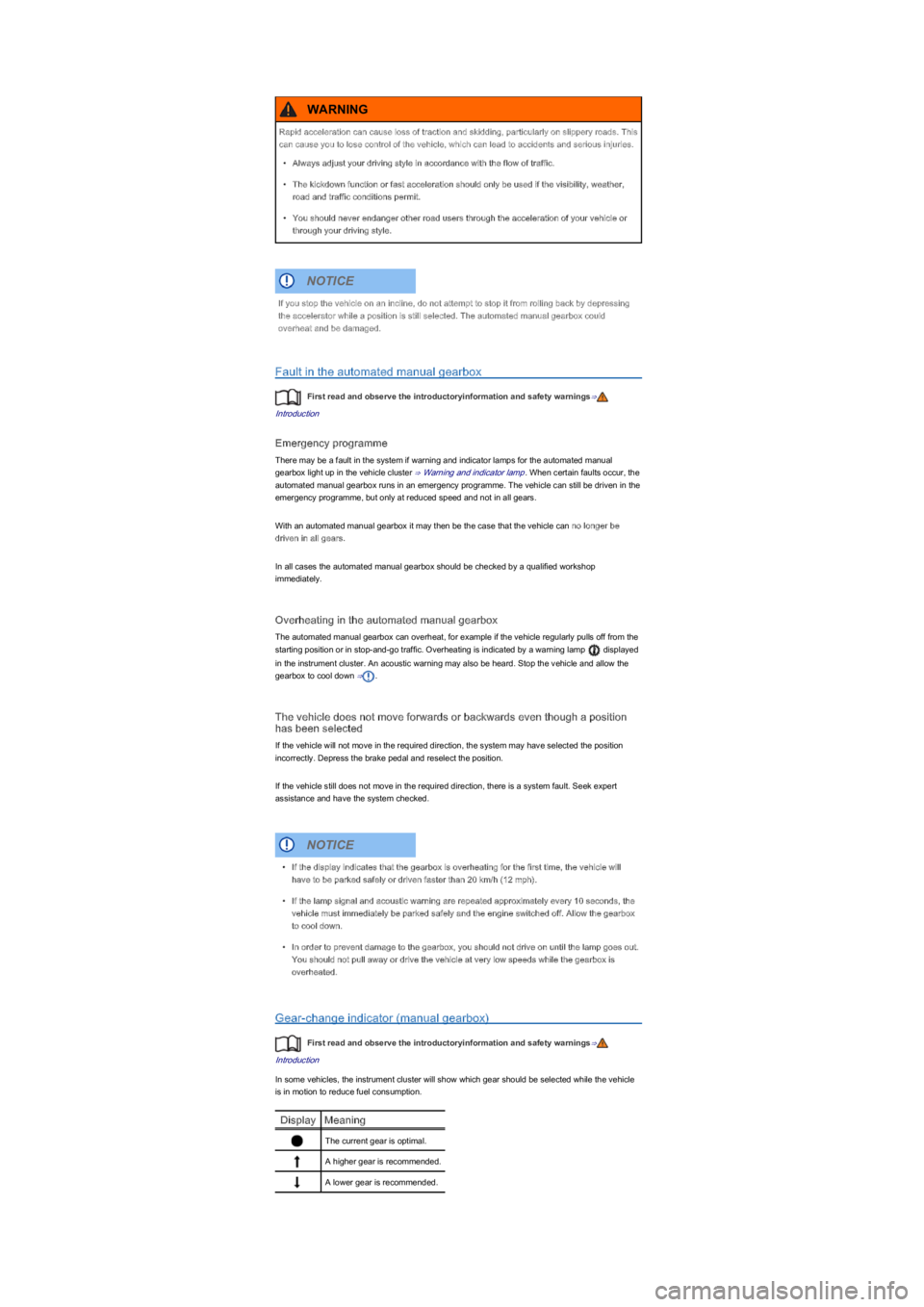
In some vehicles, the instrument cluster will show which gear should be selected while the vehicle
is in motion to reduce fuel consumption.
DisplayMeaning
The current gear is optimal.
A higher gear is recommended.
A lower gear is recommended.
Rapid acceleration can cause loss of traction and skidding, particularly on slippery roads. This
can cause you to lose control of the vehicle, which can lead to accidents and serious injuries.
•Always adjust your driving style in accordance with the flow of traffic.
•The kickdown function or fast acceleration should only be used if the visibility, weather,
road and traffic conditions permit.
•You should never endanger other road users through the acceleration of your vehicle or
through your driving style.
WARNING
If you stop the vehicle on an incline, do not attempt to stop it from rolling back by depressing
the accelerator while a position is still selected. The automated manual gearbox could
overheat and be damaged.
NOTICE
•If the display indicates that the gearbox is overheating for the first time, the vehicle will
have to be parked safely or driven faster than 20 km/h (12 mph).
•If the lamp signal and acoustic warning are repeated approximately every 10 seconds, the
vehicle must immediately be parked safely and the engine switched off. Allow the gearbox
to cool down.
•In order to prevent damage to the gearbox, you should not drive on until the lamp goes out.
You should not pull away or drive the vehicle at very low speeds while the gearbox is
overheated.
NOTICE
Page 103 of 211
to assist every time that there is a sudden change in the road surface quality. If a section of dry
road is suddenly covered with water, mud or snow, ESC will not be able to assist in the same
manner as on a dry road. If the vehicle aquaplanes (drives on a layer of water rather than on the
road surface), ESC will not be able to assist in steering the vehicle as the contact to the road
surface has been interrupted and it is therefore no longer possible to steer or brake the vehicle.
Always adapt your speed and driving style to suit visibility, weather, road and traffic conditions. ESC
cannot defy the laws of motion, improve the available power output, or keep the vehicle on the road
if insufficient care and attention on the part of the driver causes the vehicle to leave the road.
Instead, ESC increases the possibility of keeping the vehicle under control and, in extreme on-road
driving situations, it assesses the driver’s steering input and helps the vehicle to continue in the
required direction. If the vehicle is driving at a speed that leads it to leave the road before the ESC
can provide any kind of support, the ESC will be unable to provide any assistance.
The ABS, BAS, TCS and EDL systems are integrated into the ESC. The ESC is always on.
Anti-lock brake system (ABS)
The ABS prevents the wheels from locking when the brakes are applied up until the point where the
vehicle is nearly stationary and assists the driver in steering the vehicle and keeping it under
control. This means that the vehicle is less likely to spin, even when the brakes are depressed fully:
•Depress and hold the brake pedal with force. Do not take your foot off the brake pedal or
reduce the force on the brake pedal!
•Do not pump the brake pedal or reduce the pressure on the brake pedal!
•Steer the vehicle while the brake pedal is fully depressed.
•The ABS will switch off when the brake pedal is released or if the pressure on the brake pedal is
reduced.
If the ABS is taking corrective action, there is a pulsing movement in the brake pedal and some
noise. However, ABS will not necessarily guarantee shorter braking distances in all conditions. The
braking distance could even be longer when braking on gravel or on fresh snow covering an icy or
slippery surface.
Electronic brake pressure distribution system (EBD)
Every vehicle's centre of gravity moves forwards whenever the brake is operated. This means that
the rear wheels are in danger of locking due to the lower traction. The electronic brake pressure
distribution system controls the brake pressure for the rear wheels and thereby ensures the
optimum distribution of brake pressure between the front and rear axles. Under normal conditions,
the system will prevent the rear from breaking away if too much brake pressure if applied to the rear
wheels. The electronic brake pressure distribution system is included in the ABS' scope of
functions.
Brake Assist system (BAS)
The brake assist system can help to reduce the braking distance. The brake assist system
reinforces brake pressure hydraulically when the driver depresses the brake pedal quickly in an
emergency situation. As a result, full braking power is made accessible very quickly, brake pressure
is increased and the braking distance reduced. In this way, the ABS is activated more quickly and
more effectively.
Do not reduce the pressure on the brake pedal. The brake assist system will switch off the
hydraulic brake servo automatically when the brake pedal is released or if the pressure on the
brake pedal is reduced.
Traction Control System (TCS) or Traction Control (TC)
The TCS or TC reduces the engine output if wheelspin occurs and adapts the output to suit road
surface conditions. TCS or TC helps the car to start moving, accelerate and climb gradients in
unfavourable road conditions.
Electronic differential lock (EDL)
The EDL is available for normal driving on straight roads. EDL brakes the wheel that has lost
traction and distributes the driving force to the other drive wheel. To prevent the disc brake of the
braked wheel from overheating, the EDL cuts out automatically if subjected to excessive loads. The
EDL will switch on again automatically when the brake has cooled down.
Page 107 of 211
•The cooling function of the air conditioning system: if the air conditioning system is set to a very
high or low temperature it will require a lot of energy, which is generated by the engine.
Therefore the temperature setting in the vehicle should not vary too much from the outside
temperature. It may be a good idea to air the vehicle before setting off and then to travel a short
distance with the windows open. The air conditioning system should then be switched on once
the windows have been closed.
•Keep the windows closed when driving at high speeds. Having the windows open increases fuel
consumption.
•Switch the seat heating off as soon as it has served its purpose.
•Switch the rear window heating off as soon as the window has defogged and is clear of ice.
Other factors that increase fuel consumption (examples):
•Fault in engine management.
•Driving in hilly regions.
Driving in a fuel-efficient manner
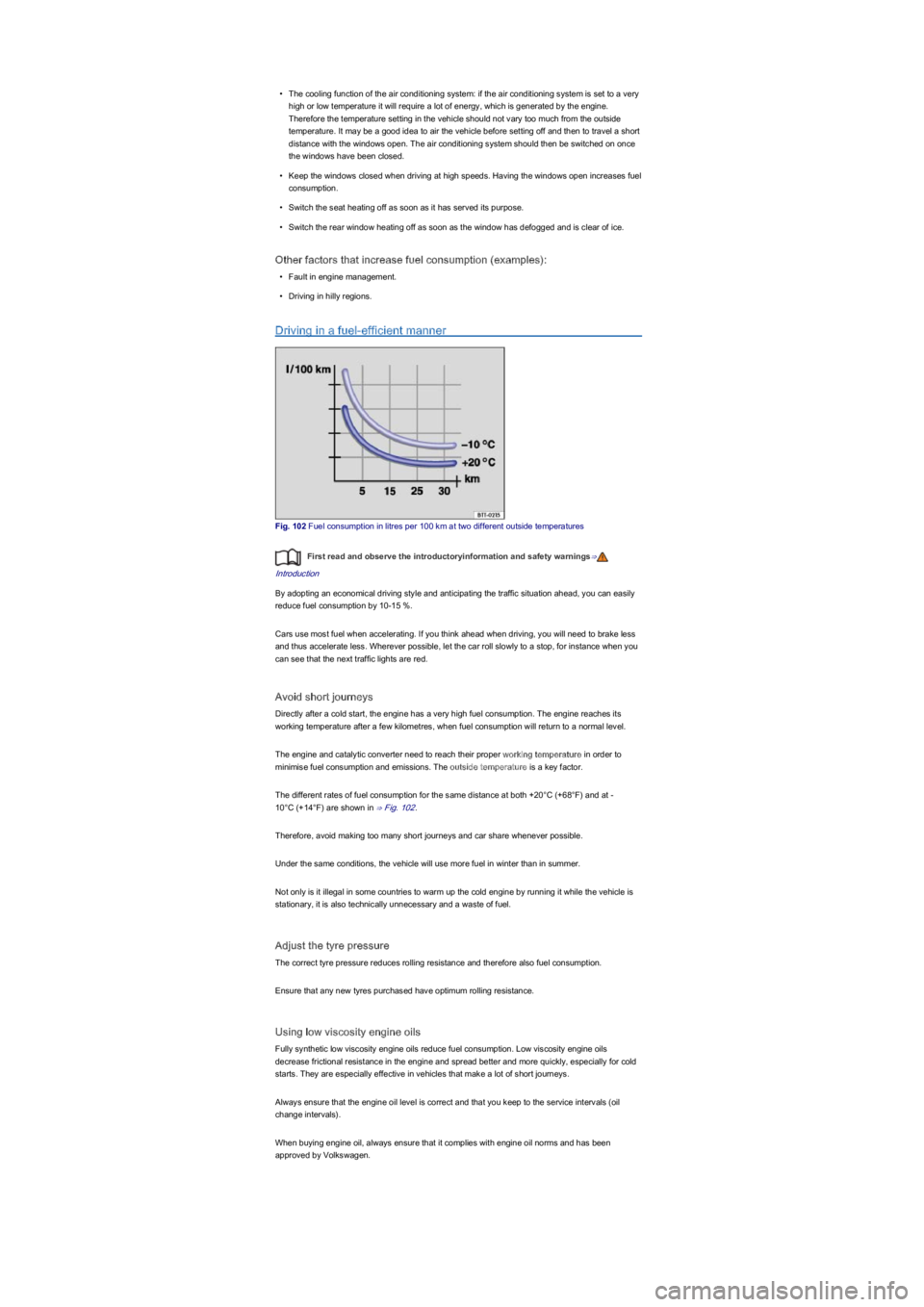
Fig. 102 Fuel consumption in litres per 100 km at two different outside temperatures
First read and observe the introductoryinformation and safety warnings⇒
Introduction
By adopting an economical driving style and anticipating the traffic situation ahead, you can easily
reduce fuel consumption by 10-15 %.
Cars use most fuel when accelerating. If you think ahead when driving, you will need to brake less
and thus accelerate less. Wherever possible, let the car roll slowly to a stop, for instance when you
can see that the next traffic lights are red.
Avoid short journeys
Directly after a cold start, the engine has a very high fuel consumption. The engine reaches its
working temperature after a few kilometres, when fuel consumption will return to a normal level.
The engine and catalytic converter need to reach their proper working temperature in order to
minimise fuel consumption and emissions. The outside temperature is a key factor.
The different rates of fuel consumption for the same distance at both +20°C (+68°F) and at -
10°C (+14°F) are shown in ⇒ Fig. 102.
Therefore, avoid making too many short journeys and car share whenever possible.
Under the same conditions, the vehicle will use more fuel in winter than in summer.
Not only is it illegal in some countries to warm up the cold engine by running it while the vehicle is
stationary, it is also technically unnecessary and a waste of fuel.
Adjust the tyre pressure
The correct tyre pressure reduces rolling resistance and therefore also fuel consumption.
Ensure that any new tyres purchased have optimum rolling resistance.
Using low viscosity engine oils
Fully synthetic low viscosity engine oils reduce fuel consumption. Low viscosity engine oils
decrease frictional resistance in the engine and spread better and more quickly, especially for cold
starts. They are especially effective in vehicles that make a lot of short journeys.
Always ensure that the engine oil level is correct and that you keep to the service intervals (oil
change intervals).
When buying engine oil, always ensure that it complies with engine oil norms and has been
approved by Volkswagen.
Page 121 of 211
•If vehicles are travelling towards you in the same lane.
•If the surrounding vehicles are very dirty and therefore not very reflective.
•If there is a lot of dust.
Air conditioning system
Heating, ventilating, cooling
Introduction
This chapter contains information on the followingsubjects:
⇒ Controls
⇒ General information on the heating and fresh air system
⇒ Information on the air conditioning system
⇒ Vents
⇒ Air recirculation mode
Dust and pollen filter
The dust and pollen filter reduces the level of impurities in the outside air entering the vehicle.
The dust and pollen filter must be changed regularly to avoid impairing the performance of the air
conditioning system.
The dust and pollen filter must be changed more frequently than stated in the service schedule if
the efficiency of the filter declines prematurely due to the vehicle being used in areas with high
levels of air pollution.
Additional information and warnings:
•Exterior views ⇒ Exterior views
•Volkswagen information system ⇒ Volkswagen information system
•Windscreen wiper/washer ⇒ Windscreen wiper and washer
•Cleaning and caring for the vehicle exterior ⇒ Caring for and cleaning the vehicle exterior
If the cooling system is switched off, the outside air that is drawn into the vehicle is not
dehumidified. To prevent the windows misting over, Volkswagen recommends that you leave the air
conditioning (compressor) switched on. Press the button. The indicator lamp in the button
must light up.
Maximum heat output, which is needed to defrost the windows as quickly as possible, is only
available when the engine has reached its operating temperature.
Poor visibility through all windows increases the risk of collisions and accidents, which can
cause serious injuries.
•Always ensure that all windows are free of ice, snow and mist to ensure good visibility.
•Maximum heat output, which is needed to defrost the windows as quickly as possible, is
only available when the engine has reached its operating temperature. Do not start your
journey until you have good visibility.
•Always ensure that the heating and fresh air system or the air conditioning system and the
heated rear window are used correctly in order to have good visibility.
•Never use the air recirculation mode for an extended period. If the cooling system is
switched off, the windows can mist up very quickly in air recirculation mode and reduce
visibility considerably.
•Always switch off the air recirculation mode when it is not required.
WARNING
Stale air can quickly cause tiredness and lack of concentration in the driver, which in turn can
cause collisions, accidents and serious injuries.
•Never switch off the blowers or switch on the air recirculation mode for an extended period
as this prevents fresh air from entering the vehicle interior.
WARNING
•Switch off the air conditioning system if you suspect that it has been damaged. This can
help to prevent further damage. The air conditioning system should be checked by a
qualified workshop.
•Repairs to the air conditioning system require specialist knowledge and special tools.
Volkswagen recommends using a Volkswagen dealership for this purpose.
NOTICE
Page 122 of 211
Keep the air intake slots in front of the windscreen free of snow, ice and leaves to ensure
heating and cooling is not impaired, and to prevent the windows from misting over.
Controls
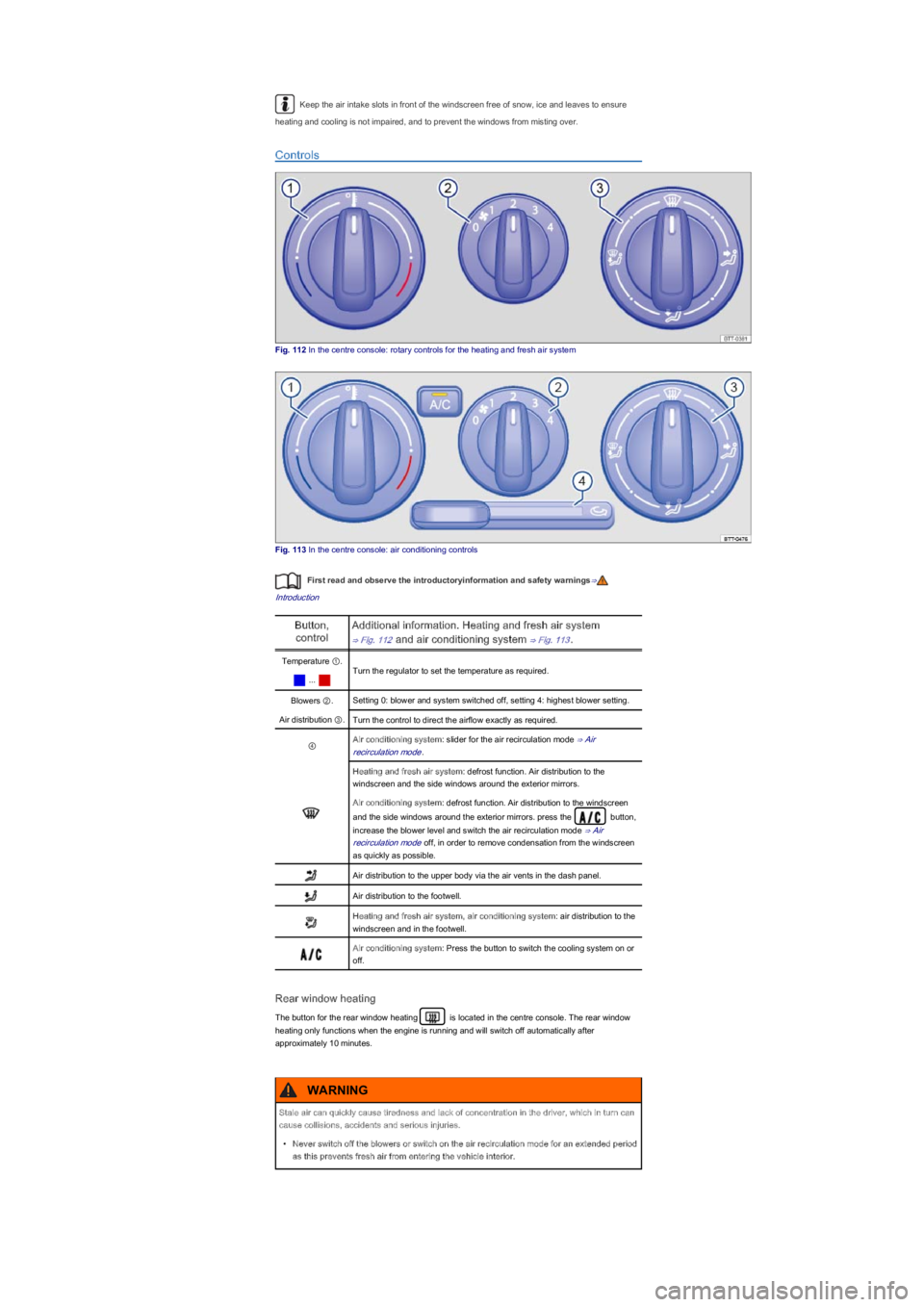
Fig. 112 In the centre console: rotary controls for the heating and fresh air system
Fig. 113 In the centre console: air conditioning controls
First read and observe the introductoryinformation and safety warnings⇒
Introduction
Button,
control
Additional information. Heating and fresh air system
⇒ Fig. 112 and air conditioning system ⇒ Fig. 113.
Temperature ①.
Turn the regulator to set the temperature as required.
...
Blowers ②.Setting 0: blower and system switched off, setting 4: highest blower setting.
Air distribution ③.Turn the control to direct the airflow exactly as required.
④Air conditioning system: slider for the air recirculation mode ⇒ Air
recirculation mode.
Heating and fresh air system: defrost function. Air distribution to the
windscreen and the side windows around the exterior mirrors.
Air conditioning system: defrost function. Air distribution to the windscreen
and the side windows around the exterior mirrors. press the button,
increase the blower level and switch the air recirculation mode ⇒ Air
recirculation mode off, in order to remove condensation from the windscreen
as quickly as possible.
Air distribution to the upper body via the air vents in the dash panel.
Air distribution to the footwell.
Heating and fresh air system, air conditioning system: air distribution to the
windscreen and in the footwell.
Air conditioning system: Press the button to switch the cooling system on or
off.
Rear window heating
The button for the rear window heating is located in the centre console. The rear window
heating only functions when the engine is running and will switch off automatically after
approximately 10 minutes.
Stale air can quickly cause tiredness and lack of concentration in the driver, which in turn can
cause collisions, accidents and serious injuries.
•Never switch off the blowers or switch on the air recirculation mode for an extended period
as this prevents fresh air from entering the vehicle interior.
WARNING
Page 123 of 211
General information on the heating and fresh air system
First read and observe the introductoryinformation and safety warnings⇒
Introduction
The required interior temperature cannot be lower than the outside temperature as the heating and
fresh air system cannot cool or dehumidify the air.
Settings for optimal road visibility
•Set blower ⇒ Fig. 112② to level 1 or 2.
•Open and position all vents on the dash panel ⇒ Vents.
•Turn the air distribution controller ⇒ Fig. 112③ to the defrost position.
Information on the air conditioning system
First read and observe the introductoryinformation and safety warnings⇒
Introduction
The cooling system for the vehicle interior only works when the engine is running and the blower is
switched on.
The air conditioning system operates most effectively with the windows and the electric panorama
sliding and tilting glass roof closed. However, if the vehicle has heated up after standing in the sun
for some time, the air inside can be cooled more quickly by opening the windows and the electric
panorama sliding and tilting glass roof for a short time.
Settings for optimal road visibility
Switching the cooling system on not only reduces the temperature of the vehicle interior, but also
the humidity. This improves comfort for the vehicle occupants and prevents the windows from
misting when the outside humidity is high.
•Switch off air recirculation mode ⇒ Air recirculation mode.
•Set the blowers to the required level.
•Open and position all vents on the dash panel ⇒ Vents.
•Turn the air distribution controller to the defrost position.
•Press the button to switch the cooling system on. The indicator lamp in the button
lights up.
The cooling system cannot be switched on
The following criteria may prevent the cooling system from being switched on:
•The engine is not running.
•The blower is switched off.
•The air conditioning system fuse has blown.
•The ambient temperature is lower than approximately +2℃ (+36°F).
•The compressor has been temporarily switched off because the coolant temperature is too high.
•There is a different fault in the vehicle. The air conditioning system should be checked by a
qualified workshop.
Things to note
If the humidity and temperature outside the vehicle are high, condensation can drip off the
evaporator in the cooling system and form a pool underneath the vehicle. This is normal and does
not indicate a leak.
The windscreen may mist up after starting the engine due to residual humidity in the air
conditioning system. Switch the defrost function on in order to clear the windscreen of condensation
or mist as quickly as possible.
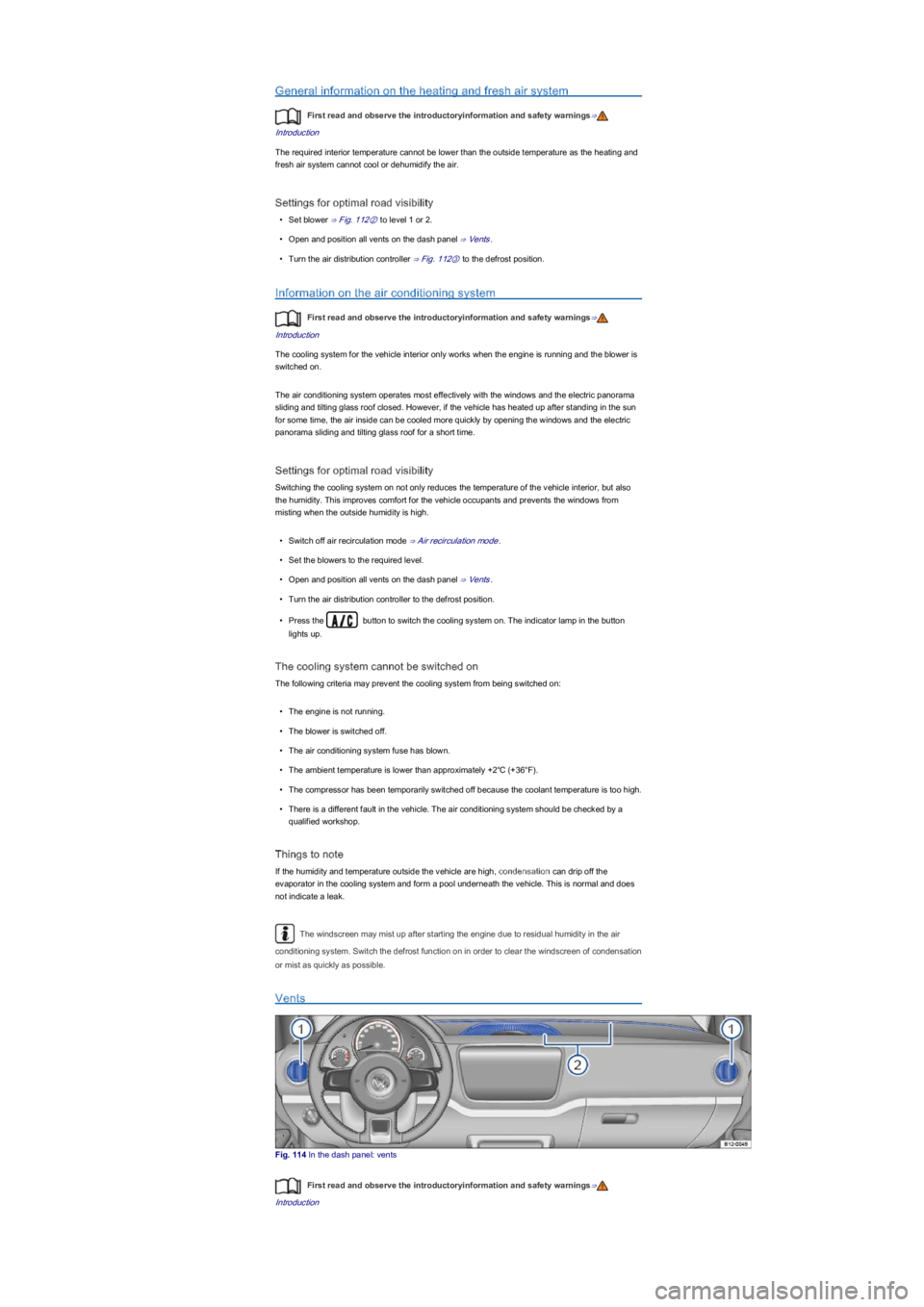
Vents
Fig. 114 In the dash panel: vents
First read and observe the introductoryinformation and safety warnings⇒
Introduction
Page 128 of 211
Switch off the engine, ignition and the mobile telephone before filling the tank and leave them
switched off during the process ⇒.
Please read and follow the instructions for the natural gas refuelling system.
The vehicle is not constructed for use with Liquefied Natural Gas (LNG) ⇒. Before refilling with
natural gas check that you are using the correct fuel ⇒ Fuel.
Opening the tank cap
The gas filler neck is located under the tank flap next to the petrol filler neck.
•The tank flap is at the rear of the vehicle on the right.
•Open the tank cap by the moulding to the rear.
Filling the tank
At very high ambient temperatures, the overheating protection function for the natural gas refuelling
system could switch off automatically.
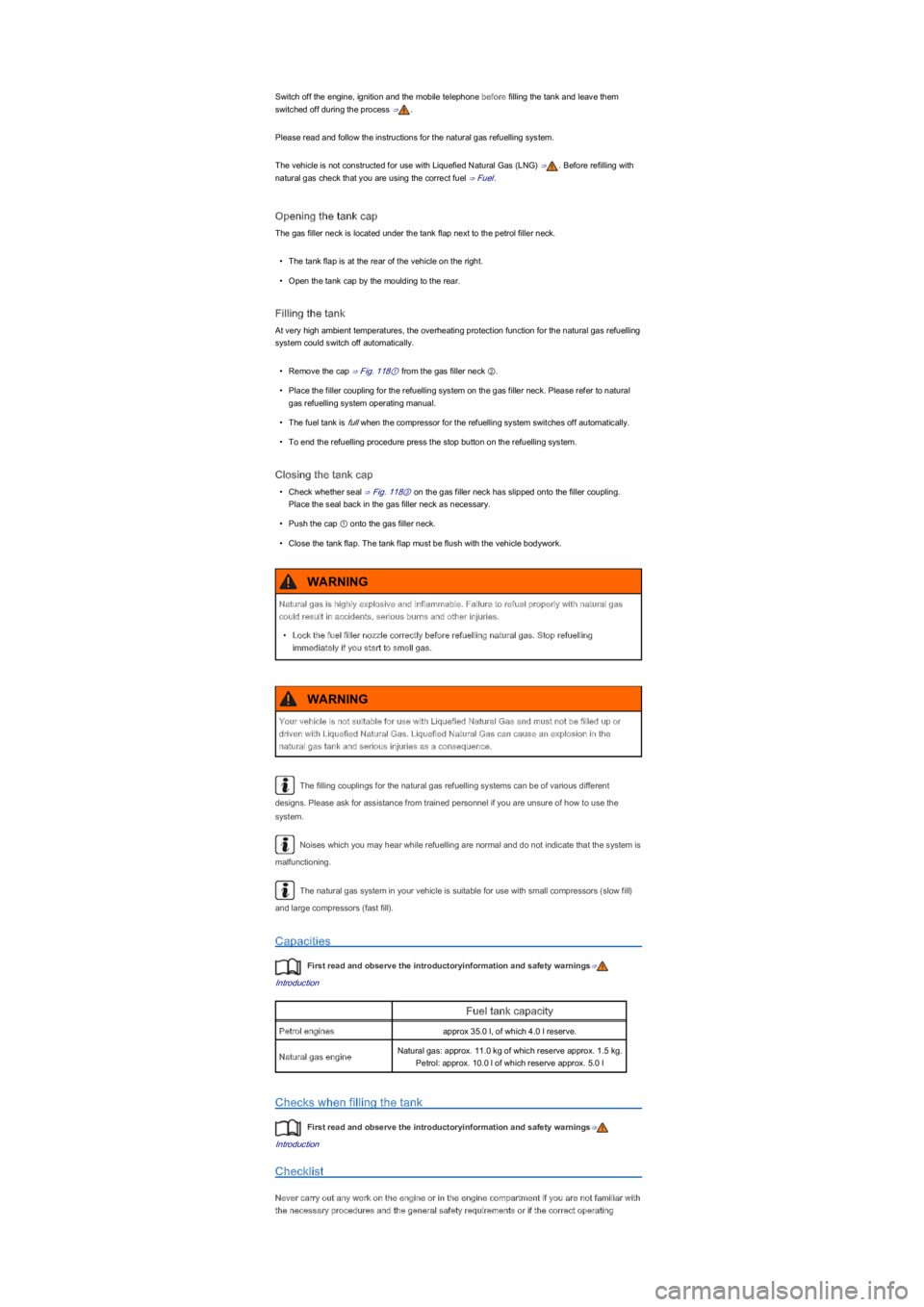
•Remove the cap ⇒ Fig. 118① from the gas filler neck ②.
•Place the filler coupling for the refuelling system on the gas filler neck. Please refer to natural
gas refuelling system operating manual.
•The fuel tank is full when the compressor for the refuelling system switches off automatically.
•To end the refuelling procedure press the stop button on the refuelling system.
Closing the tank cap
•Check whether seal ⇒ Fig. 118③ on the gas filler neck has slipped onto the filler coupling.
Place the seal back in the gas filler neck as necessary.
•Push the cap ① onto the gas filler neck.
•Close the tank flap. The tank flap must be flush with the vehicle bodywork.
The filling couplings for the natural gas refuelling systems can be of various different
designs. Please ask for assistance from trained personnel if you are unsure of how to use the
system.
Noises which you may hear while refuelling are normal and do not indicate that the system is
malfunctioning.
The natural gas system in your vehicle is suitable for use with small compressors (slow fill)
and large compressors (fast fill).
Capacities
First read and observe the introductoryinformation and safety warnings⇒
Introduction
Fuel tank capacity
Petrol enginesapprox 35.0 l, of which 4.0 l reserve.
Natural gas engineNatural gas: approx. 11.0 kg of which reserve approx. 1.5 kg.
Petrol: approx. 10.0 l of which reserve approx. 5.0 l
Checks when filling the tank
First read and observe the introductoryinformation and safety warnings⇒
Introduction
Checklist
Never carry out any work on the engine or in the engine compartment if you are not familiar with
the necessary procedures and the general safety requirements or if the correct operating
Natural gas is highly explosive and inflammable. Failure to refuel properly with natural gas
could result in accidents, serious burns and other injuries.
•Lock the fuel filler nozzle correctly before refuelling natural gas. Stop refuelling
immediately if you start to smell gas.
WARNING
Your vehicle is not suitable for use with Liquefied Natural Gas and must not be filled up or
driven with Liquefied Natural Gas. Liquefied Natural Gas can cause an explosion in the
natural gas tank and serious injuries as a consequence.
WARNING
Page 133 of 211
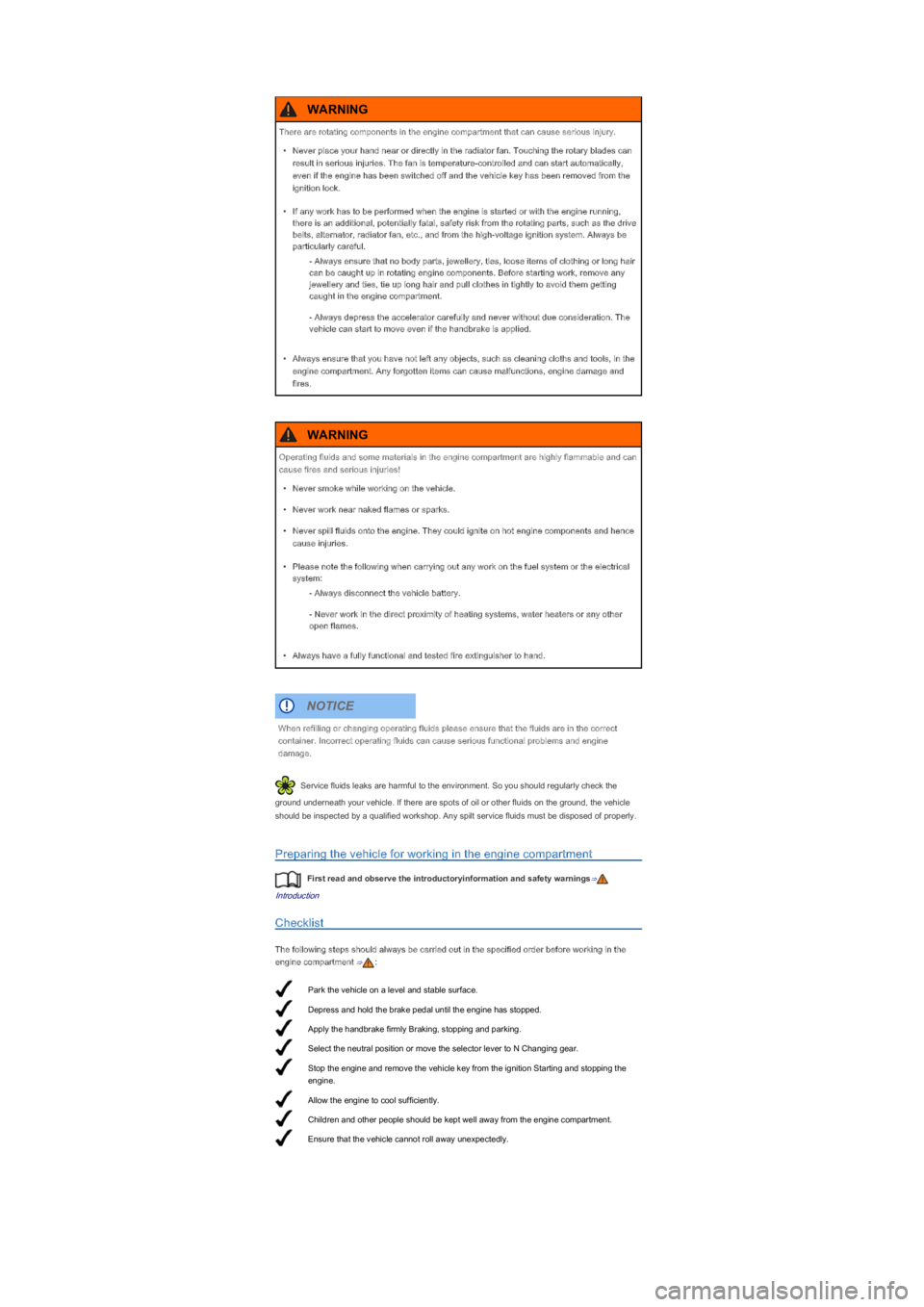
Park the vehicle on a level and stable surface.
Depress and hold the brake pedal until the engine has stopped.
Apply the handbrake firmly Braking, stopping and parking.
Select the neutral position or move the selector lever to N Changing gear.
Stop the engine and remove the vehicle key from the ignition Starting and stopping the
engine.
Allow the engine to cool sufficiently.
Children and other people should be kept well away from the engine compartment.
Ensure that the vehicle cannot roll away unexpectedly.
Service fluids leaks are harmful to the environment. So you should regularly check the
ground underneath your vehicle. If there are spots of oil or other fluids on the ground, the vehicle
should be inspected by a qualified workshop. Any spilt service fluids must be disposed of properly.
Preparing the vehicle for working in the engine compartment
First read and observe the introductoryinformation and safety warnings⇒
Introduction
Checklist
The following steps should always be carried out in the specified order before working in the
engine compartment ⇒:
There are rotating components in the engine compartment that can cause serious injury.
•Never place your hand near or directly in the radiator fan. Touching the rotary blades can
result in serious injuries. The fan is temperature-controlled and can start automatically,
even if the engine has been switched off and the vehicle key has been removed from the
ignition lock.
•If any work has to be performed when the engine is started or with the engine running,
there is an additional, potentially fatal, safety risk from the rotating parts, such as the drive
belts, alternator, radiator fan, etc., and from the high-voltage ignition system. Always be
particularly careful.
- Always ensure that no body parts, jewellery, ties, loose items of clothing or long hair
can be caught up in rotating engine components. Before starting work, remove any
jewellery and ties, tie up long hair and pull clothes in tightly to avoid them getting
caught in the engine compartment.
- Always depress the accelerator carefully and never without due consideration. The
vehicle can start to move even if the handbrake is applied.
•Always ensure that you have not left any objects, such as cleaning cloths and tools, in the
engine compartment. Any forgotten items can cause malfunctions, engine damage and
fires.
WARNING
Operating fluids and some materials in the engine compartment are highly flammable and can
cause fires and serious injuries!
•Never smoke while working on the vehicle.
•Never work near naked flames or sparks.
•Never spill fluids onto the engine. They could ignite on hot engine components and hence
cause injuries.
•Please note the following when carrying out any work on the fuel system or the electrical
system:
- Always disconnect the vehicle battery.
- Never work in the direct proximity of heating systems, water heaters or any other
open flames.
•Always have a fully functional and tested fire extinguisher to hand.
WARNING
When refilling or changing operating fluids please ensure that the fluids are in the correct
container. Incorrect operating fluids can cause serious functional problems and engine
damage.
NOTICE
Page 138 of 211
Changing engine oil
First read and observe the introductoryinformation and safety warnings⇒
Introduction
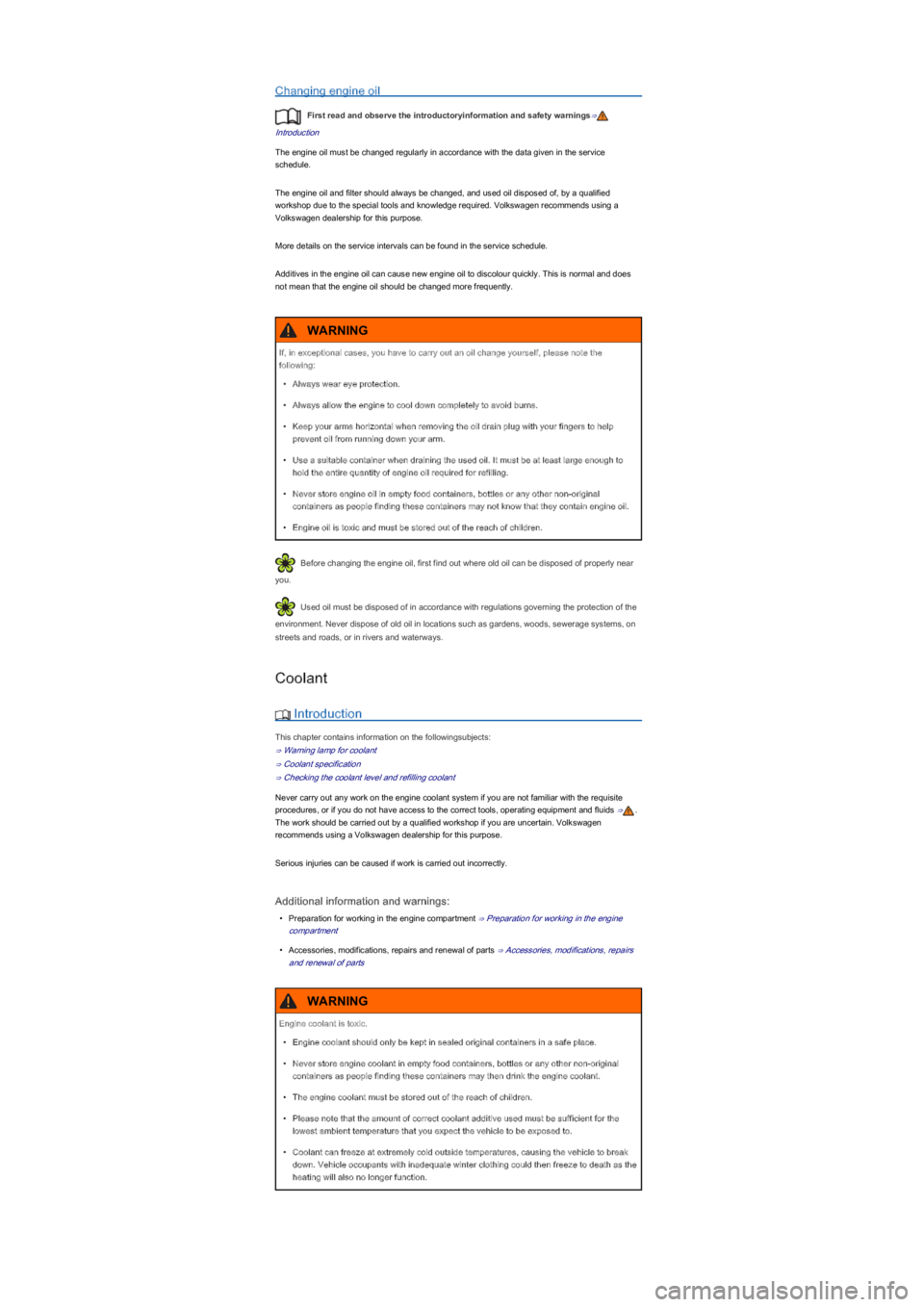
The engine oil must be changed regularly in accordance with the data given in the service
schedule.
The engine oil and filter should always be changed, and used oil disposed of, by a qualified
workshop due to the special tools and knowledge required. Volkswagen recommends using a
Volkswagen dealership for this purpose.
More details on the service intervals can be found in the service schedule.
Additives in the engine oil can cause new engine oil to discolour quickly. This is normal and does
not mean that the engine oil should be changed more frequently.
Before changing the engine oil, first find out where old oil can be disposed of properly near
you.
Used oil must be disposed of in accordance with regulations governing the protection of the
environment. Never dispose of old oil in locations such as gardens, woods, sewerage systems, on
streets and roads, or in rivers and waterways.
Coolant
Introduction
This chapter contains information on the followingsubjects:
⇒ Warning lamp for coolant
⇒ Coolant specification
⇒ Checking the coolant level and refilling coolant
Never carry out any work on the engine coolant system if you are not familiar with the requisite
procedures, or if you do not have access to the correct tools, operating equipment and fluids ⇒.
The work should be carried out by a qualified workshop if you are uncertain. Volkswagen
recommends using a Volkswagen dealership for this purpose.
Serious injuries can be caused if work is carried out incorrectly.
Additional information and warnings:
•Preparation for working in the engine compartment ⇒ Preparation for working in the engine
compartment
•Accessories, modifications, repairs and renewal of parts ⇒ Accessories, modifications, repairs
and renewal of parts
If, in exceptional cases, you have to carry out an oil change yourself, please note the
following:
•Always wear eye protection.
•Always allow the engine to cool down completely to avoid burns.
•Keep your arms horizontal when removing the oil drain plug with your fingers to help
prevent oil from running down your arm.
•Use a suitable container when draining the used oil. It must be at least large enough to
hold the entire quantity of engine oil required for refilling.
•Never store engine oil in empty food containers, bottles or any other non-original
containers as people finding these containers may not know that they contain engine oil.
•Engine oil is toxic and must be stored out of the reach of children.
WARNING
Engine coolant is toxic.
•Engine coolant should only be kept in sealed original containers in a safe place.
•Never store engine coolant in empty food containers, bottles or any other non-original
containers as people finding these containers may then drink the engine coolant.
•The engine coolant must be stored out of the reach of children.
•Please note that the amount of correct coolant additive used must be sufficient for the
lowest ambient temperature that you expect the vehicle to be exposed to.
•Coolant can freeze at extremely cold outside temperatures, causing the vehicle to break
down. Vehicle occupants with inadequate winter clothing could then freeze to death as the
heating will also no longer function.
WARNING