heating VOLKSWAGEN UP! 2021 Owner´s Manual
[x] Cancel search | Manufacturer: VOLKSWAGEN, Model Year: 2021, Model line: UP!, Model: VOLKSWAGEN UP! 2021Pages: 211, PDF Size: 5.98 MB
Page 140 of 211
Coolant and coolant additives can pollute the environment. Spilt operating fluids must be
collected and disposed of properly and with respect for the environment.
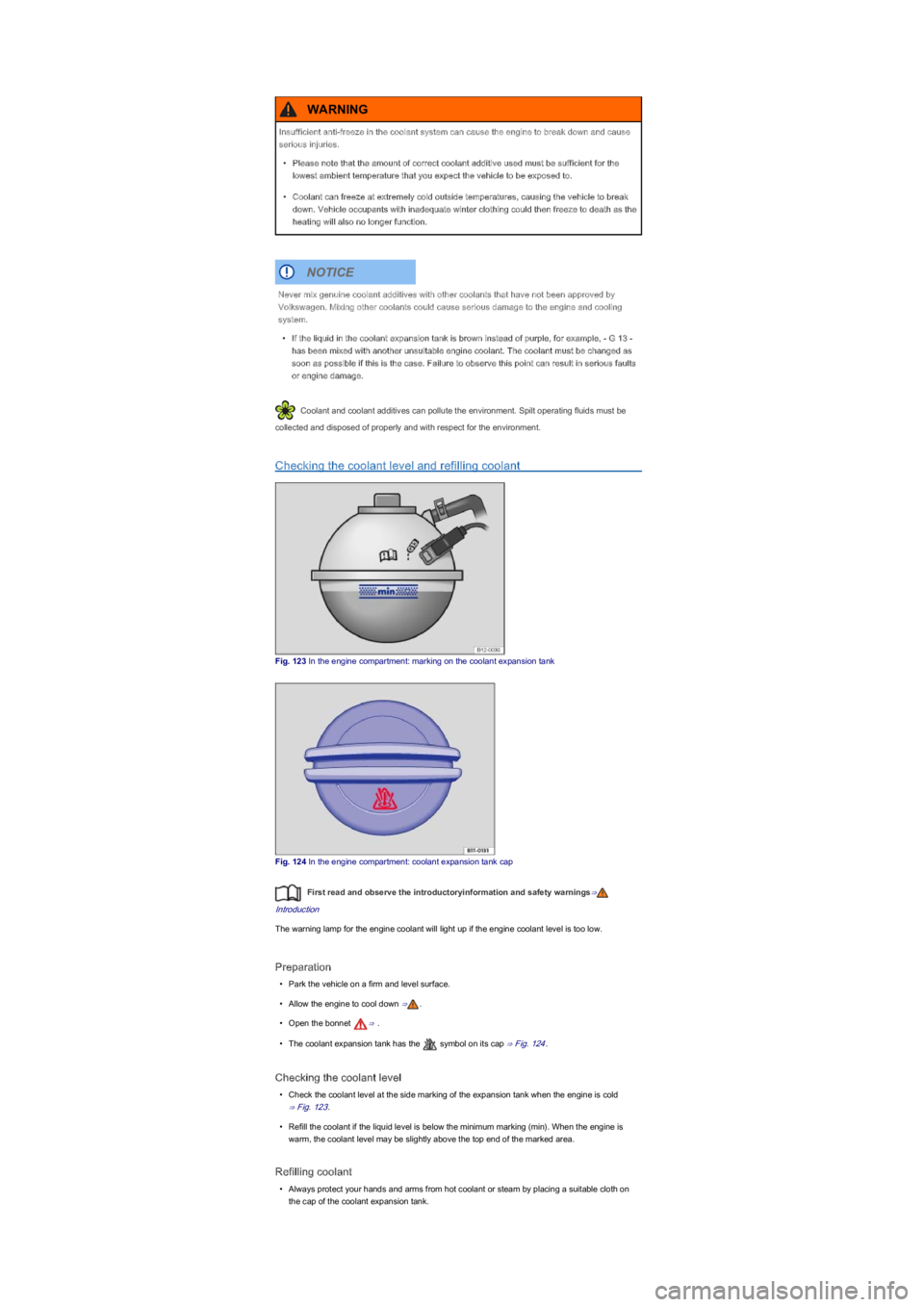
Checking the coolant level and refilling coolant
Fig. 123 In the engine compartment: marking on the coolant expansion tank
Fig. 124 In the engine compartment: coolant expansion tank cap
First read and observe the introductoryinformation and safety warnings⇒
Introduction
The warning lamp for the engine coolant will light up if the engine coolant level is too low.
Preparation
•Park the vehicle on a firm and level surface.
•Allow the engine to cool down ⇒.
•Open the bonnet ⇒ .
•The coolant expansion tank has the symbol on its cap ⇒ Fig. 124.
Checking the coolant level
•Check the coolant level at the side marking of the expansion tank when the engine is cold
⇒ Fig. 123.
•Refill the coolant if the liquid level is below the minimum marking (min). When the engine is
warm, the coolant level may be slightly above the top end of the marked area.
Refilling coolant
•Always protect your hands and arms from hot coolant or steam by placing a suitable cloth on
the cap of the coolant expansion tank.
Insufficient anti-freeze in the coolant system can cause the engine to break down and cause
serious injuries.
•Please note that the amount of correct coolant additive used must be sufficient for the
lowest ambient temperature that you expect the vehicle to be exposed to.
•Coolant can freeze at extremely cold outside temperatures, causing the vehicle to break
down. Vehicle occupants with inadequate winter clothing could then freeze to death as the
heating will also no longer function.
WARNING
Never mix genuine coolant additives with other coolants that have not been approved by
Volkswagen. Mixing other coolants could cause serious damage to the engine and cooling
system.
•If the liquid in the coolant expansion tank is brown instead of purple, for example, - G 13 -
has been mixed with another unsuitable engine coolant. The coolant must be changed as
soon as possible if this is the case. Failure to observe this point can result in serious faults
or engine damage.
NOTICE
Page 149 of 211
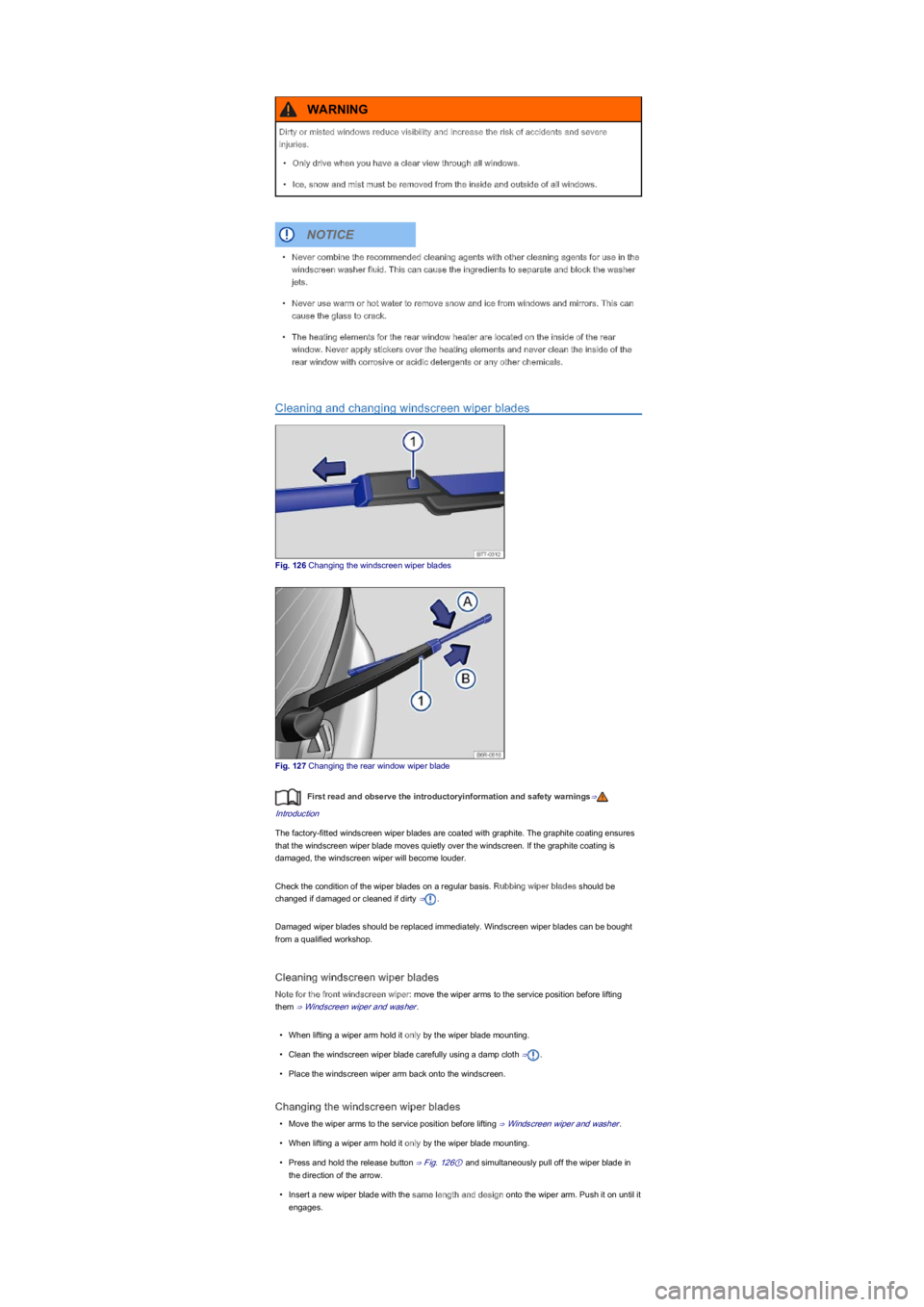
Cleaning and changing windscreen wiper blades
Fig. 126 Changing the windscreen wiper blades
Fig. 127 Changing the rear window wiper blade
First read and observe the introductoryinformation and safety warnings⇒
Introduction
The factory-fitted windscreen wiper blades are coated with graphite. The graphite coating ensures
that the windscreen wiper blade moves quietly over the windscreen. If the graphite coating is
damaged, the windscreen wiper will become louder.
Check the condition of the wiper blades on a regular basis. Rubbing wiper blades should be
changed if damaged or cleaned if dirty ⇒.
Damaged wiper blades should be replaced immediately. Windscreen wiper blades can be bought
from a qualified workshop.
Cleaning windscreen wiper blades
Note for the front windscreen wiper: move the wiper arms to the service position before lifting
them ⇒ Windscreen wiper and washer.
•When lifting a wiper arm hold it only by the wiper blade mounting.
•Clean the windscreen wiper blade carefully using a damp cloth ⇒.
•Place the windscreen wiper arm back onto the windscreen.
Changing the windscreen wiper blades
•Move the wiper arms to the service position before lifting ⇒ Windscreen wiper and washer.
•When lifting a wiper arm hold it only by the wiper blade mounting.
•Press and hold the release button ⇒ Fig. 126① and simultaneously pull off the wiper blade in
the direction of the arrow.
•Insert a new wiper blade with the same length and design onto the wiper arm. Push it on until it
engages.
Dirty or misted windows reduce visibility and increase the risk of accidents and severe
injuries.
•Only drive when you have a clear view through all windows.
•Ice, snow and mist must be removed from the inside and outside of all windows.
WARNING
•Never combine the recommended cleaning agents with other cleaning agents for use in the
windscreen washer fluid. This can cause the ingredients to separate and block the washer
jets.
•Never use warm or hot water to remove snow and ice from windows and mirrors. This can
cause the glass to crack.
•The heating elements for the rear window heater are located on the inside of the rear
window. Never apply stickers over the heating elements and never clean the inside of the
rear window with corrosive or acidic detergents or any other chemicals.
NOTICE
Page 152 of 211
recommends that the protective coating on the underside of the vehicle and on the running gear
should be checked regularly and repaired if necessary.
Cleaning the engine compartment
First read and observe the introductoryinformation and safety warnings⇒
Introduction
The engine compartment of any motor vehicle is a hazardous area ⇒ Preparation for working in the
engine compartment.
The engine compartment should be cleaned by a qualified workshop. An incorrect cleaning
procedure could possibly remove corrosion protection and damage electrical components.
Furthermore, water could enter the vehicle interior directly via the plenum chamber ⇒.
If the engine compartment is very dirty, we recommend that you always proceed to a qualified
workshop to have it cleaned by a professional mechanic. Volkswagen recommends using a
Volkswagen dealership for this purpose.
Plenum chamber
The plenum chamber is located in the engine compartment between the windscreen and the engine
and has a perforated cover. Air from outside is drawn in from the plenum chamber and is passed
into the vehicle interior via the heating and air conditioning system.
Leaves and other loose objects must be removed from the cover of the plenum chamber at regular
intervals using a vacuum cleaner or by hand.
In the interests of environmental protection, the engine compartment should be washed only
in specially provided wash bays. This prevents toxic waste water containing oil, grease and fuel
from entering the sewerage system. In some districts, washing the engine compartment anywhere
else may be prohibited.
Cleaning and caring for the interior
Introduction
This chapter contains information on the followingsubjects:
⇒ Seat covers
⇒ Cleaning cloth seat covers, fabric trim and Alcantara upholstery
⇒ Cleaning and caring for natural leather covers
⇒ Cleaning leatherette upholstery
⇒ Cleaning stowage compartments, drink holders and ash trays
⇒ Cleaning and caring for the dash panel, wooden trims and plastic parts
⇒ Cleaning seat belts
Modern fabrics, such as dark denim, are often not colourfast. Light-coloured upholstery (soft
materials or leather) is particularly sensitive to staining caused by these fabrics, even if you are
careful. This is not caused by a fault in the upholstery, but by the non-colourfast nature of the
garments.
Leaving stains, dirt and other deposits on the surface of vehicle components and cloth seat covers
for a long time can make it difficult to clean and treat them. Stains, dirt and deposits may become
impossible to remove, particularly if left for a long time.
Additional information and warnings:
•Cleaning and caring for the vehicle exterior ⇒ Caring for and cleaning the vehicle exterior
Underseal and anti-corrosion coatings can ignite on the hot exhaust system or on other hot
engine parts.
•Never apply underseal or anti-corrosion coatings to the exhaust pipes, catalytic converter,
heat shields or other vehicle components that become hot.
CAUTION
All work in the engine compartment carries the risk of injury, scalding, accidents and fire.
•Before carrying out any work ensure that you are familiar with the requisite procedures
and general safety regulations ⇒ Preparation for working in the engine compartment.
•Volkswagen recommends having the work carried out by a qualified workshop.
WARNING
Water that has entered the plenum chamber via a manual process (e.g. from a high-pressure
cleaner) can cause considerable damage to the vehicle.
NOTICE
Page 154 of 211
Cleaning upholstery on seat cushions with seat heating, electrically
adjustable seats, or seats containing airbag components
Airbag-related components and electrical connectors may be installed in the driver seat, passenger
seat and sometimes also in the rear outer seats. Seat cushions or backrests that are damaged,
incorrectly cleaned or treated, or that become wet, may cause damage to the vehicle electrics or
trigger a fault in the airbag system ⇒.
Electrical components and connectors are installed in electrically adjustable seats and seat
cushions with seat heating. These can be damaged if cleaned or treated incorrectly ⇒. This can
also result in damage to other parts of the vehicle electrics.
For this reason, please follow these cleaning guidelines:
•Do not use high-pressure cleaners, steam cleaners or coolant spray.
•Do not use washing paste or fine detergent solutions.
•Avoid getting the seat wet.
•Only use detergents that have been approved by Volkswagen.
•If in doubt, consult a specialist cleaning company.
Cleaning upholstery on seat cushions without seat heating, seats that are
not electrically adjustable, and seats that do not contain airbag components
•Please read and follow the instructions, notes and warnings on the package before using
cleaning products.
•Upholstery, fabric trims, Alcantara seat covers and carpeting should be cleaned regularly with
a vacuum cleaner (brush).
•Do not use high-pressure cleaners, steam cleaners or coolant spray.
•We recommend that you use a soft sponge or commercially available lint-free microfibre cloth
for cleaning jobs ⇒.
•Clean Alcantara surfaces with a slightly damp cotton or woollen cloth or a commercially
available lint-free microfibre cloth ⇒.
General surface soiling of the upholstery and fabric trim can be cleaned with a commercially
available foam cleaner.
If the upholstery and fabric trims are generally heavily soiled, consult a Volkswagen dealership for
information on suitable cleaning methods before attempting any cleaning. If required, take the
vehicle to a specialist cleaning company.
Treating stains
When treating stains, it may be necessary to clean the entire surface and not just the stain itself.
This particularly applies if the surface shows general signs of wear. The cleaned area could
otherwise be lighter than the surrounding area. If in doubt, consult a specialist cleaning company.
Type of stainRecommended cleaning method for seat cushions
and upholstery
Water-based stains, e.g.
coffee, fruit juice.
– Moisten a sponge using a spray bottle and treat the stain by
rubbing it in a circular motion.
– Wipe with a dry absorbent cloth.
Stubborn stains, e.g.
chocolate, foundation.
– Only use detergents approved by Volkswagen.
– If required, take the vehicle to a specialist cleaning firm to have the
upholstery cleaned.
Oily stains, e.g. oil,
lipstick.
– Only use detergents approved by Volkswagen.
– If required, take the vehicle to a specialist cleaning firm to have the
upholstery cleaned.
®
®
If there is a fault in the airbag system, the airbag may not function properly, or not function at
all or function unexpectedly. This could cause accidents and fatal injuries.
•The airbag system should be checked by a qualified workshop as soon as possible.
WARNING
If the upholstery on electrically adjustable seats or on seat cushions containing airbag
components gets wet, electric components and the vehicle electrics could be damaged.
•A wet seat cushion should always be dried out, and system components checked, by a
qualified workshop.
•Do not use steam cleaners as the steam pushes the soiling into the fabric and sets it.
•High-pressure cleaners and coolant sprays can damage the upholstery.
NOTICE
Page 155 of 211
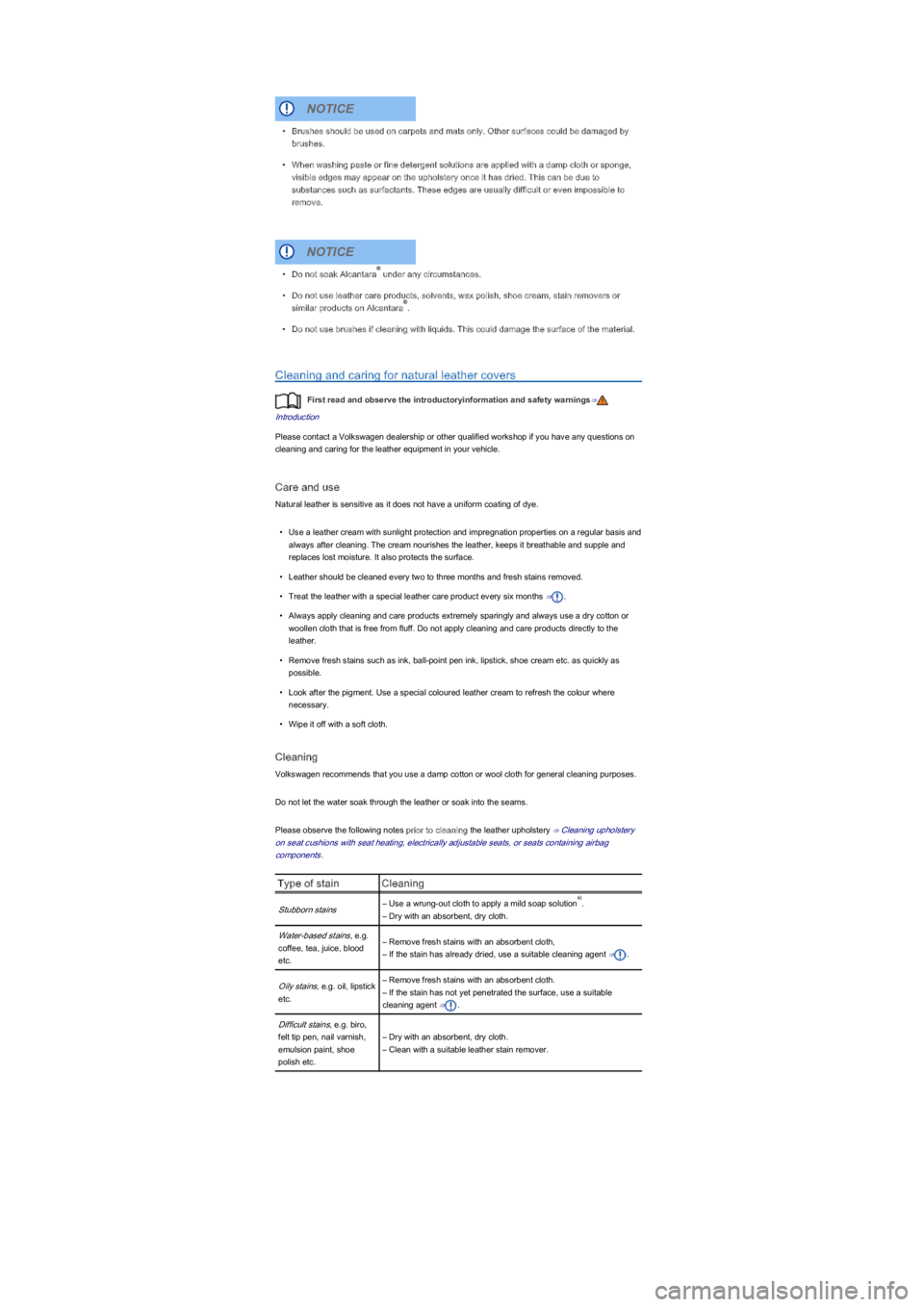
Cleaning and caring for natural leather covers
First read and observe the introductoryinformation and safety warnings⇒
Introduction
Please contact a Volkswagen dealership or other qualified workshop if you have any questions on
cleaning and caring for the leather equipment in your vehicle.
Care and use
Natural leather is sensitive as it does not have a uniform coating of dye.
•Use a leather cream with sunlight protection and impregnation properties on a regular basis and
always after cleaning. The cream nourishes the leather, keeps it breathable and supple and
replaces lost moisture. It also protects the surface.
•Leather should be cleaned every two to three months and fresh stains removed.
•Treat the leather with a special leather care product every six months ⇒.
•Always apply cleaning and care products extremely sparingly and always use a dry cotton or
woollen cloth that is free from fluff. Do not apply cleaning and care products directly to the
leather.
•Remove fresh stains such as ink, ball-point pen ink, lipstick, shoe cream etc. as quickly as
possible.
•Look after the pigment. Use a special coloured leather cream to refresh the colour where
necessary.
•Wipe it off with a soft cloth.
Cleaning
Volkswagen recommends that you use a damp cotton or wool cloth for general cleaning purposes.
Do not let the water soak through the leather or soak into the seams.
Please observe the following notes prior to cleaning the leather upholstery ⇒ Cleaning upholstery
on seat cushions with seat heating, electrically adjustable seats, or seats containing airbag
components.
Type of stainCleaning
Stubborn stains– Use a wrung-out cloth to apply a mild soap solution.
– Dry with an absorbent, dry cloth.
Water-based stains, e.g.
coffee, tea, juice, blood
etc.
– Remove fresh stains with an absorbent cloth,
– If the stain has already dried, use a suitable cleaning agent ⇒.
Oily stains, e.g. oil, lipstick
etc.
– Remove fresh stains with an absorbent cloth.
– If the stain has not yet penetrated the surface, use a suitable
cleaning agent ⇒.
Difficult stains, e.g. biro,
felt tip pen, nail varnish,
emulsion paint, shoe
polish etc.
– Dry with an absorbent, dry cloth.
– Clean with a suitable leather stain remover.
•Brushes should be used on carpets and mats only. Other surfaces could be damaged by
brushes.
•When washing paste or fine detergent solutions are applied with a damp cloth or sponge,
visible edges may appear on the upholstery once it has dried. This can be due to
substances such as surfactants. These edges are usually difficult or even impossible to
remove.
NOTICE
•Do not soak Alcantara under any circumstances.
•Do not use leather care products, solvents, wax polish, shoe cream, stain removers or
similar products on Alcantara.
•Do not use brushes if cleaning with liquids. This could damage the surface of the material.
NOTICE
®
®
a)
Page 156 of 211
However, slight colour variations will arise in normal use.
Mild soap solution: two tablespoons neutral soap diluted in one litre of water.
Cleaning leatherette upholstery
First read and observe the introductoryinformation and safety warnings⇒
Introduction
Please observe the following notes prior to cleaning the leatherette upholstery ⇒ Cleaning
upholstery on seat cushions with seat heating, electrically adjustable seats, or seats containing
airbag components.
Only use water and neutral detergents to clean the leatherette upholstery.
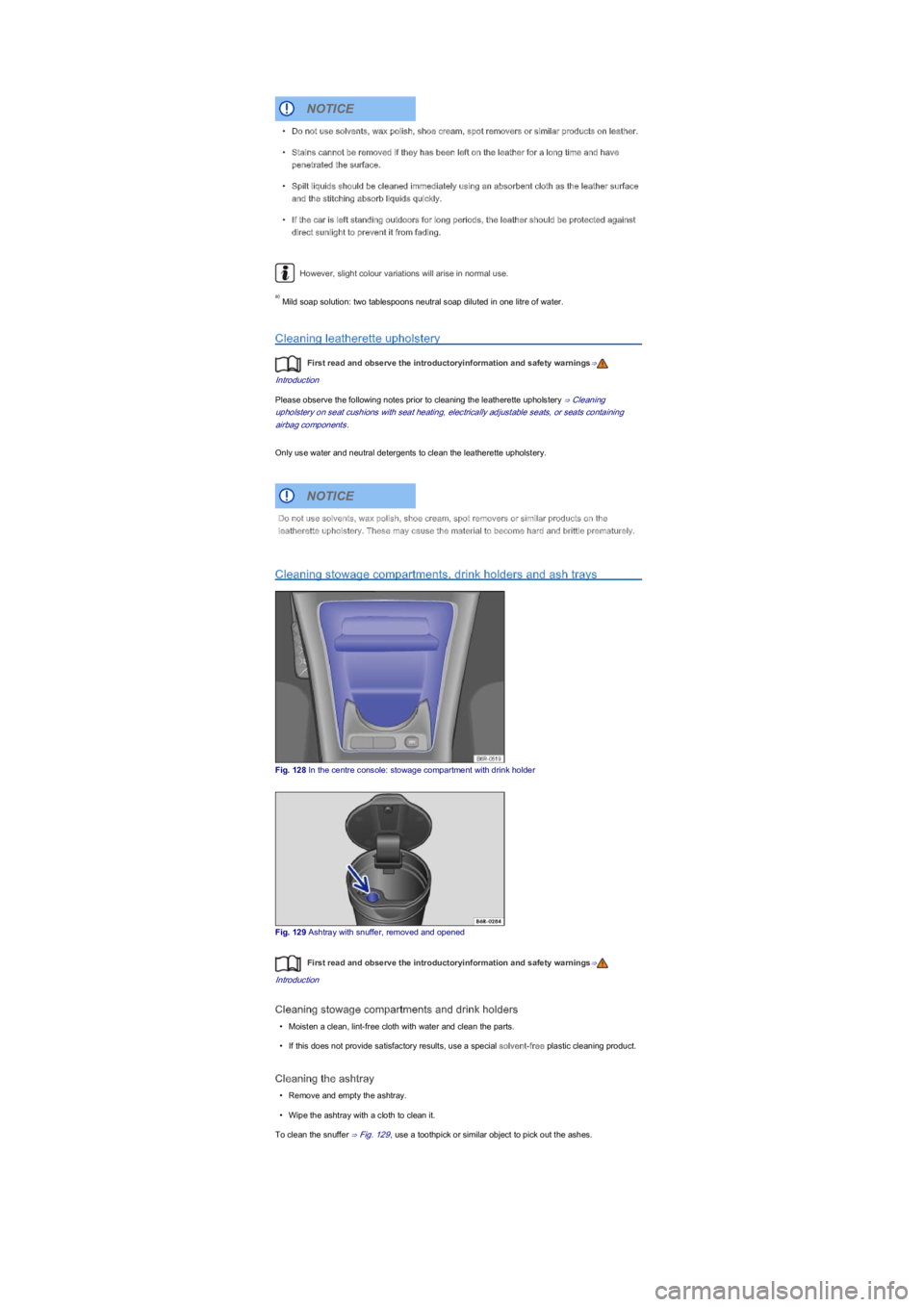
Cleaning stowage compartments, drink holders and ash trays
Fig. 128 In the centre console: stowage compartment with drink holder
Fig. 129 Ashtray with snuffer, removed and opened
First read and observe the introductoryinformation and safety warnings⇒
Introduction
Cleaning stowage compartments and drink holders
•Moisten a clean, lint-free cloth with water and clean the parts.
•If this does not provide satisfactory results, use a special solvent-free plastic cleaning product.
Cleaning the ashtray
•Remove and empty the ashtray.
•Wipe the ashtray with a cloth to clean it.
To clean the snuffer ⇒ Fig. 129, use a toothpick or similar object to pick out the ashes.
•Do not use solvents, wax polish, shoe cream, spot removers or similar products on leather.
•Stains cannot be removed if they has been left on the leather for a long time and have
penetrated the surface.
•Spilt liquids should be cleaned immediately using an absorbent cloth as the leather surface
and the stitching absorb liquids quickly.
•If the car is left standing outdoors for long periods, the leather should be protected against
direct sunlight to prevent it from fading.
NOTICE
a)
Do not use solvents, wax polish, shoe cream, spot removers or similar products on the
leatherette upholstery. These may cause the material to become hard and brittle prematurely.
NOTICE
Page 162 of 211
•After altering the tyre pressures, ensure that the valve caps are screwed on.
The spare wheel or temporary spare wheel are filled to the highest tyre pressure permissible for
the vehicle.
Under-inflated tyres can contribute to an increase in fuel consumption.
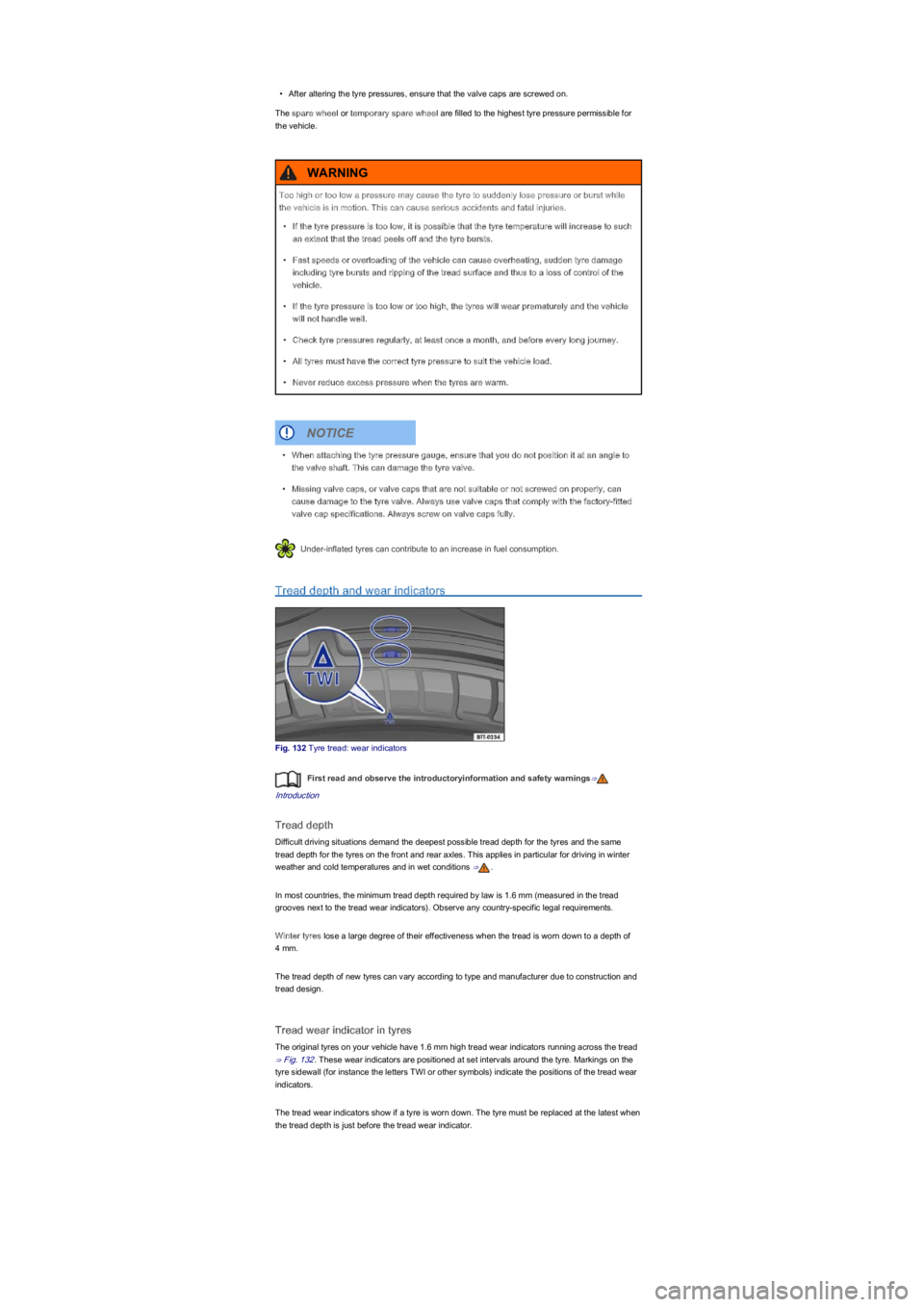
Tread depth and wear indicators
Fig. 132 Tyre tread: wear indicators
First read and observe the introductoryinformation and safety warnings⇒
Introduction
Tread depth
Difficult driving situations demand the deepest possible tread depth for the tyres and the same
tread depth for the tyres on the front and rear axles. This applies in particular for driving in winter
weather and cold temperatures and in wet conditions ⇒.
In most countries, the minimum tread depth required by law is 1.6 mm (measured in the tread
grooves next to the tread wear indicators). Observe any country-specific legal requirements.
Winter tyres lose a large degree of their effectiveness when the tread is worn down to a depth of
4 mm.
The tread depth of new tyres can vary according to type and manufacturer due to construction and
tread design.
Tread wear indicator in tyres
The original tyres on your vehicle have 1.6 mm high tread wear indicators running across the tread
⇒ Fig. 132. These wear indicators are positioned at set intervals around the tyre. Markings on the
tyre sidewall (for instance the letters TWI or other symbols) indicate the positions of the tread wear
indicators.
The tread wear indicators show if a tyre is worn down. The tyre must be replaced at the latest when
the tread depth is just before the tread wear indicator.
Too high or too low a pressure may cause the tyre to suddenly lose pressure or burst while
the vehicle is in motion. This can cause serious accidents and fatal injuries.
•If the tyre pressure is too low, it is possible that the tyre temperature will increase to such
an extent that the tread peels off and the tyre bursts.
•Fast speeds or overloading of the vehicle can cause overheating, sudden tyre damage
including tyre bursts and ripping of the tread surface and thus to a loss of control of the
vehicle.
•If the tyre pressure is too low or too high, the tyres will wear prematurely and the vehicle
will not handle well.
•Check tyre pressures regularly, at least once a month, and before every long journey.
•All tyres must have the correct tyre pressure to suit the vehicle load.
•Never reduce excess pressure when the tyres are warm.
WARNING
•When attaching the tyre pressure gauge, ensure that you do not position it at an angle to
the valve shaft. This can damage the tyre valve.
•Missing valve caps, or valve caps that are not suitable or not screwed on properly, can
cause damage to the tyre valve. Always use valve caps that comply with the factory-fitted
valve cap specifications. Always screw on valve caps fully.
NOTICE
Page 180 of 211
⇒ Catalytic converter
Additional information and warnings:
•Changing gear ⇒ Changing gear
•Filling the tank ⇒ Filling the tank
•Fuel ⇒ Fuel
•Engine oil ⇒ Engine oil
•Battery ⇒ Vehicle battery
•Information stored in the control units ⇒ Accessories, modifications, repairs and renewal of parts
•Tow-starting and towing ⇒ Tow-starting and towing
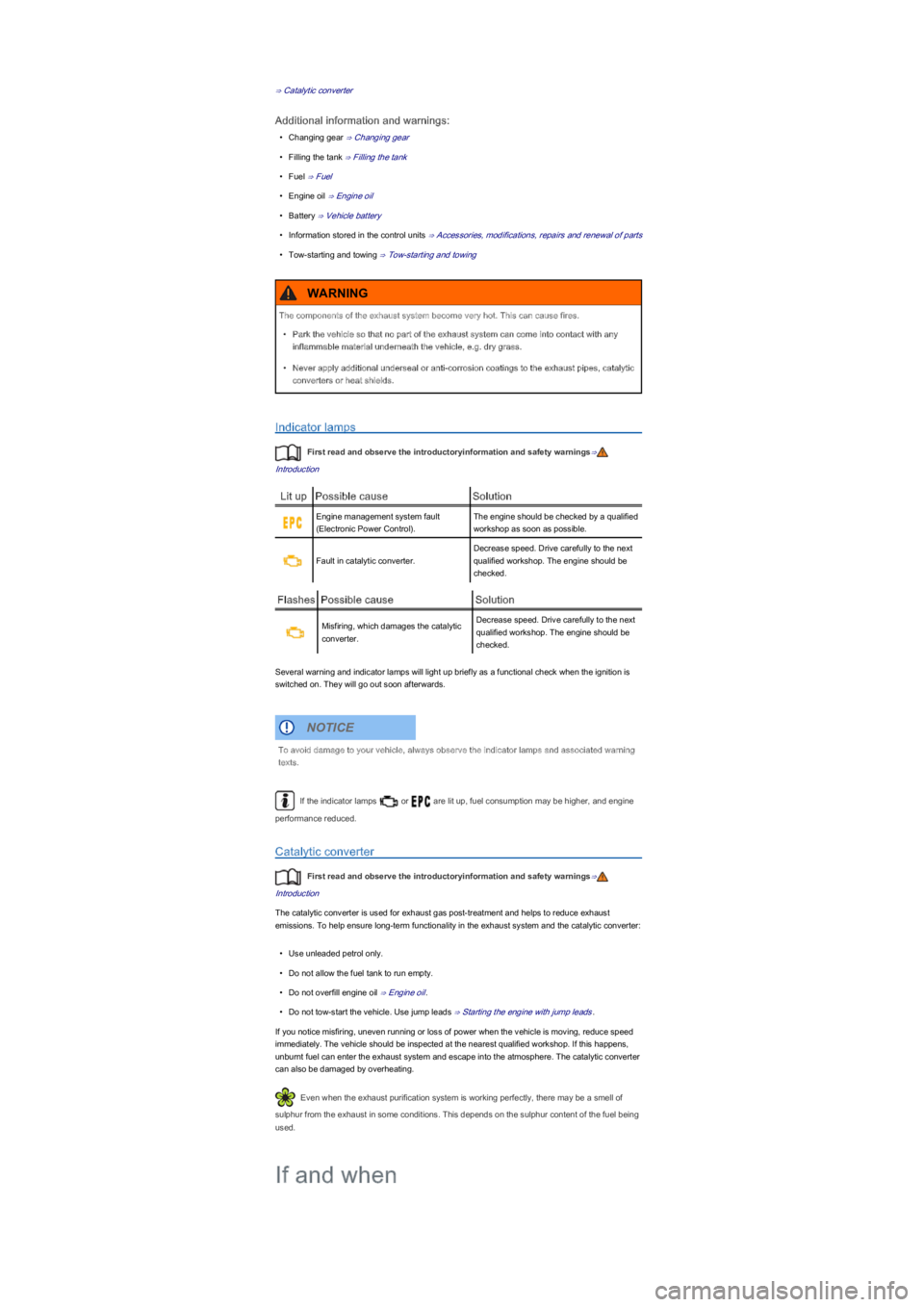
Indicator lamps
First read and observe the introductoryinformation and safety warnings⇒
Introduction
Lit upPossible causeSolution
Engine management system fault
(Electronic Power Control).
The engine should be checked by a qualified
workshop as soon as possible.
Fault in catalytic converter.
Decrease speed. Drive carefully to the next
qualified workshop. The engine should be
checked.
FlashesPossible causeSolution
Misfiring, which damages the catalytic
converter.
Decrease speed. Drive carefully to the next
qualified workshop. The engine should be
checked.
Several warning and indicator lamps will light up briefly as a functional check when the ignition is
switched on. They will go out soon afterwards.
If the indicator lamps or are lit up, fuel consumption may be higher, and engine
performance reduced.
Catalytic converter
First read and observe the introductoryinformation and safety warnings⇒
Introduction
The catalytic converter is used for exhaust gas post-treatment and helps to reduce exhaust
emissions. To help ensure long-term functionality in the exhaust system and the catalytic converter:
•Use unleaded petrol only.
•Do not allow the fuel tank to run empty.
•Do not overfill engine oil ⇒ Engine oil.
•Do not tow-start the vehicle. Use jump leads ⇒ Starting the engine with jump leads.
If you notice misfiring, uneven running or loss of power when the vehicle is moving, reduce speed
immediately. The vehicle should be inspected at the nearest qualified workshop. If this happens,
unburnt fuel can enter the exhaust system and escape into the atmosphere. The catalytic converter
can also be damaged by overheating.
Even when the exhaust purification system is working perfectly, there may be a smell of
sulphur from the exhaust in some conditions. This depends on the sulphur content of the fuel being
used.
The components of the exhaust system become very hot. This can cause fires.
•Park the vehicle so that no part of the exhaust system can come into contact with any
inflammable material underneath the vehicle, e.g. dry grass.
•Never apply additional underseal or anti-corrosion coatings to the exhaust pipes, catalytic
converters or heat shields.
WARNING
To avoid damage to your vehicle, always observe the indicator lamps and associated warning
texts.
NOTICE
If and when
Page 196 of 211
•Insert the plug ⇒ Fig. 157⑨ into one of the vehicle's 12-volt sockets ⇒ Socket.
•Use the on/off switch ⇒ Fig. 157⑧ to switch on the air compressor.
•Run the compressor until the tyre pressure has reached 2.0 – 2.5 bar (29 – 36 psi / 200 –
250 kPa) ⇒. The maximum running time is 8 minutes⇒.
•Switch off the air compressor.
•If a pressure level of 2.0 – 2.5 bar (29 – 36 psi / 200 – 250 kPa) cannot be achieved unscrew
the tyre filler hose from the tyre valve.
•Drive (or reverse) the vehicle approximately 10 metres so that the sealing compound is more
evenly distributed in the tyre.
•Screw the tyre filler hose for the air compressor firmly back onto the tyre valve and inflate the
tyre again.
•If the required pressure still cannot be reached, the tyre is too badly damaged. The tyre cannot
be sealed with the breakdown set. Do not drive on. Seek expert assistance ⇒.
•Disconnect the air compressor and unscrew the tyre filler hose from the tyre valve.
•Drive the vehicle no faster than 80 km/h (50 mph) once a tyre pressure of 2.0 – 2.5 bar
(29 – 36 psi / 200 – 250 kPa) has been reached.
•Check the tyre pressure after driving for 10 minutes⇒ Test after driving for 10 minutes.
Test after driving for 10 minutes
First read and observe the introductoryinformation and safety warnings⇒
Introduction
Reconnect the tyre filler hose ⇒ Fig. 157⑤ and check the tyre pressure on the tyre pressure
display ⑥.
1.3 bar (19 psi / 130 kPa) and lower:
•Do not drive on! The tyre cannot be sealed adequately with the breakdown set.
•Seek expert assistance ⇒.
1.4 bar (20 psi / 140 kPa) and higher:
•Set the tyre pressure back to the correct value ⇒ Wheels and tyres.
•Resume your journey to the nearest qualified workshop. Do not exceed a maximum speed of
80 km/h (50 mph).
•Have the damaged tyre replaced at the workshop.
Fuses
Introduction
This chapter contains information on the followingsubjects:
⇒ Fuses in the vehicle
⇒ Changing a blown fuse
At the time of print we are unable to provide an up-to-date overview of the locations of the fuses for
the electrical consumers. This is because the vehicle is under constant development, because
fuses are assigned differently depending on the vehicle equipment level and because several
consumers may use a single fuse. You can get more information about the fuse layout from a
Volkswagen dealership.
The tyre filler hose and the air compressor can get hot during inflation.
•Protect your hands and skin from the hot components.
•Do not place the hot tyre filler hose or the hot air compressor on any inflammable
materials.
•Allow the device to cool down fully before stowing.
•If the tyre will not inflate to at least 2.0 bar (29 psi / 200 kPa), the tyre is too damaged. The
sealant is unable to seal the tyre. Do not drive on. Seek expert assistance.
WARNING
Switch the air compressor off after a maximum of 8 minutes to avoid overheating. Let the air
compressor cool down for a few minutes before switching it back on.
NOTICE
Driving with an unsealed tyre is dangerous as it can cause accidents and serious injuries.
•Do not carry on driving if the tyre pressure is 1.3 bar (19 psi / 130 kPa) or lower.
•Seek expert assistance.
WARNING