service VOLKSWAGEN UP! 2021 Owner´s Manual
[x] Cancel search | Manufacturer: VOLKSWAGEN, Model Year: 2021, Model line: UP!, Model: VOLKSWAGEN UP! 2021Pages: 211, PDF Size: 5.98 MB
Page 21 of 211
Replacement key
You will need to quote the vehicle chassis number when ordering a replacement key or additional
remote control keys.
Every new key contains a microchip which must be encoded with the data for the vehicle's
electronic immobilizer. The vehicle key will not work if it is not fitted with a microchip, or if the
microchip has not been encoded. The same goes for keys that have been cut to fit the vehicle.
New keys or replacement keys are available from Volkswagen dealerships or from qualified
workshops and authorised key services that are qualified to manufacture these vehicle keys.
New and replacement vehicle keys must be synchronised before use. Proceed to a qualified
workshop.
Press the buttons on the key only if the corresponding function is actually needed. Pressing
a button when the function is not required could lead to the vehicle being unlocked unintentionally
or the alarm going off. This also applies even when you are not within the effective range.
The function of the vehicle key can be affected temporarily if there is more than one
transmitter in the direct vicinity working on the same frequency (e.g. a two-way radio or mobile
telephone).
Obstacles between the key and the vehicle, bad weather conditions and weak batteries can
reduce the range of the remote control.
If the buttons on the vehicle key ⇒ Fig. 16 or one of the central locking buttons ⇒ Central
locking system are pressed repeatedly within a short period of time, the central locking system will
switch off briefly to prevent overloading. The vehicle will then be unlocked. Lock the vehicle if
necessary.
Mechanical vehicle key
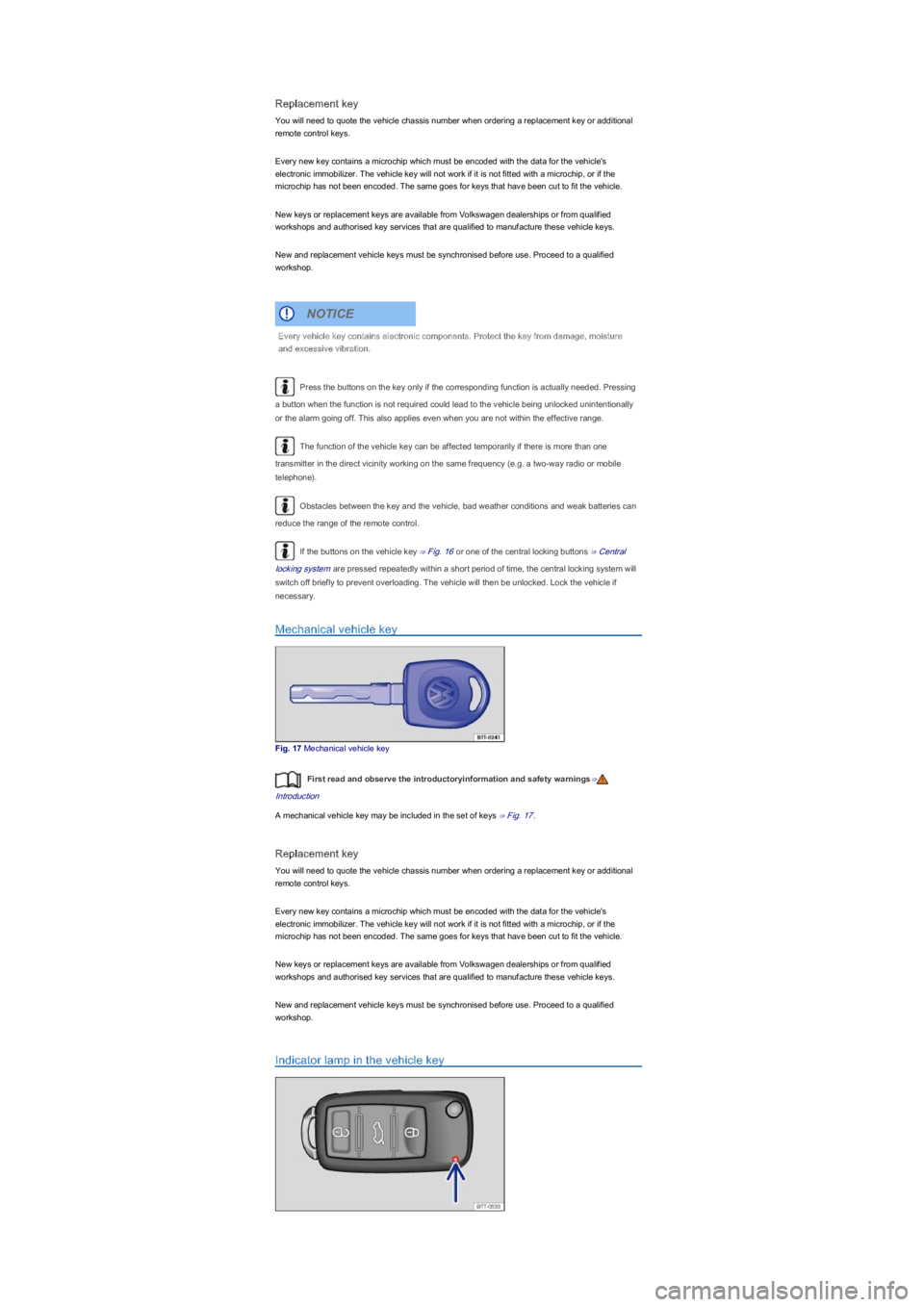
Fig. 17 Mechanical vehicle key
First read and observe the introductoryinformation and safety warnings⇒
Introduction
A mechanical vehicle key may be included in the set of keys ⇒ Fig. 17.
Replacement key
You will need to quote the vehicle chassis number when ordering a replacement key or additional
remote control keys.
Every new key contains a microchip which must be encoded with the data for the vehicle's
electronic immobilizer. The vehicle key will not work if it is not fitted with a microchip, or if the
microchip has not been encoded. The same goes for keys that have been cut to fit the vehicle.
New keys or replacement keys are available from Volkswagen dealerships or from qualified
workshops and authorised key services that are qualified to manufacture these vehicle keys.
New and replacement vehicle keys must be synchronised before use. Proceed to a qualified
workshop.
Indicator lamp in the vehicle key
Every vehicle key contains electronic components. Protect the key from damage, moisture
and excessive vibration.
NOTICE
Page 26 of 211
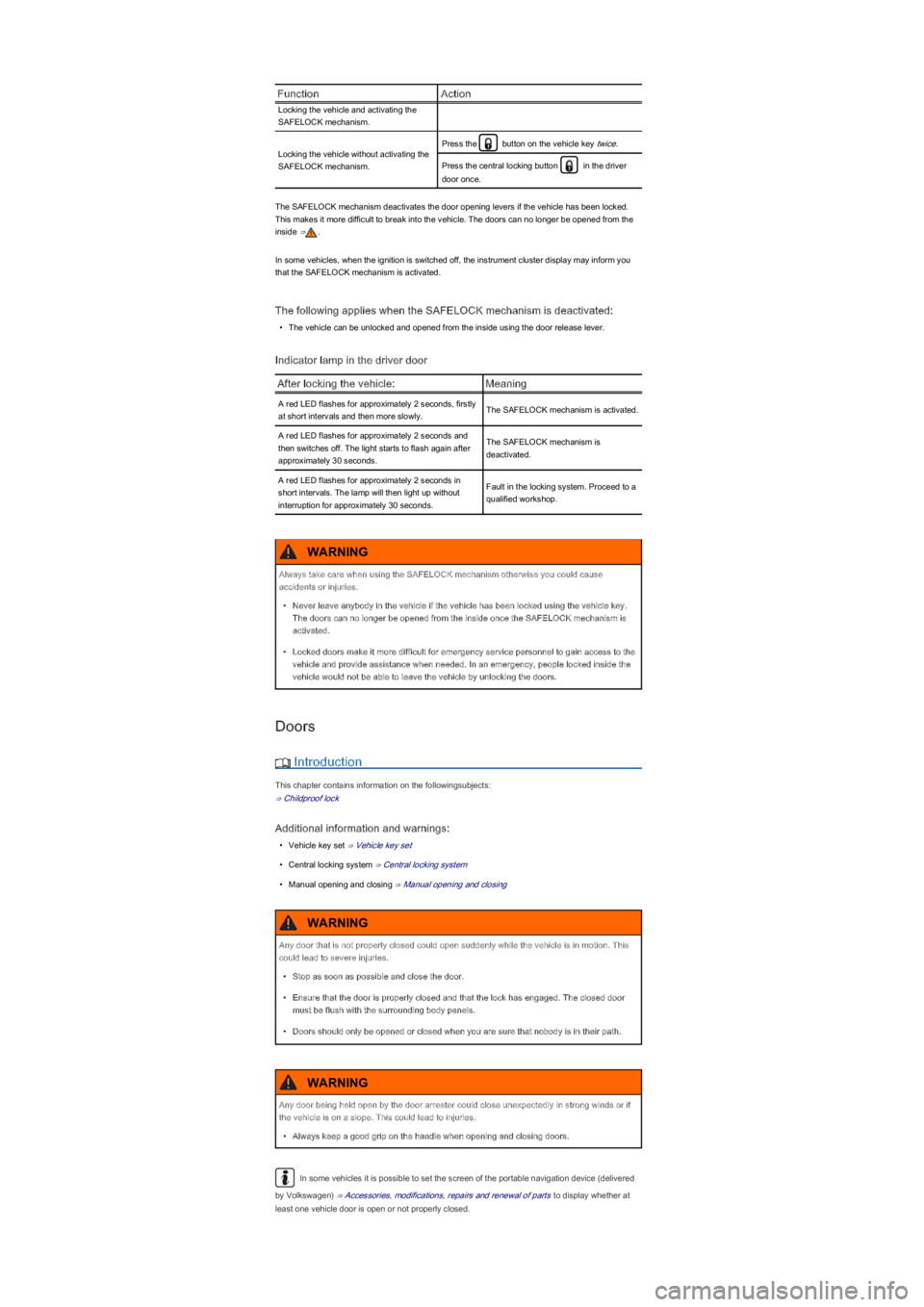
FunctionAction
Locking the vehicle and activating the
SAFELOCK mechanism.
Locking the vehicle without activating the
SAFELOCK mechanism.
Press the button on the vehicle key twice.
Press the central locking button in the driver
door once.
The SAFELOCK mechanism deactivates the door opening levers if the vehicle has been locked.
This makes it more difficult to break into the vehicle. The doors can no longer be opened from the
inside ⇒.
In some vehicles, when the ignition is switched off, the instrument cluster display may inform you
that the SAFELOCK mechanism is activated.
The following applies when the SAFELOCK mechanism is deactivated:
•The vehicle can be unlocked and opened from the inside using the door release lever.
Indicator lamp in the driver door
After locking the vehicle:Meaning
A red LED flashes for approximately 2 seconds, firstly
at short intervals and then more slowly.The SAFELOCK mechanism is activated.
A red LED flashes for approximately 2 seconds and
then switches off. The light starts to flash again after
approximately 30 seconds.
The SAFELOCK mechanism is
deactivated.
A red LED flashes for approximately 2 seconds in
short intervals. The lamp will then light up without
interruption for approximately 30 seconds.
Fault in the locking system. Proceed to a
qualified workshop.
Doors
Introduction
This chapter contains information on the followingsubjects:
⇒ Childproof lock
Additional information and warnings:
•Vehicle key set ⇒ Vehicle key set
•Central locking system ⇒ Central locking system
•Manual opening and closing ⇒ Manual opening and closing
In some vehicles it is possible to set the screen of the portable navigation device (delivered
by Volkswagen) ⇒ Accessories, modifications, repairs and renewal of parts to display whether at
least one vehicle door is open or not properly closed.
Always take care when using the SAFELOCK mechanism otherwise you could cause
accidents or injuries.
•Never leave anybody in the vehicle if the vehicle has been locked using the vehicle key.
The doors can no longer be opened from the inside once the SAFELOCK mechanism is
activated.
•Locked doors make it more difficult for emergency service personnel to gain access to the
vehicle and provide assistance when needed. In an emergency, people locked inside the
vehicle would not be able to leave the vehicle by unlocking the doors.
WARNING
Any door that is not properly closed could open suddenly while the vehicle is in motion. This
could lead to severe injuries.
•Stop as soon as possible and close the door.
•Ensure that the door is properly closed and that the lock has engaged. The closed door
must be flush with the surrounding body panels.
•Doors should only be opened or closed when you are sure that nobody is in their path.
WARNING
Any door being held open by the door arrester could close unexpectedly in strong winds or if
the vehicle is on a slope. This could lead to injuries.
•Always keep a good grip on the handle when opening and closing doors.
WARNING
Page 40 of 211
Switch off the seat heating when the seat is not occupied.
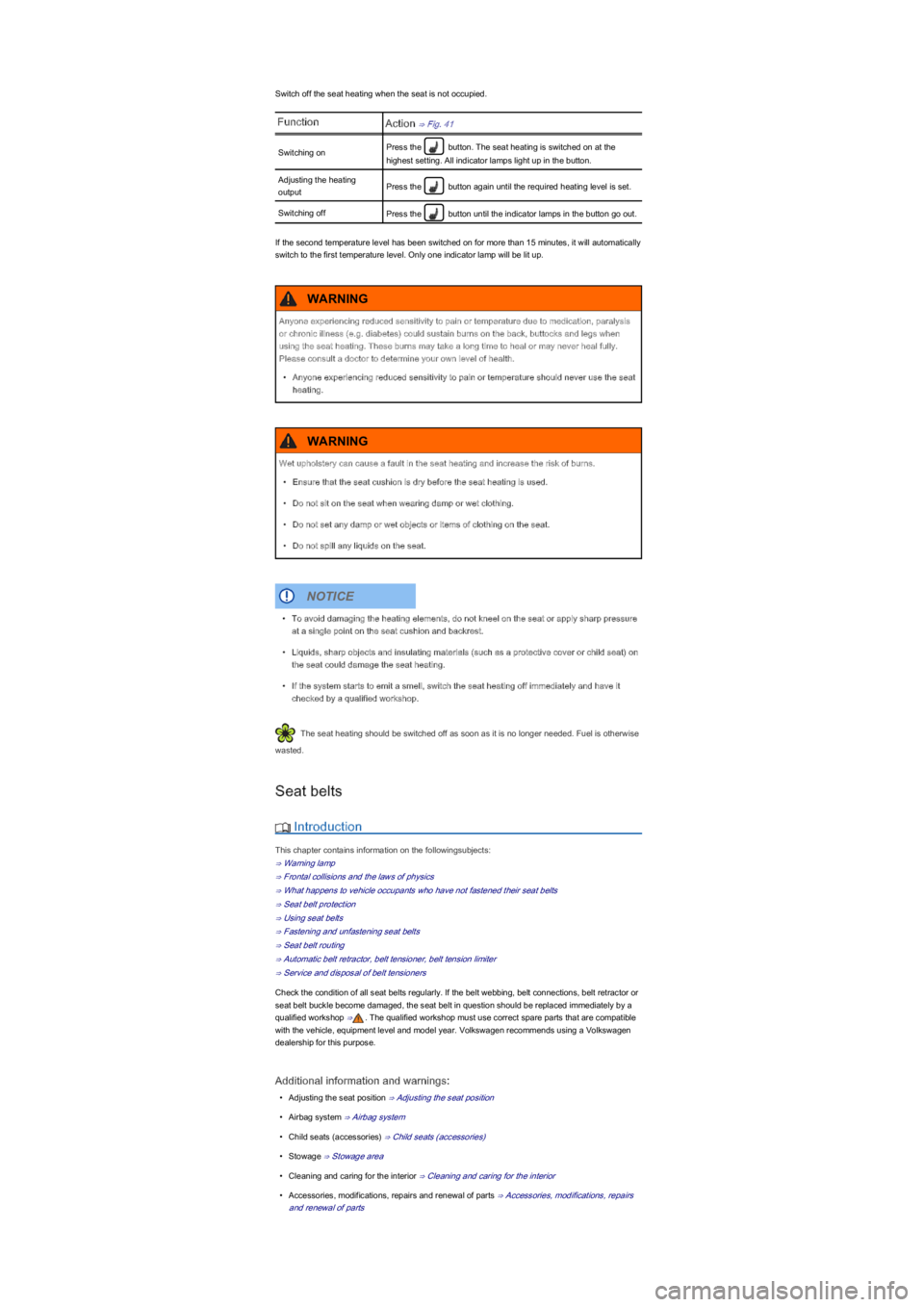
FunctionAction ⇒ Fig. 41
Switching onPress the button. The seat heating is switched on at the
highest setting. All indicator lamps light up in the button.
Adjusting the heating
outputPress the button again until the required heating level is set.
Switching offPress the button until the indicator lamps in the button go out.
If the second temperature level has been switched on for more than 15 minutes, it will automatically
switch to the first temperature level. Only one indicator lamp will be lit up.
The seat heating should be switched off as soon as it is no longer needed. Fuel is otherwise
wasted.
Seat belts
Introduction
This chapter contains information on the followingsubjects:
⇒ Warning lamp
⇒ Frontal collisions and the laws of physics
⇒ What happens to vehicle occupants who have not fastened their seat belts
⇒ Seat belt protection
⇒ Using seat belts
⇒ Fastening and unfastening seat belts
⇒ Seat belt routing
⇒ Automatic belt retractor, belt tensioner, belt tension limiter
⇒ Service and disposal of belt tensioners
Check the condition of all seat belts regularly. If the belt webbing, belt connections, belt retractor or
seat belt buckle become damaged, the seat belt in question should be replaced immediately by a
qualified workshop ⇒. The qualified workshop must use correct spare parts that are compatible
with the vehicle, equipment level and model year. Volkswagen recommends using a Volkswagen
dealership for this purpose.
Additional information and warnings:
•Adjusting the seat position ⇒ Adjusting the seat position
•Airbag system ⇒ Airbag system
•Child seats (accessories) ⇒ Child seats (accessories)
•Stowage ⇒ Stowage area
•Cleaning and caring for the interior ⇒ Cleaning and caring for the interior
•Accessories, modifications, repairs and renewal of parts ⇒ Accessories, modifications, repairs
and renewal of parts
Anyone experiencing reduced sensitivity to pain or temperature due to medication, paralysis
or chronic illness (e.g. diabetes) could sustain burns on the back, buttocks and legs when
using the seat heating. These burns may take a long time to heal or may never heal fully.
Please consult a doctor to determine your own level of health.
•Anyone experiencing reduced sensitivity to pain or temperature should never use the seat
heating.
WARNING
Wet upholstery can cause a fault in the seat heating and increase the risk of burns.
•Ensure that the seat cushion is dry before the seat heating is used.
•Do not sit on the seat when wearing damp or wet clothing.
•Do not set any damp or wet objects or items of clothing on the seat.
•Do not spill any liquids on the seat.
WARNING
•To avoid damaging the heating elements, do not kneel on the seat or apply sharp pressure
at a single point on the seat cushion and backrest.
•Liquids, sharp objects and insulating materials (such as a protective cover or child seat) on
the seat could damage the seat heating.
•If the system starts to emit a smell, switch the seat heating off immediately and have it
checked by a qualified workshop.
NOTICE
Page 47 of 211
The belt tensioners are activated by sensors during severe frontal, side and rear collisions. They
tighten the seat belts against the direction in which they are pulled. A loose seat belt is retracted,
which can reduce the forward movement or the movement of the vehicle occupants in the direction
of the impact. The belt tensioner works together with the airbag system. If the side airbags are not
activated, the belt tensioner will not be activated if the vehicle rolls over.
A fine dust may be produced when the airbags are triggered. This is quite normal and does not
mean that there is a fire in the vehicle.
Belt tension limiter
The belt tension limiter reduces the pressure exerted by the seat belt on the body during an
accident.
All safety requirements must be observed when the vehicle or components of the system are
scrapped. Qualified workshops are familiar with these requirements ⇒ Service and disposal of belt
tensioners.
Service and disposal of belt tensioners
First read and observe the introductoryinformation and safety warnings⇒
Introduction
Seat belts may become damaged during any work on the belt tensioners or while removing or
refitting any vehicle parts in conjunction with any other repair work. This damage will not always be
noticeable. The consequence may be that the belt tensioners could function incorrectly, or not
function at all, in the event of an accident.
Regulations must be observed to ensure that the effectiveness of the belt tensioner is not reduced
and that removed parts do not cause any injuries or environmental pollution. Qualified workshops
are familiar with these requirements.
The airbag modules and belt tensioners may contain perchlorate. Please comply with
legislation regarding disposal.
Airbag system
Introduction
This chapter contains information on the followingsubjects:
⇒ Types of front passenger front airbag system
⇒ Indicator lamps
⇒ Description and function of the airbags
⇒ Front airbags
⇒ Switching the front passenger front airbag on and off manually using the key-operated switch
⇒ Side airbags
The vehicle is equipped with a front airbag for the driver and front passenger. The front airbags can
provide front seat occupants with additional chest and head protection if the seat, seat belts, head
restraints and, in the case of the driver, steering wheel are adjusted and used correctly. Airbags are
meant only for additional protection. The airbags are not a substitute for seat belts. Seat belts must
always be worn, even when the front seats are equipped with front airbags.
Additional information and warnings:
•Driving tips ⇒ Driving tips
•Central locking system ⇒ Central locking system
•Correct sitting position ⇒ Adjusting the seat position
•Seat belts ⇒ Seat belts
•Child seats (accessories) ⇒ Child seats (accessories)
•Cleaning and caring for the interior ⇒ Cleaning and caring for the interior
•Accessories, modifications, repairs and renewal of parts ⇒ Accessories, modifications, repairs
and renewal of parts
•Consumer information ⇒ Consumer information
The risk of severe or fatal injuries may be increased if the seat belts, automatic belt retractors
and belt tensioners are not used correctly, or if they are repaired by a non-professional. As a
result, the belt tensioners may not be triggered when they should, or they may be triggered
unexpectedly.
•Any repairs, adjustments or removal and refitting of parts in the belt tensioners or seat
belts should always be carried out by a qualified workshop and never by yourself
⇒ Accessories, modifications, repairs and renewal of parts.
•Belt tensioners and automatic belt retractors cannot be repaired. They must be replaced.
WARNING
Page 62 of 211
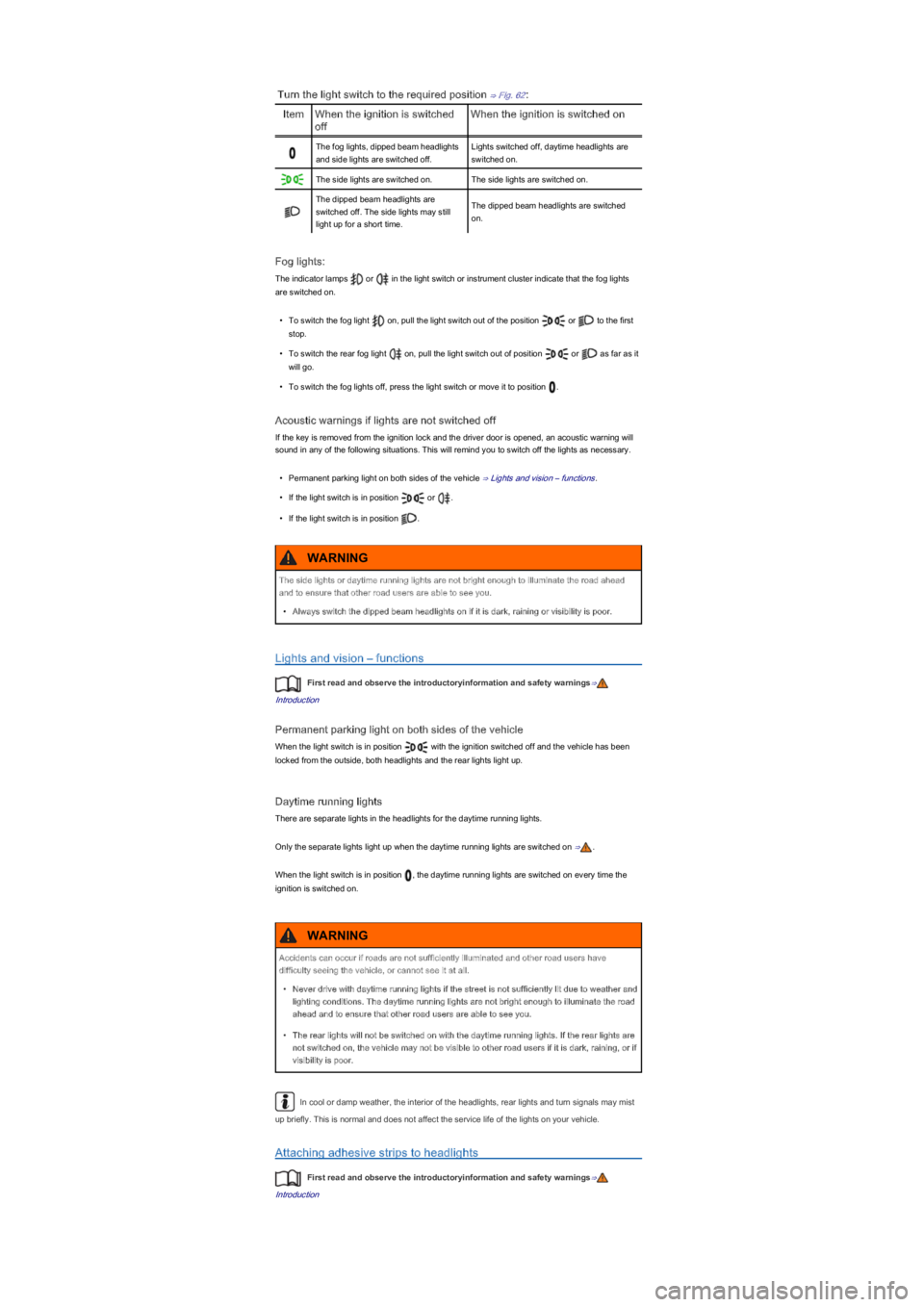
Turn the light switch to the required position ⇒ Fig. 62:
ItemWhen the ignition is switched
off
When the ignition is switched on
The fog lights, dipped beam headlights
and side lights are switched off.
Lights switched off, daytime headlights are
switched on.
The side lights are switched on.The side lights are switched on.
The dipped beam headlights are
switched off. The side lights may still
light up for a short time.
The dipped beam headlights are switched
on.
Fog lights:
The indicator lamps or in the light switch or instrument cluster indicate that the fog lights
are switched on.
•To switch the fog light on, pull the light switch out of the position or to the first
stop.
•To switch the rear fog light on, pull the light switch out of position or as far as it
will go.
•To switch the fog lights off, press the light switch or move it to position .
Acoustic warnings if lights are not switched off
If the key is removed from the ignition lock and the driver door is opened, an acoustic warning will
sound in any of the following situations. This will remind you to switch off the lights as necessary.
•Permanent parking light on both sides of the vehicle ⇒ Lights and vision – functions.
•If the light switch is in position or .
•If the light switch is in position .
Lights and vision – functions
First read and observe the introductoryinformation and safety warnings⇒
Introduction
Permanent parking light on both sides of the vehicle
When the light switch is in position with the ignition switched off and the vehicle has been
locked from the outside, both headlights and the rear lights light up.
Daytime running lights
There are separate lights in the headlights for the daytime running lights.
Only the separate lights light up when the daytime running lights are switched on ⇒.
When the light switch is in position , the daytime running lights are switched on every time the
ignition is switched on.
In cool or damp weather, the interior of the headlights, rear lights and turn signals may mist
up briefly. This is normal and does not affect the service life of the lights on your vehicle.
Attaching adhesive strips to headlights
First read and observe the introductoryinformation and safety warnings⇒
Introduction
The side lights or daytime running lights are not bright enough to illuminate the road ahead
and to ensure that other road users are able to see you.
•Always switch the dipped beam headlights on if it is dark, raining or visibility is poor.
WARNING
Accidents can occur if roads are not sufficiently illuminated and other road users have
difficulty seeing the vehicle, or cannot see it at all.
•Never drive with daytime running lights if the street is not sufficiently lit due to weather and
lighting conditions. The daytime running lights are not bright enough to illuminate the road
ahead and to ensure that other road users are able to see you.
•The rear lights will not be switched on with the daytime running lights. If the rear lights are
not switched on, the vehicle may not be visible to other road users if it is dark, raining, or if
visibility is poor.
WARNING
Page 64 of 211
Protection from the sun
Introduction
This chapter contains information on the followingsubjects:
⇒ Sun visors
Sun visors
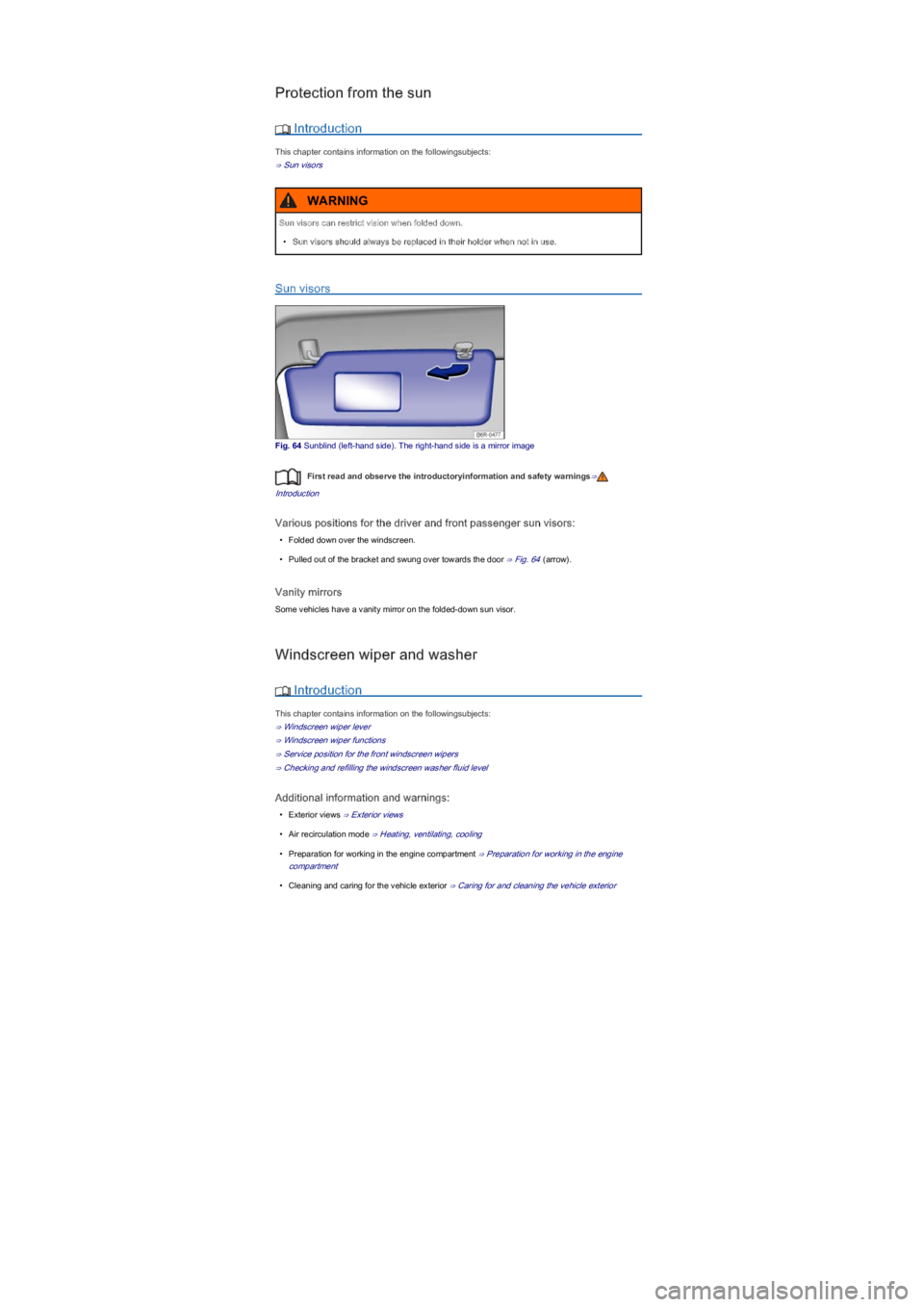
Fig. 64 Sunblind (left-hand side). The right-hand side is a mirror image
First read and observe the introductoryinformation and safety warnings⇒
Introduction
Various positions for the driver and front passenger sun visors:
•Folded down over the windscreen.
•Pulled out of the bracket and swung over towards the door ⇒ Fig. 64 (arrow).
Vanity mirrors
Some vehicles have a vanity mirror on the folded-down sun visor.
Windscreen wiper and washer
Introduction
This chapter contains information on the followingsubjects:
⇒ Windscreen wiper lever
⇒ Windscreen wiper functions
⇒ Service position for the front windscreen wipers
⇒ Checking and refilling the windscreen washer fluid level
Additional information and warnings:
•Exterior views ⇒ Exterior views
•Air recirculation mode ⇒ Heating, ventilating, cooling
•Preparation for working in the engine compartment ⇒ Preparation for working in the engine
compartment
•Cleaning and caring for the vehicle exterior ⇒ Caring for and cleaning the vehicle exterior
Sun visors can restrict vision when folded down.
•Sun visors should always be replaced in their holder when not in use.
WARNING
Page 65 of 211
Windscreen wiper lever
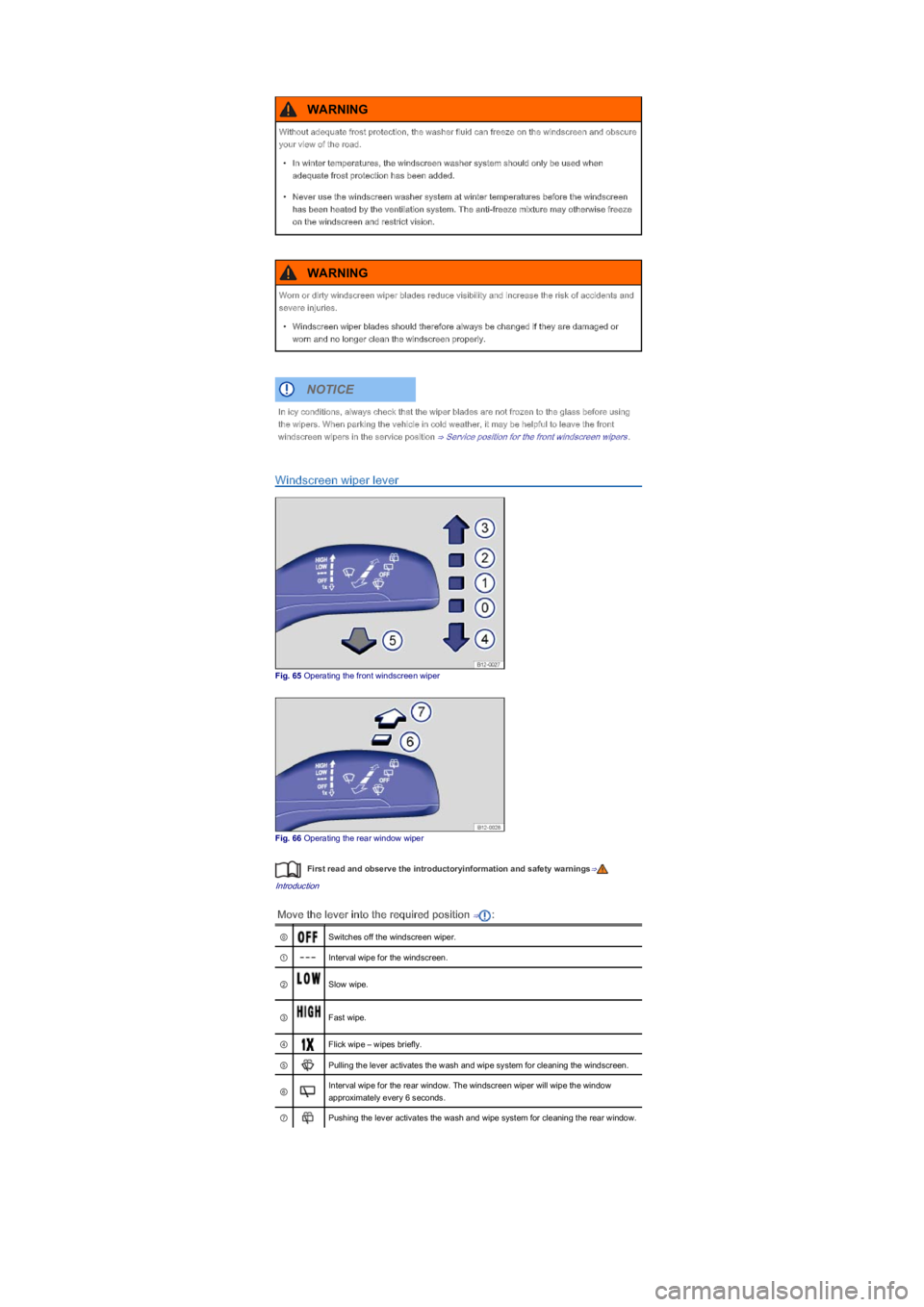
Fig. 65 Operating the front windscreen wiper
Fig. 66 Operating the rear window wiper
First read and observe the introductoryinformation and safety warnings⇒
Introduction
Move the lever into the required position ⇒:
⓪Switches off the windscreen wiper.
①Interval wipe for the windscreen.
②Slow wipe.
③Fast wipe.
④Flick wipe – wipes briefly.
⑤Pulling the lever activates the wash and wipe system for cleaning the windscreen.
⑥Interval wipe for the rear window. The windscreen wiper will wipe the window
approximately every 6 seconds.
⑦Pushing the lever activates the wash and wipe system for cleaning the rear window.
Without adequate frost protection, the washer fluid can freeze on the windscreen and obscure
your view of the road.
•In winter temperatures, the windscreen washer system should only be used when
adequate frost protection has been added.
•Never use the windscreen washer system at winter temperatures before the windscreen
has been heated by the ventilation system. The anti-freeze mixture may otherwise freeze
on the windscreen and restrict vision.
WARNING
Worn or dirty windscreen wiper blades reduce visibility and increase the risk of accidents and
severe injuries.
•Windscreen wiper blades should therefore always be changed if they are damaged or
worn and no longer clean the windscreen properly.
WARNING
In icy conditions, always check that the wiper blades are not frozen to the glass before using
the wipers. When parking the vehicle in cold weather, it may be helpful to leave the front
windscreen wipers in the service position ⇒ Service position for the front windscreen wipers.
NOTICE
Page 66 of 211
The windscreen wipers will only function when the ignition is switched on.
The interval wipe for the windscreen depends on the speed of the vehicle. The wipers will
wipe more frequently as the vehicle moves faster.
The rear window wiper is switched on automatically if the front windscreen wipers are
switched on and reverse gear is engaged.
Windscreen wiper functions
First read and observe the introductoryinformation and safety warnings⇒
Introduction
Windscreen wiper response in various situations:
When the vehicle is
stationary:
When switched on, the wipers will temporarily be switched to the next
setting down.
When the interval wipe is
switched on:
The wiper intervals are adjusted depending on the vehicle speed.
The faster the vehicle is travelling, the shorter the interval.
The wiper will try to wipe away any obstacles that are on the windscreen. The wiper will stop
moving if the obstacle blocks its path. Remove the obstacle and switch the wiper back on again.
Service position for the front windscreen wipers
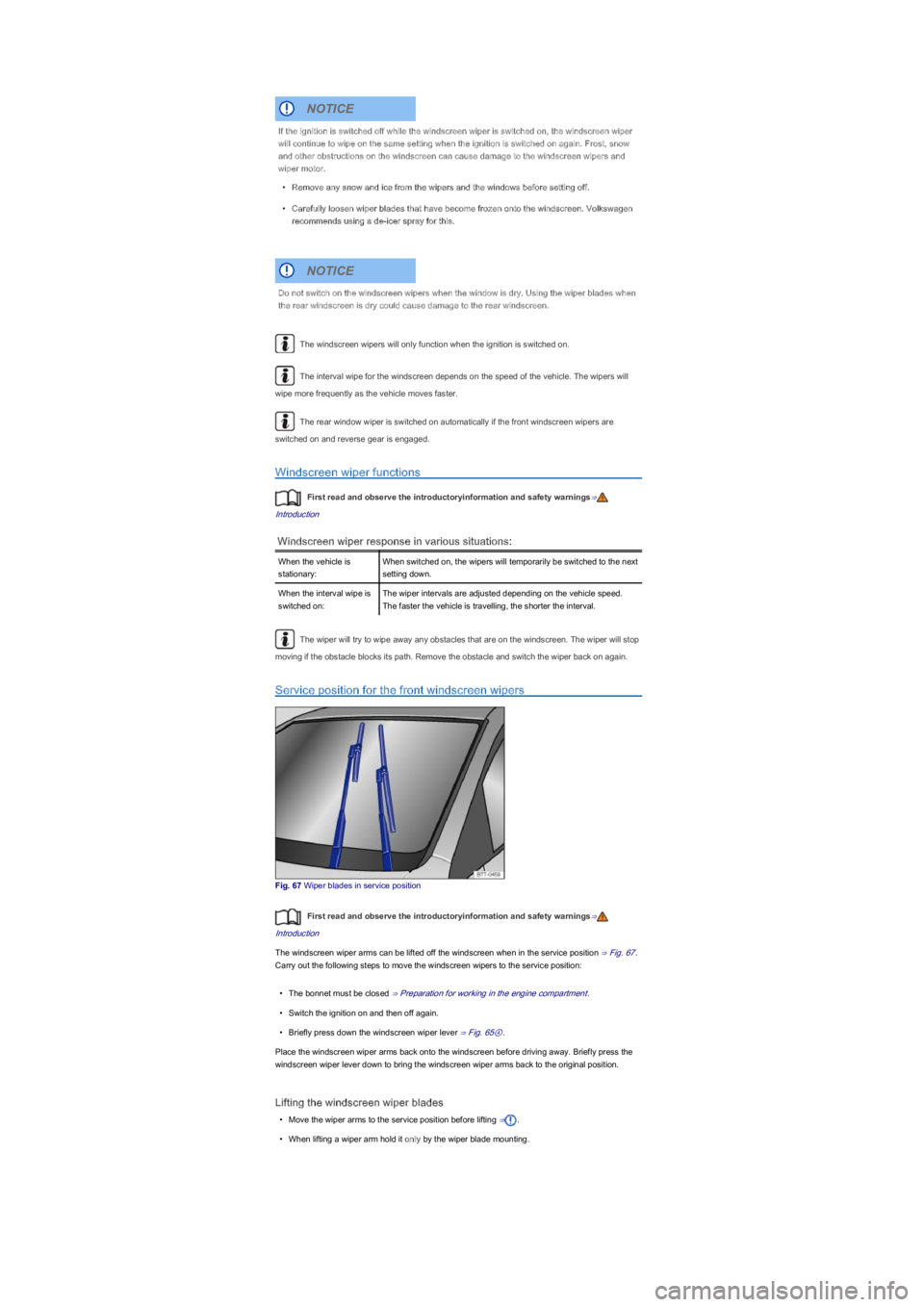
Fig. 67 Wiper blades in service position
First read and observe the introductoryinformation and safety warnings⇒
Introduction
The windscreen wiper arms can be lifted off the windscreen when in the service position ⇒ Fig. 67.
Carry out the following steps to move the windscreen wipers to the service position:
•The bonnet must be closed ⇒ Preparation for working in the engine compartment.
•Switch the ignition on and then off again.
•Briefly press down the windscreen wiper lever ⇒ Fig. 65④.
Place the windscreen wiper arms back onto the windscreen before driving away. Briefly press the
windscreen wiper lever down to bring the windscreen wiper arms back to the original position.
Lifting the windscreen wiper blades
•Move the wiper arms to the service position before lifting ⇒.
•When lifting a wiper arm hold it only by the wiper blade mounting.
If the ignition is switched off while the windscreen wiper is switched on, the windscreen wiper
will continue to wipe on the same setting when the ignition is switched on again. Frost, snow
and other obstructions on the windscreen can cause damage to the windscreen wipers and
wiper motor.
•Remove any snow and ice from the wipers and the windows before setting off.
•Carefully loosen wiper blades that have become frozen onto the windscreen. Volkswagen
recommends using a de-icer spray for this.
NOTICE
Do not switch on the windscreen wipers when the window is dry. Using the wiper blades when
the rear windscreen is dry could cause damage to the rear windscreen.
NOTICE
Page 67 of 211
Checking and refilling the windscreen washer fluid level
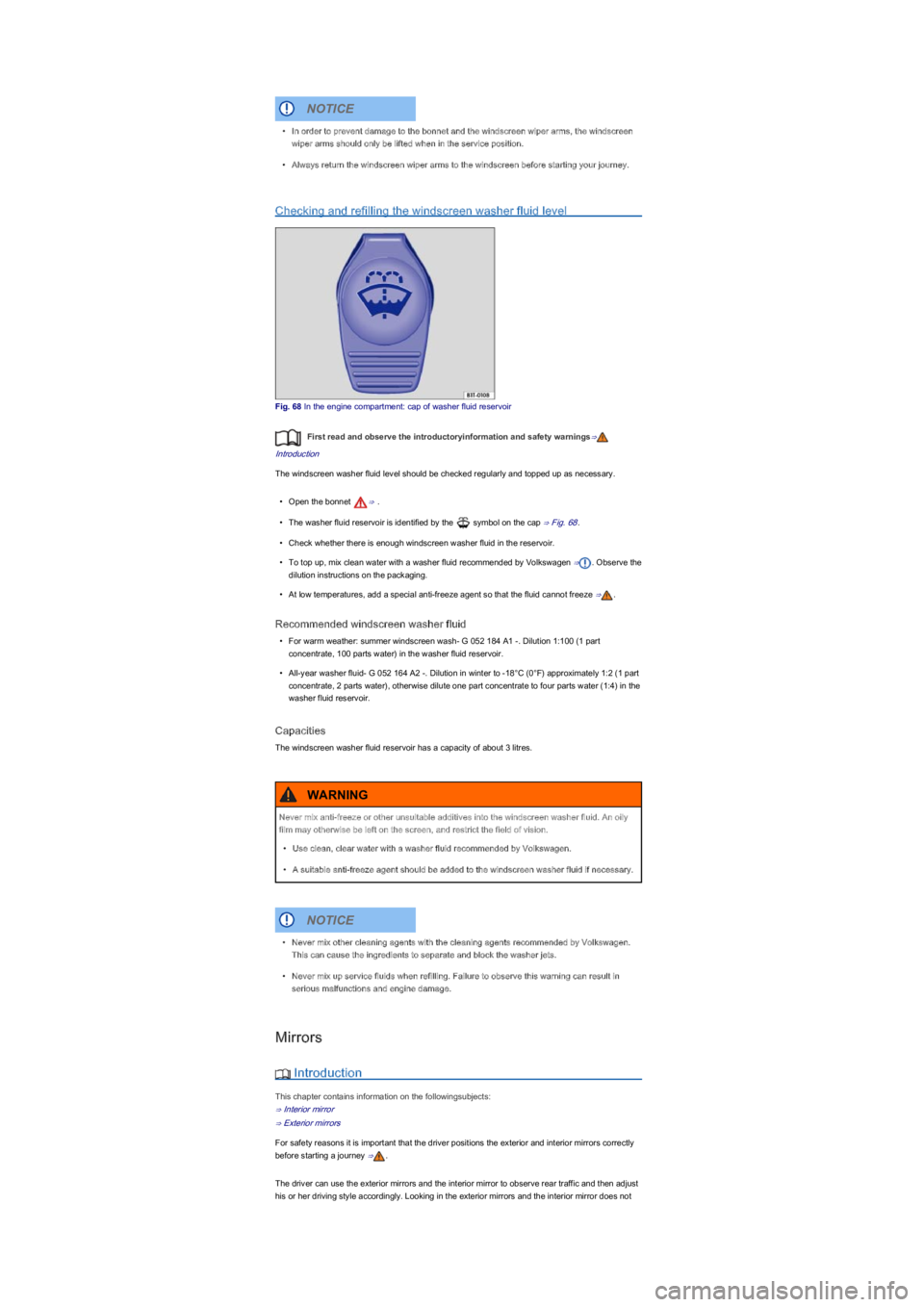
Fig. 68 In the engine compartment: cap of washer fluid reservoir
First read and observe the introductoryinformation and safety warnings⇒
Introduction
The windscreen washer fluid level should be checked regularly and topped up as necessary.
•Open the bonnet ⇒ .
•The washer fluid reservoir is identified by the symbol on the cap ⇒ Fig. 68.
•Check whether there is enough windscreen washer fluid in the reservoir.
•To top up, mix clean water with a washer fluid recommended by Volkswagen ⇒. Observe the
dilution instructions on the packaging.
•At low temperatures, add a special anti-freeze agent so that the fluid cannot freeze ⇒.
Recommended windscreen washer fluid
•For warm weather: summer windscreen wash- G 052 184 A1 -. Dilution 1:100 (1 part
concentrate, 100 parts water) in the washer fluid reservoir.
•All-year washer fluid- G 052 164 A2 -. Dilution in winter to -18°C (0°F) approximately 1:2 (1 part
concentrate, 2 parts water), otherwise dilute one part concentrate to four parts water (1:4) in the
washer fluid reservoir.
Capacities
The windscreen washer fluid reservoir has a capacity of about 3 litres.
Mirrors
Introduction
This chapter contains information on the followingsubjects:
⇒ Interior mirror
⇒ Exterior mirrors
For safety reasons it is important that the driver positions the exterior and interior mirrors correctly
before starting a journey ⇒.
The driver can use the exterior mirrors and the interior mirror to observe rear traffic and then adjust
his or her driving style accordingly. Looking in the exterior mirrors and the interior mirror does not
•In order to prevent damage to the bonnet and the windscreen wiper arms, the windscreen
wiper arms should only be lifted when in the service position.
•Always return the windscreen wiper arms to the windscreen before starting your journey.
NOTICE
Never mix anti-freeze or other unsuitable additives into the windscreen washer fluid. An oily
film may otherwise be left on the screen, and restrict the field of vision.
•Use clean, clear water with a washer fluid recommended by Volkswagen.
•A suitable anti-freeze agent should be added to the windscreen washer fluid if necessary.
WARNING
•Never mix other cleaning agents with the cleaning agents recommended by Volkswagen.
This can cause the ingredients to separate and block the washer jets.
•Never mix up service fluids when refilling. Failure to observe this warning can result in
serious malfunctions and engine damage.
NOTICE
Page 71 of 211
Driving a loaded vehicle
First read and observe the introductoryinformation and safety warnings⇒
Introduction
For good vehicle handling when driving a loaded vehicle, please observe the following:
•Stow all items of luggage securely ⇒ Stowing items of luggage.
•Accelerate carefully and gently.
•Avoid sudden braking and driving manoeuvres.
•Brake earlier than in normal driving.
•If applicable, heed the information about driving with a roof carrier ⇒ Roof carrier.
Vehicle-specific weight ratings
First read and observe the introductoryinformation and safety warnings⇒
Introduction
All data in the official vehicle documents take precedence over these data. All data in this manual
apply to the basic model. The vehicle data sticker in the service schedule and the official vehicle
documents show which engine is installed in your vehicle.
The values quoted here may differ if additional equipment is fitted, for different models or for special
vehicles.
The values for the kerb weight in the following table apply for the road-ready vehicle with driver
(75 kg), service fluids including fuel tank carrying 90% of its capacity and, if applicable, tools and
Driving with an unlocked or open tailgate can cause serious injuries.
•Always drive with the tailgate closed.
•Always stow all items in the luggage compartment securely. Loose objects can fall out of
the luggage compartment and injure other road users.
•Always drive carefully and ensure that you think ahead.
•Avoid any abrupt or sudden driving and braking manoeuvres as this can cause the open
tailgate to move unpredictably.
•Any objects protruding from the luggage compartment must be marked to ensure that they
are visible to other road users. Comply with legal regulations.
•Any objects protruding from the luggage compartment must never be held in position by
the tailgate.
•If it is necessary to drive with the tailgate open, all luggage racks and cargo stowed on the
rack must be removed from the tailgate.
WARNING
Poisonous exhaust fumes can enter the vehicle interior when the tailgate is open. This could
result in loss of consciousness, carbon monoxide poisoning, serious injury and accidents.
•Always drive with the tailgate closed in order to prevent toxic gases from entering the
vehicle.
•If exceptional circumstances require you to drive with an open tailgate, you must do the
following to reduce the quantity of toxic exhaust fumes that could enter the vehicle:
- Close the electric panorama sliding/tilting glass roof.
- Switch off air recirculation mode.
- Open all vents in the dash panel.
- Switch the blowers to the highest setting.
WARNING
The vehicle length and height are different when the tailgate is open.
NOTICE
Moving loads can severely impair the vehicle's stability and driving safety, which can cause
accidents and severe injuries.
•Secure objects properly to prevent them from sliding.
•Use suitable straps when securing heavy objects.
•Engage the rear seat backrests securely in an upright position.
WARNING