weight VOLKSWAGEN UP! 2021 Owner´s Manual
[x] Cancel search | Manufacturer: VOLKSWAGEN, Model Year: 2021, Model line: UP!, Model: VOLKSWAGEN UP! 2021Pages: 211, PDF Size: 5.98 MB
Page 56 of 211
LATCH/UCRA universal anchorage attachment points and top tether, including in North
America⇒ Securing child seats using lower anchoring points (ISOFIX, LATCH).
Three-point automatic seat belt and top tether⇒ Securing child seats with a seat belt.
The systems consist of attachments for child restraint systems with a top tether and lower
anchoring points in the seat.
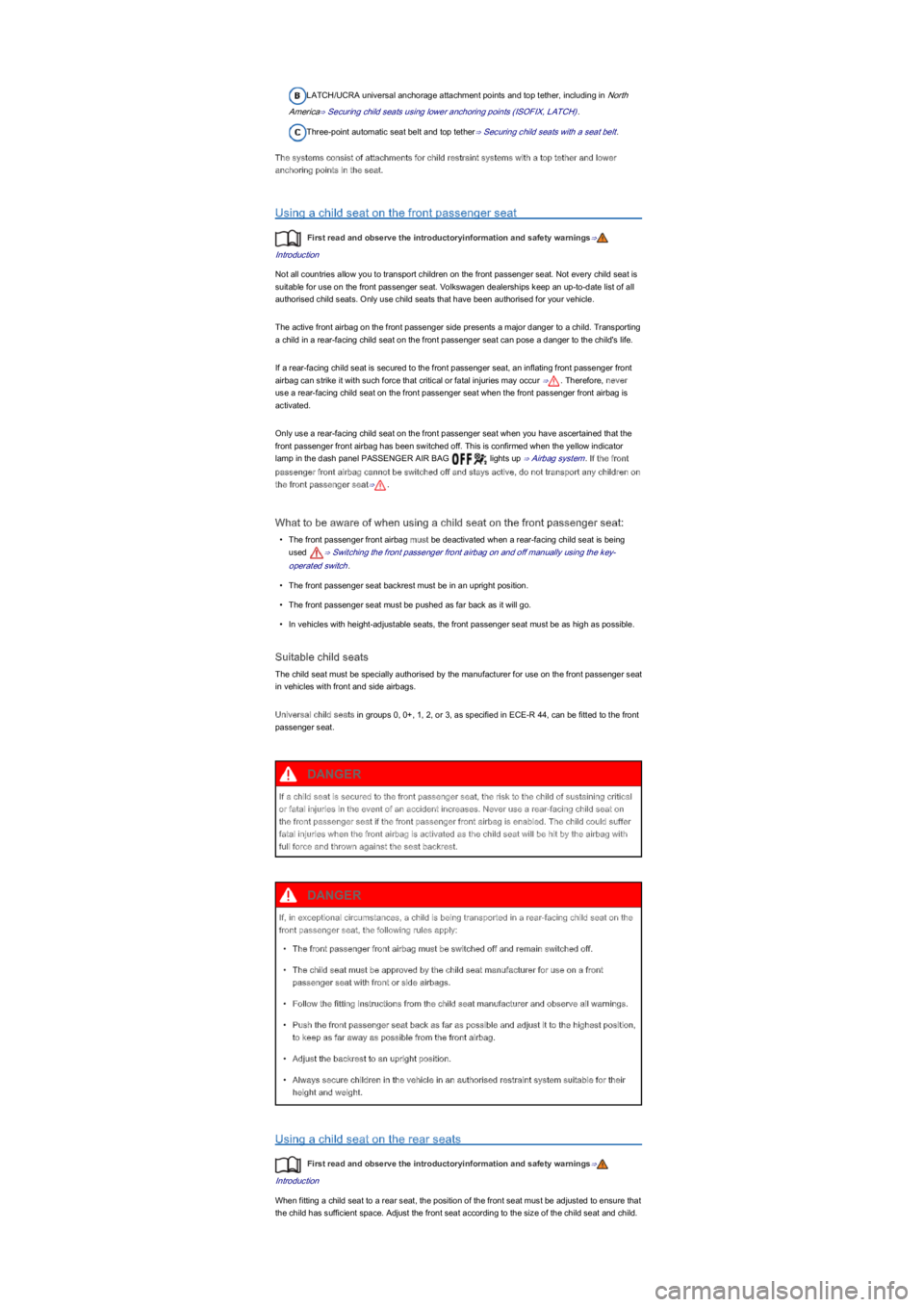
Using a child seat on the front passenger seat
First read and observe the introductoryinformation and safety warnings⇒
Introduction
Not all countries allow you to transport children on the front passenger seat. Not every child seat is
suitable for use on the front passenger seat. Volkswagen dealerships keep an up-to-date list of all
authorised child seats. Only use child seats that have been authorised for your vehicle.
The active front airbag on the front passenger side presents a major danger to a child. Transporting
a child in a rear-facing child seat on the front passenger seat can pose a danger to the child's life.
If a rear-facing child seat is secured to the front passenger seat, an inflating front passenger front
airbag can strike it with such force that critical or fatal injuries may occur ⇒. Therefore, never
use a rear-facing child seat on the front passenger seat when the front passenger front airbag is
activated.
Only use a rear-facing child seat on the front passenger seat when you have ascertained that the
front passenger front airbag has been switched off. This is confirmed when the yellow indicator
lamp in the dash panel PASSENGER AIR BAG lights up ⇒ Airbag system. If the front
passenger front airbag cannot be switched off and stays active, do not transport any children on
the front passenger seat⇒.
What to be aware of when using a child seat on the front passenger seat:
•The front passenger front airbag must be deactivated when a rear-facing child seat is being
used ⇒ Switching the front passenger front airbag on and off manually using the key-
operated switch.
•The front passenger seat backrest must be in an upright position.
•The front passenger seat must be pushed as far back as it will go.
•In vehicles with height-adjustable seats, the front passenger seat must be as high as possible.
Suitable child seats
The child seat must be specially authorised by the manufacturer for use on the front passenger seat
in vehicles with front and side airbags.
Universal child seats in groups 0, 0+, 1, 2, or 3, as specified in ECE-R 44, can be fitted to the front
passenger seat.
Using a child seat on the rear seats
First read and observe the introductoryinformation and safety warnings⇒
Introduction
When fitting a child seat to a rear seat, the position of the front seat must be adjusted to ensure that
the child has sufficient space. Adjust the front seat according to the size of the child seat and child.
If a child seat is secured to the front passenger seat, the risk to the child of sustaining critical
or fatal injuries in the event of an accident increases. Never use a rear-facing child seat on
the front passenger seat if the front passenger front airbag is enabled. The child could suffer
fatal injuries when the front airbag is activated as the child seat will be hit by the airbag with
full force and thrown against the seat backrest.
DANGER
If, in exceptional circumstances, a child is being transported in a rear-facing child seat on the
front passenger seat, the following rules apply:
•The front passenger front airbag must be switched off and remain switched off.
•The child seat must be approved by the child seat manufacturer for use on a front
passenger seat with front or side airbags.
•Follow the fitting instructions from the child seat manufacturer and observe all warnings.
•Push the front passenger seat back as far as possible and adjust it to the highest position,
to keep as far away as possible from the front airbag.
•Adjust the backrest to an upright position.
•Always secure children in the vehicle in an authorised restraint system suitable for their
height and weight.
DANGER
Page 57 of 211
Ensure that the front passenger can still maintain a correct sitting position ⇒ Adjusting the seat
position.
Suitable child seats
The child seat must have been approved by the manufacturer for use on the rear bench seat with
side airbag.
Universal child seats in groups 0, 0+, 1, 2, or 3 as specified in ECE-R 44 can be fitted to the rear
seats.
The seats are suitable for child seats with the ISOFIX system that are specially approved for this
vehicle type by ECE-R 44.
ISOFIX child seats approved for use on rear seats
There are different categories of ISOFIX child seats: universal, semi-universal and vehicle-specific.
•If the ISOFIX child seat has universal approval, the child seat must be fastened with the lower
anchoring points and the top tether.
•If ISOFIX child seats have semi-universal or vehicle-specific approval, a check must be made
prior to use in order to find out whether the child seat has been approved for the vehicle. For
this purpose, the child-seat manufacturer supplies the ISOFIX child seat with a list of vehicles
for which the respective ISOFIX child seat has been approved. If necessary, contact the child
seat manufacturer for an up-to-date list of vehicles.
Securing child seats with a seat belt
First read and observe the introductoryinformation and safety warnings⇒
Introduction
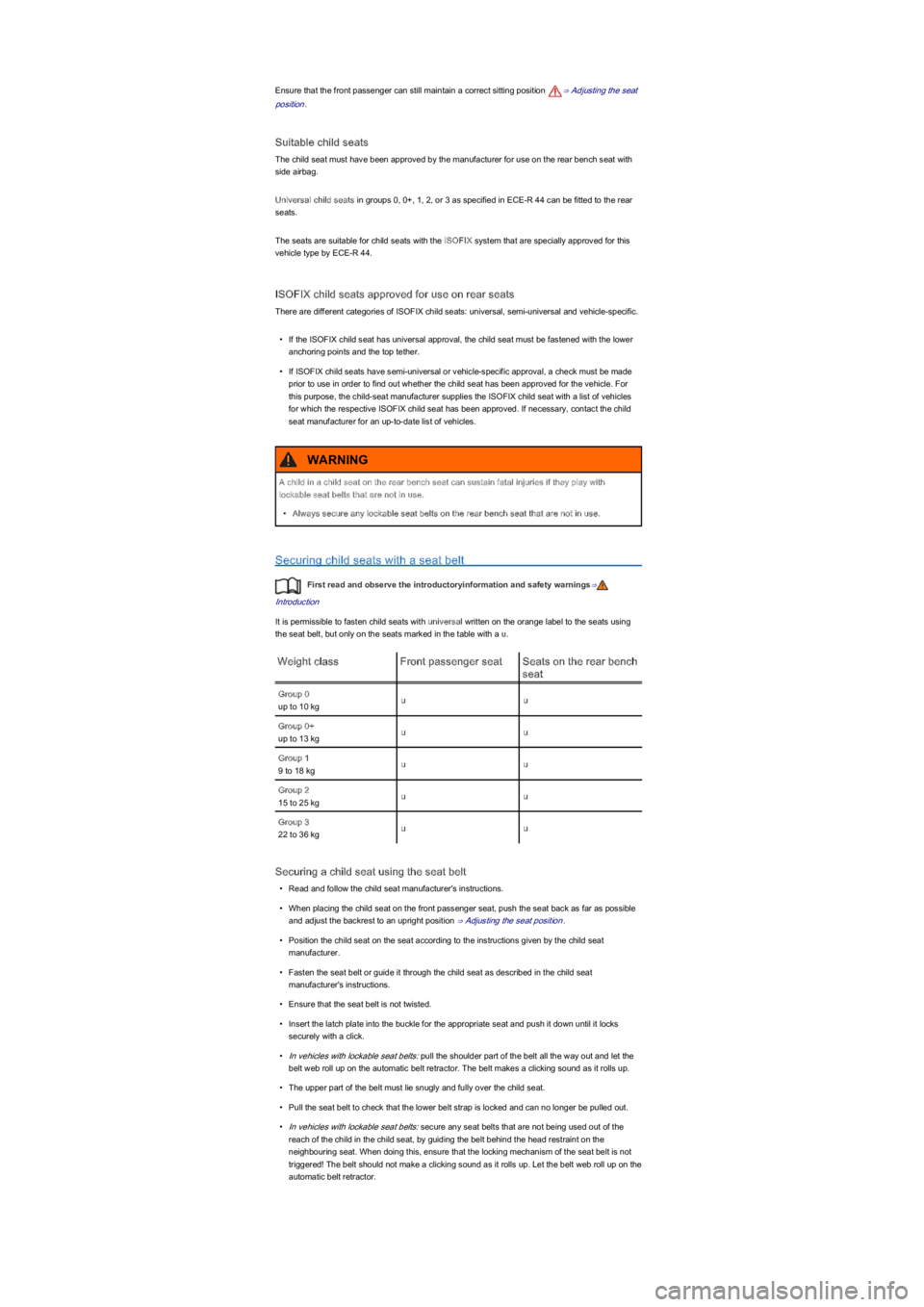
It is permissible to fasten child seats with universal written on the orange label to the seats using
the seat belt, but only on the seats marked in the table with a u.
Weight classFront passenger seatSeats on the rear bench
seat
Group 0
up to 10 kguu
Group 0+
up to 13 kguu
Group 1
9 to 18 kguu
Group 2
15 to 25 kguu
Group 3
22 to 36 kguu
Securing a child seat using the seat belt
•Read and follow the child seat manufacturer's instructions.
•When placing the child seat on the front passenger seat, push the seat back as far as possible
and adjust the backrest to an upright position ⇒ Adjusting the seat position.
•Position the child seat on the seat according to the instructions given by the child seat
manufacturer.
•Fasten the seat belt or guide it through the child seat as described in the child seat
manufacturer's instructions.
•Ensure that the seat belt is not twisted.
•Insert the latch plate into the buckle for the appropriate seat and push it down until it locks
securely with a click.
•In vehicles with lockable seat belts: pull the shoulder part of the belt all the way out and let the
belt web roll up on the automatic belt retractor. The belt makes a clicking sound as it rolls up.
•The upper part of the belt must lie snugly and fully over the child seat.
•Pull the seat belt to check that the lower belt strap is locked and can no longer be pulled out.
•In vehicles with lockable seat belts: secure any seat belts that are not being used out of the
reach of the child in the child seat, by guiding the belt behind the head restraint on the
neighbouring seat. When doing this, ensure that the locking mechanism of the seat belt is not
triggered! The belt should not make a clicking sound as it rolls up. Let the belt web roll up on the
automatic belt retractor.
A child in a child seat on the rear bench seat can sustain fatal injuries if they play with
lockable seat belts that are not in use.
•Always secure any lockable seat belts on the rear bench seat that are not in use.
WARNING
Page 58 of 211
Removing child seats
Unfasten seat belts only when the vehicle is stationary ⇒.
•Press the red button in the buckle. The latch plate is released and springs out.
•Guide the belt back by hand so that it rolls up easily, without twisting the seat belt and without
damaging the trim.
•Remove the child seat from the vehicle.
Securing child seats using lower anchoring points (ISOFIX, LATCH)
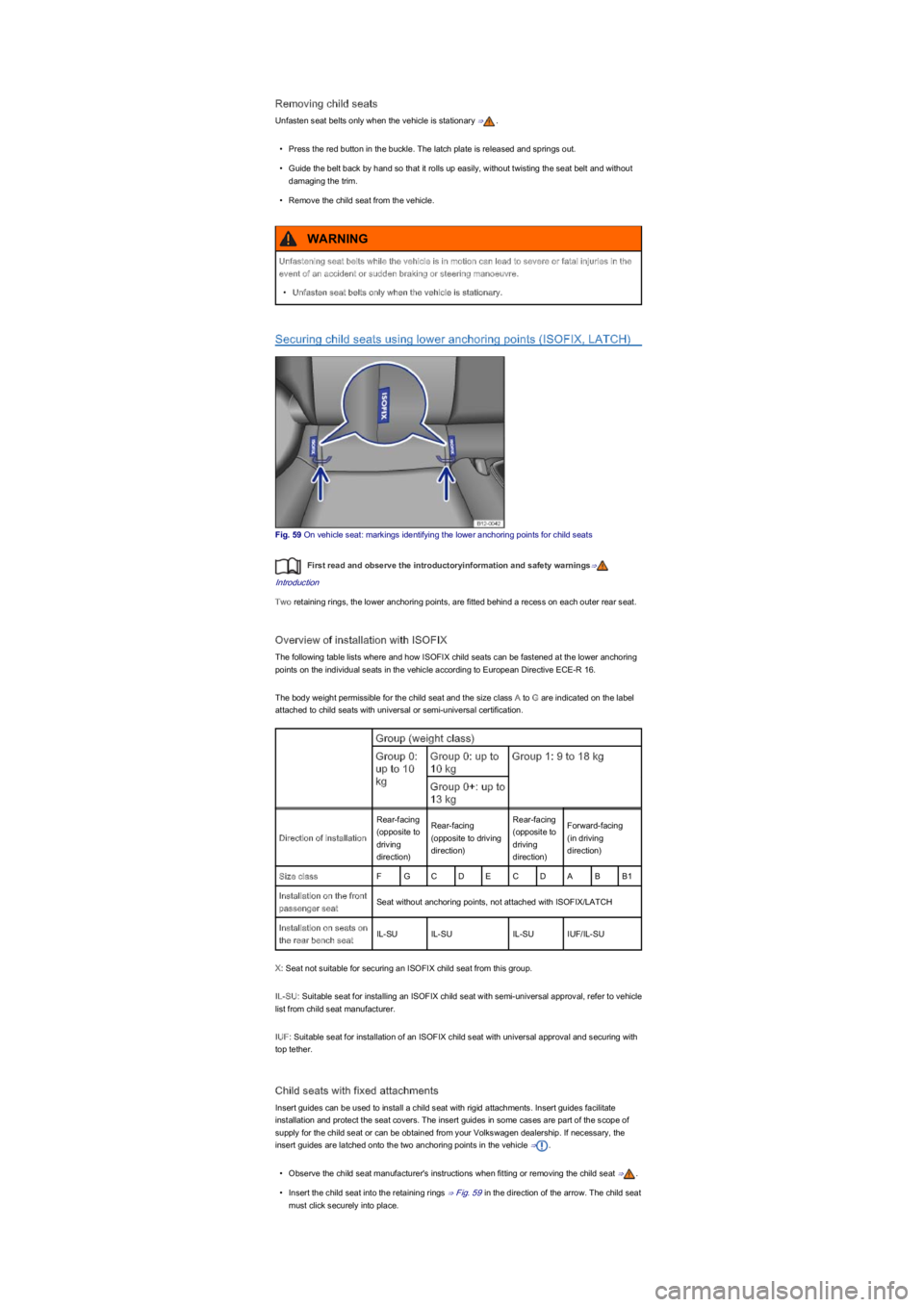
Fig. 59 On vehicle seat: markings identifying the lower anchoring points for child seats
First read and observe the introductoryinformation and safety warnings⇒
Introduction
Two retaining rings, the lower anchoring points, are fitted behind a recess on each outer rear seat.
Overview of installation with ISOFIX
The following table lists where and how ISOFIX child seats can be fastened at the lower anchoring
points on the individual seats in the vehicle according to European Directive ECE-R 16.
The body weight permissible for the child seat and the size class A to G are indicated on the label
attached to child seats with universal or semi-universal certification.
Group (weight class)
Group 0:
up to 10
kg
Group 0: up to
10 kg
Group 1: 9 to 18 kg
Group 0+: up to
13 kg
Direction of installation
Rear-facing
(opposite to
driving
direction)
Rear-facing
(opposite to driving
direction)
Rear-facing
(opposite to
driving
direction)
Forward-facing
(in driving
direction)
Size classFGCDECDABB1
Installation on the front
passenger seatSeat without anchoring points, not attached with ISOFIX/LATCH
Installation on seats on
the rear bench seatIL-SUIL-SUIL-SUIUF/IL-SU
X: Seat not suitable for securing an ISOFIX child seat from this group.
IL-SU: Suitable seat for installing an ISOFIX child seat with semi-universal approval, refer to vehicle
list from child seat manufacturer.
IUF: Suitable seat for installation of an ISOFIX child seat with universal approval and securing with
top tether.
Child seats with fixed attachments
Insert guides can be used to install a child seat with rigid attachments. Insert guides facilitate
installation and protect the seat covers. The insert guides in some cases are part of the scope of
supply for the child seat or can be obtained from your Volkswagen dealership. If necessary, the
insert guides are latched onto the two anchoring points in the vehicle ⇒.
•Observe the child seat manufacturer's instructions when fitting or removing the child seat ⇒.
•Insert the child seat into the retaining rings ⇒ Fig. 59 in the direction of the arrow. The child seat
must click securely into place.
Unfastening seat belts while the vehicle is in motion can lead to severe or fatal injuries in the
event of an accident or sudden braking or steering manoeuvre.
•Unfasten seat belts only when the vehicle is stationary.
WARNING
Page 69 of 211
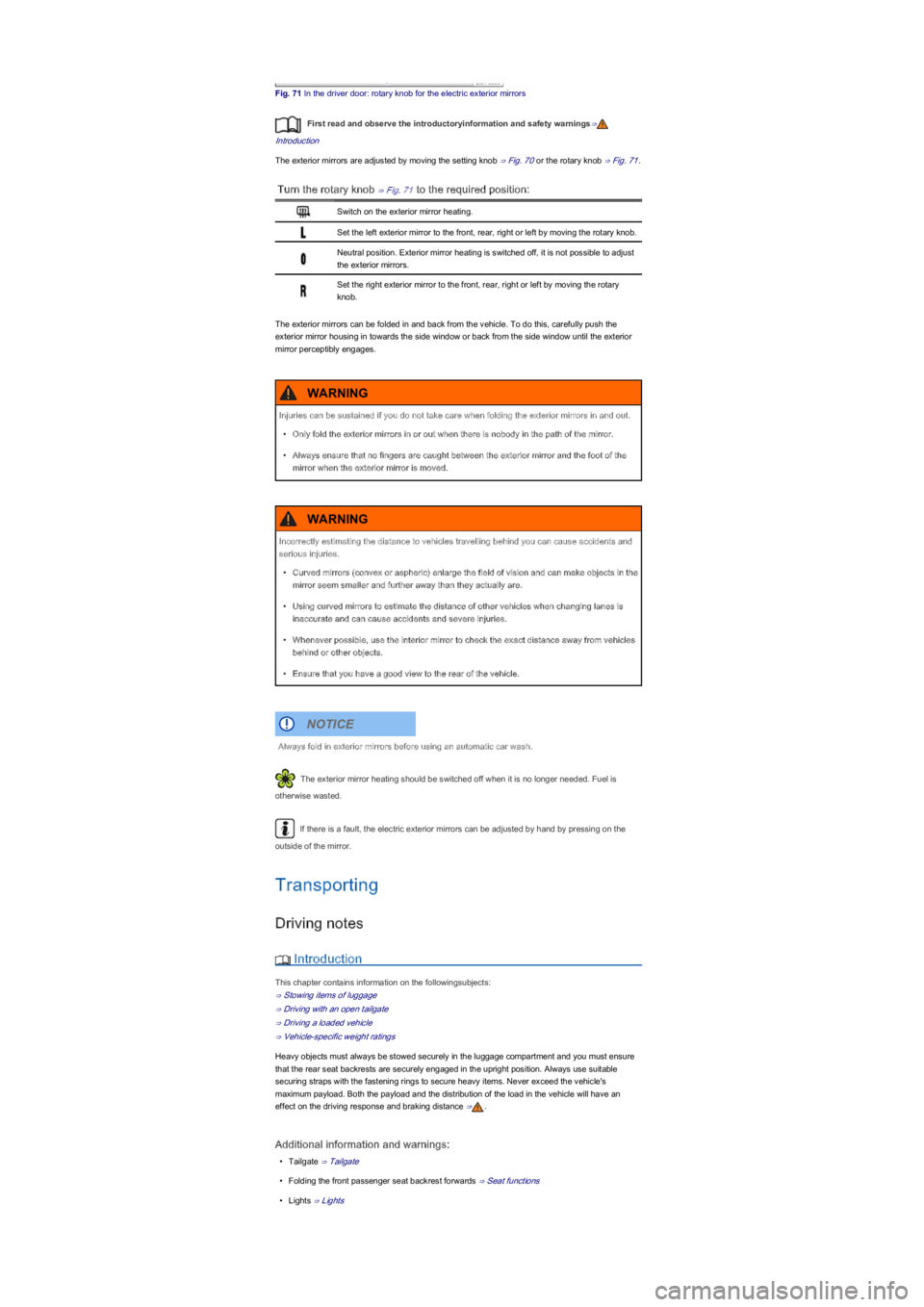
Fig. 71 In the driver door: rotary knob for the electric exterior mirrors
First read and observe the introductoryinformation and safety warnings⇒
Introduction
The exterior mirrors are adjusted by moving the setting knob ⇒ Fig. 70 or the rotary knob ⇒ Fig. 71.
Turn the rotary knob ⇒ Fig. 71 to the required position:
Switch on the exterior mirror heating.
Set the left exterior mirror to the front, rear, right or left by moving the rotary knob.
Neutral position. Exterior mirror heating is switched off, it is not possible to adjust
the exterior mirrors.
Set the right exterior mirror to the front, rear, right or left by moving the rotary
knob.
The exterior mirrors can be folded in and back from the vehicle. To do this, carefully push the
exterior mirror housing in towards the side window or back from the side window until the exterior
mirror perceptibly engages.
The exterior mirror heating should be switched off when it is no longer needed. Fuel is
otherwise wasted.
If there is a fault, the electric exterior mirrors can be adjusted by hand by pressing on the
outside of the mirror.
Transporting
Driving notes
Introduction
This chapter contains information on the followingsubjects:
⇒ Stowing items of luggage
⇒ Driving with an open tailgate
⇒ Driving a loaded vehicle
⇒ Vehicle-specific weight ratings
Heavy objects must always be stowed securely in the luggage compartment and you must ensure
that the rear seat backrests are securely engaged in the upright position. Always use suitable
securing straps with the fastening rings to secure heavy items. Never exceed the vehicle's
maximum payload. Both the payload and the distribution of the load in the vehicle will have an
effect on the driving response and braking distance ⇒.
Additional information and warnings:
•Tailgate ⇒ Tailgate
•Folding the front passenger seat backrest forwards ⇒ Seat functions
•Lights ⇒ Lights
Injuries can be sustained if you do not take care when folding the exterior mirrors in and out.
•Only fold the exterior mirrors in or out when there is nobody in the path of the mirror.
•Always ensure that no fingers are caught between the exterior mirror and the foot of the
mirror when the exterior mirror is moved.
WARNING
Incorrectly estimating the distance to vehicles travelling behind you can cause accidents and
serious injuries.
•Curved mirrors (convex or aspheric) enlarge the field of vision and can make objects in the
mirror seem smaller and further away than they actually are.
•Using curved mirrors to estimate the distance of other vehicles when changing lanes is
inaccurate and can cause accidents and severe injuries.
•Whenever possible, use the interior mirror to check the exact distance away from vehicles
behind or other objects.
•Ensure that you have a good view to the rear of the vehicle.
WARNING
Always fold in exterior mirrors before using an automatic car wash.
NOTICE
Page 70 of 211
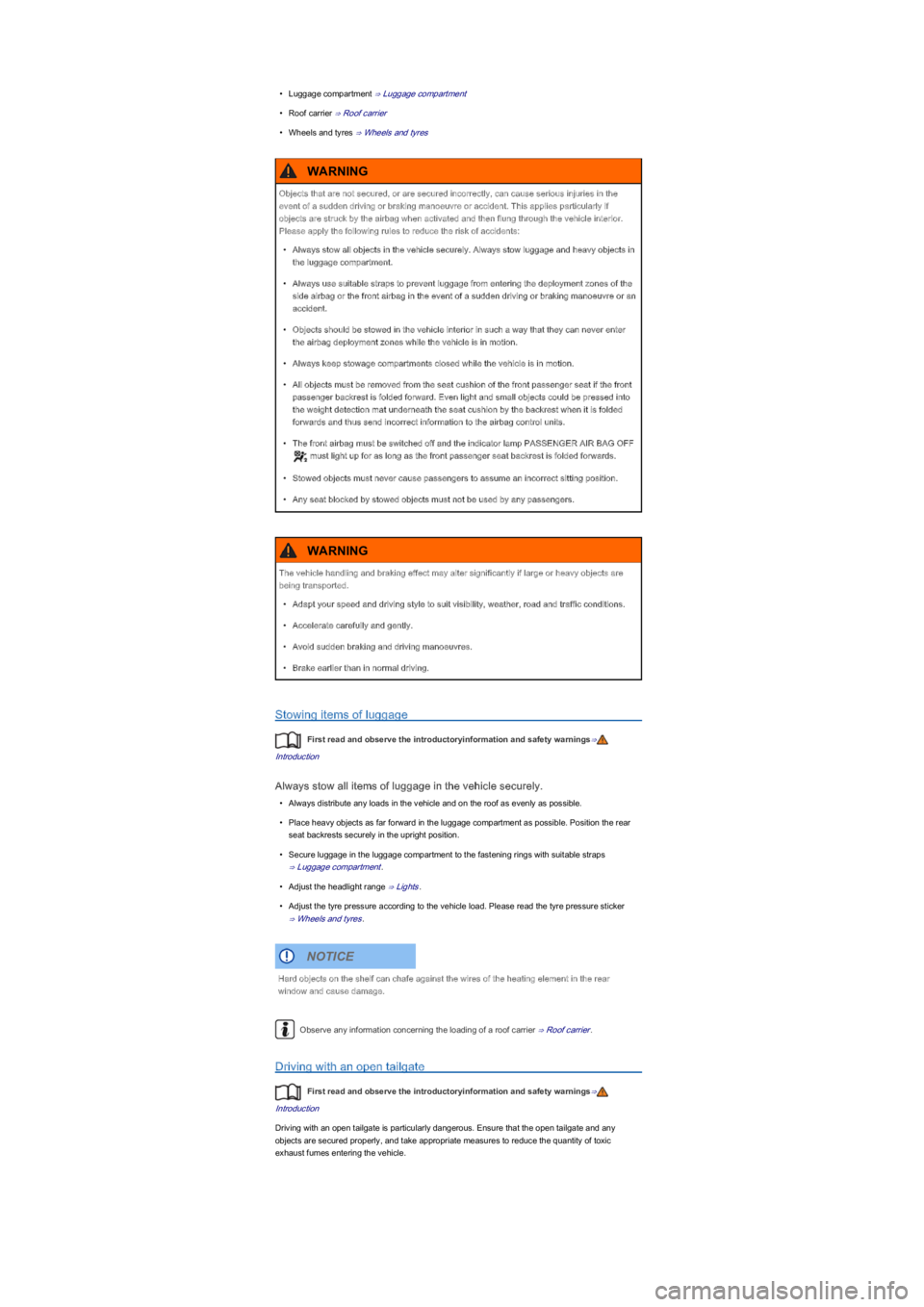
•Luggage compartment ⇒ Luggage compartment
•Roof carrier ⇒ Roof carrier
•Wheels and tyres ⇒ Wheels and tyres
Stowing items of luggage
First read and observe the introductoryinformation and safety warnings⇒
Introduction
Always stow all items of luggage in the vehicle securely.
•Always distribute any loads in the vehicle and on the roof as evenly as possible.
•Place heavy objects as far forward in the luggage compartment as possible. Position the rear
seat backrests securely in the upright position.
•Secure luggage in the luggage compartment to the fastening rings with suitable straps
⇒ Luggage compartment.
•Adjust the headlight range ⇒ Lights.
•Adjust the tyre pressure according to the vehicle load. Please read the tyre pressure sticker
⇒ Wheels and tyres.
Observe any information concerning the loading of a roof carrier ⇒ Roof carrier.
Driving with an open tailgate
First read and observe the introductoryinformation and safety warnings⇒
Introduction
Driving with an open tailgate is particularly dangerous. Ensure that the open tailgate and any
objects are secured properly, and take appropriate measures to reduce the quantity of toxic
exhaust fumes entering the vehicle.
Objects that are not secured, or are secured incorrectly, can cause serious injuries in the
event of a sudden driving or braking manoeuvre or accident. This applies particularly if
objects are struck by the airbag when activated and then flung through the vehicle interior.
Please apply the following rules to reduce the risk of accidents:
•Always stow all objects in the vehicle securely. Always stow luggage and heavy objects in
the luggage compartment.
•Always use suitable straps to prevent luggage from entering the deployment zones of the
side airbag or the front airbag in the event of a sudden driving or braking manoeuvre or an
accident.
•Objects should be stowed in the vehicle interior in such a way that they can never enter
the airbag deployment zones while the vehicle is in motion.
•Always keep stowage compartments closed while the vehicle is in motion.
•All objects must be removed from the seat cushion of the front passenger seat if the front
passenger backrest is folded forward. Even light and small objects could be pressed into
the weight detection mat underneath the seat cushion by the backrest when it is folded
forwards and thus send incorrect information to the airbag control units.
•The front airbag must be switched off and the indicator lamp PASSENGER AIR BAG OFF
must light up for as long as the front passenger seat backrest is folded forwards.
•Stowed objects must never cause passengers to assume an incorrect sitting position.
•Any seat blocked by stowed objects must not be used by any passengers.
WARNING
The vehicle handling and braking effect may alter significantly if large or heavy objects are
being transported.
•Adapt your speed and driving style to suit visibility, weather, road and traffic conditions.
•Accelerate carefully and gently.
•Avoid sudden braking and driving manoeuvres.
•Brake earlier than in normal driving.
WARNING
Hard objects on the shelf can chafe against the wires of the heating element in the rear
window and cause damage.
NOTICE
Page 71 of 211
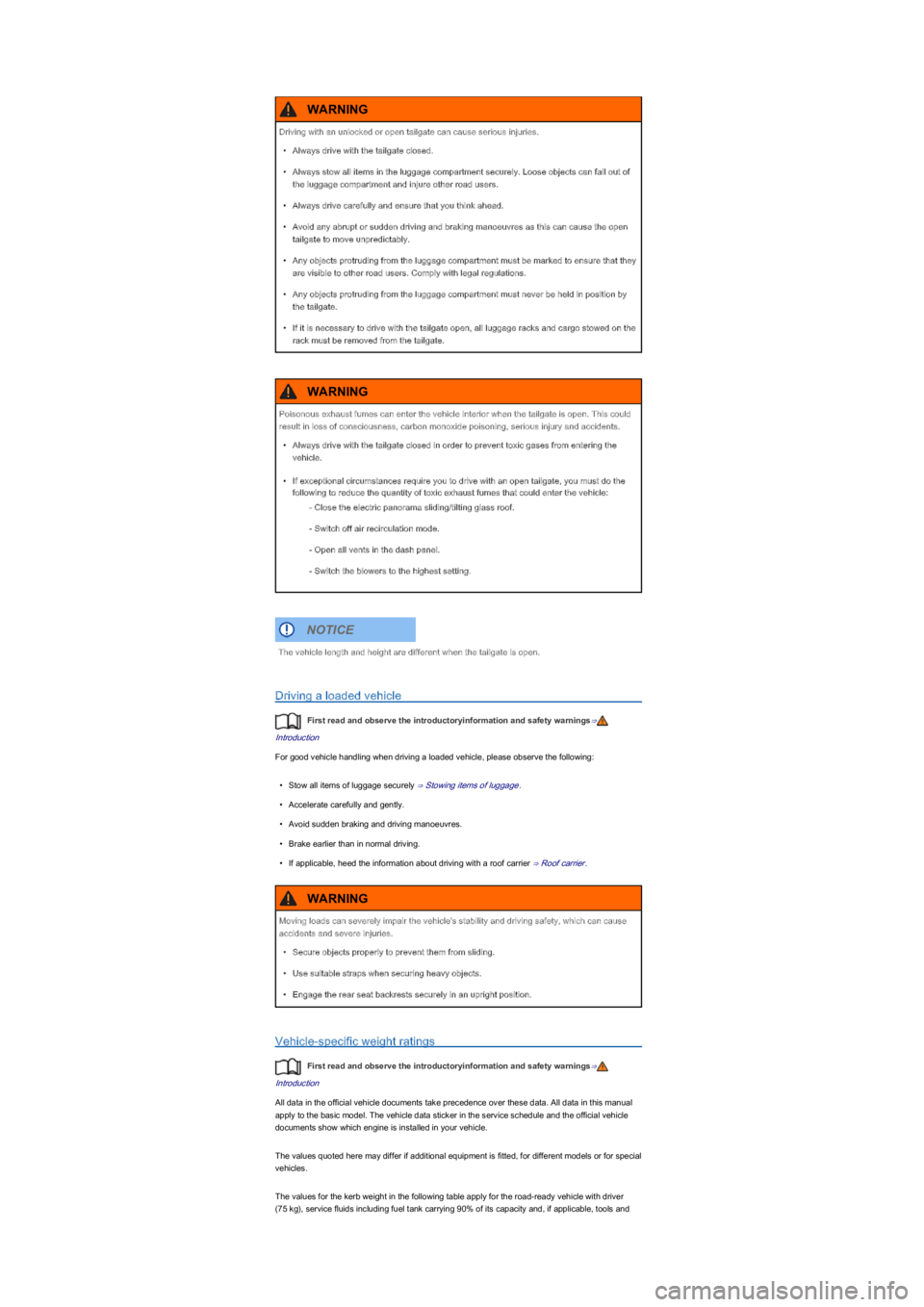
Driving a loaded vehicle
First read and observe the introductoryinformation and safety warnings⇒
Introduction
For good vehicle handling when driving a loaded vehicle, please observe the following:
•Stow all items of luggage securely ⇒ Stowing items of luggage.
•Accelerate carefully and gently.
•Avoid sudden braking and driving manoeuvres.
•Brake earlier than in normal driving.
•If applicable, heed the information about driving with a roof carrier ⇒ Roof carrier.
Vehicle-specific weight ratings
First read and observe the introductoryinformation and safety warnings⇒
Introduction
All data in the official vehicle documents take precedence over these data. All data in this manual
apply to the basic model. The vehicle data sticker in the service schedule and the official vehicle
documents show which engine is installed in your vehicle.
The values quoted here may differ if additional equipment is fitted, for different models or for special
vehicles.
The values for the kerb weight in the following table apply for the road-ready vehicle with driver
(75 kg), service fluids including fuel tank carrying 90% of its capacity and, if applicable, tools and
Driving with an unlocked or open tailgate can cause serious injuries.
•Always drive with the tailgate closed.
•Always stow all items in the luggage compartment securely. Loose objects can fall out of
the luggage compartment and injure other road users.
•Always drive carefully and ensure that you think ahead.
•Avoid any abrupt or sudden driving and braking manoeuvres as this can cause the open
tailgate to move unpredictably.
•Any objects protruding from the luggage compartment must be marked to ensure that they
are visible to other road users. Comply with legal regulations.
•Any objects protruding from the luggage compartment must never be held in position by
the tailgate.
•If it is necessary to drive with the tailgate open, all luggage racks and cargo stowed on the
rack must be removed from the tailgate.
WARNING
Poisonous exhaust fumes can enter the vehicle interior when the tailgate is open. This could
result in loss of consciousness, carbon monoxide poisoning, serious injury and accidents.
•Always drive with the tailgate closed in order to prevent toxic gases from entering the
vehicle.
•If exceptional circumstances require you to drive with an open tailgate, you must do the
following to reduce the quantity of toxic exhaust fumes that could enter the vehicle:
- Close the electric panorama sliding/tilting glass roof.
- Switch off air recirculation mode.
- Open all vents in the dash panel.
- Switch the blowers to the highest setting.
WARNING
The vehicle length and height are different when the tailgate is open.
NOTICE
Moving loads can severely impair the vehicle's stability and driving safety, which can cause
accidents and severe injuries.
•Secure objects properly to prevent them from sliding.
•Use suitable straps when securing heavy objects.
•Engage the rear seat backrests securely in an upright position.
WARNING
Page 72 of 211
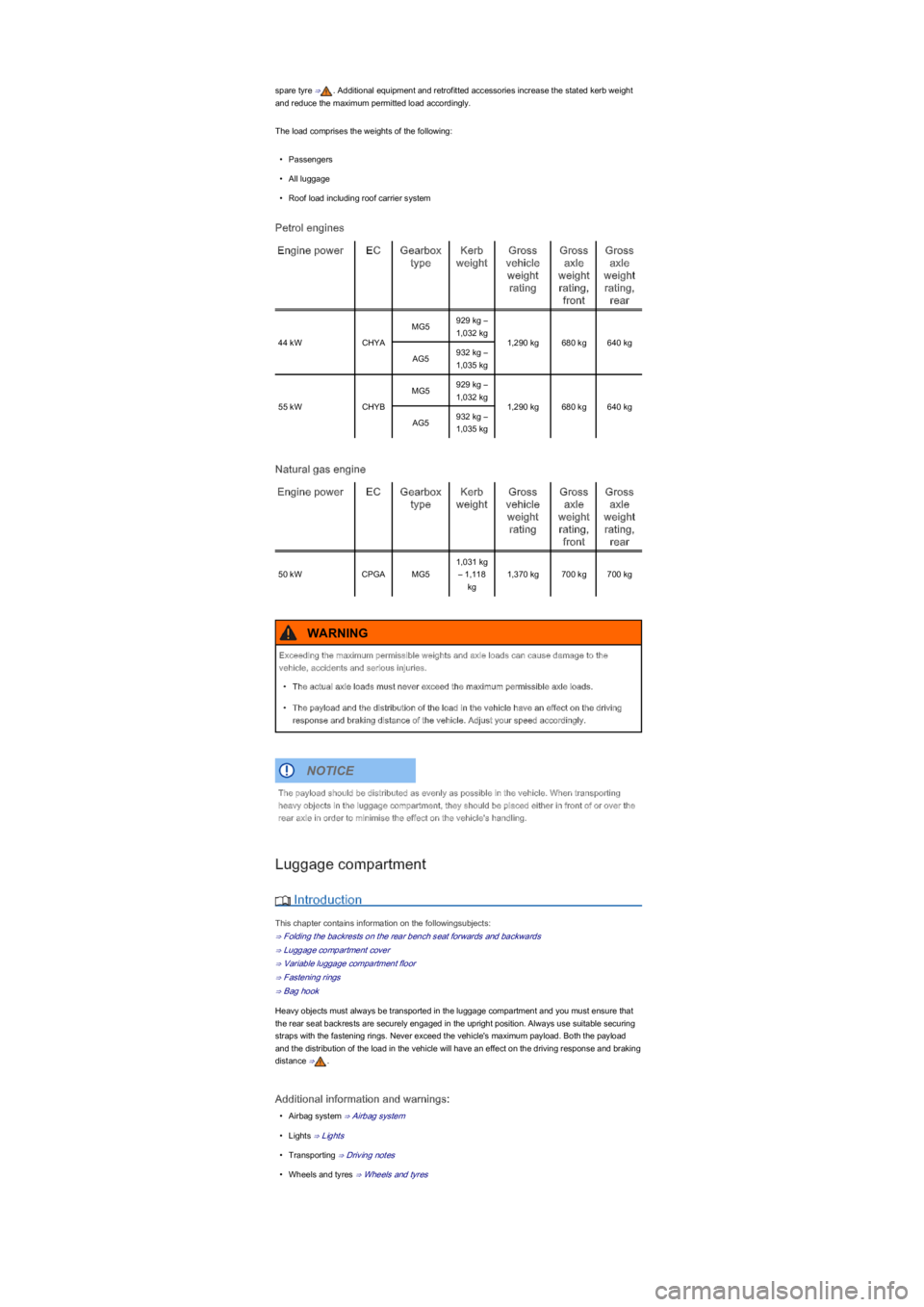
spare tyre ⇒. Additional equipment and retrofitted accessories increase the stated kerb weight
and reduce the maximum permitted load accordingly.
The load comprises the weights of the following:
•Passengers
•All luggage
•Roof load including roof carrier system
Petrol engines
Engine powerECGearbox
type
Kerb
weight
Gross
vehicle
weight
rating
Gross
axle
weight
rating,
front
Gross
axle
weight
rating,
rear
44 kWCHYA
MG5929 kg –
1,032 kg
1,290 kg680 kg640 kg
AG5932 kg –
1,035 kg
55 kWCHYB
MG5929 kg –
1,032 kg
1,290 kg680 kg640 kg
AG5932 kg –
1,035 kg
Natural gas engine
Engine powerECGearbox
type
Kerb
weight
Gross
vehicle
weight
rating
Gross
axle
weight
rating,
front
Gross
axle
weight
rating,
rear
50 kWCPGAMG5
1,031 kg
– 1,118
kg
1,370 kg700 kg700 kg
Luggage compartment
Introduction
This chapter contains information on the followingsubjects:
⇒ Folding the backrests on the rear bench seat forwards and backwards
⇒ Luggage compartment cover
⇒ Variable luggage compartment floor
⇒ Fastening rings
⇒ Bag hook
Heavy objects must always be transported in the luggage compartment and you must ensure that
the rear seat backrests are securely engaged in the upright position. Always use suitable securing
straps with the fastening rings. Never exceed the vehicle's maximum payload. Both the payload
and the distribution of the load in the vehicle will have an effect on the driving response and braking
distance ⇒.
Additional information and warnings:
•Airbag system ⇒ Airbag system
•Lights ⇒ Lights
•Transporting ⇒ Driving notes
•Wheels and tyres ⇒ Wheels and tyres
Exceeding the maximum permissible weights and axle loads can cause damage to the
vehicle, accidents and serious injuries.
•The actual axle loads must never exceed the maximum permissible axle loads.
•The payload and the distribution of the load in the vehicle have an effect on the driving
response and braking distance of the vehicle. Adjust your speed accordingly.
WARNING
The payload should be distributed as evenly as possible in the vehicle. When transporting
heavy objects in the luggage compartment, they should be placed either in front of or over the
rear axle in order to minimise the effect on the vehicle's handling.
NOTICE
Page 78 of 211
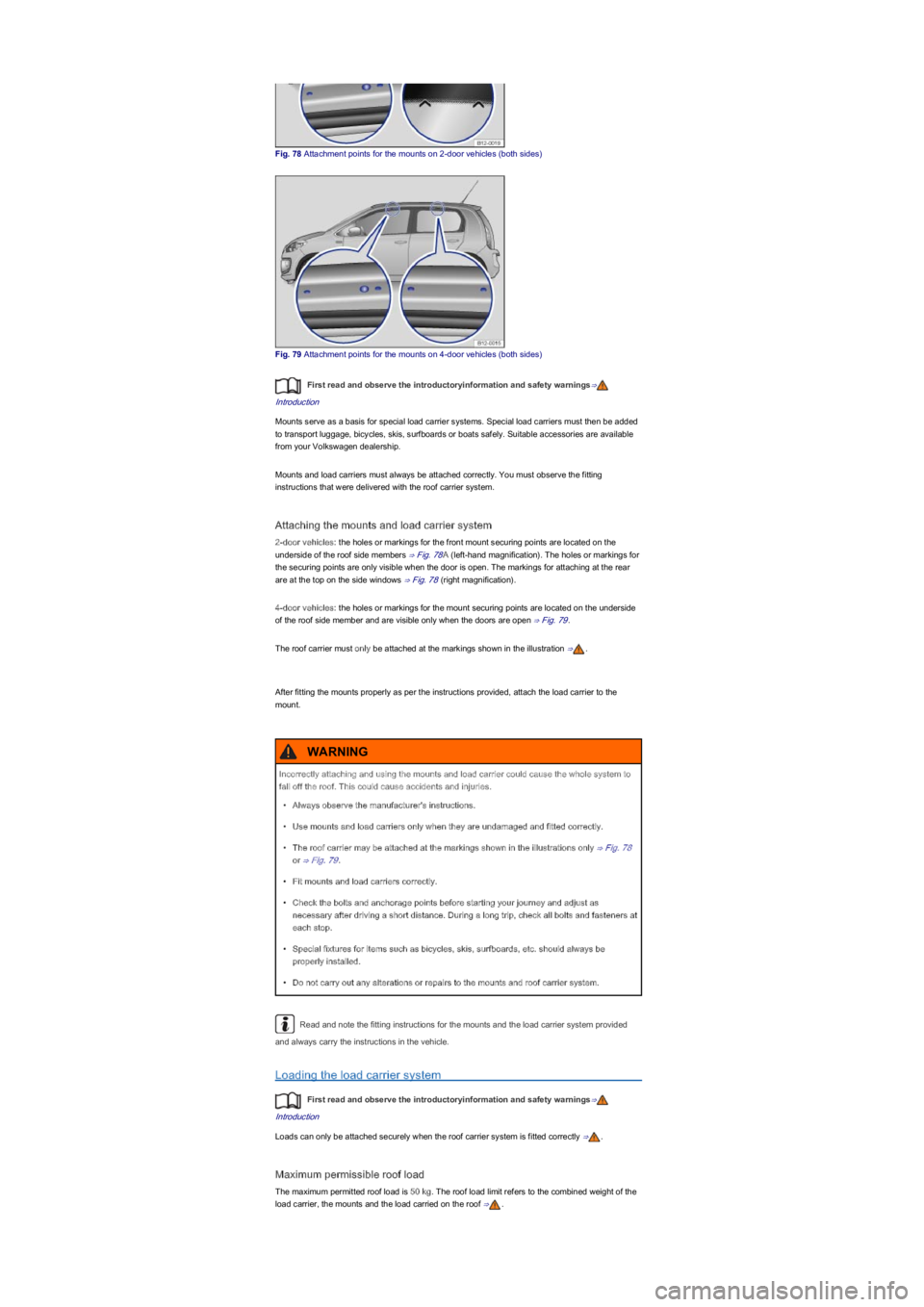
Fig. 78 Attachment points for the mounts on 2-door vehicles (both sides)
Fig. 79 Attachment points for the mounts on 4-door vehicles (both sides)
First read and observe the introductoryinformation and safety warnings⇒
Introduction
Mounts serve as a basis for special load carrier systems. Special load carriers must then be added
to transport luggage, bicycles, skis, surfboards or boats safely. Suitable accessories are available
from your Volkswagen dealership.
Mounts and load carriers must always be attached correctly. You must observe the fitting
instructions that were delivered with the roof carrier system.
Attaching the mounts and load carrier system
2-door vehicles: the holes or markings for the front mount securing points are located on the
underside of the roof side members ⇒ Fig. 78A (left-hand magnification). The holes or markings for
the securing points are only visible when the door is open. The markings for attaching at the rear
are at the top on the side windows ⇒ Fig. 78 (right magnification).
4-door vehicles: the holes or markings for the mount securing points are located on the underside
of the roof side member and are visible only when the doors are open ⇒ Fig. 79.
The roof carrier must only be attached at the markings shown in the illustration ⇒.
After fitting the mounts properly as per the instructions provided, attach the load carrier to the
mount.
Read and note the fitting instructions for the mounts and the load carrier system provided
and always carry the instructions in the vehicle.
Loading the load carrier system
First read and observe the introductoryinformation and safety warnings⇒
Introduction
Loads can only be attached securely when the roof carrier system is fitted correctly ⇒.
Maximum permissible roof load
The maximum permitted roof load is 50 kg. The roof load limit refers to the combined weight of the
load carrier, the mounts and the load carried on the roof ⇒.
Incorrectly attaching and using the mounts and load carrier could cause the whole system to
fall off the roof. This could cause accidents and injuries.
•Always observe the manufacturer's instructions.
•Use mounts and load carriers only when they are undamaged and fitted correctly.
•The roof carrier may be attached at the markings shown in the illustrations only ⇒ Fig. 78
or ⇒ Fig. 79.
•Fit mounts and load carriers correctly.
•Check the bolts and anchorage points before starting your journey and adjust as
necessary after driving a short distance. During a long trip, check all bolts and fasteners at
each stop.
•Special fixtures for items such as bicycles, skis, surfboards, etc. should always be
properly installed.
•Do not carry out any alterations or repairs to the mounts and roof carrier system.
WARNING
Page 79 of 211
Ensure that you know the weight of the mounts, roof carrier system and the items to be transported
on the roof - weigh them if necessary. Never exceed the maximum permissible roof load.
However, if you are using a carrier system with a lower weight rating, you will not be able to carry
the maximum roof load. In this case, do not exceed the maximum weight limit for the load carrier
system which is listed in the fitting instructions.
Distributing the load
Distribute the load evenly and secure it correctly ⇒.
Checking the fittings
After the mounts and load carrier have been attached, check the bolted connections and fastenings
once you have travelled a short distance and then at regular intervals.
Towing a trailer
Information on towing
The vehicle is not approved for towing a trailer. The vehicle is not factory-fitted with a towing
bracket and a towing bracket cannot be retrofitted.
Practical equipment
Stowage area
Introduction
This chapter contains information on the followingsubjects:
⇒ Stowage compartment on the driver side
⇒ Stowage compartment in the front centre console
⇒ Stowage compartment with cover on the front passenger side
⇒ Open stowage compartment on the front passenger side
⇒ Stowage compartment in the rear centre console
⇒ Other stowage areas
Only use stowage compartments to stow light or smaller objects.
Additional information and warnings:
•Cleaning and caring for the interior ⇒ Cleaning and caring for the interior
•⇒BookletRadio,
Accidents and vehicle damage can occur if the maximum permitted roof load is exceeded.
•Never exceed the quoted roof load, the maximum permissible axle loads, and the
permissible gross vehicle weight for the vehicle.
•Do not exceed the weight rating of the roof carrier system, even if the maximum roof load
has not been reached.
•Secure heavy objects as far forwards as possible and distribute the load evenly.
WARNING
Loose and incorrectly secured loads could fall off the load carrier and cause accidents and
injuries.
•Always use suitable and undamaged securing straps.
•Secure loads properly.
WARNING
Fitting a towing bracket on the vehicle while the vehicle is in operation can lead to accidents
and cause serious injuries.
•Never fit a towing bracket on the vehicle.
•The bracket could be released from the vehicle during the journey.
WARNING
Fitting towing brackets of any kind can lead to serious vehicle damage.
NOTICE
Page 108 of 211
Avoid unnecessary loads
The lighter the vehicle, the more economical and environmentally-friendly it is. An extra weight of
100 kg can increase fuel consumption by up to 0.3 l/100 km.
Remove all unnecessary objects and loads from the vehicle.
Remove any unnecessary special equipment and accessories
The more aerodynamic a vehicle, the lower its fuel consumption. Special equipment and
accessories, such as roof carriers or bicycle carriers, make the vehicle less aerodynamic.
You should therefore remove any special equipment and luggage carriers that are not in use,
especially if you are going to be driving at high speeds.
Steering
Introduction
This chapter contains information on the followingsubjects:
⇒ Warning and indicator lamps
⇒ Information on steering
Depending on its equipment level the vehicle may have power steering.
The power steering is not hydraulic. It is an electromechanical system. The advantage of this
steering system is that no hydraulic hoses, hydraulic oil, pumps, filter or other parts are required.
The electromechanical system reduces fuel consumption. A hydraulic system requires constant oil
pressure in the system, whereas an electromechanical steering system only needs an energy
supply while steering.
The power steering provided by the electromechanical steering system automatically adjusts to the
vehicle speed, steering wheel torque and steering wheel angle. The electromechanical steering
only functions when the engine is running.
Additional information and warnings:
•Starting and stopping the engine ⇒ Starting and stopping the engine
•Battery ⇒ Vehicle battery
•Tow-starting and towing ⇒ Tow-starting and towing
Warning and indicator lamps
First read and observe the introductoryinformation and safety warnings⇒
Introduction
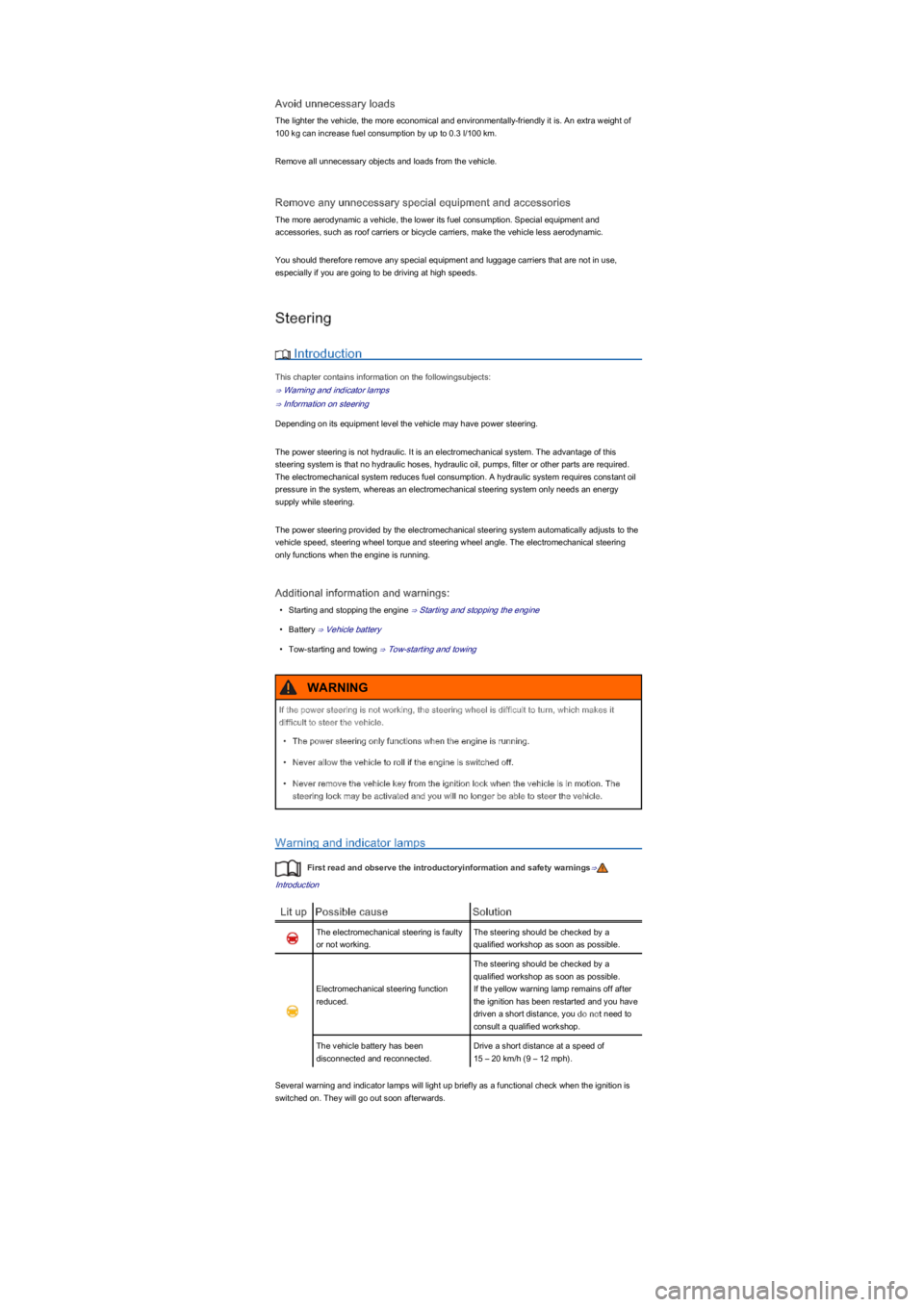
Lit upPossible causeSolution
The electromechanical steering is faulty
or not working.
The steering should be checked by a
qualified workshop as soon as possible.
Electromechanical steering function
reduced.
The steering should be checked by a
qualified workshop as soon as possible.
If the yellow warning lamp remains off after
the ignition has been restarted and you have
driven a short distance, you do not need to
consult a qualified workshop.
The vehicle battery has been
disconnected and reconnected.
Drive a short distance at a speed of
15 – 20 km/h (9 – 12 mph).
Several warning and indicator lamps will light up briefly as a functional check when the ignition is
switched on. They will go out soon afterwards.
If the power steering is not working, the steering wheel is difficult to turn, which makes it
difficult to steer the vehicle.
•The power steering only functions when the engine is running.
•Never allow the vehicle to roll if the engine is switched off.
•Never remove the vehicle key from the ignition lock when the vehicle is in motion. The
steering lock may be activated and you will no longer be able to steer the vehicle.
WARNING