check engine light VOLKSWAGEN UP! 2021 Owner´s Manual
[x] Cancel search | Manufacturer: VOLKSWAGEN, Model Year: 2021, Model line: UP!, Model: VOLKSWAGEN UP! 2021Pages: 211, PDF Size: 5.98 MB
Page 144 of 211
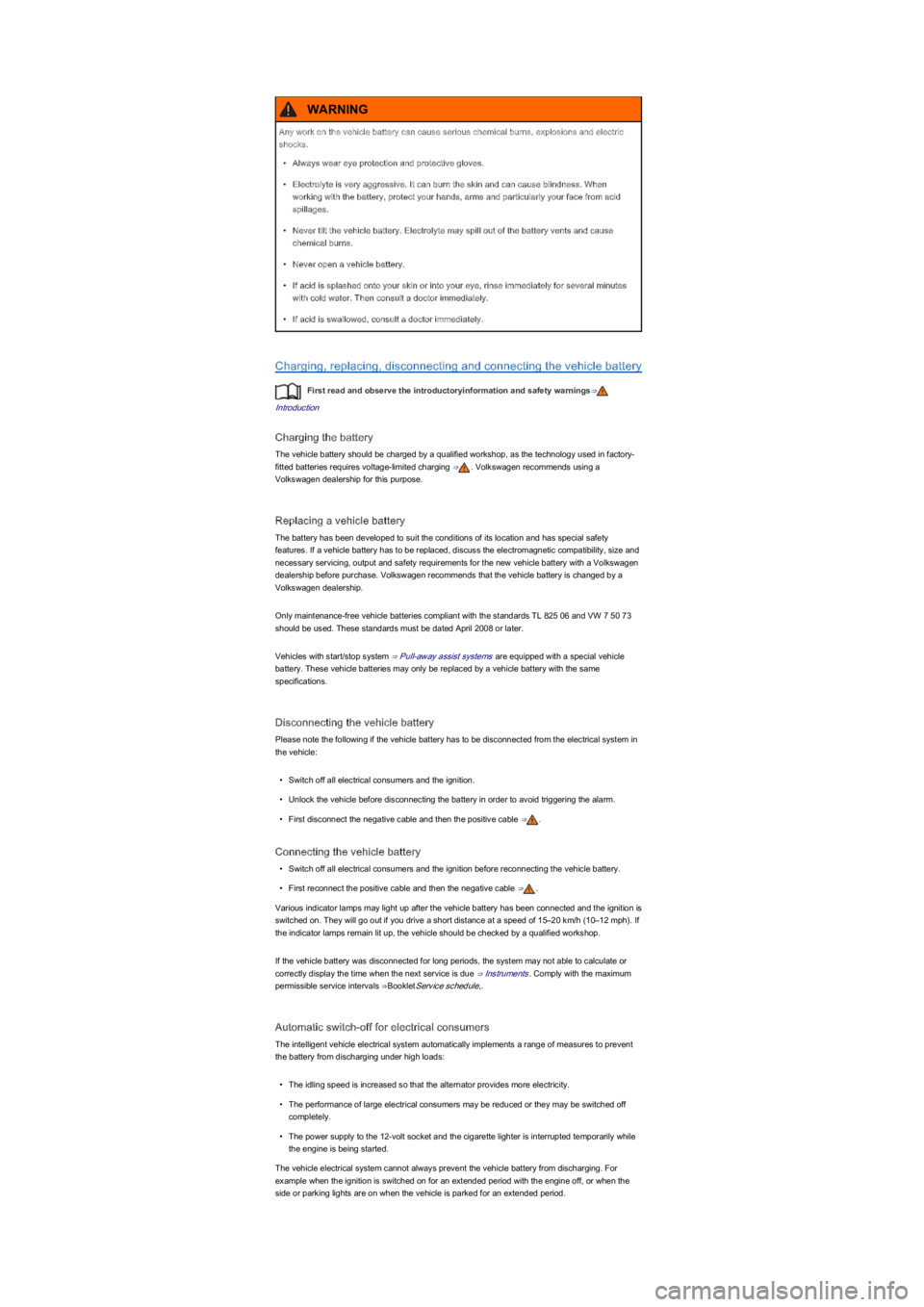
Charging, replacing, disconnecting and connecting the vehicle battery
First read and observe the introductoryinformation and safety warnings⇒
Introduction
Charging the battery
The vehicle battery should be charged by a qualified workshop, as the technology used in factory-
fitted batteries requires voltage-limited charging ⇒. Volkswagen recommends using a
Volkswagen dealership for this purpose.
Replacing a vehicle battery
The battery has been developed to suit the conditions of its location and has special safety
features. If a vehicle battery has to be replaced, discuss the electromagnetic compatibility, size and
necessary servicing, output and safety requirements for the new vehicle battery with a Volkswagen
dealership before purchase. Volkswagen recommends that the vehicle battery is changed by a
Volkswagen dealership.
Only maintenance-free vehicle batteries compliant with the standards TL 825 06 and VW 7 50 73
should be used. These standards must be dated April 2008 or later.
Vehicles with start/stop system ⇒ Pull-away assist systems are equipped with a special vehicle
battery. These vehicle batteries may only be replaced by a vehicle battery with the same
specifications.
Disconnecting the vehicle battery
Please note the following if the vehicle battery has to be disconnected from the electrical system in
the vehicle:
•Switch off all electrical consumers and the ignition.
•Unlock the vehicle before disconnecting the battery in order to avoid triggering the alarm.
•First disconnect the negative cable and then the positive cable ⇒.
Connecting the vehicle battery
•Switch off all electrical consumers and the ignition before reconnecting the vehicle battery.
•First reconnect the positive cable and then the negative cable ⇒.
Various indicator lamps may light up after the vehicle battery has been connected and the ignition is
switched on. They will go out if you drive a short distance at a speed of 15–20 km/h (10–12 mph). If
the indicator lamps remain lit up, the vehicle should be checked by a qualified workshop.
If the vehicle battery was disconnected for long periods, the system may not able to calculate or
correctly display the time when the next service is due ⇒ Instruments. Comply with the maximum
permissible service intervals ⇒BookletService schedule,.
Automatic switch-off for electrical consumers
The intelligent vehicle electrical system automatically implements a range of measures to prevent
the battery from discharging under high loads:
•The idling speed is increased so that the alternator provides more electricity.
•The performance of large electrical consumers may be reduced or they may be switched off
completely.
•The power supply to the 12-volt socket and the cigarette lighter is interrupted temporarily while
the engine is being started.
The vehicle electrical system cannot always prevent the vehicle battery from discharging. For
example when the ignition is switched on for an extended period with the engine off, or when the
side or parking lights are on when the vehicle is parked for an extended period.
Any work on the vehicle battery can cause serious chemical burns, explosions and electric
shocks.
•Always wear eye protection and protective gloves.
•Electrolyte is very aggressive. It can burn the skin and can cause blindness. When
working with the battery, protect your hands, arms and particularly your face from acid
spillages.
•Never tilt the vehicle battery. Electrolyte may spill out of the battery vents and cause
chemical burns.
•Never open a vehicle battery.
•If acid is splashed onto your skin or into your eye, rinse immediately for several minutes
with cold water. Then consult a doctor immediately.
•If acid is swallowed, consult a doctor immediately.
WARNING
Page 152 of 211
recommends that the protective coating on the underside of the vehicle and on the running gear
should be checked regularly and repaired if necessary.
Cleaning the engine compartment
First read and observe the introductoryinformation and safety warnings⇒
Introduction
The engine compartment of any motor vehicle is a hazardous area ⇒ Preparation for working in the
engine compartment.
The engine compartment should be cleaned by a qualified workshop. An incorrect cleaning
procedure could possibly remove corrosion protection and damage electrical components.
Furthermore, water could enter the vehicle interior directly via the plenum chamber ⇒.
If the engine compartment is very dirty, we recommend that you always proceed to a qualified
workshop to have it cleaned by a professional mechanic. Volkswagen recommends using a
Volkswagen dealership for this purpose.
Plenum chamber
The plenum chamber is located in the engine compartment between the windscreen and the engine
and has a perforated cover. Air from outside is drawn in from the plenum chamber and is passed
into the vehicle interior via the heating and air conditioning system.
Leaves and other loose objects must be removed from the cover of the plenum chamber at regular
intervals using a vacuum cleaner or by hand.
In the interests of environmental protection, the engine compartment should be washed only
in specially provided wash bays. This prevents toxic waste water containing oil, grease and fuel
from entering the sewerage system. In some districts, washing the engine compartment anywhere
else may be prohibited.
Cleaning and caring for the interior
Introduction
This chapter contains information on the followingsubjects:
⇒ Seat covers
⇒ Cleaning cloth seat covers, fabric trim and Alcantara upholstery
⇒ Cleaning and caring for natural leather covers
⇒ Cleaning leatherette upholstery
⇒ Cleaning stowage compartments, drink holders and ash trays
⇒ Cleaning and caring for the dash panel, wooden trims and plastic parts
⇒ Cleaning seat belts
Modern fabrics, such as dark denim, are often not colourfast. Light-coloured upholstery (soft
materials or leather) is particularly sensitive to staining caused by these fabrics, even if you are
careful. This is not caused by a fault in the upholstery, but by the non-colourfast nature of the
garments.
Leaving stains, dirt and other deposits on the surface of vehicle components and cloth seat covers
for a long time can make it difficult to clean and treat them. Stains, dirt and deposits may become
impossible to remove, particularly if left for a long time.
Additional information and warnings:
•Cleaning and caring for the vehicle exterior ⇒ Caring for and cleaning the vehicle exterior
Underseal and anti-corrosion coatings can ignite on the hot exhaust system or on other hot
engine parts.
•Never apply underseal or anti-corrosion coatings to the exhaust pipes, catalytic converter,
heat shields or other vehicle components that become hot.
CAUTION
All work in the engine compartment carries the risk of injury, scalding, accidents and fire.
•Before carrying out any work ensure that you are familiar with the requisite procedures
and general safety regulations ⇒ Preparation for working in the engine compartment.
•Volkswagen recommends having the work carried out by a qualified workshop.
WARNING
Water that has entered the plenum chamber via a manual process (e.g. from a high-pressure
cleaner) can cause considerable damage to the vehicle.
NOTICE
Page 153 of 211
Before getting into the vehicle, close all Velcro fasteners that could touch the cloth seat
covers and fabric trims. Open Velcro fasteners can cause damage to cloth seat covers and
fabric trims.
Avoid the direct contact of sharp-edged items and accessories to the upholstery and fabric
trims in order to prevent damage. Accessories include zips, studs, rhinestones on clothing
or belts.
Dust and grit in upholstery pores, folds and seams should be removed regularly so that no
permanent damage is caused to the surface of the seats by scratching.
Always check whether garments are colourfast to prevent damage to the upholstery. This
is especially important for light-coloured upholstery.
•Accessories, modifications, repairs and renewal of parts ⇒ Accessories, modifications, repairs
and renewal of parts
Suitable care products are available from a Volkswagen dealership.
Seat covers
First read and observe the introductoryinformation and safety warnings⇒
Introduction
Checklist
Please note the following for the cleaning and maintenance of the seat covers ⇒:
Volkswagen recommends that stained upholstery is cleaned by a specialist company.
Cleaning cloth seat covers, fabric trim and Alcantara upholstery
First read and observe the introductoryinformation and safety warnings⇒
Introduction
Car care products can be toxic and hazardous. Unsuitable care products and incorrect
application of care products can cause accidents, serious injuries, burns or poisoning.
•The care product must be kept in its original sealed container.
•Read the manufacturer's instructions.
•Never store car care products in empty food containers, bottles or any other non-original
containers as people finding these containers may not know that they contain care
products.
•Keep children away from care products.
•The products can give off harmful fumes during use. They should therefore only be used
outside or in well-ventilated spaces.
•Never use fuel, turpentine, engine oil, nail varnish remover or other volatile fluids to wash,
clean or care for your vehicle. These substances are toxic and highly inflammable.
WARNING
Incorrect care and cleaning of vehicle parts can impair the safety features of the vehicle and
cause serious injury.
•Vehicle parts must be cleaned according to the manufacturer's instructions.
•Only use approved or recommended cleaning products.
WARNING
•Cleaning products that contain solvents attack the material and may cause irreparable
damage.
•Stains, dirt and other deposits containing aggressive and solvent-based ingredients attack
the material and may cause irreparable damage, even if only left for a short time.
•Stains, dirt and other deposits should be removed as quickly as possible and not allowed
to dry in.
•To avoid damage, stubborn stains should be removed by a specialist cleaning company.
NOTICE
Ignoring any of the items on this important checklist for maintaining the seat covers can lead
to damage or discolouration of the seat covers and fabric trims.
•Follow the instructions on the checklist.
NOTICE
®
Page 180 of 211
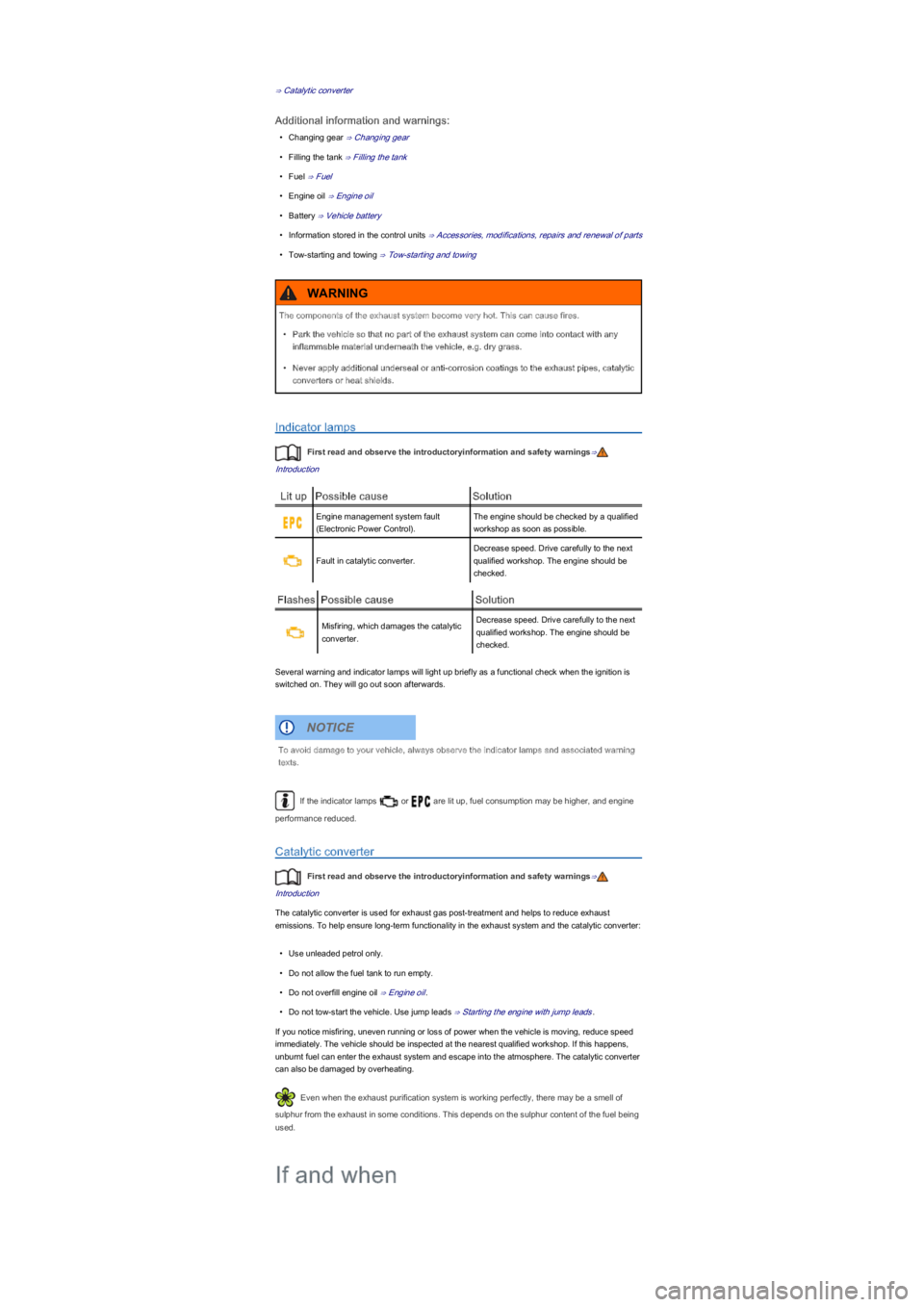
⇒ Catalytic converter
Additional information and warnings:
•Changing gear ⇒ Changing gear
•Filling the tank ⇒ Filling the tank
•Fuel ⇒ Fuel
•Engine oil ⇒ Engine oil
•Battery ⇒ Vehicle battery
•Information stored in the control units ⇒ Accessories, modifications, repairs and renewal of parts
•Tow-starting and towing ⇒ Tow-starting and towing
Indicator lamps
First read and observe the introductoryinformation and safety warnings⇒
Introduction
Lit upPossible causeSolution
Engine management system fault
(Electronic Power Control).
The engine should be checked by a qualified
workshop as soon as possible.
Fault in catalytic converter.
Decrease speed. Drive carefully to the next
qualified workshop. The engine should be
checked.
FlashesPossible causeSolution
Misfiring, which damages the catalytic
converter.
Decrease speed. Drive carefully to the next
qualified workshop. The engine should be
checked.
Several warning and indicator lamps will light up briefly as a functional check when the ignition is
switched on. They will go out soon afterwards.
If the indicator lamps or are lit up, fuel consumption may be higher, and engine
performance reduced.
Catalytic converter
First read and observe the introductoryinformation and safety warnings⇒
Introduction
The catalytic converter is used for exhaust gas post-treatment and helps to reduce exhaust
emissions. To help ensure long-term functionality in the exhaust system and the catalytic converter:
•Use unleaded petrol only.
•Do not allow the fuel tank to run empty.
•Do not overfill engine oil ⇒ Engine oil.
•Do not tow-start the vehicle. Use jump leads ⇒ Starting the engine with jump leads.
If you notice misfiring, uneven running or loss of power when the vehicle is moving, reduce speed
immediately. The vehicle should be inspected at the nearest qualified workshop. If this happens,
unburnt fuel can enter the exhaust system and escape into the atmosphere. The catalytic converter
can also be damaged by overheating.
Even when the exhaust purification system is working perfectly, there may be a smell of
sulphur from the exhaust in some conditions. This depends on the sulphur content of the fuel being
used.
The components of the exhaust system become very hot. This can cause fires.
•Park the vehicle so that no part of the exhaust system can come into contact with any
inflammable material underneath the vehicle, e.g. dry grass.
•Never apply additional underseal or anti-corrosion coatings to the exhaust pipes, catalytic
converters or heat shields.
WARNING
To avoid damage to your vehicle, always observe the indicator lamps and associated warning
texts.
NOTICE
If and when
Page 181 of 211
Practical tips
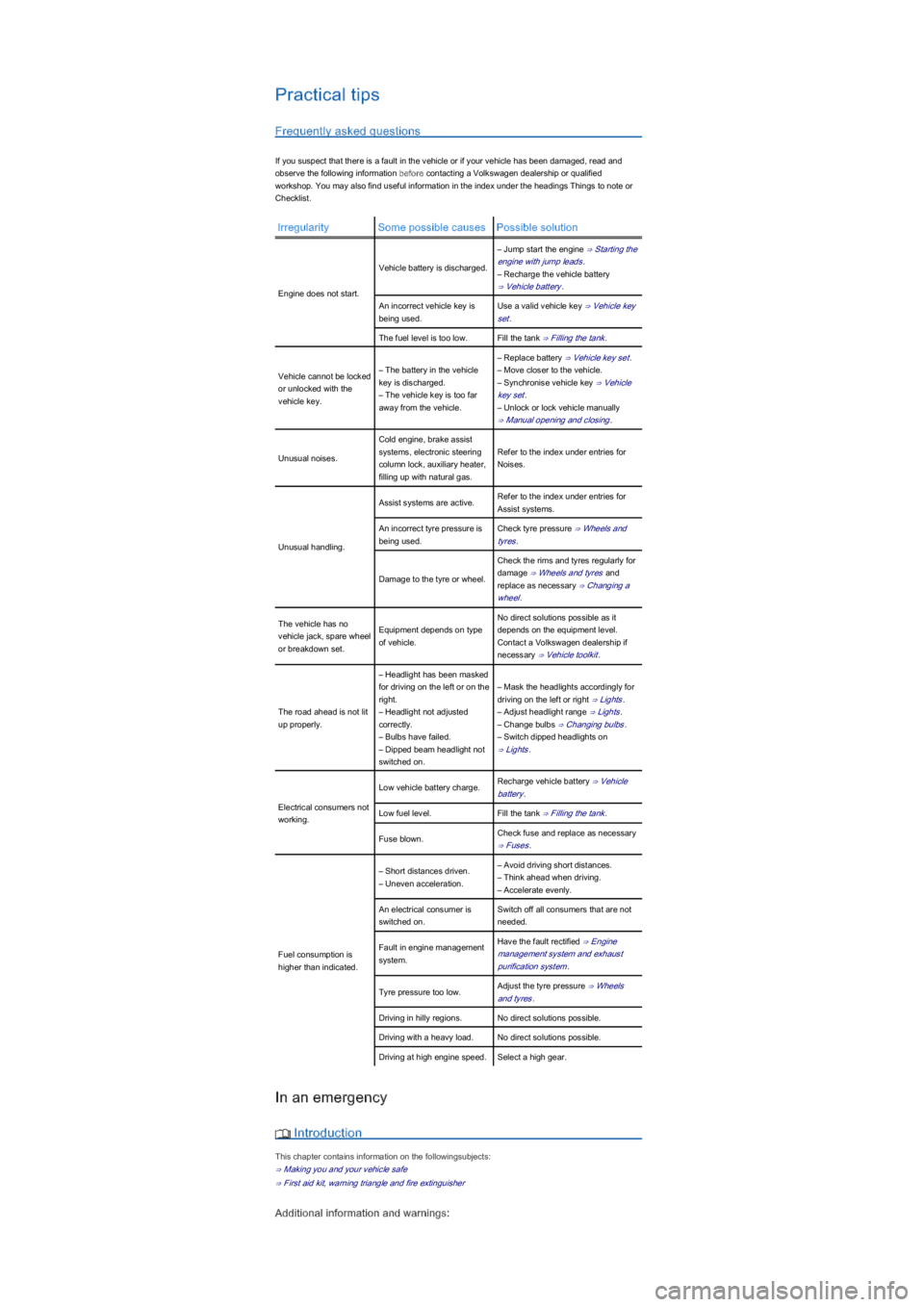
Frequently asked questions
If you suspect that there is a fault in the vehicle or if your vehicle has been damaged, read and
observe the following information before contacting a Volkswagen dealership or qualified
workshop. You may also find useful information in the index under the headings Things to note or
Checklist.
IrregularitySome possible causesPossible solution
Engine does not start.
Vehicle battery is discharged.
– Jump start the engine ⇒ Starting the
engine with jump leads.
– Recharge the vehicle battery
⇒ Vehicle battery.
An incorrect vehicle key is
being used.
Use a valid vehicle key ⇒ Vehicle key
set.
The fuel level is too low.Fill the tank ⇒ Filling the tank.
Vehicle cannot be locked
or unlocked with the
vehicle key.
– The battery in the vehicle
key is discharged.
– The vehicle key is too far
away from the vehicle.
– Replace battery ⇒ Vehicle key set.
– Move closer to the vehicle.
– Synchronise vehicle key ⇒ Vehicle
key set.
– Unlock or lock vehicle manually
⇒ Manual opening and closing.
Unusual noises.
Cold engine, brake assist
systems, electronic steering
column lock, auxiliary heater,
filling up with natural gas.
Refer to the index under entries for
Noises.
Unusual handling.
Assist systems are active.Refer to the index under entries for
Assist systems.
An incorrect tyre pressure is
being used.
Check tyre pressure ⇒ Wheels and
tyres.
Damage to the tyre or wheel.
Check the rims and tyres regularly for
damage ⇒ Wheels and tyres and
replace as necessary ⇒ Changing a
wheel.
The vehicle has no
vehicle jack, spare wheel
or breakdown set.
Equipment depends on type
of vehicle.
No direct solutions possible as it
depends on the equipment level.
Contact a Volkswagen dealership if
necessary ⇒ Vehicle toolkit.
The road ahead is not lit
up properly.
– Headlight has been masked
for driving on the left or on the
right.
– Headlight not adjusted
correctly.
– Bulbs have failed.
– Dipped beam headlight not
switched on.
– Mask the headlights accordingly for
driving on the left or right ⇒ Lights.
– Adjust headlight range ⇒ Lights.
– Change bulbs ⇒ Changing bulbs.
– Switch dipped headlights on
⇒ Lights.
Electrical consumers not
working.
Low vehicle battery charge.Recharge vehicle battery ⇒ Vehicle
battery.
Low fuel level.Fill the tank ⇒ Filling the tank.
Fuse blown.Check fuse and replace as necessary
⇒ Fuses.
Fuel consumption is
higher than indicated.
– Short distances driven.
– Uneven acceleration.
– Avoid driving short distances.
– Think ahead when driving.
– Accelerate evenly.
An electrical consumer is
switched on.
Switch off all consumers that are not
needed.
Fault in engine management
system.
Have the fault rectified ⇒ Engine
management system and exhaust
purification system.
Tyre pressure too low.Adjust the tyre pressure ⇒ Wheels
and tyres.
Driving in hilly regions.No direct solutions possible.
Driving with a heavy load.No direct solutions possible.
Driving at high engine speed.Select a high gear.
In an emergency
Introduction
This chapter contains information on the followingsubjects:
⇒ Making you and your vehicle safe
⇒ First aid kit, warning triangle and fire extinguisher
Additional information and warnings:
Page 182 of 211
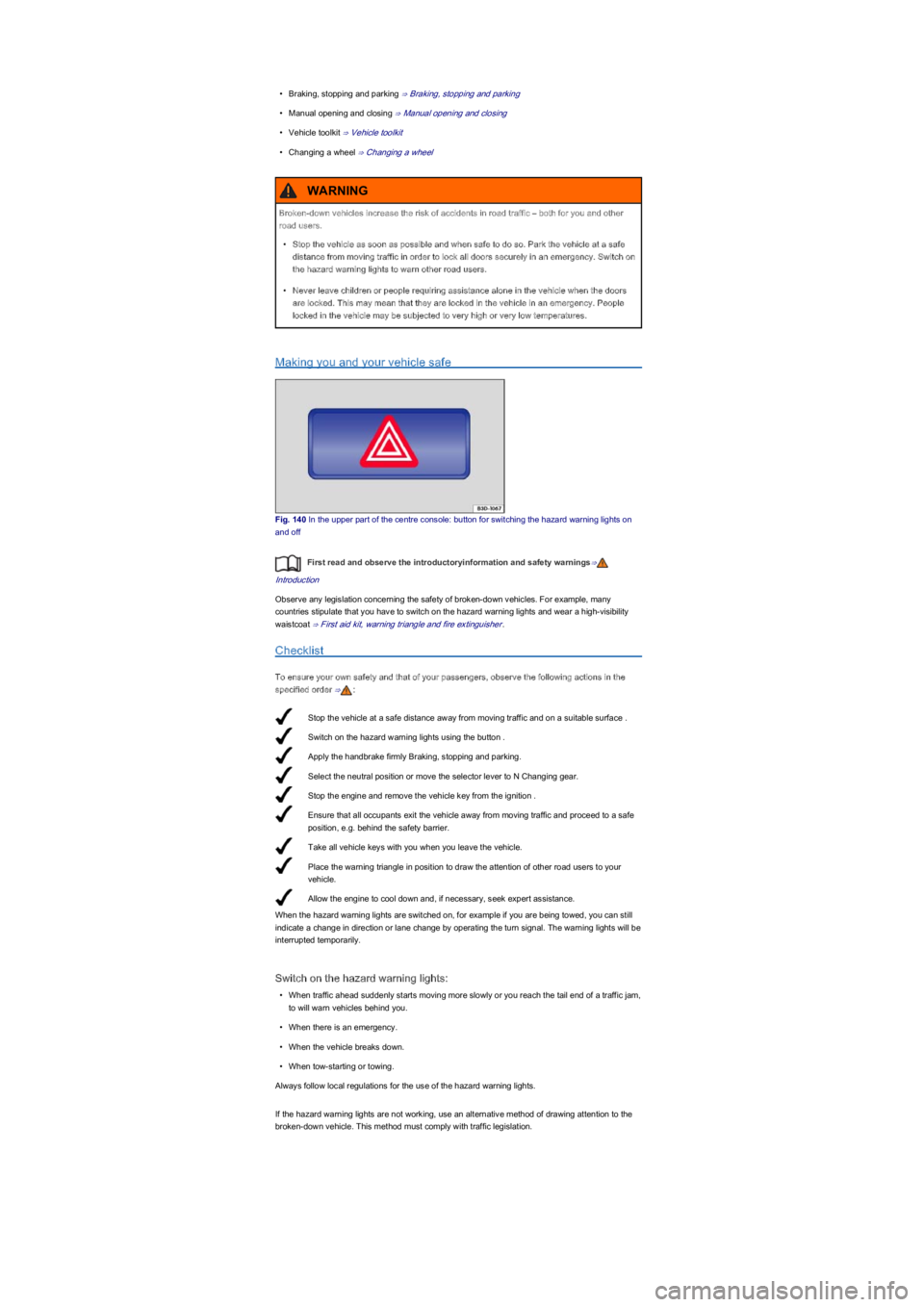
Stop the vehicle at a safe distance away from moving traffic and on a suitable surface .
Switch on the hazard warning lights using the button .
Apply the handbrake firmly Braking, stopping and parking.
Select the neutral position or move the selector lever to N Changing gear.
Stop the engine and remove the vehicle key from the ignition .
Ensure that all occupants exit the vehicle away from moving traffic and proceed to a safe
position, e.g. behind the safety barrier.
Take all vehicle keys with you when you leave the vehicle.
Place the warning triangle in position to draw the attention of other road users to your
vehicle.
Allow the engine to cool down and, if necessary, seek expert assistance.
•Braking, stopping and parking ⇒ Braking, stopping and parking
•Manual opening and closing ⇒ Manual opening and closing
•Vehicle toolkit ⇒ Vehicle toolkit
•Changing a wheel ⇒ Changing a wheel
Making you and your vehicle safe
Fig. 140 In the upper part of the centre console: button for switching the hazard warning lights on
and off
First read and observe the introductoryinformation and safety warnings⇒
Introduction
Observe any legislation concerning the safety of broken-down vehicles. For example, many
countries stipulate that you have to switch on the hazard warning lights and wear a high-visibility
waistcoat ⇒ First aid kit, warning triangle and fire extinguisher.
Checklist
To ensure your own safety and that of your passengers, observe the following actions in the
specified order ⇒:
When the hazard warning lights are switched on, for example if you are being towed, you can still
indicate a change in direction or lane change by operating the turn signal. The warning lights will be
interrupted temporarily.
Switch on the hazard warning lights:
•When traffic ahead suddenly starts moving more slowly or you reach the tail end of a traffic jam,
to will warn vehicles behind you.
•When there is an emergency.
•When the vehicle breaks down.
•When tow-starting or towing.
Always follow local regulations for the use of the hazard warning lights.
If the hazard warning lights are not working, use an alternative method of drawing attention to the
broken-down vehicle. This method must comply with traffic legislation.
Broken-down vehicles increase the risk of accidents in road traffic – both for you and other
road users.
•Stop the vehicle as soon as possible and when safe to do so. Park the vehicle at a safe
distance from moving traffic in order to lock all doors securely in an emergency. Switch on
the hazard warning lights to warn other road users.
•Never leave children or people requiring assistance alone in the vehicle when the doors
are locked. This may mean that they are locked in the vehicle in an emergency. People
locked in the vehicle may be subjected to very high or very low temperatures.
WARNING
Page 189 of 211
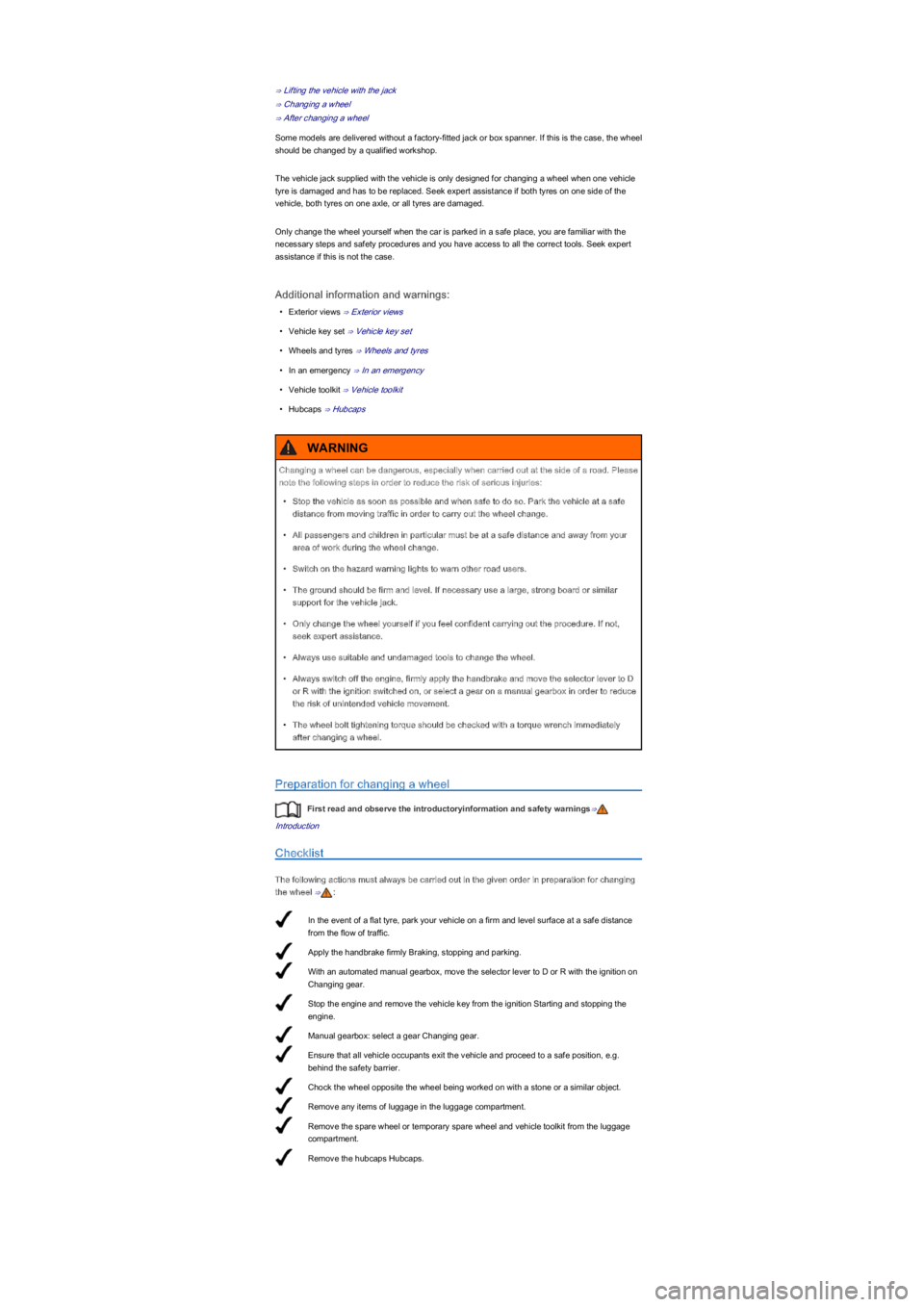
In the event of a flat tyre, park your vehicle on a firm and level surface at a safe distance
from the flow of traffic.
Apply the handbrake firmly Braking, stopping and parking.
With an automated manual gearbox, move the selector lever to D or R with the ignition on
Changing gear.
Stop the engine and remove the vehicle key from the ignition Starting and stopping the
engine.
Manual gearbox: select a gear Changing gear.
Ensure that all vehicle occupants exit the vehicle and proceed to a safe position, e.g.
behind the safety barrier.
Chock the wheel opposite the wheel being worked on with a stone or a similar object.
Remove any items of luggage in the luggage compartment.
Remove the spare wheel or temporary spare wheel and vehicle toolkit from the luggage
compartment.
Remove the hubcaps Hubcaps.
⇒ Lifting the vehicle with the jack
⇒ Changing a wheel
⇒ After changing a wheel
Some models are delivered without a factory-fitted jack or box spanner. If this is the case, the wheel
should be changed by a qualified workshop.
The vehicle jack supplied with the vehicle is only designed for changing a wheel when one vehicle
tyre is damaged and has to be replaced. Seek expert assistance if both tyres on one side of the
vehicle, both tyres on one axle, or all tyres are damaged.
Only change the wheel yourself when the car is parked in a safe place, you are familiar with the
necessary steps and safety procedures and you have access to all the correct tools. Seek expert
assistance if this is not the case.
Additional information and warnings:
•Exterior views ⇒ Exterior views
•Vehicle key set ⇒ Vehicle key set
•Wheels and tyres ⇒ Wheels and tyres
•In an emergency ⇒ In an emergency
•Vehicle toolkit ⇒ Vehicle toolkit
•Hubcaps ⇒ Hubcaps
Preparation for changing a wheel
First read and observe the introductoryinformation and safety warnings⇒
Introduction
Checklist
The following actions must always be carried out in the given order in preparation for changing
the wheel ⇒:
Changing a wheel can be dangerous, especially when carried out at the side of a road. Please
note the following steps in order to reduce the risk of serious injuries:
•Stop the vehicle as soon as possible and when safe to do so. Park the vehicle at a safe
distance from moving traffic in order to carry out the wheel change.
•All passengers and children in particular must be at a safe distance and away from your
area of work during the wheel change.
•Switch on the hazard warning lights to warn other road users.
•The ground should be firm and level. If necessary use a large, strong board or similar
support for the vehicle jack.
•Only change the wheel yourself if you feel confident carrying out the procedure. If not,
seek expert assistance.
•Always use suitable and undamaged tools to change the wheel.
•Always switch off the engine, firmly apply the handbrake and move the selector lever to D
or R with the ignition switched on, or select a gear on a manual gearbox in order to reduce
the risk of unintended vehicle movement.
•The wheel bolt tightening torque should be checked with a torque wrench immediately
after changing a wheel.
WARNING
Page 194 of 211
Dispose of used or out-of-date sealant in accordance with legal requirements.
You can get a new tyre filler bottle from a Volkswagen dealership.
Observe the separate instructions from the manufacturer of the breakdown set.
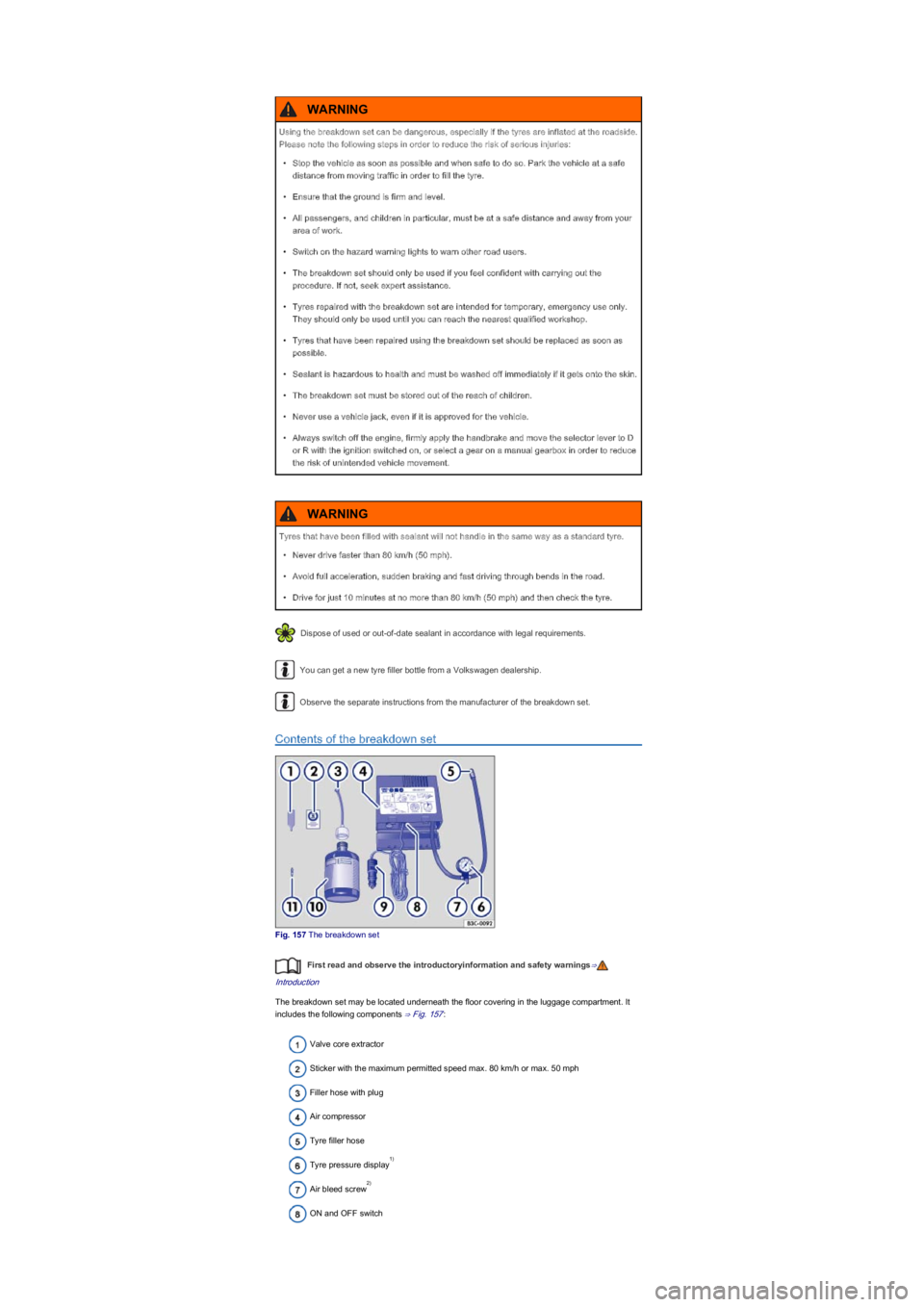
Contents of the breakdown set
Fig. 157 The breakdown set
First read and observe the introductoryinformation and safety warnings⇒
Introduction
The breakdown set may be located underneath the floor covering in the luggage compartment. It
includes the following components ⇒ Fig. 157:
Valve core extractor
Sticker with the maximum permitted speed max. 80 km/h or max. 50 mph
Filler hose with plug
Air compressor
Tyre filler hose
Tyre pressure display
Air bleed screw
ON and OFF switch
Using the breakdown set can be dangerous, especially if the tyres are inflated at the roadside.
Please note the following steps in order to reduce the risk of serious injuries:
•Stop the vehicle as soon as possible and when safe to do so. Park the vehicle at a safe
distance from moving traffic in order to fill the tyre.
•Ensure that the ground is firm and level.
•All passengers, and children in particular, must be at a safe distance and away from your
area of work.
•Switch on the hazard warning lights to warn other road users.
•The breakdown set should only be used if you feel confident with carrying out the
procedure. If not, seek expert assistance.
•Tyres repaired with the breakdown set are intended for temporary, emergency use only.
They should only be used until you can reach the nearest qualified workshop.
•Tyres that have been repaired using the breakdown set should be replaced as soon as
possible.
•Sealant is hazardous to health and must be washed off immediately if it gets onto the skin.
•The breakdown set must be stored out of the reach of children.
•Never use a vehicle jack, even if it is approved for the vehicle.
•Always switch off the engine, firmly apply the handbrake and move the selector lever to D
or R with the ignition switched on, or select a gear on a manual gearbox in order to reduce
the risk of unintended vehicle movement.
WARNING
Tyres that have been filled with sealant will not handle in the same way as a standard tyre.
•Never drive faster than 80 km/h (50 mph).
•Avoid full acceleration, sudden braking and fast driving through bends in the road.
•Drive for just 10 minutes at no more than 80 km/h (50 mph) and then check the tyre.
WARNING
1)
2)
Page 195 of 211
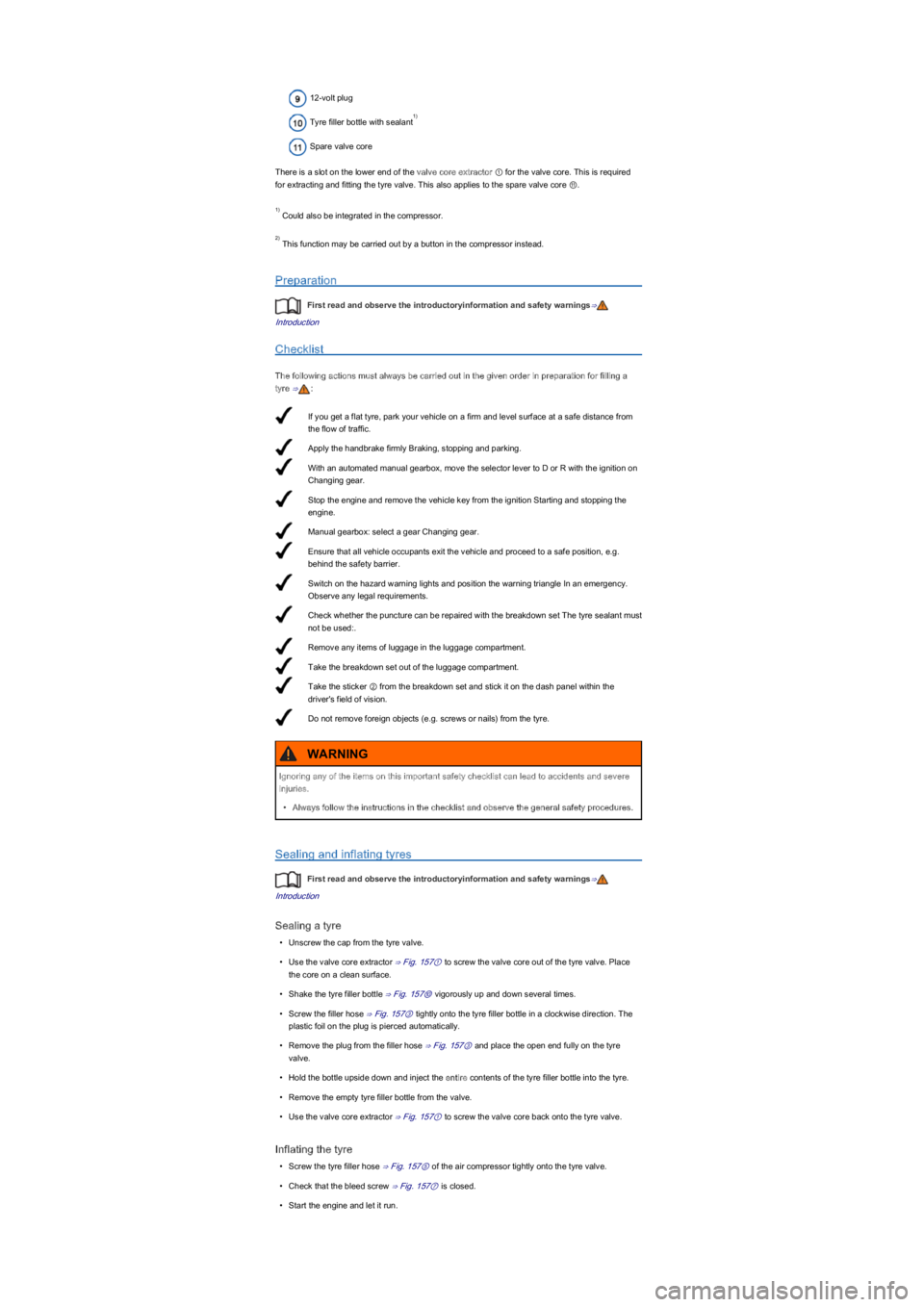
If you get a flat tyre, park your vehicle on a firm and level surface at a safe distance from
the flow of traffic.
Apply the handbrake firmly Braking, stopping and parking.
With an automated manual gearbox, move the selector lever to D or R with the ignition on
Changing gear.
Stop the engine and remove the vehicle key from the ignition Starting and stopping the
engine.
Manual gearbox: select a gear Changing gear.
Ensure that all vehicle occupants exit the vehicle and proceed to a safe position, e.g.
behind the safety barrier.
Switch on the hazard warning lights and position the warning triangle In an emergency.
Observe any legal requirements.
Check whether the puncture can be repaired with the breakdown set The tyre sealant must
not be used:.
Remove any items of luggage in the luggage compartment.
Take the breakdown set out of the luggage compartment.
Take the sticker ② from the breakdown set and stick it on the dash panel within the
driver's field of vision.
Do not remove foreign objects (e.g. screws or nails) from the tyre.
12-volt plug
Tyre filler bottle with sealant
Spare valve core
There is a slot on the lower end of the valve core extractor ① for the valve core. This is required
for extracting and fitting the tyre valve. This also applies to the spare valve core ⑪.
Could also be integrated in the compressor.
This function may be carried out by a button in the compressor instead.
Preparation
First read and observe the introductoryinformation and safety warnings⇒
Introduction
Checklist
The following actions must always be carried out in the given order in preparation for filling a
tyre ⇒:
Sealing and inflating tyres
First read and observe the introductoryinformation and safety warnings⇒
Introduction
Sealing a tyre
•Unscrew the cap from the tyre valve.
•Use the valve core extractor ⇒ Fig. 157① to screw the valve core out of the tyre valve. Place
the core on a clean surface.
•Shake the tyre filler bottle ⇒ Fig. 157⑩ vigorously up and down several times.
•Screw the filler hose ⇒ Fig. 157③ tightly onto the tyre filler bottle in a clockwise direction. The
plastic foil on the plug is pierced automatically.
•Remove the plug from the filler hose ⇒ Fig. 157③ and place the open end fully on the tyre
valve.
•Hold the bottle upside down and inject the entire contents of the tyre filler bottle into the tyre.
•Remove the empty tyre filler bottle from the valve.
•Use the valve core extractor ⇒ Fig. 157① to screw the valve core back onto the tyre valve.
Inflating the tyre
•Screw the tyre filler hose ⇒ Fig. 157⑤ of the air compressor tightly onto the tyre valve.
•Check that the bleed screw ⇒ Fig. 157⑦ is closed.
•Start the engine and let it run.
1)
1)
2)
Ignoring any of the items on this important safety checklist can lead to accidents and severe
injuries.
•Always follow the instructions in the checklist and observe the general safety procedures.
WARNING
Page 197 of 211
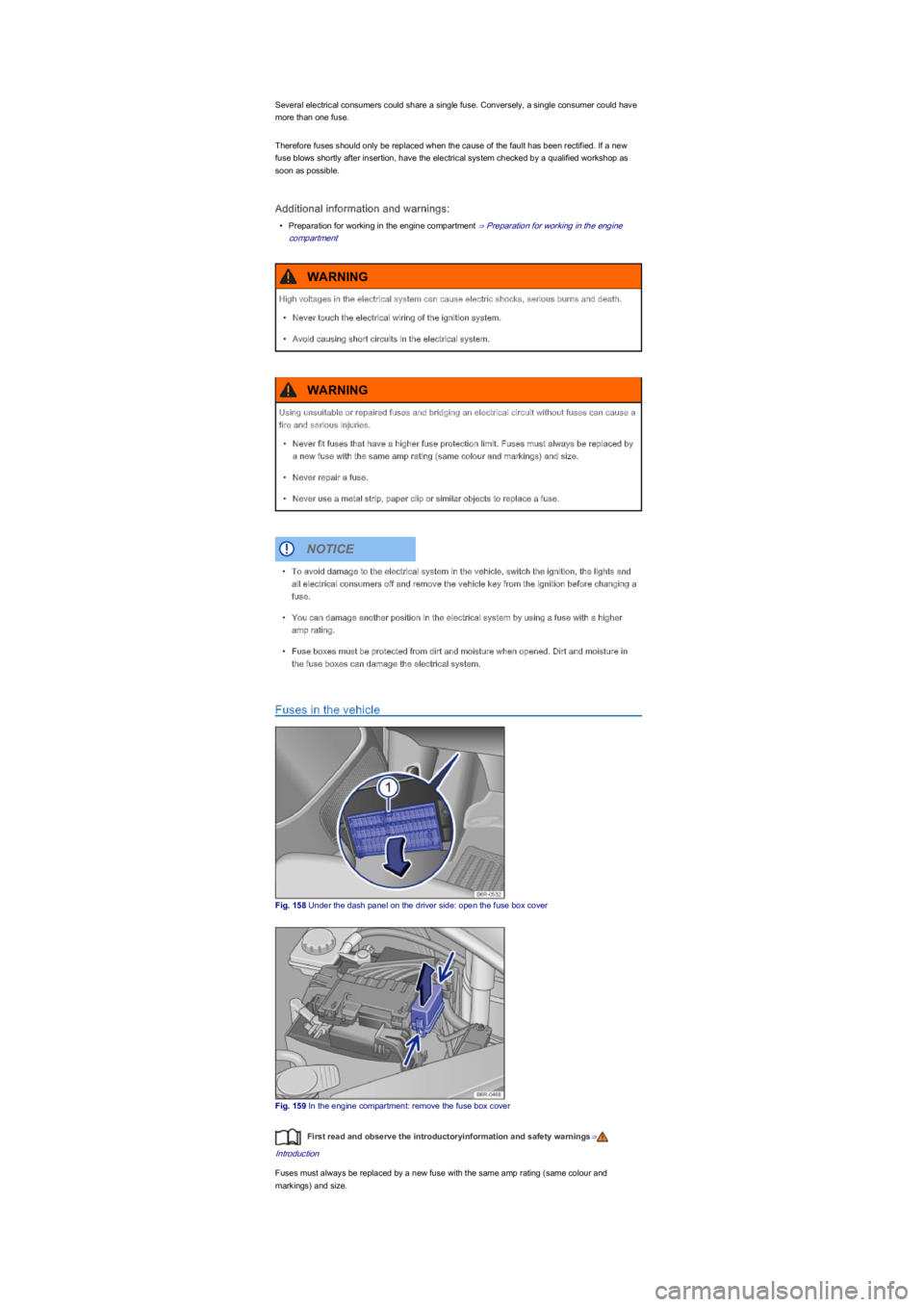
Several electrical consumers could share a single fuse. Conversely, a single consumer could have
more than one fuse.
Therefore fuses should only be replaced when the cause of the fault has been rectified. If a new
fuse blows shortly after insertion, have the electrical system checked by a qualified workshop as
soon as possible.
Additional information and warnings:
•Preparation for working in the engine compartment ⇒ Preparation for working in the engine
compartment
Fuses in the vehicle
Fig. 158 Under the dash panel on the driver side: open the fuse box cover
Fig. 159 In the engine compartment: remove the fuse box cover
First read and observe the introductoryinformation and safety warnings⇒
Introduction
Fuses must always be replaced by a new fuse with the same amp rating (same colour and
markings) and size.
High voltages in the electrical system can cause electric shocks, serious burns and death.
•Never touch the electrical wiring of the ignition system.
•Avoid causing short circuits in the electrical system.
WARNING
Using unsuitable or repaired fuses and bridging an electrical circuit without fuses can cause a
fire and serious injuries.
•Never fit fuses that have a higher fuse protection limit. Fuses must always be replaced by
a new fuse with the same amp rating (same colour and markings) and size.
•Never repair a fuse.
•Never use a metal strip, paper clip or similar objects to replace a fuse.
WARNING
•To avoid damage to the electrical system in the vehicle, switch the ignition, the lights and
all electrical consumers off and remove the vehicle key from the ignition before changing a
fuse.
•You can damage another position in the electrical system by using a fuse with a higher
amp rating.
•Fuse boxes must be protected from dirt and moisture when opened. Dirt and moisture in
the fuse boxes can damage the electrical system.
NOTICE