instrument cluster VOLKSWAGEN UP! 2021 Owner´s Manual
[x] Cancel search | Manufacturer: VOLKSWAGEN, Model Year: 2021, Model line: UP!, Model: VOLKSWAGEN UP! 2021Pages: 211, PDF Size: 5.98 MB
Page 99 of 211
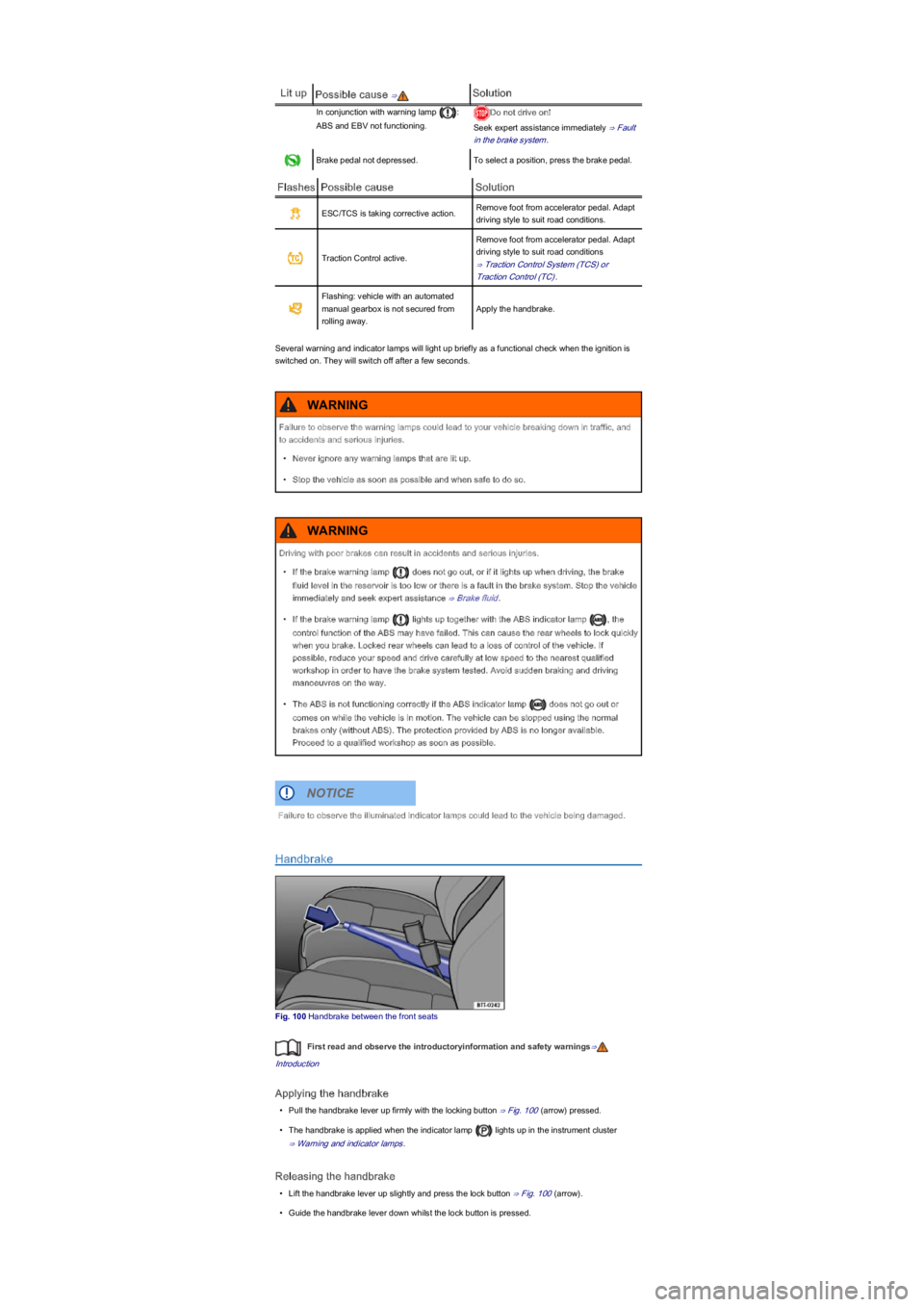
Lit upPossible cause ⇒Solution
In conjunction with warning lamp :
ABS and EBV not functioning.
Do not drive on!
Seek expert assistance immediately ⇒ Fault
in the brake system.
Brake pedal not depressed.To select a position, press the brake pedal.
FlashesPossible causeSolution
ESC/TCS is taking corrective action.Remove foot from accelerator pedal. Adapt
driving style to suit road conditions.
Traction Control active.
Remove foot from accelerator pedal. Adapt
driving style to suit road conditions
⇒ Traction Control System (TCS) or
Traction Control (TC).
Flashing: vehicle with an automated
manual gearbox is not secured from
rolling away.
Apply the handbrake.
Several warning and indicator lamps will light up briefly as a functional check when the ignition is
switched on. They will switch off after a few seconds.
Handbrake
Fig. 100 Handbrake between the front seats
First read and observe the introductoryinformation and safety warnings⇒
Introduction
Applying the handbrake
•Pull the handbrake lever up firmly with the locking button ⇒ Fig. 100 (arrow) pressed.
•The handbrake is applied when the indicator lamp lights up in the instrument cluster
⇒ Warning and indicator lamps.
Releasing the handbrake
•Lift the handbrake lever up slightly and press the lock button ⇒ Fig. 100 (arrow).
•Guide the handbrake lever down whilst the lock button is pressed.
Failure to observe the warning lamps could lead to your vehicle breaking down in traffic, and
to accidents and serious injuries.
•Never ignore any warning lamps that are lit up.
•Stop the vehicle as soon as possible and when safe to do so.
WARNING
Driving with poor brakes can result in accidents and serious injuries.
•If the brake warning lamp does not go out, or if it lights up when driving, the brake
fluid level in the reservoir is too low or there is a fault in the brake system. Stop the vehicle
immediately and seek expert assistance ⇒ Brake fluid.
•If the brake warning lamp lights up together with the ABS indicator lamp , the
control function of the ABS may have failed. This can cause the rear wheels to lock quickly
when you brake. Locked rear wheels can lead to a loss of control of the vehicle. If
possible, reduce your speed and drive carefully at low speed to the nearest qualified
workshop in order to have the brake system tested. Avoid sudden braking and driving
manoeuvres on the way.
•The ABS is not functioning correctly if the ABS indicator lamp does not go out or
comes on while the vehicle is in motion. The vehicle can be stopped using the normal
brakes only (without ABS). The protection provided by ABS is no longer available.
Proceed to a qualified workshop as soon as possible.
WARNING
Failure to observe the illuminated indicator lamps could lead to the vehicle being damaged.
NOTICE
Page 110 of 211
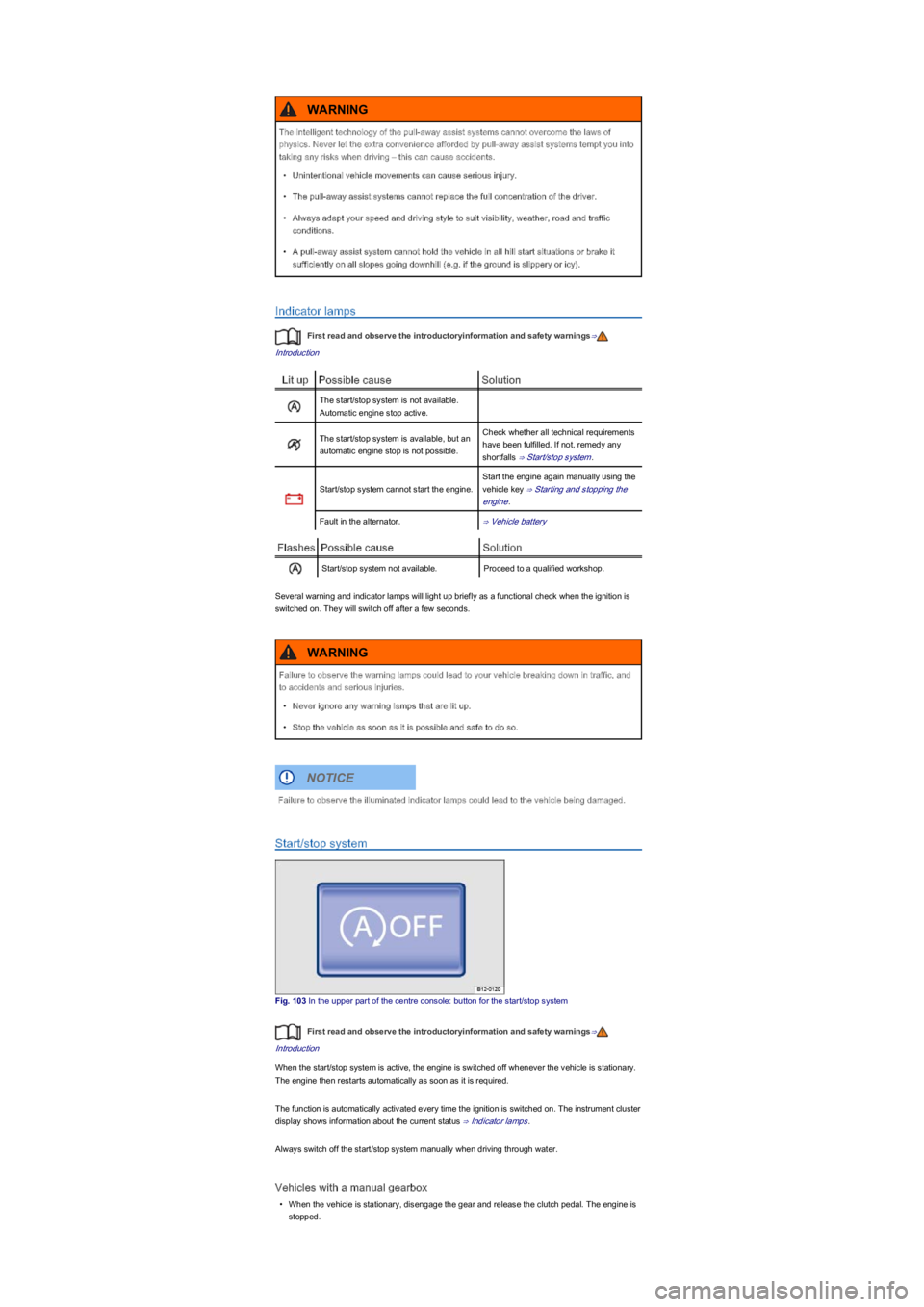
Indicator lamps
First read and observe the introductoryinformation and safety warnings⇒
Introduction
Lit upPossible causeSolution
The start/stop system is not available.
Automatic engine stop active.
The start/stop system is available, but an
automatic engine stop is not possible.
Check whether all technical requirements
have been fulfilled. If not, remedy any
shortfalls ⇒ Start/stop system.
Start/stop system cannot start the engine.
Start the engine again manually using the
vehicle key ⇒ Starting and stopping the
engine.
Fault in the alternator.⇒ Vehicle battery
FlashesPossible causeSolution
Start/stop system not available.Proceed to a qualified workshop.
Several warning and indicator lamps will light up briefly as a functional check when the ignition is
switched on. They will switch off after a few seconds.
Start/stop system
Fig. 103 In the upper part of the centre console: button for the start/stop system
First read and observe the introductoryinformation and safety warnings⇒
Introduction
When the start/stop system is active, the engine is switched off whenever the vehicle is stationary.
The engine then restarts automatically as soon as it is required.
The function is automatically activated every time the ignition is switched on. The instrument cluster
display shows information about the current status ⇒ Indicator lamps.
Always switch off the start/stop system manually when driving through water.
Vehicles with a manual gearbox
•When the vehicle is stationary, disengage the gear and release the clutch pedal. The engine is
stopped.
The intelligent technology of the pull-away assist systems cannot overcome the laws of
physics. Never let the extra convenience afforded by pull-away assist systems tempt you into
taking any risks when driving – this can cause accidents.
•Unintentional vehicle movements can cause serious injury.
•The pull-away assist systems cannot replace the full concentration of the driver.
•Always adapt your speed and driving style to suit visibility, weather, road and traffic
conditions.
•A pull-away assist system cannot hold the vehicle in all hill start situations or brake it
sufficiently on all slopes going downhill (e.g. if the ground is slippery or icy).
WARNING
Failure to observe the warning lamps could lead to your vehicle breaking down in traffic, and
to accidents and serious injuries.
•Never ignore any warning lamps that are lit up.
•Stop the vehicle as soon as it is possible and safe to do so.
WARNING
Failure to observe the illuminated indicator lamps could lead to the vehicle being damaged.
NOTICE
Page 111 of 211
•Depress the clutch pedal to restart the engine.
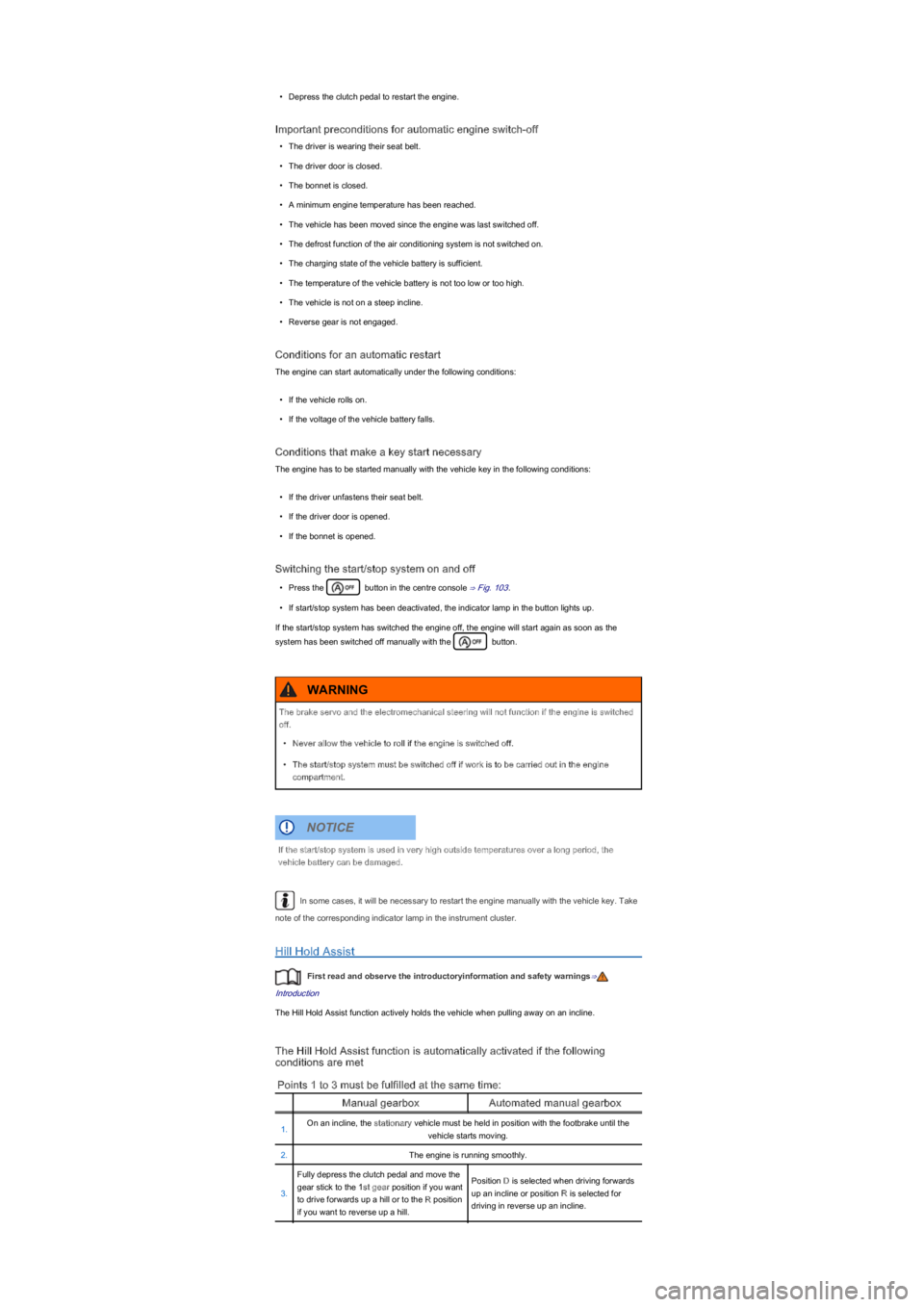
Important preconditions for automatic engine switch-off
•The driver is wearing their seat belt.
•The driver door is closed.
•The bonnet is closed.
•A minimum engine temperature has been reached.
•The vehicle has been moved since the engine was last switched off.
•The defrost function of the air conditioning system is not switched on.
•The charging state of the vehicle battery is sufficient.
•The temperature of the vehicle battery is not too low or too high.
•The vehicle is not on a steep incline.
•Reverse gear is not engaged.
Conditions for an automatic restart
The engine can start automatically under the following conditions:
•If the vehicle rolls on.
•If the voltage of the vehicle battery falls.
Conditions that make a key start necessary
The engine has to be started manually with the vehicle key in the following conditions:
•If the driver unfastens their seat belt.
•If the driver door is opened.
•If the bonnet is opened.
Switching the start/stop system on and off
•Press the button in the centre console ⇒ Fig. 103.
•If start/stop system has been deactivated, the indicator lamp in the button lights up.
If the start/stop system has switched the engine off, the engine will start again as soon as the
system has been switched off manually with the button.
In some cases, it will be necessary to restart the engine manually with the vehicle key. Take
note of the corresponding indicator lamp in the instrument cluster.
Hill Hold Assist
First read and observe the introductoryinformation and safety warnings⇒
Introduction
The Hill Hold Assist function actively holds the vehicle when pulling away on an incline.
The Hill Hold Assist function is automatically activated if the following
conditions are met
Points 1 to 3 must be fulfilled at the same time:
Manual gearboxAutomated manual gearbox
1.On an incline, the stationary vehicle must be held in position with the footbrake until the
vehicle starts moving.
2.The engine is running smoothly.
3.
Fully depress the clutch pedal and move the
gear stick to the 1st gear position if you want
to drive forwards up a hill or to the R position
if you want to reverse up a hill.
Position D is selected when driving forwards
up an incline or position R is selected for
driving in reverse up an incline.
The brake servo and the electromechanical steering will not function if the engine is switched
off.
•Never allow the vehicle to roll if the engine is switched off.
•The start/stop system must be switched off if work is to be carried out in the engine
compartment.
WARNING
If the start/stop system is used in very high outside temperatures over a long period, the
vehicle battery can be damaged.
NOTICE
Page 116 of 211
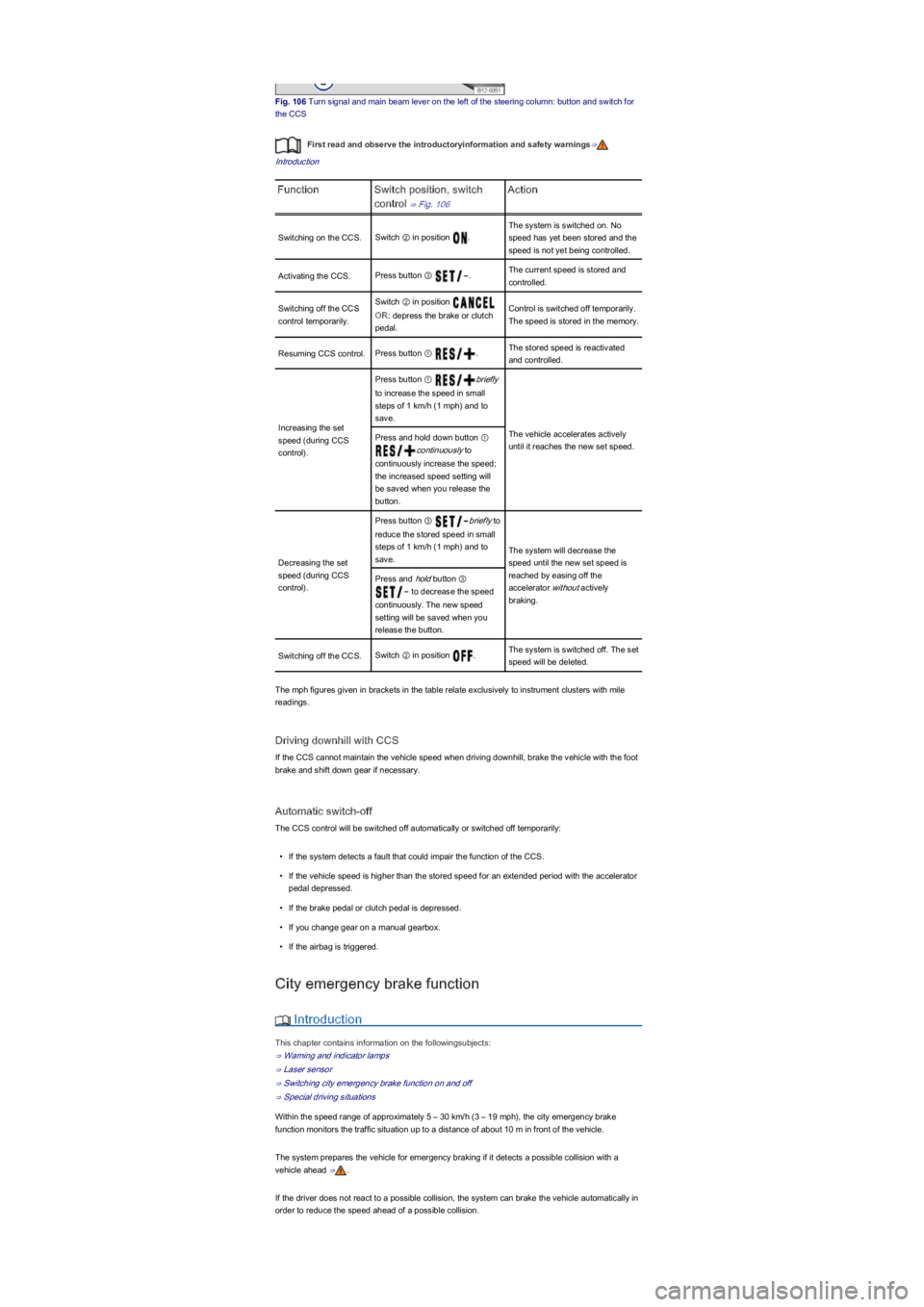
Fig. 106 Turn signal and main beam lever on the left of the steering column: button and switch for
the CCS
First read and observe the introductoryinformation and safety warnings⇒
Introduction
FunctionSwitch position, switch
control ⇒ Fig. 106
Action
Switching on the CCS.Switch ② in position .
The system is switched on. No
speed has yet been stored and the
speed is not yet being controlled.
Activating the CCS.Press button ③ .The current speed is stored and
controlled.
Switching off the CCS
control temporarily.
Switch ② in position
OR: depress the brake or clutch
pedal.
Control is switched off temporarily.
The speed is stored in the memory.
Resuming CCS control.Press button ① .The stored speed is reactivated
and controlled.
Increasing the set
speed (during CCS
control).
Press button ① briefly
to increase the speed in small
steps of 1 km/h (1 mph) and to
save.
The vehicle accelerates actively
until it reaches the new set speed.
Press and hold down button ①
continuously to
continuously increase the speed;
the increased speed setting will
be saved when you release the
button.
Decreasing the set
speed (during CCS
control).
Press button ③ briefly to
reduce the stored speed in small
steps of 1 km/h (1 mph) and to
save.
The system will decrease the
speed until the new set speed is
reached by easing off the
accelerator without actively
braking.
Press and hold button ③
to decrease the speed
continuously. The new speed
setting will be saved when you
release the button.
Switching off the CCS.Switch ② in position .The system is switched off. The set
speed will be deleted.
The mph figures given in brackets in the table relate exclusively to instrument clusters with mile
readings.
Driving downhill with CCS
If the CCS cannot maintain the vehicle speed when driving downhill, brake the vehicle with the foot
brake and shift down gear if necessary.
Automatic switch-off
The CCS control will be switched off automatically or switched off temporarily:
•If the system detects a fault that could impair the function of the CCS.
•If the vehicle speed is higher than the stored speed for an extended period with the accelerator
pedal depressed.
•If the brake pedal or clutch pedal is depressed.
•If you change gear on a manual gearbox.
•If the airbag is triggered.
City emergency brake function
Introduction
This chapter contains information on the followingsubjects:
⇒ Warning and indicator lamps
⇒ Laser sensor
⇒ Switching city emergency brake function on and off
⇒ Special driving situations
Within the speed range of approximately 5 – 30 km/h (3 – 19 mph), the city emergency brake
function monitors the traffic situation up to a distance of about 10 m in front of the vehicle.
The system prepares the vehicle for emergency braking if it detects a possible collision with a
vehicle ahead ⇒.
If the driver does not react to a possible collision, the system can brake the vehicle automatically in
order to reduce the speed ahead of a possible collision.
Page 117 of 211
If, in a potential collision scenario, the city emergency brake function detects that the driver is
applying the brakes with insufficient pressure, the system can increase the brake pressure in order
to reduce speed ahead of the collision. Hence the system can help minimise the consequences of
an accident.
Additional information and warnings:
•Exterior views ⇒ Exterior views
•Lower section of the centre console ⇒ Overview of the centre console
•Instrument cluster ⇒ Instrument cluster
•Accessories, modifications, repairs and renewal of parts ⇒ Accessories, modifications, repairs
and renewal of parts
The brake pedal travel decreases when the city emergency brake function is triggered. This
may make the brake pedal feel stiffer.
Automatic brake intervention by the city emergency brake function can be stopped by using
the clutch, the accelerator or steering intervention.
Unusual noises may be heard if the city emergency brake function is applying an automatic
braking procedure. This is normal and the noises are caused by the braking system.
Warning and indicator lamps
First read and observe the introductoryinformation and safety warnings⇒
Introduction
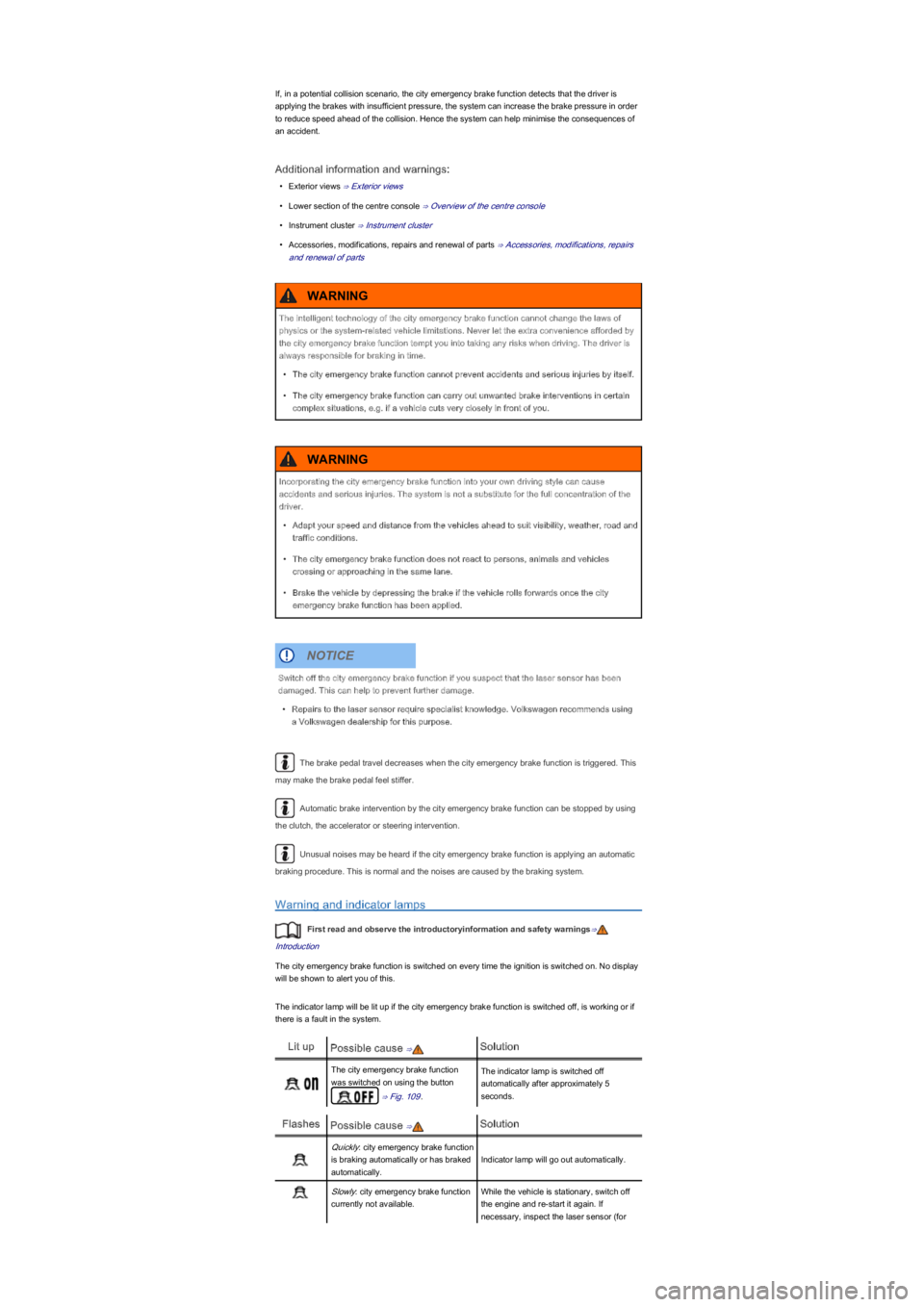
The city emergency brake function is switched on every time the ignition is switched on. No display
will be shown to alert you of this.
The indicator lamp will be lit up if the city emergency brake function is switched off, is working or if
there is a fault in the system.
Lit upPossible cause ⇒Solution
The city emergency brake function
was switched on using the button
⇒ Fig. 109.
The indicator lamp is switched off
automatically after approximately 5
seconds.
FlashesPossible cause ⇒Solution
Quickly: city emergency brake function
is braking automatically or has braked
automatically.
Indicator lamp will go out automatically.
Slowly: city emergency brake function
currently not available.
While the vehicle is stationary, switch off
the engine and re-start it again. If
necessary, inspect the laser sensor (for
The intelligent technology of the city emergency brake function cannot change the laws of
physics or the system-related vehicle limitations. Never let the extra convenience afforded by
the city emergency brake function tempt you into taking any risks when driving. The driver is
always responsible for braking in time.
•The city emergency brake function cannot prevent accidents and serious injuries by itself.
•The city emergency brake function can carry out unwanted brake interventions in certain
complex situations, e.g. if a vehicle cuts very closely in front of you.
WARNING
Incorporating the city emergency brake function into your own driving style can cause
accidents and serious injuries. The system is not a substitute for the full concentration of the
driver.
•Adapt your speed and distance from the vehicles ahead to suit visibility, weather, road and
traffic conditions.
•The city emergency brake function does not react to persons, animals and vehicles
crossing or approaching in the same lane.
•Brake the vehicle by depressing the brake if the vehicle rolls forwards once the city
emergency brake function has been applied.
WARNING
Switch off the city emergency brake function if you suspect that the laser sensor has been
damaged. This can help to prevent further damage.
•Repairs to the laser sensor require specialist knowledge. Volkswagen recommends using
a Volkswagen dealership for this purpose.
NOTICE
Page 120 of 211
Special driving situations
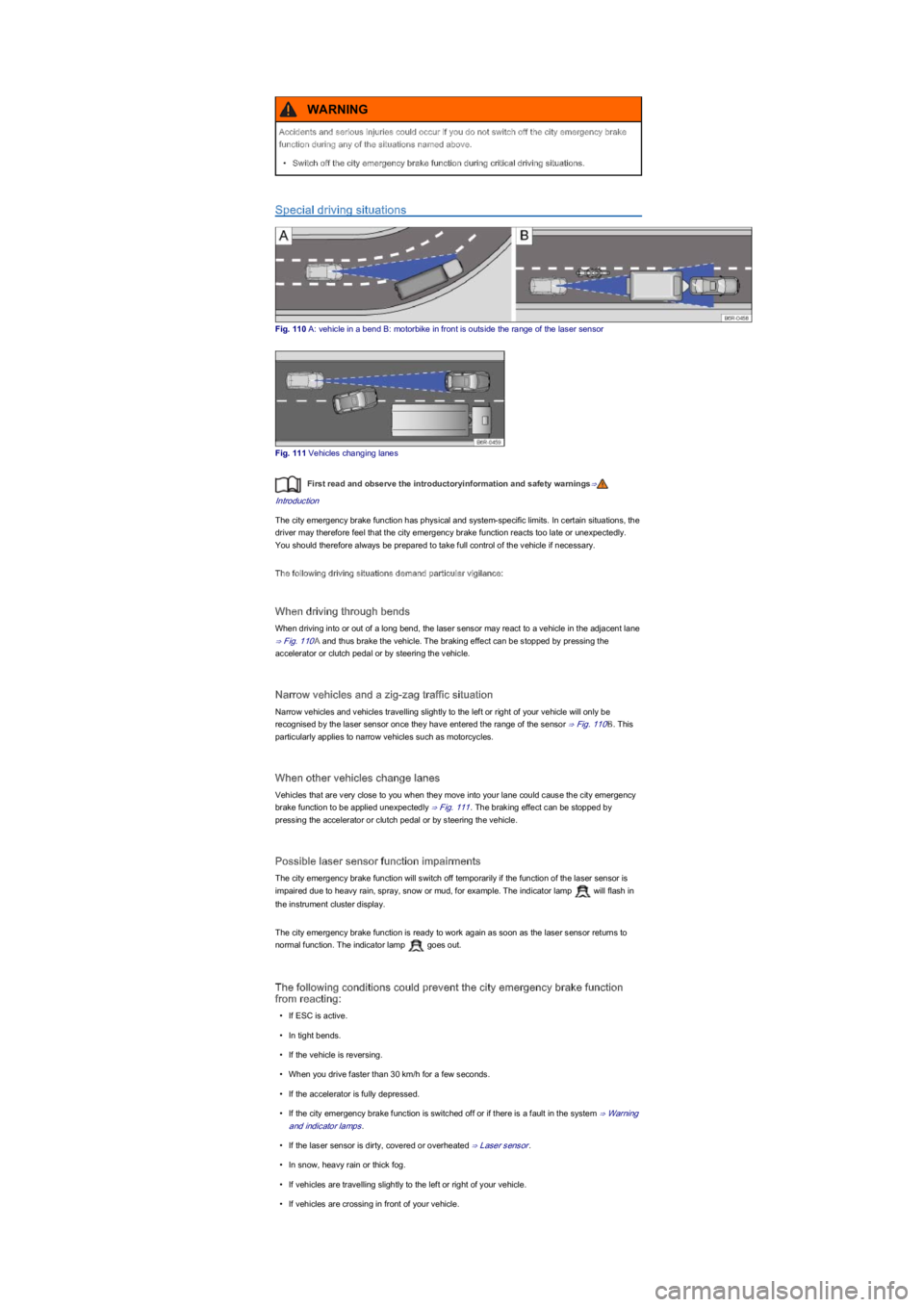
Fig. 110 A: vehicle in a bend B: motorbike in front is outside the range of the laser sensor
Fig. 111 Vehicles changing lanes
First read and observe the introductoryinformation and safety warnings⇒
Introduction
The city emergency brake function has physical and system-specific limits. In certain situations, the
driver may therefore feel that the city emergency brake function reacts too late or unexpectedly.
You should therefore always be prepared to take full control of the vehicle if necessary.
The following driving situations demand particular vigilance:
When driving through bends
When driving into or out of a long bend, the laser sensor may react to a vehicle in the adjacent lane
⇒ Fig. 110A and thus brake the vehicle. The braking effect can be stopped by pressing the
accelerator or clutch pedal or by steering the vehicle.
Narrow vehicles and a zig-zag traffic situation
Narrow vehicles and vehicles travelling slightly to the left or right of your vehicle will only be
recognised by the laser sensor once they have entered the range of the sensor ⇒ Fig. 110B. This
particularly applies to narrow vehicles such as motorcycles.
When other vehicles change lanes
Vehicles that are very close to you when they move into your lane could cause the city emergency
brake function to be applied unexpectedly ⇒ Fig. 111. The braking effect can be stopped by
pressing the accelerator or clutch pedal or by steering the vehicle.
Possible laser sensor function impairments
The city emergency brake function will switch off temporarily if the function of the laser sensor is
impaired due to heavy rain, spray, snow or mud, for example. The indicator lamp will flash in
the instrument cluster display.
The city emergency brake function is ready to work again as soon as the laser sensor returns to
normal function. The indicator lamp goes out.
The following conditions could prevent the city emergency brake function
from reacting:
•If ESC is active.
•In tight bends.
•If the vehicle is reversing.
•When you drive faster than 30 km/h for a few seconds.
•If the accelerator is fully depressed.
•If the city emergency brake function is switched off or if there is a fault in the system ⇒ Warning
and indicator lamps.
•If the laser sensor is dirty, covered or overheated ⇒ Laser sensor.
•In snow, heavy rain or thick fog.
•If vehicles are travelling slightly to the left or right of your vehicle.
•If vehicles are crossing in front of your vehicle.
Accidents and serious injuries could occur if you do not switch off the city emergency brake
function during any of the situations named above.
•Switch off the city emergency brake function during critical driving situations.
WARNING
Page 126 of 211
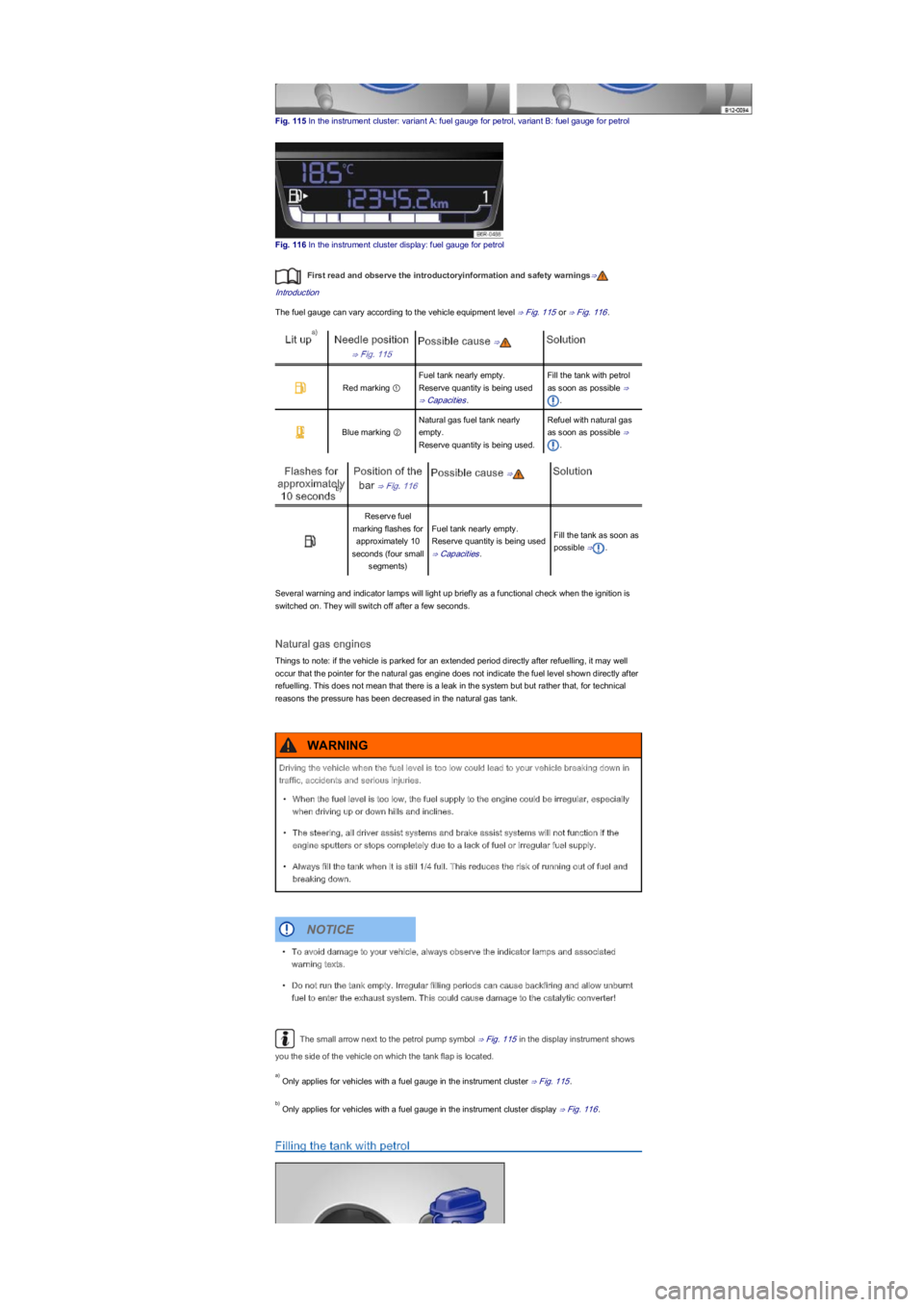
Fig. 115 In the instrument cluster: variant A: fuel gauge for petrol, variant B: fuel gauge for petrol
Fig. 116 In the instrument cluster display: fuel gauge for petrol
First read and observe the introductoryinformation and safety warnings⇒
Introduction
The fuel gauge can vary according to the vehicle equipment level ⇒ Fig. 115 or ⇒ Fig. 116.
Lit upNeedle position
⇒ Fig. 115
Possible cause ⇒Solution
Red marking ①
Fuel tank nearly empty.
Reserve quantity is being used
⇒ Capacities.
Fill the tank with petrol
as soon as possible ⇒
.
Blue marking ②
Natural gas fuel tank nearly
empty.
Reserve quantity is being used.
Refuel with natural gas
as soon as possible ⇒
.
Flashes for
approximately
10 seconds
Position of the
bar ⇒ Fig. 116
Possible cause ⇒Solution
Reserve fuel
marking flashes for
approximately 10
seconds (four small
segments)
Fuel tank nearly empty.
Reserve quantity is being used
⇒ Capacities.
Fill the tank as soon as
possible ⇒.
Several warning and indicator lamps will light up briefly as a functional check when the ignition is
switched on. They will switch off after a few seconds.
Natural gas engines
Things to note: if the vehicle is parked for an extended period directly after refuelling, it may well
occur that the pointer for the natural gas engine does not indicate the fuel level shown directly after
refuelling. This does not mean that there is a leak in the system but but rather that, for technical
reasons the pressure has been decreased in the natural gas tank.
The small arrow next to the petrol pump symbol ⇒ Fig. 115 in the display instrument shows
you the side of the vehicle on which the tank flap is located.
Only applies for vehicles with a fuel gauge in the instrument cluster ⇒ Fig. 115.
Only applies for vehicles with a fuel gauge in the instrument cluster display ⇒ Fig. 116.
Filling the tank with petrol
a)
b)
Driving the vehicle when the fuel level is too low could lead to your vehicle breaking down in
traffic, accidents and serious injuries.
•When the fuel level is too low, the fuel supply to the engine could be irregular, especially
when driving up or down hills and inclines.
•The steering, all driver assist systems and brake assist systems will not function if the
engine sputters or stops completely due to a lack of fuel or irregular fuel supply.
•Always fill the tank when it is still 1/4 full. This reduces the risk of running out of fuel and
breaking down.
WARNING
•To avoid damage to your vehicle, always observe the indicator lamps and associated
warning texts.
•Do not run the tank empty. Irregular filling periods can cause backfiring and allow unburnt
fuel to enter the exhaust system. This could cause damage to the catalytic converter!
NOTICE
a)
b)
Page 139 of 211
Coolant and coolant additives can pollute the environment. Spilt operating fluids must be
collected and disposed of properly and with respect for the environment.
Warning lamp for coolant
First read and observe the introductoryinformation and safety warnings⇒
Introduction
Several warning and indicator lamps will light up briefly as a functional check when the ignition is
switched on. They will switch off after a few seconds.
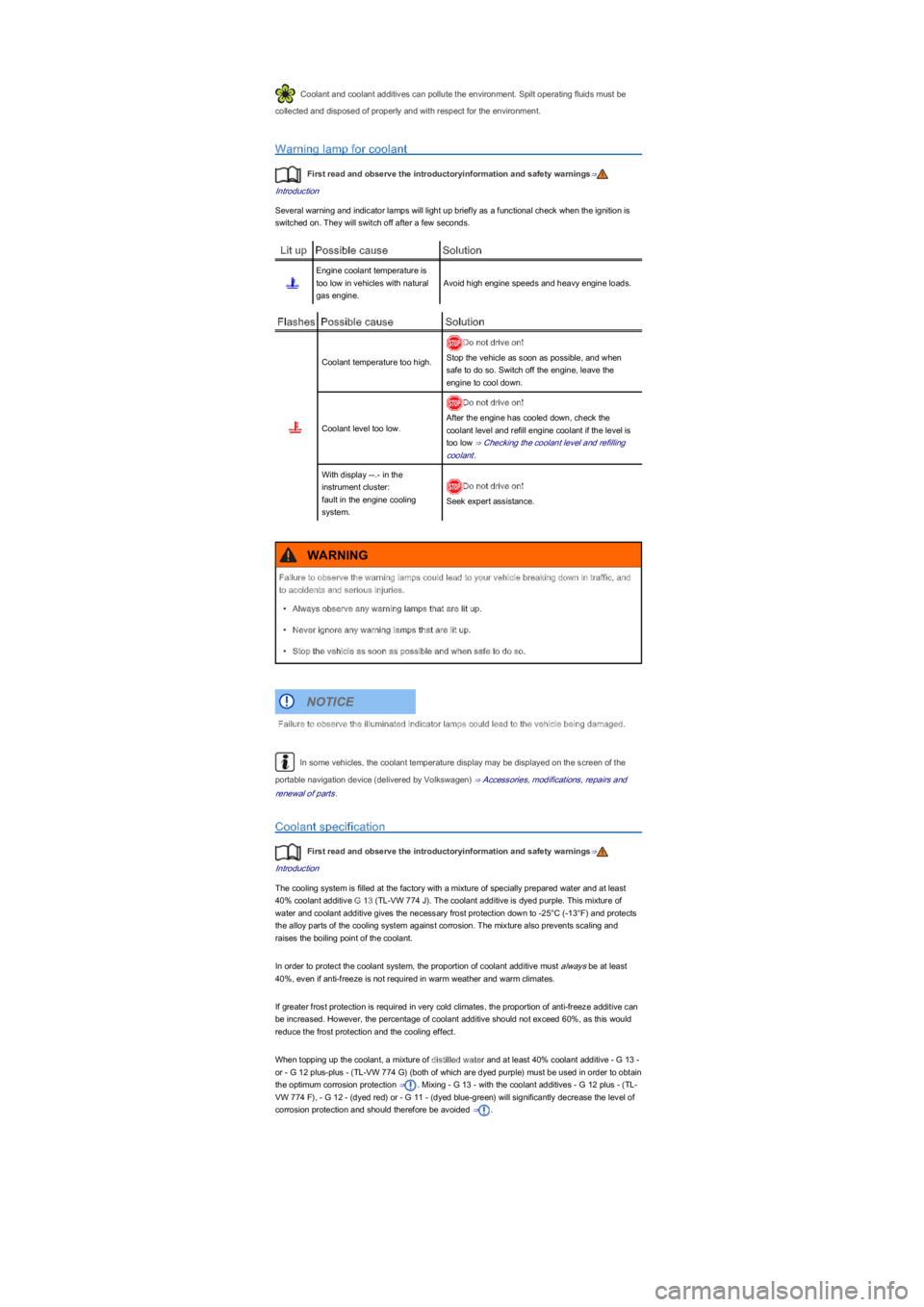
Lit upPossible causeSolution
Engine coolant temperature is
too low in vehicles with natural
gas engine.
Avoid high engine speeds and heavy engine loads.
FlashesPossible causeSolution
Coolant temperature too high.
Do not drive on!
Stop the vehicle as soon as possible, and when
safe to do so. Switch off the engine, leave the
engine to cool down.
Coolant level too low.
Do not drive on!
After the engine has cooled down, check the
coolant level and refill engine coolant if the level is
too low ⇒ Checking the coolant level and refilling
coolant.
With display --.- in the
instrument cluster:
fault in the engine cooling
system.
Do not drive on!
Seek expert assistance.
In some vehicles, the coolant temperature display may be displayed on the screen of the
portable navigation device (delivered by Volkswagen) ⇒ Accessories, modifications, repairs and
renewal of parts.
Coolant specification
First read and observe the introductoryinformation and safety warnings⇒
Introduction
The cooling system is filled at the factory with a mixture of specially prepared water and at least
40% coolant additive G 13 (TL-VW 774 J). The coolant additive is dyed purple. This mixture of
water and coolant additive gives the necessary frost protection down to -25°C (-13°F) and protects
the alloy parts of the cooling system against corrosion. The mixture also prevents scaling and
raises the boiling point of the coolant.
In order to protect the coolant system, the proportion of coolant additive must always be at least
40%, even if anti-freeze is not required in warm weather and warm climates.
If greater frost protection is required in very cold climates, the proportion of anti-freeze additive can
be increased. However, the percentage of coolant additive should not exceed 60%, as this would
reduce the frost protection and the cooling effect.
When topping up the coolant, a mixture of distilled water and at least 40% coolant additive - G 13 -
or - G 12 plus-plus - (TL-VW 774 G) (both of which are dyed purple) must be used in order to obtain
the optimum corrosion protection ⇒. Mixing - G 13 - with the coolant additives - G 12 plus - (TL-
VW 774 F), - G 12 - (dyed red) or - G 11 - (dyed blue-green) will significantly decrease the level of
corrosion protection and should therefore be avoided ⇒.
Failure to observe the warning lamps could lead to your vehicle breaking down in traffic, and
to accidents and serious injuries.
•Always observe any warning lamps that are lit up.
•Never ignore any warning lamps that are lit up.
•Stop the vehicle as soon as possible and when safe to do so.
WARNING
Failure to observe the illuminated indicator lamps could lead to the vehicle being damaged.
NOTICE
Page 167 of 211
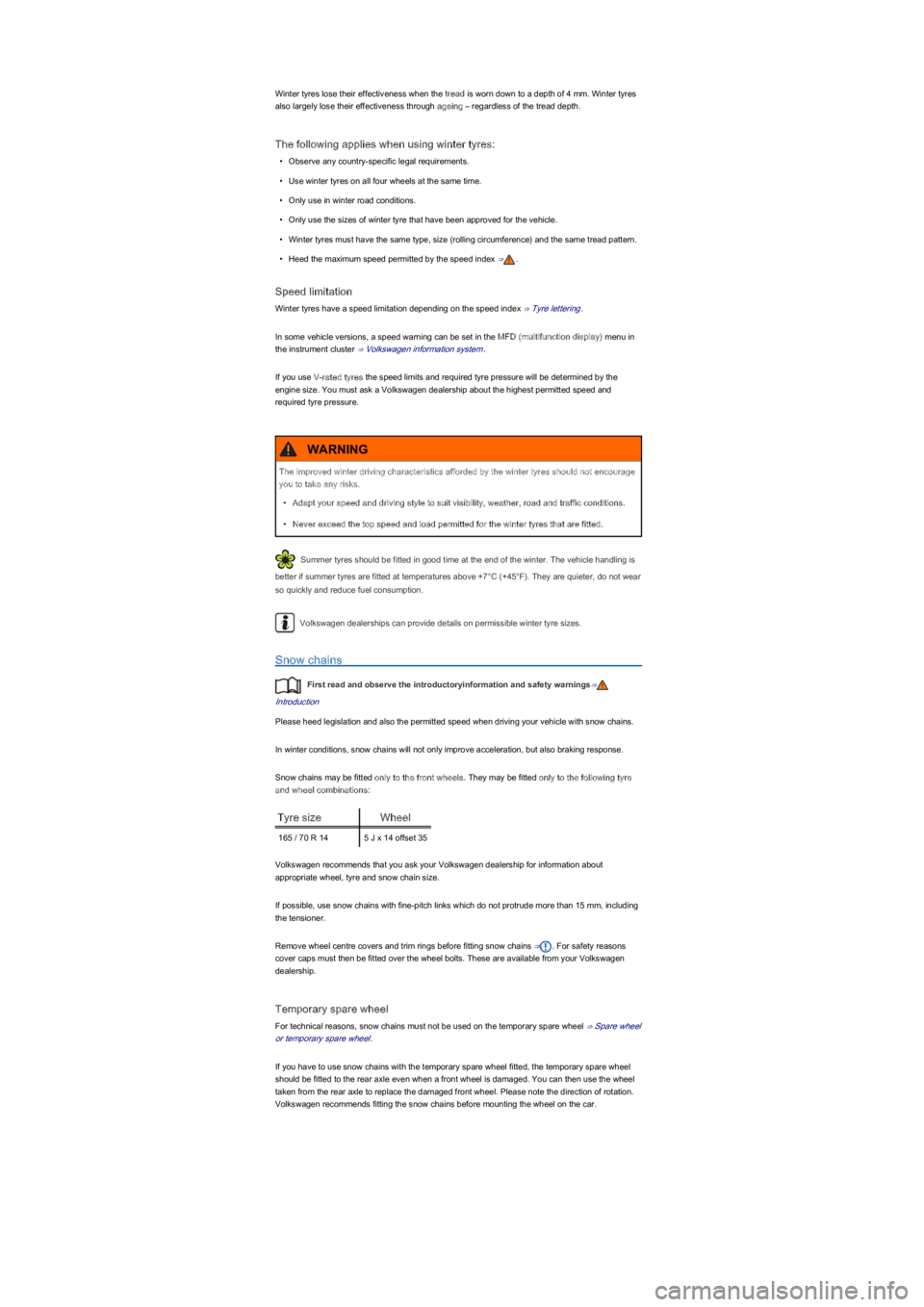
Winter tyres lose their effectiveness when the tread is worn down to a depth of 4 mm. Winter tyres
also largely lose their effectiveness through ageing – regardless of the tread depth.
The following applies when using winter tyres:
•Observe any country-specific legal requirements.
•Use winter tyres on all four wheels at the same time.
•Only use in winter road conditions.
•Only use the sizes of winter tyre that have been approved for the vehicle.
•Winter tyres must have the same type, size (rolling circumference) and the same tread pattern.
•Heed the maximum speed permitted by the speed index ⇒.
Speed limitation
Winter tyres have a speed limitation depending on the speed index ⇒ Tyre lettering.
In some vehicle versions, a speed warning can be set in the MFD (multifunction display) menu in
the instrument cluster ⇒ Volkswagen information system.
If you use V-rated tyres the speed limits and required tyre pressure will be determined by the
engine size. You must ask a Volkswagen dealership about the highest permitted speed and
required tyre pressure.
Summer tyres should be fitted in good time at the end of the winter. The vehicle handling is
better if summer tyres are fitted at temperatures above +7°C (+45°F). They are quieter, do not wear
so quickly and reduce fuel consumption.
Volkswagen dealerships can provide details on permissible winter tyre sizes.
Snow chains
First read and observe the introductoryinformation and safety warnings⇒
Introduction
Please heed legislation and also the permitted speed when driving your vehicle with snow chains.
In winter conditions, snow chains will not only improve acceleration, but also braking response.
Snow chains may be fitted only to the front wheels. They may be fitted only to the following tyre
and wheel combinations:
Tyre sizeWheel
165 / 70 R 145 J x 14 offset 35
Volkswagen recommends that you ask your Volkswagen dealership for information about
appropriate wheel, tyre and snow chain size.
If possible, use snow chains with fine-pitch links which do not protrude more than 15 mm, including
the tensioner.
Remove wheel centre covers and trim rings before fitting snow chains ⇒. For safety reasons
cover caps must then be fitted over the wheel bolts. These are available from your Volkswagen
dealership.
Temporary spare wheel
For technical reasons, snow chains must not be used on the temporary spare wheel ⇒ Spare wheel
or temporary spare wheel.
If you have to use snow chains with the temporary spare wheel fitted, the temporary spare wheel
should be fitted to the rear axle even when a front wheel is damaged. You can then use the wheel
taken from the rear axle to replace the damaged front wheel. Please note the direction of rotation.
Volkswagen recommends fitting the snow chains before mounting the wheel on the car.
The improved winter driving characteristics afforded by the winter tyres should not encourage
you to take any risks.
•Adapt your speed and driving style to suit visibility, weather, road and traffic conditions.
•Never exceed the top speed and load permitted for the winter tyres that are fitted.
WARNING
Page 172 of 211
You will need an external aerial to use a two-way radio in the vehicle.
Any retrofit installation of electrical or electronic equipment in the vehicle will affect its vehicle type
approval. Under certain circumstances, this can negate the type approval for the vehicle.
Volkswagen has approved the vehicle for use with two-way radios subject to the following
conditions:
•Correct installation of external aerial.
•A maximum transmitting power of 10 watts.
An external aerial is needed to give the equipment its optimal range.
Check first with a qualified workshop if you wish to use a two-way radio with a transmitting power of
over 10 watts. A qualified workshop is familiar with the technical options for retrofitting. Volkswagen
recommends using a Volkswagen dealership for this purpose.
Please observe legislation and the instructions and information given in the operating manuals for
radio equipment.
Information stored in the control units
First read and observe the introductoryinformation and safety warnings⇒
Introduction
Your vehicle is factory fitted with electronic control units which are responsible for engine and
gearbox management. The control units also monitor the function of the exhaust system and the
airbags.
These electronic control units continuously evaluate data relevant to the vehicle while the vehicle is
being driven. Only these data will be stored if there are any faults recorded or any deviations from
the specified values. This is generally displayed by the indicator lamps on the instrument cluster.
Special units are required to read and evaluate data stored in the control units.
These data are stored so that specialist workshops can diagnose and solve problems. The
following data may have been stored:
•Engine and gearbox-relevant data.
•Speed.
•Direction of travel.
•Braking power.
•Seat belt monitor.
The control units never record conversations that take place in the vehicle. It is neither possible nor
permitted to use the stored data to create movement profiles.
When the vehicle is being used, situations may arise in which the stored data (alone or in
conjunction with other information such as accident reports, vehicle damage, witness statements
etc.) can become assignable to a particular person, in which case it may be necessary to consult an
expert and use the expert's information.
In vehicles with an emergency call function via a mobile telephone or other units, the current
location can be transmitted. In the event of an accident in which the control units register that an
airbag has been triggered, the system can automatically send out a signal. This depends on your
service provider. Transmission is possible only in areas with a sufficiently strong mobile telephone
signal.
Additional functions that are contractually agreed with the customer, e.g. vehicle positioning in an
emergency, allow certain vehicle data to be transmitted from the vehicle.
If radio equipment is not secured or not properly secured in the vehicle, it could be flung
though the interior during a sudden driving or braking manoeuvre, or in the event of an
accident. This can cause injuries.
•While the vehicle is in motion, always secure two-way radios properly outside the airbag
deployment zones or stow them away safely.
WARNING
If two-way radios that are not connected to an external aerial are used, electromagnetic
radiation in the vehicle could exceed limit values and thus be a health hazard for drivers and
other vehicle occupants. This also applies to external aerials that have not been correctly
installed.
•Two-way radios should only be used in the vehicle if an external aerial is properly
connected.
CAUTION