lights VOLKSWAGEN UP! 2021 Owner´s Manual
[x] Cancel search | Manufacturer: VOLKSWAGEN, Model Year: 2021, Model line: UP!, Model: VOLKSWAGEN UP! 2021Pages: 211, PDF Size: 5.98 MB
Page 62 of 211
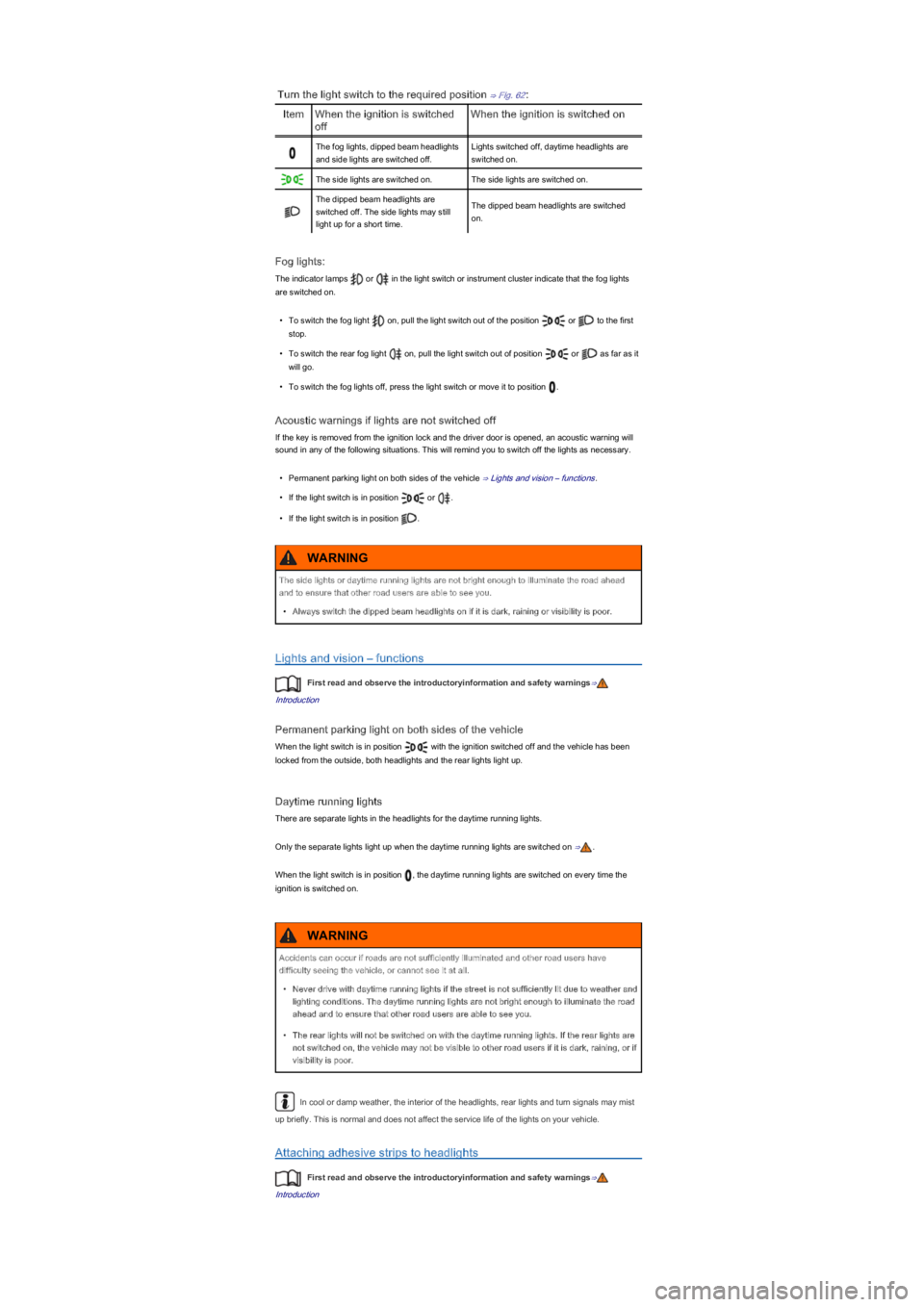
Turn the light switch to the required position ⇒ Fig. 62:
ItemWhen the ignition is switched
off
When the ignition is switched on
The fog lights, dipped beam headlights
and side lights are switched off.
Lights switched off, daytime headlights are
switched on.
The side lights are switched on.The side lights are switched on.
The dipped beam headlights are
switched off. The side lights may still
light up for a short time.
The dipped beam headlights are switched
on.
Fog lights:
The indicator lamps or in the light switch or instrument cluster indicate that the fog lights
are switched on.
•To switch the fog light on, pull the light switch out of the position or to the first
stop.
•To switch the rear fog light on, pull the light switch out of position or as far as it
will go.
•To switch the fog lights off, press the light switch or move it to position .
Acoustic warnings if lights are not switched off
If the key is removed from the ignition lock and the driver door is opened, an acoustic warning will
sound in any of the following situations. This will remind you to switch off the lights as necessary.
•Permanent parking light on both sides of the vehicle ⇒ Lights and vision – functions.
•If the light switch is in position or .
•If the light switch is in position .
Lights and vision – functions
First read and observe the introductoryinformation and safety warnings⇒
Introduction
Permanent parking light on both sides of the vehicle
When the light switch is in position with the ignition switched off and the vehicle has been
locked from the outside, both headlights and the rear lights light up.
Daytime running lights
There are separate lights in the headlights for the daytime running lights.
Only the separate lights light up when the daytime running lights are switched on ⇒.
When the light switch is in position , the daytime running lights are switched on every time the
ignition is switched on.
In cool or damp weather, the interior of the headlights, rear lights and turn signals may mist
up briefly. This is normal and does not affect the service life of the lights on your vehicle.
Attaching adhesive strips to headlights
First read and observe the introductoryinformation and safety warnings⇒
Introduction
The side lights or daytime running lights are not bright enough to illuminate the road ahead
and to ensure that other road users are able to see you.
•Always switch the dipped beam headlights on if it is dark, raining or visibility is poor.
WARNING
Accidents can occur if roads are not sufficiently illuminated and other road users have
difficulty seeing the vehicle, or cannot see it at all.
•Never drive with daytime running lights if the street is not sufficiently lit due to weather and
lighting conditions. The daytime running lights are not bright enough to illuminate the road
ahead and to ensure that other road users are able to see you.
•The rear lights will not be switched on with the daytime running lights. If the rear lights are
not switched on, the vehicle may not be visible to other road users if it is dark, raining, or if
visibility is poor.
WARNING
Page 63 of 211
If you have to drive a right-hand drive vehicle in a left-hand drive country, or vice versa, the
asymmetric dipped beam headlights may dazzle oncoming traffic.
Therefore you may have to apply stickers to certain parts of the headlight lenses if you are driving
abroad. A qualified workshop can provide you with further information. Volkswagen recommends
using a Volkswagen dealership for this purpose.
Stickers may only be used on the headlights for a limited period. Please contact a qualified
workshop for a permanent alteration. Volkswagen recommends using a Volkswagen dealership for
this purpose.
Headlight range control, instrument and switch lighting
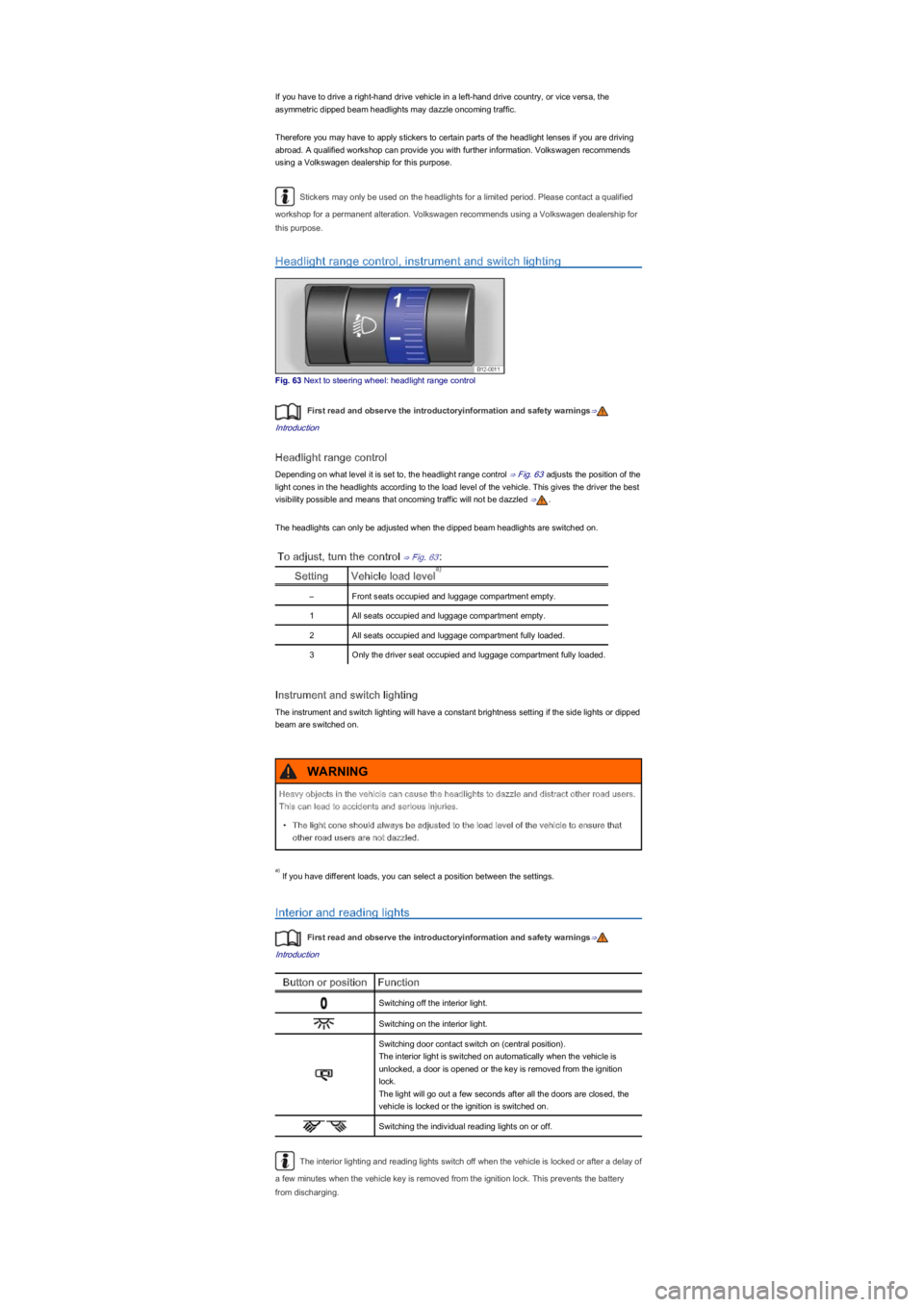
Fig. 63 Next to steering wheel: headlight range control
First read and observe the introductoryinformation and safety warnings⇒
Introduction
Headlight range control
Depending on what level it is set to, the headlight range control ⇒ Fig. 63 adjusts the position of the
light cones in the headlights according to the load level of the vehicle. This gives the driver the best
visibility possible and means that oncoming traffic will not be dazzled ⇒.
The headlights can only be adjusted when the dipped beam headlights are switched on.
To adjust, turn the control ⇒ Fig. 63:
SettingVehicle load level
–Front seats occupied and luggage compartment empty.
1All seats occupied and luggage compartment empty.
2All seats occupied and luggage compartment fully loaded.
3Only the driver seat occupied and luggage compartment fully loaded.
Instrument and switch lighting
The instrument and switch lighting will have a constant brightness setting if the side lights or dipped
beam are switched on.
If you have different loads, you can select a position between the settings.
Interior and reading lights
First read and observe the introductoryinformation and safety warnings⇒
Introduction
Button or positionFunction
Switching off the interior light.
Switching on the interior light.
Switching door contact switch on (central position).
The interior light is switched on automatically when the vehicle is
unlocked, a door is opened or the key is removed from the ignition
lock.
The light will go out a few seconds after all the doors are closed, the
vehicle is locked or the ignition is switched on.
Switching the individual reading lights on or off.
The interior lighting and reading lights switch off when the vehicle is locked or after a delay of
a few minutes when the vehicle key is removed from the ignition lock. This prevents the battery
from discharging.
a)
Heavy objects in the vehicle can cause the headlights to dazzle and distract other road users.
This can lead to accidents and serious injuries.
•The light cone should always be adjusted to the load level of the vehicle to ensure that
other road users are not dazzled.
WARNING
a)
Page 69 of 211
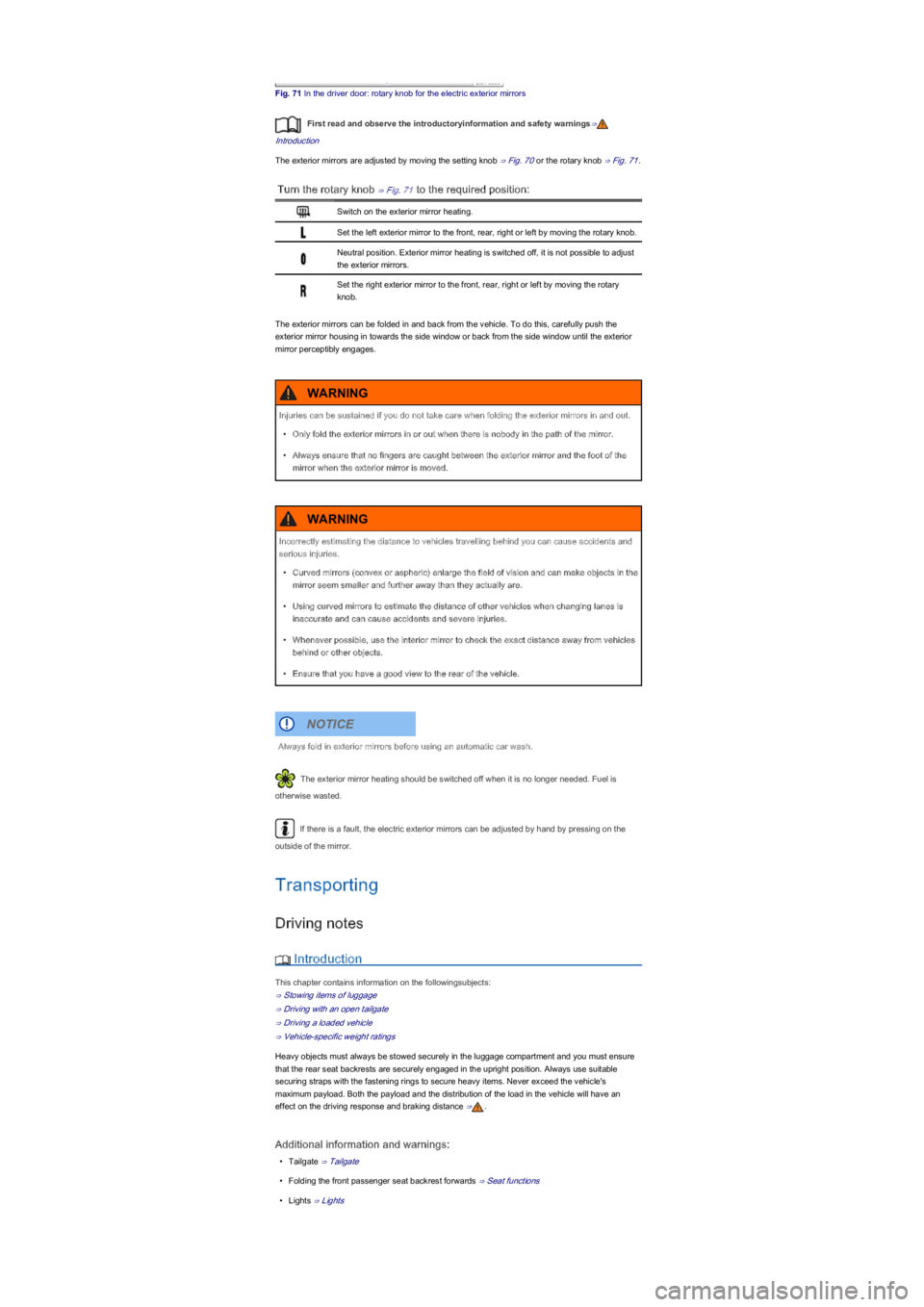
Fig. 71 In the driver door: rotary knob for the electric exterior mirrors
First read and observe the introductoryinformation and safety warnings⇒
Introduction
The exterior mirrors are adjusted by moving the setting knob ⇒ Fig. 70 or the rotary knob ⇒ Fig. 71.
Turn the rotary knob ⇒ Fig. 71 to the required position:
Switch on the exterior mirror heating.
Set the left exterior mirror to the front, rear, right or left by moving the rotary knob.
Neutral position. Exterior mirror heating is switched off, it is not possible to adjust
the exterior mirrors.
Set the right exterior mirror to the front, rear, right or left by moving the rotary
knob.
The exterior mirrors can be folded in and back from the vehicle. To do this, carefully push the
exterior mirror housing in towards the side window or back from the side window until the exterior
mirror perceptibly engages.
The exterior mirror heating should be switched off when it is no longer needed. Fuel is
otherwise wasted.
If there is a fault, the electric exterior mirrors can be adjusted by hand by pressing on the
outside of the mirror.
Transporting
Driving notes
Introduction
This chapter contains information on the followingsubjects:
⇒ Stowing items of luggage
⇒ Driving with an open tailgate
⇒ Driving a loaded vehicle
⇒ Vehicle-specific weight ratings
Heavy objects must always be stowed securely in the luggage compartment and you must ensure
that the rear seat backrests are securely engaged in the upright position. Always use suitable
securing straps with the fastening rings to secure heavy items. Never exceed the vehicle's
maximum payload. Both the payload and the distribution of the load in the vehicle will have an
effect on the driving response and braking distance ⇒.
Additional information and warnings:
•Tailgate ⇒ Tailgate
•Folding the front passenger seat backrest forwards ⇒ Seat functions
•Lights ⇒ Lights
Injuries can be sustained if you do not take care when folding the exterior mirrors in and out.
•Only fold the exterior mirrors in or out when there is nobody in the path of the mirror.
•Always ensure that no fingers are caught between the exterior mirror and the foot of the
mirror when the exterior mirror is moved.
WARNING
Incorrectly estimating the distance to vehicles travelling behind you can cause accidents and
serious injuries.
•Curved mirrors (convex or aspheric) enlarge the field of vision and can make objects in the
mirror seem smaller and further away than they actually are.
•Using curved mirrors to estimate the distance of other vehicles when changing lanes is
inaccurate and can cause accidents and severe injuries.
•Whenever possible, use the interior mirror to check the exact distance away from vehicles
behind or other objects.
•Ensure that you have a good view to the rear of the vehicle.
WARNING
Always fold in exterior mirrors before using an automatic car wash.
NOTICE
Page 70 of 211
•Luggage compartment ⇒ Luggage compartment
•Roof carrier ⇒ Roof carrier
•Wheels and tyres ⇒ Wheels and tyres
Stowing items of luggage
First read and observe the introductoryinformation and safety warnings⇒
Introduction
Always stow all items of luggage in the vehicle securely.
•Always distribute any loads in the vehicle and on the roof as evenly as possible.
•Place heavy objects as far forward in the luggage compartment as possible. Position the rear
seat backrests securely in the upright position.
•Secure luggage in the luggage compartment to the fastening rings with suitable straps
⇒ Luggage compartment.
•Adjust the headlight range ⇒ Lights.
•Adjust the tyre pressure according to the vehicle load. Please read the tyre pressure sticker
⇒ Wheels and tyres.
Observe any information concerning the loading of a roof carrier ⇒ Roof carrier.
Driving with an open tailgate
First read and observe the introductoryinformation and safety warnings⇒
Introduction
Driving with an open tailgate is particularly dangerous. Ensure that the open tailgate and any
objects are secured properly, and take appropriate measures to reduce the quantity of toxic
exhaust fumes entering the vehicle.
Objects that are not secured, or are secured incorrectly, can cause serious injuries in the
event of a sudden driving or braking manoeuvre or accident. This applies particularly if
objects are struck by the airbag when activated and then flung through the vehicle interior.
Please apply the following rules to reduce the risk of accidents:
•Always stow all objects in the vehicle securely. Always stow luggage and heavy objects in
the luggage compartment.
•Always use suitable straps to prevent luggage from entering the deployment zones of the
side airbag or the front airbag in the event of a sudden driving or braking manoeuvre or an
accident.
•Objects should be stowed in the vehicle interior in such a way that they can never enter
the airbag deployment zones while the vehicle is in motion.
•Always keep stowage compartments closed while the vehicle is in motion.
•All objects must be removed from the seat cushion of the front passenger seat if the front
passenger backrest is folded forward. Even light and small objects could be pressed into
the weight detection mat underneath the seat cushion by the backrest when it is folded
forwards and thus send incorrect information to the airbag control units.
•The front airbag must be switched off and the indicator lamp PASSENGER AIR BAG OFF
must light up for as long as the front passenger seat backrest is folded forwards.
•Stowed objects must never cause passengers to assume an incorrect sitting position.
•Any seat blocked by stowed objects must not be used by any passengers.
WARNING
The vehicle handling and braking effect may alter significantly if large or heavy objects are
being transported.
•Adapt your speed and driving style to suit visibility, weather, road and traffic conditions.
•Accelerate carefully and gently.
•Avoid sudden braking and driving manoeuvres.
•Brake earlier than in normal driving.
WARNING
Hard objects on the shelf can chafe against the wires of the heating element in the rear
window and cause damage.
NOTICE
Page 72 of 211
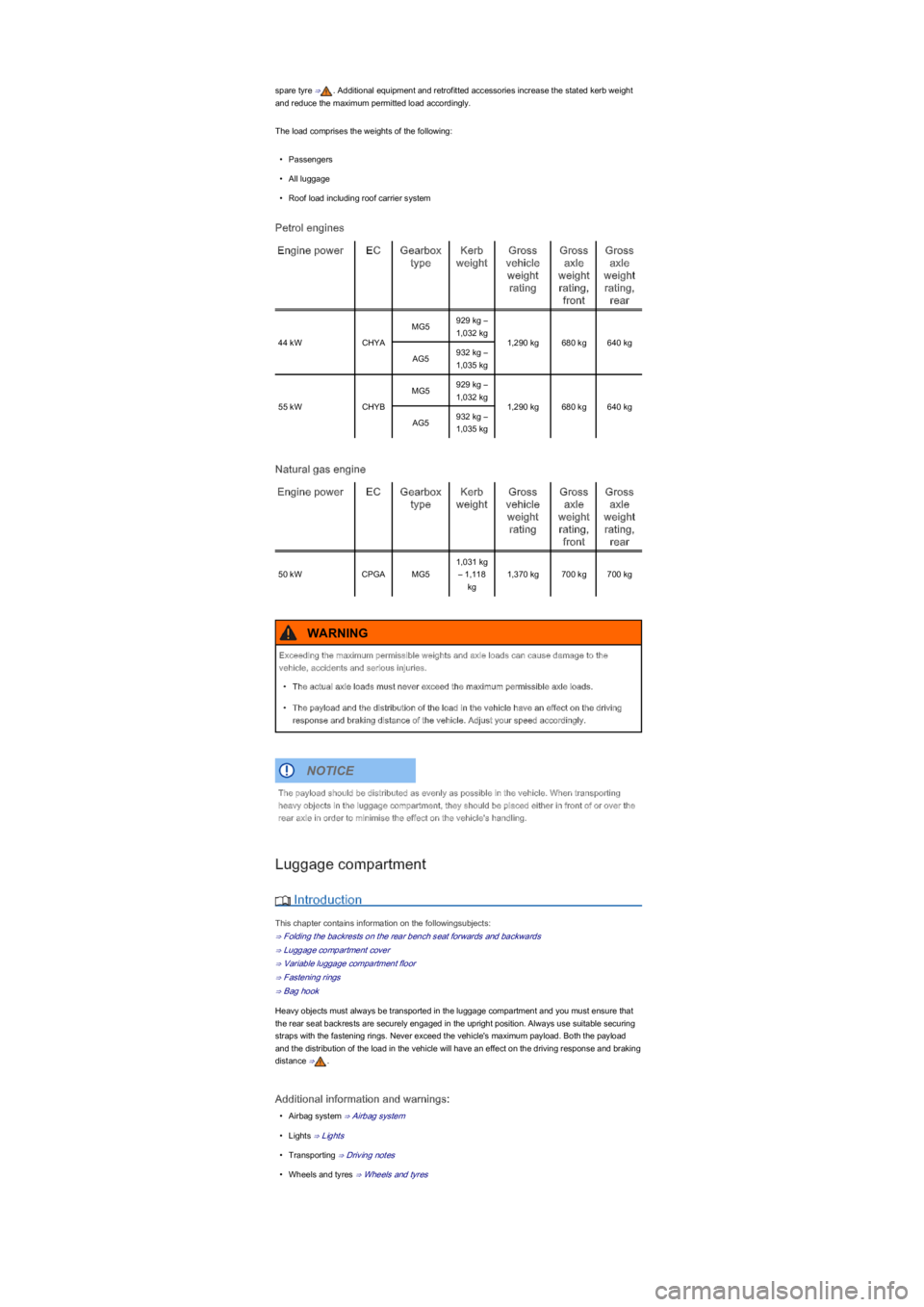
spare tyre ⇒. Additional equipment and retrofitted accessories increase the stated kerb weight
and reduce the maximum permitted load accordingly.
The load comprises the weights of the following:
•Passengers
•All luggage
•Roof load including roof carrier system
Petrol engines
Engine powerECGearbox
type
Kerb
weight
Gross
vehicle
weight
rating
Gross
axle
weight
rating,
front
Gross
axle
weight
rating,
rear
44 kWCHYA
MG5929 kg –
1,032 kg
1,290 kg680 kg640 kg
AG5932 kg –
1,035 kg
55 kWCHYB
MG5929 kg –
1,032 kg
1,290 kg680 kg640 kg
AG5932 kg –
1,035 kg
Natural gas engine
Engine powerECGearbox
type
Kerb
weight
Gross
vehicle
weight
rating
Gross
axle
weight
rating,
front
Gross
axle
weight
rating,
rear
50 kWCPGAMG5
1,031 kg
– 1,118
kg
1,370 kg700 kg700 kg
Luggage compartment
Introduction
This chapter contains information on the followingsubjects:
⇒ Folding the backrests on the rear bench seat forwards and backwards
⇒ Luggage compartment cover
⇒ Variable luggage compartment floor
⇒ Fastening rings
⇒ Bag hook
Heavy objects must always be transported in the luggage compartment and you must ensure that
the rear seat backrests are securely engaged in the upright position. Always use suitable securing
straps with the fastening rings. Never exceed the vehicle's maximum payload. Both the payload
and the distribution of the load in the vehicle will have an effect on the driving response and braking
distance ⇒.
Additional information and warnings:
•Airbag system ⇒ Airbag system
•Lights ⇒ Lights
•Transporting ⇒ Driving notes
•Wheels and tyres ⇒ Wheels and tyres
Exceeding the maximum permissible weights and axle loads can cause damage to the
vehicle, accidents and serious injuries.
•The actual axle loads must never exceed the maximum permissible axle loads.
•The payload and the distribution of the load in the vehicle have an effect on the driving
response and braking distance of the vehicle. Adjust your speed accordingly.
WARNING
The payload should be distributed as evenly as possible in the vehicle. When transporting
heavy objects in the luggage compartment, they should be placed either in front of or over the
rear axle in order to minimise the effect on the vehicle's handling.
NOTICE
Page 77 of 211
Roof carrier
Introduction
This chapter contains information on the followingsubjects:
⇒ Attaching the mounts and load carrier system
⇒ Loading the load carrier system
The roof of the vehicle has been designed for optimum aerodynamic effect. It is therefore no longer
possible to attach conventional roof carrier systems to a rain channel on the roof.
As the rain channels have been integrated into the roof for better aerodynamics, only mounts or
roof carriers approved by Volkswagen can be used.
When should the roof carrier be removed?
•When it is no longer being used.
•When the vehicle is driving through a car wash.
•When the vehicle height exceeds the required clearance height, e.g. in a garage.
Additional information and warnings:
•Lights ⇒ Lights
•Transporting ⇒ Transporting
•Driving with respect for the environment ⇒ Driving with respect for the environment
•Wheels and tyres ⇒ Wheels and tyres
•Accessories, modifications, repairs and renewal of parts ⇒ Accessories, modifications, repairs
and renewal of parts
Driving with a fitted roof carrier will increase air resistance and thus increase fuel
consumption.
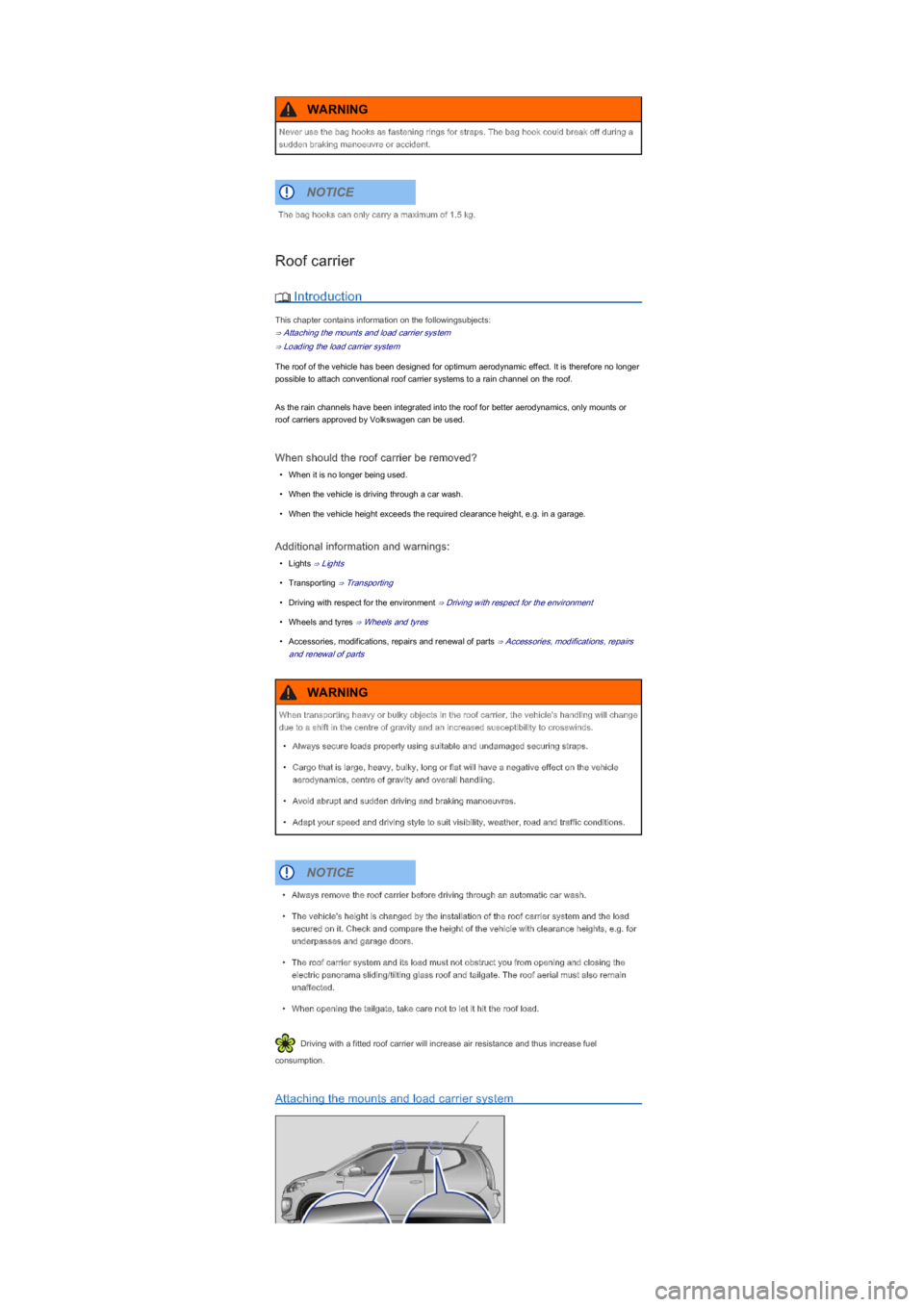
Attaching the mounts and load carrier system
Never use the bag hooks as fastening rings for straps. The bag hook could break off during a
sudden braking manoeuvre or accident.
WARNING
The bag hooks can only carry a maximum of 1.5 kg.
NOTICE
When transporting heavy or bulky objects in the roof carrier, the vehicle's handling will change
due to a shift in the centre of gravity and an increased susceptibility to crosswinds.
•Always secure loads properly using suitable and undamaged securing straps.
•Cargo that is large, heavy, bulky, long or flat will have a negative effect on the vehicle
aerodynamics, centre of gravity and overall handling.
•Avoid abrupt and sudden driving and braking manoeuvres.
•Adapt your speed and driving style to suit visibility, weather, road and traffic conditions.
WARNING
•Always remove the roof carrier before driving through an automatic car wash.
•The vehicle's height is changed by the installation of the roof carrier system and the load
secured on it. Check and compare the height of the vehicle with clearance heights, e.g. for
underpasses and garage doors.
•The roof carrier system and its load must not obstruct you from opening and closing the
electric panorama sliding/tilting glass roof and tailgate. The roof aerial must also remain
unaffected.
•When opening the tailgate, take care not to let it hit the roof load.
NOTICE
Page 92 of 211
Several warning and indicator lamps will light up briefly as a functional check when the ignition is
switched on. They will switch off after a few seconds.
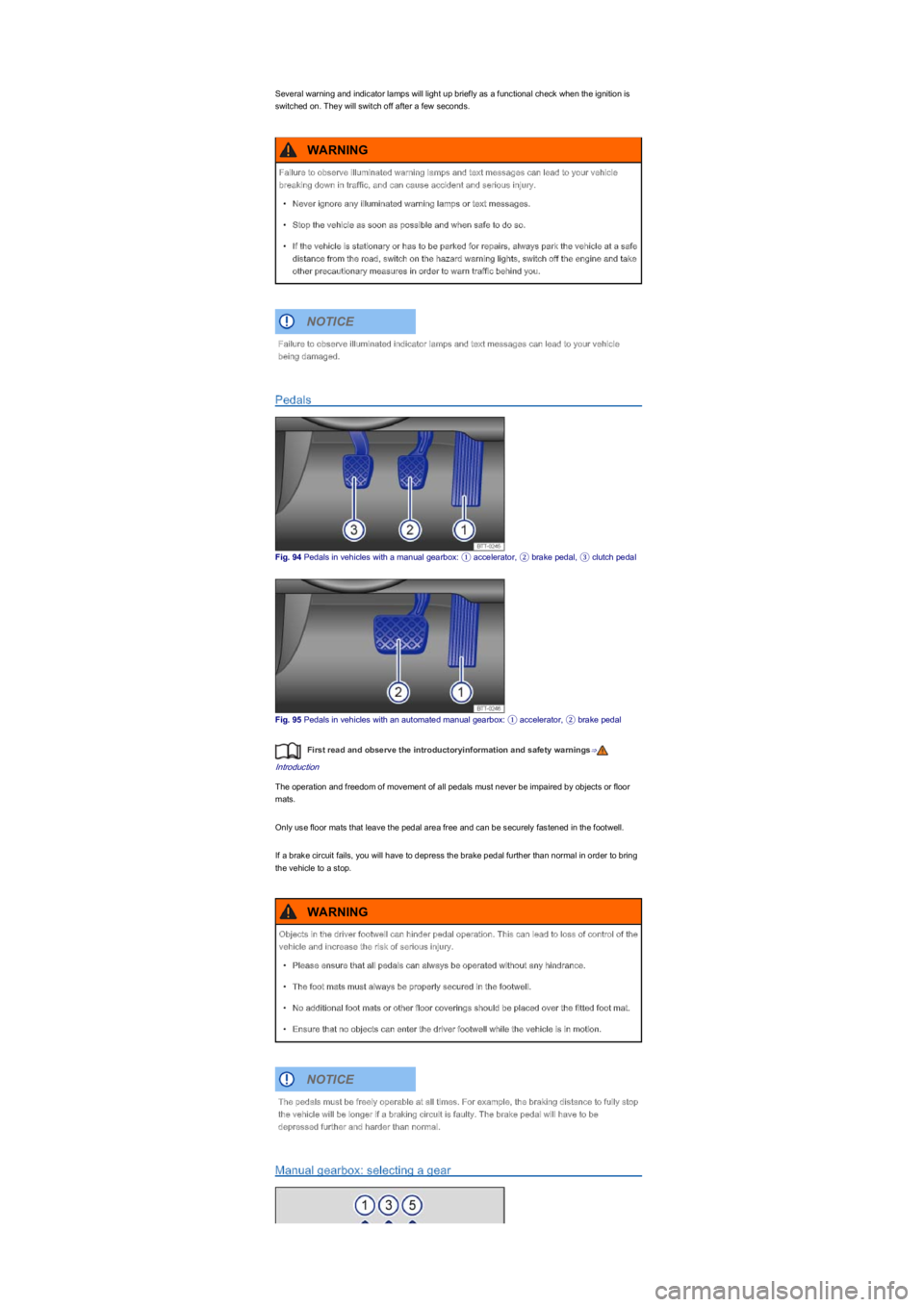
Pedals
Fig. 94 Pedals in vehicles with a manual gearbox: ① accelerator, ② brake pedal, ③ clutch pedal
Fig. 95 Pedals in vehicles with an automated manual gearbox: ① accelerator, ② brake pedal
First read and observe the introductoryinformation and safety warnings⇒
Introduction
The operation and freedom of movement of all pedals must never be impaired by objects or floor
mats.
Only use floor mats that leave the pedal area free and can be securely fastened in the footwell.
If a brake circuit fails, you will have to depress the brake pedal further than normal in order to bring
the vehicle to a stop.
Manual gearbox: selecting a gear
Failure to observe illuminated warning lamps and text messages can lead to your vehicle
breaking down in traffic, and can cause accident and serious injury.
•Never ignore any illuminated warning lamps or text messages.
•Stop the vehicle as soon as possible and when safe to do so.
•If the vehicle is stationary or has to be parked for repairs, always park the vehicle at a safe
distance from the road, switch on the hazard warning lights, switch off the engine and take
other precautionary measures in order to warn traffic behind you.
WARNING
Failure to observe illuminated indicator lamps and text messages can lead to your vehicle
being damaged.
NOTICE
Objects in the driver footwell can hinder pedal operation. This can lead to loss of control of the
vehicle and increase the risk of serious injury.
•Please ensure that all pedals can always be operated without any hindrance.
•The foot mats must always be properly secured in the footwell.
•No additional foot mats or other floor coverings should be placed over the fitted foot mat.
•Ensure that no objects can enter the driver footwell while the vehicle is in motion.
WARNING
The pedals must be freely operable at all times. For example, the braking distance to fully stop
the vehicle will be longer if a braking circuit is faulty. The brake pedal will have to be
depressed further and harder than normal.
NOTICE
Page 99 of 211
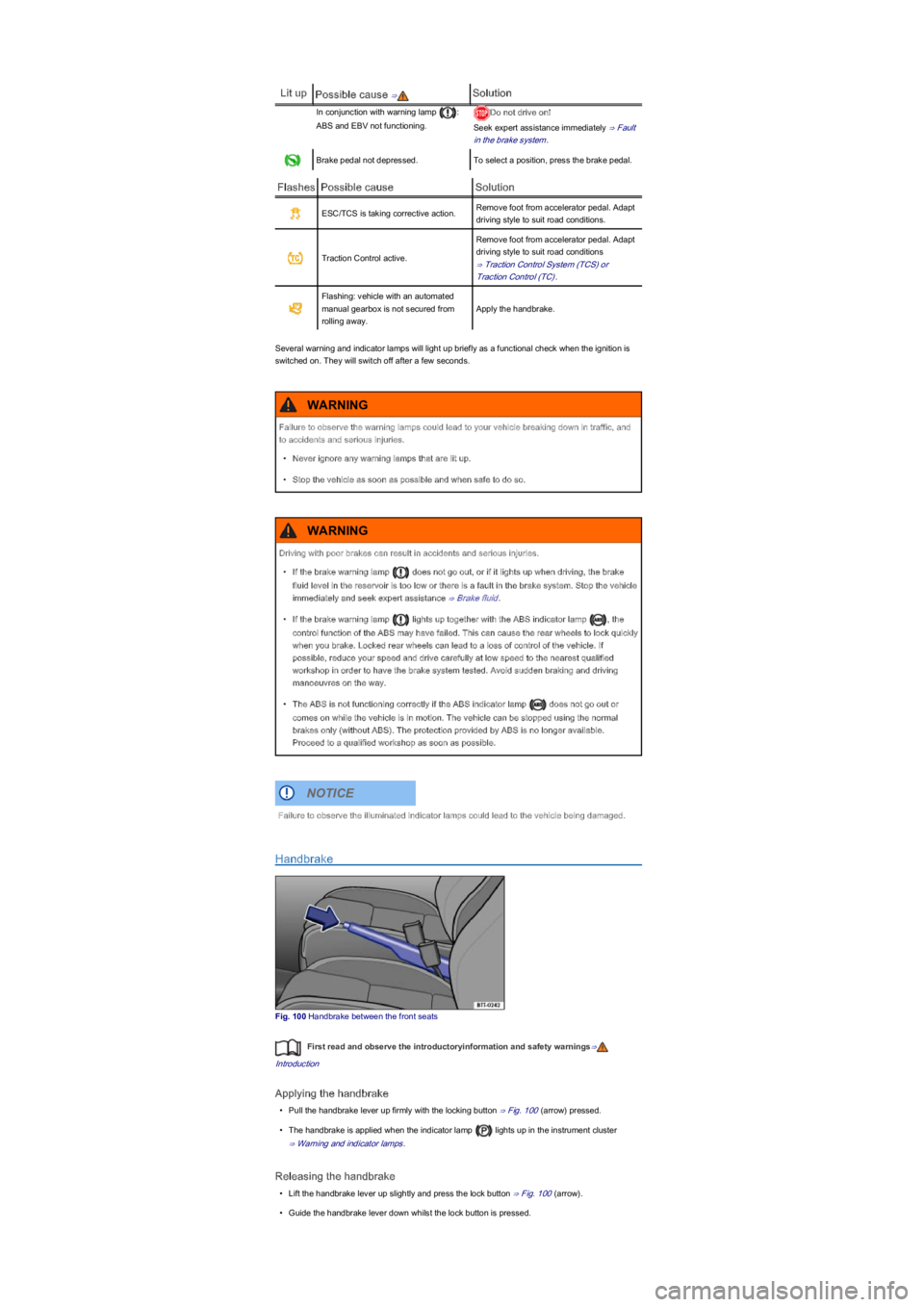
Lit upPossible cause ⇒Solution
In conjunction with warning lamp :
ABS and EBV not functioning.
Do not drive on!
Seek expert assistance immediately ⇒ Fault
in the brake system.
Brake pedal not depressed.To select a position, press the brake pedal.
FlashesPossible causeSolution
ESC/TCS is taking corrective action.Remove foot from accelerator pedal. Adapt
driving style to suit road conditions.
Traction Control active.
Remove foot from accelerator pedal. Adapt
driving style to suit road conditions
⇒ Traction Control System (TCS) or
Traction Control (TC).
Flashing: vehicle with an automated
manual gearbox is not secured from
rolling away.
Apply the handbrake.
Several warning and indicator lamps will light up briefly as a functional check when the ignition is
switched on. They will switch off after a few seconds.
Handbrake
Fig. 100 Handbrake between the front seats
First read and observe the introductoryinformation and safety warnings⇒
Introduction
Applying the handbrake
•Pull the handbrake lever up firmly with the locking button ⇒ Fig. 100 (arrow) pressed.
•The handbrake is applied when the indicator lamp lights up in the instrument cluster
⇒ Warning and indicator lamps.
Releasing the handbrake
•Lift the handbrake lever up slightly and press the lock button ⇒ Fig. 100 (arrow).
•Guide the handbrake lever down whilst the lock button is pressed.
Failure to observe the warning lamps could lead to your vehicle breaking down in traffic, and
to accidents and serious injuries.
•Never ignore any warning lamps that are lit up.
•Stop the vehicle as soon as possible and when safe to do so.
WARNING
Driving with poor brakes can result in accidents and serious injuries.
•If the brake warning lamp does not go out, or if it lights up when driving, the brake
fluid level in the reservoir is too low or there is a fault in the brake system. Stop the vehicle
immediately and seek expert assistance ⇒ Brake fluid.
•If the brake warning lamp lights up together with the ABS indicator lamp , the
control function of the ABS may have failed. This can cause the rear wheels to lock quickly
when you brake. Locked rear wheels can lead to a loss of control of the vehicle. If
possible, reduce your speed and drive carefully at low speed to the nearest qualified
workshop in order to have the brake system tested. Avoid sudden braking and driving
manoeuvres on the way.
•The ABS is not functioning correctly if the ABS indicator lamp does not go out or
comes on while the vehicle is in motion. The vehicle can be stopped using the normal
brakes only (without ABS). The protection provided by ABS is no longer available.
Proceed to a qualified workshop as soon as possible.
WARNING
Failure to observe the illuminated indicator lamps could lead to the vehicle being damaged.
NOTICE
Page 107 of 211
•The cooling function of the air conditioning system: if the air conditioning system is set to a very
high or low temperature it will require a lot of energy, which is generated by the engine.
Therefore the temperature setting in the vehicle should not vary too much from the outside
temperature. It may be a good idea to air the vehicle before setting off and then to travel a short
distance with the windows open. The air conditioning system should then be switched on once
the windows have been closed.
•Keep the windows closed when driving at high speeds. Having the windows open increases fuel
consumption.
•Switch the seat heating off as soon as it has served its purpose.
•Switch the rear window heating off as soon as the window has defogged and is clear of ice.
Other factors that increase fuel consumption (examples):
•Fault in engine management.
•Driving in hilly regions.
Driving in a fuel-efficient manner
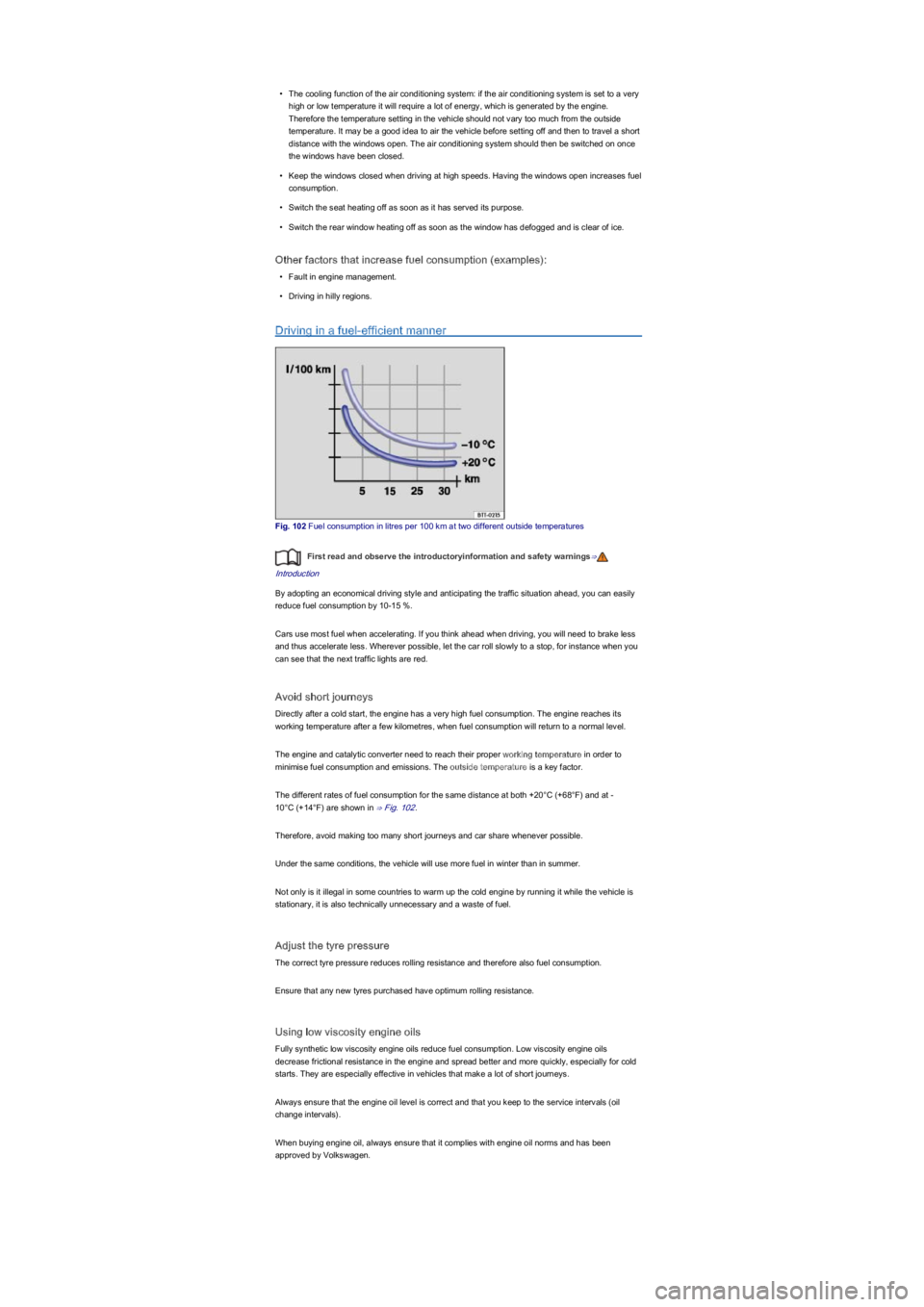
Fig. 102 Fuel consumption in litres per 100 km at two different outside temperatures
First read and observe the introductoryinformation and safety warnings⇒
Introduction
By adopting an economical driving style and anticipating the traffic situation ahead, you can easily
reduce fuel consumption by 10-15 %.
Cars use most fuel when accelerating. If you think ahead when driving, you will need to brake less
and thus accelerate less. Wherever possible, let the car roll slowly to a stop, for instance when you
can see that the next traffic lights are red.
Avoid short journeys
Directly after a cold start, the engine has a very high fuel consumption. The engine reaches its
working temperature after a few kilometres, when fuel consumption will return to a normal level.
The engine and catalytic converter need to reach their proper working temperature in order to
minimise fuel consumption and emissions. The outside temperature is a key factor.
The different rates of fuel consumption for the same distance at both +20°C (+68°F) and at -
10°C (+14°F) are shown in ⇒ Fig. 102.
Therefore, avoid making too many short journeys and car share whenever possible.
Under the same conditions, the vehicle will use more fuel in winter than in summer.
Not only is it illegal in some countries to warm up the cold engine by running it while the vehicle is
stationary, it is also technically unnecessary and a waste of fuel.
Adjust the tyre pressure
The correct tyre pressure reduces rolling resistance and therefore also fuel consumption.
Ensure that any new tyres purchased have optimum rolling resistance.
Using low viscosity engine oils
Fully synthetic low viscosity engine oils reduce fuel consumption. Low viscosity engine oils
decrease frictional resistance in the engine and spread better and more quickly, especially for cold
starts. They are especially effective in vehicles that make a lot of short journeys.
Always ensure that the engine oil level is correct and that you keep to the service intervals (oil
change intervals).
When buying engine oil, always ensure that it complies with engine oil norms and has been
approved by Volkswagen.
Page 111 of 211
•Depress the clutch pedal to restart the engine.
Important preconditions for automatic engine switch-off
•The driver is wearing their seat belt.
•The driver door is closed.
•The bonnet is closed.
•A minimum engine temperature has been reached.
•The vehicle has been moved since the engine was last switched off.
•The defrost function of the air conditioning system is not switched on.
•The charging state of the vehicle battery is sufficient.
•The temperature of the vehicle battery is not too low or too high.
•The vehicle is not on a steep incline.
•Reverse gear is not engaged.
Conditions for an automatic restart
The engine can start automatically under the following conditions:
•If the vehicle rolls on.
•If the voltage of the vehicle battery falls.
Conditions that make a key start necessary
The engine has to be started manually with the vehicle key in the following conditions:
•If the driver unfastens their seat belt.
•If the driver door is opened.
•If the bonnet is opened.
Switching the start/stop system on and off
•Press the button in the centre console ⇒ Fig. 103.
•If start/stop system has been deactivated, the indicator lamp in the button lights up.
If the start/stop system has switched the engine off, the engine will start again as soon as the
system has been switched off manually with the button.
In some cases, it will be necessary to restart the engine manually with the vehicle key. Take
note of the corresponding indicator lamp in the instrument cluster.
Hill Hold Assist
First read and observe the introductoryinformation and safety warnings⇒
Introduction
The Hill Hold Assist function actively holds the vehicle when pulling away on an incline.
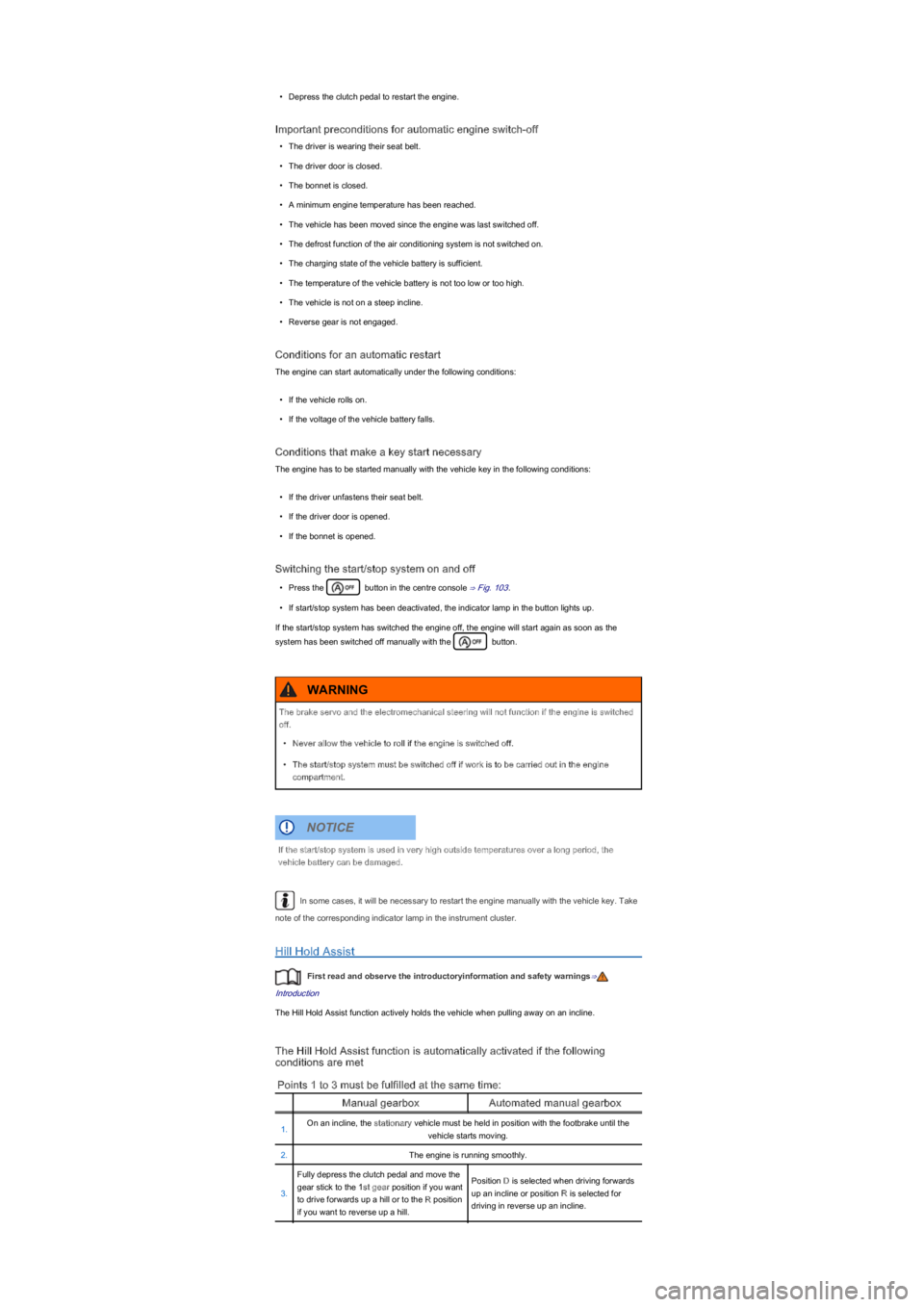
The Hill Hold Assist function is automatically activated if the following
conditions are met
Points 1 to 3 must be fulfilled at the same time:
Manual gearboxAutomated manual gearbox
1.On an incline, the stationary vehicle must be held in position with the footbrake until the
vehicle starts moving.
2.The engine is running smoothly.
3.
Fully depress the clutch pedal and move the
gear stick to the 1st gear position if you want
to drive forwards up a hill or to the R position
if you want to reverse up a hill.
Position D is selected when driving forwards
up an incline or position R is selected for
driving in reverse up an incline.
The brake servo and the electromechanical steering will not function if the engine is switched
off.
•Never allow the vehicle to roll if the engine is switched off.
•The start/stop system must be switched off if work is to be carried out in the engine
compartment.
WARNING
If the start/stop system is used in very high outside temperatures over a long period, the
vehicle battery can be damaged.
NOTICE