fuel VOLKSWAGEN UP! 2021 Owner´s Manual
[x] Cancel search | Manufacturer: VOLKSWAGEN, Model Year: 2021, Model line: UP!, Model: VOLKSWAGEN UP! 2021Pages: 211, PDF Size: 5.98 MB
Page 133 of 211
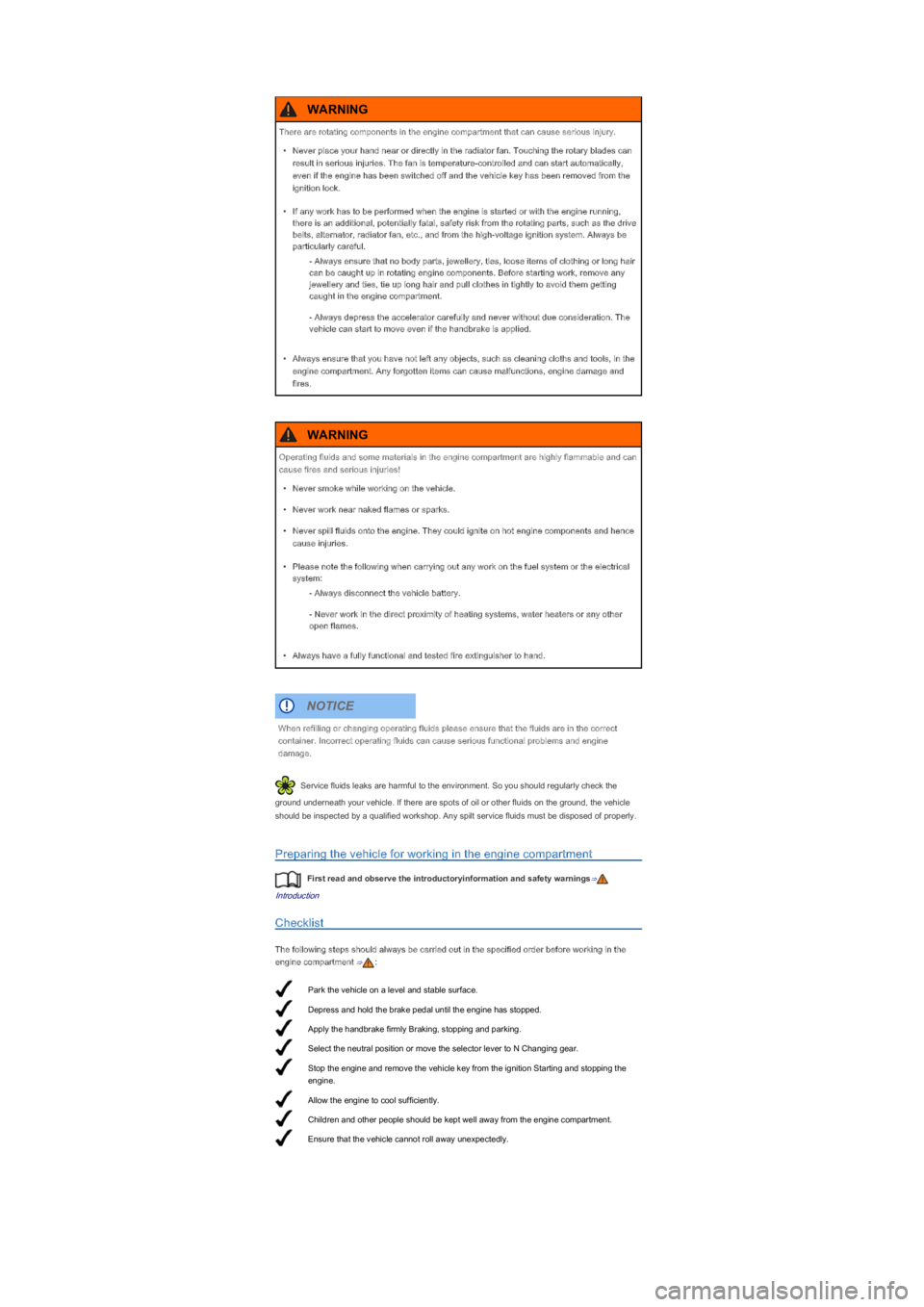
Park the vehicle on a level and stable surface.
Depress and hold the brake pedal until the engine has stopped.
Apply the handbrake firmly Braking, stopping and parking.
Select the neutral position or move the selector lever to N Changing gear.
Stop the engine and remove the vehicle key from the ignition Starting and stopping the
engine.
Allow the engine to cool sufficiently.
Children and other people should be kept well away from the engine compartment.
Ensure that the vehicle cannot roll away unexpectedly.
Service fluids leaks are harmful to the environment. So you should regularly check the
ground underneath your vehicle. If there are spots of oil or other fluids on the ground, the vehicle
should be inspected by a qualified workshop. Any spilt service fluids must be disposed of properly.
Preparing the vehicle for working in the engine compartment
First read and observe the introductoryinformation and safety warnings⇒
Introduction
Checklist
The following steps should always be carried out in the specified order before working in the
engine compartment ⇒:
There are rotating components in the engine compartment that can cause serious injury.
•Never place your hand near or directly in the radiator fan. Touching the rotary blades can
result in serious injuries. The fan is temperature-controlled and can start automatically,
even if the engine has been switched off and the vehicle key has been removed from the
ignition lock.
•If any work has to be performed when the engine is started or with the engine running,
there is an additional, potentially fatal, safety risk from the rotating parts, such as the drive
belts, alternator, radiator fan, etc., and from the high-voltage ignition system. Always be
particularly careful.
- Always ensure that no body parts, jewellery, ties, loose items of clothing or long hair
can be caught up in rotating engine components. Before starting work, remove any
jewellery and ties, tie up long hair and pull clothes in tightly to avoid them getting
caught in the engine compartment.
- Always depress the accelerator carefully and never without due consideration. The
vehicle can start to move even if the handbrake is applied.
•Always ensure that you have not left any objects, such as cleaning cloths and tools, in the
engine compartment. Any forgotten items can cause malfunctions, engine damage and
fires.
WARNING
Operating fluids and some materials in the engine compartment are highly flammable and can
cause fires and serious injuries!
•Never smoke while working on the vehicle.
•Never work near naked flames or sparks.
•Never spill fluids onto the engine. They could ignite on hot engine components and hence
cause injuries.
•Please note the following when carrying out any work on the fuel system or the electrical
system:
- Always disconnect the vehicle battery.
- Never work in the direct proximity of heating systems, water heaters or any other
open flames.
•Always have a fully functional and tested fire extinguisher to hand.
WARNING
When refilling or changing operating fluids please ensure that the fluids are in the correct
container. Incorrect operating fluids can cause serious functional problems and engine
damage.
NOTICE
Page 136 of 211

If possible, only use Volkswagen-approved engine oil ⇒. The engine oils listed are multigrade
high-lubricity oils.
Engine oils are constantly being developed and improved. A Volkswagen dealership is always kept
up to date on innovations. Volkswagen therefore recommends having engine oil changes done by a
Volkswagen dealership.
The quality of the engine oil is not only tailored to the requirements of engines and exhaust gas
treatment systems, but also to fuel quality. Due to the way in which a combustion engine works,
engine oil always comes into contact with combustion residues and fuel, which has a knock-on
effect on the ageing process of the oil.
The quality of fuels can vary greatly between individual markets and this must be taken into account
when selecting the correct engine oil.
The use of engine oils compliant with the VW 504 00 requires a fuel quality compliant with EN 228
(petrol) or fuel of and equivalent quality. Engine oils compliant with VW 504 00 are therefore
unsuitable for use in a large number of markets.
Permitted engine oil
specifications ⇒
Alternative engine oil
specifications⇒
Engine
type
Fixed service QI1, QI2, QI3,
QI4, QI7 (based on
time/distance travelled)
Only in the EU, Switzerland,
Norway, Japan and Australia
Petrol
enginesVW 502 00VW 504 00
Natural gas
engineVW 502 00-----
Alternative engine oil specifications may only be used in fixed services QI1, QI2, QI3, QI4 and
QI7, and only when fuel of a quality compliant with EN 228 (petrol), or fuel of an equivalent quality,
is available in the particular country.
Checking the engine oil level and refilling engine oil
Fig. 121 Oil dipstick with markings
Fig. 122 In the engine compartment: engine oil filler cap
First read and observe the introductoryinformation and safety warnings⇒
Introduction
a)
•Do not add any additional lubricants to the engine oil. Any damage caused by the use of
such additives is not covered by the warranty.
•Only engine oil specifications that have been approved for use with the engine should be
used. Using other engine oils can cause engine damage.
•Another engine oil can be used in the event of an emergency if the listed engine oils () are
not available. To avoid damaging the engine, a maximum quantity of 0.5 litres of the
following engine oil may be used only once until the next oil change:
- Petrol engines: standards ACEAA3/B4 or API SN (API SM).
NOTICE
a)
Page 137 of 211

With the engine at operating temperature, park the vehicle on a level surface to ensure
that the engine oil reading is correct.
Switch off the engine and wait a few minutes for the engine oil to flow back into the sump.
Open the bonnet .
Identify the engine oil filler cap and oil dipstick. The engine oil filler opening bears the
symbol on the cap and the oil dipstick has a coloured handle. If you cannot find the cap
and dipstick please contact a qualified workshop.
Pull the dipstick out of the guide tube and wipe it off with a clean cloth.
Insert the oil dipstick into the guide tube again as far as it will go. If there is a marking on
the oil dipstick, this marking must fit in the corresponding groove at the top end of the
guide tube when inserting.
After reading the oil level, push the oil dipstick back into the guide tube as far as it will go.
Unscrew the engine oil filler opening cap .
Using only the engine oil approved by Volkswagen expressly for this engine, top up the oil
in small gradual amounts (no more than 0.5 l).
To avoid overfilling, wait for approximately one minute after each pour to allow the engine
oil to flow into the oil sump up to the marking on the engine oil dipstick.
Read the engine oil level from the dipstick again before refilling with a further small
quantity of engine oil. Never overfill engine oil .
After the refilling procedure, the engine oil level should be at least in the centre of area Ⓑ,
but never above area Ⓐ .
After refilling, screw the engine oil filler cap back on correctly.
Reinsert the oil dipstick correctly into the guide tube as far as it will go.
Close the bonnet correctly .
Checklist
Carry out the steps in the specified order ⇒:
Pull the dipstick out again and read the engine oil level on the dipstick as follows: Ⓐ: do not
refill oil . Proceed to step 15. Ⓑ: oil can be refilled (approximately 0.5 l). Proceed to step 8
or 15. Ⓒ: oil must be refilled (approximately 1.0 l). Proceed to step 8.
The engine oil level must never be above area ⇒ Fig. 121Ⓐ. Otherwise oil can be drawn in
through the crankcase breather and escape into the atmosphere via the exhaust system.
Engine oil consumption
First read and observe the introductoryinformation and safety warnings⇒
Introduction
Engine oil consumption can vary from engine to engine and can change during the working life of
an engine.
Depending on how you drive and the conditions in which the car is used, oil consumption can be up
to 1.0 litre/2,000 km – and is likely to be higher for the first 5,000 km for new vehicles. The engine
oil level must therefore be checked at regular intervals, preferably when refuelling and before long
journeys.
When the engine is working hard the oil level must be kept within the area shown in ⇒ Fig. 121Ⓐ,
for instance during long motorway cruising in summer or climbing mountain passes.
Engine oil can ignite if it comes into contact with hot engine components. It can cause fires,
burns and other serious injuries.
•If engine oil is spilt on cold engine parts it can heat up and ignite when the engine is
running.
•Always ensure that the engine oil filler cap is securely tightened after refilling, and that the
dipstick is properly inserted back into the guide tube. This will prevent the engine oil from
draining out on to hot engine components when the engine is running.
WARNING
•Do not start the engine if the engine oil level is above area ⇒ Fig. 121Ⓐ. Seek expert
assistance. The catalytic converter and the engine could otherwise be damaged.
•When refilling or changing operating fluids please ensure that the fluids are in the correct
container. Incorrect operating fluids can cause serious functional problems and engine
damage.
NOTICE
Page 146 of 211
In the interests of environmental protection, the vehicle should only be washed in specially
provided wash bays. This prevents waste water contaminated with oil, grease or fuel from entering
the sewerage system. In some countries, washing vehicles anywhere else may be prohibited.
Environmentally-friendly care products should be used.
Leftover car care products should not be disposed of with ordinary household waste. Read
the manufacturer's instructions.
Washing the vehicle
First read and observe the introductoryinformation and safety warnings⇒
Introduction
The longer substances such as insects, bird droppings, resinous tree sap, road dirt, industrial
deposits, tar, soot or road salt and other corrosive materials remain on the vehicle, the more
damage they do to the paintwork. High temperatures (for instance in strong sunlight) further
intensify the corrosive effect. The underside of the vehicle should also be cleaned thoroughly and
regularly.
Car washes
Please observe the signs on the automatic car wash. Before using an automatic car wash take
the usual precautions, such as closing all windows and folding in the exterior mirrors, in order to
avoid damage to the vehicle. You must consult the car wash operator if there are special parts on
your vehicle such as spoilers, roof luggage carrier systems or radio aerials ⇒.
The paint is hard-wearing enough for the car to be generally washed in an automatic car wash.
However, the effect on the paint depends to a large extent on the design of the car wash.
Volkswagen recommends the use of car washes without brushes.
To remove any waxy residue from the windows and to stop wipers rubbing, please note the
following ⇒ Cleaning windows and exterior mirrors.
Washing the car by hand
When washing by hand, first soften the dirt with plenty of water and rinse off as well as possible.
Then clean the vehicle with a soft sponge, a glove or a brush using only light pressure. Start with
the roof and work from the top to the bottom. Use a shampoo for very stubborn dirt only.
The sponge or glove should be wrung out thoroughly at regular intervals.
Clean the wheels, sill panels etc. last. Use a different sponge for this purpose.
Car care products can be toxic and hazardous. Unsuitable care products and incorrect
application of care products can cause accidents, serious injuries, burns or poisoning.
•The care product must be kept in its original sealed container.
•Read the manufacturer's instructions.
•Never store car care products in empty food containers, bottles or any other non-original
containers as people finding these containers may not know that they contain care
products.
•Keep children away from care products.
•The products can give off harmful fumes during use. They should therefore only be used
outside or in well-ventilated spaces.
•Never use fuel, turpentine, engine oil, nail varnish remover or other volatile fluids to wash,
clean or care for your vehicle. These substances are toxic and highly inflammable.
WARNING
Incorrect care and cleaning of vehicle parts can impair the safety features of the vehicle and
thus cause serious injury.
•Vehicle parts must be cleaned according to the manufacturer's instructions.
•Only use approved or recommended cleaning products.
WARNING
Cleaning agents that contain solvents attack the material and can cause damage.
NOTICE
Page 150 of 211
•Place the windscreen wiper arm back onto the windscreen.
Changing the wiper blade for the rear window
•When lifting a wiper arm hold it only by the wiper blade mounting.
•Lift the wiper blade arm and fold away at an angle of 60°.
•Press and hold the release button ①.
•Tilt the wiper blade in the direction of the wiper arm ⇒ Fig. 127 (arrow Ⓐ) and pull it off in the
direction of the arrow Ⓑ at the same time. You may need to use some force to do this.
•Insert a new wiper blade with the same length and design onto the wiper arm against the
direction of the arrow. Push it on until it engages ⇒ Fig. 127Ⓑ. The wiper blade must be in the
tilted position (arrow Ⓐ).
•Place the wiper arm back onto the rear window.
Wax deposits on the windscreen and rear window could cause the wiper blades to rub.
Remove wax residue using a special cleaning product or cleaning cloths.
Waxing and polishing the vehicle
First read and observe the introductoryinformation and safety warnings⇒
Introduction
Waxing
Waxing protects the paintwork. You will need to re-wax the vehicle with a good hard wax if water
no longer clearly forms small drops and runs off the paintwork when it is clean.
Even if a wax solution is used regularly in the car wash, Volkswagen recommends protecting the
paint with a coat of hard wax at least twice a year.
Polishing
Polishing is only necessary if the paint has lost its shine, and the gloss cannot be brought back by
applying wax.
The car must be waxed after polishing if the polish used does not contain wax compounds to seal
the paint.
Cleaning and caring for chrome and aluminium trim parts
First read and observe the introductoryinformation and safety warnings⇒
Introduction
•Use a damp, clean, lint-free and soft cloth to clean the surfaces.
•For heavy soiling use a special solvent-free cleaning product.
•Polish the chrome and aluminium trim parts using a soft, dry cloth.
Worn or dirty windscreen wiper blades reduce visibility and increase the risk of accidents and
severe injuries.
•Therefore, always change windscreen wiper blades if they are damaged or worn and no
longer clean the windscreen properly.
WARNING
•Damaged or dirty windscreen wipers can scratch the windscreen.
•Detergents containing solvents, hard sponges and other sharp objects can damage the
graphite coating.
•Do not use fuel, nail varnish remover, paint thinner or similar products to clean the
windows.
NOTICE
•In order to avoid damage, painted parts with a matt finish, plastic parts, headlight lenses
and the tail lights should not be treated with polish or hard wax.
•Do not polish the paint if the vehicle is in a sandy or dusty environment or if it is dirty.
NOTICE
Page 152 of 211
recommends that the protective coating on the underside of the vehicle and on the running gear
should be checked regularly and repaired if necessary.
Cleaning the engine compartment
First read and observe the introductoryinformation and safety warnings⇒
Introduction
The engine compartment of any motor vehicle is a hazardous area ⇒ Preparation for working in the
engine compartment.
The engine compartment should be cleaned by a qualified workshop. An incorrect cleaning
procedure could possibly remove corrosion protection and damage electrical components.
Furthermore, water could enter the vehicle interior directly via the plenum chamber ⇒.
If the engine compartment is very dirty, we recommend that you always proceed to a qualified
workshop to have it cleaned by a professional mechanic. Volkswagen recommends using a
Volkswagen dealership for this purpose.
Plenum chamber
The plenum chamber is located in the engine compartment between the windscreen and the engine
and has a perforated cover. Air from outside is drawn in from the plenum chamber and is passed
into the vehicle interior via the heating and air conditioning system.
Leaves and other loose objects must be removed from the cover of the plenum chamber at regular
intervals using a vacuum cleaner or by hand.
In the interests of environmental protection, the engine compartment should be washed only
in specially provided wash bays. This prevents toxic waste water containing oil, grease and fuel
from entering the sewerage system. In some districts, washing the engine compartment anywhere
else may be prohibited.
Cleaning and caring for the interior
Introduction
This chapter contains information on the followingsubjects:
⇒ Seat covers
⇒ Cleaning cloth seat covers, fabric trim and Alcantara upholstery
⇒ Cleaning and caring for natural leather covers
⇒ Cleaning leatherette upholstery
⇒ Cleaning stowage compartments, drink holders and ash trays
⇒ Cleaning and caring for the dash panel, wooden trims and plastic parts
⇒ Cleaning seat belts
Modern fabrics, such as dark denim, are often not colourfast. Light-coloured upholstery (soft
materials or leather) is particularly sensitive to staining caused by these fabrics, even if you are
careful. This is not caused by a fault in the upholstery, but by the non-colourfast nature of the
garments.
Leaving stains, dirt and other deposits on the surface of vehicle components and cloth seat covers
for a long time can make it difficult to clean and treat them. Stains, dirt and deposits may become
impossible to remove, particularly if left for a long time.
Additional information and warnings:
•Cleaning and caring for the vehicle exterior ⇒ Caring for and cleaning the vehicle exterior
Underseal and anti-corrosion coatings can ignite on the hot exhaust system or on other hot
engine parts.
•Never apply underseal or anti-corrosion coatings to the exhaust pipes, catalytic converter,
heat shields or other vehicle components that become hot.
CAUTION
All work in the engine compartment carries the risk of injury, scalding, accidents and fire.
•Before carrying out any work ensure that you are familiar with the requisite procedures
and general safety regulations ⇒ Preparation for working in the engine compartment.
•Volkswagen recommends having the work carried out by a qualified workshop.
WARNING
Water that has entered the plenum chamber via a manual process (e.g. from a high-pressure
cleaner) can cause considerable damage to the vehicle.
NOTICE
Page 153 of 211
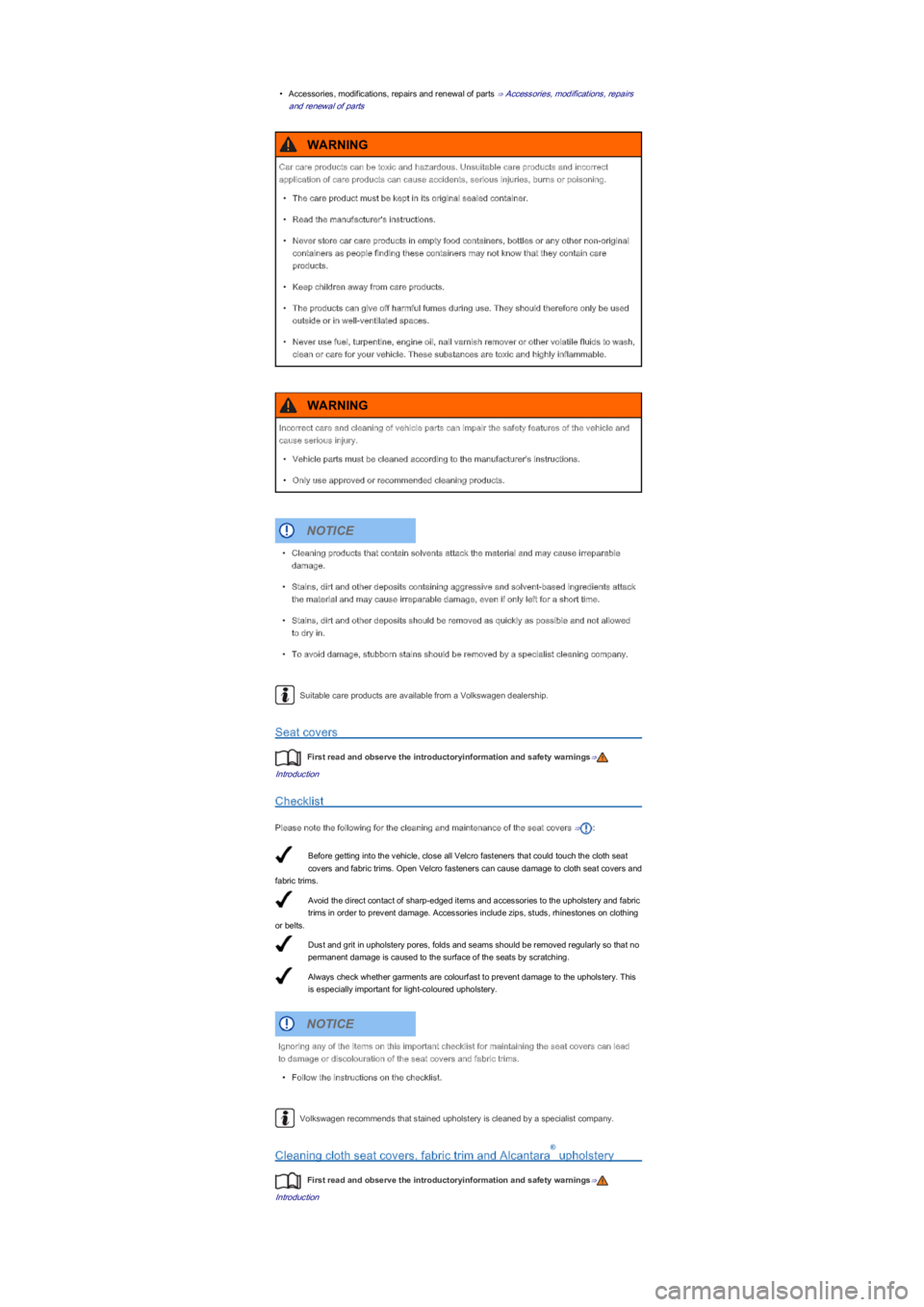
Before getting into the vehicle, close all Velcro fasteners that could touch the cloth seat
covers and fabric trims. Open Velcro fasteners can cause damage to cloth seat covers and
fabric trims.
Avoid the direct contact of sharp-edged items and accessories to the upholstery and fabric
trims in order to prevent damage. Accessories include zips, studs, rhinestones on clothing
or belts.
Dust and grit in upholstery pores, folds and seams should be removed regularly so that no
permanent damage is caused to the surface of the seats by scratching.
Always check whether garments are colourfast to prevent damage to the upholstery. This
is especially important for light-coloured upholstery.
•Accessories, modifications, repairs and renewal of parts ⇒ Accessories, modifications, repairs
and renewal of parts
Suitable care products are available from a Volkswagen dealership.
Seat covers
First read and observe the introductoryinformation and safety warnings⇒
Introduction
Checklist
Please note the following for the cleaning and maintenance of the seat covers ⇒:
Volkswagen recommends that stained upholstery is cleaned by a specialist company.
Cleaning cloth seat covers, fabric trim and Alcantara upholstery
First read and observe the introductoryinformation and safety warnings⇒
Introduction
Car care products can be toxic and hazardous. Unsuitable care products and incorrect
application of care products can cause accidents, serious injuries, burns or poisoning.
•The care product must be kept in its original sealed container.
•Read the manufacturer's instructions.
•Never store car care products in empty food containers, bottles or any other non-original
containers as people finding these containers may not know that they contain care
products.
•Keep children away from care products.
•The products can give off harmful fumes during use. They should therefore only be used
outside or in well-ventilated spaces.
•Never use fuel, turpentine, engine oil, nail varnish remover or other volatile fluids to wash,
clean or care for your vehicle. These substances are toxic and highly inflammable.
WARNING
Incorrect care and cleaning of vehicle parts can impair the safety features of the vehicle and
cause serious injury.
•Vehicle parts must be cleaned according to the manufacturer's instructions.
•Only use approved or recommended cleaning products.
WARNING
•Cleaning products that contain solvents attack the material and may cause irreparable
damage.
•Stains, dirt and other deposits containing aggressive and solvent-based ingredients attack
the material and may cause irreparable damage, even if only left for a short time.
•Stains, dirt and other deposits should be removed as quickly as possible and not allowed
to dry in.
•To avoid damage, stubborn stains should be removed by a specialist cleaning company.
NOTICE
Ignoring any of the items on this important checklist for maintaining the seat covers can lead
to damage or discolouration of the seat covers and fabric trims.
•Follow the instructions on the checklist.
NOTICE
®
Page 159 of 211
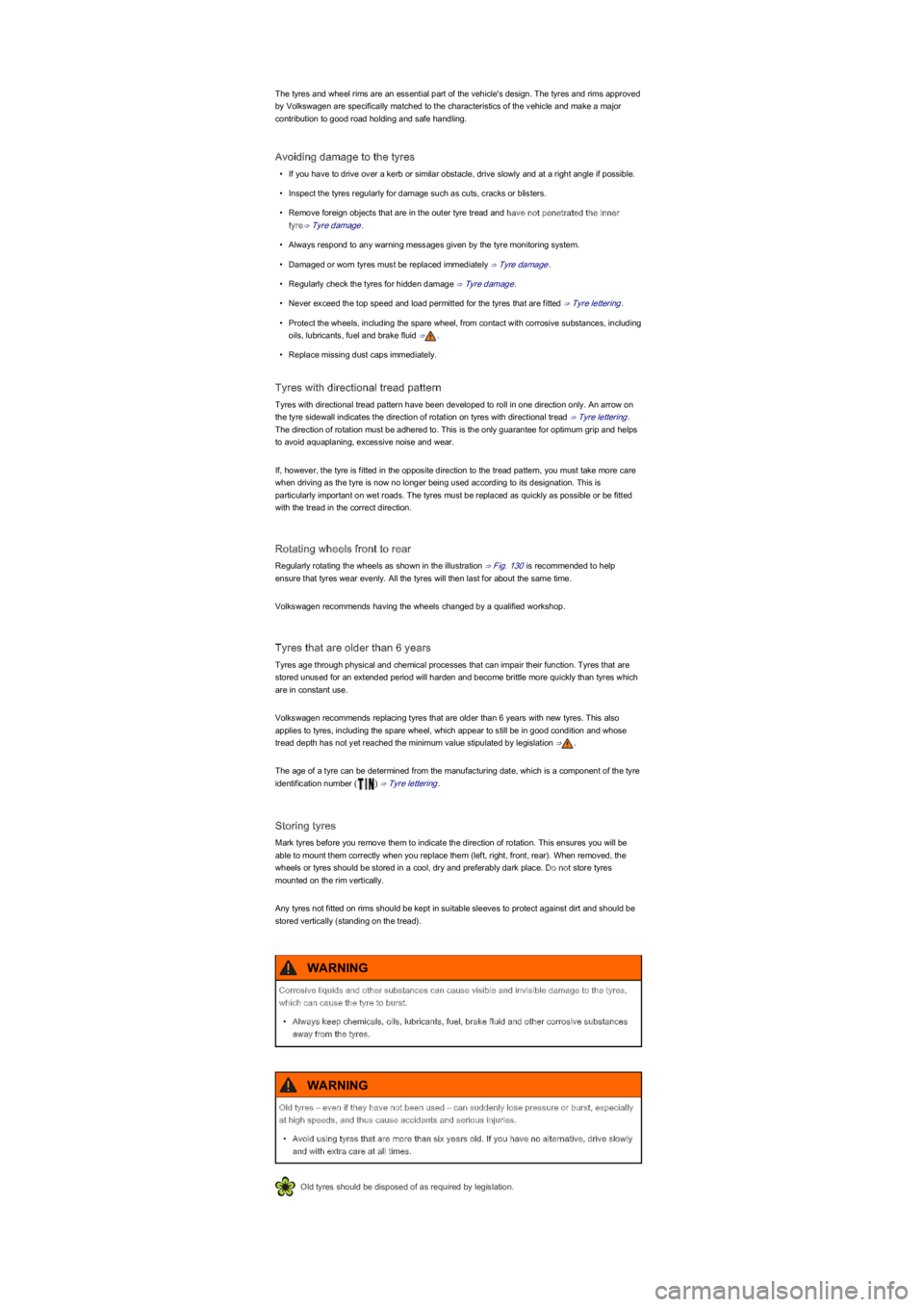
The tyres and wheel rims are an essential part of the vehicle's design. The tyres and rims approved
by Volkswagen are specifically matched to the characteristics of the vehicle and make a major
contribution to good road holding and safe handling.
Avoiding damage to the tyres
•If you have to drive over a kerb or similar obstacle, drive slowly and at a right angle if possible.
•Inspect the tyres regularly for damage such as cuts, cracks or blisters.
•Remove foreign objects that are in the outer tyre tread and have not penetrated the inner
tyre⇒ Tyre damage.
•Always respond to any warning messages given by the tyre monitoring system.
•Damaged or worn tyres must be replaced immediately ⇒ Tyre damage.
•Regularly check the tyres for hidden damage ⇒ Tyre damage.
•Never exceed the top speed and load permitted for the tyres that are fitted ⇒ Tyre lettering.
•Protect the wheels, including the spare wheel, from contact with corrosive substances, including
oils, lubricants, fuel and brake fluid ⇒.
•Replace missing dust caps immediately.
Tyres with directional tread pattern
Tyres with directional tread pattern have been developed to roll in one direction only. An arrow on
the tyre sidewall indicates the direction of rotation on tyres with directional tread ⇒ Tyre lettering.
The direction of rotation must be adhered to. This is the only guarantee for optimum grip and helps
to avoid aquaplaning, excessive noise and wear.
If, however, the tyre is fitted in the opposite direction to the tread pattern, you must take more care
when driving as the tyre is now no longer being used according to its designation. This is
particularly important on wet roads. The tyres must be replaced as quickly as possible or be fitted
with the tread in the correct direction.
Rotating wheels front to rear
Regularly rotating the wheels as shown in the illustration ⇒ Fig. 130 is recommended to help
ensure that tyres wear evenly. All the tyres will then last for about the same time.
Volkswagen recommends having the wheels changed by a qualified workshop.
Tyres that are older than 6 years
Tyres age through physical and chemical processes that can impair their function. Tyres that are
stored unused for an extended period will harden and become brittle more quickly than tyres which
are in constant use.
Volkswagen recommends replacing tyres that are older than 6 years with new tyres. This also
applies to tyres, including the spare wheel, which appear to still be in good condition and whose
tread depth has not yet reached the minimum value stipulated by legislation ⇒.
The age of a tyre can be determined from the manufacturing date, which is a component of the tyre
identification number () ⇒ Tyre lettering.
Storing tyres
Mark tyres before you remove them to indicate the direction of rotation. This ensures you will be
able to mount them correctly when you replace them (left, right, front, rear). When removed, the
wheels or tyres should be stored in a cool, dry and preferably dark place. Do not store tyres
mounted on the rim vertically.
Any tyres not fitted on rims should be kept in suitable sleeves to protect against dirt and should be
stored vertically (standing on the tread).
Old tyres should be disposed of as required by legislation.
Corrosive liquids and other substances can cause visible and invisible damage to the tyres,
which can cause the tyre to burst.
•Always keep chemicals, oils, lubricants, fuel, brake fluid and other corrosive substances
away from the tyres.
WARNING
Old tyres – even if they have not been used – can suddenly lose pressure or burst, especially
at high speeds, and thus cause accidents and serious injuries.
•Avoid using tyres that are more than six years old. If you have no alternative, drive slowly
and with extra care at all times.
WARNING
Page 162 of 211
•After altering the tyre pressures, ensure that the valve caps are screwed on.
The spare wheel or temporary spare wheel are filled to the highest tyre pressure permissible for
the vehicle.
Under-inflated tyres can contribute to an increase in fuel consumption.
Tread depth and wear indicators
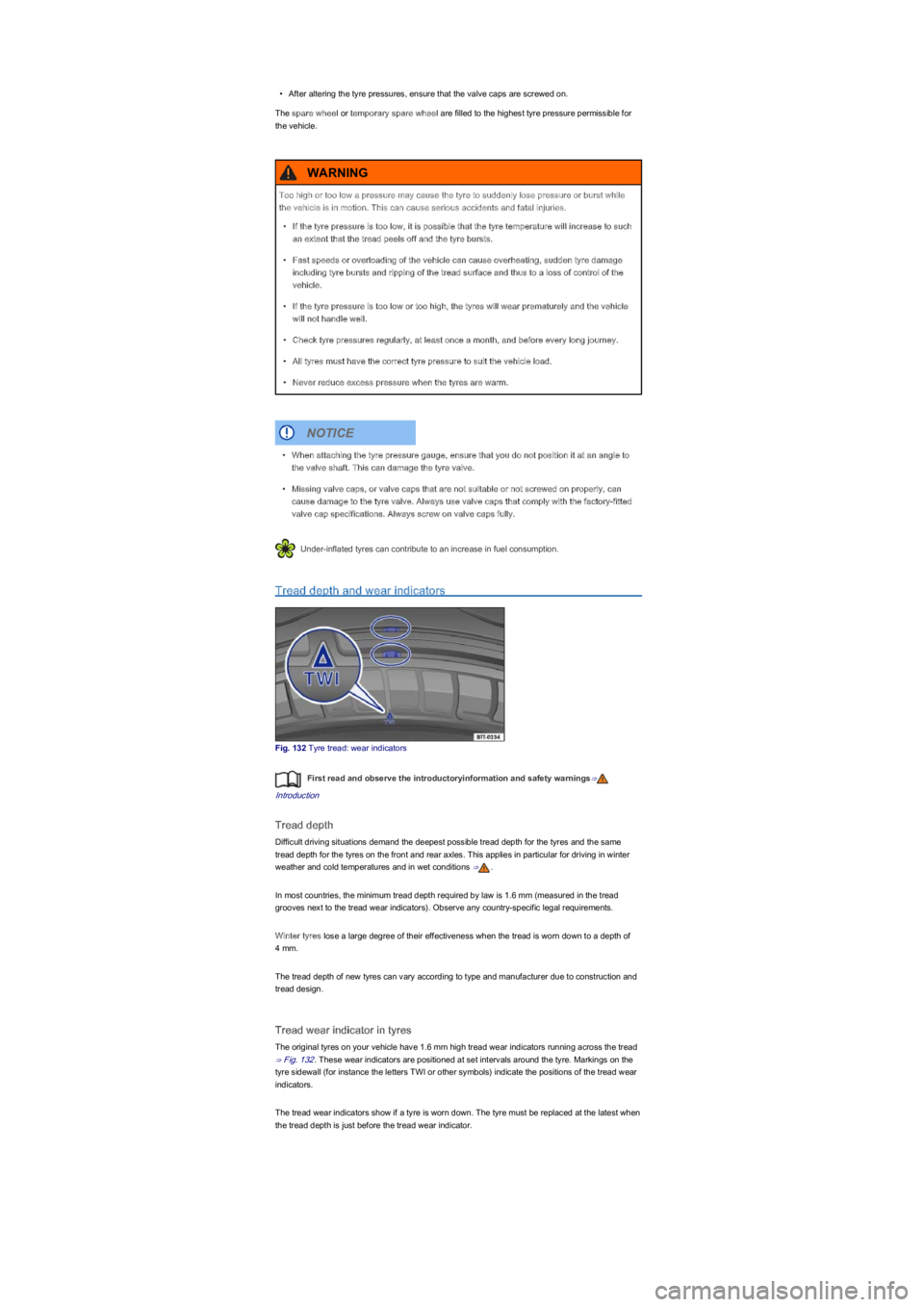
Fig. 132 Tyre tread: wear indicators
First read and observe the introductoryinformation and safety warnings⇒
Introduction
Tread depth
Difficult driving situations demand the deepest possible tread depth for the tyres and the same
tread depth for the tyres on the front and rear axles. This applies in particular for driving in winter
weather and cold temperatures and in wet conditions ⇒.
In most countries, the minimum tread depth required by law is 1.6 mm (measured in the tread
grooves next to the tread wear indicators). Observe any country-specific legal requirements.
Winter tyres lose a large degree of their effectiveness when the tread is worn down to a depth of
4 mm.
The tread depth of new tyres can vary according to type and manufacturer due to construction and
tread design.
Tread wear indicator in tyres
The original tyres on your vehicle have 1.6 mm high tread wear indicators running across the tread
⇒ Fig. 132. These wear indicators are positioned at set intervals around the tyre. Markings on the
tyre sidewall (for instance the letters TWI or other symbols) indicate the positions of the tread wear
indicators.
The tread wear indicators show if a tyre is worn down. The tyre must be replaced at the latest when
the tread depth is just before the tread wear indicator.
Too high or too low a pressure may cause the tyre to suddenly lose pressure or burst while
the vehicle is in motion. This can cause serious accidents and fatal injuries.
•If the tyre pressure is too low, it is possible that the tyre temperature will increase to such
an extent that the tread peels off and the tyre bursts.
•Fast speeds or overloading of the vehicle can cause overheating, sudden tyre damage
including tyre bursts and ripping of the tread surface and thus to a loss of control of the
vehicle.
•If the tyre pressure is too low or too high, the tyres will wear prematurely and the vehicle
will not handle well.
•Check tyre pressures regularly, at least once a month, and before every long journey.
•All tyres must have the correct tyre pressure to suit the vehicle load.
•Never reduce excess pressure when the tyres are warm.
WARNING
•When attaching the tyre pressure gauge, ensure that you do not position it at an angle to
the valve shaft. This can damage the tyre valve.
•Missing valve caps, or valve caps that are not suitable or not screwed on properly, can
cause damage to the tyre valve. Always use valve caps that comply with the factory-fitted
valve cap specifications. Always screw on valve caps fully.
NOTICE
Page 167 of 211
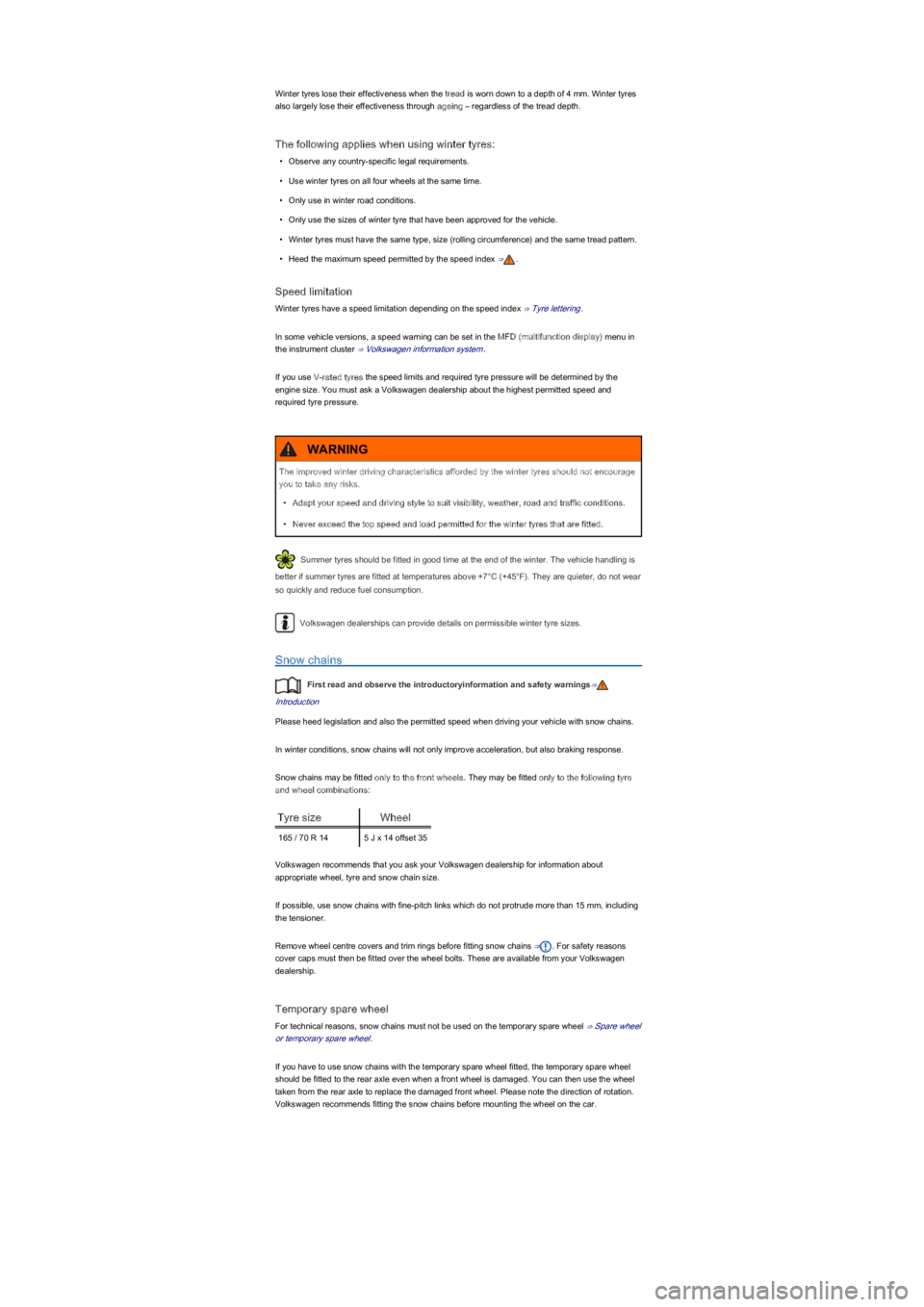
Winter tyres lose their effectiveness when the tread is worn down to a depth of 4 mm. Winter tyres
also largely lose their effectiveness through ageing – regardless of the tread depth.
The following applies when using winter tyres:
•Observe any country-specific legal requirements.
•Use winter tyres on all four wheels at the same time.
•Only use in winter road conditions.
•Only use the sizes of winter tyre that have been approved for the vehicle.
•Winter tyres must have the same type, size (rolling circumference) and the same tread pattern.
•Heed the maximum speed permitted by the speed index ⇒.
Speed limitation
Winter tyres have a speed limitation depending on the speed index ⇒ Tyre lettering.
In some vehicle versions, a speed warning can be set in the MFD (multifunction display) menu in
the instrument cluster ⇒ Volkswagen information system.
If you use V-rated tyres the speed limits and required tyre pressure will be determined by the
engine size. You must ask a Volkswagen dealership about the highest permitted speed and
required tyre pressure.
Summer tyres should be fitted in good time at the end of the winter. The vehicle handling is
better if summer tyres are fitted at temperatures above +7°C (+45°F). They are quieter, do not wear
so quickly and reduce fuel consumption.
Volkswagen dealerships can provide details on permissible winter tyre sizes.
Snow chains
First read and observe the introductoryinformation and safety warnings⇒
Introduction
Please heed legislation and also the permitted speed when driving your vehicle with snow chains.
In winter conditions, snow chains will not only improve acceleration, but also braking response.
Snow chains may be fitted only to the front wheels. They may be fitted only to the following tyre
and wheel combinations:
Tyre sizeWheel
165 / 70 R 145 J x 14 offset 35
Volkswagen recommends that you ask your Volkswagen dealership for information about
appropriate wheel, tyre and snow chain size.
If possible, use snow chains with fine-pitch links which do not protrude more than 15 mm, including
the tensioner.
Remove wheel centre covers and trim rings before fitting snow chains ⇒. For safety reasons
cover caps must then be fitted over the wheel bolts. These are available from your Volkswagen
dealership.
Temporary spare wheel
For technical reasons, snow chains must not be used on the temporary spare wheel ⇒ Spare wheel
or temporary spare wheel.
If you have to use snow chains with the temporary spare wheel fitted, the temporary spare wheel
should be fitted to the rear axle even when a front wheel is damaged. You can then use the wheel
taken from the rear axle to replace the damaged front wheel. Please note the direction of rotation.
Volkswagen recommends fitting the snow chains before mounting the wheel on the car.
The improved winter driving characteristics afforded by the winter tyres should not encourage
you to take any risks.
•Adapt your speed and driving style to suit visibility, weather, road and traffic conditions.
•Never exceed the top speed and load permitted for the winter tyres that are fitted.
WARNING