fuel VOLKSWAGEN UP! 2021 Owner´s Manual
[x] Cancel search | Manufacturer: VOLKSWAGEN, Model Year: 2021, Model line: UP!, Model: VOLKSWAGEN UP! 2021Pages: 211, PDF Size: 5.98 MB
Page 71 of 211
Driving a loaded vehicle
First read and observe the introductoryinformation and safety warnings⇒
Introduction
For good vehicle handling when driving a loaded vehicle, please observe the following:
•Stow all items of luggage securely ⇒ Stowing items of luggage.
•Accelerate carefully and gently.
•Avoid sudden braking and driving manoeuvres.
•Brake earlier than in normal driving.
•If applicable, heed the information about driving with a roof carrier ⇒ Roof carrier.
Vehicle-specific weight ratings
First read and observe the introductoryinformation and safety warnings⇒
Introduction
All data in the official vehicle documents take precedence over these data. All data in this manual
apply to the basic model. The vehicle data sticker in the service schedule and the official vehicle
documents show which engine is installed in your vehicle.
The values quoted here may differ if additional equipment is fitted, for different models or for special
vehicles.
The values for the kerb weight in the following table apply for the road-ready vehicle with driver
(75 kg), service fluids including fuel tank carrying 90% of its capacity and, if applicable, tools and
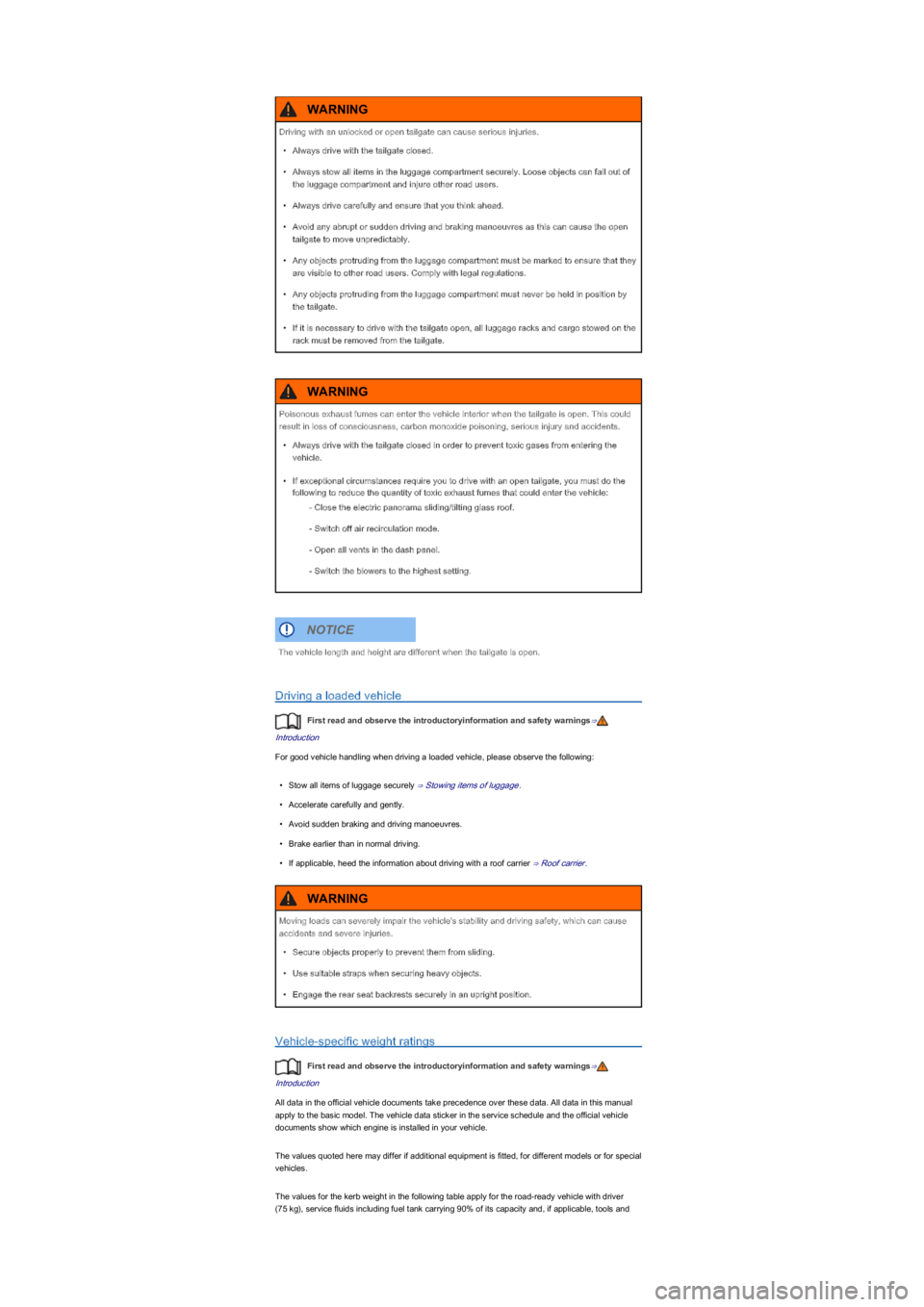
Driving with an unlocked or open tailgate can cause serious injuries.
•Always drive with the tailgate closed.
•Always stow all items in the luggage compartment securely. Loose objects can fall out of
the luggage compartment and injure other road users.
•Always drive carefully and ensure that you think ahead.
•Avoid any abrupt or sudden driving and braking manoeuvres as this can cause the open
tailgate to move unpredictably.
•Any objects protruding from the luggage compartment must be marked to ensure that they
are visible to other road users. Comply with legal regulations.
•Any objects protruding from the luggage compartment must never be held in position by
the tailgate.
•If it is necessary to drive with the tailgate open, all luggage racks and cargo stowed on the
rack must be removed from the tailgate.
WARNING
Poisonous exhaust fumes can enter the vehicle interior when the tailgate is open. This could
result in loss of consciousness, carbon monoxide poisoning, serious injury and accidents.
•Always drive with the tailgate closed in order to prevent toxic gases from entering the
vehicle.
•If exceptional circumstances require you to drive with an open tailgate, you must do the
following to reduce the quantity of toxic exhaust fumes that could enter the vehicle:
- Close the electric panorama sliding/tilting glass roof.
- Switch off air recirculation mode.
- Open all vents in the dash panel.
- Switch the blowers to the highest setting.
WARNING
The vehicle length and height are different when the tailgate is open.
NOTICE
Moving loads can severely impair the vehicle's stability and driving safety, which can cause
accidents and severe injuries.
•Secure objects properly to prevent them from sliding.
•Use suitable straps when securing heavy objects.
•Engage the rear seat backrests securely in an upright position.
WARNING
Page 77 of 211
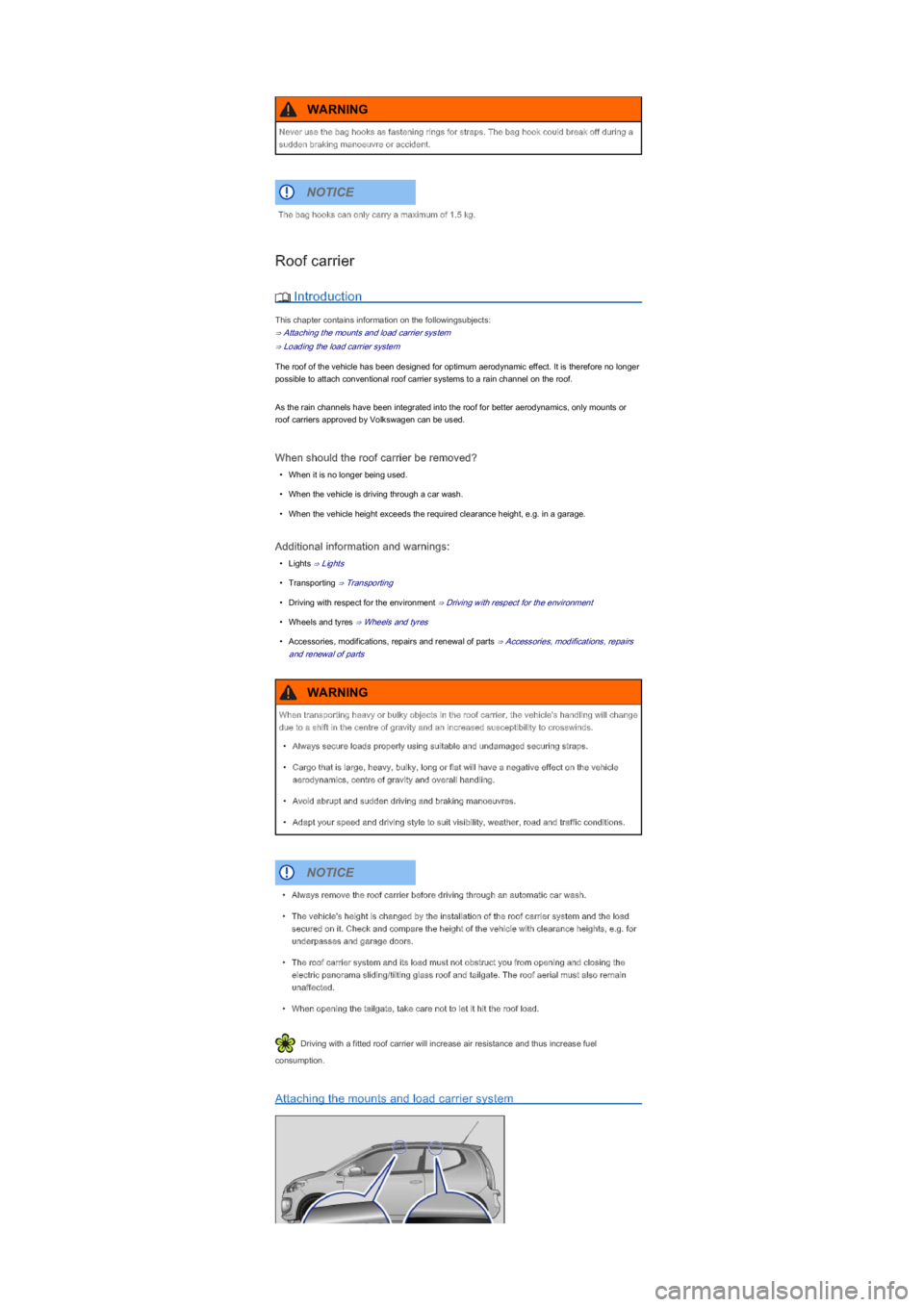
Roof carrier
Introduction
This chapter contains information on the followingsubjects:
⇒ Attaching the mounts and load carrier system
⇒ Loading the load carrier system
The roof of the vehicle has been designed for optimum aerodynamic effect. It is therefore no longer
possible to attach conventional roof carrier systems to a rain channel on the roof.
As the rain channels have been integrated into the roof for better aerodynamics, only mounts or
roof carriers approved by Volkswagen can be used.
When should the roof carrier be removed?
•When it is no longer being used.
•When the vehicle is driving through a car wash.
•When the vehicle height exceeds the required clearance height, e.g. in a garage.
Additional information and warnings:
•Lights ⇒ Lights
•Transporting ⇒ Transporting
•Driving with respect for the environment ⇒ Driving with respect for the environment
•Wheels and tyres ⇒ Wheels and tyres
•Accessories, modifications, repairs and renewal of parts ⇒ Accessories, modifications, repairs
and renewal of parts
Driving with a fitted roof carrier will increase air resistance and thus increase fuel
consumption.
Attaching the mounts and load carrier system
Never use the bag hooks as fastening rings for straps. The bag hook could break off during a
sudden braking manoeuvre or accident.
WARNING
The bag hooks can only carry a maximum of 1.5 kg.
NOTICE
When transporting heavy or bulky objects in the roof carrier, the vehicle's handling will change
due to a shift in the centre of gravity and an increased susceptibility to crosswinds.
•Always secure loads properly using suitable and undamaged securing straps.
•Cargo that is large, heavy, bulky, long or flat will have a negative effect on the vehicle
aerodynamics, centre of gravity and overall handling.
•Avoid abrupt and sudden driving and braking manoeuvres.
•Adapt your speed and driving style to suit visibility, weather, road and traffic conditions.
WARNING
•Always remove the roof carrier before driving through an automatic car wash.
•The vehicle's height is changed by the installation of the roof carrier system and the load
secured on it. Check and compare the height of the vehicle with clearance heights, e.g. for
underpasses and garage doors.
•The roof carrier system and its load must not obstruct you from opening and closing the
electric panorama sliding/tilting glass roof and tailgate. The roof aerial must also remain
unaffected.
•When opening the tailgate, take care not to let it hit the roof load.
NOTICE
Page 87 of 211
Starting the engine, changing gear and
parking
Starting and stopping the engine
Introduction
This chapter contains information on the followingsubjects:
⇒ Ignition lock
⇒ Starting the engine
⇒ Stopping the engine
⇒ Electronic immobilizer
Immobilizer display
If the vehicle key is not valid or there is a fault in the system, then may be displayed in the
instrument cluster. The engine cannot be started ⇒ Electronic immobilizer.
Push-starting or towing
For technical reasons, your vehicle must not be push-started or tow-started. Use jump leads to
start the engine instead.
Additional information and warnings:
•Vehicle key set ⇒ Vehicle key set
•Changing gear ⇒ Changing gear
•Braking, stopping and parking ⇒ Braking, stopping and parking
•Steering ⇒ Steering
•Pull-away assist systems ⇒ Pull-away assist systems
•Filling the tank ⇒ Filling the tank
•Fuel ⇒ Fuel
•Manual opening and closing ⇒ Manual opening and closing
•Starting the engine with jump leads ⇒ Starting the engine with jump leads
•Tow starting and towing ⇒ Tow-starting and towing
•Observe the operating instructions for any device that you plug into the socket.
•Never exceed the maximum power rating as this could damage the whole vehicle electrical
system.
•12-volt socket:
- Only use accessories that have been approved in accordance with the relevant
guidelines on electromagnetic compatibility.
- Never feed electricity into the socket.
NOTICE
While driving
Page 88 of 211
Ignition lock
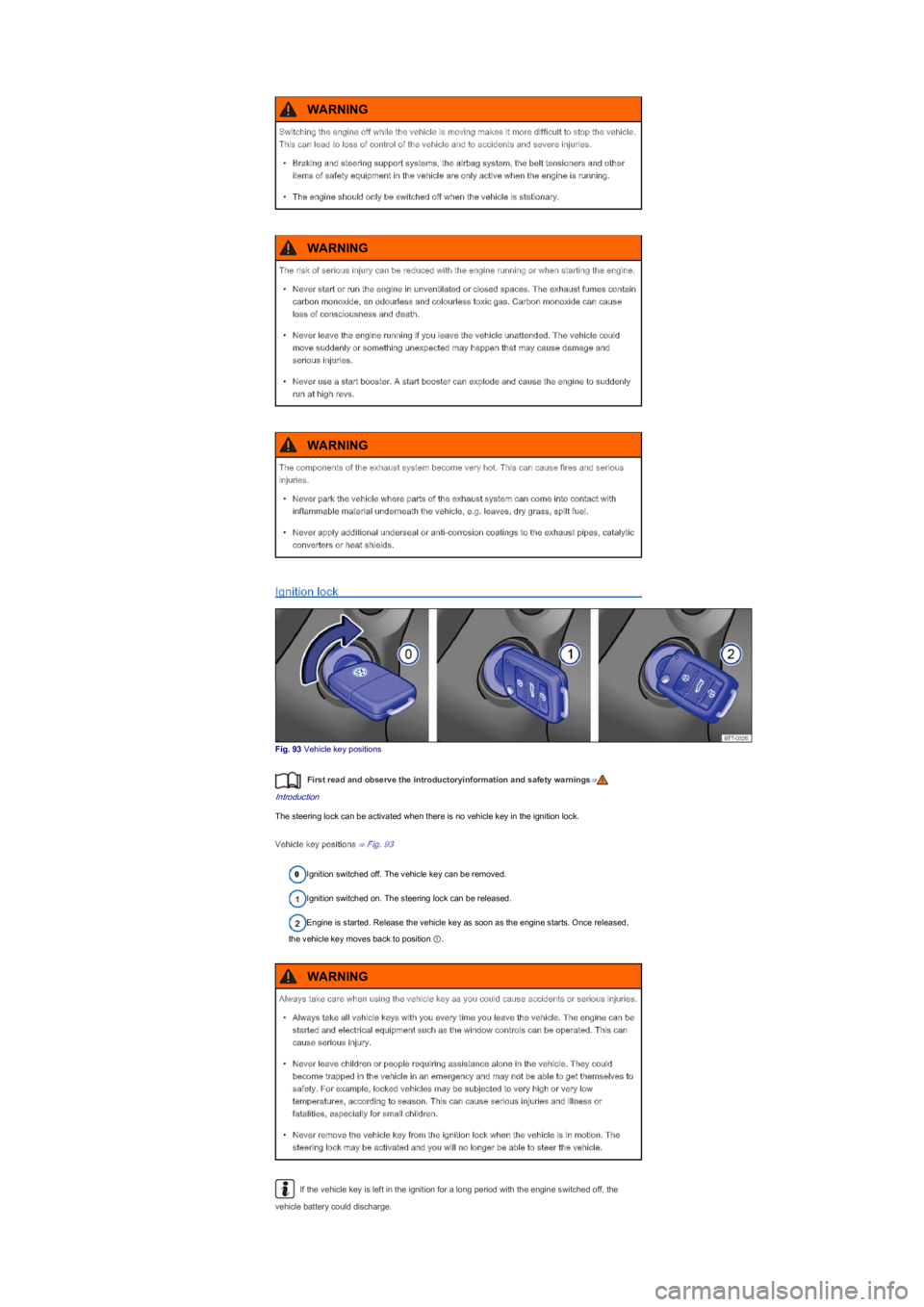
Fig. 93 Vehicle key positions
First read and observe the introductoryinformation and safety warnings⇒
Introduction
The steering lock can be activated when there is no vehicle key in the ignition lock.
Vehicle key positions ⇒ Fig. 93
Ignition switched off. The vehicle key can be removed.
Ignition switched on. The steering lock can be released.
Engine is started. Release the vehicle key as soon as the engine starts. Once released,
the vehicle key moves back to position ①.
If the vehicle key is left in the ignition for a long period with the engine switched off, the
vehicle battery could discharge.
Switching the engine off while the vehicle is moving makes it more difficult to stop the vehicle.
This can lead to loss of control of the vehicle and to accidents and severe injuries.
•Braking and steering support systems, the airbag system, the belt tensioners and other
items of safety equipment in the vehicle are only active when the engine is running.
•The engine should only be switched off when the vehicle is stationary.
WARNING
The risk of serious injury can be reduced with the engine running or when starting the engine.
•Never start or run the engine in unventilated or closed spaces. The exhaust fumes contain
carbon monoxide, an odourless and colourless toxic gas. Carbon monoxide can cause
loss of consciousness and death.
•Never leave the engine running if you leave the vehicle unattended. The vehicle could
move suddenly or something unexpected may happen that may cause damage and
serious injuries.
•Never use a start booster. A start booster can explode and cause the engine to suddenly
run at high revs.
WARNING
The components of the exhaust system become very hot. This can cause fires and serious
injuries.
•Never park the vehicle where parts of the exhaust system can come into contact with
inflammable material underneath the vehicle, e.g. leaves, dry grass, spilt fuel.
•Never apply additional underseal or anti-corrosion coatings to the exhaust pipes, catalytic
converters or heat shields.
WARNING
Always take care when using the vehicle key as you could cause accidents or serious injuries.
•Always take all vehicle keys with you every time you leave the vehicle. The engine can be
started and electrical equipment such as the window controls can be operated. This can
cause serious injury.
•Never leave children or people requiring assistance alone in the vehicle. They could
become trapped in the vehicle in an emergency and may not be able to get themselves to
safety. For example, locked vehicles may be subjected to very high or very low
temperatures, according to season. This can cause serious injuries and illness or
fatalities, especially for small children.
•Never remove the vehicle key from the ignition lock when the vehicle is in motion. The
steering lock may be activated and you will no longer be able to steer the vehicle.
WARNING
Page 89 of 211
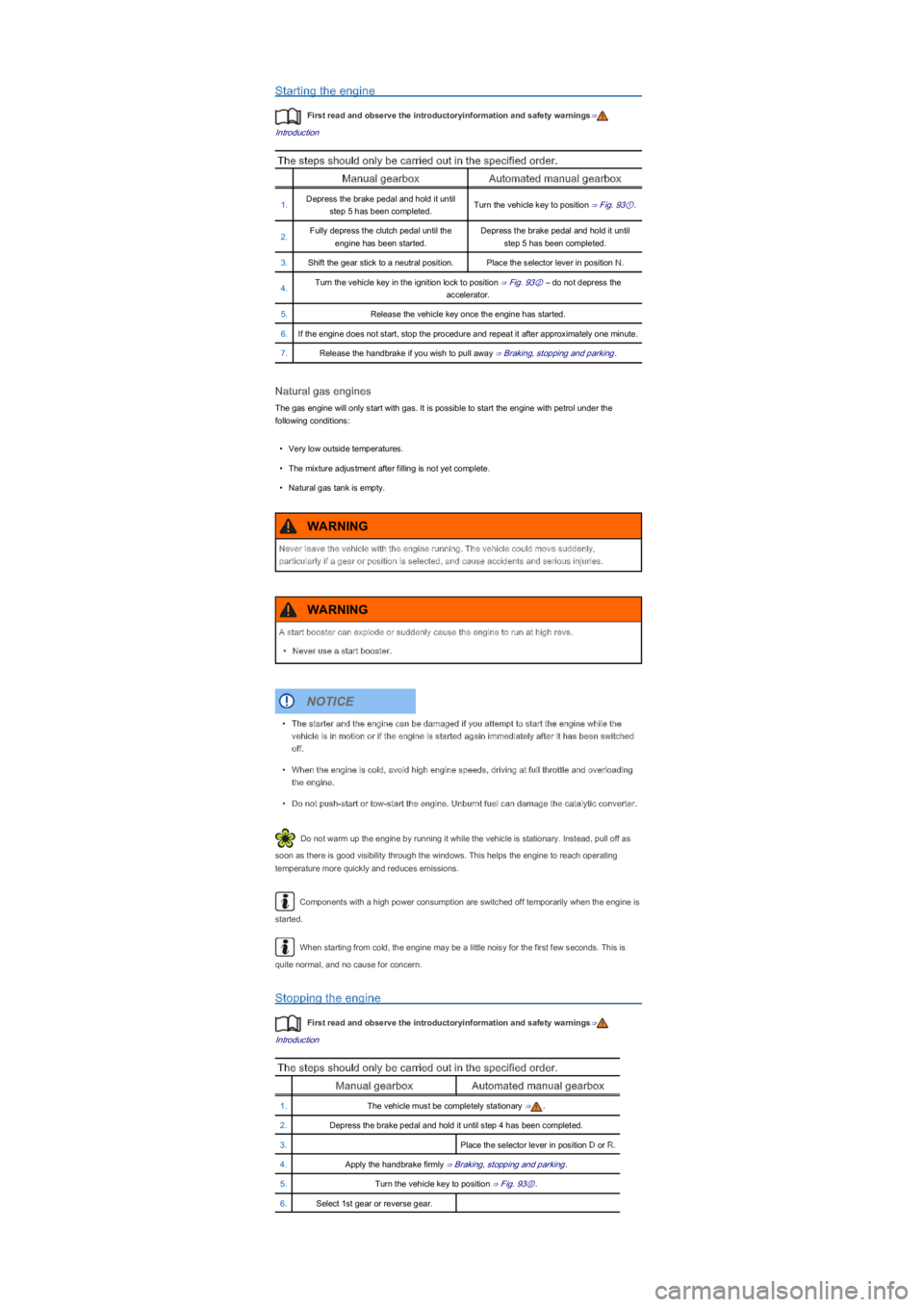
Starting the engine
First read and observe the introductoryinformation and safety warnings⇒
Introduction
The steps should only be carried out in the specified order.
Manual gearboxAutomated manual gearbox
1.Depress the brake pedal and hold it until
step 5 has been completed.Turn the vehicle key to position ⇒ Fig. 93①.
2.Fully depress the clutch pedal until the
engine has been started.
Depress the brake pedal and hold it until
step 5 has been completed.
3.Shift the gear stick to a neutral position.Place the selector lever in position N.
4.Turn the vehicle key in the ignition lock to position ⇒ Fig. 93② – do not depress the
accelerator.
5.Release the vehicle key once the engine has started.
6.If the engine does not start, stop the procedure and repeat it after approximately one minute.
7.Release the handbrake if you wish to pull away ⇒ Braking, stopping and parking.
Natural gas engines
The gas engine will only start with gas. It is possible to start the engine with petrol under the
following conditions:
•Very low outside temperatures.
•The mixture adjustment after filling is not yet complete.
•Natural gas tank is empty.
Do not warm up the engine by running it while the vehicle is stationary. Instead, pull off as
soon as there is good visibility through the windows. This helps the engine to reach operating
temperature more quickly and reduces emissions.
Components with a high power consumption are switched off temporarily when the engine is
started.
When starting from cold, the engine may be a little noisy for the first few seconds. This is
quite normal, and no cause for concern.
Stopping the engine
First read and observe the introductoryinformation and safety warnings⇒
Introduction
The steps should only be carried out in the specified order.
Manual gearboxAutomated manual gearbox
1.The vehicle must be completely stationary ⇒.
2.Depress the brake pedal and hold it until step 4 has been completed.
3.Place the selector lever in position D or R.
4.Apply the handbrake firmly ⇒ Braking, stopping and parking.
5.Turn the vehicle key to position ⇒ Fig. 93⓪.
6.Select 1st gear or reverse gear.
Never leave the vehicle with the engine running. The vehicle could move suddenly,
particularly if a gear or position is selected, and cause accidents and serious injuries.
WARNING
A start booster can explode or suddenly cause the engine to run at high revs.
•Never use a start booster.
WARNING
•The starter and the engine can be damaged if you attempt to start the engine while the
vehicle is in motion or if the engine is started again immediately after it has been switched
off.
•When the engine is cold, avoid high engine speeds, driving at full throttle and overloading
the engine.
•Do not push-start or tow-start the engine. Unburnt fuel can damage the catalytic converter.
NOTICE
Page 96 of 211
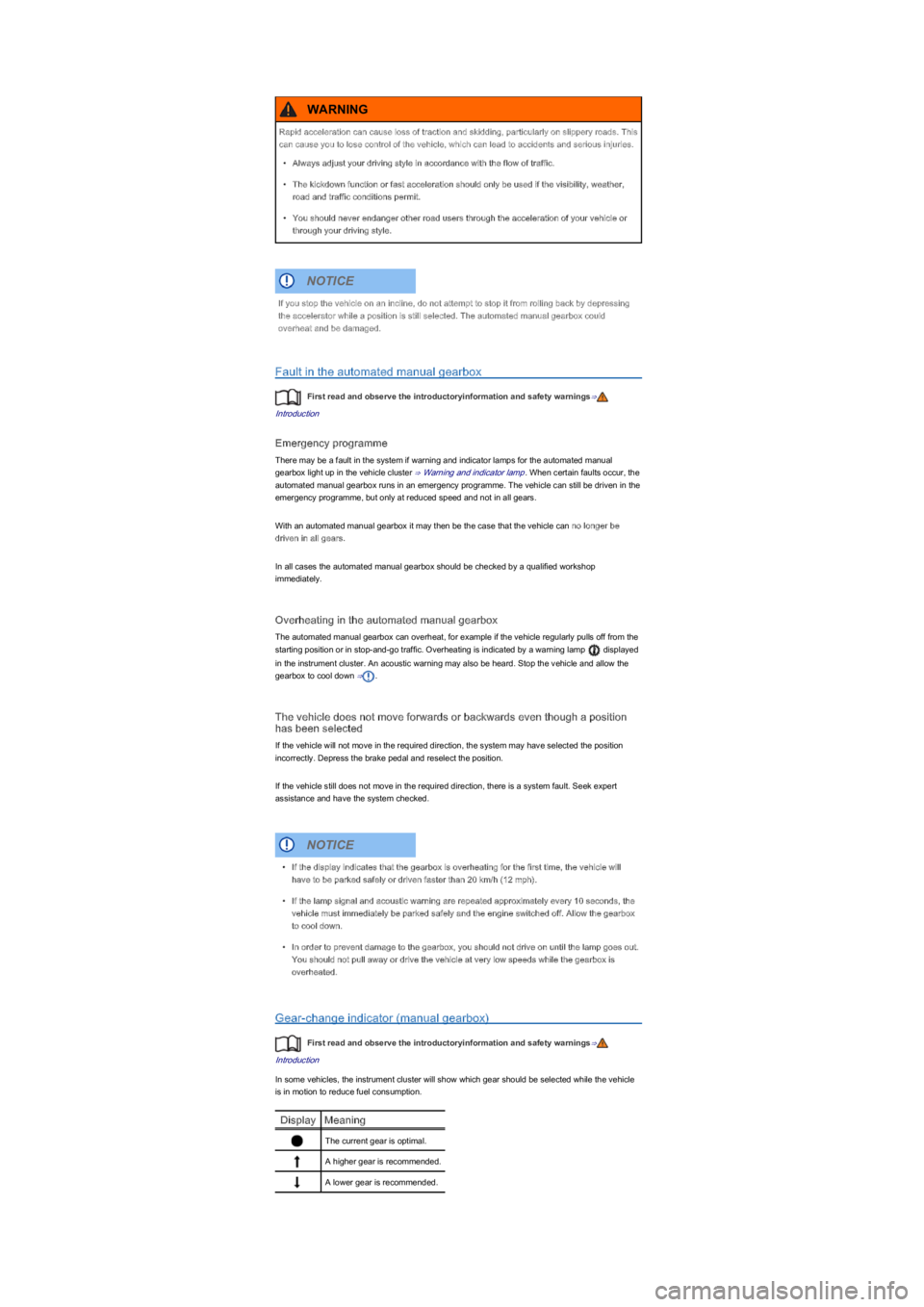
Fault in the automated manual gearbox
First read and observe the introductoryinformation and safety warnings⇒
Introduction
Emergency programme
There may be a fault in the system if warning and indicator lamps for the automated manual
gearbox light up in the vehicle cluster ⇒ Warning and indicator lamp. When certain faults occur, the
automated manual gearbox runs in an emergency programme. The vehicle can still be driven in the
emergency programme, but only at reduced speed and not in all gears.
With an automated manual gearbox it may then be the case that the vehicle can no longer be
driven in all gears.
In all cases the automated manual gearbox should be checked by a qualified workshop
immediately.
Overheating in the automated manual gearbox
The automated manual gearbox can overheat, for example if the vehicle regularly pulls off from the
starting position or in stop-and-go traffic. Overheating is indicated by a warning lamp displayed
in the instrument cluster. An acoustic warning may also be heard. Stop the vehicle and allow the
gearbox to cool down ⇒.
The vehicle does not move forwards or backwards even though a position
has been selected
If the vehicle will not move in the required direction, the system may have selected the position
incorrectly. Depress the brake pedal and reselect the position.
If the vehicle still does not move in the required direction, there is a system fault. Seek expert
assistance and have the system checked.
Gear-change indicator (manual gearbox)
First read and observe the introductoryinformation and safety warnings⇒
Introduction
In some vehicles, the instrument cluster will show which gear should be selected while the vehicle
is in motion to reduce fuel consumption.
DisplayMeaning
The current gear is optimal.
A higher gear is recommended.
A lower gear is recommended.
Rapid acceleration can cause loss of traction and skidding, particularly on slippery roads. This
can cause you to lose control of the vehicle, which can lead to accidents and serious injuries.
•Always adjust your driving style in accordance with the flow of traffic.
•The kickdown function or fast acceleration should only be used if the visibility, weather,
road and traffic conditions permit.
•You should never endanger other road users through the acceleration of your vehicle or
through your driving style.
WARNING
If you stop the vehicle on an incline, do not attempt to stop it from rolling back by depressing
the accelerator while a position is still selected. The automated manual gearbox could
overheat and be damaged.
NOTICE
•If the display indicates that the gearbox is overheating for the first time, the vehicle will
have to be parked safely or driven faster than 20 km/h (12 mph).
•If the lamp signal and acoustic warning are repeated approximately every 10 seconds, the
vehicle must immediately be parked safely and the engine switched off. Allow the gearbox
to cool down.
•In order to prevent damage to the gearbox, you should not drive on until the lamp goes out.
You should not pull away or drive the vehicle at very low speeds while the gearbox is
overheated.
NOTICE
Page 97 of 211
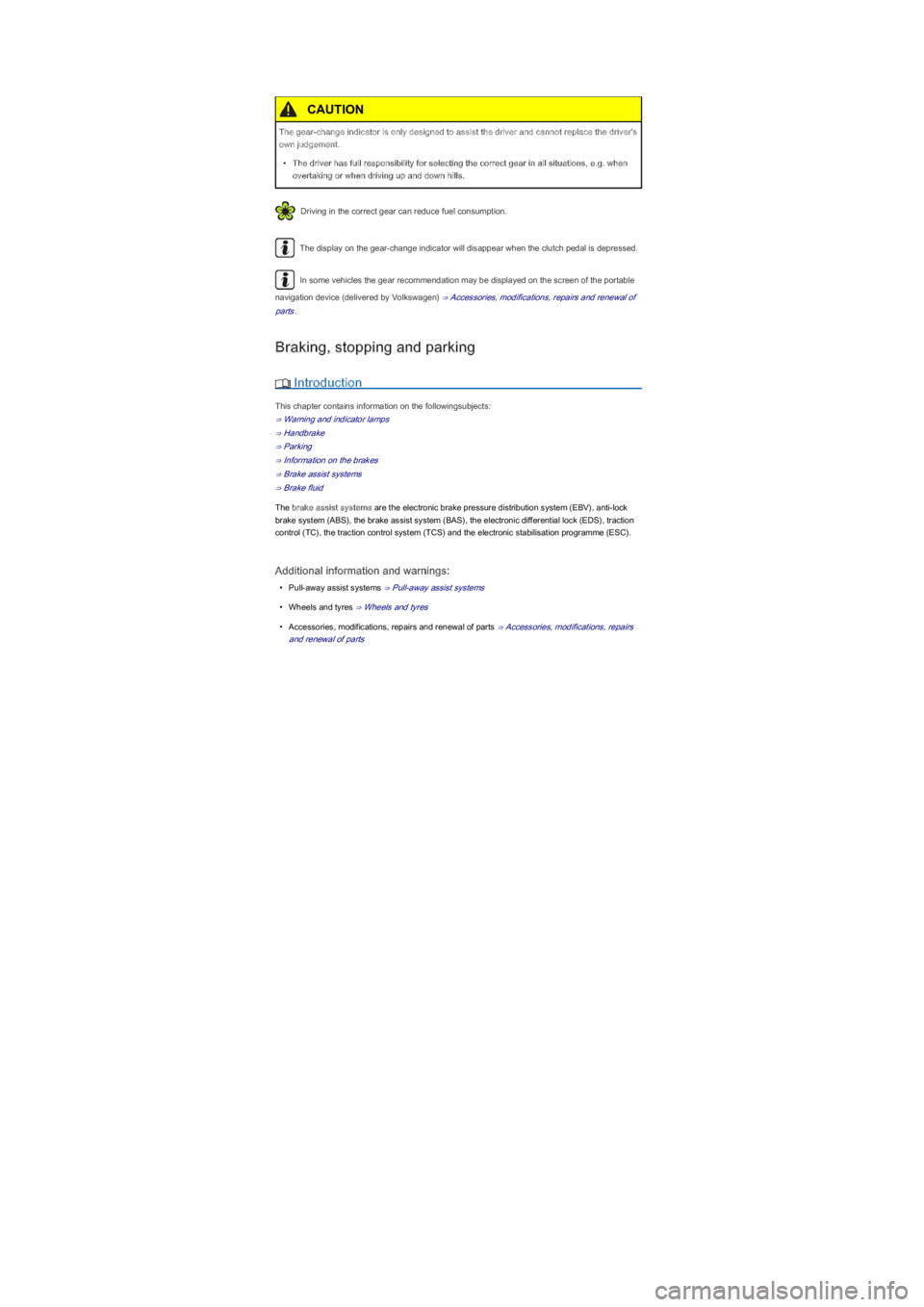
Driving in the correct gear can reduce fuel consumption.
The display on the gear-change indicator will disappear when the clutch pedal is depressed.
In some vehicles the gear recommendation may be displayed on the screen of the portable
navigation device (delivered by Volkswagen) ⇒ Accessories, modifications, repairs and renewal of
parts.
Braking, stopping and parking
Introduction
This chapter contains information on the followingsubjects:
⇒ Warning and indicator lamps
⇒ Handbrake
⇒ Parking
⇒ Information on the brakes
⇒ Brake assist systems
⇒ Brake fluid
The brake assist systems are the electronic brake pressure distribution system (EBV), anti-lock
brake system (ABS), the brake assist system (BAS), the electronic differential lock (EDS), traction
control (TC), the traction control system (TCS) and the electronic stabilisation programme (ESC).
Additional information and warnings:
•Pull-away assist systems ⇒ Pull-away assist systems
•Wheels and tyres ⇒ Wheels and tyres
•Accessories, modifications, repairs and renewal of parts ⇒ Accessories, modifications, repairs
and renewal of parts
The gear-change indicator is only designed to assist the driver and cannot replace the driver's
own judgement.
•The driver has full responsibility for selecting the correct gear in all situations, e.g. when
overtaking or when driving up and down hills.
CAUTION
Page 98 of 211
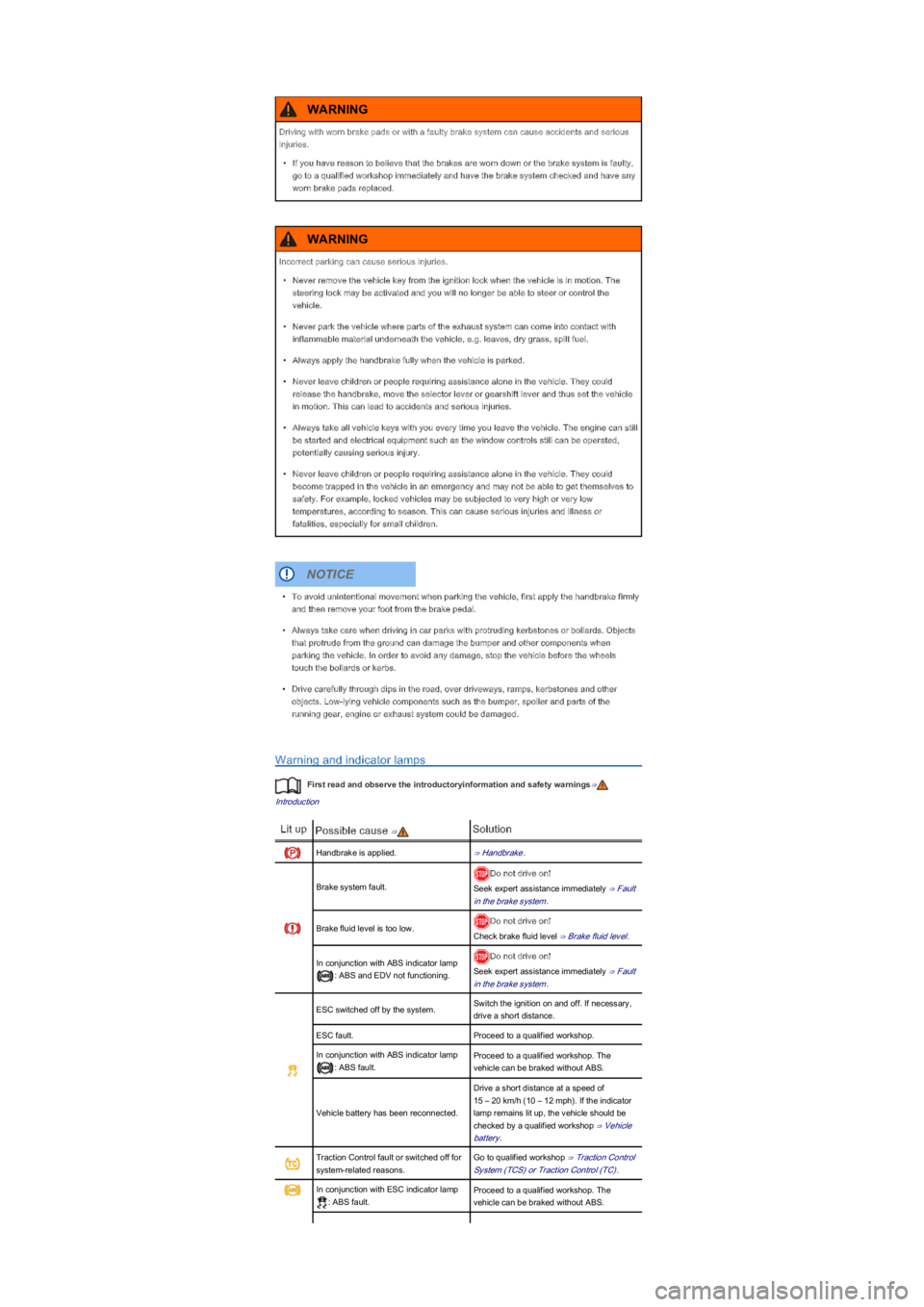
Warning and indicator lamps
First read and observe the introductoryinformation and safety warnings⇒
Introduction
Lit upPossible cause ⇒Solution
Handbrake is applied.⇒ Handbrake.
Brake system fault.
Do not drive on!
Seek expert assistance immediately ⇒ Fault
in the brake system.
Brake fluid level is too low.Do not drive on!
Check brake fluid level ⇒ Brake fluid level.
In conjunction with ABS indicator lamp
: ABS and EDV not functioning.
Do not drive on!
Seek expert assistance immediately ⇒ Fault
in the brake system.
ESC switched off by the system.Switch the ignition on and off. If necessary,
drive a short distance.
ESC fault.Proceed to a qualified workshop.
In conjunction with ABS indicator lamp
: ABS fault.
Proceed to a qualified workshop. The
vehicle can be braked without ABS.
Vehicle battery has been reconnected.
Drive a short distance at a speed of
15 – 20 km/h (10 – 12 mph). If the indicator
lamp remains lit up, the vehicle should be
checked by a qualified workshop ⇒ Vehicle
battery.
Traction Control fault or switched off for
system-related reasons.
Go to qualified workshop ⇒ Traction Control
System (TCS) or Traction Control (TC).
In conjunction with ESC indicator lamp
: ABS fault.
Proceed to a qualified workshop. The
vehicle can be braked without ABS.
Driving with worn brake pads or with a faulty brake system can cause accidents and serious
injuries.
•If you have reason to believe that the brakes are worn down or the brake system is faulty,
go to a qualified workshop immediately and have the brake system checked and have any
worn brake pads replaced.
WARNING
Incorrect parking can cause serious injuries.
•Never remove the vehicle key from the ignition lock when the vehicle is in motion. The
steering lock may be activated and you will no longer be able to steer or control the
vehicle.
•Never park the vehicle where parts of the exhaust system can come into contact with
inflammable material underneath the vehicle, e.g. leaves, dry grass, spilt fuel.
•Always apply the handbrake fully when the vehicle is parked.
•Never leave children or people requiring assistance alone in the vehicle. They could
release the handbrake, move the selector lever or gearshift lever and thus set the vehicle
in motion. This can lead to accidents and serious injuries.
•Always take all vehicle keys with you every time you leave the vehicle. The engine can still
be started and electrical equipment such as the window controls still can be operated,
potentially causing serious injury.
•Never leave children or people requiring assistance alone in the vehicle. They could
become trapped in the vehicle in an emergency and may not be able to get themselves to
safety. For example, locked vehicles may be subjected to very high or very low
temperatures, according to season. This can cause serious injuries and illness or
fatalities, especially for small children.
WARNING
•To avoid unintentional movement when parking the vehicle, first apply the handbrake firmly
and then remove your foot from the brake pedal.
•Always take care when driving in car parks with protruding kerbstones or bollards. Objects
that protrude from the ground can damage the bumper and other components when
parking the vehicle. In order to avoid any damage, stop the vehicle before the wheels
touch the bollards or kerbs.
•Drive carefully through dips in the road, over driveways, ramps, kerbstones and other
objects. Low-lying vehicle components such as the bumper, spoiler and parts of the
running gear, engine or exhaust system could be damaged.
NOTICE
Page 101 of 211
Information on the brakes
First read and observe the introductoryinformation and safety warnings⇒
Introduction
New brake pads cannot generate the full braking effect during the first 200 to 300 km and must first
be run in ⇒. However, you can compensate for the slightly reduced braking force by applying
more pressure to the brake pedal. During the run-in period, the braking distance is longer when
the brakes are depressed fully or during emergency braking than with brakes that have been fully
run in. In the run-in period, the brakes should not be depressed fully and situations that create a
heavy load on the brakes should be avoided. For example, when driving too close to the vehicle
ahead.
The rate of wear of the brake pads depends to a great extent on the conditions under which the
vehicle is operated and the way in which the vehicle is driven. With regular urban trips, short
journeys and a sporty driving style, the brake pads must be checked by a qualified workshop more
regularly than stated in the service schedule.
When driving with wet brakes, for example after driving through water, after heavy rainfall or after
washing the vehicle, the braking effect may be delayed as the brake discs will be wet, or possibly
iced up (in winter). The brakes must be dried as quickly as possible by careful braking at higher
speed. Please ensure that no following vehicle and no other road user is put at risk as a result of
this action ⇒.
Any layer of salt accumulated on the discs and pads will delay the braking effect and increase the
braking distance. If the brakes on the vehicle have not been applied for a long time on roads that
have been gritted with salt, the layer of salt must be reduced through careful braking ⇒.
Corrosion on the brake discs and dirt in the brake pads are facilitated through long periods of
inactivity, low mileage and low load levels. If the brake pads have been hardly used, or if they are at
all corroded, Volkswagen recommends that the brake discs and brake pads be cleaned by braking
strongly several times from high speed. Please ensure that no following vehicle and no other road
user is put at risk as a result of this action ⇒.
Fault in the brake system
A brake circuit may have failed if you have to reduce speed and the vehicle does not brake as
normal (sudden increase in braking distance). This is indicated by the warning light . Go to the
nearest qualified workshop immediately to have the fault corrected. Drive at low speed when doing
this and anticipate much longer braking distances and an increase in the pressure required on the
pedal.
Brake servo
The brake servo will only function when the engine is running and reinforces the pressure applied
by the driver on the brake pedal.
If the brake servo is not functioning or the vehicle is being towed, the brake pedal will have to be
depressed more forcefully as the braking distance will be increased due to the lack of assistance for
the brake system ⇒.
The components of the exhaust system become very hot. This can cause fires and serious
injuries.
•Never park the vehicle where parts of the exhaust system can come into contact with any
inflammable material underneath the vehicle, e.g. leaves, dry grass, spilt fuel.
WARNING
•To avoid unintentional movement when parking the vehicle, first apply the handbrake firmly
and then remove your foot from the brake pedal.
•Always take care when driving in car parks with protruding kerbstones or bollards. Objects
that protrude from the ground can damage the bumper and other components when
parking the vehicle. In order to avoid any damage, stop the vehicle before the wheels
touch the bollards or kerbs.
•Drive carefully through dips in the road, over driveways, ramps, kerbstones and other
objects. Low-lying vehicle components such as the bumper, spoiler and parts of the
running gear, engine or exhaust system could be damaged.
NOTICE
Page 106 of 211
Driving with respect for the environment
Introduction
This chapter contains information on the followingsubjects:
⇒ An economic driving style
⇒ Driving in a fuel-efficient manner
Fuel economy, environmental impact and wear on the engine, brakes and tyres depend largely on
three factors:
•Personal driving style.
•Conditions of use (weather, road surface).
•Technical conditions.
Depending on your personal driving style, a few simple measures can help save fuel by up to 25%.
An economic driving style
First read and observe the introductoryinformation and safety warnings⇒
Introduction
Changing gear earlier
In principle, the highest gear is always the most economical gear. A rule of thumb for most vehicles:
at a speed of 30 km/h (19 mph) drive in 3rd gear, at 40 km/h (25 mph) in 4th gear and at 50 km/h
(31 mph) in 5th gear.
If the traffic and driving situation allows it, skipping gears when changing up a gear will also save
fuel.
Do not drive gears to their upper limit. Use first gear only for pulling away then quickly change up to
second gear. Avoid using the kickdown function in vehicles with an automated manual gearbox.
Vehicles with a gear display help to improve fuel economy by indicating the optimum time to
change gear.
Rolling to a stop
Taking your foot off the accelerator will interrupt the supply of fuel to the engine and decrease fuel
consumption.
Therefore, in situations such as approaching a red traffic light, let the vehicle roll without applying
the accelerator. Only press on the clutch pedal to disengage if the vehicle becomes too slow or if
the stopping distance is longer. The engine will then run at idling speed.
Switch off the engine in situations when the vehicle might be stationary for a long time, e.g. at a
level crossing. In vehicles with an active start/stop system, the engine will switch off automatically
when the vehicle is stationary.
Thinking ahead when driving, and driving with the flow of traffic
Applying the brake and accelerator too often will significantly increase fuel consumption. By thinking
ahead when driving and by maintaining a sufficient distance from the vehicle in front, simply
keeping your foot off the accelerator will stop the speed from fluctuating. This means that active
braking and accelerating is not always necessary.
Driving smoothly and evenly
Even more important than speed is smoothness: the more evenly you drive, the lower your fuel
consumption will be.
When driving on a motorway, it is much more effective to drive at a constant moderate speed than
to drive with constant acceleration and braking. As a rule, driving with a constant style will get you
to your destination just as quickly.
The cruise control system will help you to maintain a constant driving style.
Using additional equipment in moderation
It is always important to be comfortable in your vehicle, but it is also important to consider the
environment.
Some equipment will increase fuel consumption when switched on:
Adapt your speed and distance from the vehicles ahead to suit visibility, weather, road and
traffic conditions.
WARNING