gearbox VOLKSWAGEN UP! 2021 Owner´s Manual
[x] Cancel search | Manufacturer: VOLKSWAGEN, Model Year: 2021, Model line: UP!, Model: VOLKSWAGEN UP! 2021Pages: 211, PDF Size: 5.98 MB
Page 200 of 211
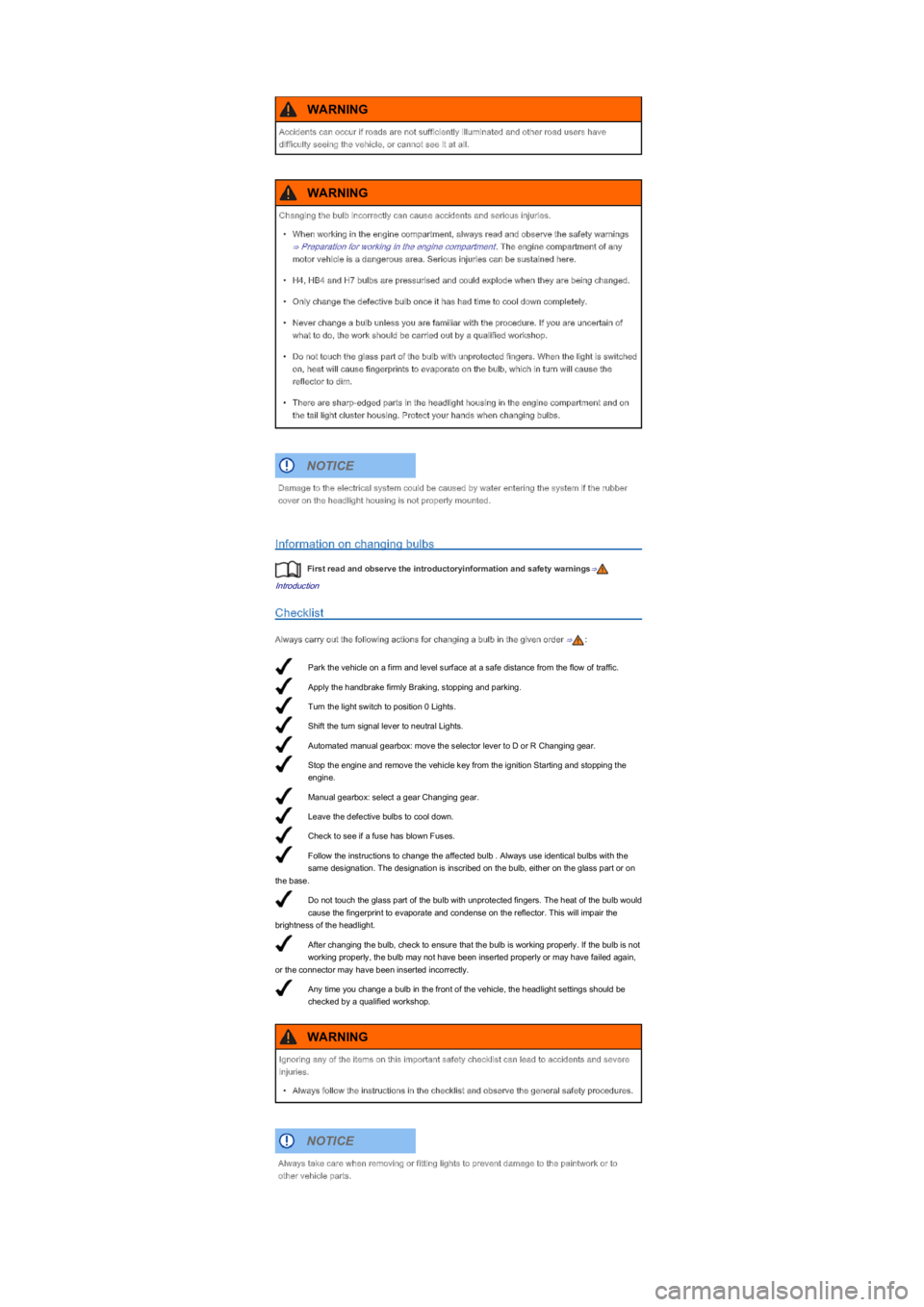
Park the vehicle on a firm and level surface at a safe distance from the flow of traffic.
Apply the handbrake firmly Braking, stopping and parking.
Turn the light switch to position 0 Lights.
Shift the turn signal lever to neutral Lights.
Automated manual gearbox: move the selector lever to D or R Changing gear.
Stop the engine and remove the vehicle key from the ignition Starting and stopping the
engine.
Manual gearbox: select a gear Changing gear.
Leave the defective bulbs to cool down.
Check to see if a fuse has blown Fuses.
Follow the instructions to change the affected bulb . Always use identical bulbs with the
same designation. The designation is inscribed on the bulb, either on the glass part or on
the base.
Do not touch the glass part of the bulb with unprotected fingers. The heat of the bulb would
cause the fingerprint to evaporate and condense on the reflector. This will impair the
brightness of the headlight.
After changing the bulb, check to ensure that the bulb is working properly. If the bulb is not
working properly, the bulb may not have been inserted properly or may have failed again,
or the connector may have been inserted incorrectly.
Any time you change a bulb in the front of the vehicle, the headlight settings should be
checked by a qualified workshop.
Information on changing bulbs
First read and observe the introductoryinformation and safety warnings⇒
Introduction
Checklist
Always carry out the following actions for changing a bulb in the given order ⇒:
Accidents can occur if roads are not sufficiently illuminated and other road users have
difficulty seeing the vehicle, or cannot see it at all.
WARNING
Changing the bulb incorrectly can cause accidents and serious injuries.
•When working in the engine compartment, always read and observe the safety warnings
⇒ Preparation for working in the engine compartment. The engine compartment of any
motor vehicle is a dangerous area. Serious injuries can be sustained here.
•H4, HB4 and H7 bulbs are pressurised and could explode when they are being changed.
•Only change the defective bulb once it has had time to cool down completely.
•Never change a bulb unless you are familiar with the procedure. If you are uncertain of
what to do, the work should be carried out by a qualified workshop.
•Do not touch the glass part of the bulb with unprotected fingers. When the light is switched
on, heat will cause fingerprints to evaporate on the bulb, which in turn will cause the
reflector to dim.
•There are sharp-edged parts in the headlight housing in the engine compartment and on
the tail light cluster housing. Protect your hands when changing bulbs.
WARNING
Damage to the electrical system could be caused by water entering the system if the rubber
cover on the headlight housing is not properly mounted.
NOTICE
Ignoring any of the items on this important safety checklist can lead to accidents and severe
injuries.
•Always follow the instructions in the checklist and observe the general safety procedures.
WARNING
Always take care when removing or fitting lights to prevent damage to the paintwork or to
other vehicle parts.
NOTICE
Page 207 of 211
⇒ Fitting the front towing eye
⇒ Driving tips when towing
Observe any legal requirements when towing or tow-starting.
For technical reasons, vehicles with a discharged battery must not be tow-started.
For technical reasons, vehicles with an automated manual gearbox must not be tow started
unless it has been ascertained that the gearbox is in position N⇒ When a vehicle with an
automated manual gearbox has to be towed:.
Towing a vehicle when the engine is switched off and the ignition is switched on discharges the
vehicle battery. In some vehicles battery charge level, the drop in voltage can be large enough after
just a few minutes that electrical consumers in the vehicle will no longer function, e.g. the hazard
warning lights.
Additional information and warnings:
•Exterior views ⇒ Exterior views
•Changing gear ⇒ Changing gear
•Engine management system and exhaust purification system ⇒ Engine management system
and exhaust purification system
•Starting the engine with jump leads ⇒ Starting the engine with jump leads
You will not be able to fit a towing eye onto the rear bumper. The vehicle is not suited for
towing other vehicles.
Notes on tow-starting
First read and observe the introductoryinformation and safety warnings⇒
Introduction
Vehicles should not be tow-started wherever possible. Use jump leads to start the engine
instead⇒ Starting the engine with jump leads.
For technical reasons, the following vehicles cannot be tow-started:
•If the vehicle battery has discharged, the engine control unit will not function properly.
However, if the vehicle still has to be tow-started (manual gearbox):
•Engage 2nd or 3rd gear.
•Keep the clutch pressed down.
Never tow a vehicle that has no power supply.
•Never remove the key from the ignition. This could cause the steering lock to engage
suddenly. You will no longer be able to steer the vehicle. This can lead to a loss of control
of the vehicle, accidents and serious injuries.
•If the power supply to the towed vehicle is disconnected, stop towing immediately and
seek expert assistance.
WARNING
If a vehicle is being towed, the vehicle handling and braking effect will change significantly.
Please note the following in order to reduce the risk of an accident or serious injuries:
•Notes for the driver of the towed vehicle:
- You will need to depress the brake pedal more vigorously than normal as the brake
servo is not working. Always be careful not to drive into the vehicle that is pulling your
vehicle.
- You will need to turn the steering wheel more vigorously as the power-assisted
steering function is not working.
•Notes for the driver of the towing vehicle
- Accelerate carefully and gently.
- Avoid sudden braking and driving manoeuvres.
- Brake earlier than normal by pressing lightly on the brake pedal.
WARNING
•Remove and install the cover and the towing eye carefully so as to avoid damage to the
vehicle, e.g. the paintwork.
•Unburnt fuel can enter the catalytic converter and damage it while the vehicle is being
towed.
NOTICE
Page 208 of 211
•Switch on the ignition and the hazard warning lights.
•Once both vehicles are in motion, release the clutch.
•As soon as the engine starts, press the clutch and put the gear into neutral. This helps to
prevent driving into the towing vehicle.
However, if the vehicle still has to be tow-started (automated manual
gearbox):
•Switch on the ignition and the hazard warning lights.
•Place the selector lever in position N.
•When both vehicles are in motion and the brake pedal indicator lamp goes out, move the
selector lever to position D.
•As soon as the engine starts, press the brake pedal and move the selector lever to position N.
This helps to prevent driving into the towing vehicle.
Notes on towing
First read and observe the introductoryinformation and safety warnings⇒
Introduction
Tow rope or tow bar
It is easier and safer to tow a vehicle with a tow bar. Only use a tow rope if you do not have a tow
bar.
The tow rope should be slightly elastic to reduce the strain on both vehicles. It is advisable to use a
tow rope made of synthetic fibre or similarly elastic material.
Only attach the tow rope or tow bar to the specially provided towing eyes or to the towing bracket.
When a vehicle with a manual gearbox has to be towed:
Check whether the vehicle can be towed ⇒ When should your vehicle not be towed?.
•Move the gear stick to neutral ⇒ Changing gear.
•Do not allow the vehicle to be towed at speeds faster than 50 km/h (30 mph).
•Do not have the vehicle towed further than 50 km (30 miles).
When a vehicle with an automated manual gearbox has to be towed:
Check whether the vehicle can be towed ⇒ When should your vehicle not be towed?
•Switch on the ignition.
•Move the selector lever to N⇒ Changing gear.
•Check whether the automated manual gearbox is really in neutral. To do this drive the car a few
metres as a test. The automated manual gearbox is in neutral if the vehicle can be easily
moved.
•Seek expert assistance if the automated manual gearbox cannot be put into neutral ⇒.
•Do not allow the vehicle to be towed at speeds faster than 50 km/h (30 mph).
•Do not have the vehicle towed further than 50 km (30 miles).
•If a breakdown truck is used, the vehicle must be towed with the front wheels raised.
When should your vehicle not be towed?
•If, due to damage, the vehicle gearbox no longer contains any lubricant.
•If the automated manual gearbox cannot be put into neutral ⇒.
•If the distance to be towed is further than 50 km - applies to vehicles with an automated manual
gearbox only.
•If the steering function or the operating clearance of the wheels cannot be ensured, e.g. after an
accident.
The vehicle can only be towed when the handbrake and steering lock are not engaged.
Fitting the front towing eye
When tow-starting, unburnt fuel can enter the catalytic converter and damage it.
NOTICE
Never tow a vehicle with automated manual gearbox if the automated manual gearbox cannot
be put into neutral. Otherwise, the gearbox and engine can suffer considerable damage.
NOTICE
Page 210 of 211
•You will need to depress the brake pedal more vigorously than normal as the brake servo is not
working. Do not drive too close to the towing vehicle.
•Read and comply with the information and notes in the owner's manual of the towing vehicle.
Notes for the driver of the towing vehicle
•Accelerate carefully and gently. Avoid any sudden driving manoeuvres.
•Brake earlier than normal by pressing lightly on the brake pedal.
•Read and comply with any information and notes in the owner's manual of the towed vehicle.
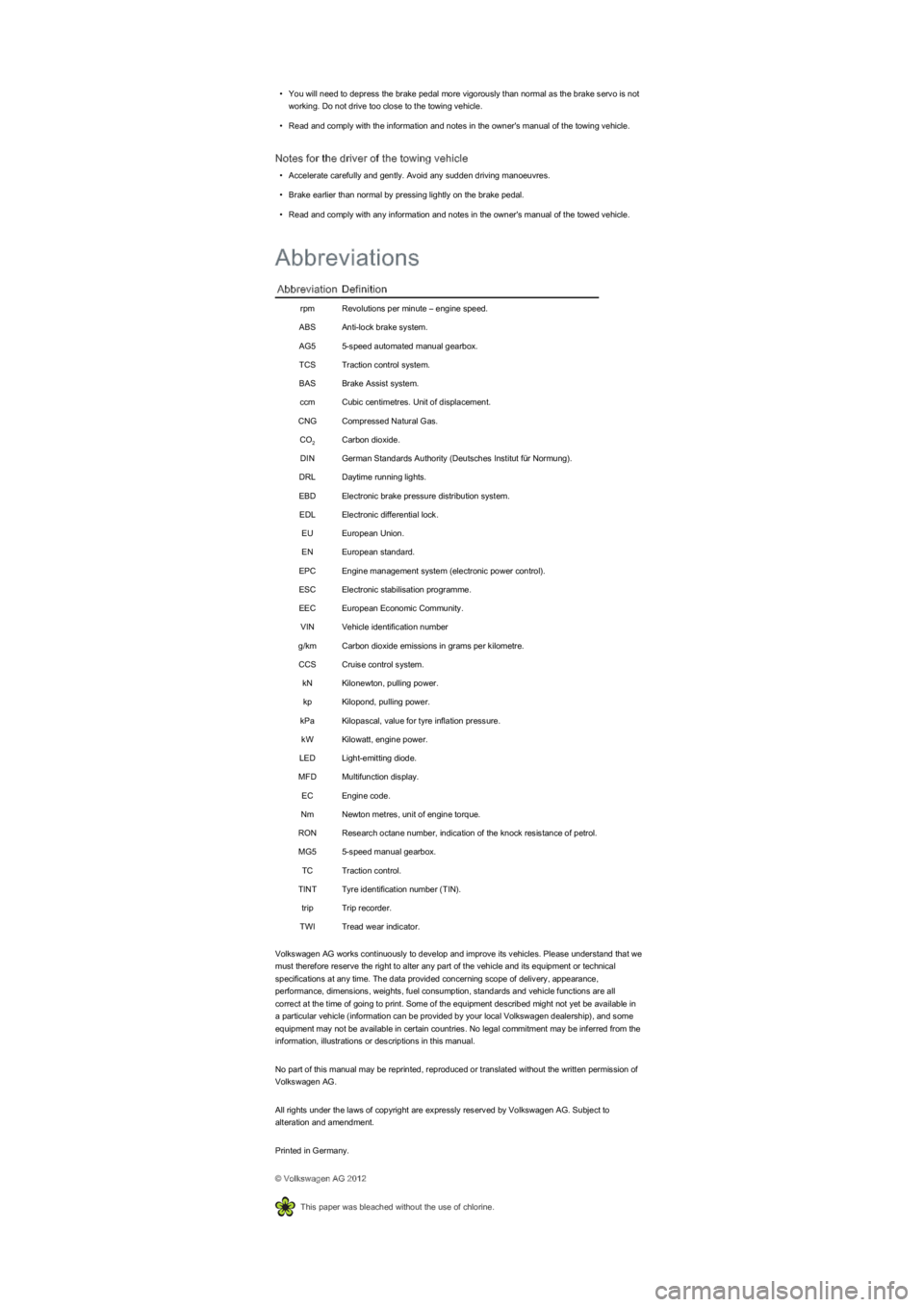
AbbreviationDefinition
rpmRevolutions per minute – engine speed.
ABSAnti-lock brake system.
AG55-speed automated manual gearbox.
TCSTraction control system.
BASBrake Assist system.
ccmCubic centimetres. Unit of displacement.
CNGCompressed Natural Gas.
COCarbon dioxide.
DINGerman Standards Authority (Deutsches Institut für Normung).
DRLDaytime running lights.
EBDElectronic brake pressure distribution system.
EDLElectronic differential lock.
EUEuropean Union.
ENEuropean standard.
EPCEngine management system (electronic power control).
ESCElectronic stabilisation programme.
EECEuropean Economic Community.
VINVehicle identification number
g/kmCarbon dioxide emissions in grams per kilometre.
CCSCruise control system.
kNKilonewton, pulling power.
kpKilopond, pulling power.
kPaKilopascal, value for tyre inflation pressure.
kWKilowatt, engine power.
LEDLight-emitting diode.
MFDMultifunction display.
ECEngine code.
NmNewton metres, unit of engine torque.
RONResearch octane number, indication of the knock resistance of petrol.
MG55-speed manual gearbox.
TCTraction control.
TINT Tyre identification number (TIN).
tripTrip recorder.
TWITread wear indicator.
Volkswagen AG works continuously to develop and improve its vehicles. Please understand that we
must therefore reserve the right to alter any part of the vehicle and its equipment or technical
specifications at any time. The data provided concerning scope of delivery, appearance,
performance, dimensions, weights, fuel consumption, standards and vehicle functions are all
correct at the time of going to print. Some of the equipment described might not yet be available in
a particular vehicle (information can be provided by your local Volkswagen dealership), and some
equipment may not be available in certain countries. No legal commitment may be inferred from the
information, illustrations or descriptions in this manual.
No part of this manual may be reprinted, reproduced or translated without the written permission of
Volkswagen AG.
All rights under the laws of copyright are expressly reserved by Volkswagen AG. Subject to
alteration and amendment.
Printed in Germany.
© Volkswagen AG 2012
This paper was bleached without the use of chlorine.
Abbreviations
2