brake VOLKSWAGEN UP! 2021 Owner´s Manual
[x] Cancel search | Manufacturer: VOLKSWAGEN, Model Year: 2021, Model line: UP!, Model: VOLKSWAGEN UP! 2021Pages: 211, PDF Size: 5.98 MB
Page 169 of 211
Running-in
First read and observe the introductoryinformation and safety warnings⇒
Introduction
Please follow the regulations concerning running-in new parts.
Running in a new engine
Any new engine has to be run in during the first 1,500 kilometres. During its first few hours of
running, the internal friction in the engine is greater than later on when all the moving parts have
bedded down.
The style of driving during the first 1,500 kilometres will also affect the engine quality. Even after
this time – and especially with a cold engine – drive the vehicle at moderate speeds in order to
reduce engine wear and to increase the mileage that the engine can cover. Do not drive at engine
speeds that are too low. Always shift down gear if the engine is not running smoothly. The
following applies up to 1,000 kilometres:
•Do not depress the accelerator fully.
•Do not drive the vehicle at more than 2/3 of the top engine speed.
From 1,000 to 1,500 kilometres, gradually increase driving performance to top speed and highest
engine speed.
Running in new tyres and brake pads
•New wheels and tyres ⇒ Wheels and tyres
•Information on the brakes ⇒ Braking, stopping and parking
If the engine is run in gently, the life of the engine will be increased and its oil consumption
reduced.
Accessories and parts
First read and observe the introductoryinformation and safety warnings⇒
Introduction
Volkswagen recommends that you seek advice from a Volkswagen dealership before purchasing
accessories, spare parts or service fluids. For example, if the vehicle is to be retrofitted with
accessories or if parts have to be renewed. Volkswagen dealerships can recommend accessories,
parts and service fluids suitable for your requirements. They can also answer any questions you
might have regarding official regulations.
Volkswagen recommends that you only use approved Volkswagen accessories and Volkswagen
Genuine Parts. These parts and accessories have been specially tested by Volkswagen for
suitability, reliability and safety. And Volkswagen dealerships are qualified to install them correctly.
Although the market is constantly scrutinised, Volkswagen cannot assume responsibility for the
reliability, safety and suitability of products Volkswagen has not approved. Volkswagen can
therefore assume no responsibility for these parts, even if they have been approved by an official
testing agency or are covered by an official approval certificate.
Any retro-fitted equipment that has a direct effect on the vehicle and/or the way it is driven must be
approved by Volkswagen for use in your vehicle and bear the e mark (the European Union's
authorization symbol). These devices include cruise control systems or an electronically controlled
suspension.
Any additional electrical components fitted that do not serve to control the vehicle itself must bear
the mark (manufacturer conformity declaration in the European Union). Such devices include
refrigerator boxes, laptops and ventilator fans.
Unsuitable spare parts and accessories, incorrectly carried out work, modifications and
repairs can lead to damage to the vehicle and cause accidents and serious injuries.
•Volkswagen strongly recommends that you only use approved Volkswagen accessories
and Volkswagen Genuine Parts. These parts and accessories have been specially tested
by Volkswagen for suitability, reliability and safety.
•Repairs and modifications to your vehicle should only be carried out by a qualified
workshop. Qualified workshops have the necessary tools, diagnostic equipment, repair
information and qualified personnel.
•Never fit parts to your vehicle that are in any way different from the factory-fitted parts.
•Never secure or mount objects such as drink holders or telephone holders on or next to
the airbag covers or within the deployment zone of the airbag.
•Only use rim/tyre combinations that have been approved by Volkswagen for your vehicle
type.
WARNING
®
®
Page 178 of 211
Information stickers and plates
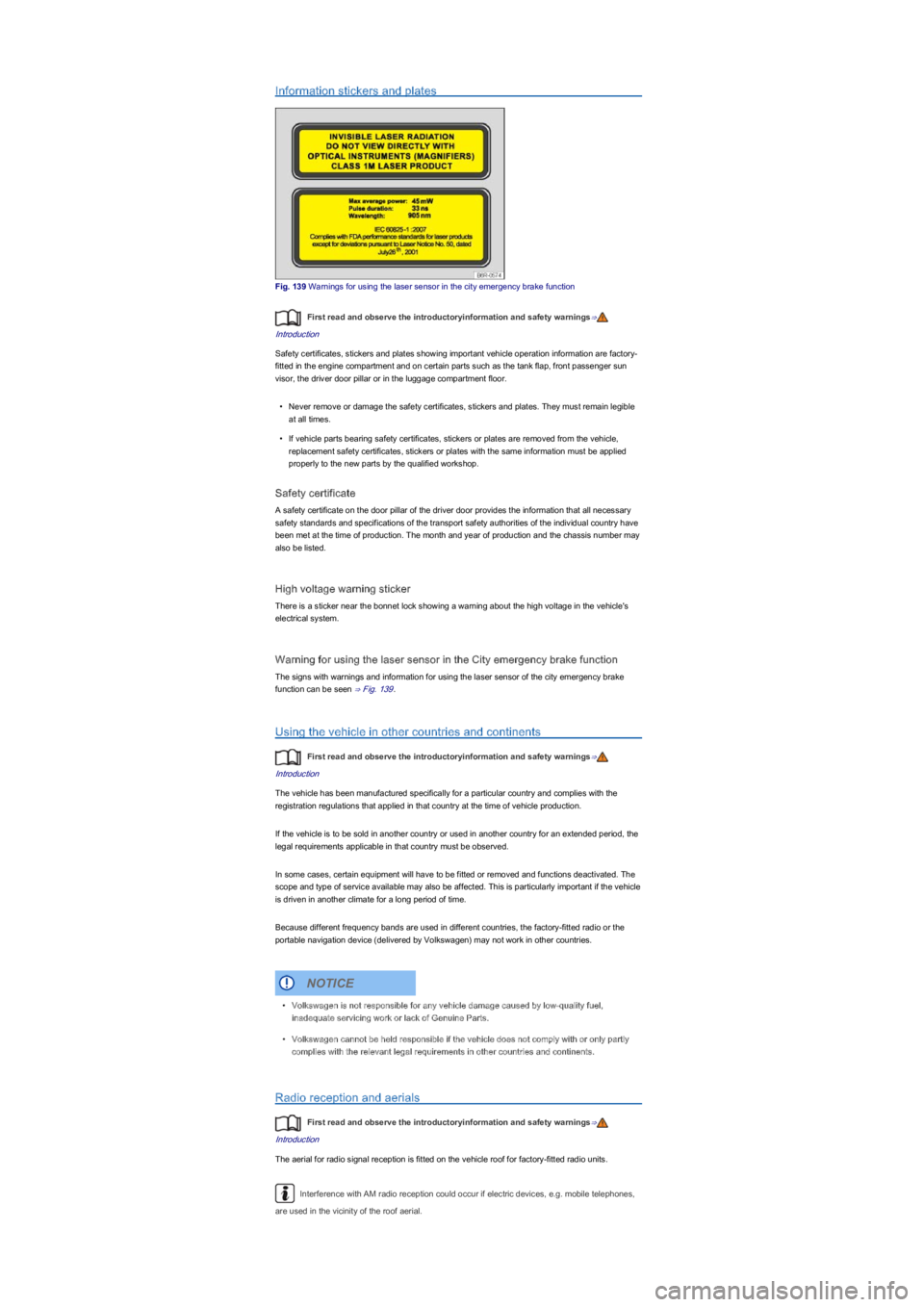
Fig. 139 Warnings for using the laser sensor in the city emergency brake function
First read and observe the introductoryinformation and safety warnings⇒
Introduction
Safety certificates, stickers and plates showing important vehicle operation information are factory-
fitted in the engine compartment and on certain parts such as the tank flap, front passenger sun
visor, the driver door pillar or in the luggage compartment floor.
•Never remove or damage the safety certificates, stickers and plates. They must remain legible
at all times.
•If vehicle parts bearing safety certificates, stickers or plates are removed from the vehicle,
replacement safety certificates, stickers or plates with the same information must be applied
properly to the new parts by the qualified workshop.
Safety certificate
A safety certificate on the door pillar of the driver door provides the information that all necessary
safety standards and specifications of the transport safety authorities of the individual country have
been met at the time of production. The month and year of production and the chassis number may
also be listed.
High voltage warning sticker
There is a sticker near the bonnet lock showing a warning about the high voltage in the vehicle's
electrical system.
Warning for using the laser sensor in the City emergency brake function
The signs with warnings and information for using the laser sensor of the city emergency brake
function can be seen ⇒ Fig. 139.
Using the vehicle in other countries and continents
First read and observe the introductoryinformation and safety warnings⇒
Introduction
The vehicle has been manufactured specifically for a particular country and complies with the
registration regulations that applied in that country at the time of vehicle production.
If the vehicle is to be sold in another country or used in another country for an extended period, the
legal requirements applicable in that country must be observed.
In some cases, certain equipment will have to be fitted or removed and functions deactivated. The
scope and type of service available may also be affected. This is particularly important if the vehicle
is driven in another climate for a long period of time.
Because different frequency bands are used in different countries, the factory-fitted radio or the
portable navigation device (delivered by Volkswagen) may not work in other countries.
Radio reception and aerials
First read and observe the introductoryinformation and safety warnings⇒
Introduction
The aerial for radio signal reception is fitted on the vehicle roof for factory-fitted radio units.
Interference with AM radio reception could occur if electric devices, e.g. mobile telephones,
are used in the vicinity of the roof aerial.
•Volkswagen is not responsible for any vehicle damage caused by low-quality fuel,
inadequate servicing work or lack of Genuine Parts.
•Volkswagen cannot be held responsible if the vehicle does not comply with or only partly
complies with the relevant legal requirements in other countries and continents.
NOTICE
Page 181 of 211
Practical tips
Frequently asked questions
If you suspect that there is a fault in the vehicle or if your vehicle has been damaged, read and
observe the following information before contacting a Volkswagen dealership or qualified
workshop. You may also find useful information in the index under the headings Things to note or
Checklist.
IrregularitySome possible causesPossible solution
Engine does not start.
Vehicle battery is discharged.
– Jump start the engine ⇒ Starting the
engine with jump leads.
– Recharge the vehicle battery
⇒ Vehicle battery.
An incorrect vehicle key is
being used.
Use a valid vehicle key ⇒ Vehicle key
set.
The fuel level is too low.Fill the tank ⇒ Filling the tank.
Vehicle cannot be locked
or unlocked with the
vehicle key.
– The battery in the vehicle
key is discharged.
– The vehicle key is too far
away from the vehicle.
– Replace battery ⇒ Vehicle key set.
– Move closer to the vehicle.
– Synchronise vehicle key ⇒ Vehicle
key set.
– Unlock or lock vehicle manually
⇒ Manual opening and closing.
Unusual noises.
Cold engine, brake assist
systems, electronic steering
column lock, auxiliary heater,
filling up with natural gas.
Refer to the index under entries for
Noises.
Unusual handling.
Assist systems are active.Refer to the index under entries for
Assist systems.
An incorrect tyre pressure is
being used.
Check tyre pressure ⇒ Wheels and
tyres.
Damage to the tyre or wheel.
Check the rims and tyres regularly for
damage ⇒ Wheels and tyres and
replace as necessary ⇒ Changing a
wheel.
The vehicle has no
vehicle jack, spare wheel
or breakdown set.
Equipment depends on type
of vehicle.
No direct solutions possible as it
depends on the equipment level.
Contact a Volkswagen dealership if
necessary ⇒ Vehicle toolkit.
The road ahead is not lit
up properly.
– Headlight has been masked
for driving on the left or on the
right.
– Headlight not adjusted
correctly.
– Bulbs have failed.
– Dipped beam headlight not
switched on.
– Mask the headlights accordingly for
driving on the left or right ⇒ Lights.
– Adjust headlight range ⇒ Lights.
– Change bulbs ⇒ Changing bulbs.
– Switch dipped headlights on
⇒ Lights.
Electrical consumers not
working.
Low vehicle battery charge.Recharge vehicle battery ⇒ Vehicle
battery.
Low fuel level.Fill the tank ⇒ Filling the tank.
Fuse blown.Check fuse and replace as necessary
⇒ Fuses.
Fuel consumption is
higher than indicated.
– Short distances driven.
– Uneven acceleration.
– Avoid driving short distances.
– Think ahead when driving.
– Accelerate evenly.
An electrical consumer is
switched on.
Switch off all consumers that are not
needed.
Fault in engine management
system.
Have the fault rectified ⇒ Engine
management system and exhaust
purification system.
Tyre pressure too low.Adjust the tyre pressure ⇒ Wheels
and tyres.
Driving in hilly regions.No direct solutions possible.
Driving with a heavy load.No direct solutions possible.
Driving at high engine speed.Select a high gear.
In an emergency
Introduction
This chapter contains information on the followingsubjects:
⇒ Making you and your vehicle safe
⇒ First aid kit, warning triangle and fire extinguisher
Additional information and warnings:
Page 182 of 211
Stop the vehicle at a safe distance away from moving traffic and on a suitable surface .
Switch on the hazard warning lights using the button .
Apply the handbrake firmly Braking, stopping and parking.
Select the neutral position or move the selector lever to N Changing gear.
Stop the engine and remove the vehicle key from the ignition .
Ensure that all occupants exit the vehicle away from moving traffic and proceed to a safe
position, e.g. behind the safety barrier.
Take all vehicle keys with you when you leave the vehicle.
Place the warning triangle in position to draw the attention of other road users to your
vehicle.
Allow the engine to cool down and, if necessary, seek expert assistance.
•Braking, stopping and parking ⇒ Braking, stopping and parking
•Manual opening and closing ⇒ Manual opening and closing
•Vehicle toolkit ⇒ Vehicle toolkit
•Changing a wheel ⇒ Changing a wheel
Making you and your vehicle safe
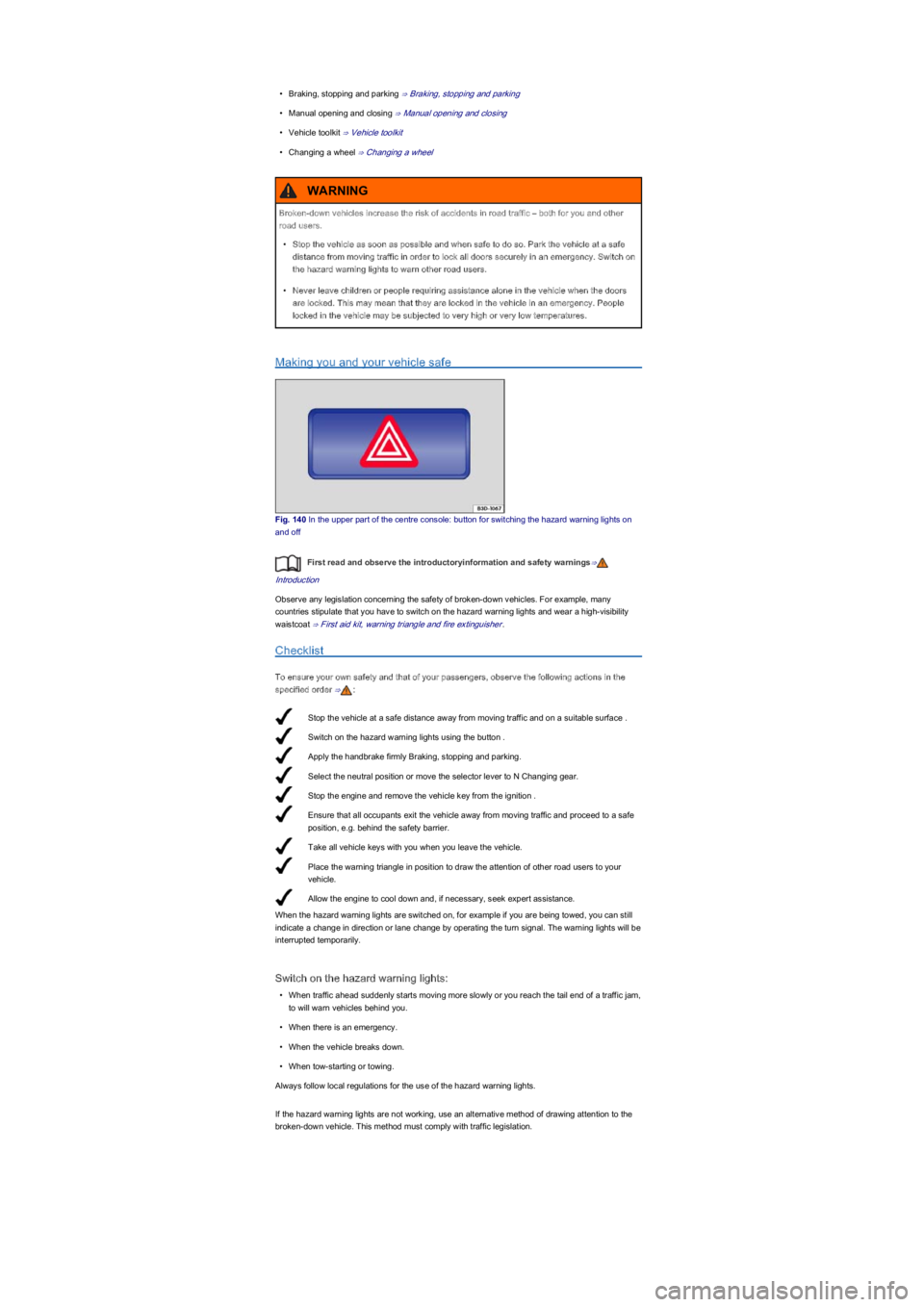
Fig. 140 In the upper part of the centre console: button for switching the hazard warning lights on
and off
First read and observe the introductoryinformation and safety warnings⇒
Introduction
Observe any legislation concerning the safety of broken-down vehicles. For example, many
countries stipulate that you have to switch on the hazard warning lights and wear a high-visibility
waistcoat ⇒ First aid kit, warning triangle and fire extinguisher.
Checklist
To ensure your own safety and that of your passengers, observe the following actions in the
specified order ⇒:
When the hazard warning lights are switched on, for example if you are being towed, you can still
indicate a change in direction or lane change by operating the turn signal. The warning lights will be
interrupted temporarily.
Switch on the hazard warning lights:
•When traffic ahead suddenly starts moving more slowly or you reach the tail end of a traffic jam,
to will warn vehicles behind you.
•When there is an emergency.
•When the vehicle breaks down.
•When tow-starting or towing.
Always follow local regulations for the use of the hazard warning lights.
If the hazard warning lights are not working, use an alternative method of drawing attention to the
broken-down vehicle. This method must comply with traffic legislation.
Broken-down vehicles increase the risk of accidents in road traffic – both for you and other
road users.
•Stop the vehicle as soon as possible and when safe to do so. Park the vehicle at a safe
distance from moving traffic in order to lock all doors securely in an emergency. Switch on
the hazard warning lights to warn other road users.
•Never leave children or people requiring assistance alone in the vehicle when the doors
are locked. This may mean that they are locked in the vehicle in an emergency. People
locked in the vehicle may be subjected to very high or very low temperatures.
WARNING
Page 183 of 211
The vehicle battery will discharge if the hazard warning lights are left on over a long period of
time – even when the ignition is switched off.
If you brake hard at speeds over approximately 80 km/h (50 mph), the brake lights will flash
to warn the traffic behind. If you then continue to brake, the hazard warning lights will be switched
on automatically at speeds under approximately 10 km/h (6 mph). The brake light will light up
continuously. Once the vehicle starts to accelerate, the hazard warning lights will switch off again.
First aid kit, warning triangle and fire extinguisher
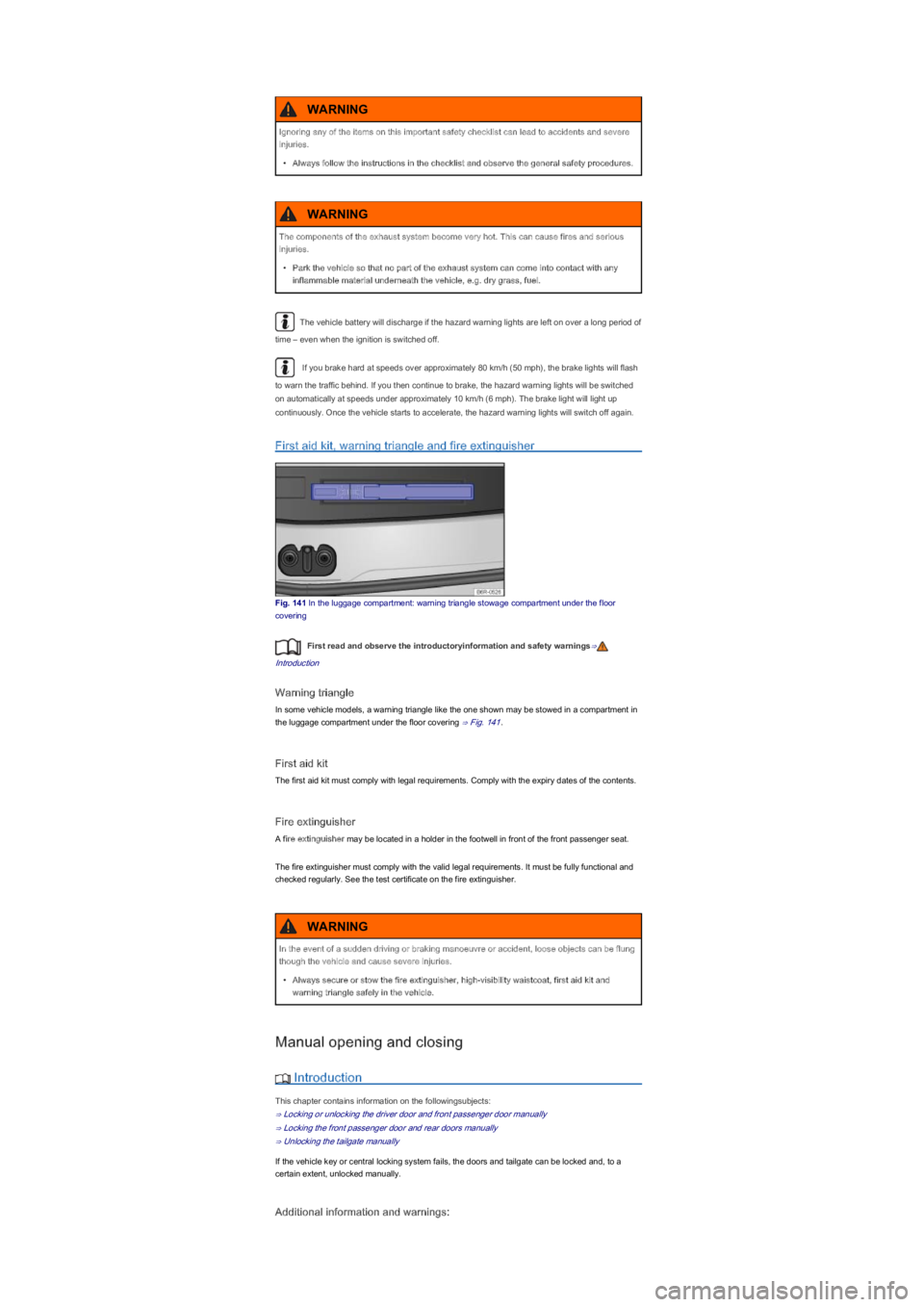
Fig. 141 In the luggage compartment: warning triangle stowage compartment under the floor
covering
First read and observe the introductoryinformation and safety warnings⇒
Introduction
Warning triangle
In some vehicle models, a warning triangle like the one shown may be stowed in a compartment in
the luggage compartment under the floor covering ⇒ Fig. 141.
First aid kit
The first aid kit must comply with legal requirements. Comply with the expiry dates of the contents.
Fire extinguisher
A fire extinguisher may be located in a holder in the footwell in front of the front passenger seat.
The fire extinguisher must comply with the valid legal requirements. It must be fully functional and
checked regularly. See the test certificate on the fire extinguisher.
Manual opening and closing
Introduction
This chapter contains information on the followingsubjects:
⇒ Locking or unlocking the driver door and front passenger door manually
⇒ Locking the front passenger door and rear doors manually
⇒ Unlocking the tailgate manually
If the vehicle key or central locking system fails, the doors and tailgate can be locked and, to a
certain extent, unlocked manually.
Additional information and warnings:
Ignoring any of the items on this important safety checklist can lead to accidents and severe
injuries.
•Always follow the instructions in the checklist and observe the general safety procedures.
WARNING
The components of the exhaust system become very hot. This can cause fires and serious
injuries.
•Park the vehicle so that no part of the exhaust system can come into contact with any
inflammable material underneath the vehicle, e.g. dry grass, fuel.
WARNING
In the event of a sudden driving or braking manoeuvre or accident, loose objects can be flung
though the vehicle and cause severe injuries.
•Always secure or stow the fire extinguisher, high-visibility waistcoat, first aid kit and
warning triangle safely in the vehicle.
WARNING
Page 187 of 211
Vehicle jack. Before you return the vehicle jack to the toolbox, fully wind in the claw. To
stow the vehicle jack securely the crank lever must be braced against the side of the jack.
Box spanner for wheel bolts.
Vehicles with a natural gas engine
In vehicles with natural gas engines delivered with a second wheel set, the toolkit is kept in a
seperate bag. Volkswagen recommends not keeping the bag in the vehicle all the time but only
when it is necessary for changing to winter or summer tyres.
Hubcaps
Introduction
This chapter contains information on the followingsubjects:
⇒ Centre cover
⇒ Wheel cover
⇒ Wheel bolt caps
Additional information and warnings:
•Cleaning and caring for the vehicle exterior ⇒ Caring for and cleaning the vehicle exterior
•Vehicle toolkit ⇒ Vehicle toolkit
•Changing a wheel ⇒ Changing a wheel
•Breakdown set ⇒ Breakdown set
Centre cover
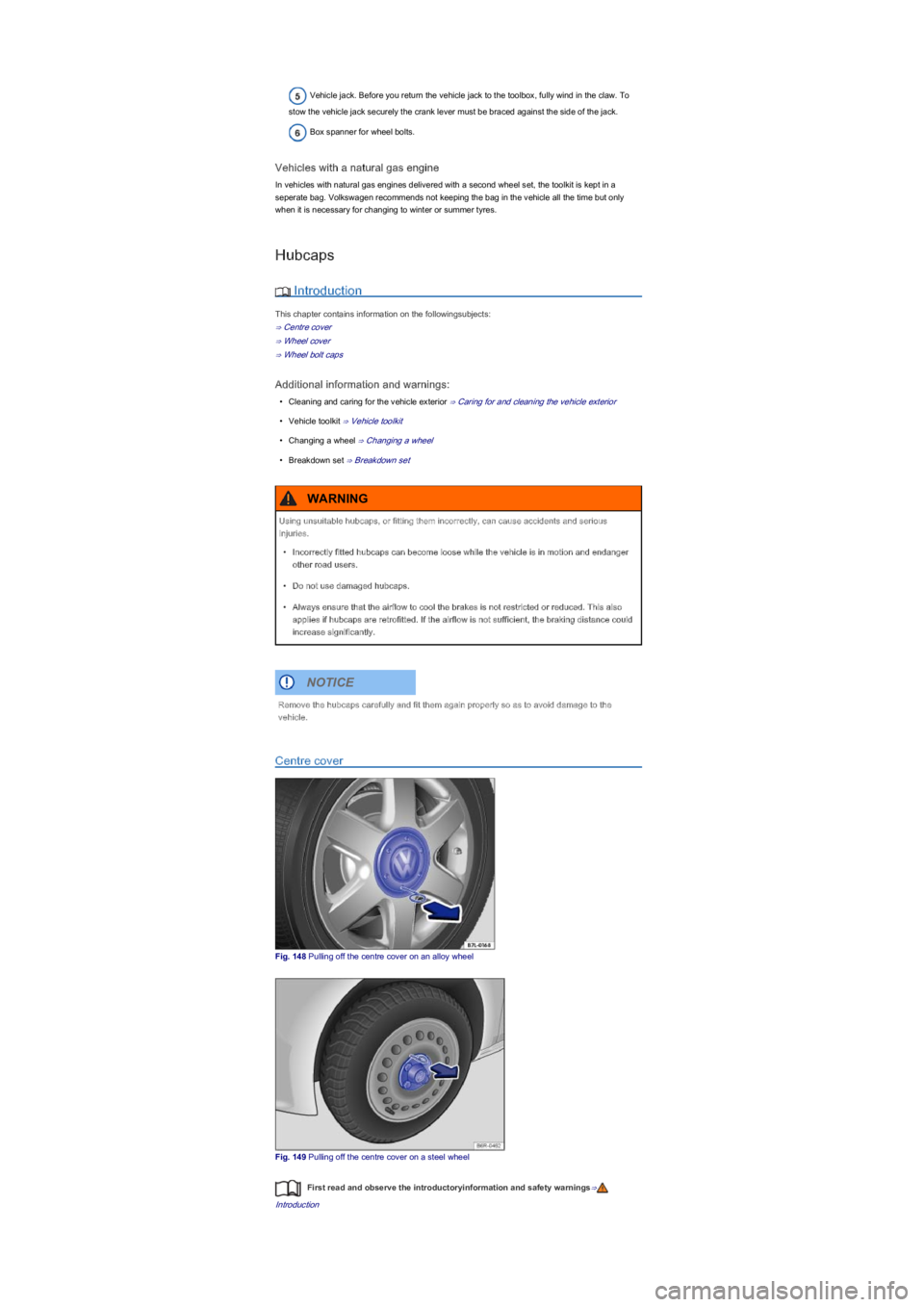
Fig. 148 Pulling off the centre cover on an alloy wheel
Fig. 149 Pulling off the centre cover on a steel wheel
First read and observe the introductoryinformation and safety warnings⇒
Introduction
Using unsuitable hubcaps, or fitting them incorrectly, can cause accidents and serious
injuries.
•Incorrectly fitted hubcaps can become loose while the vehicle is in motion and endanger
other road users.
•Do not use damaged hubcaps.
•Always ensure that the airflow to cool the brakes is not restricted or reduced. This also
applies if hubcaps are retrofitted. If the airflow is not sufficient, the braking distance could
increase significantly.
WARNING
Remove the hubcaps carefully and fit them again properly so as to avoid damage to the
vehicle.
NOTICE
Page 189 of 211
In the event of a flat tyre, park your vehicle on a firm and level surface at a safe distance
from the flow of traffic.
Apply the handbrake firmly Braking, stopping and parking.
With an automated manual gearbox, move the selector lever to D or R with the ignition on
Changing gear.
Stop the engine and remove the vehicle key from the ignition Starting and stopping the
engine.
Manual gearbox: select a gear Changing gear.
Ensure that all vehicle occupants exit the vehicle and proceed to a safe position, e.g.
behind the safety barrier.
Chock the wheel opposite the wheel being worked on with a stone or a similar object.
Remove any items of luggage in the luggage compartment.
Remove the spare wheel or temporary spare wheel and vehicle toolkit from the luggage
compartment.
Remove the hubcaps Hubcaps.
⇒ Lifting the vehicle with the jack
⇒ Changing a wheel
⇒ After changing a wheel
Some models are delivered without a factory-fitted jack or box spanner. If this is the case, the wheel
should be changed by a qualified workshop.
The vehicle jack supplied with the vehicle is only designed for changing a wheel when one vehicle
tyre is damaged and has to be replaced. Seek expert assistance if both tyres on one side of the
vehicle, both tyres on one axle, or all tyres are damaged.
Only change the wheel yourself when the car is parked in a safe place, you are familiar with the
necessary steps and safety procedures and you have access to all the correct tools. Seek expert
assistance if this is not the case.
Additional information and warnings:
•Exterior views ⇒ Exterior views
•Vehicle key set ⇒ Vehicle key set
•Wheels and tyres ⇒ Wheels and tyres
•In an emergency ⇒ In an emergency
•Vehicle toolkit ⇒ Vehicle toolkit
•Hubcaps ⇒ Hubcaps
Preparation for changing a wheel
First read and observe the introductoryinformation and safety warnings⇒
Introduction
Checklist
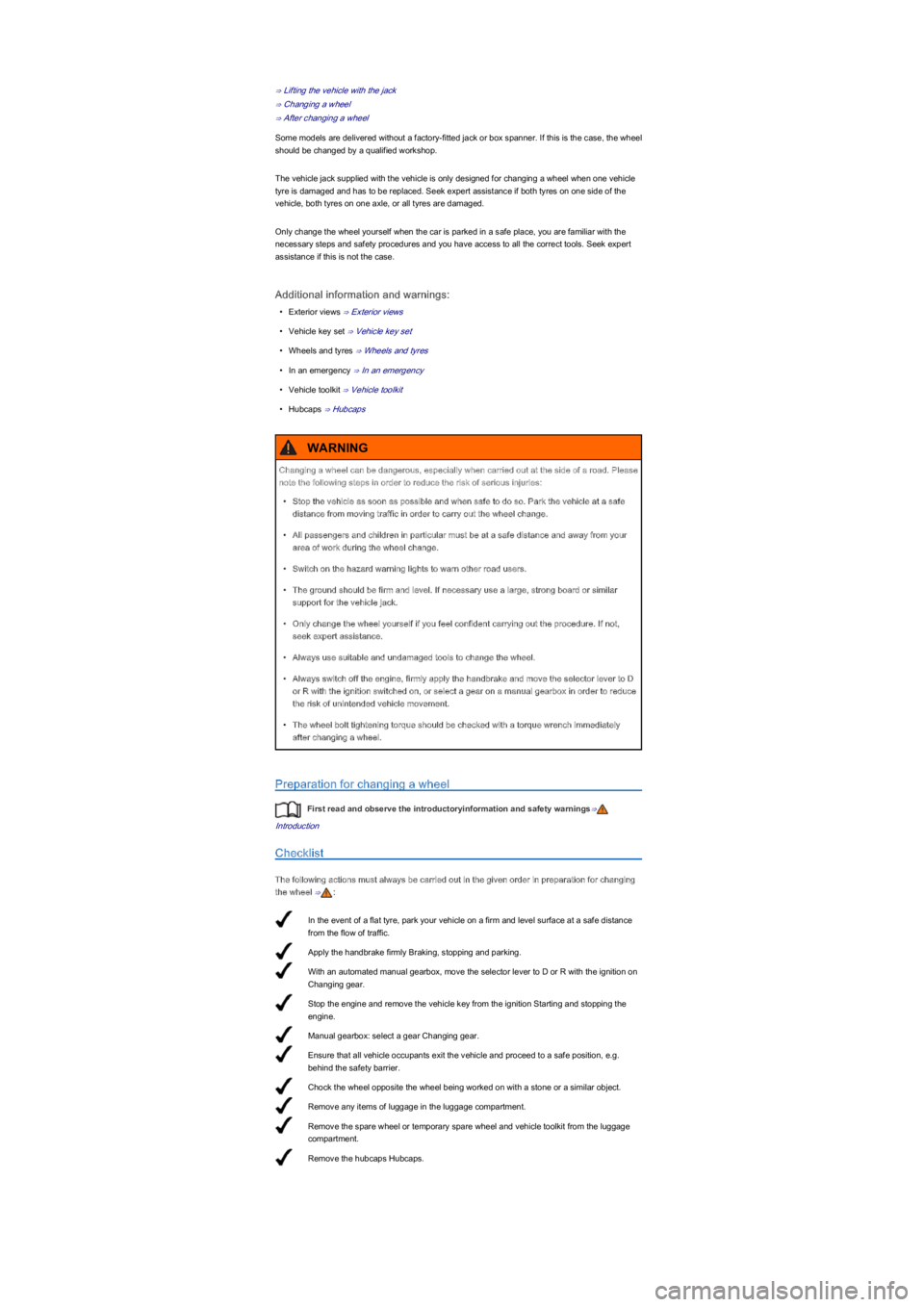
The following actions must always be carried out in the given order in preparation for changing
the wheel ⇒:
Changing a wheel can be dangerous, especially when carried out at the side of a road. Please
note the following steps in order to reduce the risk of serious injuries:
•Stop the vehicle as soon as possible and when safe to do so. Park the vehicle at a safe
distance from moving traffic in order to carry out the wheel change.
•All passengers and children in particular must be at a safe distance and away from your
area of work during the wheel change.
•Switch on the hazard warning lights to warn other road users.
•The ground should be firm and level. If necessary use a large, strong board or similar
support for the vehicle jack.
•Only change the wheel yourself if you feel confident carrying out the procedure. If not,
seek expert assistance.
•Always use suitable and undamaged tools to change the wheel.
•Always switch off the engine, firmly apply the handbrake and move the selector lever to D
or R with the ignition switched on, or select a gear on a manual gearbox in order to reduce
the risk of unintended vehicle movement.
•The wheel bolt tightening torque should be checked with a torque wrench immediately
after changing a wheel.
WARNING
Page 190 of 211
Wheel bolts
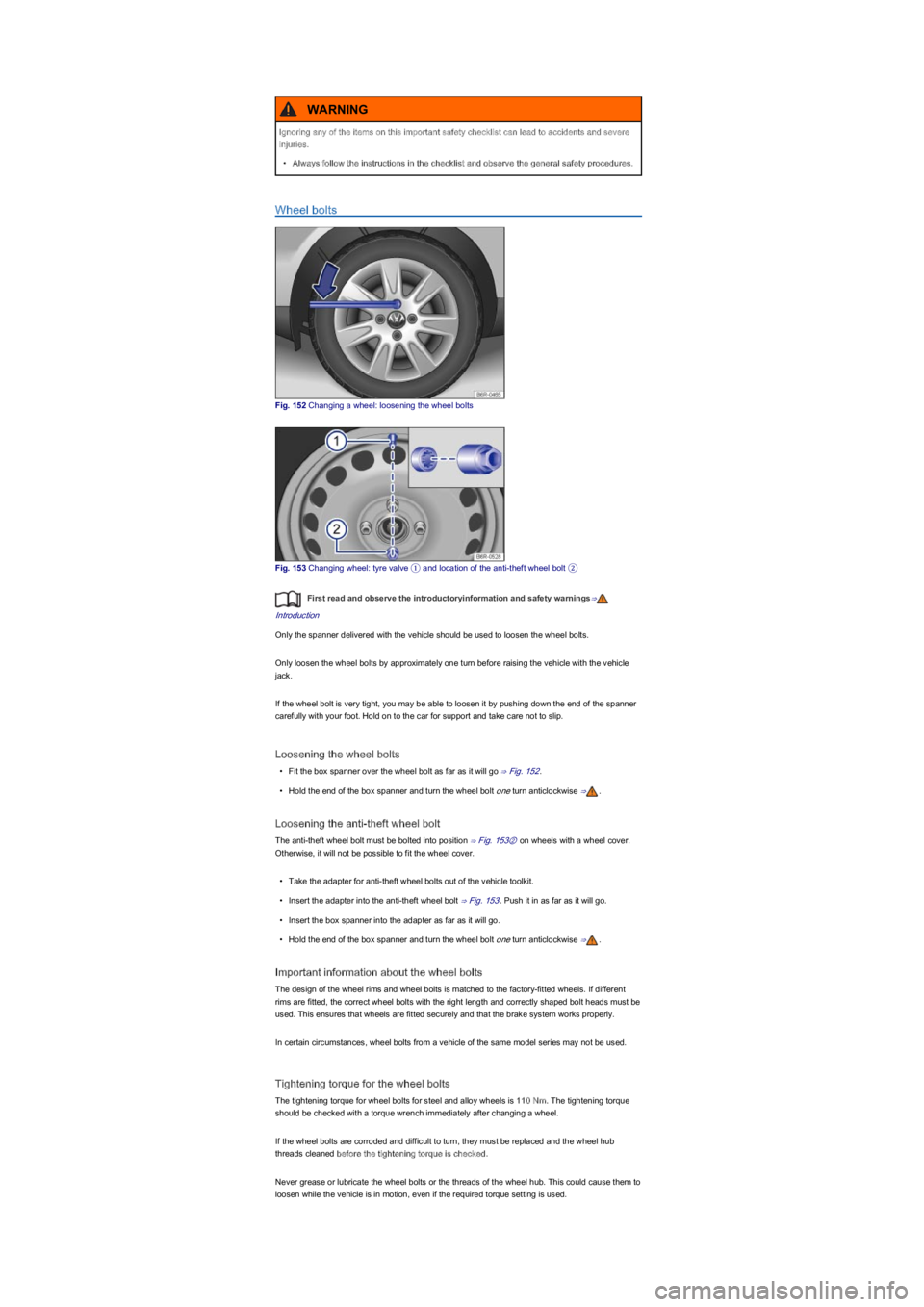
Fig. 152 Changing a wheel: loosening the wheel bolts
Fig. 153 Changing wheel: tyre valve ① and location of the anti-theft wheel bolt ②
First read and observe the introductoryinformation and safety warnings⇒
Introduction
Only the spanner delivered with the vehicle should be used to loosen the wheel bolts.
Only loosen the wheel bolts by approximately one turn before raising the vehicle with the vehicle
jack.
If the wheel bolt is very tight, you may be able to loosen it by pushing down the end of the spanner
carefully with your foot. Hold on to the car for support and take care not to slip.
Loosening the wheel bolts
•Fit the box spanner over the wheel bolt as far as it will go ⇒ Fig. 152.
•Hold the end of the box spanner and turn the wheel bolt one turn anticlockwise ⇒.
Loosening the anti-theft wheel bolt
The anti-theft wheel bolt must be bolted into position ⇒ Fig. 153② on wheels with a wheel cover.
Otherwise, it will not be possible to fit the wheel cover.
•Take the adapter for anti-theft wheel bolts out of the vehicle toolkit.
•Insert the adapter into the anti-theft wheel bolt ⇒ Fig. 153. Push it in as far as it will go.
•Insert the box spanner into the adapter as far as it will go.
•Hold the end of the box spanner and turn the wheel bolt one turn anticlockwise ⇒.
Important information about the wheel bolts
The design of the wheel rims and wheel bolts is matched to the factory-fitted wheels. If different
rims are fitted, the correct wheel bolts with the right length and correctly shaped bolt heads must be
used. This ensures that wheels are fitted securely and that the brake system works properly.
In certain circumstances, wheel bolts from a vehicle of the same model series may not be used.
Tightening torque for the wheel bolts
The tightening torque for wheel bolts for steel and alloy wheels is 110 Nm. The tightening torque
should be checked with a torque wrench immediately after changing a wheel.
If the wheel bolts are corroded and difficult to turn, they must be replaced and the wheel hub
threads cleaned before the tightening torque is checked.
Never grease or lubricate the wheel bolts or the threads of the wheel hub. This could cause them to
loosen while the vehicle is in motion, even if the required torque setting is used.
Ignoring any of the items on this important safety checklist can lead to accidents and severe
injuries.
•Always follow the instructions in the checklist and observe the general safety procedures.
WARNING
Page 191 of 211
Find a firm and level surface suitable for lifting the vehicle.
Stop the engine, select a gear on a manual gearbox or with an automated manual
gearbox, move the selector lever to D or R with the ignition switched onChanging gear
then apply the handbrake firmly Braking, stopping and parking.
Chock the wheel diagonally opposite using the collapsible chocks or other suitable objects.
Loosen the wheel bolts on the wheel that is being changed Wheel bolts.
Find the jacking point under the vehicle which is closest to the wheel that is being
changed.
Raise the vehicle jack until it just fits under the jacking point of the vehicle.
Ensure that the foot of the jack is resting securely on the ground with its whole surface and
that the foot of the jack is positioned precisely, i.e. vertically beneath the point of
application .
Position the vehicle jack. At the same time, continue to crank the claw up until it is in
position around the vertical rib underneath the vehicle .
Lifting the vehicle with the jack
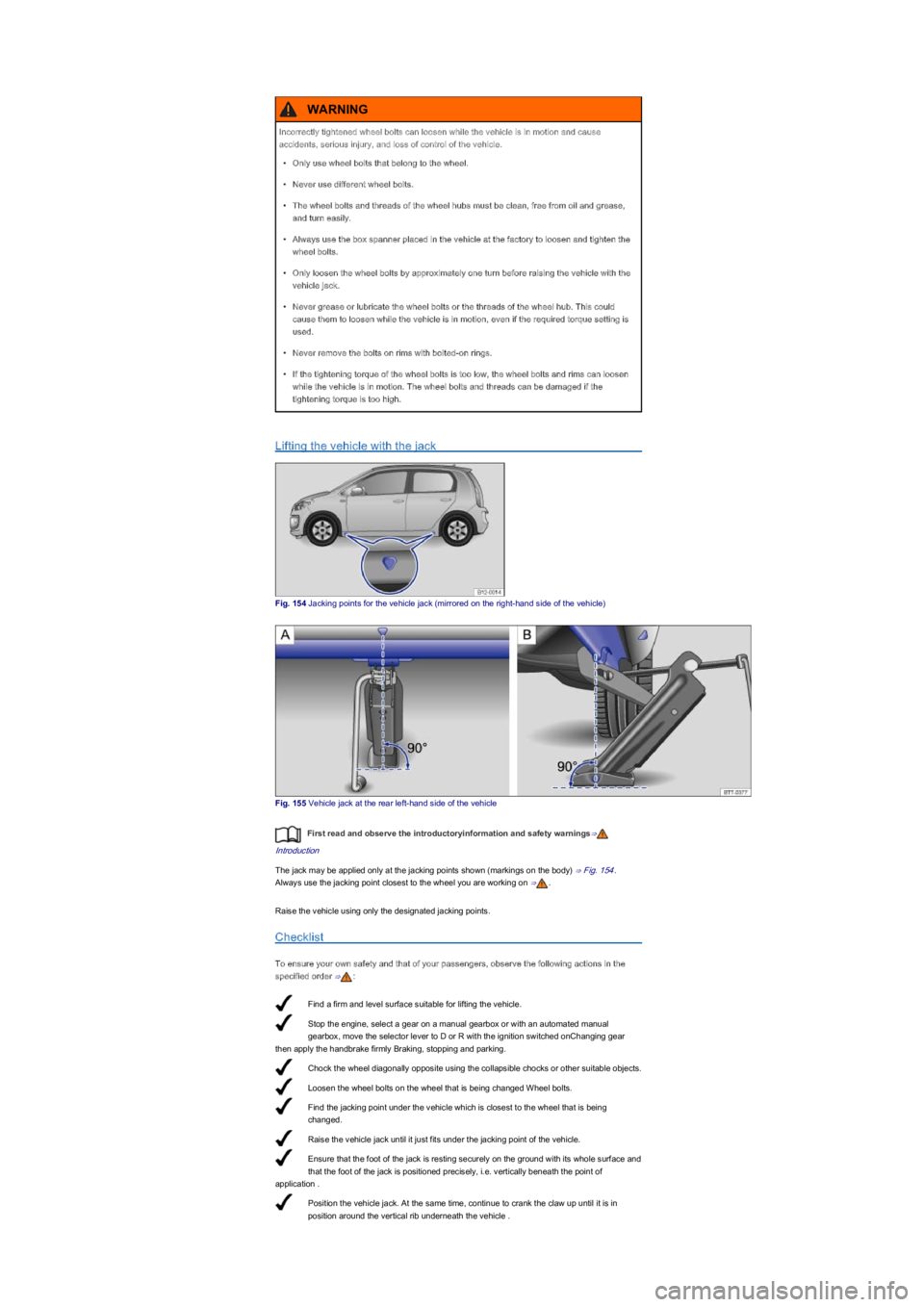
Fig. 154 Jacking points for the vehicle jack (mirrored on the right-hand side of the vehicle)
Fig. 155 Vehicle jack at the rear left-hand side of the vehicle
First read and observe the introductoryinformation and safety warnings⇒
Introduction
The jack may be applied only at the jacking points shown (markings on the body) ⇒ Fig. 154.
Always use the jacking point closest to the wheel you are working on ⇒.
Raise the vehicle using only the designated jacking points.
Checklist
To ensure your own safety and that of your passengers, observe the following actions in the
specified order ⇒:
Incorrectly tightened wheel bolts can loosen while the vehicle is in motion and cause
accidents, serious injury, and loss of control of the vehicle.
•Only use wheel bolts that belong to the wheel.
•Never use different wheel bolts.
•The wheel bolts and threads of the wheel hubs must be clean, free from oil and grease,
and turn easily.
•Always use the box spanner placed in the vehicle at the factory to loosen and tighten the
wheel bolts.
•Only loosen the wheel bolts by approximately one turn before raising the vehicle with the
vehicle jack.
•Never grease or lubricate the wheel bolts or the threads of the wheel hub. This could
cause them to loosen while the vehicle is in motion, even if the required torque setting is
used.
•Never remove the bolts on rims with bolted-on rings.
•If the tightening torque of the wheel bolts is too low, the wheel bolts and rims can loosen
while the vehicle is in motion. The wheel bolts and threads can be damaged if the
tightening torque is too high.
WARNING
Page 194 of 211
Dispose of used or out-of-date sealant in accordance with legal requirements.
You can get a new tyre filler bottle from a Volkswagen dealership.
Observe the separate instructions from the manufacturer of the breakdown set.
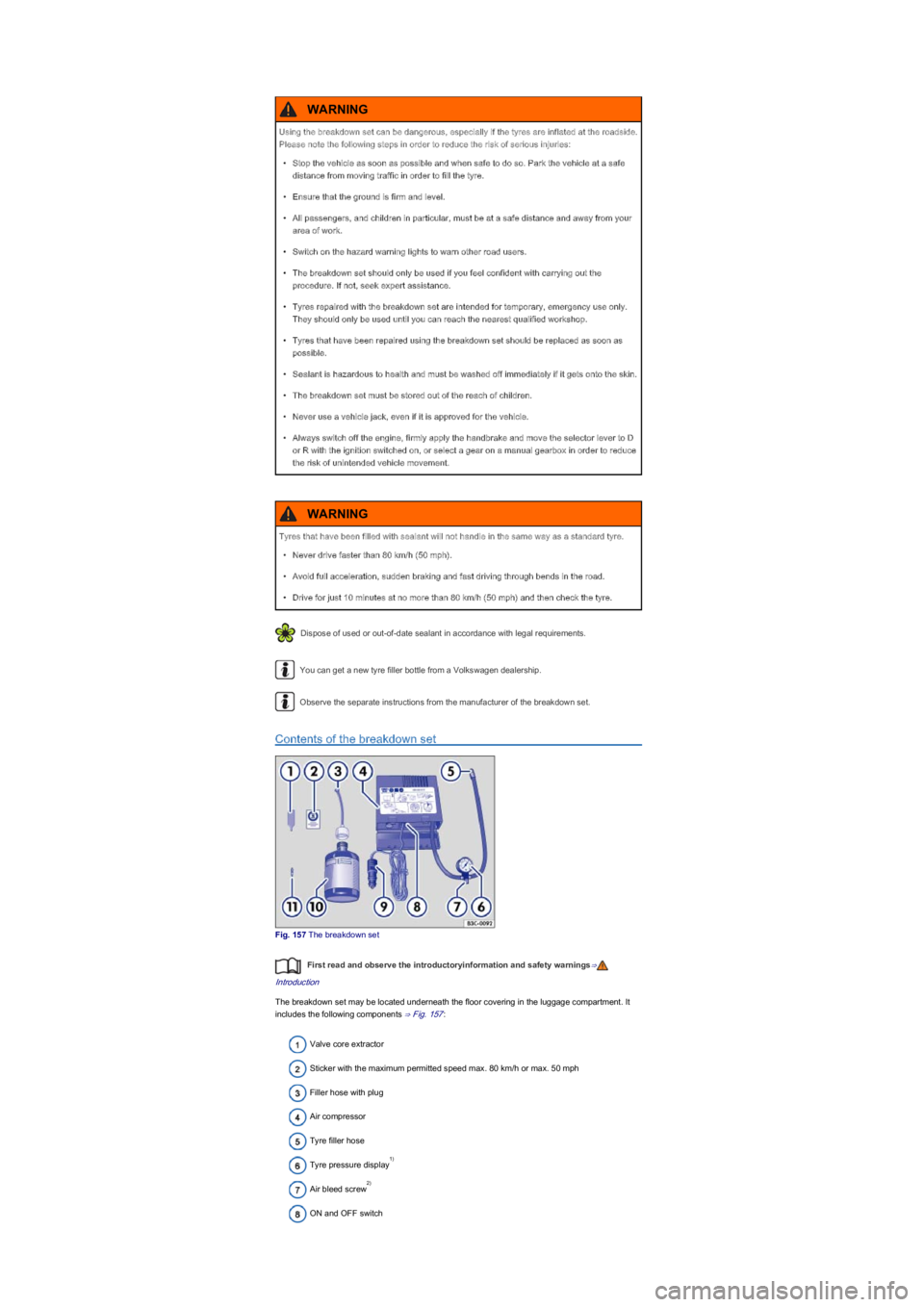
Contents of the breakdown set
Fig. 157 The breakdown set
First read and observe the introductoryinformation and safety warnings⇒
Introduction
The breakdown set may be located underneath the floor covering in the luggage compartment. It
includes the following components ⇒ Fig. 157:
Valve core extractor
Sticker with the maximum permitted speed max. 80 km/h or max. 50 mph
Filler hose with plug
Air compressor
Tyre filler hose
Tyre pressure display
Air bleed screw
ON and OFF switch
Using the breakdown set can be dangerous, especially if the tyres are inflated at the roadside.
Please note the following steps in order to reduce the risk of serious injuries:
•Stop the vehicle as soon as possible and when safe to do so. Park the vehicle at a safe
distance from moving traffic in order to fill the tyre.
•Ensure that the ground is firm and level.
•All passengers, and children in particular, must be at a safe distance and away from your
area of work.
•Switch on the hazard warning lights to warn other road users.
•The breakdown set should only be used if you feel confident with carrying out the
procedure. If not, seek expert assistance.
•Tyres repaired with the breakdown set are intended for temporary, emergency use only.
They should only be used until you can reach the nearest qualified workshop.
•Tyres that have been repaired using the breakdown set should be replaced as soon as
possible.
•Sealant is hazardous to health and must be washed off immediately if it gets onto the skin.
•The breakdown set must be stored out of the reach of children.
•Never use a vehicle jack, even if it is approved for the vehicle.
•Always switch off the engine, firmly apply the handbrake and move the selector lever to D
or R with the ignition switched on, or select a gear on a manual gearbox in order to reduce
the risk of unintended vehicle movement.
WARNING
Tyres that have been filled with sealant will not handle in the same way as a standard tyre.
•Never drive faster than 80 km/h (50 mph).
•Avoid full acceleration, sudden braking and fast driving through bends in the road.
•Drive for just 10 minutes at no more than 80 km/h (50 mph) and then check the tyre.
WARNING
1)
2)