gas type VOLKSWAGEN UP! 2021 Owner´s Manual
[x] Cancel search | Manufacturer: VOLKSWAGEN, Model Year: 2021, Model line: UP!, Model: VOLKSWAGEN UP! 2021Pages: 211, PDF Size: 5.98 MB
Page 18 of 211
Engine and gearbox code, paint number, interior equipment. In the example, the engine
code is CCZB ⇒ Fig. 13A.
Optional extras, PR numbers
These vehicle data are also contained in the service schedule.
Type plate
The type plate ⇒ Fig. 13B can be seen on the lower part of the door pillar when the door is open.
Vehicles for certain export countries do not have a type plate.
The type plate contains the following data:
Gross vehicle weight rating
Gross axle weight rating, front
Gross axle weight rating, rear
Engine data
First read and observe the introductoryinformation and safety warnings⇒
Introduction
For reasons of vehicle registration and vehicle taxation, the power output and performance of some
engines may vary in some countries from the information given in this booklet.
Petrol engines
Engine powerECMaximum torqueCylinders,
capacity
44 kW at
5,000 – 6,000 rpmCHYA95 Nm at 1,750 – 3,000 rpm3 cylinders,
999 ccm
55 kW at 6,200 rpmCHYB95 Nm at 3,000 – 4,300 rpm3 cylinders,
999 ccm
Natural gas engine
Engine powerECMaximum torqueCylinders,
capacity
50 kW at 6,200 rpmCPGA90 Nm at 3,000 rpm3 cylinders,
999 ccm
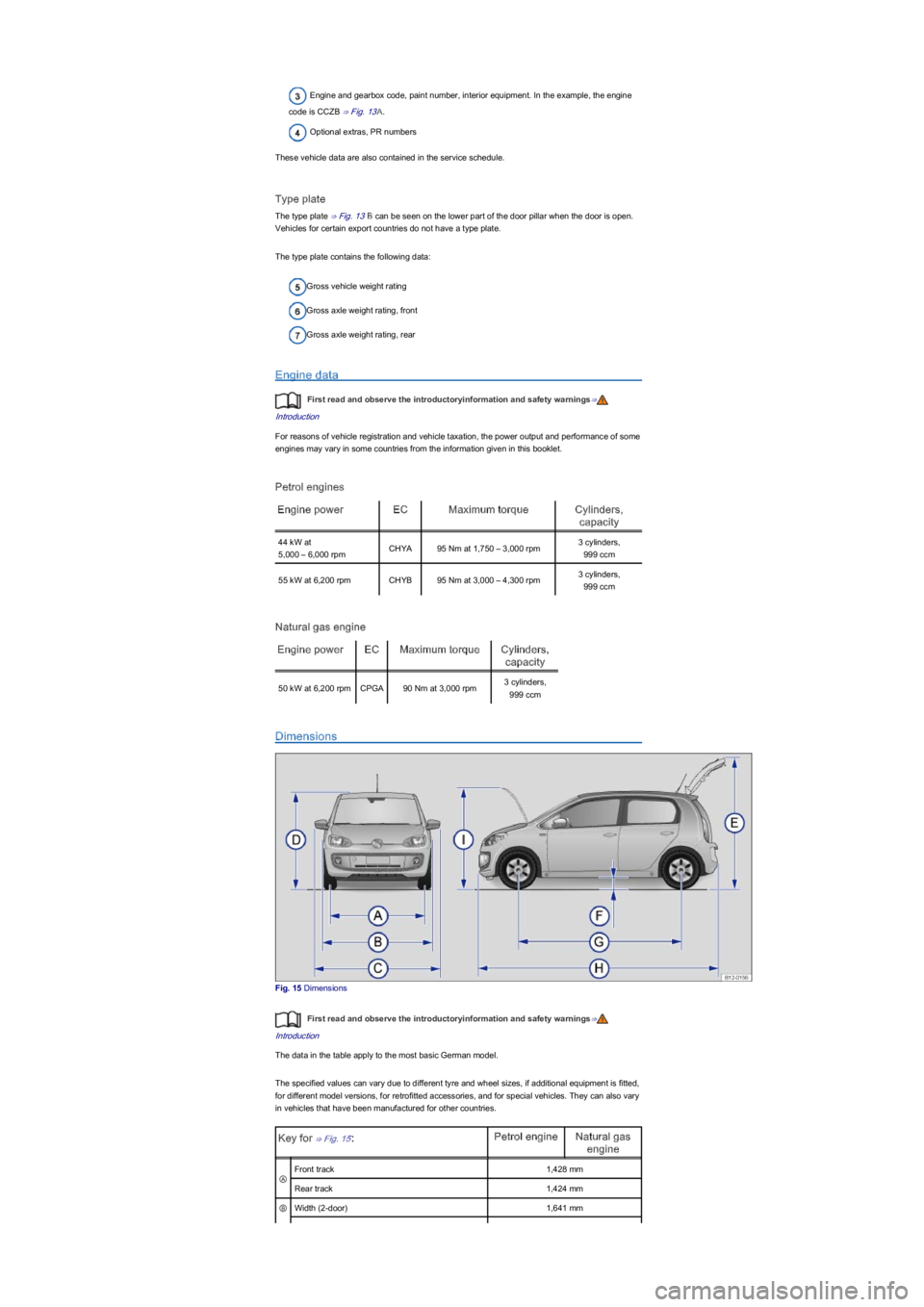
Dimensions
Fig. 15 Dimensions
First read and observe the introductoryinformation and safety warnings⇒
Introduction
The data in the table apply to the most basic German model.
The specified values can vary due to different tyre and wheel sizes, if additional equipment is fitted,
for different model versions, for retrofitted accessories, and for special vehicles. They can also vary
in vehicles that have been manufactured for other countries.
Key for ⇒ Fig. 15:Petrol engineNatural gas
engine
Ⓐ
Front track1,428 mm
Rear track1,424 mm
ⒷWidth (2-door)1,641 mm
Page 19 of 211
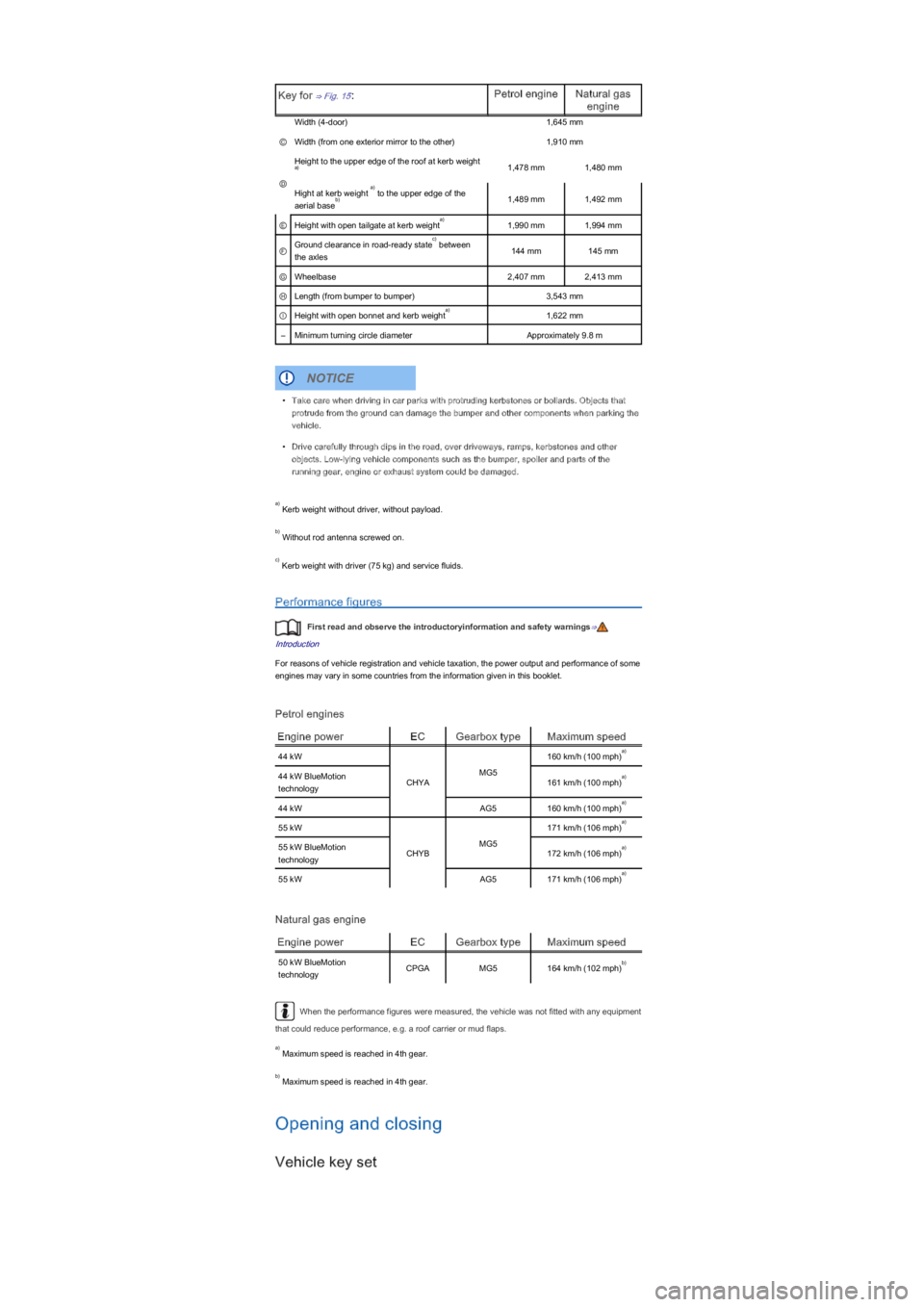
Key for ⇒ Fig. 15:Petrol engineNatural gas
engine
Width (4-door)1,645 mm
ⒸWidth (from one exterior mirror to the other)1,910 mm
Ⓓ
Height to the upper edge of the roof at kerb weight 1,478 mm1,480 mm
Hight at kerb weight to the upper edge of the
aerial base1,489 mm1,492 mm
ⒺHeight with open tailgate at kerb weight1,990 mm1,994 mm
ⒻGround clearance in road-ready state between
the axles144 mm145 mm
ⒼWheelbase2,407 mm2,413 mm
ⒽLength (from bumper to bumper)3,543 mm
ⒾHeight with open bonnet and kerb weight1,622 mm
–Minimum turning circle diameterApproximately 9.8 m
Kerb weight without driver, without payload.
Without rod antenna screwed on.
Kerb weight with driver (75 kg) and service fluids.
Performance figures
First read and observe the introductoryinformation and safety warnings⇒
Introduction
For reasons of vehicle registration and vehicle taxation, the power output and performance of some
engines may vary in some countries from the information given in this booklet.
Petrol engines
Engine powerECGearbox typeMaximum speed
44 kW
CHYA
MG5
160 km/h (100 mph)
44 kW BlueMotion
technology161 km/h (100 mph)
44 kWAG5160 km/h (100 mph)
55 kW
CHYB
MG5
171 km/h (106 mph)
55 kW BlueMotion
technology172 km/h (106 mph)
55 kWAG5171 km/h (106 mph)
Natural gas engine
Engine powerECGearbox typeMaximum speed
50 kW BlueMotion
technologyCPGAMG5164 km/h (102 mph)
When the performance figures were measured, the vehicle was not fitted with any equipment
that could reduce performance, e.g. a roof carrier or mud flaps.
Maximum speed is reached in 4th gear.
Maximum speed is reached in 4th gear.
Opening and closing
Vehicle key set
a)
a)
b)
a)
c)
a)
•Take care when driving in car parks with protruding kerbstones or bollards. Objects that
protrude from the ground can damage the bumper and other components when parking the
vehicle.
•Drive carefully through dips in the road, over driveways, ramps, kerbstones and other
objects. Low-lying vehicle components such as the bumper, spoiler and parts of the
running gear, engine or exhaust system could be damaged.
NOTICE
a)
b)
c)
a)
a)
a)
a)
a)
a)
b)
a)
b)
Page 50 of 211
When an airbag is triggered, it is inflated by a gas generator. This causes the airbag covers to
break, and the airbags inflate forcefully to cover their deployment zones within milliseconds. Once a
vehicle occupant wearing a seat belt starts to sink into the inflated airbag, the gas inside the airbag
starts to escape to cushion the occupant and slow down their movement. This can reduce the risk
of severe and fatal injuries. A triggered airbag will not always prevent other injuries such as
swelling, bruising and grazing. Deployment of a triggered airbag can also result in frictional heat.
Airbags provide no protection for the arms or lower body.
The most important factors for triggering the airbag are the type of accident, the angle of impact,
the vehicle speed and the type of object with which the vehicle collides. Therefore, visible damage
to the vehicle does not always mean that the airbag should have been triggered.
The triggering of the airbag system depends on the vehicle deceleration rate caused by the collision
and registered by the electronic control unit. If this rate is below the reference value programmed
into the control unit, the airbags will not be triggered, even though the vehicle may be badly
damaged as a result of the collision. Vehicle damage, repair costs or even the lack of vehicle
damage in an accident do not necessarily give an indication of whether an airbag should inflate or
not. It is not possible to define a range of vehicle speeds and reference values, since the
circumstances will vary considerably between one collision and another. It is therefore impossible to
cover every possible kind and angle of impact that would trigger the airbags. Important factors in
the triggering of the airbag include the nature (hard or soft) of the object that the vehicle hits, the
angle of impact, and the vehicle speed.
Airbags only serve as a supplement to the three-point seat belt in some accident situations when
the vehicle braking is sufficient to trigger the airbags. Airbags can only be triggered once and only
in certain situations. The seat belts are always there to provide protection in situations in which the
airbags are not triggered or have already been triggered. For example, if the vehicle collides with a
further vehicle following the initial collision, or is hit by another vehicle.
The airbag system is part of the vehicle's overall passive safety concept. The airbag system can
only work effectively when the occupants are wearing their seat belts correctly and have assumed a
proper sitting position ⇒ Adjusting the seat position.
Components of the vehicle safety concept
The following vehicle safety equipment makes up the vehicle's safety concept to reduce the risk of
severe and fatal injuries. Some of this equipment may not be fitted in your particular vehicle. It may
not be available at all in some countries.
•Optimised seat belts for all seats.
•Belt tensioners for driver and front passenger.
•Belt tension limiters for driver and front passenger.
•Warning lamp .
•Front airbags for driver and front passenger.
•Side airbags for driver and front passenger.
•Airbag indicator lamp .
•Control units and sensors.
•Head restraints optimised for rear impact.
•Adjustable steering column.
•If fitted, ISOFIX anchor points for child seats on the rear outer seats.
•If applicable, securing points for the top tether for child seats.
Situations in which the front and side airbags will not be triggered:
•If the ignition is switched off during a collision.
•If the level of deceleration measured by the control unit is too low during a collision at the front
of the vehicle.
•During a minor side collision.
•During rear collisions.
•If the vehicle rolls over.
•If the speed in a collision is lower than the reference value specified in the control unit.
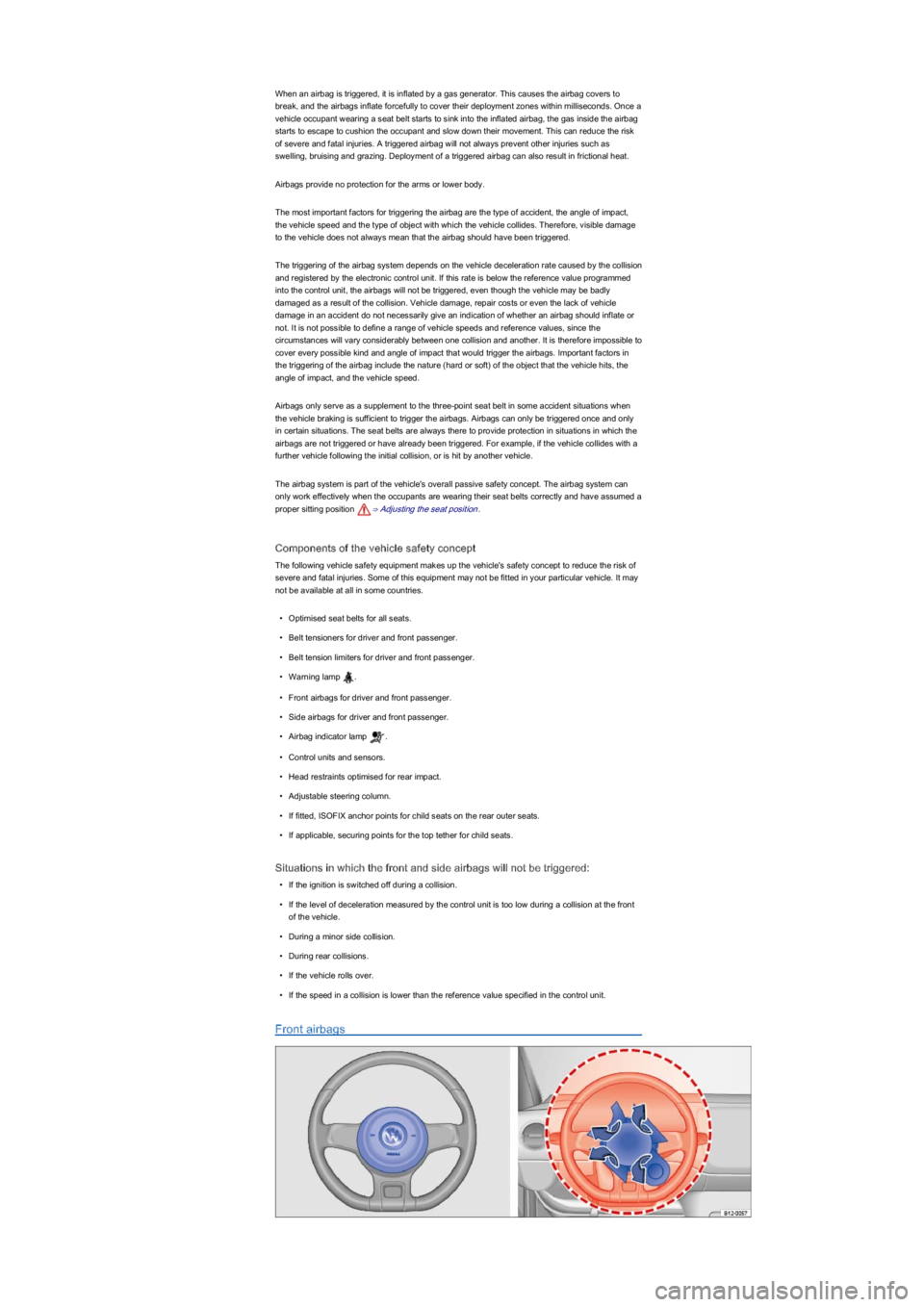
Front airbags
Page 72 of 211
spare tyre ⇒. Additional equipment and retrofitted accessories increase the stated kerb weight
and reduce the maximum permitted load accordingly.
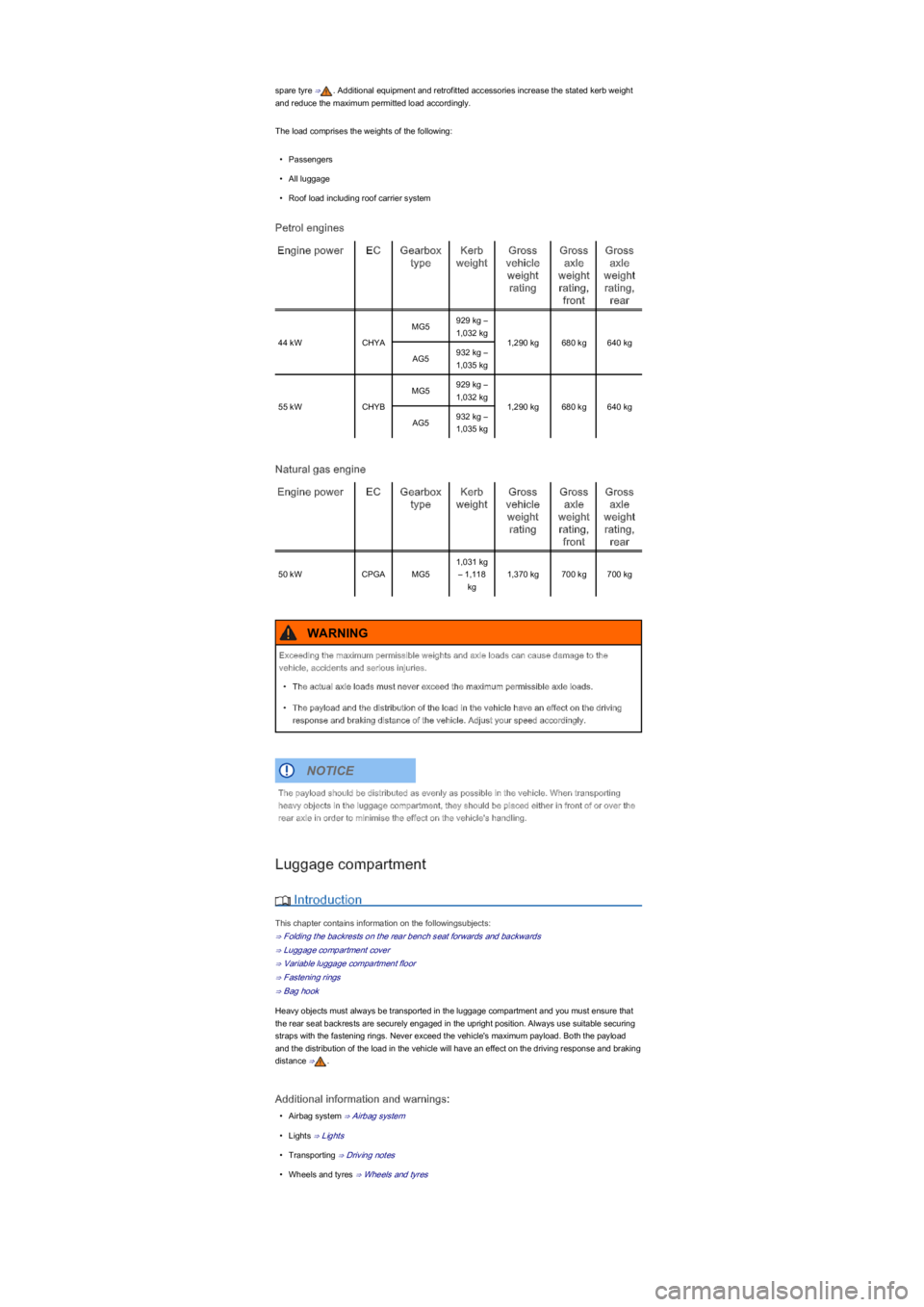
The load comprises the weights of the following:
•Passengers
•All luggage
•Roof load including roof carrier system
Petrol engines
Engine powerECGearbox
type
Kerb
weight
Gross
vehicle
weight
rating
Gross
axle
weight
rating,
front
Gross
axle
weight
rating,
rear
44 kWCHYA
MG5929 kg –
1,032 kg
1,290 kg680 kg640 kg
AG5932 kg –
1,035 kg
55 kWCHYB
MG5929 kg –
1,032 kg
1,290 kg680 kg640 kg
AG5932 kg –
1,035 kg
Natural gas engine
Engine powerECGearbox
type
Kerb
weight
Gross
vehicle
weight
rating
Gross
axle
weight
rating,
front
Gross
axle
weight
rating,
rear
50 kWCPGAMG5
1,031 kg
– 1,118
kg
1,370 kg700 kg700 kg
Luggage compartment
Introduction
This chapter contains information on the followingsubjects:
⇒ Folding the backrests on the rear bench seat forwards and backwards
⇒ Luggage compartment cover
⇒ Variable luggage compartment floor
⇒ Fastening rings
⇒ Bag hook
Heavy objects must always be transported in the luggage compartment and you must ensure that
the rear seat backrests are securely engaged in the upright position. Always use suitable securing
straps with the fastening rings. Never exceed the vehicle's maximum payload. Both the payload
and the distribution of the load in the vehicle will have an effect on the driving response and braking
distance ⇒.
Additional information and warnings:
•Airbag system ⇒ Airbag system
•Lights ⇒ Lights
•Transporting ⇒ Driving notes
•Wheels and tyres ⇒ Wheels and tyres
Exceeding the maximum permissible weights and axle loads can cause damage to the
vehicle, accidents and serious injuries.
•The actual axle loads must never exceed the maximum permissible axle loads.
•The payload and the distribution of the load in the vehicle have an effect on the driving
response and braking distance of the vehicle. Adjust your speed accordingly.
WARNING
The payload should be distributed as evenly as possible in the vehicle. When transporting
heavy objects in the luggage compartment, they should be placed either in front of or over the
rear axle in order to minimise the effect on the vehicle's handling.
NOTICE
Page 129 of 211
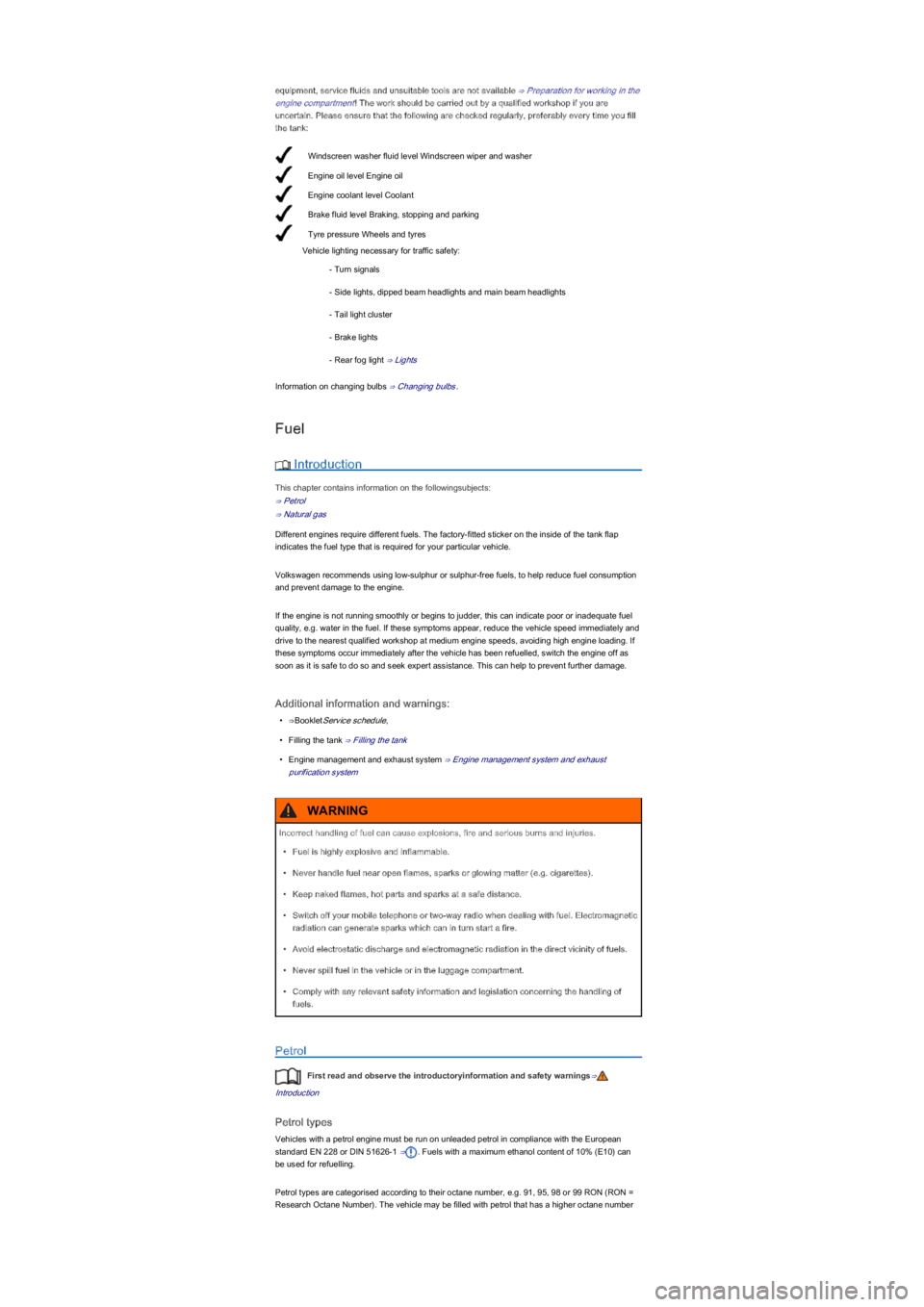
Windscreen washer fluid level Windscreen wiper and washer
Engine oil level Engine oil
Engine coolant level Coolant
Brake fluid level Braking, stopping and parking
Tyre pressure Wheels and tyres
equipment, service fluids and unsuitable tools are not available ⇒ Preparation for working in the
engine compartment! The work should be carried out by a qualified workshop if you are
uncertain. Please ensure that the following are checked regularly, preferably every time you fill
the tank:
Vehicle lighting necessary for traffic safety:
- Turn signals
- Side lights, dipped beam headlights and main beam headlights
- Tail light cluster
- Brake lights
- Rear fog light ⇒ Lights
Information on changing bulbs ⇒ Changing bulbs.
Fuel
Introduction
This chapter contains information on the followingsubjects:
⇒ Petrol
⇒ Natural gas
Different engines require different fuels. The factory-fitted sticker on the inside of the tank flap
indicates the fuel type that is required for your particular vehicle.
Volkswagen recommends using low-sulphur or sulphur-free fuels, to help reduce fuel consumption
and prevent damage to the engine.
If the engine is not running smoothly or begins to judder, this can indicate poor or inadequate fuel
quality, e.g. water in the fuel. If these symptoms appear, reduce the vehicle speed immediately and
drive to the nearest qualified workshop at medium engine speeds, avoiding high engine loading. If
these symptoms occur immediately after the vehicle has been refuelled, switch the engine off as
soon as it is safe to do so and seek expert assistance. This can help to prevent further damage.
Additional information and warnings:
•⇒BookletService schedule,
•Filling the tank ⇒ Filling the tank
•Engine management and exhaust system ⇒ Engine management system and exhaust
purification system
Petrol
First read and observe the introductoryinformation and safety warnings⇒
Introduction
Petrol types
Vehicles with a petrol engine must be run on unleaded petrol in compliance with the European
standard EN 228 or DIN 51626-1 ⇒. Fuels with a maximum ethanol content of 10% (E10) can
be used for refuelling.
Petrol types are categorised according to their octane number, e.g. 91, 95, 98 or 99 RON (RON =
Research Octane Number). The vehicle may be filled with petrol that has a higher octane number
Incorrect handling of fuel can cause explosions, fire and serious burns and injuries.
•Fuel is highly explosive and inflammable.
•Never handle fuel near open flames, sparks or glowing matter (e.g. cigarettes).
•Keep naked flames, hot parts and sparks at a safe distance.
•Switch off your mobile telephone or two-way radio when dealing with fuel. Electromagnetic
radiation can generate sparks which can in turn start a fire.
•Avoid electrostatic discharge and electromagnetic radiation in the direct vicinity of fuels.
•Never spill fuel in the vehicle or in the luggage compartment.
•Comply with any relevant safety information and legislation concerning the handling of
fuels.
WARNING
Page 136 of 211

If possible, only use Volkswagen-approved engine oil ⇒. The engine oils listed are multigrade
high-lubricity oils.
Engine oils are constantly being developed and improved. A Volkswagen dealership is always kept
up to date on innovations. Volkswagen therefore recommends having engine oil changes done by a
Volkswagen dealership.
The quality of the engine oil is not only tailored to the requirements of engines and exhaust gas
treatment systems, but also to fuel quality. Due to the way in which a combustion engine works,
engine oil always comes into contact with combustion residues and fuel, which has a knock-on
effect on the ageing process of the oil.
The quality of fuels can vary greatly between individual markets and this must be taken into account
when selecting the correct engine oil.
The use of engine oils compliant with the VW 504 00 requires a fuel quality compliant with EN 228
(petrol) or fuel of and equivalent quality. Engine oils compliant with VW 504 00 are therefore
unsuitable for use in a large number of markets.
Permitted engine oil
specifications ⇒
Alternative engine oil
specifications⇒
Engine
type
Fixed service QI1, QI2, QI3,
QI4, QI7 (based on
time/distance travelled)
Only in the EU, Switzerland,
Norway, Japan and Australia
Petrol
enginesVW 502 00VW 504 00
Natural gas
engineVW 502 00-----
Alternative engine oil specifications may only be used in fixed services QI1, QI2, QI3, QI4 and
QI7, and only when fuel of a quality compliant with EN 228 (petrol), or fuel of an equivalent quality,
is available in the particular country.
Checking the engine oil level and refilling engine oil
Fig. 121 Oil dipstick with markings
Fig. 122 In the engine compartment: engine oil filler cap
First read and observe the introductoryinformation and safety warnings⇒
Introduction
a)
•Do not add any additional lubricants to the engine oil. Any damage caused by the use of
such additives is not covered by the warranty.
•Only engine oil specifications that have been approved for use with the engine should be
used. Using other engine oils can cause engine damage.
•Another engine oil can be used in the event of an emergency if the listed engine oils () are
not available. To avoid damaging the engine, a maximum quantity of 0.5 litres of the
following engine oil may be used only once until the next oil change:
- Petrol engines: standards ACEAA3/B4 or API SN (API SM).
NOTICE
a)
Page 181 of 211
Practical tips
Frequently asked questions
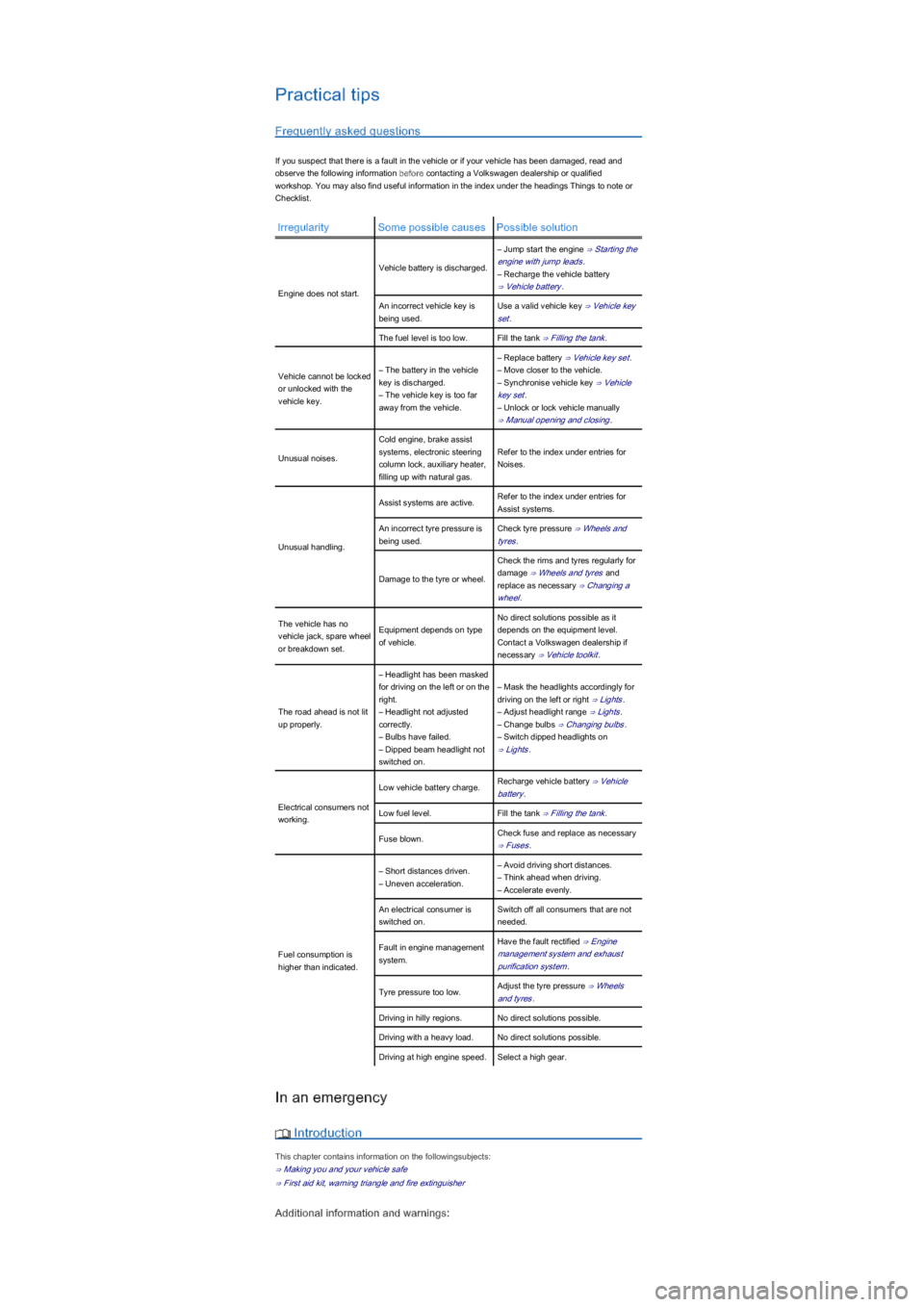
If you suspect that there is a fault in the vehicle or if your vehicle has been damaged, read and
observe the following information before contacting a Volkswagen dealership or qualified
workshop. You may also find useful information in the index under the headings Things to note or
Checklist.
IrregularitySome possible causesPossible solution
Engine does not start.
Vehicle battery is discharged.
– Jump start the engine ⇒ Starting the
engine with jump leads.
– Recharge the vehicle battery
⇒ Vehicle battery.
An incorrect vehicle key is
being used.
Use a valid vehicle key ⇒ Vehicle key
set.
The fuel level is too low.Fill the tank ⇒ Filling the tank.
Vehicle cannot be locked
or unlocked with the
vehicle key.
– The battery in the vehicle
key is discharged.
– The vehicle key is too far
away from the vehicle.
– Replace battery ⇒ Vehicle key set.
– Move closer to the vehicle.
– Synchronise vehicle key ⇒ Vehicle
key set.
– Unlock or lock vehicle manually
⇒ Manual opening and closing.
Unusual noises.
Cold engine, brake assist
systems, electronic steering
column lock, auxiliary heater,
filling up with natural gas.
Refer to the index under entries for
Noises.
Unusual handling.
Assist systems are active.Refer to the index under entries for
Assist systems.
An incorrect tyre pressure is
being used.
Check tyre pressure ⇒ Wheels and
tyres.
Damage to the tyre or wheel.
Check the rims and tyres regularly for
damage ⇒ Wheels and tyres and
replace as necessary ⇒ Changing a
wheel.
The vehicle has no
vehicle jack, spare wheel
or breakdown set.
Equipment depends on type
of vehicle.
No direct solutions possible as it
depends on the equipment level.
Contact a Volkswagen dealership if
necessary ⇒ Vehicle toolkit.
The road ahead is not lit
up properly.
– Headlight has been masked
for driving on the left or on the
right.
– Headlight not adjusted
correctly.
– Bulbs have failed.
– Dipped beam headlight not
switched on.
– Mask the headlights accordingly for
driving on the left or right ⇒ Lights.
– Adjust headlight range ⇒ Lights.
– Change bulbs ⇒ Changing bulbs.
– Switch dipped headlights on
⇒ Lights.
Electrical consumers not
working.
Low vehicle battery charge.Recharge vehicle battery ⇒ Vehicle
battery.
Low fuel level.Fill the tank ⇒ Filling the tank.
Fuse blown.Check fuse and replace as necessary
⇒ Fuses.
Fuel consumption is
higher than indicated.
– Short distances driven.
– Uneven acceleration.
– Avoid driving short distances.
– Think ahead when driving.
– Accelerate evenly.
An electrical consumer is
switched on.
Switch off all consumers that are not
needed.
Fault in engine management
system.
Have the fault rectified ⇒ Engine
management system and exhaust
purification system.
Tyre pressure too low.Adjust the tyre pressure ⇒ Wheels
and tyres.
Driving in hilly regions.No direct solutions possible.
Driving with a heavy load.No direct solutions possible.
Driving at high engine speed.Select a high gear.
In an emergency
Introduction
This chapter contains information on the followingsubjects:
⇒ Making you and your vehicle safe
⇒ First aid kit, warning triangle and fire extinguisher
Additional information and warnings: