wheel VOLVO 240 1990 User Guide
[x] Cancel search | Manufacturer: VOLVO, Model Year: 1990, Model line: 240, Model: VOLVO 240 1990Pages: 143, PDF Size: 2.32 MB
Page 53 of 143
, transmission in neutral, applyin\
g the parking brake")
Volvo 1990 240 Model
To obtain best parking brake performance, the brake linings should be br\
oken in.
Stop 5-7 times from 30 mph (50 km/h), transmission in neutral, applyin\
g the parking brake with the
release button pressed in during the stop. The force must not lock the r\
ear wheels. If this happens,
release the brake enough to let the wheels rotate. Drive a mile between \
each stop to cool the brakes.
Check for proper parking brake operation.
Note: The brake lights are not illuminated when applying the parking bra\
ke. To warn traffic from
behind it is therefore advisable to depress the brake pedal slightly to \
illuminate the brake lights.
600 - 1,200 mile maintenance service
To ensure proper operation the car should be taken to a Volvo dealer bet\
ween the first 600 - 1,200 miles
(1,000 - 2,000 km) for a maintenance service. The oil in the engine, m\
anual transmission and rear axle
will then be changed. This is very important since the oil rapidly colle\
cts impurities during the break-in
period.
pg. 43 Driving economy, Shift indicator light
Economical driving does not necessarily mean driving slowly
Better driving economy may be obtained by thinking ahead, avoiding rapid\
starts and stops and
adjusting the speed of your vehicle to immediate traffic conditions. Obs\
erve the following rules:
l Bring the engine to normal operating temperature as soon as possible by \
driving with a light foot on
the accelerator pedal instead of allowing the engine to idle for a prolo\
nged period. A cold engine uses
more fuel and is subject to increased wear.
l When possible avoid using the car for driving short distances. This does\
not allow the engine to reach
normal operating temperature.
l Drive carefully and avoid rapid acceleration and hard braking.
l Do not exceed speed limit.
l Avoid carrying unnecessary items (extra load) in the car.
l Check tire pressures regularly (cold tires).
l Remove snow tires when threat of snow or ice has ended.
l Note that roof racks, ski racks, etc., increase air resistance and there\
by fuel consumption.
file:///K|/ownersdocs/1990/1990_240/90240_09.htm (3 of 6)12/30/2006 8:\
25:05 AM
Page 62 of 143

Volvo 1990 240 Model
Precautionary steps to observe when towing
Please check with state and local authorities before attempting this typ\
e of towing as vehicles being
towed are subject to regulations regarding maximum towing speed, length \
and type of towing device,
lighting, etc.
l Steering must be unlocked.
l Remember that power brake and power steering assists will not be availab\
le when engine is
inoperative. Pedal pressure required is 3 - 4 times above normal and gre\
ater steering effort must be
employed.
l Towing cars equipped with automatic transmission:
-- Gear selector in position N. Check transmission oil level (see secti\
on titled "Transmission oil").
-- Maximum speed: 20 mph (30 km/h).
-- Maximum distance with rear wheels on ground: 20 miles (30 km).
CAUTION!
Do not attempt to start the car by pushing or pulling as damage to catal\
ytic converter can
result.
Jump starting, see section titled "alternator, jump starting".
NOTE:
Refer lo the section regarding "On-
Call"
pg. 49 Tow-truck information
Only use wheel lift or flat bed equipment.
CAUTION:
Sling-type equipment applied at the font will damage radiator and air co\
nditioning lines. It is equally
important not to use sling-type equipment at the rear or apply lifting e\
quipment inside the rear wheels;
serious damage to the rear axle may result.
file:///K|/ownersdocs/1990/1990_240/90240_10.htm (6 of 7)12/30/2006 8:\
25:05 AM
Page 65 of 143
.
l More frequent vehicle maint")
Volvo 1990 240 Model
l It is necessary to balance trailer brakes with the towing vehicle brakes\
to provide a safe stop (check
and observe State regulations).
l More frequent vehicle maintenance is required.
l Remove the ball and drawbar assembly when the hitch is not being used.
l Increase tire pressure to recommended full-load pressure. See section 'W\
heels and Tires."
Note: Refer to section entitled "Automatic transmission" for additional \
trailer hauling
tips.
Warning: Do not drive with trunk lid or tailgate
open!
Poisonous exhaust gases may enter via the open trunk lid or tailgate. (\
This is especially true for wagon
models.)
If the trunk lid or tailgate for any reason must be open, proceed as fol\
lows:
l Close the windows.
l Set the heating system controls for floor and defroster to max. and the \
blower to full speed (4). See
section titled "Heating and Ventilation".
Handling, roadholding
Vehicle load, tire design and inflation pressure are important for prope\
r handling. Therefore check that
the tires are inflated to the recommended pressure according to the vehi\
cle load.
Loads should be distributed so that capacity weight or maximum permissib\
le axle loads are not
exceeded.
It is recommended to use tires of the same make and dimensions on all fo\
ur wheels.
Warning: Do not mix radial ply and bias ply tires as this will adversely\
alter the vehicle handling
characteristics.
Roof rack
Permanent and removable roof racks are available from Volvo Accessories.\
file:///K|/ownersdocs/1990/1990_240/90240_11.htm (2 of 6)12/30/2006 8:\
25:06 AM
Page 67 of 143

Volvo 1990 240 Model
The power assist to the brakes functions only when the engine is running\
. When the car is moving
without the engine running the brake pedal pressure required to stop the\
car is increased 3- 4 times.
The brake pedal feels stiff and hard.
Disc brake noise: A slight-to-moderate amount of disc brake "squeal" is \
considered normal.
Air dam (front spoiler)
A non-factory air dam can negatively influence the normal flow of coolin\
g air to the front wheel brakes.
(See section titled "Wheels and Tires").
If one of the brake circuits should malfunction the red warning light wi\
ll come on
(See section titled "Warning Lights".)
The pedal stroke increases slightly and the pedal feels softer but the p\
edal pressure required does not
increase noticeably.
If the light comes on while driving and the brake pedal can be depressed\
further than normal, it is an
indication that one of the brake circuits is not functioning. Stop immed\
iately, open engine hood and
check brake fluid level.
Reservoir empty: do NOT drive. Tow car to shop for check/repair of brake\
system. Reservoir not empty:
proceed immediately and with caution to a Volvo dealer for an inspection\
of the brake system.
Severe strain on the brake system
The brakes will be subject to severe strain when driving in mountains or\
hilly areas. The speed is usually
low which means that the cooling of the brake is less efficient than whe\
n driving on level roads.
To reduce the strain on the brakes it is advisable not to use the brakes\
excessively.
Instead, shift into a lower gear and let the engine help with the brakin\
g. A good rule is to use the same
gear downhill as would be used ascending the same grade. For vehicles wi\
th automatic transmission use
position 2, or in some cases, 1.
file:///K|/ownersdocs/1990/1990_240/90240_11.htm (4 of 6)12/30/2006 8:\
25:06 AM
Page 70 of 143
Volvo 1990 240 Model
pg. 53 Service and maintenance
55Maintenance services
56Service requirements
59Engine B230F
60Fuel requirements
61Engine fluids
62Engine oil, Oil/oil filter change interval
63Cooling system
65Servicing
70Transmission oil
72Rear axle, power steering, brake fluid
73Lubrication
74Coolant
75Alternator, jump starting
76Replacing bulbs
81Fuses
82Wheels and tires
84Wheel changing
86Replacing wiper blades
87Washing, cleaning
87Cleaning, anti-rust treatment
88Paint touch-up
90What causes rust
91Long distance trips, cold weather
92Service diagnosis
96Label information
file:///K|/ownersdocs/1990/1990_240/90240_12.htm (1 of 7)12/30/2006 8:\
25:07 AM
Page 106 of 143
Volvo 1990 240 Model
3 Rear turn signal 32 21 Ba 15s 1156
4 Tail light 4 5 Ba 15s 67
5 Reflector - - - -
6 Brake light/tail
light* 32/3
21/5 BaY
15d 1157
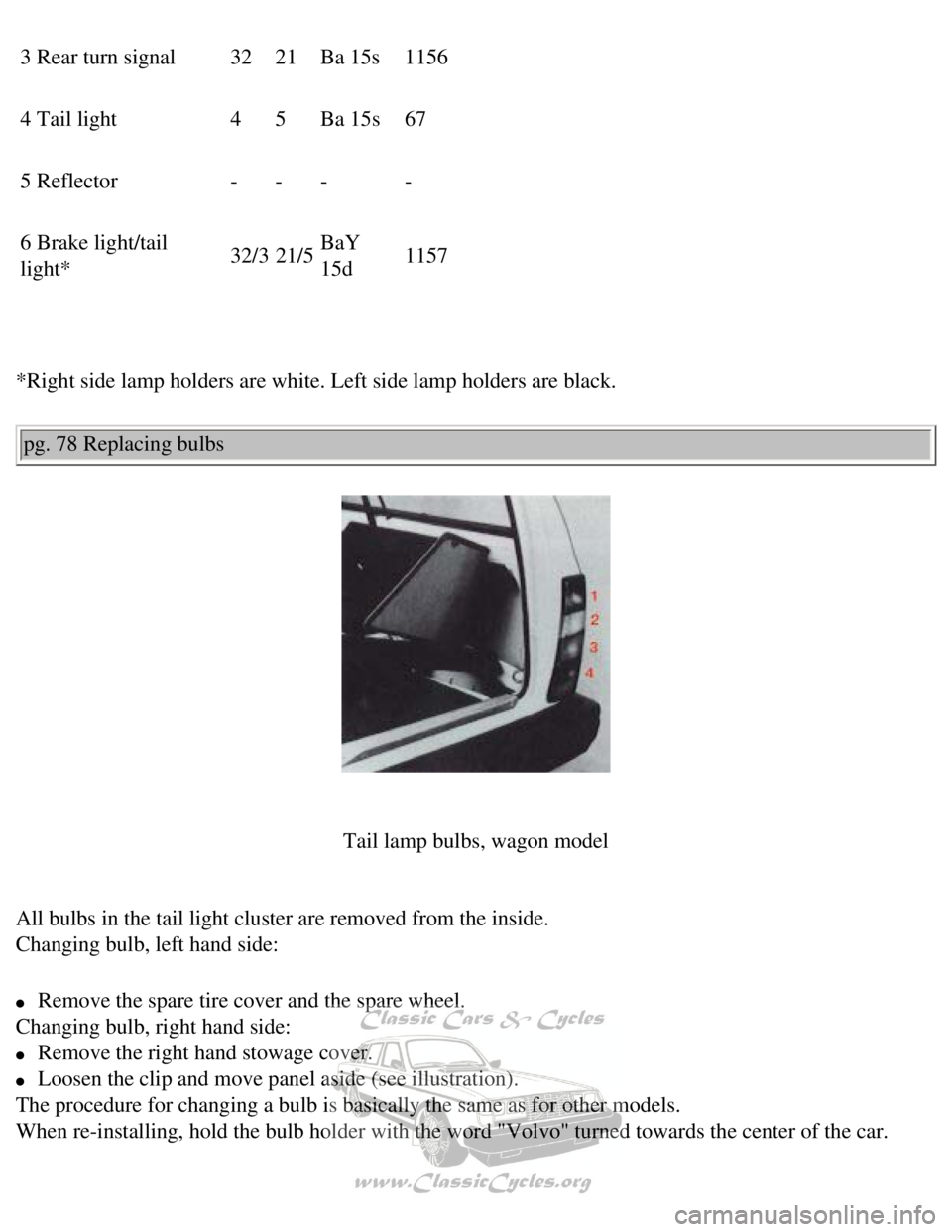
*Right side lamp holders are white. Left side lamp holders are black. pg. 78 Replacing bulbs
Tail lamp bulbs, wagon model
All bulbs in the tail light cluster are removed from the inside.
Changing bulb, left hand side:
l Remove the spare tire cover and the spare wheel.
Changing bulb, right hand side:
l Remove the right hand stowage cover.
l Loosen the clip and move panel aside (see illustration).
The procedure for changing a bulb is basically the same as for other mod\
els.
When re-installing, hold the bulb holder with the word "Volvo" turned to\
wards the center of the car.
file:///K|/ownersdocs/1990/1990_240/90240_16.htm (4 of 10)12/30/2006 8\
:25:10 AM
Page 112 of 143
 switch OFF before replacing fuses. E\
xcessive heat may be created by
a short circuit. Care must be exercised while replacing blown fuses.")
Volvo 1990 240 Model
Warning: Turn starting (ignition) switch OFF before replacing fuses. E\
xcessive heat may be created by
a short circuit. Care must be exercised while replacing blown fuses.
Some of the equipment listed below is optional
Refer to the fuse location chart at fuse box for fuses specific to your \
car.
1 Cigarette lighter, Power mirrors, Radio, Tailgate wiper/washer 8A
2 Windshield wiper/washer, Horn 16A
3 Heater blower 25A
4 Fuel feed (in-tank) pump, Lambda-sond heating element 8A
5 Turn signals, Back-up lights 16A
6 Main fuel pump relay 16A
7 Brake lights 8A
8 Central locking, Interior and glove compartment lights, Trunk and engi\
ne
compartment lights, Radio, Power antenna, Clock, Daytime running lights \
(Canada)* 8A
9 Hazard warning Flashers 8A
10 Power windows 16A
11 Heated rear window, 4th gear (automatic transmission) 16A
12 Air conditioning (with blower control), Power windows (relay),
Heated rear window (relay), Seat belt reminder, Cruise control 8A
13 Heated front seats, Daytime running lights - relay (Canada)* 16A
14 Rear fog lights 8A
15 Parking lights (left side), License plate light 8A
16 Parking lights (right side), Instruments and control panel lights, \
Shift indicator light 8A
Blade type fuse, serving LH-Jetronic fuel injection system. Located on t\
he left
wheel housing by the ignition coil 25A
* Note: Early production Canadian vehicles are not equipped with Daytime\
Running Lights.
Contents | Top of Page
file:///K|/ownersdocs/1990/1990_240/90240_16.htm (10 of 10)12/30/2006 \
8:25:10 AM
Page 113 of 143

Volvo 1990 240 Model
pg. 82 Wheels and tires
Checking and correcting tire pressure
Check the tire pressure when refueling. The tire pressure should only be\
corrected when the tires are
cold. With warm tires, correct only when the pressure is too low. The ti\
re temperature (and, thus,
pressure) rises after driving just a few miles.
Warning: Improperly inflated tires will reduce tire life, adversely affe\
ct vehicle handling and can
possibly lead to failure resulting in loss of vehicle control without pr\
ior warning.
Vehicle Loading
The tires on your Volvo will perform to specifications at all normal loa\
ds when inflated as
recommended on the tire information label located on the rear facing sid\
e of the right front door. This
label lists both tire and vehicle design limits.
Do not load your car beyond the load limits indicated.
Tire Pressure Label
The tire pressure label is located on the rear facing side of the right \
front door.
See section titled ''Specifications'' and Consumer Information Booklet f\
or complete tire pressure
information.
Wear indicator
The tires have a so-called "wear indicator in the form of a number of na\
rrow strips running across or
parallel to the tread. When approx 1/16 " (1.5 mm) is left on the trea\
d, these strips show up and indicate
the tire should be replaced.
Tires with less than 1/16" (1.5 mm) tread have a very poor grip in rai\
n or snow.
pg. 83 Wheels and tires
file:///K|/ownersdocs/1990/1990_240/90240_17.htm (1 of 2)12/30/2006 8:\
25:10 AM
Page 116 of 143

Volvo 1990 240 Model
cloth.
CAUTION: It is particularly important to wash the car frequently in the \
winter time, to prevent
corrosion, when salt has been used on the roads. Also wash off the dirt \
on the underside (Wheel
housings and fenders etc.)
WARNING: When the car is driven immediately after being washed, carefull\
y apply the brakes
several times in order to remove any moisture from the brake linings.
pg. 87 Washing, Cleaning, Anti-rust treatment
Automatic washing - simple and quick
An automatic wash is a simple and quick way to clean your car, but it is\
worth remembering that it can
never be as thorough as when you yourself go over the car with sponge an\
d water. Keeping the
underbody clean is most important, especially in the winter. Some automa\
tic washers do not have
facilities for washing the underbody.
Before driving into an automatic wash, make sure that side view mirrors,\
auxiliary lamps, etc., are
secure, otherwise there is risk of the machine dislodging them. You shou\
ld also lower the antenna.
We recommend that you do not wash your car in an automatic wash during t\
he first six months (because
the paint will not have hardened sufficiently).
Bird droppings /Tree sap
Remove from paintwork as soon as possible. Otherwise the finish may be p\
ermanently damaged.
Chromed parts
Chromium-plated and anodized parts should be washed with clean water as \
soon as they become dirty.
This is particularly important if you drive on gravel roads or on roads \
where salt is used during the
winter. After the car has been washed, apply wax or an anti-rust prepara\
tion.
Stains on chrome trim can be removed with commercially available chrome \
cleaner. Do not use abrasive
compounds or steel wool.
file:///K|/ownersdocs/1990/1990_240/90240_18.htm (2 of 8)12/30/2006 8:\
25:11 AM
Page 118 of 143

Volvo 1990 240 Model
The floor mats should be vacuumed or brushed clean regularly, especially\
during the winter when they
should be taken out for drying.
Spots on textile mats can be removed with a mild detergent.
Anti-rust treatment
Your Volvo has been rust protected at the factory. On external surfaces \
a heavy coat of wear resistant
material has been used, while on the internal surfaces a lighter rust in\
hibitor is used.
The rust protection should be inspected regularly by your authorized Vol\
vo dealer. Consult the Volvo
Protection Limited Warranty found in your Warranty Information Booklet f\
or additional terms and
conditions.
For further information, see section titled "What causes rust" or see yo\
ur Volvo dealer. pg. 88 Paint touch-up
Paint touch-up
Paint damage requires immediate attention to avoid rusting. Make it a ha\
bit to check the finish regularly,
for instance when washing the car. Touch-up if necessary.
Paint repairs require special equipment and skill. Contact your Volvo de\
aler for any extensive damages.
Minor scratches can be repaired by using Volvo touch-up paint.
Note: When ordering touch-up paint from your Volvo dealer, use the paint\
code indicated on the
service label. The label is located on the wheel housing in the engine c\
ompartment.
Minor stone chips and scratches
Material:
Primer-can
Paint-can or touch-up bottle
file:///K|/ownersdocs/1990/1990_240/90240_18.htm (4 of 8)12/30/2006 8:\
25:11 AM