battery VOLVO 850 1996 User Guide
[x] Cancel search | Manufacturer: VOLVO, Model Year: 1996, Model line: 850, Model: VOLVO 850 1996Pages: 265, PDF Size: 4.57 MB
Page 159 of 265

1996 Volvo 850
Starting and driving
pg. 4:1 Starting and driving
Starting and driving
This section on starting and driving contains items such as starting the\
engine, operating gear selector,
towing, trailers.
4:2 Break-in period
4:3Fuel requirements, Octane rating
4:4Driving economy
4:5Starting the engine
4:6Manual transmission
4:7Automatic Transmission
4:10Points to remember
4:12Emergency towing
4:13Vehicle Towing Information
4:14Starting with an auxiliary battery (jump starting)
4:15Three-way catalytic converter
4:16Brake system, ABS
4:17Trailer towing
4:18Winter driving
4:19Long distance trips, City driving
pg. 4:2 Break-in period, Fuel requirements
A new car should be broken-in!
Refrain from utilizing your car's full driving potential during the firs\
t 1,200 miles (2,000 km) including
the "kick-down" function (automatic transmission).
file:///K|/ownersdocs/1996/1996_850/96850_401.htm (1 of 8)12/30/2006 9\
:59:32 AMClassic Cars & Cycles www.ClassicCycles.org
Page 174 of 265
1996 Volvo 850
WARNING! Do not remove the coolant expansion tank
cap.
See "Coolant" to check and top-up the coolant level if necessary.
CAUTION: Drive slowly and carefully if going through standing water (i.\
e. flooded roadways, etc.).
Damage to engine could result if excess water is ingested through the ai\
r intake system.
Never drive the vehicle in water deeper than 1 foot (300 mm).
See the flood warning on page 3:7.
WARNING! Do not drive with trunk lid or tailgate open!
Poisonous exhaust gases may enter via the trunk lid or tailgate.
If the trunk lid/tailgate must be kept open for any reason, proceed as f\
ollows:
l Close the windows.
l Set the ventilation system control to air to floor, windshield and side \
windows and blower control to
its highest setting.
Electrical system
When replacing the battery or when carrying out work involving the elect\
rical system, the following
should be observed:
l A battery connection to the wrong terminal will damage the diodes. Befor\
e connections are made,
check the polarity of the battery with a voltmeter.
l If booster batteries are used for starting, they must be properly connec\
ted to minimize the risk of the
diode being damaged. For correct connection, see "Jump starting" section\
.
l Never disconnect the battery circuit (for example, to replace the batte\
ry) while the engine is running,
as this will immediately ruin the generator. Always make sure that all t\
he battery connections are
properly tightened.
l If any electrical-welding work is performed on the vehicle, the ground l\
ead and all the connecting
cables of the generator must be disconnected and the welder cables place\
d as near the welding point as
possible.
l The radio must be turned off before the battery is disconnected.
l The anti-theft code must be re-entered before the radio will function pr\
operly.
l The electrical system in your car is designed to accommodate Volvo acces\
sories. It also has an
accessory connector beneath the dashboard on the driver's side.
pg. 4:11 Points to remember
file:///K|/ownersdocs/1996/1996_850/96850_406.htm (8 of 10)12/30/2006 \
9:59:34 AMClassic Cars & Cycles www.ClassicCycles.org
Page 177 of 265
1996 Volvo 850
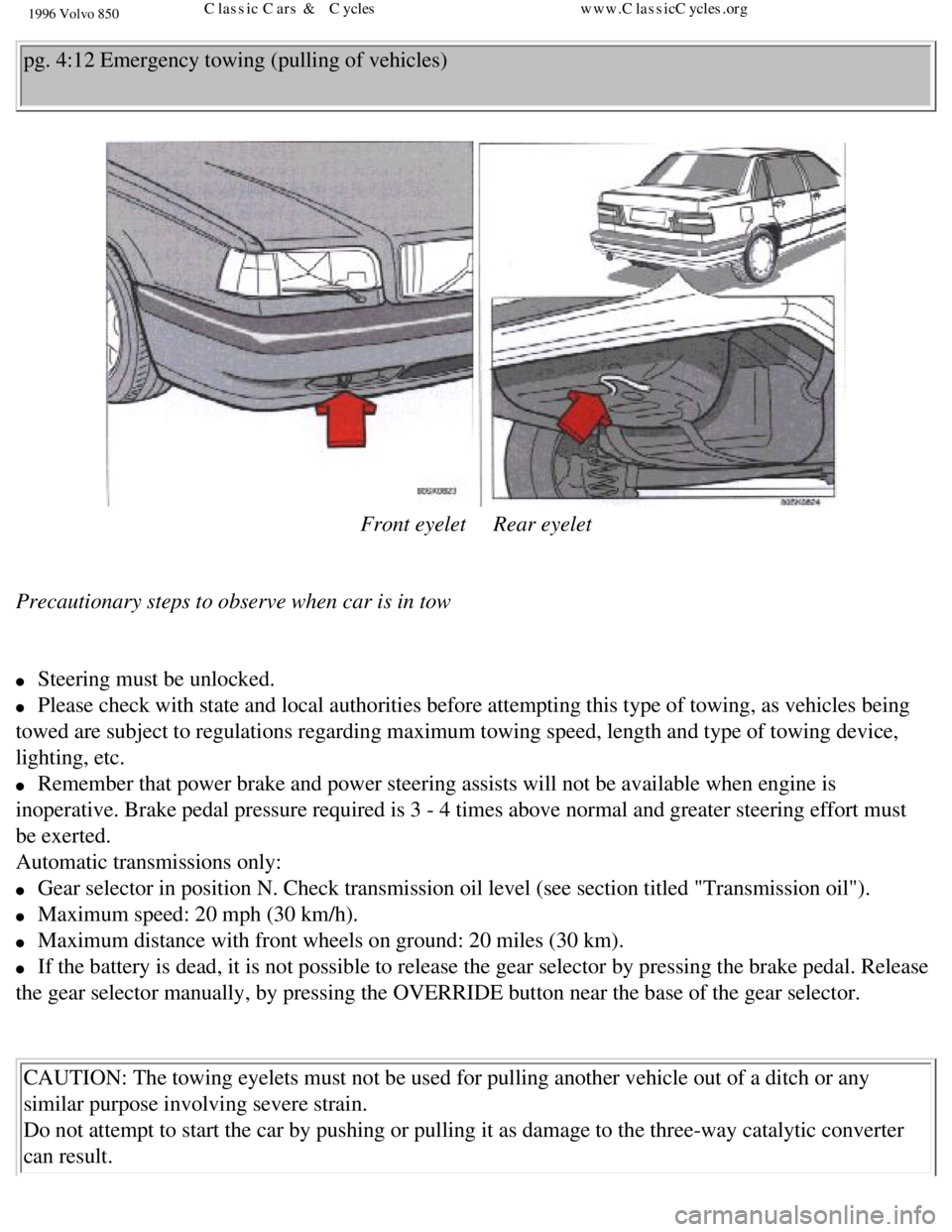
pg. 4:12 Emergency towing (pulling of vehicles)
Front eyelet Rear eyelet
Precautionary steps to observe when car is in tow
l Steering must be unlocked.
l Please check with state and local authorities before attempting this typ\
e of towing, as vehicles being
towed are subject to regulations regarding maximum towing speed, length \
and type of towing device,
lighting, etc.
l Remember that power brake and power steering assists will not be availab\
le when engine is
inoperative. Brake pedal pressure required is 3 - 4 times above normal a\
nd greater steering effort must
be exerted.
Automatic transmissions only:
l Gear selector in position N. Check transmission oil level (see section \
titled "Transmission oil").
l Maximum speed: 20 mph (30 km/h).
l Maximum distance with front wheels on ground: 20 miles (30 km).
l If the battery is dead, it is not possible to release the gear selector \
by pressing the brake pedal. Release
the gear selector manually, by pressing the OVERRIDE button near the bas\
e of the gear selector.
CAUTION: The towing eyelets must not be used for pulling another vehicle\
out of a ditch or any
similar purpose involving severe strain.
Do not attempt to start the car by pushing or pulling it as damage to th\
e three-way catalytic converter
can result.
file:///K|/ownersdocs/1996/1996_850/96850_412.htm (1 of 10)12/30/2006 \
9:59:35 AMClassic Cars & Cycles www.ClassicCycles.org
Page 179 of 265

1996 Volvo 850
Jump starting
If the booster battery to be used is in another car, check that the cars\
are not touching to prevent
premature completion of negative circuit. Note the position of the batte\
ry terminals and using jumper
cables:
l First connect the booster battery positive (+) terminal (1) to car b\
attery positive (+) terminal (2).
l Then connect the booster battery negative (-) terminal (3) to a stat\
ionary solid metal part on the
engine at a point away from the battery (4).
Do not connect booster cable to any part of fuel system or any moving pa\
rts. Avoid touching hot
manifolds.
After the engine has started, first remove the negative (-) terminal j\
umper cable. Then remove the
positive (+) terminal jumper cable.
CAUTION: Improper hook-up of jumper cables or use of other than 12-volt \
batteries could result in
damage to equipment and/or battery.
file:///K|/ownersdocs/1996/1996_850/96850_412.htm (3 of 10)12/30/2006 \
9:59:35 AMClassic Cars & Cycles www.ClassicCycles.org
Page 180 of 265

1996 Volvo 850
WARNING!
l To reduce the possibility of explosion, never expose battery to open fla\
me or electric spark.
l Do not smoke near battery.
l Batteries generate hydrogen gas which is flammable and explosive.
l Battery fluid contains sulfuric acid. Do not allow battery fluid to cont\
act eyes, skin, fabrics or
painted surfaces. If contact occurs, flush affected area immediately wit\
h water. Obtain medical
attention immediately if eyes are affected.
Failure to follow the instructions for jump starting can lead to persona\
l injury.
pg. 4:15 Three-way catalytic converter
Three-way catalytic converter cautions
l Keep your engine properly tuned. Certain engine malfunctions, particular\
ly involving the electrical,
fuel or distributor ignition systems, may cause unusually high three-way\
catalytic converter
temperatures. Do not continue to operate your vehicle if you detect engi\
ne misfire, noticeable loss of
power or other unusual operating conditions, such as engine overheating \
or backfiring. A properly tuned
engine will help avoid malfunction that could damage the three-way catal\
ytic converter.
l Do not park your car over combustible materials, such as grass or leaves\
, which can come into contact
with the hot exhaust system and cause such materials to ignite under cer\
tain wind and weather
conditions.
l Excessive starter cranking (in excess of one minute), with an intermit\
tently firing or flooded engine,
file:///K|/ownersdocs/1996/1996_850/96850_412.htm (4 of 10)12/30/2006 \
9:59:35 AMClassic Cars & Cycles www.ClassicCycles.org
Page 184 of 265

1996 Volvo 850
mountainous areas.
NOTE: Refer to section "Automatic transmission" for additional trailer h\
auling tips.
WARNING!
l Bumper-attached trailer hitches must not be used on Volvos, nor should s\
afety chains be attached to
the bumper.
l Trailer hitches attaching to the vehicle rear axle must not be used.
l Never connect a trailer's hydraulic brake system directly to the vehicle\
brake system, nor a trailer's
lighting system directly to the vehicle lighting system. Consult your ne\
arest authorized Volvo retailer
for correct installation.
pg. 4:18 Winter driving
Cold weather precautions
l If you wish to check your car before the approach of cold weather, the f\
ollowing advice is worth
noting:
l Make sure that the engine coolant contains at least 50 percent antifreez\
e: that is, 3.7 qts. (3.5 liters)
Volvo Genuine Coolant/Antifreeze. This gives protection against freezing\
down to -31°F (-35°C). See
section "Coolant". The use of "recycled" antifreeze is not approved by V\
olvo. Different types of
antifreeze may not be mixed.
l Try to keep the fuel tank well filled - this prevents the formation of c\
ondensation in the tank. In
addition in extremely cold weather conditions it is worthwhile to add fu\
el line de-icer before refueling.
l The viscosity of the engine oil is important. Oil with low viscosity (t\
hinner oil) improves cold-
weather starting as well as decreasing fuel consumption while the engine\
is warming up. For winter use,
5W-30 oil, particularly the synthetic type, is recommended. Be sure to u\
se good quality oil but do not
use this cold-weather oil for hard driving or in warm weather. See secti\
on "Engine oil" for more
information.
l The load placed on the battery is greater during the winter since the he\
ater, windshield wipers,
lighting etc. are used more often. Moreover, the capacity of the battery\
decreases as the temperature
drops. In very cold weather, a poorly charged battery can freeze and be \
damaged. It is therefore
advisable to check the state of charge more frequently and spray an anti\
-rust oil on the battery posts.
l Volvo recommends the use of snow tires on all four wheels for winter dri\
ving - see section "Wheels
and tires".
l To prevent the washer reservoir from freezing, add washer solvents conta\
ining antifreeze (see page
file:///K|/ownersdocs/1996/1996_850/96850_412.htm (8 of 10)12/30/2006 \
9:59:35 AMClassic Cars & Cycles www.ClassicCycles.org
Page 186 of 265
, and replace those th\
at are worn. Check tire pr")
1996 Volvo 850
l Check condition of drive belts.
l Check state of charge of battery.
l Examine tires carefully (the spare tire as well), and replace those th\
at are worn. Check tire pressures.
l The brakes, front wheel alignment, and steering gear should be checked b\
y your Volvo retailer only.
l Check all lights, including high beams.
l Reflective warning triangles are legal requirement in some countries.
l Have a word with your Volvo retailer concerning engine adjustments if yo\
u intend to drive in
countries where it may be difficult to obtain correct fuel.
l Consider your destination. If you will be driving through an area where \
snow or ice are likely to
occur, consider snow tires.
Contents | Top of Page
file:///K|/ownersdocs/1996/1996_850/96850_412.htm (10 of 10)12/30/2006\
9:59:35 AMClassic Cars & Cycles www.ClassicCycles.org
Page 213 of 265

1996 Volvo 850
Installation of accessories
In order to help avoid interference and damage to your car's electrical \
system, your car is equipped with
an accessory connector located under the instrument panel on the driver'\
s side.
Please consult your Volvo retailer if you have any questions before conn\
ecting accessory or optional
equipment to the vehicle's electrical system.
Connector (for accessories)
Position Connection Max.
load
1 Battery + (30) 20 A
2 X Supply 0,5 A
3 High beam 1 A
4 Low beam 1 A
5 Pos Light 1 A
6 Rheostat 0,5 A
7 Front acc.
conn. 2 A
8 Earth (31) –
file:///K|/ownersdocs/1996/1996_850/96850_613.htm (4 of 8)12/30/2006 9\
:59:46 AMClassic Cars & Cycles www.ClassicCycles.org
Page 230 of 265

1996 Volvo 850
Maintenance Operation thousand miles
(thousand km) 10
(16) 20
(32) 30
(48) 40
(64) 50
(80) 60
(96)
ENGINE SYSTEM MAINTENANCE
ENGINE
Fuel (Line) Filter¹
PCV Nipple (orifice)/hoses,clean I
Battery I I I I I I
BRAKES
Inspect brakes, replace components as necessary I I I I I I
Brake Fluid²
STEERING/SUSPENSION
Rotate tires/check wear (align front end if
needed.) I
I I I I I
Check power steering fluid level. I I I I I I
Grease front link arm stops L L L L L L
BODY
Power antenna (clean) I I I I I I
Trunk/hood, hinges and latches L L L L L L
1) Replace at 100,000 miles (160,000 km)
2) Brake fluid should be changed at owner request every second year (o\
nce a year if the car is driven in
mountainous areas or in areas with high humidity).
The following items should be checked weekly by the driver (it takes on\
ly a few minutes).
Engine oil level Horns
Brake fluid level Windshield wipers
Radiator coolant level Tire pressure (all five tires)
Operation of all lights Level of windshield washer fluid
The following should also be carried out at regular intervals:
Washing
Polishing
Cleaning
Rust protection
file:///K|/ownersdocs/1996/1996_850/96850_801.htm (5 of 6)12/30/2006 9\
:59:50 AMClassic Cars & Cycles www.ClassicCycles.org
Page 232 of 265

The following precautions must be observed when carrying out repairs to \
the vehicle
WARNING! The distributor ignition system operates at very high volta")
1996 Volvo 850
pg. 8:6 Servicing (cont.)
The following precautions must be observed when carrying out repairs to \
the vehicle
WARNING! The distributor ignition system operates at very high voltages.\
Special safety precautions
must be followed to prevent injury. Always turn the ignition off when:
l Connecting engine test and diagnostic equipment to the vehicle (timing \
light, tach-dwell tester,
ignition oscilloscope, etc.).
l Replacing distributor ignition components e.g. plugs, coil, etc.
l Do not touch any part of the distributor ignition system while the engin\
e is running. This may result
in unintended movements and body injury.
Battery
l Check that the battery cables are correctly connected and properly tight\
ened.
l Never disconnect the battery when the engine is running, for example whe\
n changing the battery.
l The battery should be disconnected when a boost charger is used.
l Switch off the radio before disconnecting the battery. If your radio has\
an anti-theft code and the
battery is disconnected, the radio code has to be re-entered in order fo\
r the radio to function.
Replacing spark plugs
The spark plugs should be changed every 30,000 miles (48,000 km). Howe\
ver, city driving or fast
highway driving may necessitate changing after 15,000 miles (24,000 km)\
of driving. When installing
new plugs, be sure to fit the right type and use correct torque, see "Sp\
ecifications". When changing the
plugs, check that the suppressor connectors are in good condition. Crack\
ed or damaged connectors
should be replaced. When changing the spark plugs, clean the terminals a\
nd the rubber seals.
Hoisting the car
If a garage jack is used to lift the car, the two jack attachments point\
s should be used. They are specially
reinforced to bear the weight of the car. A garage jack can also be plac\
ed under the front of the engine
file:///K|/ownersdocs/1996/1996_850/96850_806.htm (1 of 11)12/30/2006 \
9:59:52 AMClassic Cars & Cycles www.ClassicCycles.org