fuel VOLVO 850 1996 User Guide
[x] Cancel search | Manufacturer: VOLVO, Model Year: 1996, Model line: 850, Model: VOLVO 850 1996Pages: 265, PDF Size: 4.57 MB
Page 160 of 265

1996 Volvo 850
NOTE - ENGINE OIL:
Although some oil consumption during normal engine operation, more oil i\
s consumed when the engine
is new as the internal parts generate higher friction while wearing-in t\
o each other. From the time the
engine is new until the first service is performed, the oil consumption \
could be higher than normal. For
this reason, it is especially important to check the oil every time you \
refuel your car during this period.
See page 8:10.
In general, the rate of oil consumption depends on such factors as: engi\
ne temperature, length of trip,
driving conditions, oil viscosity and quality, engine speed and accelera\
tion/deceleration.
Checking your engine oil level each time the car is refuelled is one of \
the most important items you can
perform to help keep your car in good running order.
Manual transmission
The following speeds should not be exceeded during the break-in period: \
Up to 600 miles
(1000 km) 600 - 1,200 miles
(1000 - 2000 km)
1st gear 20 mph (30 km/h) 25 mph (40 km/h)
2nd gear 30 mph (50 km/h) 40 mph (70 km/h)
3rd gear 45 mph (80 km/h) 65 mph (100 km/
h)
4th gear 70 mph (110 km/
h) 80 mph (130 km/
h)
5th gear/
overdrive 80 mph (130 km/
h) 95 mph (150 km/
h)
Posted speed limits should not be exceeded.
file:///K|/ownersdocs/1996/1996_850/96850_401.htm (2 of 8)12/30/2006 9\
:59:32 AMClassic Cars & Cycles www.ClassicCycles.org
Page 161 of 265

1996 Volvo 850
Deposit control gasoline
Volvo recommends the use of gasoline containing deposit control additive\
s. These additives have shown
to be efficient in keeping injectors and intake valves clean. Consistent\
use of deposit control gasolines
will help ensure good driveability and fuel economy. If you are not sure\
whether the gasoline contains
deposit control additives, check with the service station operator.
Unleaded Fuel
Each Volvo has a three-way catalytic converter and must use only unleade\
d gasoline (as specified on the
instrument panel and by a label near the filler inlet). U.S. and Canadi\
an regulations require that pumps
delivering unleaded gasoline be labelled "UNLEADED". Only these pumps ha\
ve nozzles which fit your
car's filler inlet. It is unlawful to dispense leaded fuel into a vehicl\
e labelled "unleaded gasoline only".
Leaded gasoline damages the three-way catalytic converter and the heated\
oxygen sensor system.
Repeated use of leaded gasoline will lessen the effectiveness of the emi\
ssion control system and could
result in loss of emission warranty coverage. State and local vehicle in\
spection programs will make
detection of misfueling easier, possibly resulting in emission test fail\
ure for misfueled vehicles. pg. 4:3 Fuel requirements, Refueling
Octane Rating
Volvo engines are designed for optimum performance on unleaded premium g\
asoline with an octane
rating, AKI of 91, or above. AKI (ANTI KNOCK INDEX) is an average of t\
he Research Octane
Number, RON, and the Motor Octane Number, MON, (RON + MON/ 2).
The minimum octane requirement is AKI 87 (RON 91).
Gasoline Containing Alcohol and Ethers
"Oxygenated fuels"
Some fuel suppliers sell gasoline containing "oxygenates" which are usua\
lly alcohols or ethers. In some
areas, state or local laws require that the service pump be marked indic\
ating use of alcohol or ethers.
However, there are areas in which the pumps are unmarked. If you are not\
sure whether there is alcohol
or ethers in the gasoline you buy, check with the service station operat\
or. To meet seasonal air quality
restrictions, some states require the use of "oxygenated" fuel in certai\
n areas.
file:///K|/ownersdocs/1996/1996_850/96850_401.htm (3 of 8)12/30/2006 9\
:59:32 AMClassic Cars & Cycles www.ClassicCycles.org
Page 162 of 265

1996 Volvo 850
Volvo allows the use of the following "oxygenated fuels"; however, the o\
ctane ratings listed on this page
must still be met.
Alcohol -- Ethanol
Fuels containing up to 10% ethanol by volume may be used.
Ethanol may also be referred to as Ethyl alcohol, or "Gasohol".
Ethers -- MTBE
Fuels containing up to 15% MTBE may be used.
Refueling
The fuel tank filler cap is located behind the door on the left rear fen\
der. Open cap slowly during hot
weather conditions.
When filling, position the cap in the special bracket on the door.
NOTE: Turn the ignition off or to position I when refueling. If the igni\
tion is on, an incorrect reading
could occur in the fuel gauge (low fuel will be indicated).
After filling the tank, install the cap and turn until a "click" is hear\
d.
The fuel tank is designed to hold approximately 19.3 US gals (73 liters\
) with sufficient volume left over
to accommodate possible expansion of the fuel in hot weather. The "usabl\
e" tank capacity will be
somewhat less than the specified maximum. When the fuel level is low, su\
ch factors as ambient
temperature, the fuel's "vapor pressure" characteristics, and terrain ca\
n affect the fuel pumps' ability to
supply the engine with an adequate supply of fuel. Therefore, it is advi\
sable to refuel as soon as possible
when the needle nears the red zone, or when the fuel warning light comes\
on.
CAUTION: Do not refuel with the engine running. After refueling, close t\
he fuel filler cap by turning
it clockwise until it clicks into place.
NOTE: if the filler cap is not closed tightly or if the engine is runnin\
g when the car is refueled, the
Malfunction Indicator Lamp may indicate a fault. Use only Volvo original\
or approved fuel filler caps.
file:///K|/ownersdocs/1996/1996_850/96850_401.htm (4 of 8)12/30/2006 9\
:59:32 AMClassic Cars & Cycles www.ClassicCycles.org
Page 163 of 265

1996 Volvo 850
CAUTION: Take care not to spill gasoline during refueling. Gasolines con\
taining alcohol can cause
damage to painted surfaces, which may not be covered under the New Vehic\
le Limited Warranty.
Do not use gasoline containing methanol (methyl alcohol, wood alcohol)\
. This practice can result in
vehicle performance deterioration and can damage critical parts in the f\
uel system. Such damage may
not be covered under the New Vehicle Limited Warranty.
pg. 4:4 Driving economy
Economical driving does not necessarily mean driving slowly
Better driving economy may be obtained by thinking ahead, avoiding rapid\
starts and stops and
adjusting the speed of your vehicle to immediate traffic conditions. Obs\
erve the following rules:
l Bring the engine to normal operating temperature as soon as possible by \
driving with a light foot on
the accelerator pedal for the first minutes of operation. A cold engine \
uses more fuel and is subject to
increased wear.
l Whenever possible, avoid using the car for driving short distances. This\
does not allow the engine to
reach normal operating temperature.
l Drive carefully and avoid rapid acceleration and hard braking.
l Do not exceed speed limit.
l Avoid carrying unnecessary items (extra load) in the car.
l Check tire pressure regularly (check when tires are cold).
l Remove snow tires when threat of snow or ice has ended.
l Note that roof racks, ski racks, etc., increase air resistance and there\
by fuel consumption.
l Avoid using automatic transmission kick-down feature unless necessary.
l Avoid using the air conditioning when it is not required. When engaged, \
the air conditioner's
compressor places places an additional load on the engine.
l If your car is equipped with the optional Trip Computer, utilizing the f\
uel consumption modes can
help you "learn" how to drive more economically.
Other factors which decrease gas mileage are:
l Low tire pressure
l Worn or dirty spark plugs
l Incorrect spark plug gap
l Dirty air cleaner
l Dirty engine oil and clogged oil filter
l Dragging brakes
l Incorrect front end alignment
file:///K|/ownersdocs/1996/1996_850/96850_401.htm (5 of 8)12/30/2006 9\
:59:32 AMClassic Cars & Cycles www.ClassicCycles.org
Page 164 of 265
rive or 5th gear (manual transmissions) should be used as\
o")
1996 Volvo 850
Some of the above mentioned items and others are checked at the standard\
Maintenance Service
intervals.
NOTE: ( D )rive or 5th gear (manual transmissions) should be used as\
often as possible to help improve
fuel economy. pg. 4:5 Starting the engine
Starting and stopping
1. Fasten the seat belt.
WARNING! Before starting, check that the seat and steering wheel are adj\
usted properly. Make sure
the brake pedal can be depressed completely. Move the seat closer if nec\
essary. Refer to section "front
seats".
2. Apply the parking brake, if not already set. The gear selector ( aut\
omatic transmission ) is locked in
the ( P )ark position ( SHIFT LOCK ).
3. Without touching the accelerator pedal , turn the ignition key to the\
starting position. Allow the starter
to operate for 5-10 seconds (turbo: 10 seconds). Release the key as so\
on as the engine starts. If the
engine fails to start, repeat step 3.
For cold starts at altitudes above 6000 ft (1800 m), depress the accel\
erator pedal halfway and turn the
key to the starting position. Release the accelerator pedal slowly when \
the engine starts.
4. To release the gear selector from the (P)ark position (automatic t\
ransmission), the ignition key must
be in position II and the brake pedal must be depressed.
See page 6:18 for instructions on manually
overriding the SHIFTLOCK system.
Do not race a cold engine immediately after starting. Oil flow may not r\
each some lubricating points fast
enough to prevent engine damage.
NOTE: (Automatic transmission only)
file:///K|/ownersdocs/1996/1996_850/96850_401.htm (6 of 8)12/30/2006 9\
:59:32 AMClassic Cars & Cycles www.ClassicCycles.org
Page 167 of 265
1996 Volvo 850
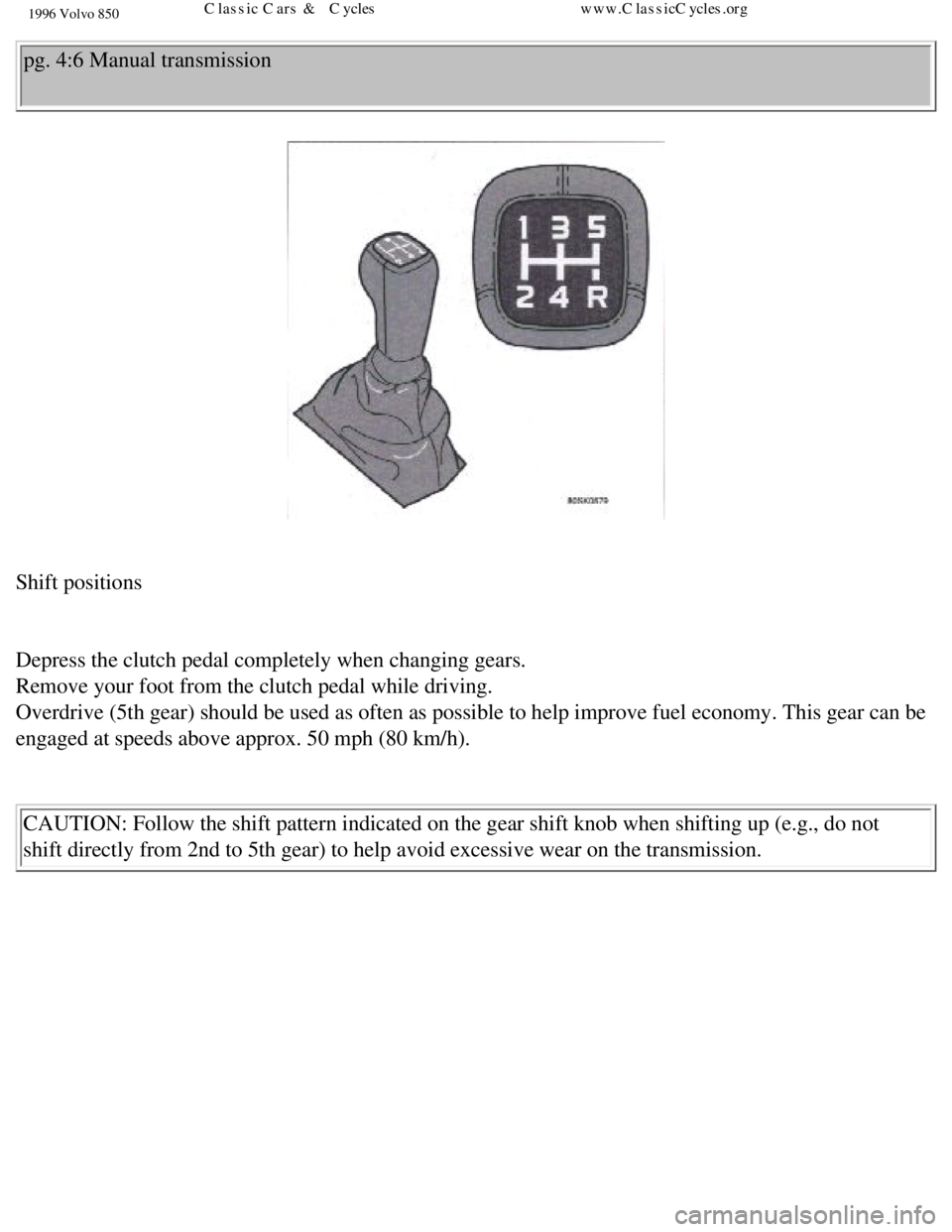
pg. 4:6 Manual transmission
Shift positions
Depress the clutch pedal completely when changing gears.
Remove your foot from the clutch pedal while driving.
Overdrive (5th gear) should be used as often as possible to help impro\
ve fuel economy. This gear can be
engaged at speeds above approx. 50 mph (80 km/h).
CAUTION: Follow the shift pattern indicated on the gear shift knob when \
shifting up (e.g., do not
shift directly from 2nd to 5th gear) to help avoid excessive wear on th\
e transmission.
file:///K|/ownersdocs/1996/1996_850/96850_406.htm (1 of 10)12/30/2006 \
9:59:34 AMClassic Cars & Cycles www.ClassicCycles.org
Page 169 of 265
1996 Volvo 850
P (Park)
Use this position when starting the engine or parking the car.
Never use P while car is in motion.
The parking brake should also be used when parking on grades.
The gear selector is mechanically locked in the P position (Shift lock)\
. To release the selector, start the
engine and depress the brake pedal. If it is necessary to manually relea\
se the gear selector,
see page 6:18
for instructions.
CAUTION:
l Never select P or R while the car is in motion.
l When initially selecting positions D, 3, L or R, your right foot should \
press firmly on the brake
pedal to ensure that the car is standing still with the engine idling.
l The gear selector should not be downshifted to L at speeds above 75 mph \
(125 km/h).*
* Always observe posted speed limits.
WARNING! Never leave the car when the engine is running. If, by mistake,\
the gear selector is moved
from P the car may start moving.
R (Reverse)
Never engage R while is moving forward.
N (Neutral)
Neutral = no gear is engaged. Use the parking brake. The engine can be s\
tarted with the gear selector in
this position.
D (Drive)
D is the normal driving position and should be used as often as possible\
to help improve fuel economy.
When modes E or S are selected, upshift and downshift of the forward gea\
rs occur automatically and are
file:///K|/ownersdocs/1996/1996_850/96850_406.htm (3 of 10)12/30/2006 \
9:59:34 AMClassic Cars & Cycles www.ClassicCycles.org
Page 170 of 265

Automatically shifts up and down between 1st, 2nd, and 3rd gears when in\
driving modes E or")
1996 Volvo 850
governed by accelerator pedal position and vehicle speed.
3 (Intermediate position)
Automatically shifts up and down between 1st, 2nd, and 3rd gears when in\
driving modes E or S. There
is no upshift from 3rd gear. Position 3 can be used for driving in hilly\
terrain, for towing trailers or for
increased engine braking power.
L (low position)
No upshift can occur when L is engaged. Select position L for driving in\
first and second gears. Use this
position to select low gear with no upshift, e.g. when ascending and des\
cending steep grades. The
transmission will noticeably shift down from second to first if road spe\
ed drops to below 40 km/h (25
mph) when driving in E mode and below 10 km/h (6 mph in S mode.
Kick-down
Automatic shift to a lower gear (kick-down) is achieved by depressing \
the accelerator pedal fully and
briskly. An upshift will be achieved when approaching the top speed for \
a particular gear or by releasing
the accelerator pedal slightly. Kick-down can be used for maximum accele\
ration or when passing at
highway speeds.
"Lock-up"
The transmission has a "lock-up" function which reduces engine speed and\
saves fuel. "Lock-up" can
sometimes be felt as an additional gear change. pg. 4:8 Automatic transmission
file:///K|/ownersdocs/1996/1996_850/96850_406.htm (4 of 10)12/30/2006 \
9:59:34 AMClassic Cars & Cycles www.ClassicCycles.org
Page 172 of 265

1996 Volvo 850
The push-buttons to the left of the gear lever are for selection of mode\
s E, S and W. The desired mode
can be selected at any time, including while the car is moving.
Winter/Wet mode
Enhanced Vehicle Traction
This mode may be selected for starting/moving off on slippery roads.
In this mode:
* In position D, the gearbox starts in 3rd gear and changes up to 4th ge\
ar.
* In position 3, 2nd gear is locked and there is no change up to 3rd gea\
r.
In position L, 1st gear is locked.
* These positions always offer the kick-down function.
The indicator lamp in the instrument panel
lights up when this mode is selected (the lamp will also
light up if the gear selector is in position 3 or L.). Press button WIN\
TER in order to disengage this
mode.
When mode is disengaged, the gearbox automatically reverts to the previo\
usly selected S or E mode. If
the indicator lamp
begins to flash, this is an indication of a fault in the automatic gear\
box. The
Malfunction Indicator lamp will also light up if a fault is detected. Pl\
ease contact your Volvo retailer if
this occurs.
CAUTION: Driveability and fuel economy will be adversely affected by pro\
longed driving in mode
W . Volvo recommends using this mode only when starting in extremely sli\
ppery conditions.
Economy Mode
This mode is used for normal driving. The gearbox changes gears at a low\
er engine speed to achieve the
lowest possible fuel consumption.
Sport Mode
This mode is adapted to "sporty" driving characteristics. The transmissi\
on upshifts at higher engine
speeds and less accelerator pedal pressure is required to initiate a dow\
nshift.
file:///K|/ownersdocs/1996/1996_850/96850_406.htm (6 of 10)12/30/2006 \
9:59:34 AMClassic Cars & Cycles www.ClassicCycles.org
Page 176 of 265

1996 Volvo 850
Roof racks are available as Volvo accessories. Observe the following poi\
nts when is use:
l Avoid single-point loads. Distribute the load evenly.
l Place heavier cargo at bottom of load.
l Observe that center of gravity and handling are influenced by load weigh\
t.
l Increasing load size increases wind resistance and, thus, adversely affe\
cts fuel economy.
l Anchor the cargo correctly with appropriate tie-down equipment.
l Drive carefully. Avoid rapid starts, fast cornering and hard braking.
l Max. roof load is 220 lbs. (100 kg) when Volvo approved removable roof\
racks are attached to the
points indicated in the illustration. For permanent roof racks, check th\
e manufacturers weight
specifications.
WARNING! An extra mat on the driver's floor can cause the accelerator pe\
dal to catch. Check that the
movement of the accelerator pedal is not impeded. Not more than one prot\
ective floor covering may be
used at one time.
Contents | Top of Page
file:///K|/ownersdocs/1996/1996_850/96850_406.htm (10 of 10)12/30/2006\
9:59:34 AMClassic Cars & Cycles www.ClassicCycles.org