fuel VOLVO 850 1996 Owner's Guide
[x] Cancel search | Manufacturer: VOLVO, Model Year: 1996, Model line: 850, Model: VOLVO 850 1996Pages: 265, PDF Size: 4.57 MB
Page 217 of 265
 and the cover panel
on the right lower tail light. Pull on the hook and the fuel tank cover \
can")
1996 Volvo 850
Remove the right floor cover (the center storage compartment must be op\
ened first) and the cover panel
on the right lower tail light. Pull on the hook and the fuel tank cover \
can then be opened.
Contents | Top of Page
file:///K|/ownersdocs/1996/1996_850/96850_613.htm (8 of 8)12/30/2006 9\
:59:46 AMClassic Cars & Cycles www.ClassicCycles.org
Page 226 of 265

1996 Volvo 850
Volvo service
pg. 8:1 Volvo Service
Service - an investment!
An investment which will pay dividends in the form of improved reliabili\
ty, durability, and resale value.
8:2 Label Information
8:3Maintenance service, Warranty
8:4Maintenance schedule
8:6Servicing
8:9Lubrication
8:10Engine oil
8:12Power steering fluid, Brake/clutch system fluid reservoir
8:13Automatic transmission fluid
8:14Drive belt, Air pump system
8:15Windshield washer nozzle, Washer fluid reservoir
8:16Coolant
8:17Engine compartment
pg. 8:2 Label information
1 Vehicle Emission Control Information
Your Volvo is designed to meet all applicable emission standards, as evi\
denced by the certification label
on the underside of the hood. For further information regarding these re\
gulations, please consult your
Volvo retailer.
2 Vacuum hose routing
(underside of hood)
3 Loads and Tire Pressures
(on inside of fuel tank cover)
4 Model plate
Vehicle Identification Number (VIN). Codes for color and upholstery et\
c. This plate is located on panel
file:///K|/ownersdocs/1996/1996_850/96850_801.htm (1 of 6)12/30/2006 9\
:59:50 AMClassic Cars & Cycles www.ClassicCycles.org
Page 230 of 265

1996 Volvo 850
Maintenance Operation thousand miles
(thousand km) 10
(16) 20
(32) 30
(48) 40
(64) 50
(80) 60
(96)
ENGINE SYSTEM MAINTENANCE
ENGINE
Fuel (Line) Filter¹
PCV Nipple (orifice)/hoses,clean I
Battery I I I I I I
BRAKES
Inspect brakes, replace components as necessary I I I I I I
Brake Fluid²
STEERING/SUSPENSION
Rotate tires/check wear (align front end if
needed.) I
I I I I I
Check power steering fluid level. I I I I I I
Grease front link arm stops L L L L L L
BODY
Power antenna (clean) I I I I I I
Trunk/hood, hinges and latches L L L L L L
1) Replace at 100,000 miles (160,000 km)
2) Brake fluid should be changed at owner request every second year (o\
nce a year if the car is driven in
mountainous areas or in areas with high humidity).
The following items should be checked weekly by the driver (it takes on\
ly a few minutes).
Engine oil level Horns
Brake fluid level Windshield wipers
Radiator coolant level Tire pressure (all five tires)
Operation of all lights Level of windshield washer fluid
The following should also be carried out at regular intervals:
Washing
Polishing
Cleaning
Rust protection
file:///K|/ownersdocs/1996/1996_850/96850_801.htm (5 of 6)12/30/2006 9\
:59:50 AMClassic Cars & Cycles www.ClassicCycles.org
Page 233 of 265

1996 Volvo 850
support frame and under the reinforced plate in the spare wheel well. Ta\
ke care not to damage the splash
guard under the engine. Ensure that the jack is positioned so that the c\
ar cannot slide off it. Always use
axle stands or similar structures.
If a two-post hoist is used to lift the car, the front and rear lift arm\
pads should be centered under the
reinforced lift plates on the inboard edge of the sill rail. The positio\
n of these plates is marked with
arrows molded into the bottom of the sill rail.
CAUTION: 850 R turbo models have reduced ground clearance due to the des\
ign of the front spoiler.
Please observe caution when driving the car onto a garage hoist.
pg. 8:7 Servicing (cont.)
Torque exhaust and intake manifold nuts
A loose manifold could alter air/fuel ratio and cause an increase in emi\
ssion and/or poor driveability.
Air cleaner
Replace the air cleaner cartridge with a new one every 30,000 miles (48\
,000 km). The cartridge should
be replaced more often when driving under dirty and dusty conditions. Th\
e filter cannot be cleaned and
therefore should always be replaced with a new one.
Vacuum fittings, hoses and connections
file:///K|/ownersdocs/1996/1996_850/96850_806.htm (2 of 11)12/30/2006 \
9:59:52 AMClassic Cars & Cycles www.ClassicCycles.org
Page 234 of 265

1996 Volvo 850
Unstable idle, misfiring, or poor emission control is often caused by le\
aking vacuum hoses or
connections. Check all vacuum hoses and connections.
Checking and adjusting idle air control system
Your Volvo is equipped with an electronically controlled idle air contro\
l system that requires no
checking or adjustment.
Timing belt
For proper functioning of the vehicle and its emission control systems, \
Volvo recommends that the
timing belt be replaced every 70,000 miles (112,000 km).
Fuel system cap, tank and lines and connections
The effectiveness of the fuel system to contain hydrocarbons is dependen\
t largely on a leak-free system.
Check for proper sealing of the gasoline filler cap which contains "O" r\
ing type seals.
Fuel (line) filter
The fuel line filter is located next to the fuel pump. For proper functi\
oning of the vehicle and its
emission control systems, the fuel line filter should be replaced at 100\
,000 miles (160,000 km). The
filter is replaced as one complete unit. Replace more frequently if cont\
aminated fuel is introduced into
the tank (or if there is reason to suspect that this has occurred).
Charge air cooler (Intercooler)
The B 5234 Turbo engine employs a turbo-compressor to force air into the\
engine inlet manifold and a
charge air cooler to cool the compressed inlet air. The resulting increa\
se in air flow raises pressure in the
intake manifold by approx. 8.7 psi (over atmospheric pressure) and eng\
ine power output by approx. 50
horsepower over that developed by the normally-aspirated engine. The cha\
rge air cooler (which
resembles a radiator) is located between the turbo-compressor and inlet\
manifold.
file:///K|/ownersdocs/1996/1996_850/96850_806.htm (3 of 11)12/30/2006 \
9:59:52 AMClassic Cars & Cycles www.ClassicCycles.org
Page 235 of 265

Fuel System
The fuel system is all-electronic and is microprocessor-controlled. It c\
an continually compensate for
variation in engine load, speed and t")
1996 Volvo 850
pg. 8:8 Servicing (cont.)
Fuel System
The fuel system is all-electronic and is microprocessor-controlled. It c\
an continually compensate for
variation in engine load, speed and temperature to give the best economy\
and power. A mass air flow
sensor measures the inducted air. In this way the system can make instan\
taneous adjustments for
changes in air temperature or density, thus always assuring the best eco\
nomy with the lowest possible
exhaust emissions.
Heated oxygen sensor
This is an emission control system designed to reduce emissions and impr\
ove fuel economy. The heated
oxygen sensor monitors the composition of the exhaust gases leaving the \
engine. The exhaust gas
analysis is fed into an electronic module. This adjusts the air-fuel rat\
io to provide optimum conditions
for combustion and efficient reduction of the three major pollutants (h\
ydrocarbons, carbon monoxide
and oxides of nitrogen (NOx) by a three-way catalytic converter.
Secondary Air Injection (certain models)
This system adds air to the hot exhaust gases as they are expelled from \
the engine. This causes a
secondary combustion of residual hydrocarbons and carbon monoxide, resul\
ting in lower emissions
levels in the exhaust gases.
file:///K|/ownersdocs/1996/1996_850/96850_806.htm (4 of 11)12/30/2006 \
9:59:52 AMClassic Cars & Cycles www.ClassicCycles.org
Page 236 of 265

1996 Volvo 850
Evaporative control system
The car is equipped with a gas evaporative control system, which prevent\
s gasoline fumes from being
released into the atmosphere. The system is comprised of an expansion ch\
amber in the fuel tank, a roll-
over valve on the cross member in front of the fuel tank and a charcoal \
canister with a built-in vacuum
valve under the left-front wheel housing. The components are interconnec\
ted by hoses which channel
fuel vapor from the gas tank to the charcoal filter, where it is stored \
until the engine is started and then
drawn into the engine's air intake system.
Crankcase ventilation
The engine is provided with positive crankcase ventilation which prevent\
s crankcase gases from being
released into the atmosphere. Instead, the crankcase gases are admitted \
to the intake manifold and
cylinders.
PCV system
The orifice nipple in the intake manifold and the filter at the end of t\
he PCV hose in the air cleaner
should be inspected every 60,000 miles (96,000 km). Check/replace rubb\
er hoses at the same time. pg. 8:9 Lubrication
file:///K|/ownersdocs/1996/1996_850/96850_806.htm (5 of 11)12/30/2006 \
9:59:52 AMClassic Cars & Cycles www.ClassicCycles.org
Page 237 of 265
1996 Volvo 850
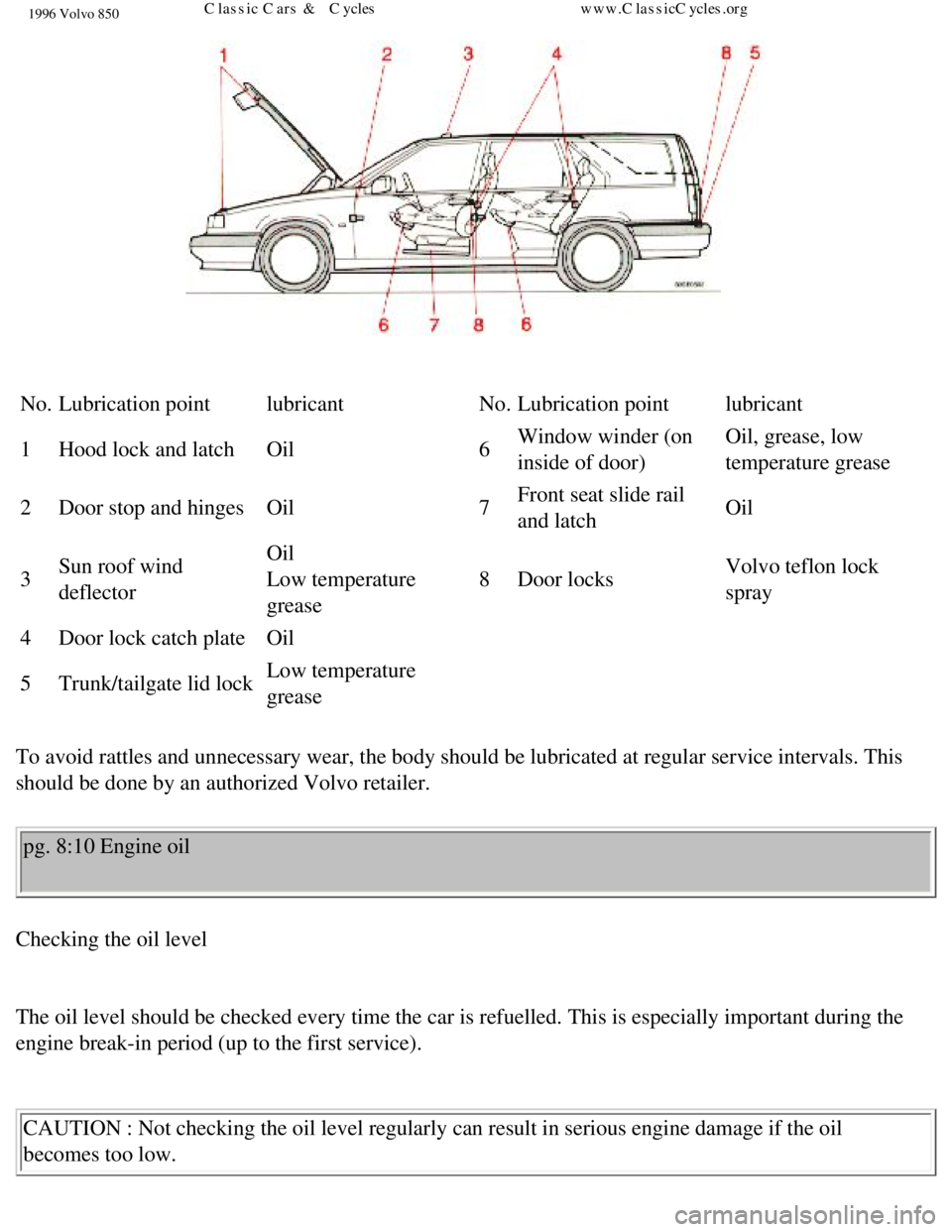
No. Lubrication point lubricant No. Lubrication point lubricant
1 Hood lock and latch Oil 6 Window winder (on
inside of door) Oil, grease, low
temperature grease
2 Door stop and hinges Oil 7 Front seat slide rail
and latch Oil
3 Sun roof wind
deflector Oil
Low temperature
grease
8
Door locks Volvo teflon lock
spray
4 Door lock catch plate Oil
5 Trunk/tailgate lid lock Low temperature
grease
To avoid rattles and unnecessary wear, the body should be lubricated at \
regular service intervals. This
should be done by an authorized Volvo retailer.
pg. 8:10 Engine oil
Checking the oil level
The oil level should be checked every time the car is refuelled. This is\
especially important during the
engine break-in period (up to the first service).
CAUTION : Not checking the oil level regularly can result in serious eng\
ine damage if the oil
becomes too low.
file:///K|/ownersdocs/1996/1996_850/96850_806.htm (6 of 11)12/30/2006 \
9:59:52 AMClassic Cars & Cycles www.ClassicCycles.org
Page 239 of 265
1996 Volvo 850
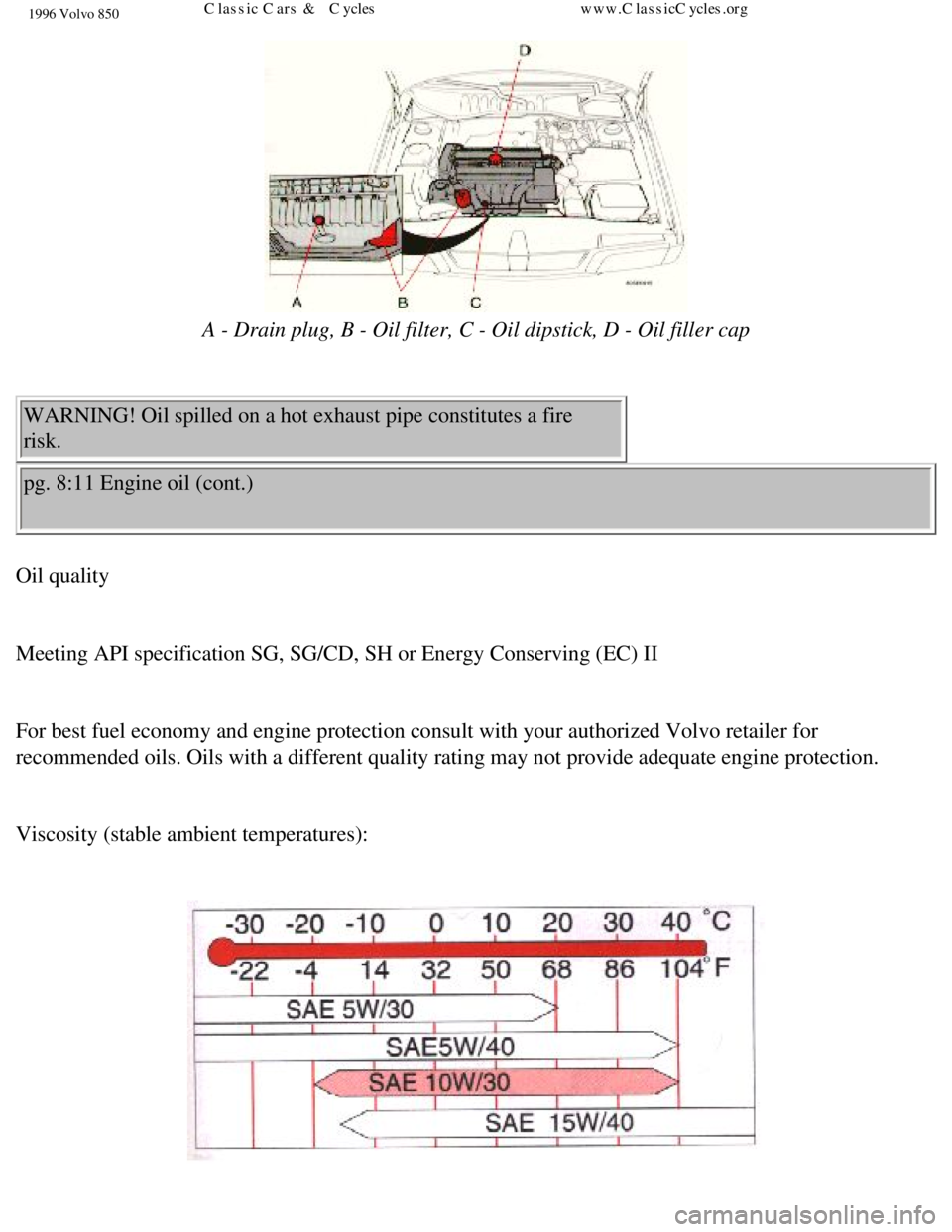
A - Drain plug, B - Oil filter, C - Oil dipstick, D - Oil filler cap
WARNING! Oil spilled on a hot exhaust pipe constitutes a fire
risk.
pg. 8:11 Engine oil (cont.)
Oil quality
Meeting API specification SG, SG/CD, SH or Energy Conserving (EC) II
For best fuel economy and engine protection consult with your authorized\
Volvo retailer for
recommended oils. Oils with a different quality rating may not provide a\
dequate engine protection.
Viscosity (stable ambient temperatures):
file:///K|/ownersdocs/1996/1996_850/96850_806.htm (8 of 11)12/30/2006 \
9:59:52 AMClassic Cars & Cycles www.ClassicCycles.org
Page 250 of 265

1996 Volvo 850
Specifications
pg. 9:1 Specifications
Specifications
This chapter contains facts and figures pertaining to the technical spec\
ifications of your car.
9:2 Oil/Fluids specifications
9:3Engine specifications
9:4Cooling/fuel distributor ignition systems
9:4Front/rear suspensions
9:5Transmission, Capacities, Vehicle
loading
9:6
Electrical system/bulbs
9:7Dimensions and weights
9:8Service manuals, Road assistance
pg. 9:2 Oil/Fluids Specifications
Oil quality
Meeting API specification SG, SG/CD, SH or Energy Conserving (EC) II \
For best fuel economy and engine protection, consult with your authorize\
d Volvo retailer for
recommended oils. Oil with a different quality rating may not provide ad\
equate engine protection.
Synthetic oils complying with oil quality requirements are recommended. \
Volvo recommends the use of
fuel economy improving oils. Look for the API label.
Synthetic oils complying with oil quality requirements are recommended f\
or: Driving in areas of
sustained temperature extremes (hot or cold), when towing a trailer ov\
er long distances or for prolonged
driving in mountainous areas.
Extra oil additives must not be used unless advised by an authorized Vol\
vo retailer.
Viscosity (stable ambient temperatures):
file:///K|/ownersdocs/1996/1996_850/96850_901.htm (1 of 7)12/30/2006 9\
:59:55 AMClassic Cars & Cycles www.ClassicCycles.org