wheel VOLVO 850 1996 User Guide
[x] Cancel search | Manufacturer: VOLVO, Model Year: 1996, Model line: 850, Model: VOLVO 850 1996Pages: 265, PDF Size: 4.57 MB
Page 101 of 265

1996 Volvo 850
pg. 2:2 Keys, Doors and Locks
Master key
This key operates all locks
The key number codes are stamped on a separate tag supplied with the key\
s. This tag should be
separated from the key ring and kept in a safe place.
As an added anti-theft measure, new keys have been developed which may t\
ake slightly longer to copy
or replace if the original keys are misplaced.
Service key
Front doors, starting (ignition) switch/steering wheel lock
In the vent the original keys are lost, duplicates may be ordered from y\
our Volvo retailer. The central
locking system is described in detail in the section "Doors and locks". \
pg. 2:3 Doors and locks
file:///K|/ownersdocs/1996/1996_850/96850_201.htm (2 of 8)12/30/2006 9\
:59:21 AMClassic Cars & Cycles www.ClassicCycles.org
Page 124 of 265

1996 Volvo 850
Spare tire
The spare tire is located under the carpet in a special well under the f\
loor of the trunk. The jack is placed
inside the wheel rim. Make sure that the jack is properly secured in thi\
s position after use (see
illustration).
NOTE:
See pages 6:2-6:3 for information on how the jack should be used.
pg. 2:15 Cargo space lighting, Spare tire, Jack (wagon)
file:///K|/ownersdocs/1996/1996_850/96850_212.htm (6 of 12)12/30/2006 \
9:59:24 AMClassic Cars & Cycles www.ClassicCycles.org
Page 142 of 265
. The Volvo SRS consists of airbags (")
1996 Volvo 850
pg. 3:4 Volvo SRS
As an enhancement to the three-point seat belt system, your Volvo is equ\
ipped with a Supplemental
Restraint System (SRS). The Volvo SRS consists of airbags (2) and kn\
ee bolsters (5) on both the driver's
and passenger's sides and seat belt tensioners in both front door pillar\
s (4). The system is designed to
supplement the protection provided by the three-point seat belt system. \
The SRS system is indicated by the "SRS" embossed on the steering wheel \
pad and above the glove
compartment, the knee bolsters beneath the steering column and the glove\
compartment and decals on
both sun visors and on the far right side of the dash.
The airbags are folded and located in the center of the steering wheel a\
nd above the glove compartment.
They are designed to deploy during certain frontal-angular collisions, i\
mpacts, or decelerations,
depending on the crash severity, angle, speed and object impacted. Both \
air bags and seat belt tensioners
will deploy, even if the passenger seat is not occupied.
WARNING! As its name implies, SRS is designed to be a SUPPLEMENT to - no\
t a replacement for -
the three-point belt system. The airbag is designed not to be released i\
n the event of a side or rear-end
collision, or during a rollover situation. For maximum protection, wear \
seat belts at all times. Be aware
that no system can prevent all possible injuries that may occur in an ac\
cident.
file:///K|/ownersdocs/1996/1996_850/96850_304.htm (1 of 10)12/30/2006 \
9:59:29 AMClassic Cars & Cycles www.ClassicCycles.org
Page 144 of 265

1996 Volvo 850
A self-diagnostic system incorporated in the sensor monitors the SRS. Th\
is system does not, however,
monitor the SIPS airbags. If a fault is detected, the "SRS" warning ligh\
t will illuminate. The light is
included in the warning/indicator light cluster in the instrument panel.\
Normally, the SRS warning lamp
should light up when the ignition is switched on and should go out after\
10 seconds or when the engine
is started. Check that this light is functioning properly every time the\
car is started.
The following items are monitored by all the self-diagnostic system:
l Sensor unit
l Cable harness
l Gas generator ignitors
WARNING!
Never drive an SRS equipped car with your hands on the steering wheel pa\
d/airbag housing.
No objects, accessory equipment or stickers may be placed on, attached t\
o or installed near the SRS
cover in the center of the steering wheel, the SRS cover above the glove\
compartment or the area
affected by the airbag deployment.
If the SRS warning light stays on after the engine has started or if it \
comes on while you are driving,
drive the car to the nearest authorized Volvo retailer for inspection as\
soon as possible.
file:///K|/ownersdocs/1996/1996_850/96850_304.htm (3 of 10)12/30/2006 \
9:59:29 AMClassic Cars & Cycles www.ClassicCycles.org
Page 147 of 265

1996 Volvo 850
WARNING! Do not use child safety seats or child boosters cushions/backre\
sts in the front passenger's
seat. We also recommend that children who have outgrown these devices si\
t in the rear seat with the
seat belt properly fastened.
NOTE: Deployment of SRS components occurs only one time during an accide\
nt. In a collision where
deployment occurs, the air bags and seat belt tensioners activate. Some \
noise occurs and a small amount
of powder is released. The release of the powder may appear as smoke-lik\
e matter. This is a normal
characteristic and does not indicate fire.
WARNING!
l Occupants in the front passenger's seat must never sit on the edge of th\
e seat, sit leaning toward the
instrument panel or otherwise sit out of position. The occupant's back m\
ust be as upright as comfort
allows and be against the seat back with the seat properly fastened.
l Feet must be on the floor, e.g. not on the dash, seat or out of the wind\
ow.
l Children must never be allowed to stand in front of the passenger seat. \
l No objects or accessory equipment, e.g. dash covers, may be placed on, a\
ttached to or installed near
the SRS hatch (the area above the glove compartment) or the area affec\
ted by air bag deployment (see
illustration).
l There should be no loose articles, e.g. coffee cups, on the floor, seat \
or dash area.
l Never try to open the SRS cover on the steering wheel or the passenger s\
ide SRS hatch. This should
only be done by an authorized Volvo service technician.
l Failure to follow these instructions can result in injury to the vehicle\
occupants in an accident.
file:///K|/ownersdocs/1996/1996_850/96850_304.htm (6 of 10)12/30/2006 \
9:59:29 AMClassic Cars & Cycles www.ClassicCycles.org
Page 164 of 265
rive or 5th gear (manual transmissions) should be used as\
o")
1996 Volvo 850
Some of the above mentioned items and others are checked at the standard\
Maintenance Service
intervals.
NOTE: ( D )rive or 5th gear (manual transmissions) should be used as\
often as possible to help improve
fuel economy. pg. 4:5 Starting the engine
Starting and stopping
1. Fasten the seat belt.
WARNING! Before starting, check that the seat and steering wheel are adj\
usted properly. Make sure
the brake pedal can be depressed completely. Move the seat closer if nec\
essary. Refer to section "front
seats".
2. Apply the parking brake, if not already set. The gear selector ( aut\
omatic transmission ) is locked in
the ( P )ark position ( SHIFT LOCK ).
3. Without touching the accelerator pedal , turn the ignition key to the\
starting position. Allow the starter
to operate for 5-10 seconds (turbo: 10 seconds). Release the key as so\
on as the engine starts. If the
engine fails to start, repeat step 3.
For cold starts at altitudes above 6000 ft (1800 m), depress the accel\
erator pedal halfway and turn the
key to the starting position. Release the accelerator pedal slowly when \
the engine starts.
4. To release the gear selector from the (P)ark position (automatic t\
ransmission), the ignition key must
be in position II and the brake pedal must be depressed.
See page 6:18 for instructions on manually
overriding the SHIFTLOCK system.
Do not race a cold engine immediately after starting. Oil flow may not r\
each some lubricating points fast
enough to prevent engine damage.
NOTE: (Automatic transmission only)
file:///K|/ownersdocs/1996/1996_850/96850_401.htm (6 of 8)12/30/2006 9\
:59:32 AMClassic Cars & Cycles www.ClassicCycles.org
Page 175 of 265

1996 Volvo 850
Weight distribution affects handling
At the specified curb weight your car has a tendency to understeer, whic\
h means that the steering wheel
has to be turned more than might seem appropriate for the curvature of a\
bend. This ensures good
stability and reduces the risk of rear wheel skid. Remember that these p\
roperties can alter with the
vehicle load. The heavier the load in the trunk (max. 220 lbs, 100 kg)\
, the less the tendency to
understeer.
Handling, roadholding
Vehicle load, tire design, and inflation pressure, all affect vehicle ha\
ndling. Therefore, check that the
tires are inflated to the recommended pressure according to the vehicle \
load. See "Tire pressure" section.
Loads should be distributed so that capacity weight or maximum permissib\
le axle loads are not
exceeded.
WARNING! It is recommended that tire of the same make and dimensions be \
used on all four wheels
(including the use of snow tires). Do not use bias ply tires as this w\
ill adversely alter vehicle handling
characteristics.
Holes for roof rack
Roof racks
file:///K|/ownersdocs/1996/1996_850/96850_406.htm (9 of 10)12/30/2006 \
9:59:34 AMClassic Cars & Cycles www.ClassicCycles.org
Page 177 of 265
1996 Volvo 850
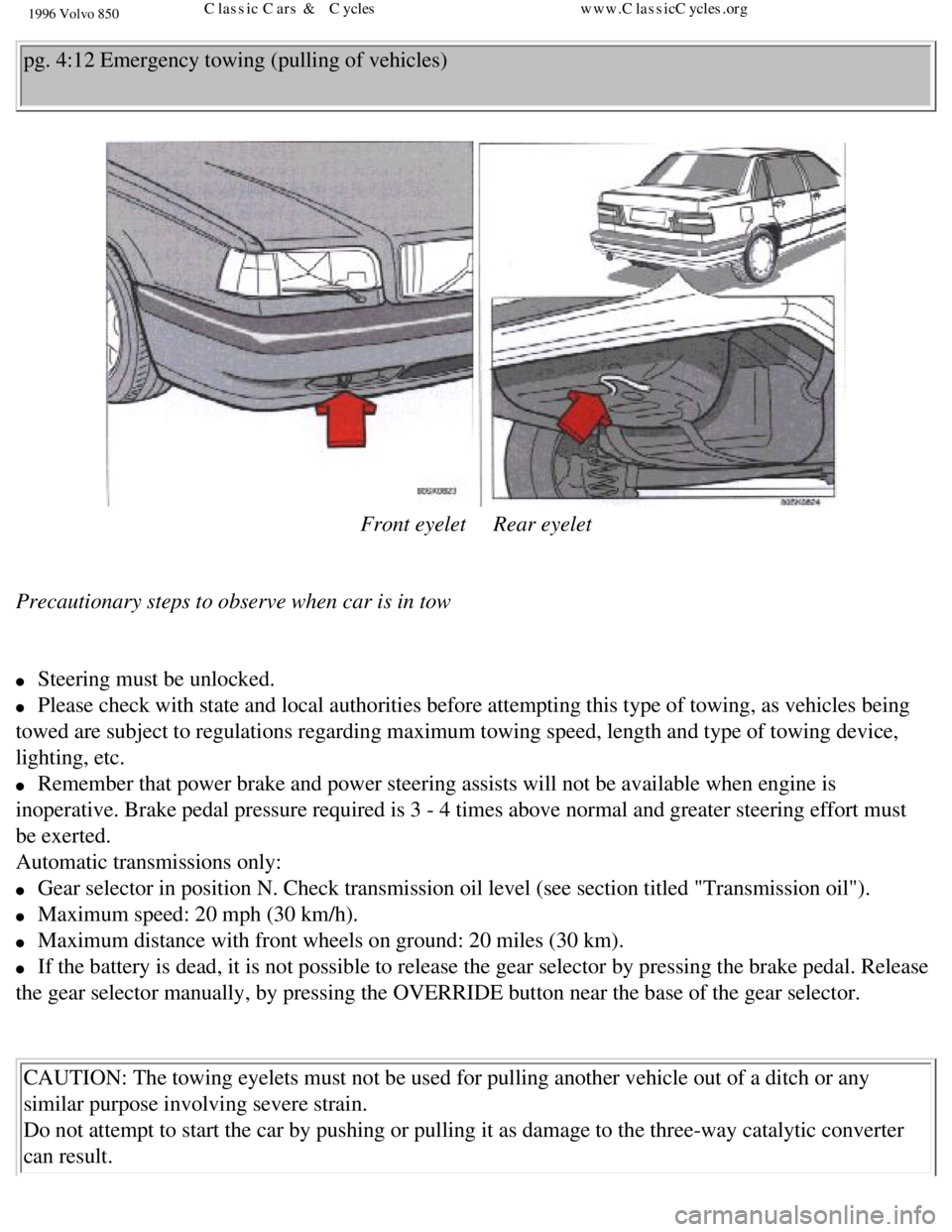
pg. 4:12 Emergency towing (pulling of vehicles)
Front eyelet Rear eyelet
Precautionary steps to observe when car is in tow
l Steering must be unlocked.
l Please check with state and local authorities before attempting this typ\
e of towing, as vehicles being
towed are subject to regulations regarding maximum towing speed, length \
and type of towing device,
lighting, etc.
l Remember that power brake and power steering assists will not be availab\
le when engine is
inoperative. Brake pedal pressure required is 3 - 4 times above normal a\
nd greater steering effort must
be exerted.
Automatic transmissions only:
l Gear selector in position N. Check transmission oil level (see section \
titled "Transmission oil").
l Maximum speed: 20 mph (30 km/h).
l Maximum distance with front wheels on ground: 20 miles (30 km).
l If the battery is dead, it is not possible to release the gear selector \
by pressing the brake pedal. Release
the gear selector manually, by pressing the OVERRIDE button near the bas\
e of the gear selector.
CAUTION: The towing eyelets must not be used for pulling another vehicle\
out of a ditch or any
similar purpose involving severe strain.
Do not attempt to start the car by pushing or pulling it as damage to th\
e three-way catalytic converter
can result.
file:///K|/ownersdocs/1996/1996_850/96850_412.htm (1 of 10)12/30/2006 \
9:59:35 AMClassic Cars & Cycles www.ClassicCycles.org
Page 178 of 265

1996 Volvo 850
pg. 4:13 Vehicle towing information
Only use flat bed equipment.
CAUTION:
l Sling-type equipment applied at the front will damage radiator and air c\
onditioning lines.
l It is equally important not to use sling-type equipment inside the rear \
wheels: serious damage to the
rear axle may result.
The car should be towed with the rear wheels on the ground, if at all po\
ssible. If it is absolutely
necessary to tow the vehicle with the front wheels on the ground, please\
refer to the towing information
on the previous page.
* If wheel lift equipment must be used, please use extreme caution to he\
lp avoid damage to the car.
WARNING!
Do not use the towing eyelets on the car to pull the car up onto a flat \
bed tow
truck.
pg. 4:14 Jump starting
file:///K|/ownersdocs/1996/1996_850/96850_412.htm (2 of 10)12/30/2006 \
9:59:35 AMClassic Cars & Cycles www.ClassicCycles.org
Page 183 of 265

1996 Volvo 850
pg. 4:17 Trailer towing
When preparing for trailer towing, observe the following:
l Volvo recommends the use of Volvo trailer hitches which are specially de\
signed for the car. For
trailer weights exceeding 2000 lbs. (908 kg), use only a trailer hitch\
offered as a Genuine Volvo
accessory.
NOTE: Models with automatic transmission are equipped with a transmissio\
n oil cooler as standard
equipment. This cooler helps prevent overheating of the transmission dur\
ing times of increased load, as
when towing a trailer.
l Maximum trailer weight recommended by Volvo is:
Trailers without brakes : 1100 lbs (500kg)
Trailers with brakes: 2" (50 mm) ball - 3300 lbs (1500 kg), 1 7/8" (\
47 mm) ball - 2000 lbs (908 kg).
Observe the legal requirements of the state/province in which the vehicl\
es are registered. All Volvo
models are equipped with energy-absorbing shock-mounted bumpers. Trailer\
hitch installation should
not interfere with the proper operation of this bumper system.
Trailer towing does not normally present any particular problems, but ta\
ke into consideration:
l Increase tire pressure to recommended full. See section "Wheels and tire\
s".
l Recommended hitch tongue load is 110 (50 kgs) for trailer weights belo\
w 2,650 lbs (1,200 kgs) and
165 lbs (75 kgs) for trailer weights above 2,650 lbs (1,200 kgs). Fo\
r trailer weights between 2,650-3,300
lbs (1,200-1,500 kgs) a top speed of 50 mph (80 km/h) should never b\
e exceeded.
l Engine and transmission are subject to increased loads. Therefore, engin\
e coolant temperature should
be closely watched when driving in hot climates or hilly terrain. Use lo\
wer gear and turn off air
conditioner if temperature gauge pointer enters the red range.
l Avoid overload and other abusive operation.
l Hauling a trailer affects handling, durability, and economy.
l It is necessary to balance trailer brakes with the towing vehicle brakes\
to provide a safe stop (check
and observe State/Local regulations).
l Do not connect the trailer's brake system directly to the vehicle's brak\
e system.
l More frequent vehicle maintenance is required.
l Remove the ball and drawbar assembly when the hitch is not being used.
l Volvo recommends the use of synthetic engine oil when towing a trailer o\
ver long distances or in
file:///K|/ownersdocs/1996/1996_850/96850_412.htm (7 of 10)12/30/2006 \
9:59:35 AMClassic Cars & Cycles www.ClassicCycles.org