engine VOLVO 850 1996 Owner's Manual
[x] Cancel search | Manufacturer: VOLVO, Model Year: 1996, Model line: 850, Model: VOLVO 850 1996Pages: 265, PDF Size: 4.57 MB
Page 170 of 265

Automatically shifts up and down between 1st, 2nd, and 3rd gears when in\
driving modes E or")
1996 Volvo 850
governed by accelerator pedal position and vehicle speed.
3 (Intermediate position)
Automatically shifts up and down between 1st, 2nd, and 3rd gears when in\
driving modes E or S. There
is no upshift from 3rd gear. Position 3 can be used for driving in hilly\
terrain, for towing trailers or for
increased engine braking power.
L (low position)
No upshift can occur when L is engaged. Select position L for driving in\
first and second gears. Use this
position to select low gear with no upshift, e.g. when ascending and des\
cending steep grades. The
transmission will noticeably shift down from second to first if road spe\
ed drops to below 40 km/h (25
mph) when driving in E mode and below 10 km/h (6 mph in S mode.
Kick-down
Automatic shift to a lower gear (kick-down) is achieved by depressing \
the accelerator pedal fully and
briskly. An upshift will be achieved when approaching the top speed for \
a particular gear or by releasing
the accelerator pedal slightly. Kick-down can be used for maximum accele\
ration or when passing at
highway speeds.
"Lock-up"
The transmission has a "lock-up" function which reduces engine speed and\
saves fuel. "Lock-up" can
sometimes be felt as an additional gear change. pg. 4:8 Automatic transmission
file:///K|/ownersdocs/1996/1996_850/96850_406.htm (4 of 10)12/30/2006 \
9:59:34 AMClassic Cars & Cycles www.ClassicCycles.org
Page 172 of 265

1996 Volvo 850
The push-buttons to the left of the gear lever are for selection of mode\
s E, S and W. The desired mode
can be selected at any time, including while the car is moving.
Winter/Wet mode
Enhanced Vehicle Traction
This mode may be selected for starting/moving off on slippery roads.
In this mode:
* In position D, the gearbox starts in 3rd gear and changes up to 4th ge\
ar.
* In position 3, 2nd gear is locked and there is no change up to 3rd gea\
r.
In position L, 1st gear is locked.
* These positions always offer the kick-down function.
The indicator lamp in the instrument panel
lights up when this mode is selected (the lamp will also
light up if the gear selector is in position 3 or L.). Press button WIN\
TER in order to disengage this
mode.
When mode is disengaged, the gearbox automatically reverts to the previo\
usly selected S or E mode. If
the indicator lamp
begins to flash, this is an indication of a fault in the automatic gear\
box. The
Malfunction Indicator lamp will also light up if a fault is detected. Pl\
ease contact your Volvo retailer if
this occurs.
CAUTION: Driveability and fuel economy will be adversely affected by pro\
longed driving in mode
W . Volvo recommends using this mode only when starting in extremely sli\
ppery conditions.
Economy Mode
This mode is used for normal driving. The gearbox changes gears at a low\
er engine speed to achieve the
lowest possible fuel consumption.
Sport Mode
This mode is adapted to "sporty" driving characteristics. The transmissi\
on upshifts at higher engine
speeds and less accelerator pedal pressure is required to initiate a dow\
nshift.
file:///K|/ownersdocs/1996/1996_850/96850_406.htm (6 of 10)12/30/2006 \
9:59:34 AMClassic Cars & Cycles www.ClassicCycles.org
Page 173 of 265

1996 Volvo 850
pg. 4:9 Automatic transmission
Special Tips - automatic transmission
l For driving down steep hills and when driving for prolonged periods at l\
ow speeds, position L should
be selected. Avoid, however, repeated changes since this can cause overh\
eating of the transmission oil.
For driving on long continuous uphill gradients, select position 3.
l See caution on page 4:7.
l Do not hold the car stationary on an incline by using the accelerator pe\
dal. Instead, apply the hand
brake (parking brake). This prevents the transmission oil from becomin\
g overheated.
l When towing a trailer, select shift position 3.
l The (E)conomy mode should be selected when the cruise control is engag\
ed.
l While towing a trailer in hilly terrain, do not drive continuously at en\
gine speeds above 4500 rpm to
help avoid high engine oil temperatures.
pg. 4:10 Points to remember
Cooling system
The risk for engine overheating is greatest, especially in hot weather, \
when:
l towing a trailer up steep inclines for prolonged periods at wide open th\
rottle and low engine rpm.
l stopping the engine suddenly after high speed driving (so-called "after\
-boiling" can occur).
l To avoid overheating, the following rules should be followed:
l Do not drive for prolonged periods at engine speeds above 4500 rpm if yo\
u are towing a trailer in
hilly terrain.
l Reduce speed and downshift when towing a trailer up long, steep inclines\
. The risk of overheating can
be reduced by switching off the air conditioning system for a short time\
.
l Do not let the engine idle unnecessarily for prolonged periods.
l Do not mount auxiliary lamps in front of the grill.
When the risk of overheating is imminent, or in the event of overheating\
, (the temperature gauge goes
repeatedly into, or stays continually in, the red section) the followin\
g precautions should be taken:
l Switch off the air conditioning system.
l Stop the car and put the gear lever into neutral. Do not stop the engine\
!
l Switch the heater to full (maximum) position. Increase the engine spee\
d to approx. 2000 rpm (twice
idling speed) until the temperature begins to drop.
file:///K|/ownersdocs/1996/1996_850/96850_406.htm (7 of 10)12/30/2006 \
9:59:34 AMClassic Cars & Cycles www.ClassicCycles.org
Page 174 of 265
1996 Volvo 850
WARNING! Do not remove the coolant expansion tank
cap.
See "Coolant" to check and top-up the coolant level if necessary.
CAUTION: Drive slowly and carefully if going through standing water (i.\
e. flooded roadways, etc.).
Damage to engine could result if excess water is ingested through the ai\
r intake system.
Never drive the vehicle in water deeper than 1 foot (300 mm).
See the flood warning on page 3:7.
WARNING! Do not drive with trunk lid or tailgate open!
Poisonous exhaust gases may enter via the trunk lid or tailgate.
If the trunk lid/tailgate must be kept open for any reason, proceed as f\
ollows:
l Close the windows.
l Set the ventilation system control to air to floor, windshield and side \
windows and blower control to
its highest setting.
Electrical system
When replacing the battery or when carrying out work involving the elect\
rical system, the following
should be observed:
l A battery connection to the wrong terminal will damage the diodes. Befor\
e connections are made,
check the polarity of the battery with a voltmeter.
l If booster batteries are used for starting, they must be properly connec\
ted to minimize the risk of the
diode being damaged. For correct connection, see "Jump starting" section\
.
l Never disconnect the battery circuit (for example, to replace the batte\
ry) while the engine is running,
as this will immediately ruin the generator. Always make sure that all t\
he battery connections are
properly tightened.
l If any electrical-welding work is performed on the vehicle, the ground l\
ead and all the connecting
cables of the generator must be disconnected and the welder cables place\
d as near the welding point as
possible.
l The radio must be turned off before the battery is disconnected.
l The anti-theft code must be re-entered before the radio will function pr\
operly.
l The electrical system in your car is designed to accommodate Volvo acces\
sories. It also has an
accessory connector beneath the dashboard on the driver's side.
pg. 4:11 Points to remember
file:///K|/ownersdocs/1996/1996_850/96850_406.htm (8 of 10)12/30/2006 \
9:59:34 AMClassic Cars & Cycles www.ClassicCycles.org
Page 177 of 265
1996 Volvo 850
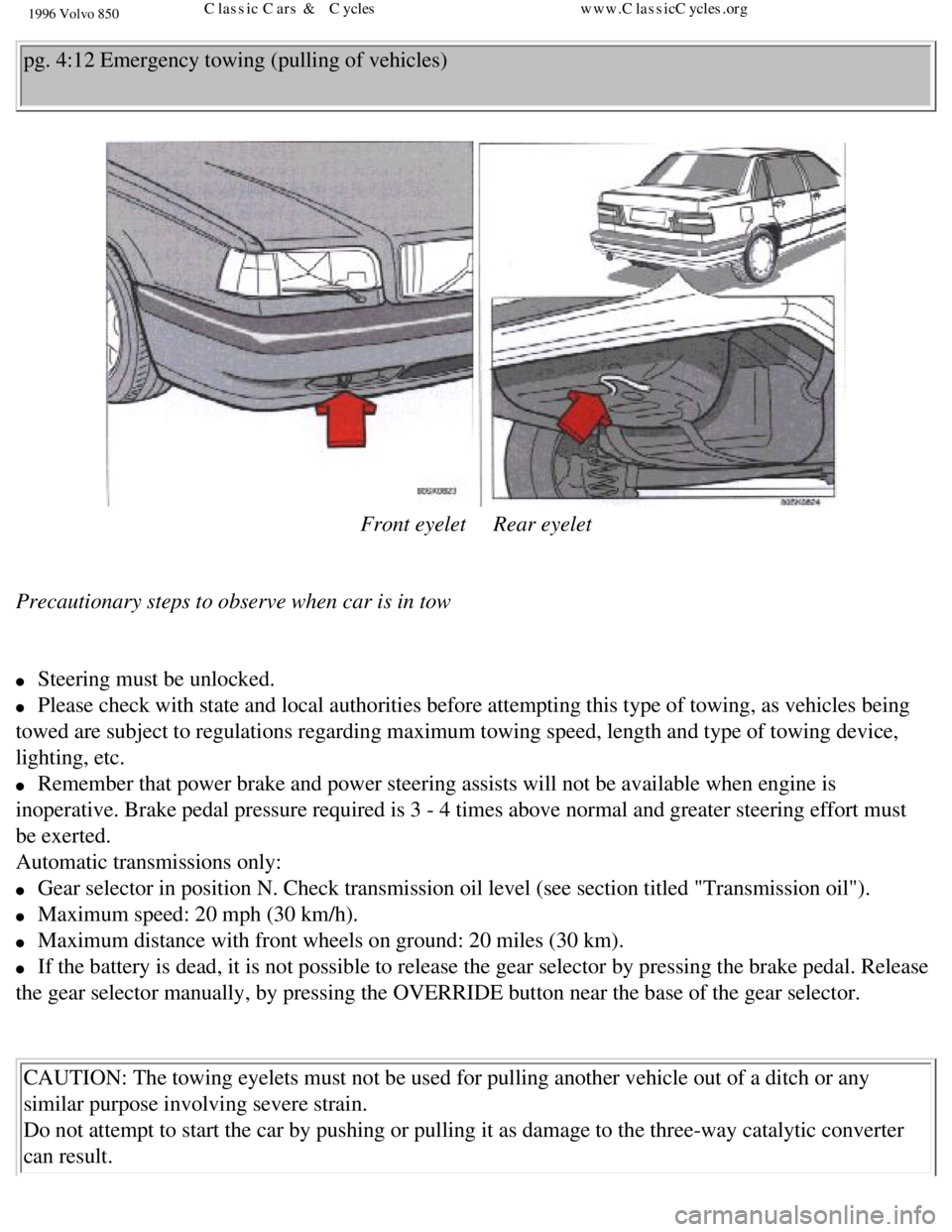
pg. 4:12 Emergency towing (pulling of vehicles)
Front eyelet Rear eyelet
Precautionary steps to observe when car is in tow
l Steering must be unlocked.
l Please check with state and local authorities before attempting this typ\
e of towing, as vehicles being
towed are subject to regulations regarding maximum towing speed, length \
and type of towing device,
lighting, etc.
l Remember that power brake and power steering assists will not be availab\
le when engine is
inoperative. Brake pedal pressure required is 3 - 4 times above normal a\
nd greater steering effort must
be exerted.
Automatic transmissions only:
l Gear selector in position N. Check transmission oil level (see section \
titled "Transmission oil").
l Maximum speed: 20 mph (30 km/h).
l Maximum distance with front wheels on ground: 20 miles (30 km).
l If the battery is dead, it is not possible to release the gear selector \
by pressing the brake pedal. Release
the gear selector manually, by pressing the OVERRIDE button near the bas\
e of the gear selector.
CAUTION: The towing eyelets must not be used for pulling another vehicle\
out of a ditch or any
similar purpose involving severe strain.
Do not attempt to start the car by pushing or pulling it as damage to th\
e three-way catalytic converter
can result.
file:///K|/ownersdocs/1996/1996_850/96850_412.htm (1 of 10)12/30/2006 \
9:59:35 AMClassic Cars & Cycles www.ClassicCycles.org
Page 179 of 265

1996 Volvo 850
Jump starting
If the booster battery to be used is in another car, check that the cars\
are not touching to prevent
premature completion of negative circuit. Note the position of the batte\
ry terminals and using jumper
cables:
l First connect the booster battery positive (+) terminal (1) to car b\
attery positive (+) terminal (2).
l Then connect the booster battery negative (-) terminal (3) to a stat\
ionary solid metal part on the
engine at a point away from the battery (4).
Do not connect booster cable to any part of fuel system or any moving pa\
rts. Avoid touching hot
manifolds.
After the engine has started, first remove the negative (-) terminal j\
umper cable. Then remove the
positive (+) terminal jumper cable.
CAUTION: Improper hook-up of jumper cables or use of other than 12-volt \
batteries could result in
damage to equipment and/or battery.
file:///K|/ownersdocs/1996/1996_850/96850_412.htm (3 of 10)12/30/2006 \
9:59:35 AMClassic Cars & Cycles www.ClassicCycles.org
Page 180 of 265

1996 Volvo 850
WARNING!
l To reduce the possibility of explosion, never expose battery to open fla\
me or electric spark.
l Do not smoke near battery.
l Batteries generate hydrogen gas which is flammable and explosive.
l Battery fluid contains sulfuric acid. Do not allow battery fluid to cont\
act eyes, skin, fabrics or
painted surfaces. If contact occurs, flush affected area immediately wit\
h water. Obtain medical
attention immediately if eyes are affected.
Failure to follow the instructions for jump starting can lead to persona\
l injury.
pg. 4:15 Three-way catalytic converter
Three-way catalytic converter cautions
l Keep your engine properly tuned. Certain engine malfunctions, particular\
ly involving the electrical,
fuel or distributor ignition systems, may cause unusually high three-way\
catalytic converter
temperatures. Do not continue to operate your vehicle if you detect engi\
ne misfire, noticeable loss of
power or other unusual operating conditions, such as engine overheating \
or backfiring. A properly tuned
engine will help avoid malfunction that could damage the three-way catal\
ytic converter.
l Do not park your car over combustible materials, such as grass or leaves\
, which can come into contact
with the hot exhaust system and cause such materials to ignite under cer\
tain wind and weather
conditions.
l Excessive starter cranking (in excess of one minute), with an intermit\
tently firing or flooded engine,
file:///K|/ownersdocs/1996/1996_850/96850_412.htm (4 of 10)12/30/2006 \
9:59:35 AMClassic Cars & Cycles www.ClassicCycles.org
Page 181 of 265

1996 Volvo 850
can cause three-way catalytic converter or exhaust system overheating.
l Remember that tampering or unauthorized modification to the engine or th\
e vehicle may be illegal
and can cause three-way catalytic converter or exhaust system overheatin\
g. This includes:
- Altering fuel injection settings or components.
- Adjusting distributor ignition timing beyond specified limits.
- Altering emission system components or location or removing components\
- Repeated use of leaded fuel.
NOTE: Unleaded fuel is required for cars with three-way catalytic conver\
ters. A label on the instrument
panel and inside fuel tank filler door will remind owners and filling st\
ation attendants of this
requirement.
Important! It is unlawful to dispense leaded fuel into any vehicle label\
ed "unleaded gasoline only".
pg. 4:16 Brake system
Anti-lock Brake System (ABS)
If the warning lamp lights up there is a malfunction of the ABS system (\
the standard braking system will
however function) and the vehicle should be driven to a Volvo retailer \
for inspection. The Anti-lock
Braking System (ABS) helps to improve vehicle control (stopping and s\
teering) during severe braking
conditions by limiting brake lock-up. When the system "senses" impending\
lock-up, braking pressure is
automatically modulated in order to help prevent lockup, which could lea\
d to a skid.
The system performs a self-diagnostic test when the vehicle first reache\
s a speed of approximately 12
mph (20 km/h). The brake pedal will pulsate several times and a sound \
may be audible from the ABS
control module. This is normal.
To obtain optimal effect from the ABS system, constant pressure should b\
e kept on the brake pedal
while the system is modulating the brakes. Do not pump the brake pedal. \
The switching of the ABS modulator will be audible and the brake pedal w\
ill pulsate at this time. Please
be aware that ABS does not increase the absolute braking potential of th\
e vehicle. While control will be
enhanced, ABS will not shorten stopping distances on slippery surfaces. \
file:///K|/ownersdocs/1996/1996_850/96850_412.htm (5 of 10)12/30/2006 \
9:59:35 AMClassic Cars & Cycles www.ClassicCycles.org
Page 182 of 265

1996 Volvo 850
Brake circuit malfunction
If one of the brake circuits should malfunction, the red warning light w\
ill come on, the pedal stroke
increases slightly, the pedal feels softer and extra pressure is require\
d for normal braking. If the light
comes on while driving or braking, stop immediately and check the brake \
fluid level in the reservoir.
WARNING! If the fluid level is below the MIN mark in either section of t\
he reservoir: DO NOT
DRIVE. Tow the car to a Volvo retailer and have the brake system checked\
and repaired.
Moisture on brake discs and brake pads affects braking.
Driving in rain and slush or passing through an automatic car wash can c\
ause water to collect on the
brake discs and pads. This will cause a delay in braking effect when the\
pedal is depressed. To avoid
such a delay when the brakes are needed, depress the pedal occasionally \
when driving through rain,
slush etc. This will remove the water from the brakes. Check that brake \
application feels normal! This
should also be done after washing or starting in very damp weather.
Severe strain on the brake system
The brakes will be subject to severe strain when driving in mountains or\
hilly areas or towing. The speed
is usually low which means that the cooling of the brakes is less effici\
ent than when driving on level
roads. To reduce the strain on the brakes it is advisable not to use the\
brakes excessively. Instead, shift
into a lower gear, position 3 or in some cases, L(automatic transmissio\
n) and let the engine help with the
braking. Do not forget that, if you are towing a trailer, the brakes wil\
l be subjected to greater load than is
normal.
If the brake power-assist does function
The power assist to the brakes functions only when the engine is running\
. When the car is moving
without the engine running, the brake pedal pressure required to stop th\
e car is increased by 3-4 times
and the brake pedal feels stiff.
file:///K|/ownersdocs/1996/1996_850/96850_412.htm (6 of 10)12/30/2006 \
9:59:35 AMClassic Cars & Cycles www.ClassicCycles.org
Page 183 of 265

1996 Volvo 850
pg. 4:17 Trailer towing
When preparing for trailer towing, observe the following:
l Volvo recommends the use of Volvo trailer hitches which are specially de\
signed for the car. For
trailer weights exceeding 2000 lbs. (908 kg), use only a trailer hitch\
offered as a Genuine Volvo
accessory.
NOTE: Models with automatic transmission are equipped with a transmissio\
n oil cooler as standard
equipment. This cooler helps prevent overheating of the transmission dur\
ing times of increased load, as
when towing a trailer.
l Maximum trailer weight recommended by Volvo is:
Trailers without brakes : 1100 lbs (500kg)
Trailers with brakes: 2" (50 mm) ball - 3300 lbs (1500 kg), 1 7/8" (\
47 mm) ball - 2000 lbs (908 kg).
Observe the legal requirements of the state/province in which the vehicl\
es are registered. All Volvo
models are equipped with energy-absorbing shock-mounted bumpers. Trailer\
hitch installation should
not interfere with the proper operation of this bumper system.
Trailer towing does not normally present any particular problems, but ta\
ke into consideration:
l Increase tire pressure to recommended full. See section "Wheels and tire\
s".
l Recommended hitch tongue load is 110 (50 kgs) for trailer weights belo\
w 2,650 lbs (1,200 kgs) and
165 lbs (75 kgs) for trailer weights above 2,650 lbs (1,200 kgs). Fo\
r trailer weights between 2,650-3,300
lbs (1,200-1,500 kgs) a top speed of 50 mph (80 km/h) should never b\
e exceeded.
l Engine and transmission are subject to increased loads. Therefore, engin\
e coolant temperature should
be closely watched when driving in hot climates or hilly terrain. Use lo\
wer gear and turn off air
conditioner if temperature gauge pointer enters the red range.
l Avoid overload and other abusive operation.
l Hauling a trailer affects handling, durability, and economy.
l It is necessary to balance trailer brakes with the towing vehicle brakes\
to provide a safe stop (check
and observe State/Local regulations).
l Do not connect the trailer's brake system directly to the vehicle's brak\
e system.
l More frequent vehicle maintenance is required.
l Remove the ball and drawbar assembly when the hitch is not being used.
l Volvo recommends the use of synthetic engine oil when towing a trailer o\
ver long distances or in
file:///K|/ownersdocs/1996/1996_850/96850_412.htm (7 of 10)12/30/2006 \
9:59:35 AMClassic Cars & Cycles www.ClassicCycles.org