lock VOLVO C70 2002 Owners Manual
[x] Cancel search | Manufacturer: VOLVO, Model Year: 2002, Model line: C70, Model: VOLVO C70 2002Pages: 99, PDF Size: 2.56 MB
Page 3 of 99
CAUTION: Certain models have reduced ground clearance due to the design of the front spoiler. Please observe
caution when e.g., driving onto garage hoists, through drifted snow or when other road debris is encountered, or when
parking near curbs.
© 2001 Volvo Cars of North America Inc.
Shiftlock (automatic transmission only)
When your car is parked, the gear selector is locked in the (P)ark position. To release the selector from this position,
turn the ignition key to position II (or start the engine), depress the brake pedal, press the button on the front side of the
gear selector and move the selector from (P)ark.
If it is necessary to manually override the shiftlock system:
· Turn the starting (ignition) key to position I
· Press firmly on the "SHIFTLOCK OVERRIDE" button located to the right of the base of the gear selector
· While holding the override button down, press the button on the front of the gear selector
· Move the selector from the ( P)ark position.
Keylock (automatic transmission only)
This means that when you switch off the ignition, the gear selector must be in the (P)ark position before the starting
(ignition) key can be removed from the ignition switch.
Clutch interlock (manual transmission only)
The clutch must be fully depressed before you can start you car. If the clutch is not depressed, it will not be possible to
start the engine.
Anti-lock Brake System (ABS)
The ABS system in your car performs a self -diagnostic test when the vehicle first reaches the speed of approximately
12 mph (20 km/h). The brake pedal will pulsate several times and a sound may be audible from the ABS control
module. This is normal.
Fuel tank cover
The fuel tank cover is locked and must be popped open using the control on the driver's door (see illustration on page
16).
Volvo and the environment
Volvo is committed to the well being of our customers. As a natural part of this commitment, we care about the
environment in which we all live. Caring for the environment means an everyday involvement in reducing our
ProCarManuals.com
Page 6 of 99
Always fasten the seat belts before you drive or ride.
Two lights above the rear view mirror will be illuminated for 4-8 seconds after the starting (ignition) key is turned to
the driving position. A chime will sound at the same time if the driver has not fastened his seat belt. The rear seats are
provided with self - retracting inertia reel belts. The front seats are provided with single roller belts with tensioners.
To buckle:
Pull the belt out far enough to insert the latch plate into the receptacle (buckle for rear seats) until a distinct snapping
sound is heard. The seat belt retractor is normally "unlocked" and you can move freely, provided that the shoulder belt
is not pulled out too far. The retractor will lock up as follows:
· if the belt is pulled out rapidly
· during braking and acceleration
· if the vehicle is leaning excessively
· when driving in turns
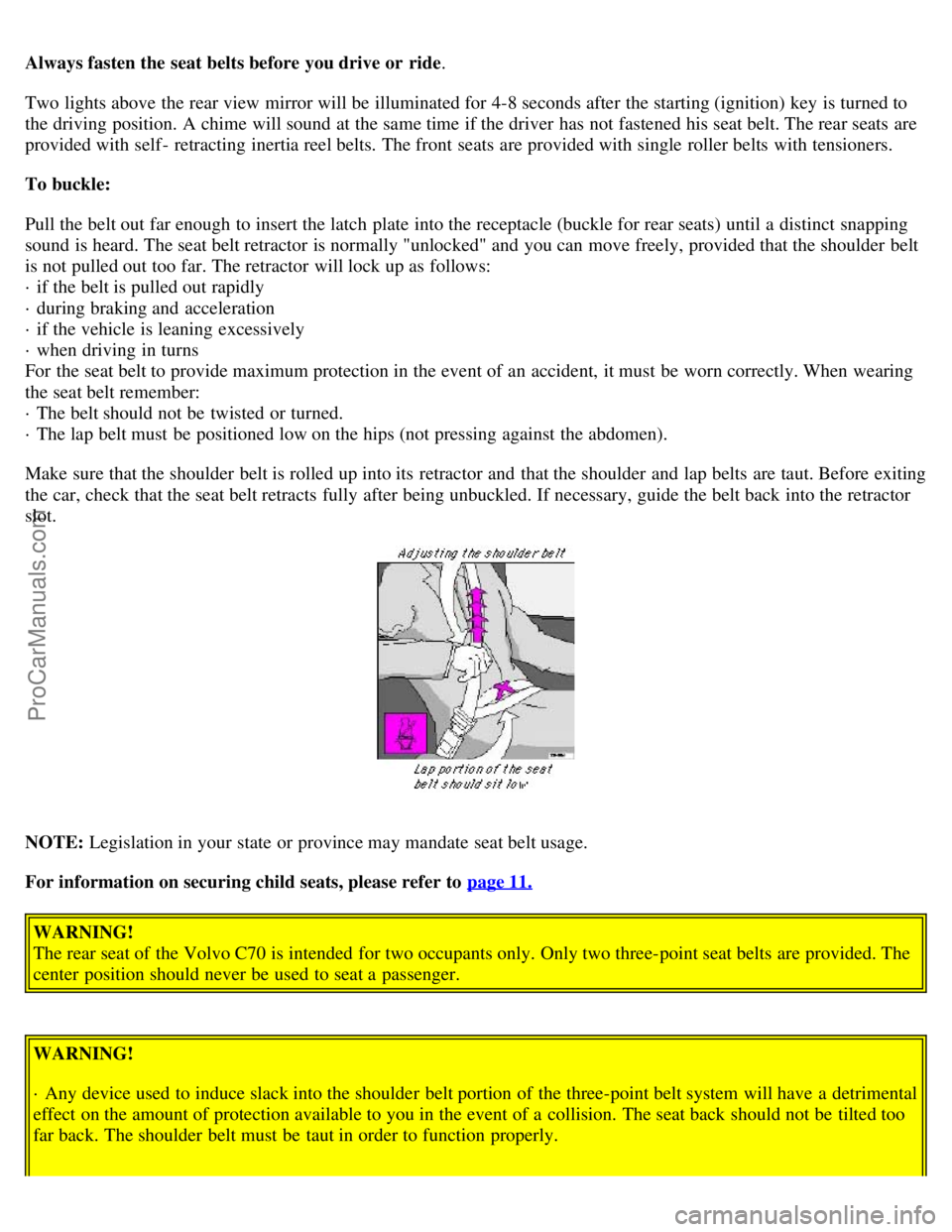
For the seat belt to provide maximum protection in the event of an accident, it must be worn correctly. When wearing
the seat belt remember:
· The belt should not be twisted or turned.
· The lap belt must be positioned low on the hips (not pressing against the abdomen).
Make sure that the shoulder belt is rolled up into its retractor and that the shoulder and lap belts are taut. Before exiting
the car, check that the seat belt retracts fully after being unbuckled. If necessary, guide the belt back into the retractor
slot.
NOTE: Legislation in your state or province may mandate seat belt usage.
For information on securing child seats, please refer to page 11.
WARNING!
The rear seat of the Volvo C70 is intended for two occupants only. Only two three-point seat belts are provided. The
center position should never be used to seat a passenger.
WARNING!
· Any device used to induce slack into the shoulder belt portion of the three-point belt system will have a detrimental
effect on the amount of protection available to you in the event of a collision. The seat back should not be tilted too
far back. The shoulder belt must be taut in order to function properly.
ProCarManuals.com
Page 11 of 99

When are the airbags deployed?
The SRS system is designed to deploy during certain frontal or frontangular collisions, impacts, or decelerations,
depending on the crash severity, angle, speed and object impacted. The SRS sensor is designed to react to both the
impact of the collision and the inertial forces generated by it and to determine if the intensity of the collision is
sufficient for the airbags to be deployed.WARNING!
The SRS is designed to help prevent serious injury. Deployment occurs very quickly and with considerable force.
During normal deployment and depending on variables such as seating position, one may experience abrasions,
bruises, swellings, or other injuries as a result of airbag(s) deployment.
· If the airbags have been deployed, we recommend the following:
· Have the car towed to an authorized Volvo retailer. Never drive with the airbags deployed.
· Have an authorized Volvo retailer replace the SRS system components.
· Use only new, Genuine Volvo Parts when replacing SRS components (airbags, seat belts, tensioners, etc.).
When are the airbags NOT deployed?
Not all frontal collisions activate the SRS system. If the collision involves a nonrigid object (e.g., a snow drift or
bush), or a rigid, fixed object at a low speed, the SRS system will not necessarily deploy. Airbags do not normally
deploy in a side impact collision, in a collision from the rear or in a rollover situation. The amount of damage to the
bodywork does not reliably indicate if the airbags should have deployed or not.
Seat belts the heart of the Volvo safety system
The heart of the Volvo safety system is the threepoint seat belt (a Volvo invention)! In order for the SRS system to
provide the protection intended, seat belts must be worn at all times by everyone in the car.
The SRS system is a supplement to the seat belts.
WARNING!
If your car has been subjected to flood conditions (e.g. soaked carpeting/standing water on the floor of the vehicle)
or if your car has become flooddamaged in any way, do not attempt to start the vehicle or put the key in the ignition
before disconnecting the battery (see below). This may cause airbag deployment which could result in personal
injury. Have the car towed to an authorized Volvo retailer for repairs.
Automatic transmission only:
Before attempting to tow the car, use the following procedure to override the shiftlock system to move the gear
selector to the neutral position.
· Disconnect the battery
· Wait at least one minute
· Insert the key in the ignition and turn it to position 1
· Press firmly on the shiftlock override button (located near the base of the gear selector).
· While holding the override button down, move the gear selector from the park position.
WARNING!
ProCarManuals.com
Page 14 of 99

6Space for additional equipment
7Space for additional equipment
8 Instruments 16-17
9Stability Control System - STC 25
10Trip computer (optional) 28-30
11Electrically operated sun roof (C70 Coupe) 44
11Electrically operated convertible top (C70 Convertible) 44
12Rear window demister/heated door mirrors 25
13Air mix 35
14Air vents 35
15Passenger side air bag (SRS) hatch 4-6
16Air vents 35
17Hood release 58
18Turn signals, high/low beams, exterior courtesy lights 22
18Cruise control 31
19Adjustable steering wheel 34
20Windshield wiper/washer 23
21Heated front seats (optional) 32
22Auxiliary socket 33
23Audio systems 137
24Heating and ventilation controls 35-37
25Hazard warning flashers 25
26Ashtray 33
27Coin holder 42
28Shiftlock release button (automatic transmission only) 105
29Gear selector shift positions 69-71
30Winter mode selector 71
31Parking brake 32
32Horn/SRS 4-6
33Trunk open control 59
34Power window controls 38
35Power mirror controls 54
36Fuel tank open control 40
37Central locking button 38
Some of the items above are available on certain models only.
pg. 18 Instruments
ProCarManuals.com
Page 15 of 99
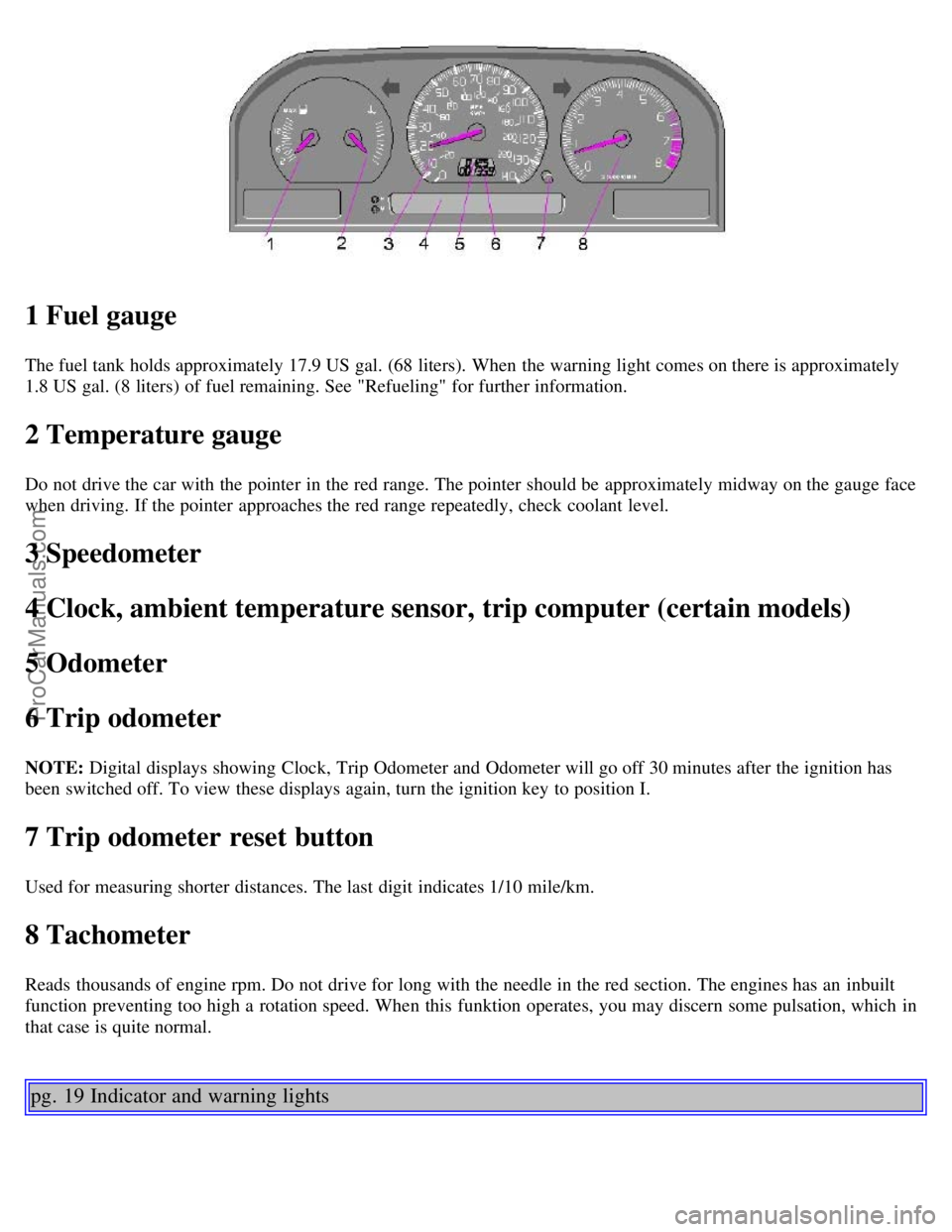
1 Fuel gauge
The fuel tank holds approximately 17.9 US gal. (68 liters). When the warning light comes on there is approximately
1.8 US gal. (8 liters) of fuel remaining. See "Refueling" for further information.
2 Temperature gauge
Do not drive the car with the pointer in the red range. The pointer should be approximately midway on the gauge face
when driving. If the pointer approaches the red range repeatedly, check coolant level.
3 Speedometer
4 Clock, ambient temperature sensor, trip computer (certain models)
5 Odometer
6 Trip odometer
NOTE: Digital displays showing Clock, Trip Odometer and Odometer will go off 30 minutes after the ignition has
been switched off. To view these displays again, turn the ignition key to position I.
7 Trip odometer reset button
Used for measuring shorter distances. The last digit indicates 1/10 mile/km.
8 Tachometer
Reads thousands of engine rpm. Do not drive for long with the needle in the red section. The engines has an inbuilt
function preventing too high a rotation speed. When this funktion operates, you may discern some pulsation, which in
that case is quite normal.
pg. 19 Indicator and warning lights
ProCarManuals.com
Page 18 of 99
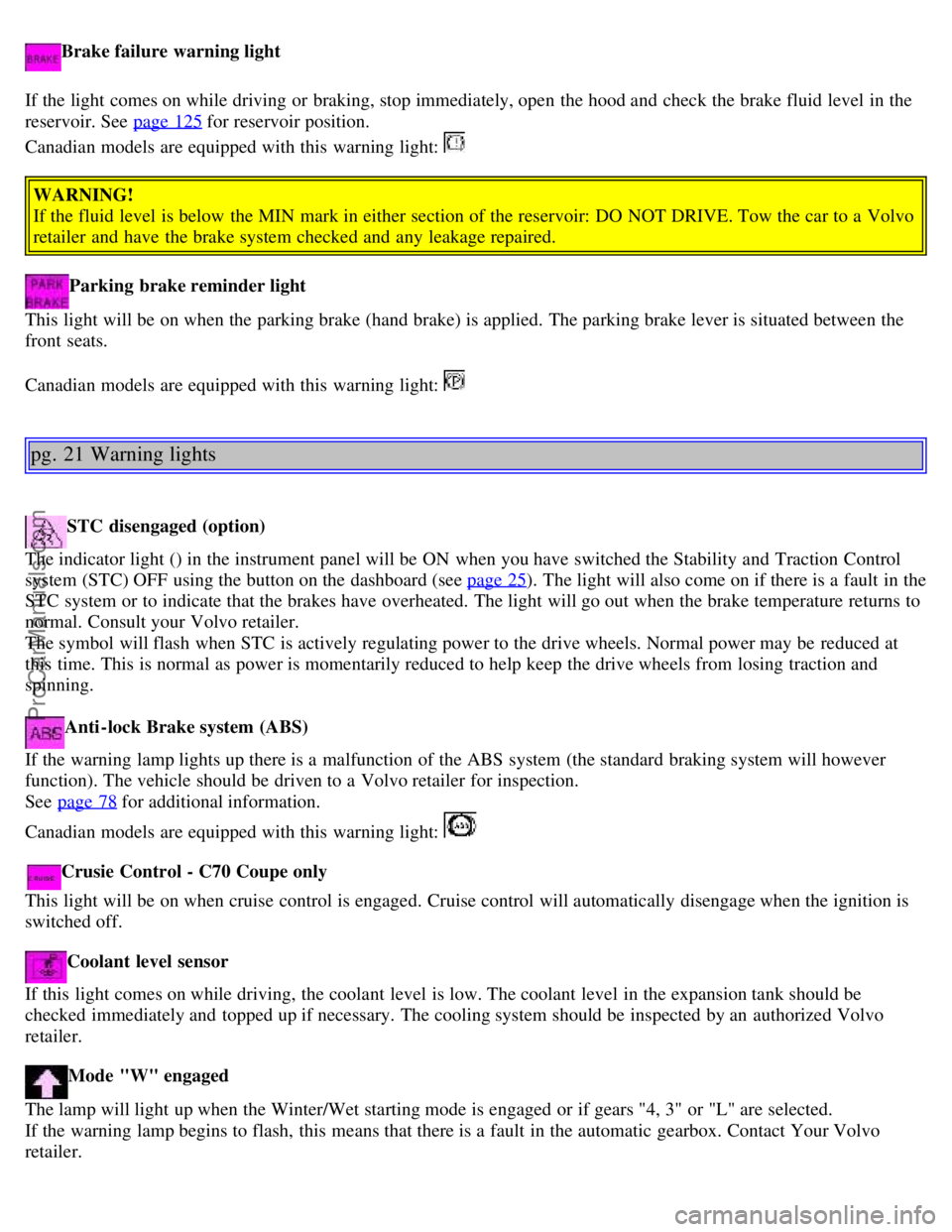
Brake failure warning light
If the light comes on while driving or braking, stop immediately, open the hood and check the brake fluid level in the
reservoir. See page 125
for reservoir position.
Canadian models are equipped with this warning light:
WARNING!
If the fluid level is below the MIN mark in either section of the reservoir: DO NOT DRIVE. Tow the car to a Volvo
retailer and have the brake system checked and any leakage repaired.
Parking brake reminder light
This light will be on when the parking brake (hand brake) is applied. The parking brake lever is situated between the
front seats.
Canadian models are equipped with this warning light:
pg. 21 Warning lights
STC disengaged (option)
The indicator light () in the instrument panel will be ON when you have switched the Stability and Traction Control
system (STC) OFF using the button on the dashboard (see page 25
). The light will also come on if there is a fault in the
STC system or to indicate that the brakes have overheated. The light will go out when the brake temperature returns to
normal. Consult your Volvo retailer.
The symbol will flash when STC is actively regulating power to the drive wheels. Normal power may be reduced at
this time. This is normal as power is momentarily reduced to help keep the drive wheels from losing traction and
spinning.
Anti-lock Brake system (ABS)
If the warning lamp lights up there is a malfunction of the ABS system (the standard braking system will however
function). The vehicle should be driven to a Volvo retailer for inspection.
See page 78
for additional information.
Canadian models are equipped with this warning light:
Crusie Control - C70 Coupe only
This light will be on when cruise control is engaged. Cruise control will automatically disengage when the ignition is
switched off.
Coolant level sensor
If this light comes on while driving, the coolant level is low. The coolant level in the expansion tank should be
checked immediately and topped up if necessary. The cooling system should be inspected by an authorized Volvo
retailer.
Mode "W" engaged
The lamp will light up when the Winter/Wet starting mode is engaged or if gears "4, 3" or "L" are selected.
If the warning lamp begins to flash, this means that there is a fault in the automatic gearbox. Contact Your Volvo
retailer.
ProCarManuals.com
Page 21 of 99
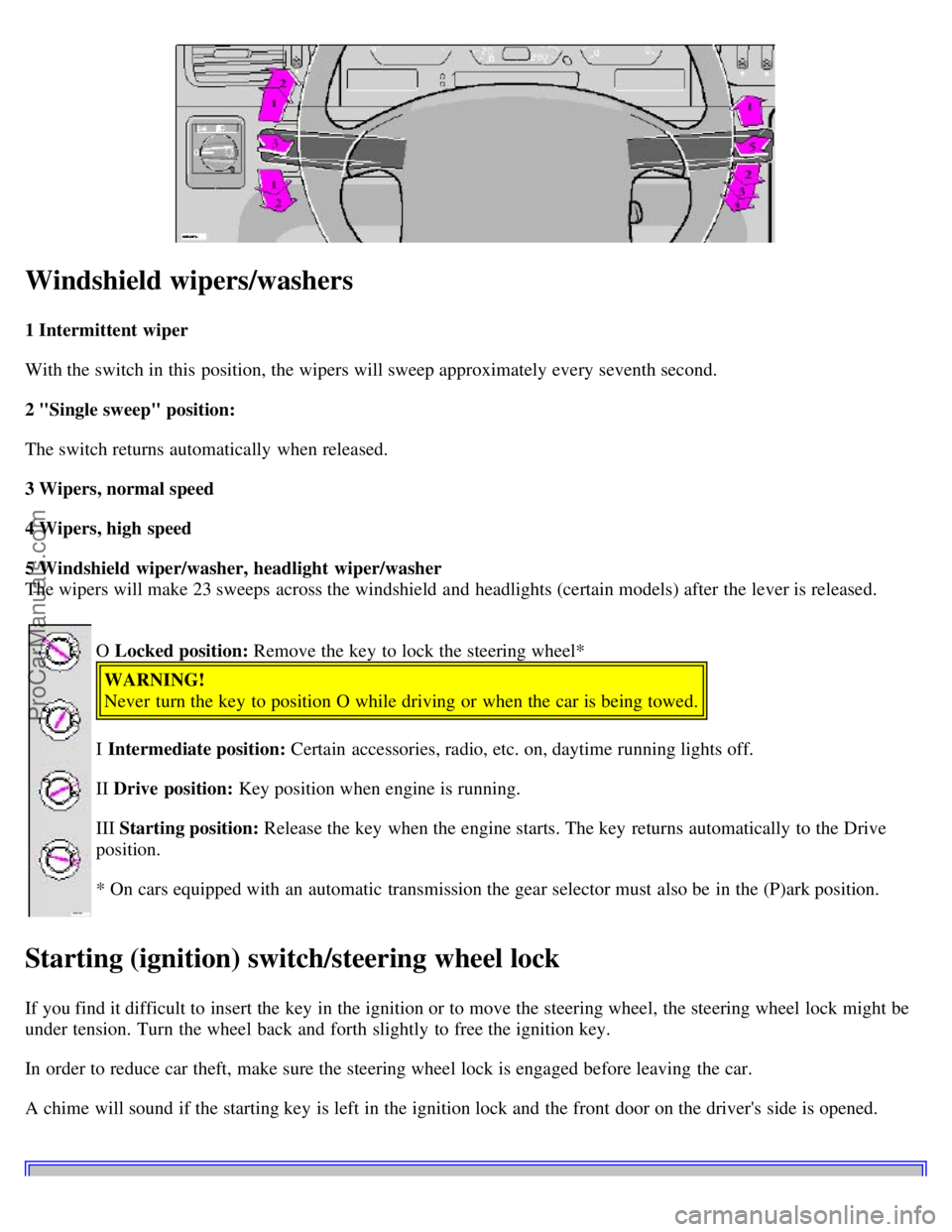
Windshield wipers/washers
1 Intermittent wiper
With the switch in this position, the wipers will sweep approximately every seventh second.
2 "Single sweep" position:
The switch returns automatically when released.
3 Wipers, normal speed
4 Wipers, high speed
5 Windshield wiper/washer, headlight wiper/washer
The wipers will make 23 sweeps across the windshield and headlights (certain models) after the lever is released.
O Locked position: Remove the key to lock the steering wheel*
WARNING!
Never turn the key to position O while driving or when the car is being towed.
I Intermediate position: Certain accessories, radio, etc. on, daytime running lights off.
II Drive position: Key position when engine is running.
III Starting position: Release the key when the engine starts. The key returns automatically to the Drive
position.
* On cars equipped with an automatic transmission the gear selector must also be in the (P)ark position.
Starting (ignition) switch/steering wheel lock
If you find it difficult to insert the key in the ignition or to move the steering wheel, the steering wheel lock might be
under tension. Turn the wheel back and forth slightly to free the ignition key.
In order to reduce car theft, make sure the steering wheel lock is engaged before leaving the car.
A chime will sound if the starting key is left in the ignition lock and the front door on the driver's side is opened.
ProCarManuals.com
Page 23 of 99

2 0 0 2
VOLVO
C70 Coupe & Convertible
Chapter 3 - Body and interior
pg. 41 Body and interior
Page
Storage compartments 42
Sun roof43
Convertible top/wind deflector44
Keys, doors and locks46
Remote keyless entry system47
Alarm48
Front seats50
Rear/side view mirrors53
Interior lights, Vanity mirrors55
Long load storage57
Hood58
Opening the trunk59
Trunk light, Spare tire, Jack60
Securing cargo, Avoiding battery drain61
pg. 42 Storage compartments
WARNING!
Packages on the rear window shelf can obscure vision and may become danagerous projectiles in the event of a
sudden stop or an accident.
ProCarManuals.com
Page 25 of 99
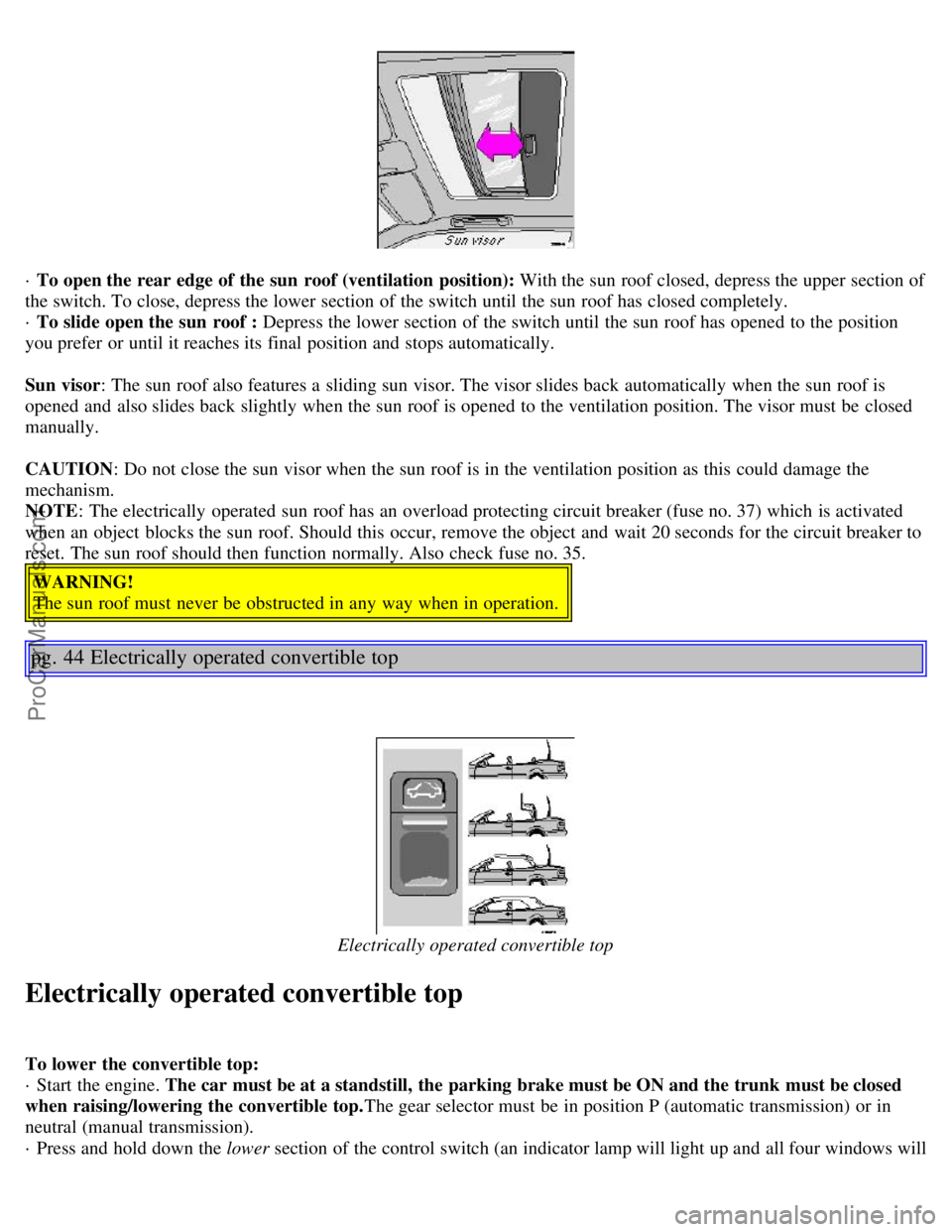
· To open the rear edge of the sun roof (ventilation position): With the sun roof closed, depress the upper section of
the switch. To close, depress the lower section of the switch until the sun roof has closed completely.
· To slide open the sun roof : Depress the lower section of the switch until the sun roof has opened to the position
you prefer or until it reaches its final position and stops automatically.
Sun visor : The sun roof also features a sliding sun visor. The visor slides back automatically when the sun roof is
opened and also slides back slightly when the sun roof is opened to the ventilation position. The visor must be closed
manually.
CAUTION : Do not close the sun visor when the sun roof is in the ventilation position as this could damage the
mechanism.
NOTE : The electrically operated sun roof has an overload protecting circuit breaker (fuse no. 37) which is activated
when an object blocks the sun roof. Should this occur, remove the object and wait 20 seconds for the circuit breaker to
reset. The sun roof should then function normally. Also check fuse no. 35.
WARNING!
The sun roof must never be obstructed in any way when in operation.
pg. 44 Electrically operated convertible top
Electrically operated convertible top
Electrically operated convertible top
To lower the convertible top:
· Start the engine. The car must be at a standstill, the parking brake must be ON and the trunk must be closed
when raising/lowering the convertible top. The gear selector must be in position P (automatic transmission) or in
neutral (manual transmission).
· Press and hold down the lower section of the control switch (an indicator lamp will light up and all four windows will
ProCarManuals.com
Page 26 of 99

automatically be lowered slightly) until the convertible top is completely lowered. A chime will indicate when the top
is completely down and properly in place in the storage compartment. The windows can then be raised/lowered with
the "All windows" button on the driver's door.
"All windows" control button
To raise the convertible top:
· Press and hold down the upper section of the control switch until the convertible top is completely raised. A chime
will indicate when the top is properly in position.
Check that the cover over the convertible top storage compartment closes completely.
Movement of the convertible top can be stopped at any time by releasing the control switch.
WARNING!
· The convertible top must not be obstructed in any way when it is being raised or lowered.
· The rear seat should not be occupied while the convertible top is being raised or lowered.
· Anyone near the car should be well clear of the convertible top's moving parts before it is raised or lowered.
· Children should never be allowed to play with the convertible top control switch.
CAUTION: If the cover over the convertible top storage space is not completely closed , the trunk lid should NOT be
opened to help avoid scratching the paint.
NOTE: · The electrically operated convertible top has an overload protecting circuit breaker that is activated when an
object blocks the top when it is in motion. If this occurs, remove the object and wait 20 seconds for the circuit breaker
to reset before trying to raise/lower the top again.
See page 106
for fault tracing information and instructions on manually raising the convertible top.
· The trunk cannot be opened and the power windows/power antenna cannot be operated while the convertible top is
being raised/lowered.
pg. 45 Electrically operated convertible top, Wind deflector
CAUTION:
· Be sure there is sufficient clearance above the car before raising/lowering the convertible top.
· Volvo recommends that you raise the convertible top and close the windows when you leave the car to help deter
thefts and to protect the interior from rain, windblown dust, etc.
· No objects should be placed in the convertible top storage compartment. This could damage the convertible top
mechanism.
· Roof racks may not be attached to or placed on the convertible top. See page 74
for information on trunk-mounted
luggage racks.
· Ice scrapers should not be used to remove snow from the convertible top.
· Do not lower the convertible top if it is frozen. The top should not be raised/lowered if the temperature is below 32°
F (0° C).
· The top should be completely dry before it is lowered and stored in the storage compartment to help prevent damage
ProCarManuals.com