warning VOLVO S40 2009 Owner´s Manual
[x] Cancel search | Manufacturer: VOLVO, Model Year: 2009, Model line: S40, Model: VOLVO S40 2009Pages: 286, PDF Size: 7.08 MB
Page 159 of 286
06 Starting and driving
Jump starting
06
159
G020298
Follow these instructions to jump start your
vehicle's dead battery or to jump start another
vehicle's dead battery using your vehicle. If the
12-volt auxiliary battery to be used is in another
vehicle, check that the vehicles are not touch-
ing to prevent premature completion of a cir-
cuit. Be sure to follow jump starting instruc-
tions provided for the other vehicle.
To jump start your vehicle:
1. Switch off the ignition.
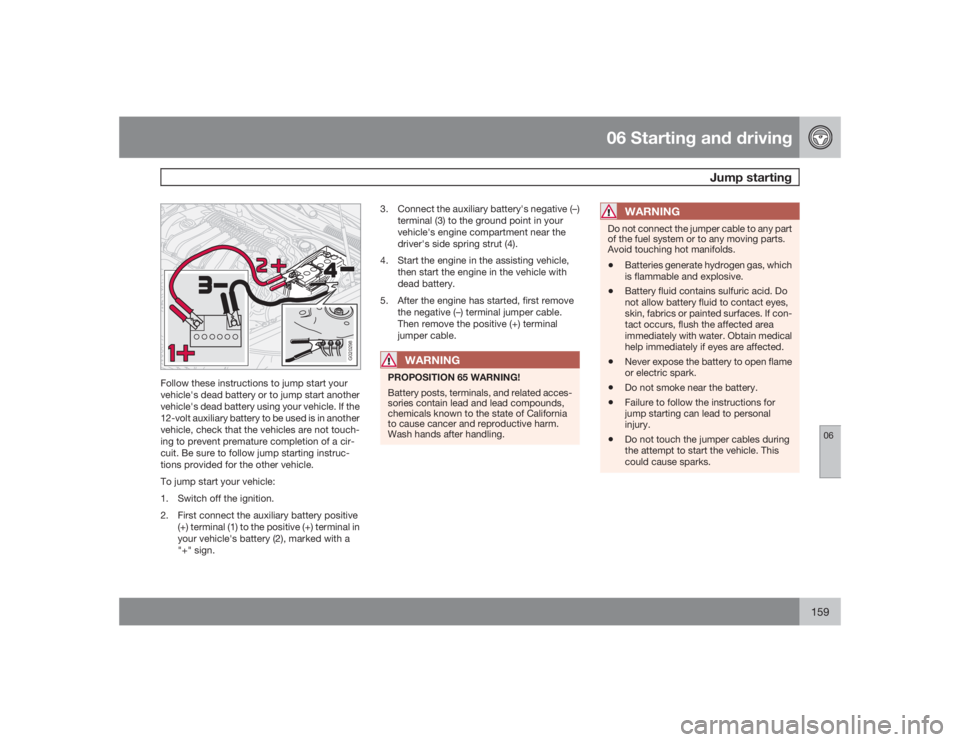
2. First connect the auxiliary battery positive
(+) terminal (1) to the positive (+) terminal in
your vehicle's battery (2), marked with a
"+" sign.3. Connect the auxiliary battery's negative (–)
terminal (3) to the ground point in your
vehicle's engine compartment near the
driver's side spring strut (4).
4. Start the engine in the assisting vehicle,
then start the engine in the vehicle with
dead battery.
5. After the engine has started, first remove
the negative (–) terminal jumper cable.
Then remove the positive (+) terminal
jumper cable.
WARNING
PROPOSITION 65 WARNING!
Battery posts, terminals, and related acces-
sories contain lead and lead compounds,
chemicals known to the state of California
to cause cancer and reproductive harm.
Wash hands after handling.
WARNING
Do not connect the jumper cable to any part
of the fuel system or to any moving parts.
Avoid touching hot manifolds.•
Batteries generate hydrogen gas, which
is flammable and explosive.
•
Battery fluid contains sulfuric acid. Do
not allow battery fluid to contact eyes,
skin, fabrics or painted surfaces. If con-
tact occurs, flush the affected area
immediately with water. Obtain medical
help immediately if eyes are affected.
•
Never expose the battery to open flame
or electric spark.
•
Do not smoke near the battery.
•
Failure to follow the instructions for
jump starting can lead to personal
injury.
•
Do not touch the jumper cables during
the attempt to start the vehicle. This
could cause sparks.
Page 160 of 286
06 Starting and drivingTowing a trailer
06160
General information•
Volvo recommends the use of Volvo trailer
hitches that are specially designed for the
vehicle.CAUTION
Models equipped with the B5244S7 engine
(engine code 39 , which is the 6th and
7th digits from the left in your vehicle's VIN
number, see page 262 for the location of
the VIN plate), may not be used to tow trail-
ers or vehicles of any kind. This could cause
damage to the vehicle's emission control
systems.Maximum trailer weights recommended by
Volvo are:•
Trailers without brakes: 1,540 lbs
(700 kg).
•
Trailers with brakes: 2,000 lbs (900 kg)
Observe the legal requirements of the
state/province in which the vehicles are
registered.
•
The maximum recommended hitch
tongue load is 165 lbs (75 kg).
•
All Volvo models are equipped with
energy-absorbing shock-mounted bump-
ers. Trailer hitch installation should not
interfere with the proper operation of this
bumper system.Trailer towing does not normally present any
particular problems, but take into considera-
tion:
•
Increase tire pressure to recommended
full. See the chapter "Wheels and tires."
•
When your vehicle is new, avoid towing
heavy trailers during the first 620 miles
(1,000 km).
•
Maximum speed when towing a trailer:
50 mph (80 km/h).
•
Engine and transmission are subject to
increased loads. Therefore, engine coolant
temperature should be closely watched
when driving in hot climates or hilly terrain.
Use a lower gear and turn off the air con-
ditioner if the temperature gauge needle
enters the red range.
•
If the automatic transmission begins to
overheat, a message will be displayed in
the information display.
•
Avoid overload and other abusive opera-
tion.
•
Hauling a trailer affects handling, durabil-
ity, and economy.
•
It is necessary to balance trailer brakes
with the towing vehicle brakes to provide a
safe stop (check and observe state/local
regulations).
•
Do not connect the trailer's brake system
directly to the vehicle's brake system.
•
More frequent vehicle maintenance is
required.
•
Remove the ball and drawbar assembly
when the hitch is not being used.
•
Volvo recommends the use of synthetic
engine oil when towing a trailer over long
distances or in mountainous areas.WARNING
•
Bumper-attached trailer hitches must
not be used on Volvos, nor should
safety chains be attached to the
bumper.
•
Trailer hitches attaching to the vehicle's
rear axle must not be used.
•
Never connect a trailer's hydraulic
brake system directly to the vehicle
brake system, nor a trailer's lighting
system directly to the vehicle lighting
system. Consult your nearest trained
and qualified Volvo service technician
for correct installation.
•
When towing a trailer, the trailer's safety
wire must be correctly fastened to the
hole or hook provided in the trailer hitch
on the vehicle. The safety wire should
never be fastened to or wound around
the drawbar ball.
Page 163 of 286
06 Starting and driving
Transporting loads
06
163 Loading the vehicle
Your vehicle's load-carrying capacity is affec-
ted by factors such as:•
the number of passengers
•
tire inflation
•
the amount of optional or accessory equip-
ment installed
•
the amount of cargo.
See the chapter "Wheels and tires" for more
detailed information.
Before loading the car, turn off the engine, and
apply the parking brake when loading or
unloading long objects. The gear selector can
be inadvertently knocked out of position by
long cargo, causing the car to move.
Keep the following in mind when
loading the vehicle:•
Load objects in the trunk against the rear
seat backrest.
•
Load heavy cargo as low as possible.
•
Center wide loads.
•
Secure all cargo with restraining straps
anchored to the load securing eyelets.
•
Cover sharp edges on the load.
•
Seats can be folded down and head
restraints removed to extend the cargo
compartment, see page 113.
WARNING
•
Remember that an object weighing
44 lbs (20 kg) produces a force of
2,200 lbs (1,000 kg) in a head-on colli-
sion at 30 mph (50 km/h)!
•
When the rear backrest(s) are folded
down, the vehicle should not be loaded
to a level higher than 2 in. (5 cm) below
the upper edge of the rear side win-
dows. Objects placed higher than this
level could impede the function of the
Volvo Inflatable Curtain.
Load carriers (accessory)Load carriers are available as Volvo accesso-
ries. Follow the installation instructions sup-
plied with the load carriers.
Observe the following points when using load
carriers:•
To avoid damaging your car and to achieve
maximum safety when driving, we recom-
mend using the load carriers that Volvo has
developed especially for your car.
•
Volvo-approved removable roof racks are
designed to carry the maximum allowable
roof load for this vehicle: 165 lbs (75 kg).
For Non-Volvo roof racks, check the man-
ufacturer's weight limits for the rack.
•
Never exceed the rack manufacturer's
weigh limits and never exceed the maxi-
mum rated roof load of 165 lbs (75 kg).
•
Avoid single-point loads. Distribute loads
evenly.
•
Place heavier cargo at the bottom of the
load.
•
Secure the cargo correctly with appropri-
ate tie-down equipment.
•
Check periodically that the load carriers
and load are properly secured.
•
Remember that the car's center of gravity
and handling change when you carry a
load on the roof.
•
The car's wind resistance and fuel con-
sumption will increase with the size of the
load.
•
Drive smoothly. Avoid rapid starts, fast
cornering and hard braking.
Page 164 of 286
06 Starting and drivingBlind Spot Information System (BLIS)–option
06164
Introduction
G020295
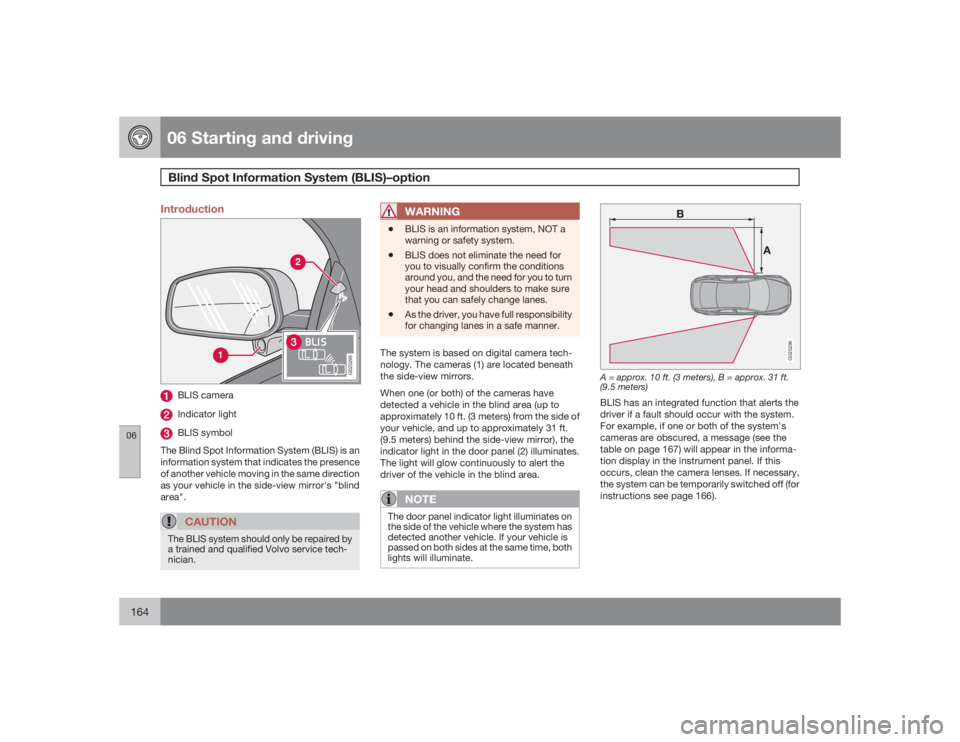
BLIS cameraIndicator lightBLIS symbol
The Blind Spot Information System (BLIS) is an
information system that indicates the presence
of another vehicle moving in the same direction
as your vehicle in the side-view mirror's "blind
area".CAUTION
The BLIS system should only be repaired by
a trained and qualified Volvo service tech-
nician.
WARNING
•
BLIS is an information system, NOT a
warning or safety system.
•
BLIS does not eliminate the need for
you to visually confirm the conditions
around you, and the need for you to turn
your head and shoulders to make sure
that you can safely change lanes.
•
As the driver, you have full responsibility
for changing lanes in a safe manner.
The system is based on digital camera tech-
nology. The cameras (1) are located beneath
the side-view mirrors.
When one (or both) of the cameras have
detected a vehicle in the blind area (up to
approximately 10 ft. (3 meters) from the side of
your vehicle, and up to approximately 31 ft.
(9.5 meters) behind the side-view mirror), the
indicator light in the door panel (2) illuminates.
The light will glow continuously to alert the
driver of the vehicle in the blind area.
NOTE
The door panel indicator light illuminates on
the side of the vehicle where the system has
detected another vehicle. If your vehicle is
passed on both sides at the same time, both
lights will illuminate.
A B
G020296
A = approx. 10 ft. (3 meters), B = approx. 31 ft.
(9.5 meters)BLIS has an integrated function that alerts the
driver if a fault should occur with the system.
For example, if one or both of the system's
cameras are obscured, a message (see the
table on page 167) will appear in the informa-
tion display in the instrument panel. If this
occurs, clean the camera lenses. If necessary,
the system can be temporarily switched off (for
instructions see page 166).
Page 165 of 286
06 Starting and driving
Blind Spot Information System (BLIS)–option
06``165 When does BLIS function
The system functions when your vehicle is
moving at speeds above 6 mph (10 km/h).
When you pass another vehicle:
The system reacts when you pass another
vehicle at a speed of up to 6 mph (10 km/h)
faster than that vehicle.
When you are passed by another vehicle:
The system reacts if your vehicle is passed by
another vehicle at a speed of up to 43 mph
(70 km/h) faster than your vehicle.
WARNING
•
BLIS does not function in sharp curves.
•
BLIS does not function when your vehi-
cle is backing up.
•
If you are towing a wide trailer, this may
prevent the BLIS cameras from detect-
ing other vehicles in adjacent lanes.
How BLIS functions in daylight and
darkness
DaylightBLIS reacts to the shape of surrounding vehi-
cles. The system is designed to help detect
motor vehicles such as cars, trucks, buses,
motorcycles, etc.
DarknessBLIS reacts to the headlights of surrounding
vehicles. In order to be detected by BLIS, a
vehicle in the blind area must have its head-
lights on. This means, for example, that the
system will not detect a trailer without head-
lights that is being towed behind a car or truck.
WARNING
•
BLIS does not react to cyclists or
mopeds.
•
BLIS does not react to vehicles that are
standing still.
•
The function of the BLIS cameras may
be affected by intense light, or when
driving at night in areas where there are
no external sources of light (e.g., street
lights, other vehicles, etc.). In such
cases, the system may react as if the
cameras were obscured.
•
In both of the above mentioned condi-
tions, a message will appear in the infor-
mation display.
•
When driving in such conditions, the
system's function will be limited or it
may be temporarily switched off, see
page 166 for instructions.
•
When the message is no longer dis-
played, BLIS will return to normal func-
tion.
•
The BLIS cameras have the same limi-
tation as the human eye. In other words,
their "vision is impaired" by adverse
weather conditions such as heavy
snowfall, dense fog, etc.
Page 168 of 286
06 Starting and drivingPark assist (Option/accessory)
06168
Introduction
G020294
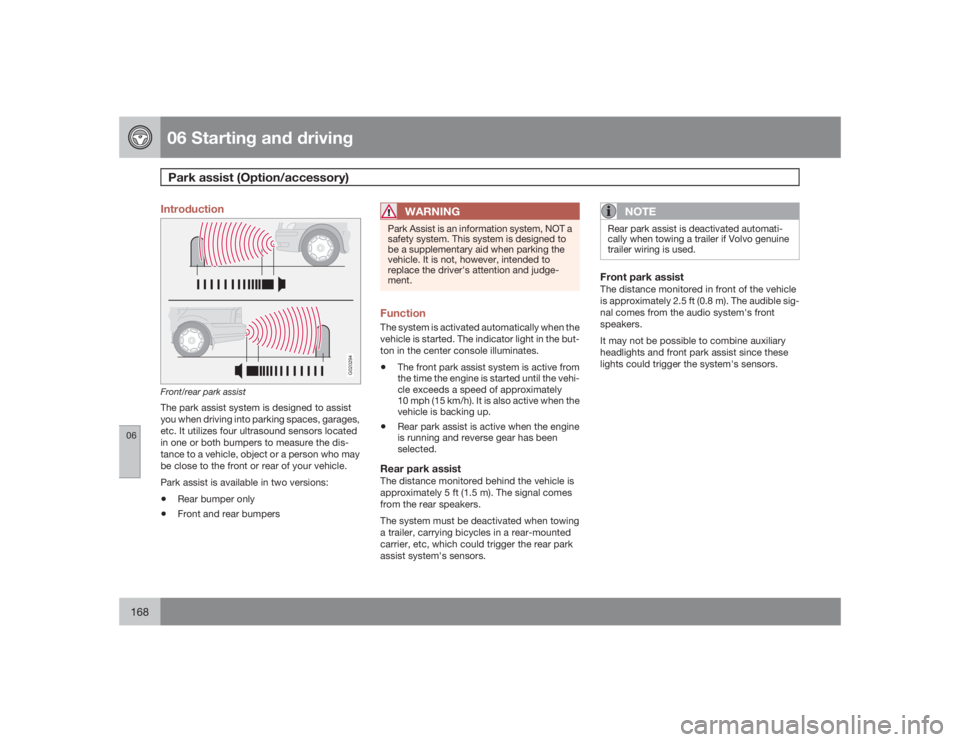
Front/rear park assistThe park assist system is designed to assist
you when driving into parking spaces, garages,
etc. It utilizes four ultrasound sensors located
in one or both bumpers to measure the dis-
tance to a vehicle, object or a person who may
be close to the front or rear of your vehicle.
Park assist is available in two versions:•
Rear bumper only
•
Front and rear bumpers
WARNING
Park Assist is an information system, NOT a
safety system. This system is designed to
be a supplementary aid when parking the
vehicle. It is not, however, intended to
replace the driver's attention and judge-
ment.FunctionThe system is activated automatically when the
vehicle is started. The indicator light in the but-
ton in the center console illuminates.•
The front park assist system is active from
the time the engine is started until the vehi-
cle exceeds a speed of approximately
10 mph (15 km/h). It is also active when the
vehicle is backing up.
•
Rear park assist is active when the engine
is running and reverse gear has been
selected.
Rear park assistThe distance monitored behind the vehicle is
approximately 5 ft (1.5 m). The signal comes
from the rear speakers.
The system must be deactivated when towing
a trailer, carrying bicycles in a rear-mounted
carrier, etc, which could trigger the rear park
assist system's sensors.
NOTE
Rear park assist is deactivated automati-
cally when towing a trailer if Volvo genuine
trailer wiring is used.Front park assistThe distance monitored in front of the vehicle
is approximately 2.5 ft (0.8 m). The audible sig-
nal comes from the audio system's front
speakers.
It may not be possible to combine auxiliary
headlights and front park assist since these
lights could trigger the system's sensors.
Page 169 of 286
06 Starting and drivingPark assist (Option/accessory)
06``169 Activating/deactivating park assist
G021267
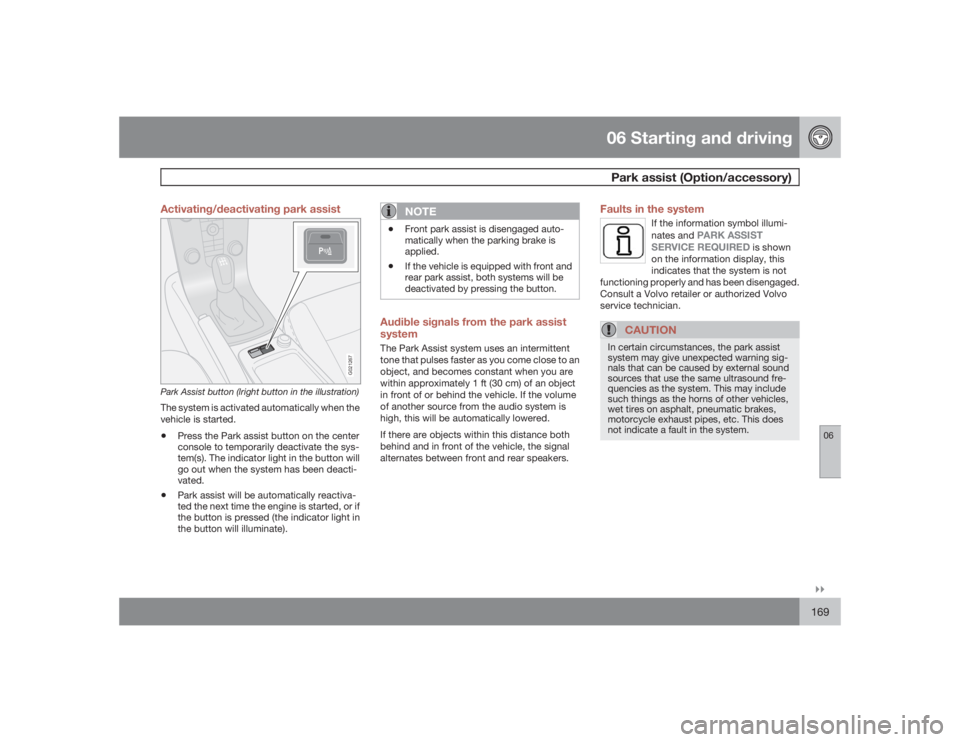
Park Assist button (lright button in the illustration)The system is activated automatically when the
vehicle is started.•
Press the Park assist button on the center
console to temporarily deactivate the sys-
tem(s). The indicator light in the button will
go out when the system has been deacti-
vated.
•
Park assist will be automatically reactiva-
ted the next time the engine is started, or if
the button is pressed (the indicator light in
the button will illuminate).
NOTE
•
Front park assist is disengaged auto-
matically when the parking brake is
applied.
•
If the vehicle is equipped with front and
rear park assist, both systems will be
deactivated by pressing the button.
Audible signals from the park assist
systemThe Park Assist system uses an intermittent
tone that pulses faster as you come close to an
object, and becomes constant when you are
within approximately 1 ft (30 cm) of an object
in front of or behind the vehicle. If the volume
of another source from the audio system is
high, this will be automatically lowered.
If there are objects within this distance both
behind and in front of the vehicle, the signal
alternates between front and rear speakers.
Faults in the system
If the information symbol illumi-
nates and
PARK ASSIST
SERVICE REQUIRED
is shown
on the information display, this
indicates that the system is not
functioning properly and has been disengaged.
Consult a Volvo retailer or authorized Volvo
service technician.
CAUTION
In certain circumstances, the park assist
system may give unexpected warning sig-
nals that can be caused by external sound
sources that use the same ultrasound fre-
quencies as the system. This may include
such things as the horns of other vehicles,
wet tires on asphalt, pneumatic brakes,
motorcycle exhaust pipes, etc. This does
not indicate a fault in the system.
Page 170 of 286
06 Starting and drivingPark assist (Option/accessory)
06170
Cleaning the sensors
G021298
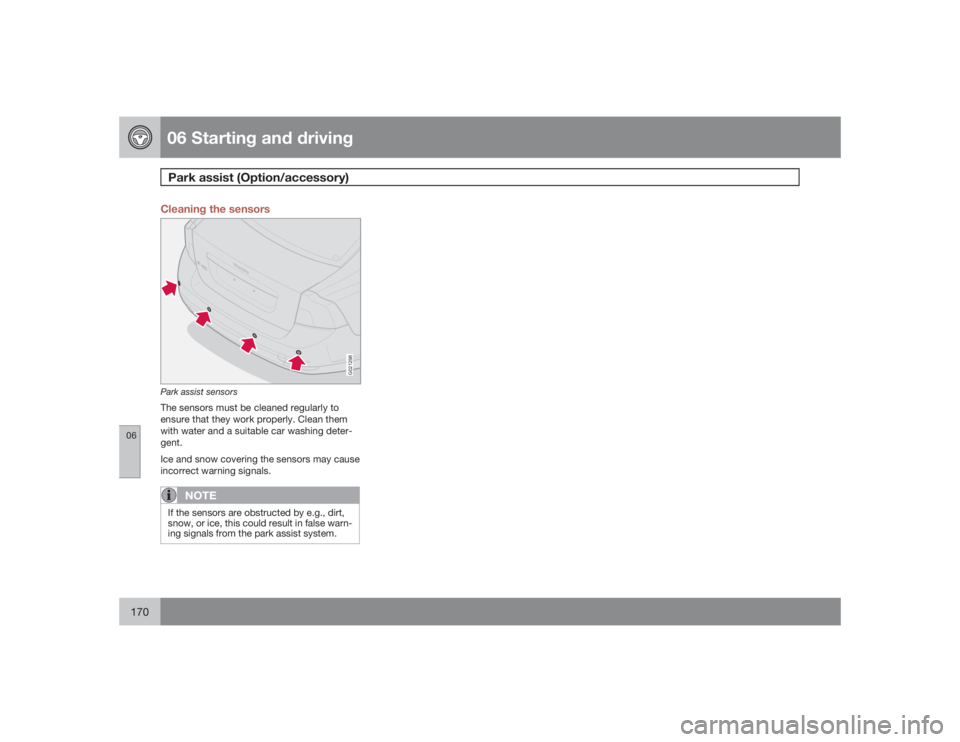
Park assist sensorsThe sensors must be cleaned regularly to
ensure that they work properly. Clean them
with water and a suitable car washing deter-
gent.
Ice and snow covering the sensors may cause
incorrect warning signals.
NOTE
If the sensors are obstructed by e.g., dirt,
snow, or ice, this could result in false warn-
ing signals from the park assist system.
Page 174 of 286
07 Wheels and tiresGeneral information
07174
Your vehicle is equipped with tires according
to the vehicle's tire information placard on the
B-pillar (the structural member at the side of
the vehicle, at the rear of the driver's door
opening), or on the inside of the fuel filler door
on Canadian models.
CAUTION
Some Volvo models are equipped with an
Ultra High Performance tire and wheel com-
bination designed to provide maximum dry
pavement performance with consideration
for hydroplaning resistance. As such, they
may be more susceptible to road hazard
damage and, depending on driving condi-
tions, may achieve a tread life of less than
20,000 miles (30,000 km). Even if this vehi-
cle is equipped with Volvo’s advanced AWD
or DSTC system, these tires are not
designed for winter driving, and should be
replaced with winter tires when weather
conditions dictate.The tires have good road holding characteris-
tics and offer good handling on dry and wet
surfaces. It should be noted however that the
tires have been developed to give these fea-
tures on snow/ice-free surfaces.
Certain models are equipped with "all-season"
tires, which provide a somewhat higher degree
of road holding on slippery surfaces than tires
without the "all-season" rating. However, foroptimum road holding on icy or snow-covered
roads, we recommend suitable winter tires on
all four wheels.
When replacing tires, be sure that the new tires
are the same size designation, type (radial) and
preferably from the same manufacturer, on all
four wheels. Otherwise there is a risk of altering
the car's roadholding and handling characte-
ristics.
Storing wheels and tiresWhen storing complete wheels (tires mounted
on rims), they should be suspended off the
floor or placed on their sides on the floor.
Tires not mounted on rims should be stored on
their sides or standing upright, but should not
be suspended.
CAUTION
Tires should preferably be stored in a cool,
dry, dark place, and should never be stored
in close proximity to solvents, gasoline, oils,
etc.
WARNING
•
The wheel and tire sizes for your Volvo
are specified to meet stringent stability
and handling requirements. Unap-
proved wheel/tire size combinations
can negatively affect your vehicle's sta-
bility and handling. Approved tire sizes
are shown in the Tire inflation pressure
tables, see page 178.
•
Any damage caused by installation of
unapproved wheel/tire size combina-
tions will not be covered by your new
vehicle warranty. Volvo assumes no
responsibility for death, injury, or
expenses that may result from such
installations.
Page 176 of 286
07 Wheels and tiresTire inflation
07176
Inflation labels
G032513
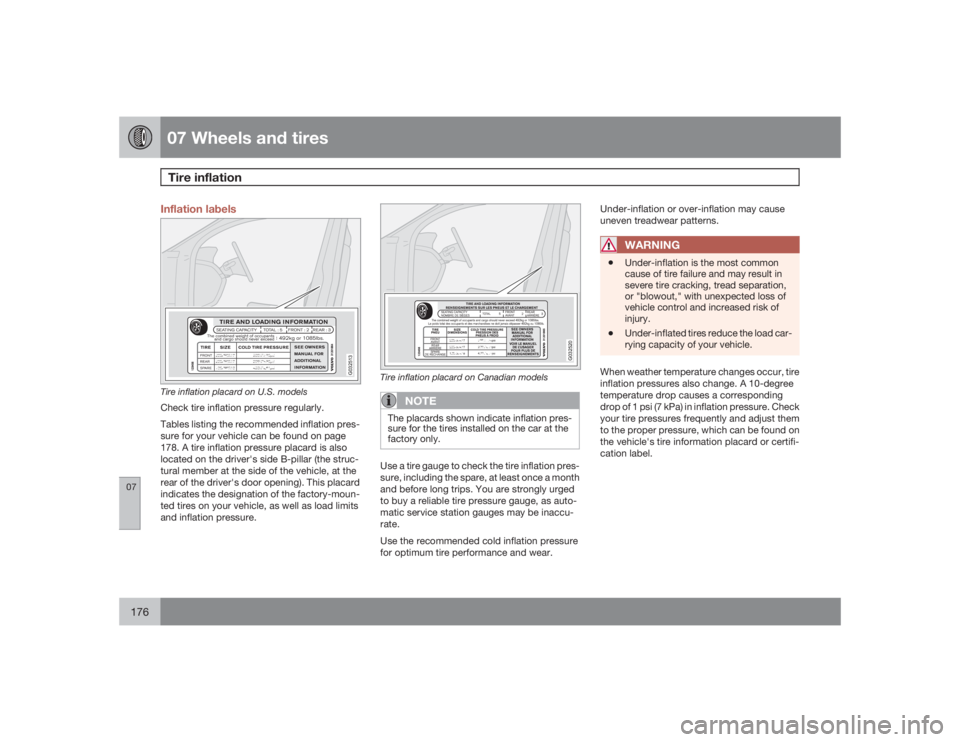
Tire inflation placard on U.S. modelsCheck tire inflation pressure regularly.
Tables listing the recommended inflation pres-
sure for your vehicle can be found on page
178. A tire inflation pressure placard is also
located on the driver's side B-pillar (the struc-
tural member at the side of the vehicle, at the
rear of the driver's door opening). This placard
indicates the designation of the factory-moun-
ted tires on your vehicle, as well as load limits
and inflation pressure.
G032520
Tire inflation placard on Canadian models
NOTE
The placards shown indicate inflation pres-
sure for the tires installed on the car at the
factory only.Use a tire gauge to check the tire inflation pres-
sure, including the spare, at least once a month
and before long trips. You are strongly urged
to buy a reliable tire pressure gauge, as auto-
matic service station gauges may be inaccu-
rate.
Use the recommended cold inflation pressure
for optimum tire performance and wear.Under-inflation or over-inflation may cause
uneven treadwear patterns.
WARNING
•
Under-inflation is the most common
cause of tire failure and may result in
severe tire cracking, tread separation,
or "blowout," with unexpected loss of
vehicle control and increased risk of
injury.
•
Under-inflated tires reduce the load car-
rying capacity of your vehicle.
When weather temperature changes occur, tire
inflation pressures also change. A 10-degree
temperature drop causes a corresponding
drop of 1 psi (7 kPa) in inflation pressure. Check
your tire pressures frequently and adjust them
to the proper pressure, which can be found on
the vehicle's tire information placard or certifi-
cation label.