fuel VOLVO S60 2001 Owner's Manual
[x] Cancel search | Manufacturer: VOLVO, Model Year: 2001, Model line: S60, Model: VOLVO S60 2001Pages: 128, PDF Size: 2.52 MB
Page 92 of 128

Tires for winter use:
Owners who live in or regularly commute through areas with sustained periods of snow or icy driving conditions are
strongly advised to fit suitable winter tires to help retain the highest degree of traction.
It is important to install winter tires on all four wheels to help retain traction during cornering, braking, and
accelerating. Failure to do so could reduce traction to an unsafe level or adversely affect handling. Do not mix tires of
different design as this could also negatively affect overall tire road grip.
Volvo recommends195/ 65 R15 (205/ 55R16 on turbo models) winter tires on all four wheels.
Winter tires wear more quickly on dry roads in warm weather. They should be removed when the winter driving
season has ended.
Studded tires should be run- in 300- 600 miles (500- 1000 km) during which the car should be driven as smoothly as
possible to give the studs the opportunity to seat properly in the tires. The tires should have the same rotational
direction throughout their entire lifetime. In other words, if you wish to rotate the wheels, make sure that the same
wheels are always on the same side of the car.
NOTE: Please consult state or provincial regulations restricting the use of studded winter tires before installing such
tires.
* Where permitted
pg. 154 Tire pressure
Checking and correcting tire pressure
The tire pressure label is located on the inside of the fuel filler door.
Check the tire pressure regularly.
The tire pressure should be corrected only when the tires are cold.
With warm tires, correct only when the pressure is too low. The tire temperature rises after driving just a few miles.
Vehicle loading The tires on your Volvo will perform to specifi- cations at all normal loads when inflated as
recommended on the tire information label located on the inside of the fuel filler door. This label lists both tire and
vehicle design limits. Do not load your car beyond the load limits indicated.
WARNING!
Improperly inflated tires will reduce tire life, adversely affect vehicle handling and can possibly lead to failure
resulting in loss of vehicle control without prior warning.
ProCarManuals.com
Page 93 of 128
Temporary Spare (certain models)
The spare tire in your car is called a "Temporary Spare". It has the following designation: T125/ 80 R17.
Recommended tire pressure (see decal on Fuel filler door) should be maintained irrespective of which position on the
car the Temporary Spare tire is used on. In the event of damage to this tire, a new one can be purchased from your
Volvo retailer.
WARNING!
Current legislation prohibits the use of the "Temporary Spare" tire other than as a temporary replacement for a
punctured tire. It must be replaced as soon as possible by a standard tire. Road holding and handling may be
affected with the "Temporary Spare" in use. Do not exceed 50 mph (80 km/ h). Do not drive farther than 50 miles
(80 km) on a temporary spare tire.
CAUTION:
The car must not be driven with wheels of different dimensions or with a spare tire other than the one that came with
the car. The use of different size wheels can seriously damage your car's transmission.
NOTE: Certain models may be equipped with a full- size spare tire. When used, it should be inflated to the same
pressure as the tire it is replacing.
pg. 155 Tread wear indicators
Tires have tread
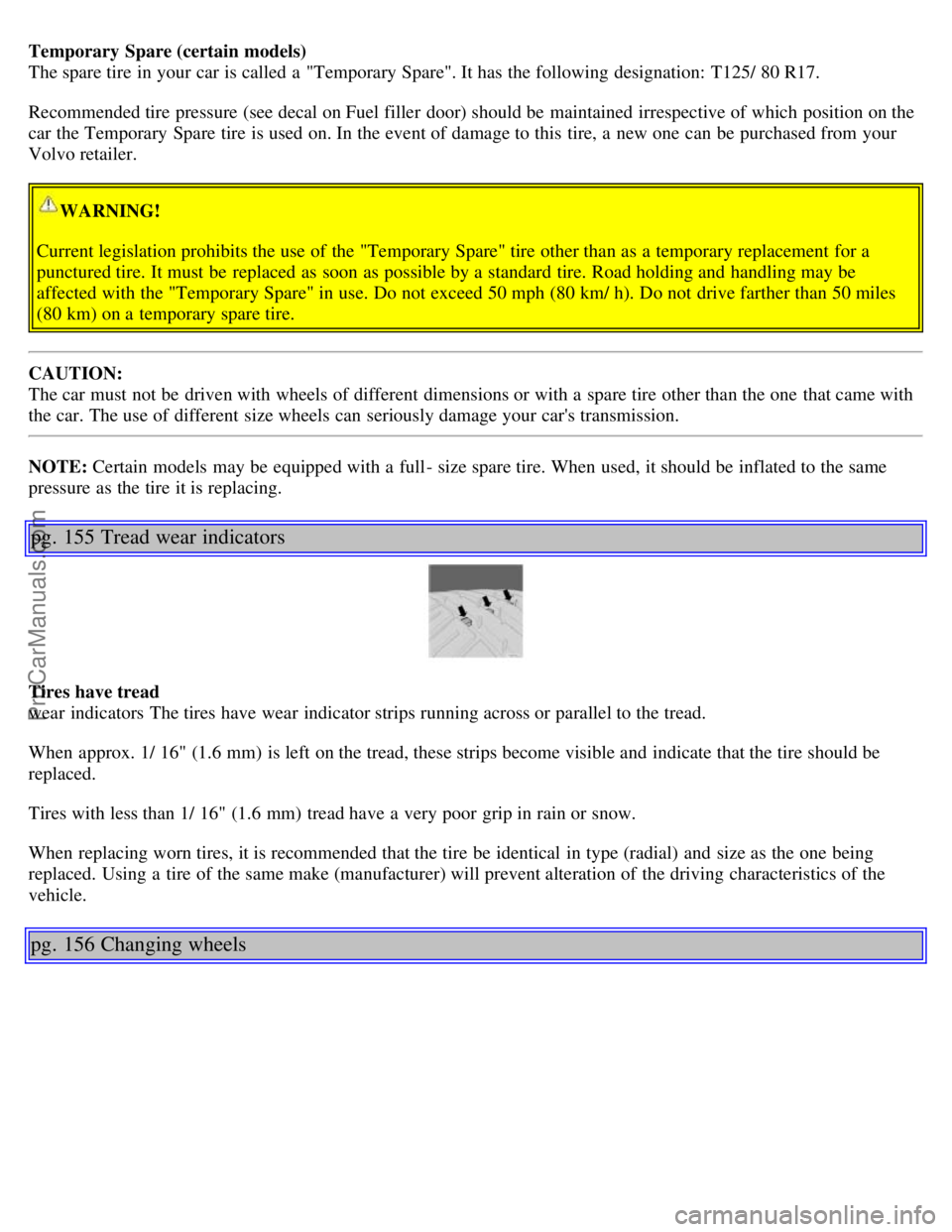
wear indicators The tires have wear indicator strips running across or parallel to the tread.
When approx. 1/ 16" (1.6 mm) is left on the tread, these strips become visible and indicate that the tire should be
replaced.
Tires with less than 1/ 16" (1.6 mm) tread have a very poor grip in rain or snow.
When replacing worn tires, it is recommended that the tire be identical in type (radial) and size as the one being
replaced. Using a tire of the same make (manufacturer) will prevent alteration of the driving characteristics of the
vehicle.
pg. 156 Changing wheels
ProCarManuals.com
Page 103 of 128

(thousand km)(12)(24)(36) (48)(60) (72)(84) (96)(108) (120)(132)(144)
EMISSION SYSTEM MAINTENANCE
Engine
Fuel line filter
1
PCV nipple (orifice)/hoses, clean I I
Battery (check charge and electrolyte level) II II II II I III
Brakes
Inspect brake pads, replace components as necessary I II II II I III
Brake fluid level
2 - check
I I I I I I
Steering/suspension
Tires
3, check pressure, wear and condition I
I II II II I III
Check power steering fluid level I I I I I I
Body
Power antenna (clean) L L L L L L
Trunk/hood, hinges and latches L L L L
Cabin air filter (see page 167
) R R R R R R
1) Replace at 105,000 miles (168,000 km)
2) Brake fluid should be changed at owner request every second year or 30,000 miles (48,000 km). The fluid
should be replaced once a year or every 15,000 miles (24,000 km) when driving under extremely hard
conditions (mountain driving, etc.).
3) Rotate tires at owner request.
The following items should be checked weekly by the driver (it takes only a few minutes):
Engine oil level, brake fluid level, radiator coolant level, operation of all lights, horns, windshield wipers, tire
pressure (all five tires), windshield washer fluid level
The following should also be carried out at regular intervals:
Washing (check all drain holes), polishing, cleaning
pg. 167 Maintenance Schedule
Air cleaner
Replace the air cleaner cartridge with a new one every 30,000 miles (48,000 km). The cartridge should be replaced
more often when driving under dirty and dusty conditions. The filter cannot be cleaned and therefore should always
be replaced with a new one.
Timing belt
For proper functioning of the vehicle and its emission control systems, the timing belt must be replaced every 105,000
miles (168,000 km). Engine damage will occur if the belt fails.
Fuel filler cap, tank and lines and
connections The effectiveness of the fuel system to contain hydrocarbons is dependent largely on a leak- free system.
Check for proper sealing of the fuel filler cap which contains "O" ring type seals. NOTE: If the fuel filler cap is not
closed tightly or if the engine is running when the car is refueled, the Malfunction Indicator Lamp (" Check Engine")
may indicate a fault. However, your vehicle's performance will not be affected. Use only Volvo original or approved
fuel filler caps.
ProCarManuals.com
Page 104 of 128

Fuel (line) filter
For proper functioning of the vehicle and its emission control systems, the fuel line filter should be replaced at
105,000 miles (168,000 km). The filter is replaced as one complete unit. Replace more frequently if contaminated fuel
is introduced into the tank (or if there is reason to suspect that this has occurred).
PCV system
The orifice nipple in the intake manifold and the filter at the end of the PCV hose in the air cleaner should be
inspected at 60,000 miles (96,000 km) and thereafter, at 30,000 mile (48,000 km) intervals.
Cabin air filter
Replace the cabin air filter with a new one at 15,000 mile (24,000 km) intervals. Volvo recommends replacing the
filter more often if the car is driven under dirty and dusty condi- tions. The filter cannot be cleaned and therefore
should always be replaced with a new one.
pg. 168 Working on your car
Note the following before you begin working on your car:
Battery
Ensure that the battery cables are correctly connected and tightened.
Never disconnect the battery when the engine is running (e. g. when replacing the battery).
Never use a fast charger to charge the battery. The battery cables should be disconnected when recharging.
The battery contains acid that is both corrosive and poisonous. It is important that the battery is handled in an
environ- mentally friendly way. Let your Volvo dealer assist you.
Hoisting the car
If a garage jack is used to lift the car, the two jack attachments points should be used. They are specially reinforced to
bear the weight of the car. A garage jack can also be placed under the front of the engine support frame. Take care not
to damage the splash guard under the engine. Ensure that the jack is positioned so that the car cannot slide off it.
Always use axle stands or similar structures.
If a two- post hoist is used to lift the car, the front and rear lift arm pads should be centered under the reinforced lift
plates on the inboard edge of the sill rail (see illustration).
WARNING!
The car ignition system has very high voltage!
The voltage in the ignition system is dangerous!
Do not touch spark plugs, ignition cables or the ignition coil when the engine is running or the ignition is switched
on!
ProCarManuals.com
Page 107 of 128
pg. 171 Oils and fluids
Oil quality
Meeting minimum ILSAC specification GF- 2, including ACEA A1, API SJ, SJ/ CF and SJ/ Energy Conserving.
Your Volvo has been certified using ILSAC oil specification GF- 2 5W/ 30.
Depending on your driving habits, premium or synthetic oils may provide superior fuel economy and engine
protection. Consult your Volvo retailer for recommendations on premium or synthetic oils. Volvo does not
recommend the use of oil additives.
Volvo recommends use of oil with a quality rating equal to or higher than ILSAC GF- 2. Equivalent and better oils
include ACEA A1, API SJ, SJ/ CF, and SJ/ Energy conserving. Lower quality oils may not offer the same fuel
economy, engine performance, or engine protection.
Operation in hot climates
When temperatures exceed 86¡ F (30¡ C) in your area, Volvo recommends, for the protection of your engine, that you
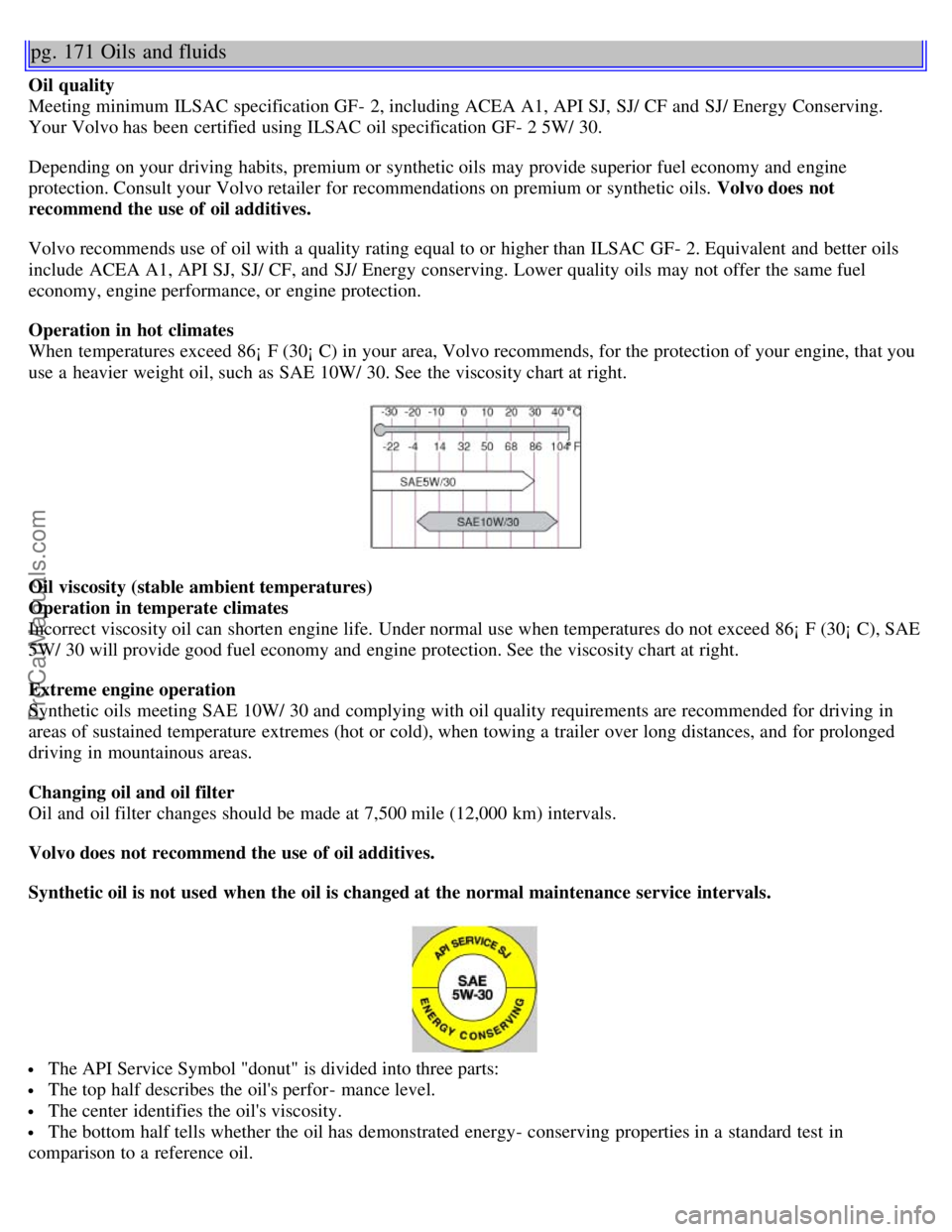
use a heavier weight oil, such as SAE 10W/ 30. See the viscosity chart at right.
Oil viscosity (stable ambient temperatures)
Operation in temperate climates
Incorrect viscosity oil can shorten engine life. Under normal use when temperatures do not exceed 86¡ F (30¡ C), SAE
5W/ 30 will provide good fuel economy and engine protection. See the viscosity chart at right.
Extreme engine operation
Synthetic oils meeting SAE 10W/ 30 and complying with oil quality requirements are recommended for driving in
areas of sustained temperature extremes (hot or cold), when towing a trailer over long distances, and for prolonged
driving in mountainous areas.
Changing oil and oil filter
Oil and oil filter changes should be made at 7,500 mile (12,000 km) intervals.
Volvo does not recommend the use of oil additives.
Synthetic oil is not used when the oil is changed at the normal maintenance service intervals.
The API Service Symbol "donut" is divided into three parts:
The top half describes the oil's perfor - mance level.
The center identifies the oil's viscosity.
The bottom half tells whether the oil has demonstrated energy- conserving properties in a standard test in
comparison to a reference oil.
ProCarManuals.com
Page 108 of 128

pg. 172 Oils and fluids
Checking the oil level
The oil level should be checked every time the car is refueled. This is especially important during the period up to the
first service.
CAUTION:
Not checking the oil level regularly can result in serious engine damage if the oil level becomes too low.
Park the car on a level surface and wait for at least 5 minutes after the engine has been switched off. Be sure the oil
level is maintained between the upper and lower marks on the dipstick. Low oil level can cause internal damage to
the engine and overfilling can result in high oil consumption. The distance between the dipstick marks represents
approx. 1.6 US qt (1.5 liter). The oil should preferably be checked when cold, before the engine has been started.
NOTE: The engine must be stopped when checking the oil.
WARNING!
Do not allow oil to spill onto or come into contact with hot exhaust pipe surfaces.
Adding oil (topping up)
Add oil of the same kind as already used.
Capacity (including filter): Normally- aspirated 5- cylinder engine - 5.8 US qts (5.5 liters). Turbo 5- cylinder
engine - 6.1 US qts (5.8 liters).
The oil filter should be replaced at every oil change.
pg. 173 Oils and fluids
Washer fluid reservoir
The washer fluid reservoir is located in the engine compartment and holds approx. 4.7 US qts. (4.5 liters).
During cold weather, the reservoir should be filled with windshield washer solvent containing antifreeze.
ProCarManuals.com
Page 111 of 128

2 0 0 1
VOLVO S60
Specifications
pg. 191 Specifications
Label information 192
Dimensions, weights193
Capacities194
Lubricants, Cooling system195
Three way catalytic converter196
Suspension197
Bulbs198
Electrical system199
Engine specifications200
Transmission201
Volvo On Call202
pg. 192 Label information
1 Vehicle Emission Control Information
Your Volvo is designed to meet all applicable emission standards, as evidenced by the certification label on the
underside of the hood. For further information regarding these regulations, please consult your Volvo retailer.
2 Vacuum hose routing
(underside of hood)
3 Loads and Tire Pressures
(on inside of fuel filler door)
4 Model plate
Vehicle Identification Number (VIN). Codes for color and upholstery, etc. The plate is located in the engine
compartment, on the inside of the left front fender.
5 Vehicle Identification Number (VIN) *
The VIN plate is located on the top left surface of the dashboard. The VIN is also stamped on the right hand door
pillar.
6 Federal Motor Vehicle Safety Standards (FMVSS) specifications (USA) and Ministry of Transport (CMVSS)
standards (Canada)
Your Volvo is designed to meet all applicable safety standards, as evidenced by the certification label on the facing
side of the driver's door. For further information regarding these regulations, please consult your Volvo retailer.
7 Child safety latch label
ProCarManuals.com
Page 113 of 128

Capacity weight
All models
USA 890 lbs (400 kg)
Canada 400 kg
Permissible axle weights, front *
5 cyl.
USA 2330 lbs (1057 kg)
Canada 1060 kg
5 cyl. turbo
USA 2400 lbs (1089 kg)
Canada 1010 kg
Permissible axle weights, rear *
All models
USA 2220 lbs (1007 kg)
Canada 1010 kg
Curb weight
5 cyl.
USA 3220- 3330 lbs (1461- 1510 kg)
Canada 1470- 1515 kg
5 cyl. turbo
USA 3370- 3470 lbs (1529- 1547 kg)
Canada 1535- 1580 kg
Max. loads,
Max. roof load 220 lbs 100 kg
Max. trailer weight
without brakes 1100 lbs (500 kg)
with brakes 2" ball 3300 lbs (1500 kg)
1 7/ 8" ball 3300 lbs (1500 kg)
Max. tongue weight ** 165 lbs (75 kg)
* Permissible axle weight or gross vehicle weight must never be exceeded.
** See also section "Trailer towing"
WARNING!
When adding accessories, equipment, luggage and other cargo to your vehicle, the total capacity weight must not be
exceeded.
pg. 194 Capacities
Fuel tank 18.5/ 21.1 US gal. (70/ 80 liters) *
Engine oil
ProCarManuals.com
Page 114 of 128
B5244S 5.8 US qts. (5.5 liters)
B5234T3 6. 1 US qts. (5.8 liters)
B5244T3 6. 1 US qts. (5.8 liters)
Transmission oil
manual (M 56) 2. 2 US qts. (2.1 liters)
automatic (AW 55- 50) 7.9 US qts. (7.5 liters)
Miscellaneous
Power steering 0. 9 US qts. (0.9 liters)
Windshield washer reservoir 4. 8 US qts. (4.5 liters)
Brake and clutch fluid 0. 69 US qts. (0.65 liters)
Air conditioning system 2.2 lbs. (1 kg) R 134a
* Turbo models have 21.1 US gal. (80 liter) fuel tanks.
Minimum octane requirement - AKI 87 (RON 91) unleaded fuel (See also page 126
)
pg. 195 Lubricants, Cooling system
Lubricants
Engine oil
Meeting minimum ILSAC specification GF- 2, including ACEA A1, API SJ, SJ/ CF and SJ/ Energy Conserving.
Volvo does not recommend the use of oil additives.
Transmission
Oil grade:
Manual: Volvo synthetic transmission oil 97308
Automatic: Volvo transmission oil 1161540- 8 Different types of oil should never be mixed.
Power steering
Grade: ATF
Brake fluid
Fluid type: Brake fluid DOT 4+.
Cooling system
Type Positive pressure, closed system.
Coolant Volvo original coolant/ antifreeze
Volume 5 cyl. non- turbo
8.5 US qts. (8.0 liters)
5 cyl. turbo
9.3 US qts (8.8 liters)
pg. 196 Three way catalytic converter
Three- way catalytic converter cautions
Keep your engine properly tuned. Certain engine malfunctions, particularly involving the electrical, fuel or
distributor ignition systems, may cause unusually high three- way catalytic converter temperatures. Do not continue to
operate your vehicle if you detect engine misfire, noticeable loss of power or other unusual operating conditions, such
as engine overheating or backfiring. A properly tuned engine will help avoid malfunctions that could damage the
ProCarManuals.com
Page 115 of 128
three- way catalytic converter.
Do not park your car over combustible materials, such as grass or leaves, which can come into contact with the hot
exhaust system and cause such materials to ignite under certain wind and weather conditions.
Excessive starter cranking (in excess of one minute), or an intermittently firing or flooded engine can cause three-
way catalytic converter or exhaust system overheating.
Remember that tampering or unauthorized modifications to the engine, the Electronic Control Module, or the
vehicle may be illegal and can cause three- way catalytic converter or exhaust system overheating. This includes:
- Altering fuel injection setting or components.
- Altering emission system components or location or removing components.
- Repeated use of leaded fuel.
NOTE: Unleaded fuel is required for cars with three-way catalytic converters.)
pg. 197 Suspension
Wheel dimension 15"16"
Rim diameter (mm) 415440
tire side diameter(mm) 515540
Toe- in front (degrees) 0.1°± 0. 1°0.1°± 0. 1°
Toe- in rear (degrees) 0.2°+± 0.2°0.2+± 0. 2°
Toe- in front (mm) rim measurement 2. 2± 0. 72.3± 0.8
tire side measurement 2.7± 0.92. 8± 0. 9
Toe- in rear (mm) rim measurement 1. 4± 1. 41.5± 1.5
tire side measurement 1.8± 1.81. 9± 1. 9
Rear suspension
Individual rear wheel suspension with longitudinal support arms, double link arms and track rods.
Front suspension
Spring strut suspension with integrated shock absorbers and control arms linked to the support frame. Power-assisted
rack and pinion steering. Safety type steering column.
pg. 198 Bulbs
Bulbs OutputSocket
Low beam 55 WH 7
High beam 55 WHB3
Fog lights, front 55 WH 1
Parking lights, front W5 W-
Side indicator lamps P10 W-
Turn signals, front 21 WPY
Turn signals, rear 21 WPY
Parking lights, rear 5 WBA 15 s
Brake light 21 W BA 15 s
Back up lights 21 WBA 15 s
Fog light/ Parking lights, rear 5 WBA 15 s
License plate lighting 5 WW 2.1x9.5 d
Courtesy lighting, front 5 WSV 8.5
Trunk lighting 5 WSV 8.5
ProCarManuals.com