ECO mode VOLVO S60 2004 User Guide
[x] Cancel search | Manufacturer: VOLVO, Model Year: 2004, Model line: S60, Model: VOLVO S60 2004Pages: 113, PDF Size: 2.35 MB
Page 55 of 113
NOTE: Vehicles equipped with automatic transmissions should use (D)rive as often as possible and avoid using
"kickdown" to help improve fuel economy.
WARNING!
Driving with the trunk open: Driving with the trunk open could lead to poisonous exhaust gases entering the
passenger compartment.
If the trunk must be kept open for any reason, proceed as follows
- Close the windows
- Set the ventilation system control to air flow to floor, windshield and side windows and blower control to its
highest setting.
CAUTION: Drive slowly and carefully if going through standing water (i.e. flooded roadways, etc.). Damage to the
engine could result if excess water is drawn in through the air intake system. Never drive the vehicle in water deeper
than 1 foot (300 mm).
pg. 84 Starting and driving
General information (contd)
Weight distribution affects handling
At the specified curb weight your car has a tendency to understeer, which means that the steering wheel has to be
turned more than might seem appropriate for the curvature of a bend.
This ensures good stability and reduces the risk of rear wheel skid. Remember that these properties can alter with the
vehicle load.
The heavier the load in the trunk (max. 220 lbs, 100 kg), the less the tendency to understeer.
Handling, roadholding
Vehicle load, tire design and inflation pressure all affect vehicle handling. Therefore, check that the tires are inflated to
the recommended pressure according to the vehicle load. See "Tire pressure" section.
Loads should be distributed so that capacity weight or maximum permissible axle loads are not exceeded.
Speed-sensitive power steering
(Option on certain models)
With this feature, the steering is most responsive at lower speeds to make parking, driving in city traffic, etc, easier.
The effect of the power steering diminishes as you accelerate for greater stability at highway speeds.
pg. 85 Starting and driving
Manual transmission
ProCarManuals.com
Page 56 of 113
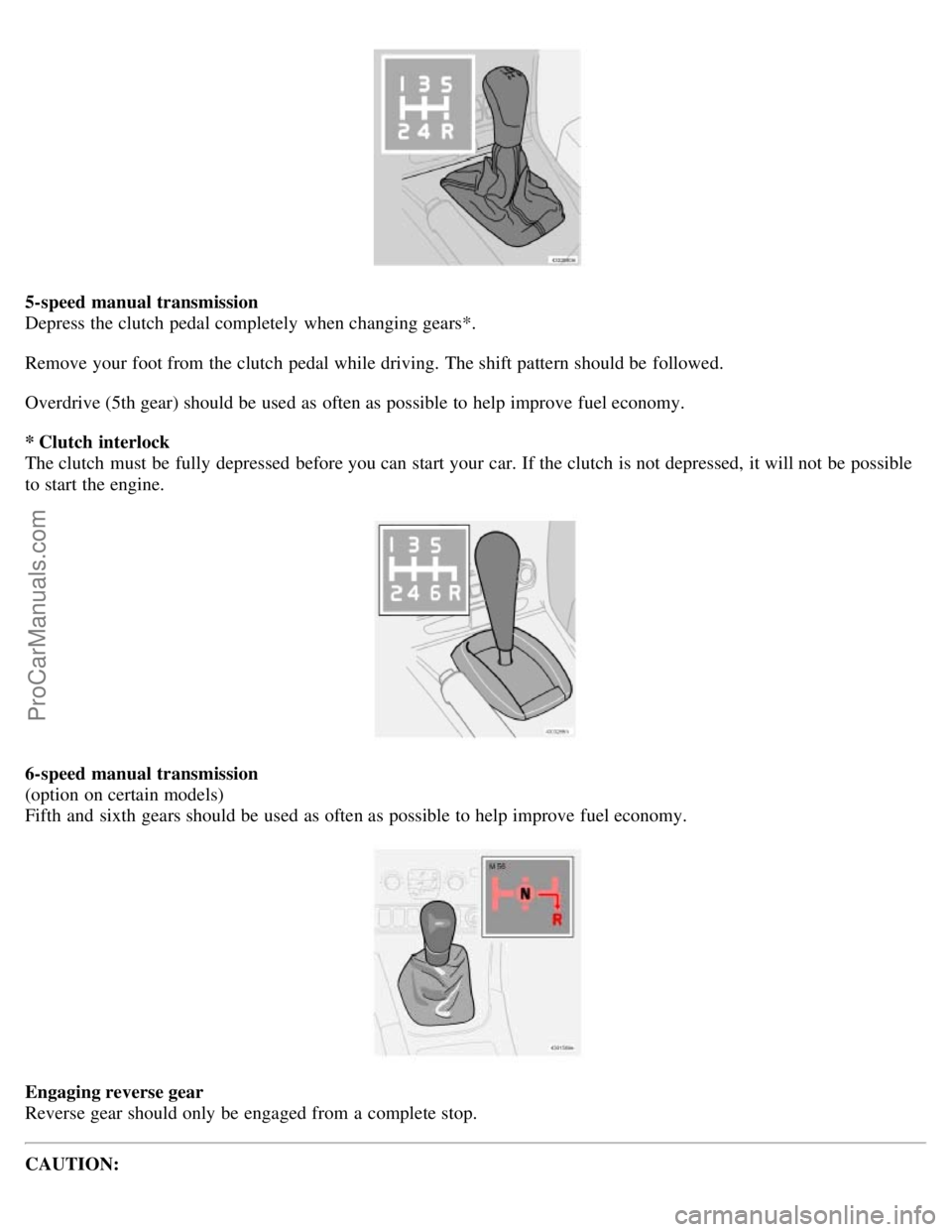
5-speed manual transmission
Depress the clutch pedal completely when changing gears*.
Remove your foot from the clutch pedal while driving. The shift pattern should be followed.
Overdrive (5th gear) should be used as often as possible to help improve fuel economy.
* Clutch interlock
The clutch must be fully depressed before you can start your car. If the clutch is not depressed, it will not be possible
to start the engine.
6-speed manual transmission
(option on certain models)
Fifth and sixth gears should be used as often as possible to help improve fuel economy.
Engaging reverse gear
Reverse gear should only be engaged from a complete stop.
CAUTION:
ProCarManuals.com
Page 61 of 113
W - Winter/Wet driving mode - enhanced vehicle traction
Please refer to the information on page 87.
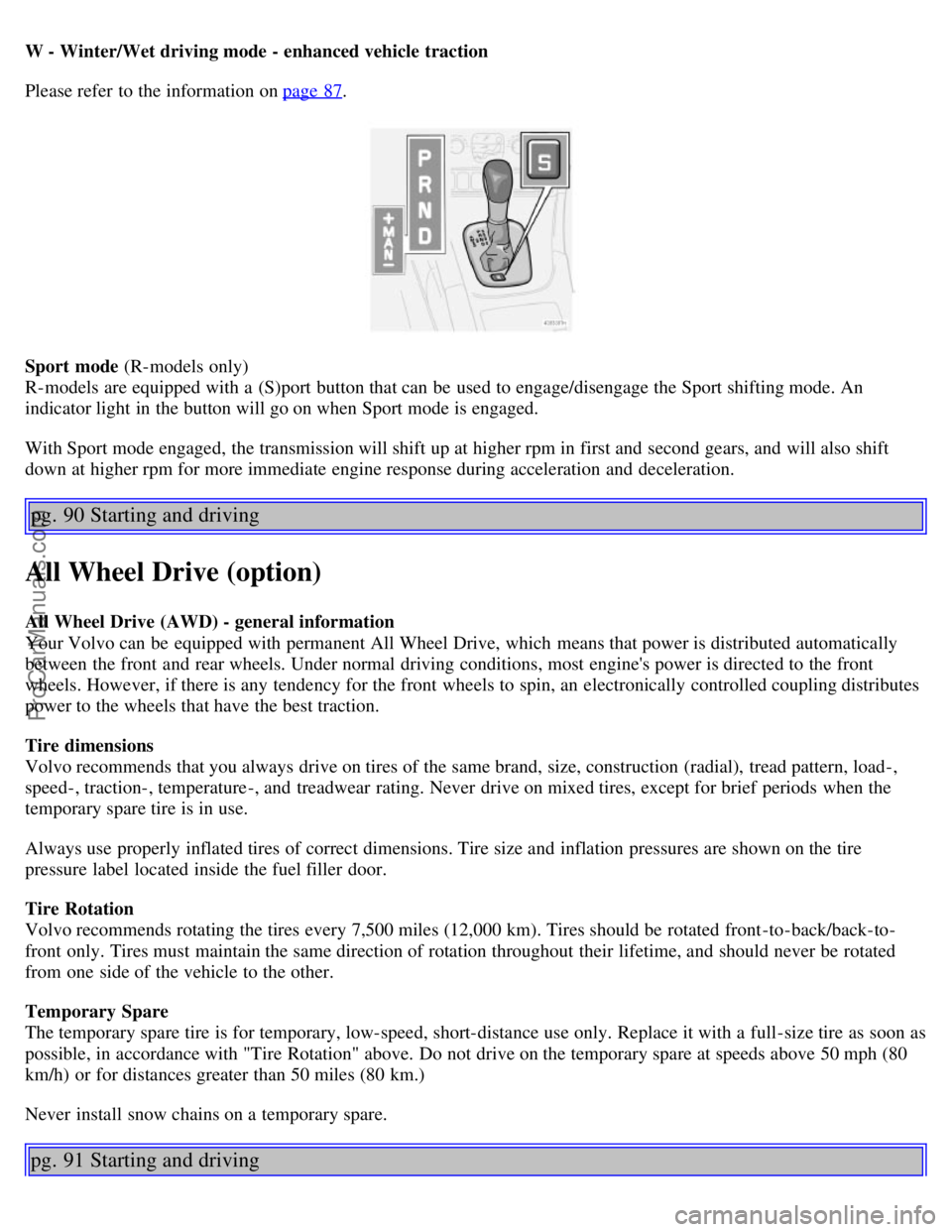
Sport mode (R-models only)
R-models are equipped with a (S)port button that can be used to engage/disengage the Sport shifting mode. An
indicator light in the button will go on when Sport mode is engaged.
With Sport mode engaged, the transmission will shift up at higher rpm in first and second gears, and will also shift
down at higher rpm for more immediate engine response during acceleration and deceleration.
pg. 90 Starting and driving
All Wheel Drive (option)
All Wheel Drive (AWD) - general information
Your Volvo can be equipped with permanent All Wheel Drive, which means that power is distributed automatically
between the front and rear wheels. Under normal driving conditions, most engine's power is directed to the front
wheels. However, if there is any tendency for the front wheels to spin, an electronically controlled coupling distributes
power to the wheels that have the best traction.
Tire dimensions
Volvo recommends that you always drive on tires of the same brand, size, construction (radial), tread pattern, load-,
speed-, traction-, temperature-, and treadwear rating. Never drive on mixed tires, except for brief periods when the
temporary spare tire is in use.
Always use properly inflated tires of correct dimensions. Tire size and inflation pressures are shown on the tire
pressure label located inside the fuel filler door.
Tire Rotation
Volvo recommends rotating the tires every 7,500 miles (12,000 km). Tires should be rotated front -to-back/back-to-
front only. Tires must maintain the same direction of rotation throughout their lifetime, and should never be rotated
from one side of the vehicle to the other.
Temporary Spare
The temporary spare tire is for temporary, low-speed, short-distance use only. Replace it with a full-size tire as soon as
possible, in accordance with "Tire Rotation" above. Do not drive on the temporary spare at speeds above 50 mph (80
km/h) or for distances greater than 50 miles (80 km.)
Never install snow chains on a temporary spare.
pg. 91 Starting and driving
ProCarManuals.com
Page 62 of 113
Four-C active chassis system
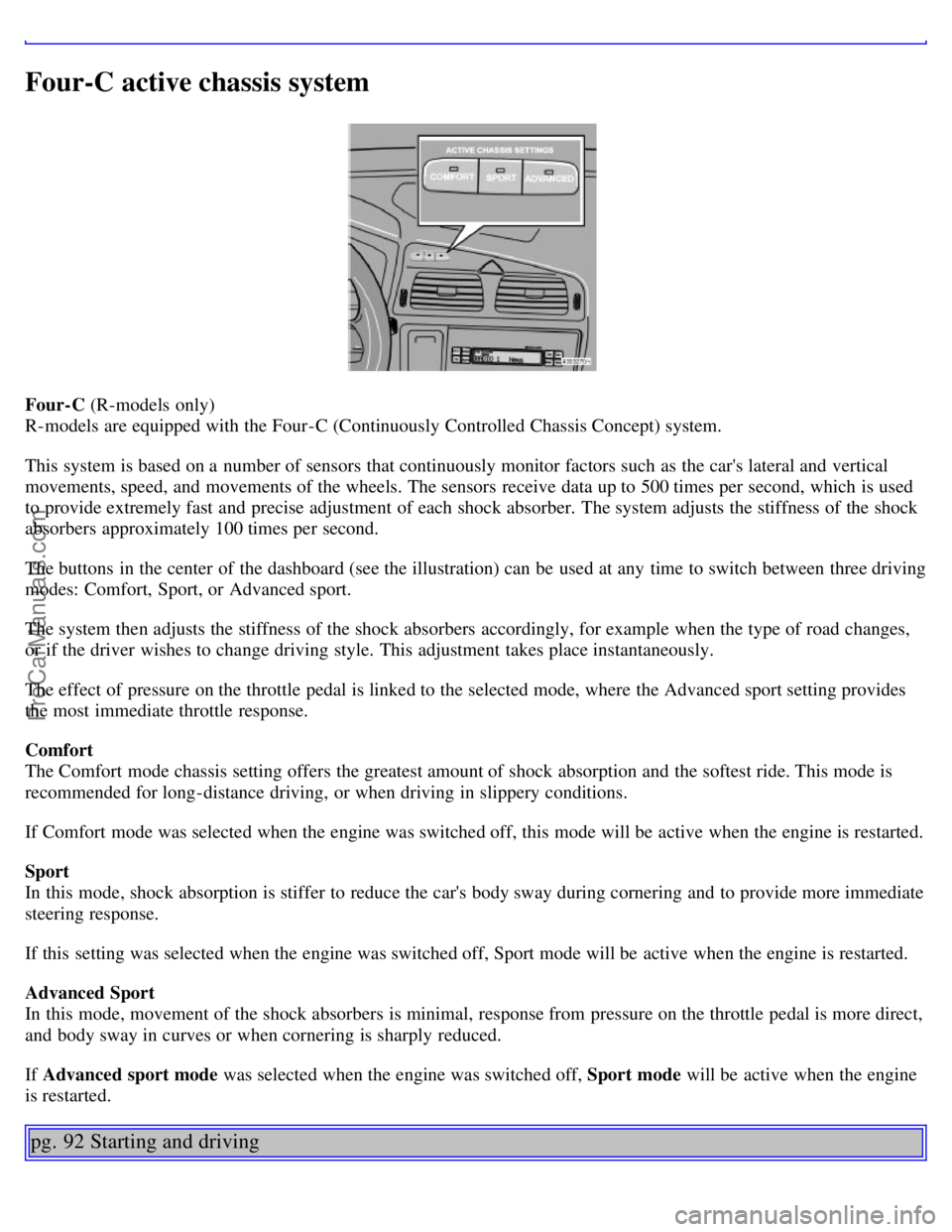
Four-C (R-models only)
R-models are equipped with the Four-C (Continuously Controlled Chassis Concept) system.
This system is based on a number of sensors that continuously monitor factors such as the car's lateral and vertical
movements, speed, and movements of the wheels. The sensors receive data up to 500 times per second, which is used
to provide extremely fast and precise adjustment of each shock absorber. The system adjusts the stiffness of the shock
absorbers approximately 100 times per second.
The buttons in the center of the dashboard (see the illustration) can be used at any time to switch between three driving
modes: Comfort, Sport, or Advanced sport.
The system then adjusts the stiffness of the shock absorbers accordingly, for example when the type of road changes,
or if the driver wishes to change driving style. This adjustment takes place instantaneously.
The effect of pressure on the throttle pedal is linked to the selected mode, where the Advanced sport setting provides
the most immediate throttle response.
Comfort
The Comfort mode chassis setting offers the greatest amount of shock absorption and the softest ride. This mode is
recommended for long-distance driving, or when driving in slippery conditions.
If Comfort mode was selected when the engine was switched off, this mode will be active when the engine is restarted.
Sport
In this mode, shock absorption is stiffer to reduce the car's body sway during cornering and to provide more immediate
steering response.
If this setting was selected when the engine was switched off, Sport mode will be active when the engine is restarted.
Advanced Sport
In this mode, movement of the shock absorbers is minimal, response from pressure on the throttle pedal is more direct,
and body sway in curves or when cornering is sharply reduced.
If Advanced sport mode was selected when the engine was switched off, Sport mode will be active when the engine
is restarted.
pg. 92 Starting and driving
ProCarManuals.com
Page 65 of 113
2 0 0 4
VOLVO S60
Wheels and tires
pg. 107 Wheels and tires
General information 108
Tire pressure110
Tread wear indicators111
Changing wheels112
Uniform Tire Quality Grading114
pg. 108 Wheels and tires
General information
General information about wheels and tires
Your vehicle is equipped with tires according to the tire information label on the inside of the fuel filler door.
All tires have a dimension designation.
Example of designation: 215/55R16.
215 section width (mm)
55 relationship between section
height and width
R radial tire
16 wheel rim diameter (")
The tires have good road holding characteristics and offer good handling on dry and wet surfaces. It should be noted
however that the tires have been developed to give these features on snow/ice-free surfaces.
Certain models are equipped with "all-season" tires, which provide a somewhat higher degree of road holding
on slippery surfaces than tires without the "all-season" rating.
However, for optimum road holding on icy or snow-covered roads - we recommend suitable winter tires on all four
wheels. When replacing tires, be sure that the new tires are the same size designation, type (radial) and preferably from
the same manufacturer, on all four wheels. Otherwise there is a risk of altering the car's roadholding and handling
characteristics.
NOTE: When storing wheel/tire assemblies (e.g. winter tires and wheels), either stand the assemblies upright, or
suspend them off the ground. Laying wheel/tire assemblies on their sides for prolonged periods can cause wheel and/or
tire damage.
ProCarManuals.com
Page 66 of 113
New tires
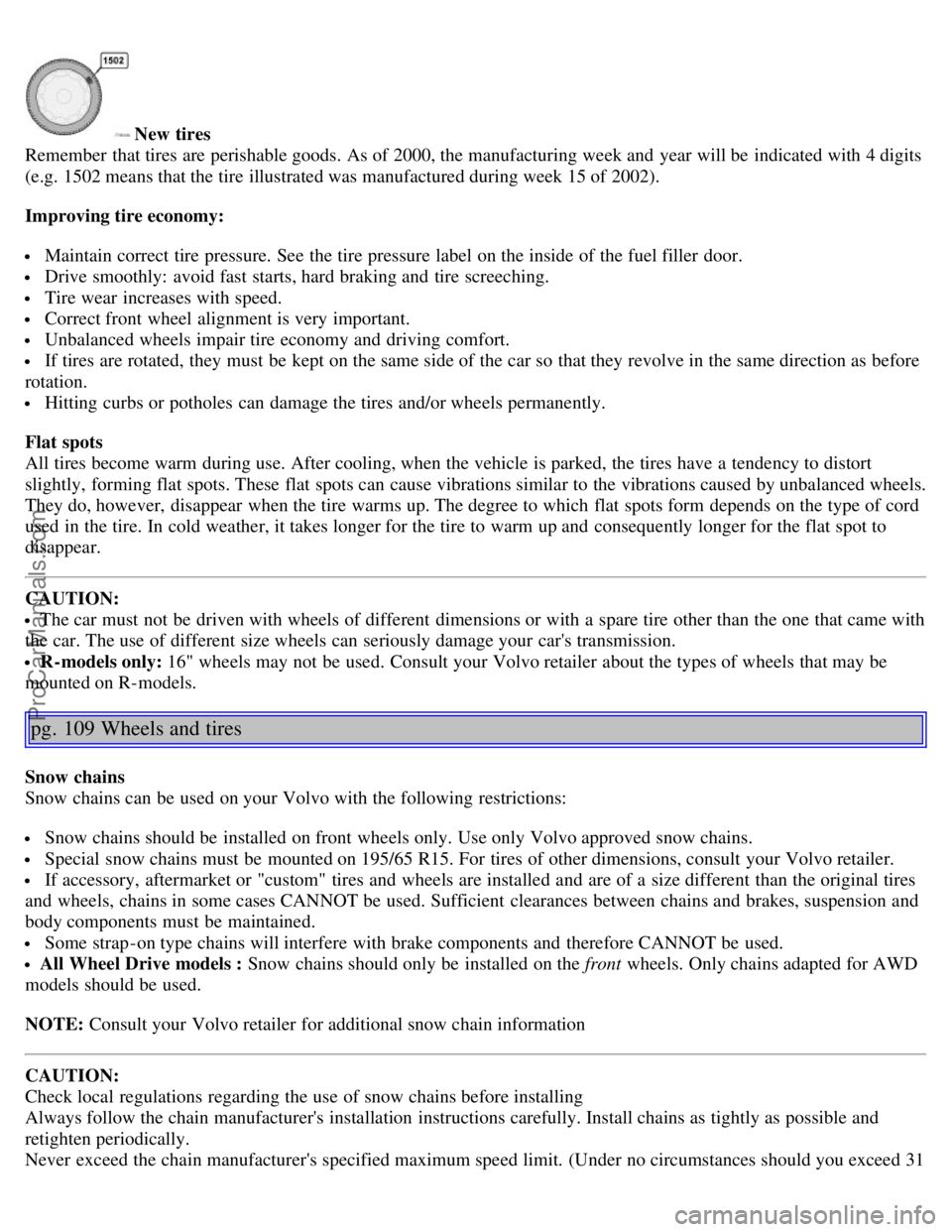
Remember that tires are perishable goods. As of 2000, the manufacturing week and year will be indicated with 4 digits
(e.g. 1502 means that the tire illustrated was manufactured during week 15 of 2002).
Improving tire economy:
Maintain correct tire pressure. See the tire pressure label on the inside of the fuel filler door.
Drive smoothly: avoid fast starts, hard braking and tire screeching.
Tire wear increases with speed.
Correct front wheel alignment is very important.
Unbalanced wheels impair tire economy and driving comfort.
If tires are rotated, they must be kept on the same side of the car so that they revolve in the same direction as before
rotation.
Hitting curbs or potholes can damage the tires and/or wheels permanently.
Flat spots
All tires become warm during use. After cooling, when the vehicle is parked, the tires have a tendency to distort
slightly, forming flat spots. These flat spots can cause vibrations similar to the vibrations caused by unbalanced wheels.
They do, however, disappear when the tire warms up. The degree to which flat spots form depends on the type of cord
used in the tire. In cold weather, it takes longer for the tire to warm up and consequently longer for the flat spot to
disappear.
CAUTION:
The car must not be driven with wheels of different dimensions or with a spare tire other than the one that came with
the car. The use of different size wheels can seriously damage your car's transmission.
R-models only: 16" wheels may not be used. Consult your Volvo retailer about the types of wheels that may be
mounted on R-models.
pg. 109 Wheels and tires
Snow chains
Snow chains can be used on your Volvo with the following restrictions:
Snow chains should be installed on front wheels only. Use only Volvo approved snow chains.
Special snow chains must be mounted on 195/65 R15. For tires of other dimensions, consult your Volvo retailer.
If accessory, aftermarket or "custom" tires and wheels are installed and are of a size different than the original tires
and wheels, chains in some cases CANNOT be used. Sufficient clearances between chains and brakes, suspension and
body components must be maintained.
Some strap -on type chains will interfere with brake components and therefore CANNOT be used.
All Wheel Drive models : Snow chains should only be installed on the front wheels. Only chains adapted for AWD
models should be used.
NOTE: Consult your Volvo retailer for additional snow chain information
CAUTION:
Check local regulations regarding the use of snow chains before installing
Always follow the chain manufacturer's installation instructions carefully. Install chains as tightly as possible and
retighten periodically.
Never exceed the chain manufacturer's specified maximum speed limit. (Under no circumstances should you exceed 31
ProCarManuals.com
Page 67 of 113
mph (50 km/h)
Avoid bumps, holes or sharp turns when driving with snow chains.
The handling of the vehicle can be adversely affected when driving with chains. Avoid fast or sharp turns as well as
locked wheel braking.
Snow tires, studded tires *
Tires for winter use:
Owners who live in or regularly commute through areas with sustained periods of snow or icy driving conditions are
strongly advised to fit suitable winter tires to help retain the highest degree of traction.
It is important to install winter tires on all four wheels to help retain traction during cornering, braking, and
accelerating. Failure to do so could reduce traction to an unsafe level or adversely affect handling. Do not mix tires of
different design as this could also negatively affect overall tire road grip.
Volvo recommends 195/65 R15 (205/55R16 on turbo models) winter tires on all four wheels.
Winter tires wear more quickly on dry roads in warm weather. They should be removed when the winter driving
season has ended.
Studded tires should be run-in 300-600 miles (500-1000 km) during which the car should be driven as smoothly as
possible to give the studs the opportunity to seat properly in the tires. The tires should have the same rotational
direction throughout their entire lifetime. In other words, if you wish to rotate the wheels, make sure that the same
wheels are always on the same side of the car.
NOTE: Please consult state or provincial regulations restricting the use of studded winter tires before installing such
tires.
* Where permitted
pg. 110 Wheels and tires
Tire pressure
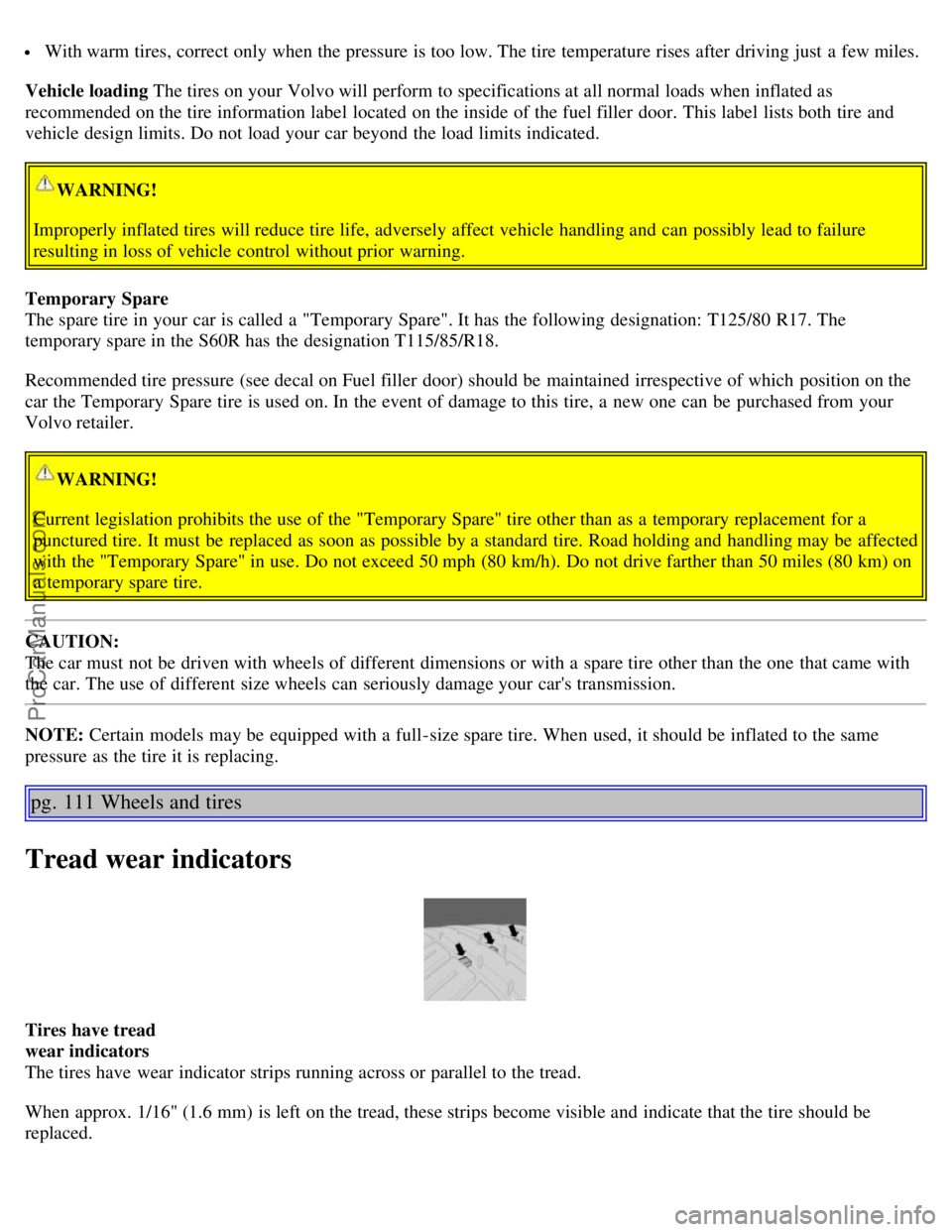
Tire pressure label
Checking and correcting tire pressure
The tire pressure label is located on the inside of the fuel filler door.
Check the tire pressure regularly.
The tire pressure should be corrected only when the tires are cold.
ProCarManuals.com
Page 68 of 113
With warm tires, correct only when the pressure is too low. The tire temperature rises after driving just a few miles.
Vehicle loading The tires on your Volvo will perform to specifications at all normal loads when inflated as
recommended on the tire information label located on the inside of the fuel filler door. This label lists both tire and
vehicle design limits. Do not load your car beyond the load limits indicated.
WARNING!
Improperly inflated tires will reduce tire life, adversely affect vehicle handling and can possibly lead to failure
resulting in loss of vehicle control without prior warning.
Temporary Spare
The spare tire in your car is called a "Temporary Spare". It has the following designation: T125/80 R17. The
temporary spare in the S60R has the designation T115/85/R18.
Recommended tire pressure (see decal on Fuel filler door) should be maintained irrespective of which position on the
car the Temporary Spare tire is used on. In the event of damage to this tire, a new one can be purchased from your
Volvo retailer.
WARNING!
Current legislation prohibits the use of the "Temporary Spare" tire other than as a temporary replacement for a
punctured tire. It must be replaced as soon as possible by a standard tire. Road holding and handling may be affected
with the "Temporary Spare" in use. Do not exceed 50 mph (80 km/h). Do not drive farther than 50 miles (80 km) on
a temporary spare tire.
CAUTION:
The car must not be driven with wheels of different dimensions or with a spare tire other than the one that came with
the car. The use of different size wheels can seriously damage your car's transmission.
NOTE: Certain models may be equipped with a full-size spare tire. When used, it should be inflated to the same
pressure as the tire it is replacing.
pg. 111 Wheels and tires
Tread wear indicators
Tires have tread
wear indicators
The tires have wear indicator strips running across or parallel to the tread.
When approx. 1/16" (1.6 mm) is left on the tread, these strips become visible and indicate that the tire should be
replaced.
ProCarManuals.com
Page 77 of 113
vehicle operation or in a crash or near-crash event. Stored information may be read and used by:
Volvo Car Corporation
service and repair facilities
law enforcement or government agencies
others who may assert a legal right to know, or who obtain your consent to know such information.
Applicable warranties - U.S.
In accordance with applicable U.S. and Canadian regulations, the following list of warranties is provided
New Car Limited Warranty
Parts and Accessories Limited Warranty
Corrosion Protection Limited Warranty
Seat Belt and Supplemental Restraint Systems Limited Warranty
Emission Design and Defect Warranty
Emission Performance Warranty
These are the Federal warranties; other warranties are provided as required by state/provincial law. Refer to your
separate Warranty and Service Records Information booklet for detailed information concerning each of the warranties.
pg. 121 Maintenance and service
Periodic maintenance helps minimize emissions
Periodic maintenance will help keep your vehicle running well. Your Warranty and Service Records Information
booklet provides a comprehensive periodic maintenance schedule up to 150,000 miles (240,000 km) of vehicle service.
The schedule includes components that affect vehicle emissions. This page describes some of the emission-related
components.
Engine air filter
The engine air filter cleans particles from air entering the engine. Replace the engine air filter cartridge with a new one
every 37,500 miles (60,000 km) under normal driving conditions. Replace the cartridge more often when the vehicle is
driven under dirty and dusty conditions. The cartridge cannot be cleaned, and should always be replaced with a new
one.
Fuel filter
The fuel filter should be replaced at 105,000 miles (168,000 km). The filter is replaced as one complete unit. Replace
more frequently if contaminated fuel is introduced into the tank, or if there is reason to suspect that this has occurred.
Fuel system, including filler cap, tank and lines and connections
The ability of the fuel system to contain hydrocarbons is dependent upon a leak-free system. Inspect fuel lines every
30,000 miles (48,000 km). Check for proper sealing of the fuel filler cap which contains "O" ring type seals.
NOTE: If the fuel filler cap is not closed tightly or if the engine is running when the car is refueled, the Check Engine
light (Malfunction Indicator) may indicate a fault. However, your vehicle's performance will not be affected. Use only
Volvo original or approved fuel filler caps.
Timing belt
For proper functioning of the engine and emission control systems, the timing belt and belt tensioner must be replaced
every 105,000 miles (168,000 km). Engine damage will occur if the belt fails.
PCV system
(on turbocharged models)
The nipple in the intake manifold and the filter at the end of the PCV hose in the air cleaner should be inspected at
ProCarManuals.com
Page 82 of 113

The API Service Symbol "donut" is divided into three parts:
The top half describes the oil's performance level.
The center identifies the oil's viscosity.
The bottom half tells whether the oil has demonstrated energy-conserving properties in a standard test in
comparison to a reference oil.
pg. 126 Maintenance and service
Oils and fluids (Contd)
Checking the oil level
The oil level should be checked every time the car is refueled. This is especially important during the period up
to the first service.
CAUTION:
Not checking the oil level regularly can result in serious engine damage if the oil level becomes too low.
Park the car on a level surface and wait for at least 5 minutes after the engine has been switched off. Be sure the oil
level is maintained between the upper and lower marks on the dipstick. Low oil level can cause internal damage to the
engine and overfilling can result in high oil consumption. The distance between the dipstick marks represents approx.
1.6 US qt (1.5 liter). The oil should preferably be checked when cold, before the engine has been started.
NOTE: The engine must be stopped when checking the oil.
WARNING!
Do not allow oil to spill onto or come into contact with hot exhaust pipe surfaces.
Adding oil (topping up)
Add oil of the same kind as already used.
Capacity (including filter): Normally-aspirated 5-cylinder engine - 5.8 US qts (5.5 liters). Turbo 5-cylinder engine -
6.1 US qts (5.8 liters).
The oil filter should be replaced at every oil change.
R-models
R-models are equipped with an oil level warning system. If the engine oil level becomes too low, the warning light in
ProCarManuals.com