cooling VOLVO S60 2006 Owners Manual
[x] Cancel search | Manufacturer: VOLVO, Model Year: 2006, Model line: S60, Model: VOLVO S60 2006Pages: 132, PDF Size: 2.33 MB
Page 62 of 132
Use of Additives
With the exception of gas line antifreeze during winter months, do not add solvents, thickeners, or other store -bought
additives to your car's fuel, cooling, or lubricating systems. Overuse may damage your engine, and some of these
additives contain organically volatile chemicals. Do not needlessly expose yourself to these chemicals.
WARNING!
Never carry a cell phone that is switched on while refueling your vehicle. If the phone rings, this may cause a spark
that could ignite gasoline fumes, resulting in fire and injury.
pg. 84 Starting and driving
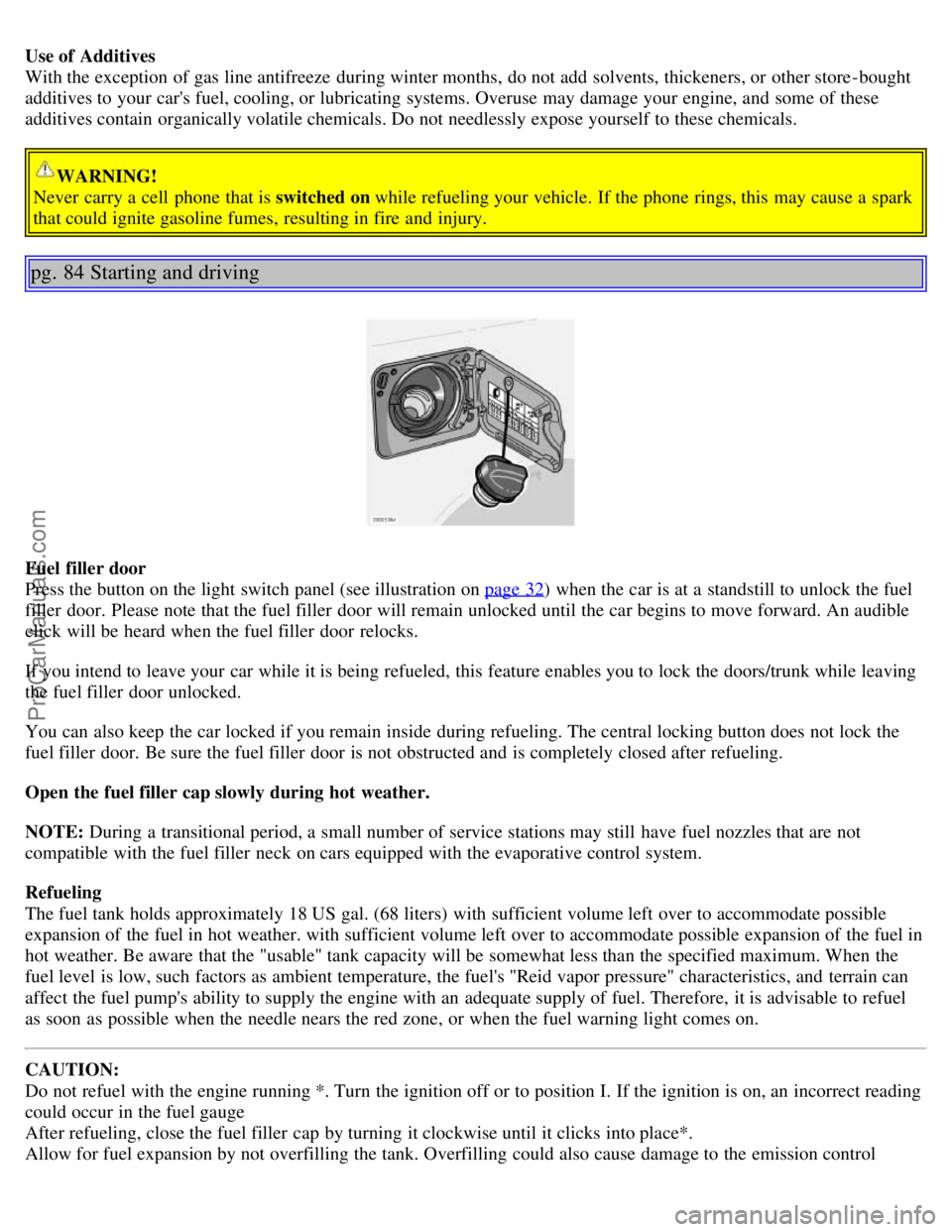
Fuel filler door
Press the button on the light switch panel (see illustration on page 32
) when the car is at a standstill to unlock the fuel
filler door. Please note that the fuel filler door will remain unlocked until the car begins to move forward. An audible
click will be heard when the fuel filler door relocks.
If you intend to leave your car while it is being refueled, this feature enables you to lock the doors/trunk while leaving
the fuel filler door unlocked.
You can also keep the car locked if you remain inside during refueling. The central locking button does not lock the
fuel filler door. Be sure the fuel filler door is not obstructed and is completely closed after refueling.
Open the fuel filler cap slowly during hot weather.
NOTE: During a transitional period, a small number of service stations may still have fuel nozzles that are not
compatible with the fuel filler neck on cars equipped with the evaporative control system.
Refueling
The fuel tank holds approximately 18 US gal. (68 liters) with sufficient volume left over to accommodate possible
expansion of the fuel in hot weather. with sufficient volume left over to accommodate possible expansion of the fuel in
hot weather. Be aware that the "usable" tank capacity will be somewhat less than the specified maximum. When the
fuel level is low, such factors as ambient temperature, the fuel's "Reid vapor pressure" characteristics, and terrain can
affect the fuel pump's ability to supply the engine with an adequate supply of fuel. Therefore, it is advisable to refuel
as soon as possible when the needle nears the red zone, or when the fuel warning light comes on.
CAUTION:
Do not refuel with the engine running *. Turn the ignition off or to position I. If the ignition is on, an incorrect reading
could occur in the fuel gauge
After refueling, close the fuel filler cap by turning it clockwise until it clicks into place*.
Allow for fuel expansion by not overfilling the tank. Overfilling could also cause damage to the emission control
ProCarManuals.com
Page 74 of 132
Brake system
BRAKE Brake circuit malfunction
The brake system is a hydraulic system consisting of two master cylinders and two separate brake circuits. If a
problem should occur in one of these circuits, it is still possible to stop the car with the other brake circuit.
If the brake pedal must be depressed farther than normal and requires greater foot pressure, the stopping distance will
be longer.
A warning light in the instrument panel will light up to warn the driver that a fault has occurred.
If this light comes on while driving or braking, stop immediately and check the brake fluid level in the reservoir.
NOTE: Press the brake pedal hard and maintain pressure on the pedal - do not pump the brakes.
WARNING!
If the fluid level is below the MIN mark in the reservoir or if a "Brake failure - Service urgent" message is displayed
in the text window: DO NOT DRIVE. Have the car towed to a Volvo retailer and have the brake system inspected.
NOTE: When the car is at a standstill and the engine is idling, e.g. at a traffic light and the brake pedal is depressed,
the pedal may go down slightly. This is a normal function of the power-assisted brake system.
Power brakes function only when the engine is running
The power brakes utilize vacuum pressure which is only created when the engine is running. Never let the vehicle roll
to a stop with the engine switched off.
If the power brakes are not working, the brake pedal must be pressed approximately four times harder than usual to
make up for the lack of power assistance. This can happen for example when towing your vehicle or if the engine is
switched off when the vehicle is rolling. The brake pedal feels harder than usual.
Water on brake discs and brake pads affects braking
Driving in rain and slush or passing through an automatic car wash can cause water to collect on the brake discs and
pads. This will cause a delay in braking effect when the pedal is depressed. To avoid such a delay when the brakes are
needed, depress the pedal occasionally when driving through rain, slush etc. This will remove the water from the
brakes. Check that brake application feels normal. This should also be done after washing or starting in very damp or
cold weather.
Severe strain on the brake system
The brakes will be subject to severe strain when driving in mountains or hilly areas or towing. Vehicle speed is usually
slower, which means that the cooling of the brakes is less efficient than when driving on level roads. To reduce the
strain on the brakes, shift into a lower gear and let the engine help with the braking. Do not forget that, if you are
towing a trailer, the brakes will be subjected to a greater than normal load.
pg. 97 Starting and driving
Anti-lock brakes (ABS)
If the warning lamp lights up there is a malfunction of the ABS system (the standard braking system will however
function) and the vehicle should be driven cautiously to a Volvo retailer for inspection. The Anti-lock Braking System
(ABS) helps to improve vehicle control (stopping and steering) during severe braking conditions by limiting brake
lockup. When the system "senses" impending lockup, braking pressure is automatically modulated in order to help
ProCarManuals.com
Page 99 of 132
Note the following before you begin working on your car:
Battery
Ensure that the battery cables are correctly connected and tightened.
Never disconnect the battery when the engine is running (e.g. when replacing the battery).
Never use a fast charger to charge the battery. The battery cables should be disconnected when recharging.
The battery contains acid that is both corrosive and poisonous. It is important that the battery is handled in an
environmentally friendly way. Let your Volvo dealer assist you.
Hoisting the car
If a garage jack is used to lift the car, the two jack attachments points should be used. They are specially reinforced to
bear the weight of the car. A garage jack can also be placed under the front of the engine support frame. Take care not
to damage the splash guard under the engine. Ensure that the jack is positioned so that the car cannot slide off it.
Always use axle stands or similar structures.
If a two-post hoist is used to lift the car, the front and rear lift arm pads should be centered under the reinforced lift
plates on the inboard edge of the sill rail (see illustration).
WARNING!
The car ignition system has very high voltage!
The voltage in the ignition system is dangerous!
Do not touch spark plugs, ignition cables or the ignition coil when the engine is running or the ignition is switched
on!
The ignition should be switched off when:
Conducting engine tests.
Replacing parts in the ignition system, such as spark plugs, ignition coil, distributor, ignition cables, etc.
WARNING!
Never try to repair any part of the SRS or SIPS bag systems yourself. Any interference in the system could cause
malfunction and serious injury. Any work should only be performed by an authorized Volvo workshop.
pg. 140 Maintenance and service
Belt check
Check the belt regularly to make sure it is in good condition and is clean. A worn or dirty belt can cause poor cooling
and low alternator output as well as impair the operation of the power steering and the air conditioning unit.
NOTE: The drive belt is equipped with a self -tensioning mechanism and requires no adjustment between changes!
WARNING!
The engine must not be running when this check is performed.
Check coolant level
The cooling system must be filled with coolant and not leak to operate at maximum efficiency. Check the coolant level
ProCarManuals.com
Page 100 of 132
regularly. The level should be between the "MAX" and "MIN" marks on the expansion tank. The check should be
made with particular thoroughness when the engine is new or when the cooling system has been drained.
Do not remove the filler cap other than for topping up with coolant. Frequent removal may prevent coolant circulation
between the engine and the expansion tank during engine warm up and cooling.
Changing coolant
Normally, the coolant does not need to be changed. If the system must be drained, consult your Volvo retailer.
NOTE: Do not top off with water only. This reduces the rust-protective and antifreeze qualities of the coolant and has
a lower boiling point. It can also cause damage to the cooling system if it should freeze. Top off with Volvo Genuine
Coolant/Antifreeze only (a 50/50 mix of water and antifreeze).
CAUTION:
The cooling system must always be kept filled to the correct level. If it is not kept filled, there can be high local
temperatures in the engine which could result in damage. Different types of antifreeze/coolant may not be mixed.
WARNING!
Never remove the radiator cap while the engine is warm. Wait until the car cools.
pg. 141 Maintenance and service
Hood and engine compartment
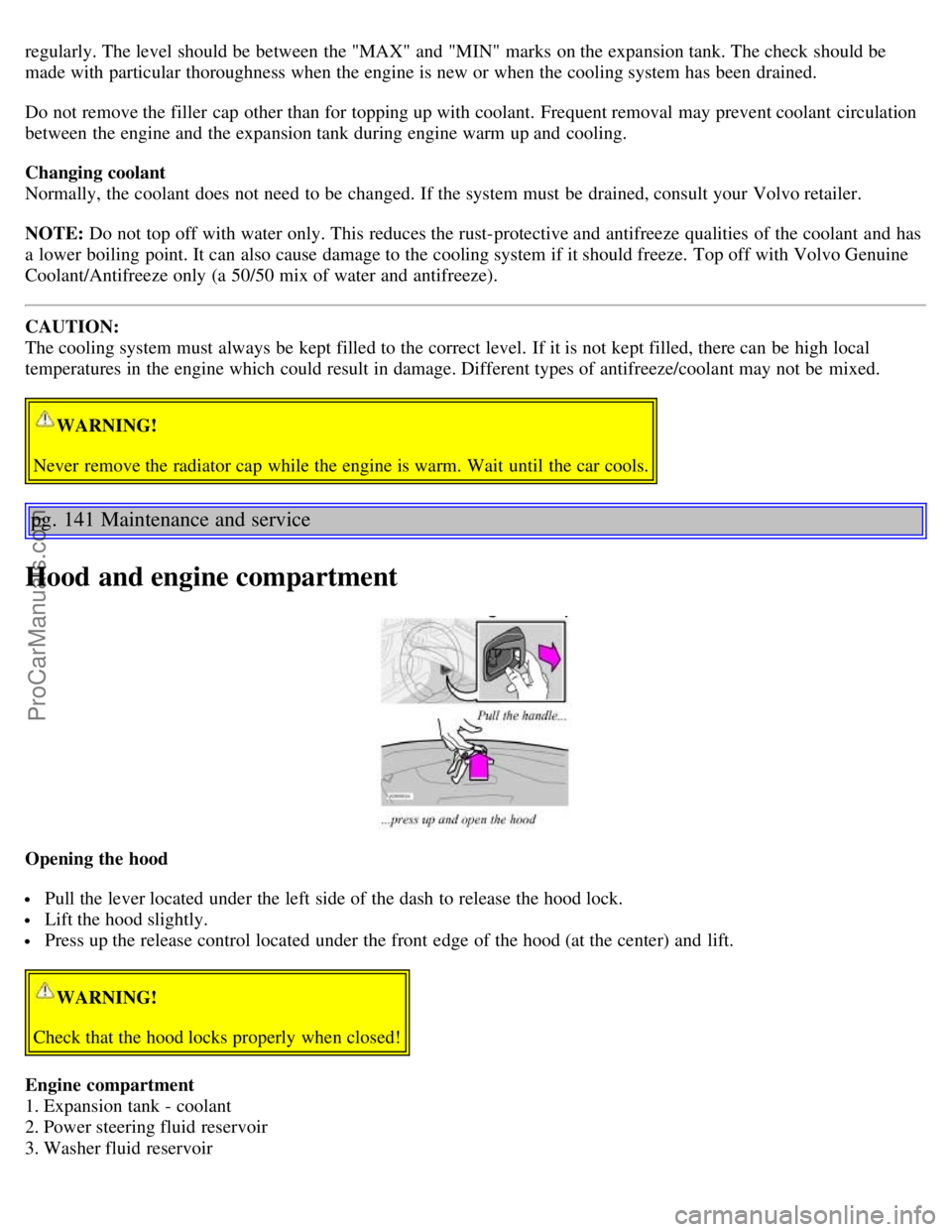
Opening the hood
Pull the lever located under the left side of the dash to release the hood lock.
Lift the hood slightly.
Press up the release control located under the front edge of the hood (at the center) and lift.
WARNING!
Check that the hood locks properly when closed!
Engine compartment
1. Expansion tank - coolant
2. Power steering fluid reservoir
3. Washer fluid reservoir
ProCarManuals.com
Page 101 of 132

4. Dipstick - engine oil
5. Radiator
6. Cooling fan
7. Oil filler cap - engine
8. Clutch/brake fluid reservoir
9. Relay/fuse box
10. Air cleaner
11. Battery (in trunk)
12. Data plate
WARNING!
The cooling fan (6) may start or continue to operate (for up to 6 minutes) after the engine has been switched off.
pg. 142 Maintenance and service
Engine oil
Oil specifications
Engine oil must meet the minimum ILSAC specification GF-3, API SL, or ACEA A1/B1. Lower quality oils may not
offer the same fuel economy, engine performance, or engine protection.
Volvo Cars recommends
.
Depending on your driving habits, premium or synthetic oils may provide superior fuel economy and engine
protection. Consult your Volvo retailer for recommendations on premium or synthetic oils.
Oil additives must not be used.
NOTE: Synthetic oil is not used when the oil is changed at normal maintenance services. This oil is only used at
customer request, at additional charge. Please consult your Volvo retailer.
Oil viscosity (stable ambient temperatures)
Operation in hot climates
When temperatures exceed 86° F (30° C) in your area, Volvo recommends, for the protection of your engine, that you
use a heavier weight oil, such as SAE 10W/30. See the viscosity chart.
ProCarManuals.com
Page 104 of 132
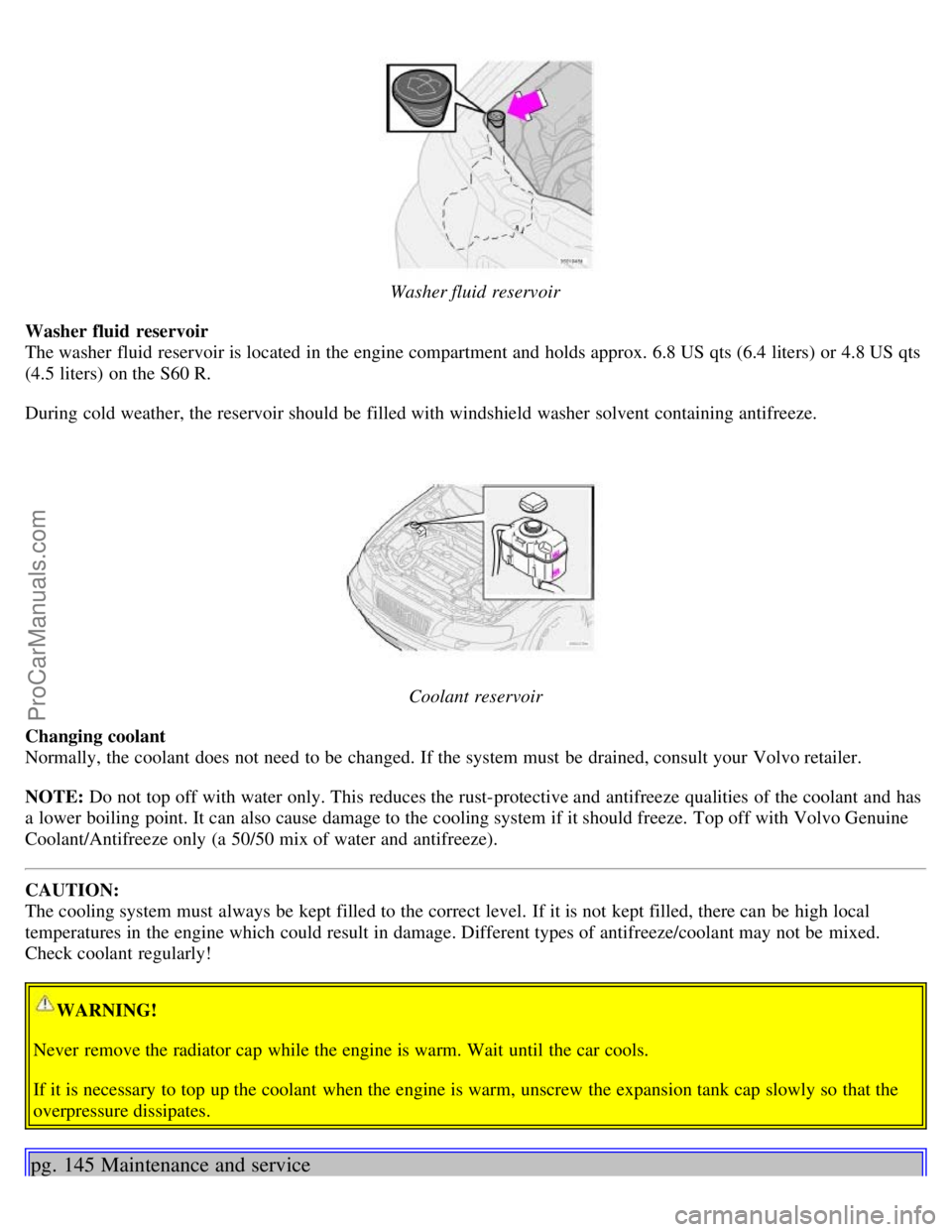
Washer fluid reservoir
Washer fluid reservoir
The washer fluid reservoir is located in the engine compartment and holds approx. 6.8 US qts (6.4 liters) or 4.8 US qts
(4.5 liters) on the S60 R.
During cold weather, the reservoir should be filled with windshield washer solvent containing antifreeze.
Coolant reservoir
Changing coolant
Normally, the coolant does not need to be changed. If the system must be drained, consult your Volvo retailer.
NOTE: Do not top off with water only. This reduces the rust-protective and antifreeze qualities of the coolant and has
a lower boiling point. It can also cause damage to the cooling system if it should freeze. Top off with Volvo Genuine
Coolant/Antifreeze only (a 50/50 mix of water and antifreeze).
CAUTION:
The cooling system must always be kept filled to the correct level. If it is not kept filled, there can be high local
temperatures in the engine which could result in damage. Different types of antifreeze/coolant may not be mixed.
Check coolant regularly!
WARNING!
Never remove the radiator cap while the engine is warm. Wait until the car cools.
If it is necessary to top up the coolant when the engine is warm, unscrew the expansion tank cap slowly so that the
overpressure dissipates.
pg. 145 Maintenance and service
ProCarManuals.com
Page 106 of 132
2 0 0 6
VOLVO S60
Specifications
pg. 163 Specifications
Label information 164
Dimensions and weights165
Capacities167
Engine oil168
Fluids169
Cooling system169
Three way catalytic converter170
Suspension171
Bulbs172
Electrical system173
Engine specifications174
All specifications are subject to change without prior notice.
pg. 164 Specifications
Label information
1 Vehicle Emission Control Information
Your Volvo is designed to meet all applicable emission standards, as evidenced by the certification label on the
underside of the hood. For further information regarding these regulations, please consult your Volvo retailer.
2 Vacuum hose routing
(underside of hood)
3 Loads and Tire Pressures
(on inside of fuel filler door): Canadian models only.
4 Model plate
Vehicle Identification Number (VIN). Codes for color and upholstery, etc. The plate is located in the engine
compartment, on the inside of the left front fender.
5 Vehicle Identification Number (VIN) *
The VIN plate is located on the top left surface of the dashboard. The VIN is also stamped on the right hand door
pillar.
6 Federal Motor Vehicle Safety Standards (FMVSS) specifications (USA) and Ministry of Transport (CMVSS)
standards (Canada)
ProCarManuals.com
Page 110 of 132
Brake fluid
Fluid type: DOT 4+ boiling point > 536°F (280° C)
Cooling system
TypePositive pressure, closed system.
Coolant Volvo original coolant/antifreeze
Volume 9.3 US qts (8.8 liters)
The thermostat begins to open at 194°F (90° C).
pg. 170 Specifications
Three way catalytic converter
Three-way catalytic converter cautions
Keep your engine properly tuned. Certain engine malfunctions, particularly involving the electrical, fuel or
distributor ignition systems, may cause unusually high three-way catalytic converter temperatures. Do not continue to
operate your vehicle if you detect engine misfire, noticeable loss of power or other unusual operating conditions, such
as engine overheating or backfiring. A properly tuned engine will help avoid malfunctions that could damage the three-
way catalytic converter.
Do not park your car over combustible materials, such as grass or leaves, which can come into contact with the hot
exhaust system and cause such materials to ignite under certain wind and weather conditions.
Excessive starter cranking (in excess of one minute), or an intermittently firing or flooded engine can cause three-
way catalytic converter or exhaust system overheating.
Remember that tampering or unauthorized modifications to the engine, the Electronic Control Module, or the vehicle
may be illegal and can cause three-way catalytic converter or exhaust system overheating. This includes:
- Altering fuel injection setting or components.
- Altering emission system components or location or removing components.
- Repeated use of leaded fuel.
NOTE: Unleaded fuel is required for cars with three-way catalytic converters.
pg. 171 Specifications
Suspension
Rear suspension
Individual rear wheel suspension with longitudinal support arms, double link arms and track rods.
Front suspension
Spring strut suspension with integrated shock absorbers and control arms linked to the support frame. Power-assisted
rack and pinion steering. Safety type steering column.
pg. 172 Specifications
Bulbs
ProCarManuals.com
Page 123 of 132
C
Capacities167
Capacity weight121
Carbon Monoxide - Important Warning83
Catalytic converter170
Ceiling lighting156
Central locking system - remote control73
Changing coolant140
Changing wheels125
Check Engine warning light27
Child restraint anchorages21
Child safety locks77
Child seat anchors20
Cigarette lighter41
Climate control systems -general information50
Clock24
Coat hanger67
Cold weather precautions107
Coolant144
Coolant - changing140, 144
Coolant - checking level of140
Cooling system169
Courtesy light62
Cruise control39
Curb weight121
Current fuel consumption38
D
Defroster53
Detachable trailer hitch105
Door mirror defroster37
Door mirrors30
Driving economically87
DSTC29
E
ECC52
Economical driving87
Electric socket30 , 41
Electrical system173
Electrically operated moonroof46
Electrically operated windows42
Emission inspection138
Engine - starting85
Engine compartment141
Engine oil142
ProCarManuals.com