spare wheel VOLVO S60 2008 User Guide
[x] Cancel search | Manufacturer: VOLVO, Model Year: 2008, Model line: S60, Model: VOLVO S60 2008Pages: 230, PDF Size: 5.33 MB
Page 149 of 230
163 07 Wheels and tires
Tire Pressure Monitoring System (TPMS) - U.S. models
NOTE
TPMS indicates low tire pressure but does not replace normal tire maintenance. For information on correct tire
pressure, please refer to the tables on pages 160 and 161
, or consult your Volvo retailer.
Erasing warning messages
When a low tire pressure warning message has been displayed, and the tire pressure warning light has come on:
Use a tire pressure gauge to check the inflation pressure of all four tires.
Re-inflate the tire(s) to the correct pressure (consult the tire pressure placard or the tables on pages 160 and 161).
Drive the vehicle for several minutes at a speed of 20 mph (30 km/h) or faster.
This will erase the warning text and the warning light will go out.
WARNING
Incorrect inflation pressure could lead to tire failure, resulting in a loss of control of the vehicle.
Changing wheels with TPMS
Please note the following when changing or replacing the factory installed TPMS wheels/tires on the vehicle:
Only the factory-mounted wheels are equipped with TPMS sensors in the valves.
If the vehicle is equipped with a temporary spare tire, this tire does not have a TPMS sensor.
If wheels without TPMS sensors are mounted on the vehicle, TIRE PRESS SYST SERVICE REQUIRED will be
displayed each time the vehicle is driven above 25 mph (40 km/h) for 10 minutes or more.
Once TPMS sensors are properly installed, the warning message should not reappear.
Volvo recommends that TPMS sensors be fitted on all wheels used on the vehicle. Volvo does not recommend
moving sensors back and forth between sets of wheels.
CAUTION
When inflating tires with TPMS valves, press the pump's mouthpiece straight onto the valve to help avoid bending or
otherwise damaging the valve.
164 07 Wheels and tires
Tire designations
ProCarManuals.com
Page 155 of 230
Please consult state or provincial regulations restricting the use of studded winter tires before installing such tires.
170 07 Wheels and tires
Temporary spare
The spare tire in your vehicle is called a "Temporary Spare".
Recommended tire pressure (see the placard on the B-pillar or on the fuel filler door) should be maintained irrespective
of which position on the vehicle the temporary spare tire is used on.
In the event of damage to this tire, a new one can be purchased from your Volvo retailer.
WARNING
Current legislation prohibits the use of the "Temporary Spare" tire other than as a temporary replacement for a
punctured tire. It must be replaced as soon as possible by a standard tire. Road holding and handling may be affected
with the "Temporary Spare" in use.
CAUTION
The vehicle must not be driven with wheels of different dimensions or with a spare tire other than the one that came
with the vehicle. The use of different size wheels can seriously damage your vehicle's transmission.
171 07 Wheels and tires
Changing wheels
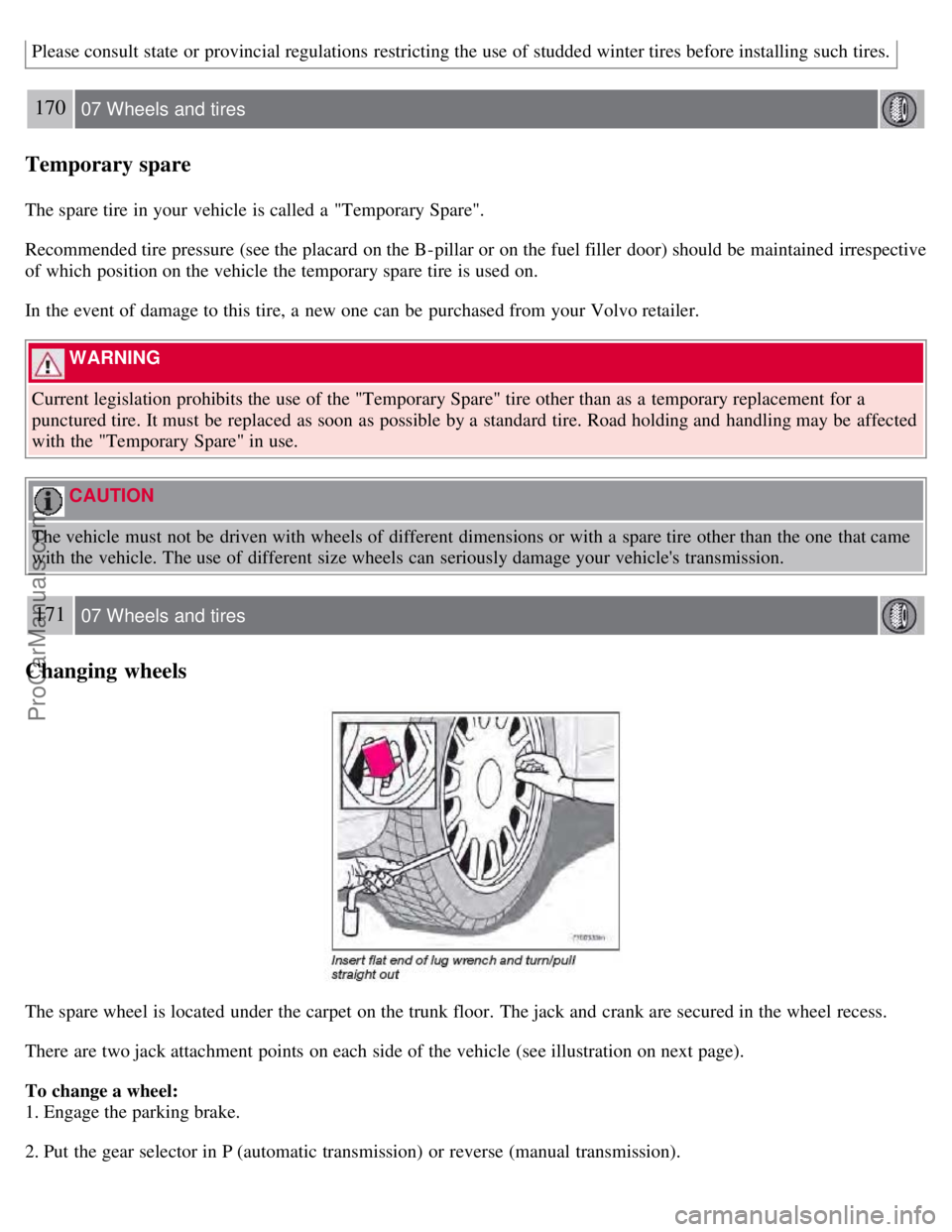
The spare wheel is located under the carpet on the trunk floor. The jack and crank are secured in the wheel recess.
There are two jack attachment points on each side of the vehicle (see illustration on next page).
To change a wheel:
1. Engage the parking brake.
2. Put the gear selector in P (automatic transmission) or reverse (manual transmission).
ProCarManuals.com
Page 156 of 230
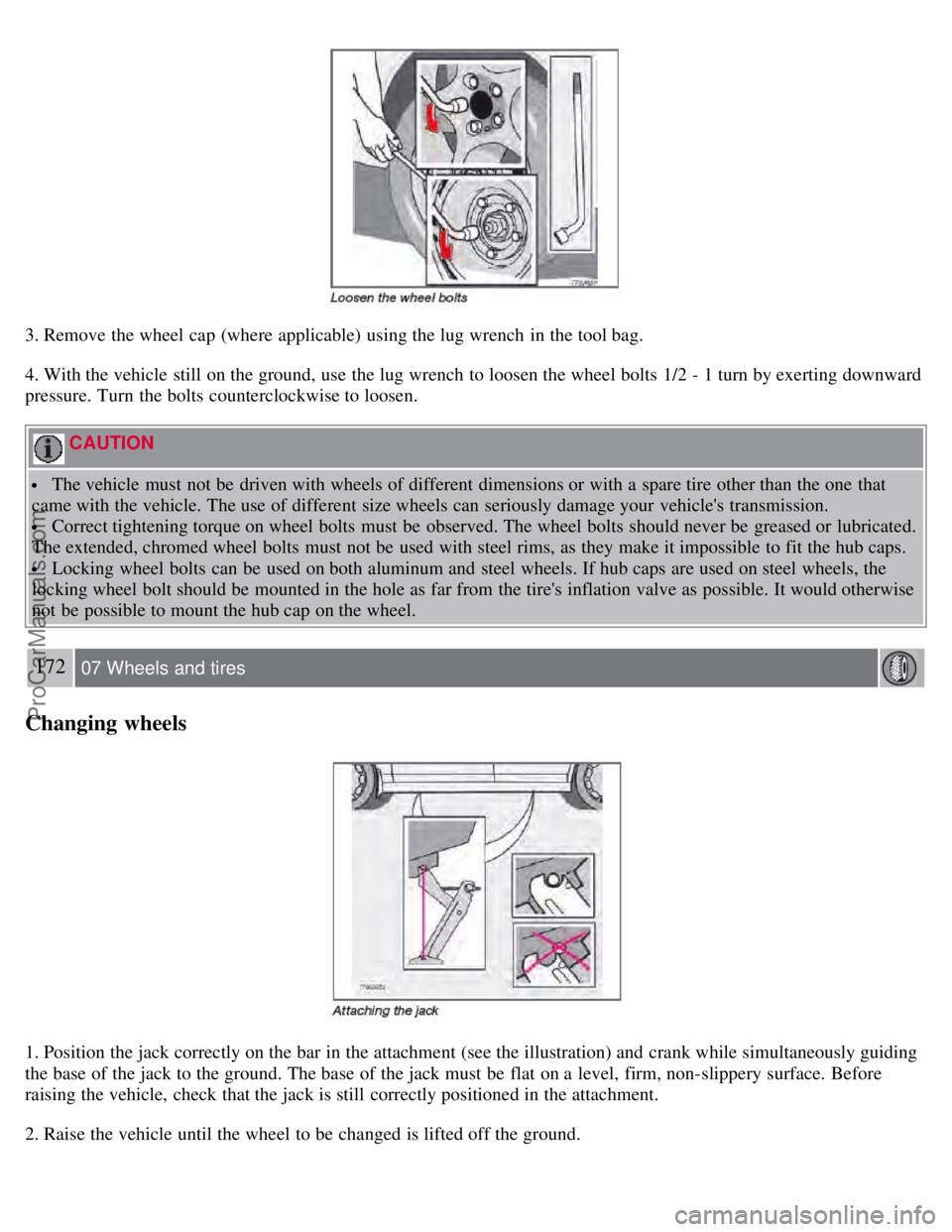
3. Remove the wheel cap (where applicable) using the lug wrench in the tool bag.
4. With the vehicle still on the ground, use the lug wrench to loosen the wheel bolts 1/2 - 1 turn by exerting downward
pressure. Turn the bolts counterclockwise to loosen.
CAUTION
The vehicle must not be driven with wheels of different dimensions or with a spare tire other than the one that
came with the vehicle. The use of different size wheels can seriously damage your vehicle's transmission.
Correct tightening torque on wheel bolts must be observed. The wheel bolts should never be greased or lubricated.
The extended, chromed wheel bolts must not be used with steel rims, as they make it impossible to fit the hub caps.
Locking wheel bolts can be used on both aluminum and steel wheels. If hub caps are used on steel wheels, the
locking wheel bolt should be mounted in the hole as far from the tire's inflation valve as possible. It would otherwise
not be possible to mount the hub cap on the wheel.
172 07 Wheels and tires
Changing wheels
1. Position the jack correctly on the bar in the attachment (see the illustration) and crank while simultaneously guiding
the base of the jack to the ground. The base of the jack must be flat on a level, firm, non-slippery surface. Before
raising the vehicle, check that the jack is still correctly positioned in the attachment.
2. Raise the vehicle until the wheel to be changed is lifted off the ground.
ProCarManuals.com
Page 229 of 230
Spare wheel106
Speedometer48
Stability systems139
Start inhibitor (immobilizer)110
Starting the car127
Steering wheel lock128
Stone chips, touching up181
STOP ENGINE53
Storage compartments99, 100, 101, 102
Studded tires169
Sun visor77
Supplemental Restraint
System (SRS) - warning light49
Suspension251
T
Tachometer48
Temperature control87
Temperature gauge48
Text window - messages52
Three-way catalytic converter250
TIME FOR REGULAR SERVICE53
Tire designations164
Tire economy, improving157
Tire inflation158
Tire inflation pressure table
Canadian models161
US models160
Tire inflation pressure, checking159
Tire Pressure Monitoring System162
indicator light51
Tires
rotation174
Towing - cars with All Wheel Drive142
Towing a trailer144
Towing the car141
Trailer hitch - detachable146
Trailer indicator lamp51
Trailer towing144
Transmission
Geartronic134, 135
Transmission - automatic132
Tread wear indicator156
Trip computer64
Trip odometer48
ProCarManuals.com